
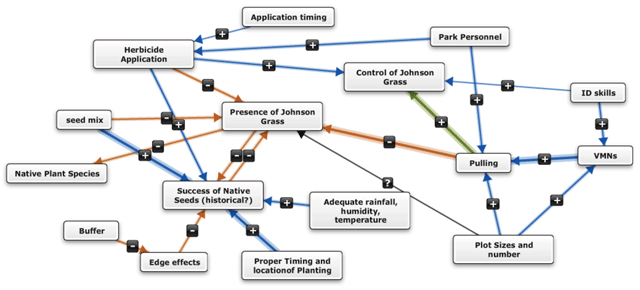
Figure 1
Collaborative Mental Model for a co-created project involving invasive exotic Johnson grass (Sorghum halepense) removal at a national monument site.
Table 1
Volunteer’s prior experience with activities associated with the project.
| Activity | Valid % (N = 51) | |||
|---|---|---|---|---|
| None | Little | Some | Lots | |
| Searching the Internet for information | 0 | 2.0 | 31.4 | 66.7 |
| Using a computer | 0 | 2.0 | 33.3 | 64.7 |
| Using social networking sites (e.g., Facebook) | 27.5 | 23.5 | 25.5 | 23.5 |
| Conducting fieldwork | 17.6 | 29.4 | 33.3 | 19.6 |
| Participating in conservation projects | 11.8 | 25.5 | 45.1 | 17.6 |
| Planning or leading conservation projects | 54.9 | 21.6 | 19.6 | 3.9 |
| Sharing the results of a conservation project | 54.9 | 27.5 | 11.8 | 5.9 |
| Evaluating conservation projects | 58.8 | 29.4 | 9.8 | 2.0 |
Table 2
Frequency of volunteer participation in various project-associated activities.
| Activity | Valid % (N = 49) | ||||||
|---|---|---|---|---|---|---|---|
| Almost never | Less than once a month | Once a month | 2–3 times a month | Once a week | 2–3 times a week | Daily | |
| Searching for information online | 0 | 0 | 0 | 4.0 | 4.0 | 28.0 | 64.0 |
| Spending time outdoors in natural settings | 0 | 0 | 2.0 | 8.2 | 10.2 | 24.5 | 55.1 |
| Educating others about environmental issues | 12.0 | 32.0 | 20.0 | 18.0 | 4.0 | 10.0 | 4.0 |
| Writing or calling politicians to express opinions on environmental issues | 48.0 | 36.0 | 10.0 | 2.0 | 0 | 0 | 4.0 |
| Participating in citizen science projects | 18.0 | 18.0 | 24.0 | 16.0 | 10.0 | 12.0 | 2.0 |
| Attending community events related to environmental issues | 12.0 | 28.0 | 34.0 | 18.0 | 6.0 | 2.0 | 0 |
| Creating a volunteer project focused on the environment | 48.0 | 28.0 | 18.0 | 4.0 | 2.0 | 0 | 0 |
Table 3
Volunteer’s rankings of potential motivations to participate in the project.
| Motivator | % (N = 52) | ||
|---|---|---|---|
| Primary | Secondary | Tertiary | |
| Interest in the environment | 36.5 | 17.3 | 19.2 |
| Interest in protecting a local natural area or resource | 21.2 | 21.2 | 15.4 |
| General interest in science | 15.4 | 7.7 | 5.8 |
| Interest in natural resource management | 11.5 | 15.4 | 19.2 |
| Interest in citizen science | 7.7 | 23.1 | 26.9 |
| Curiosity | 3.8 | 9.6 | 5.8 |
Table 4
Participant interview quotes supporting the four major themes related to volunteer retention in this project.
| Theme I: Time Commitment | |
| Sub-theme | Interview Quotes |
| 1) Struggles with time commitment | “We were a little bit strained for time …” |
| “For my role, I didn’t have time to participate in an actual project, actually go in the field, collect the data, enter the data, be immersed in it …” | |
| “It seemed like a really complex process, for me, and more than what I wanted to do and that I have time to do.” | |
| “If I was retired and not working, it would rock!” | |
| Theme II: Struggles with the online components | |
| Sub-theme | Interview Quotes |
| 2) Struggles with Online Training | “ … very long and there were so many questions involved.” |
| 3) Excitement with online training | “ …excited because I felt I wanted more scientific rigor in master naturalists, about ecosystems and things.” |
| “The online lectures were really interesting.” | |
| 4) Struggles with Mental Modeling and Website | “ … the ‘clunkiness’ of some of the software.” |
| “I reached out [to VMN staff] to say I’m stuck … and felt this was way over my head” | |
| “For me I think the process needed to be a little simpler … the online site was difficult to get into and navigate …” | |
| 5) Excited about Mental Modeling | “I really enjoyed it, and felt that as a tool it was very cool, in terms of putting your components in and making your connections … and maybe thinking about scenarios …” |
| “It was intriguing … I can really see that it could be very useful.” | |
| “I liked that it was very visual, because it helps you conceptualize all these parameters that you would ordinarily maybe not think of …” | |
| 6) Uncertain of the Value of Mental Modeling | “The more complicated you got [with the model] … very quickly, the visual end of it, you can’t make any sense out of it.” |
| Theme III: Lack of tangible, real-world projects | |
| Sub-theme | Interview Quotes |
| 7) Lack of project relevance | “In order for me to learn best, show me a real example… and walk me through the whole thing.” |
| “I was having trouble figuring out how to make this technology relevant …” | |
| 8) Uncertain of practical value of the project | “Hearing about some successful projects so that I have a clearer idea of what sorts of things people have done and how successful they have been …” |
| 9) Challenges of not having a pre-defined project | “Maybe the project would work best with a person who already had a problem that they wanted to solve.” |
| “I knew I would never see the people again… I knew that this was a project that wasn’t real …” | |
| 10) Lack of project salience | “[the] average volunteer for nature… they want something that is more tuned in with what they are seeing every day in their area around them in their own area… this is what’s in your backyard, let’s learn more about it.” |
| Theme IV: Lack of social interactions | |
| Sub-theme | Interview Quotes |
| 11) Desire for more social interaction | “If we had a buddy to work with, I think that would have been fun.” |
| “I really thought that there would be more people.” | |