Figure 1
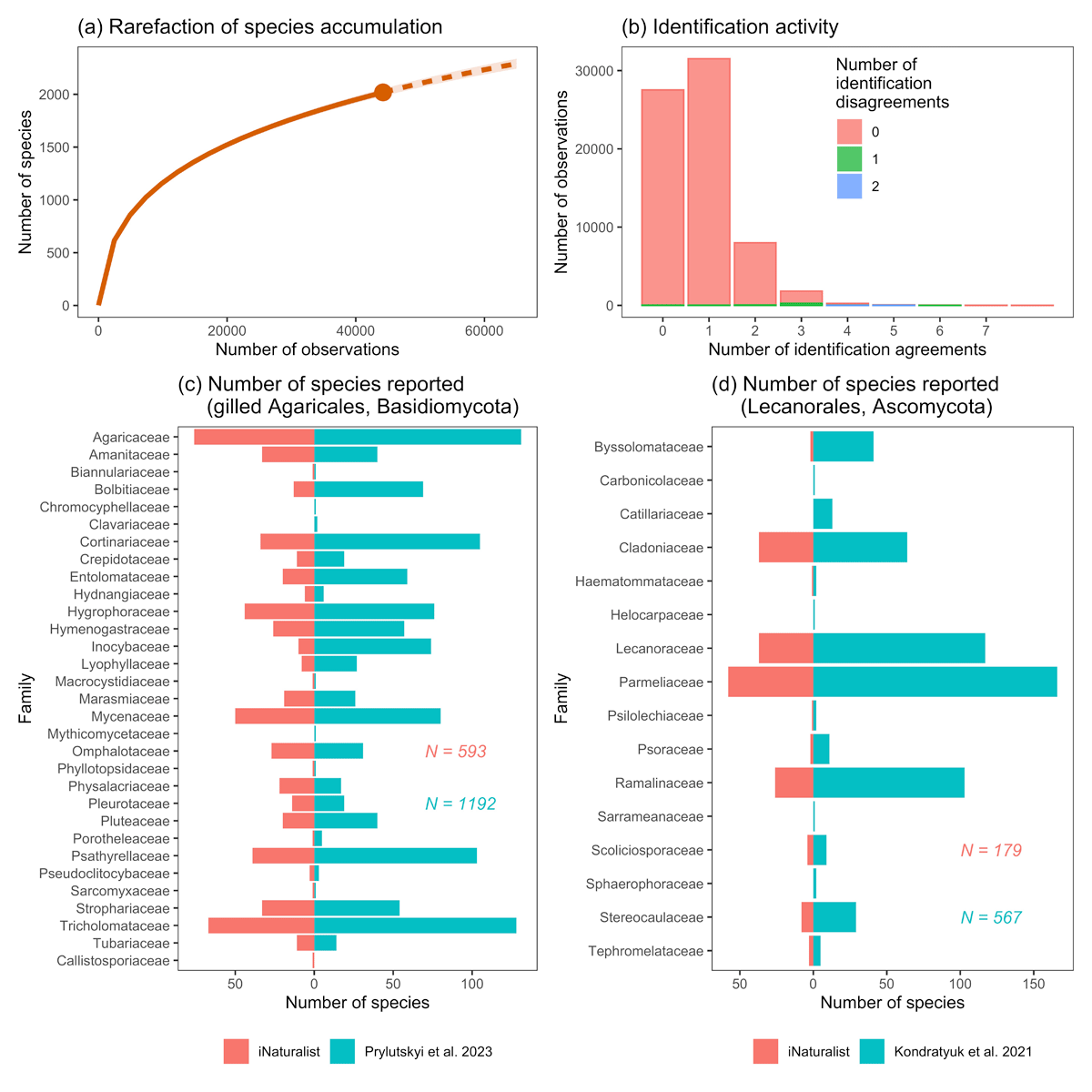
Taxonomic credibility of iNaturalist fungal data from Ukraine. (a) Accumulation of species with the accumulation of observations. The solid line highlights rarefied existing data, the dashed line is a projection for future observation growth, and the shaded area is a 95% credible interval. (b) Identification activity. The Y axis displays the number of published observations, dissected by the number of identification disagreements (in color). Fewer agreements/disagreements reflect the lower engagement of another user in identifying particular observations. (c, d) Taxonomic coverage for the two groups of fungi: gilled representatives of Order Agaricales (c), the largest order of mushroom-forming Basidiomycota, and Order Lecanorales (d), one of the largest order of lichen-forming Ascomycota, respectively. Colors reflect the data source, where red is iNaturalist data, and green is the latest national checklists for respective groups; the bar length is proportional to the number of species reported for the territory of Ukraine. N indicates the number of respective species.

Figure 2
Spatial distribution of iNaturalist fungal data from Ukraine. (a) Gridded density of iNaturalist fungal observations, published as of 1 June 2024 for the territory of Ukraine. A grid cell is 1000 km2; cells lacking observations are left colorless. (b) Population density in Ukraine as of 2020, as a reference of potential observers’ distribution. The two major cities, as well as the mountain ranges, are labeled. Data source: Gridded Population of the World, Version 4 (GPWv4): Population Density, Revision 11 (https://sedac.ciesin.columbia.edu/data/set/gpw-v4-population-density-rev11). (c, d) – Georeferenced records of protected species Hericium coralloides (c) and invasive species Clathrus archeri (d). The color indicates a data source: red is for iNaturalist observations, and green is for records from any other sources (academic publications, collections, reports from social media). N indicate numbers of respective records.
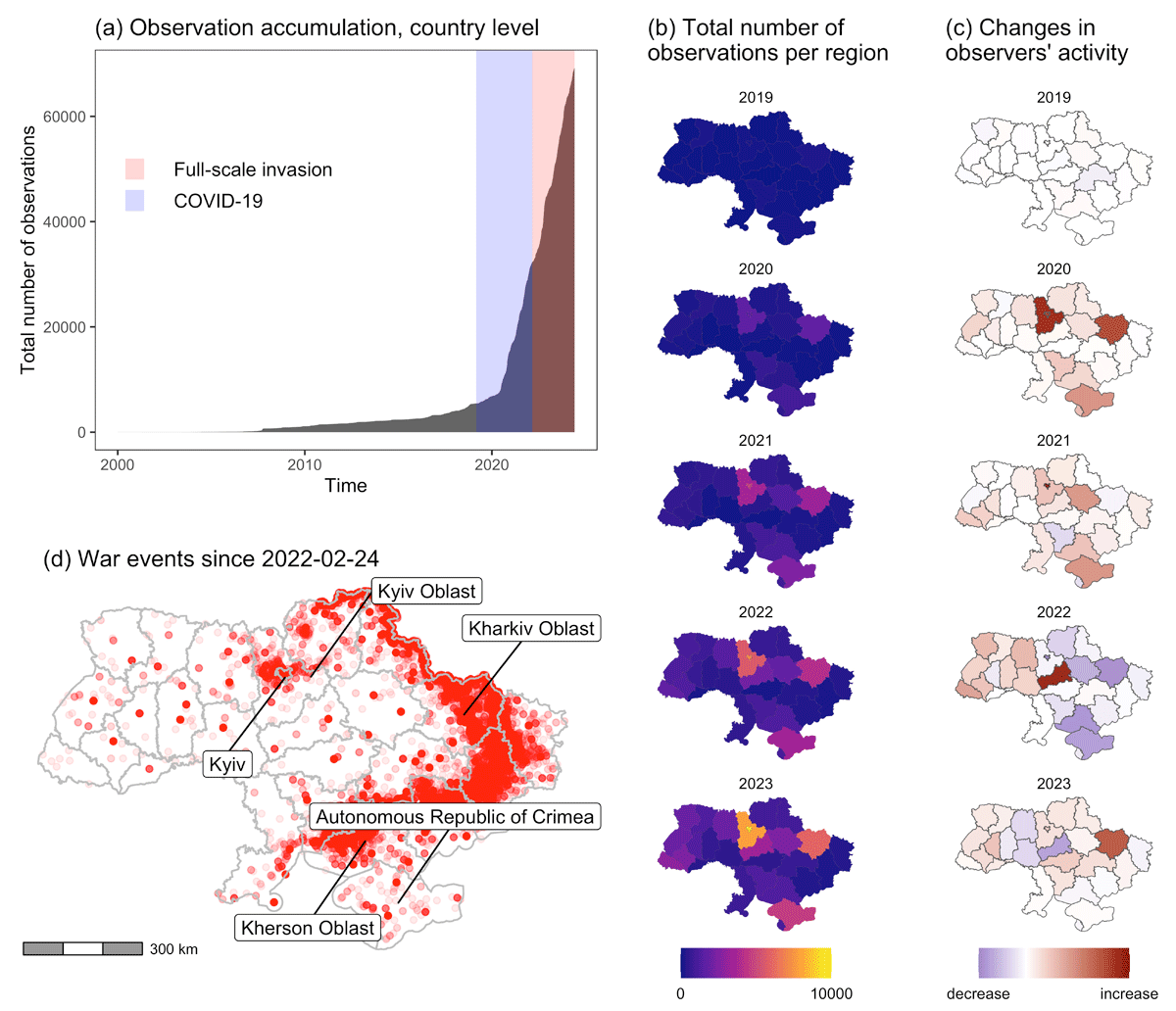
Figure 3
The social facet of fungal part of iNaturalist activity in Ukraine. (a) Accumulation of fungal observations made on Ukraine’s territory since the platform’s launch. Colors highlight the two major social events for the period: the COVID-19 pandemic and the full-scale Russian invasion. (b) Accumulation of fungal observations for each administrative region of Ukraine separately for the years 2019–2023. The brighter color indicates a higher total number of regional observations by the end of a respective year. (c) Yearly changes in observers’ activity. Regions where the total number of observations made in a given year was higher than that made in a preceding year are highlighted in red. Regions where the total number of observations made in a given year was lower than that made in a preceding year are highlighted in blue. Color saturation reflects the magnitude of the difference. The white color indicates no changes (zero point). (d) All political violence events (combat, shelling, casualties) caused by the Russian-Ukrainian war since the beginning of the full-scale invasion, as a reference to the spatial impact of the war. Data source: ACLED’s Ukraine Conflict Monitor (https://acleddata.com/ukraine-conflict-monitor/).