Figure 1
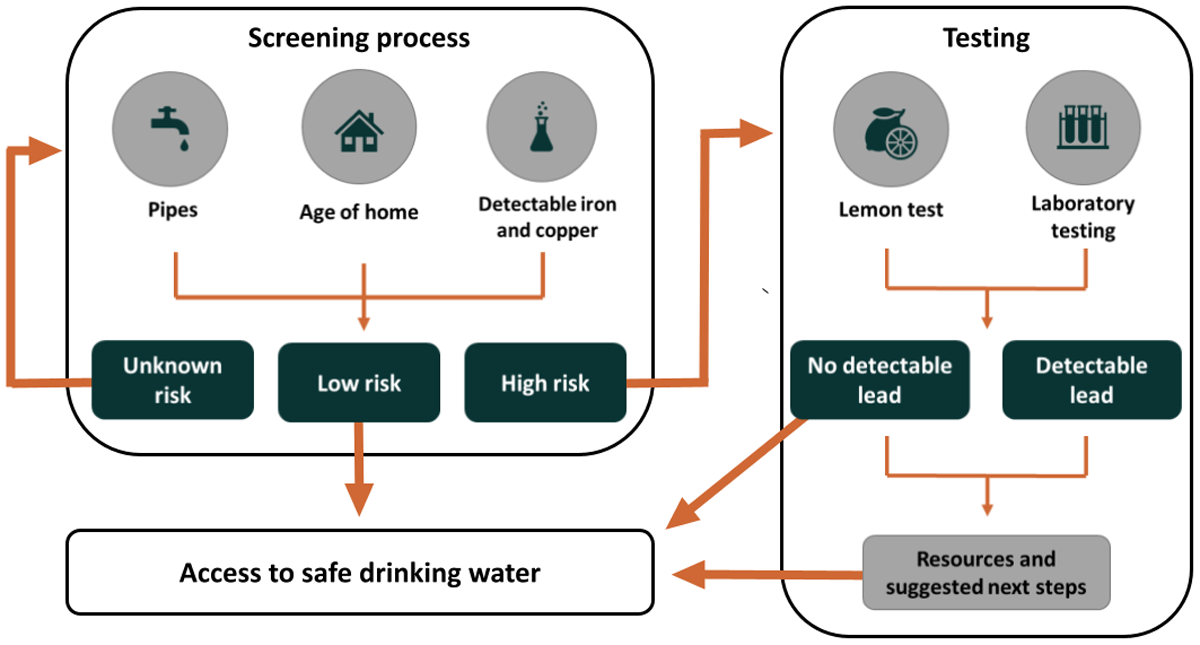
How the Crowd the Tap project works. Participants screen their homes by providing data on their pipes, on the age of their homes, and in some cases, on preliminary water chemistry data from a chemistry strip. This information is used to classify households’ priority level for lab testing. Households that do not provide enough information to determine priority level are classified as unknown, and they are provided more resources on how to informatively re-screen. Households that are high priority are offered laboratory testing alone or the combination of a modified at-home lead test (Kriss et al. 2021) called the lemon test and a laboratory test. This testing determines whether or not household water has detectable lead. People receive resources on suggested next steps for addressing lead in water. Ultimately, be it through a low-priority risk designation, through confirmation of no detectable lead in the water, or through the resources a household is provided to address detectable lead, participants can be assured of the safety of their drinking water.
Table 1
Crowd the Tap recruitment through facilitator organizations.
| PWI internship program | We mentored 25 interns from North Carolina State University (NCSU) to engage their communities in Crowd the Tap. Interns received training on water systems engineering, science communication, and public engagement. They recruited members of their hometowns to screen and sample water. Reciprocal efforts with student facilitators included financial compensation, research credits, mentored research experiences, letters of recommendation, and workshops on drafting resumes and cover letters. |
| HBCU internship program | We (Cooper and Johnson) collaboratively obtained a grant with equitably distributed funds to support an internship program at Shaw University. We hired interns from HBCUs to engage households in Crowd the Tap through the North Carolina Council of Churches’ (NCCC’s) Program for Health and Wholeness and through the Southeastern Wake Adult Day Center (SEWADC). In total, we mentored eight Shaw University students, one North Carolina A&T (NC A&T) student, and one student who did not attend an HBCU but represented a community-based, nonprofit meant to improve Black livelihoods. Reciprocity with students in the HBCU internship program was similar to those in the PWI program. Faith communities: In the summer of 2022, six students worked with NCCC to engage members of faith communities across North Carolina. Students emailed and called contacts at various faith communities about the program and provided support for faith community leaders who engaged their members. Reciprocity with faith communities included stipends provided through NCCC’s grant program to conduct health and wellness programs, in this case, Crowd the Tap. Another form of reciprocity involved data submission. We received feedback that the need for a login and the length of the survey made submitting data too complex for older members of faith communities. We completely revamped how we collected data, removing the need for a login and making questions related to water aesthetics and demographics optional. While the login information and the questions helped us fulfill our research objectives, they were a barrier to those most affected by the issue of lead contamination. We chose to prioritize people having access to information about their drinking water over our research questions. A community-based health organization: In the summer of 2023, four students worked with SEWADC, a day center run by Black employees for older adults and adults with disabilities that serves a primarily Black community in the Raleigh, NC area. Reciprocity with this facilitator organization involved providing water pitchers with filters to anyone found to have any amount of lead in their drinking water. With the permission of the people who participated, and within the scope of our IRB, we also provided non-anonymous data back to SEWADC, which they are using to apply for foundation grants. |
| University students | We engaged undergraduate students at NCSU and NC A&T through service learning projects in classrooms in which instructors had their students conduct the screening as an assignment. At NCSU, we also partnered with the Wicked Problem’s Wolfpack Solutions summer course to engage incoming students in screening their homes prior to coming to campus. Instructors from other universities engaged their students in our project, but this was not through explicit partnerships set up between Crowd the Tap project leadership and the university. Reciprocity with university classrooms involved providing anonymized datasets for classroom use and guest lecturing about the project and findings. |
| High school students | We partnered with high school science teachers to engage their students in Crowd the Tap. We specifically recruited Advanced Placement Environmental Science (APES) teachers because of the flexibility that their curriculum offered and science teachers in areas of the state of North Carolina where the Department of Environmental Quality had reported the presence of utilities with lead plumbing. We had two levels of high school participation that involved differing classroom engagement and reciprocity: Level 1 teachers received curricular materials and lesson plans without any synchronous training, and they engaged their students in the screening process only. Level 2 teachers attended synchronous training sessions and engaged their students in both the screening and testing (Figure 1). Level 2 teachers also received a stipend. Curricular materials were specific to APES and Chemistry classes and were co-developed with paid teachers and contracted education experts. |
| Corporate volunteers | Verizon has a corporate volunteer program in which employees volunteer their time to engage in participatory science projects. This program is facilitated through SciStarter.org, an online hub for participatory science projects. As part of this program, Verizon employees received volunteer hours for screening their home, and if needed, sampling their water. Because SciStarter facilitates a suite of projects for Verizon employees to participate in, Crowd the Tap staff had very little interaction with corporate participants. As a result, efforts to foster reciprocity with Verizon is outside of the scope of our work with them, though we assume that given their longstanding partnership, there are reciprocal benefits between Verizon and SciStarter. |
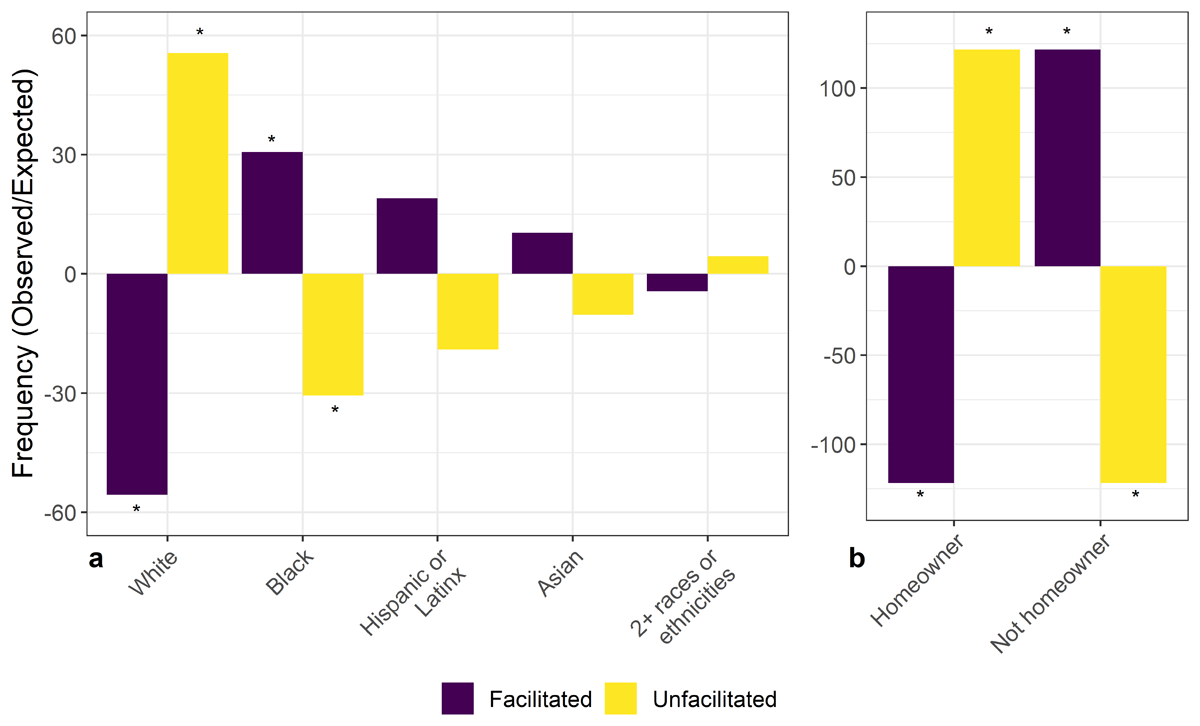
Figure 2
Breakdown of race (a) and homeownership (b) by whether or not their participation was facilitated. * indicates significance, either with an adjusted p-value based on a Bonferroni post-hoc test (a: p < 0.005) or b: 0.05).
Table 2
Makeup of race/ethnicity and homeowner status by facilitators.
| UNFACILITATED | PWI INTERN PROGRAM | FAITH COMMUNITIES (HBCU INTERN PROGRAM) | COMMUNITY-BASED HEALTH ORGANIZATION (HBCU INTERN PROGRAM) | UNIVERSITY STUDENT | LEVEL 1 HIGH SCHOOL | LEVEL 2 HIGH SCHOOL | VERIZON | |
|---|---|---|---|---|---|---|---|---|
| White | 19.6% | 17.6% | 0.2% | 0.1% | 30.4% | 11.1% | 12.7% | 8.3% |
| Black | 7.7% | 10.3% | 6.3% | 8.3% | 30.6% | 9.1% | 17.1% | 10.6% |
| Hispanic or Latinx | 8.4% | 5.5% | 0.0% | 0.0% | 10.5% | 59.1% | 11.4% | 5.1% |
| Asian | 11.2% | 17.9% | 0.0% | 0.0% | 35.7% | 17.9% | 7.7% | 9.7% |
| American Indian | 16.7% | 0.0% | 0.0% | 0.0% | 16.7% | 33.3% | 0.0% | 33.3% |
| Pacific Islander | 20.0% | 0.0% | 0.0% | 0.0% | 40.0% | 0.0% | 20.0% | 20.0% |
| Multiracial | 17.4% | 8.6% | 0.2% | 0.0% | 33.3% | 12.1% | 15.9% | 12.4% |
| Homeowner | 23.9% | 8.0% | 1.3% | 1.0% | 26.9% | 13.8% | 16.4% | 8.6% |
| Not homeowner | 8.2% | 21.9% | 0.3% | 0.8% | 30.2% | 17.9% | 10.3% | 10.5% |
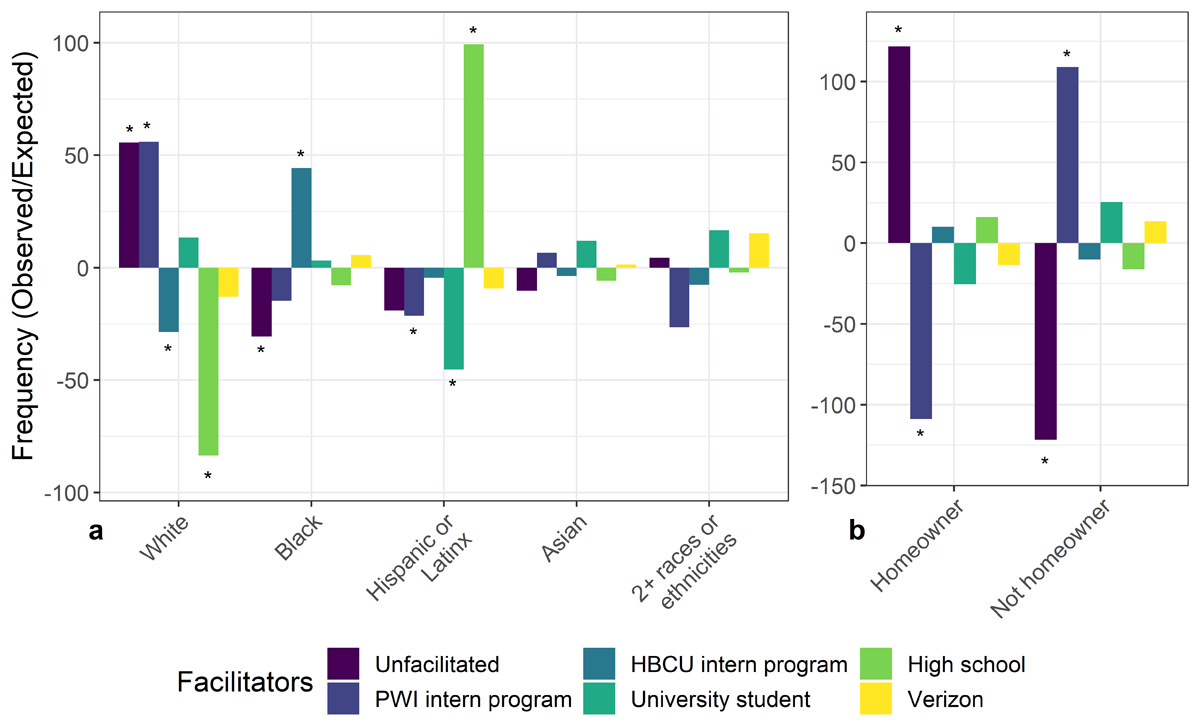
Figure 3
Breakdown of race (a) and homeownership (b) by facilitator organizations. * Indicates adjusted significance levels based on Bonferroni post-hoc tests (a: p < 0.00167; b: p < 0.00417). HBCU: historically Black college/university, PWI: predominantly white institutions.
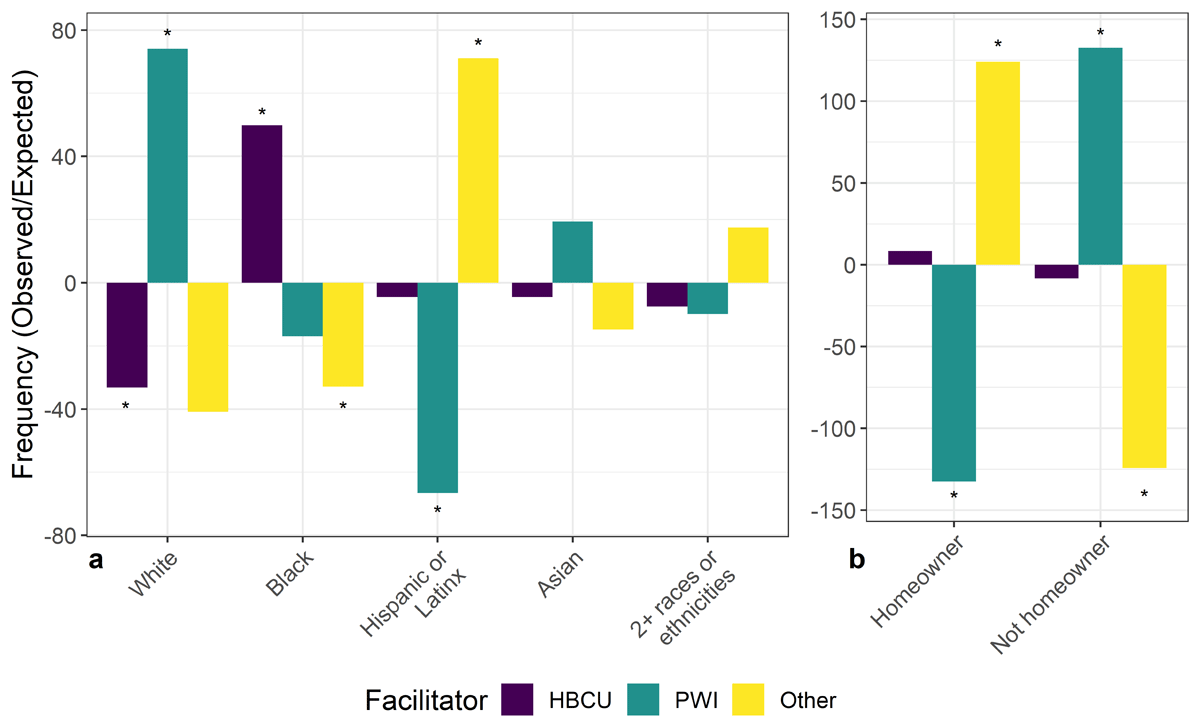
Figure 4
Breakdown of race (a) and homeownership (b) by HBCU, PWI, and other facilitators. * Indicates adjusted significance levels based on Bonferroni post-hoc tests (a: p < 0.00333; b: p < 0.00833). HBCU: historically Black college/university, PWI: predominantly white institutions.