
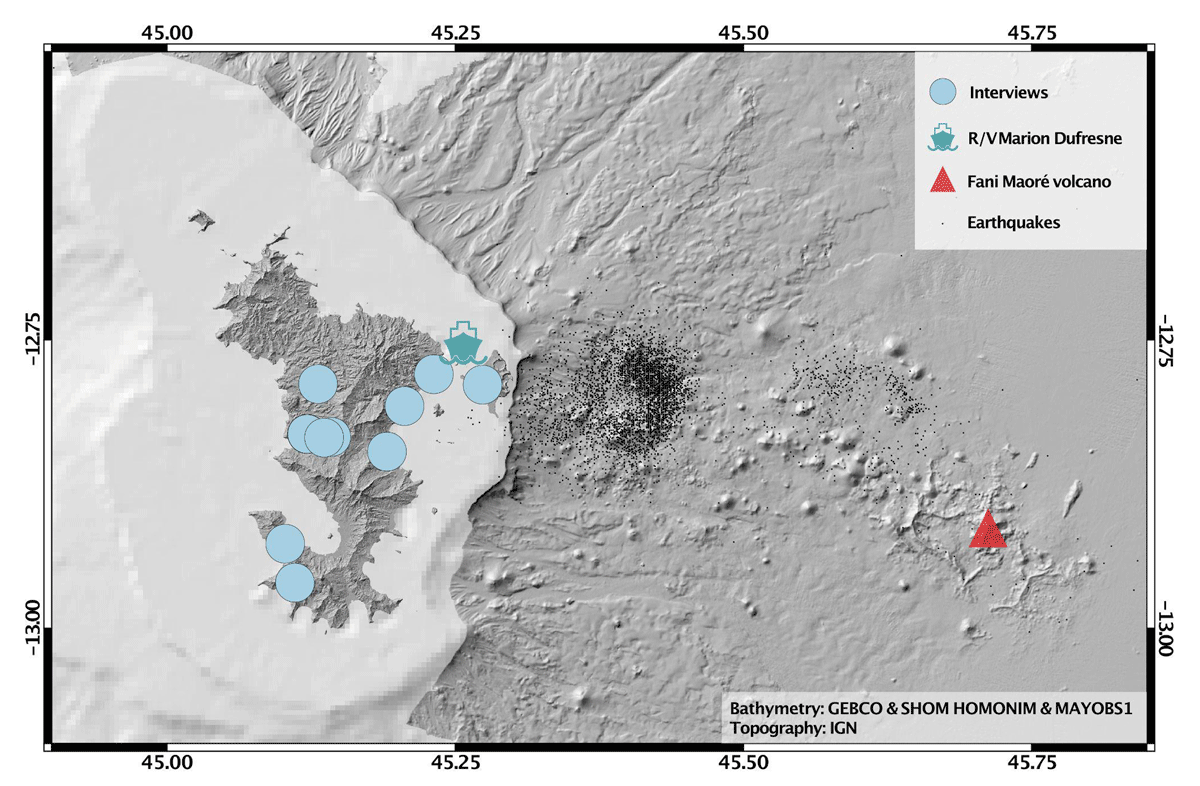
Figure 1
Map of Mayotte and the surrounding area. The red triangle shows the location of the Fani Maoré volcano and the black dots are the earthquake catalog from Saurel et al. (2022a). The blue circles show the areas where we conducted the interviews.
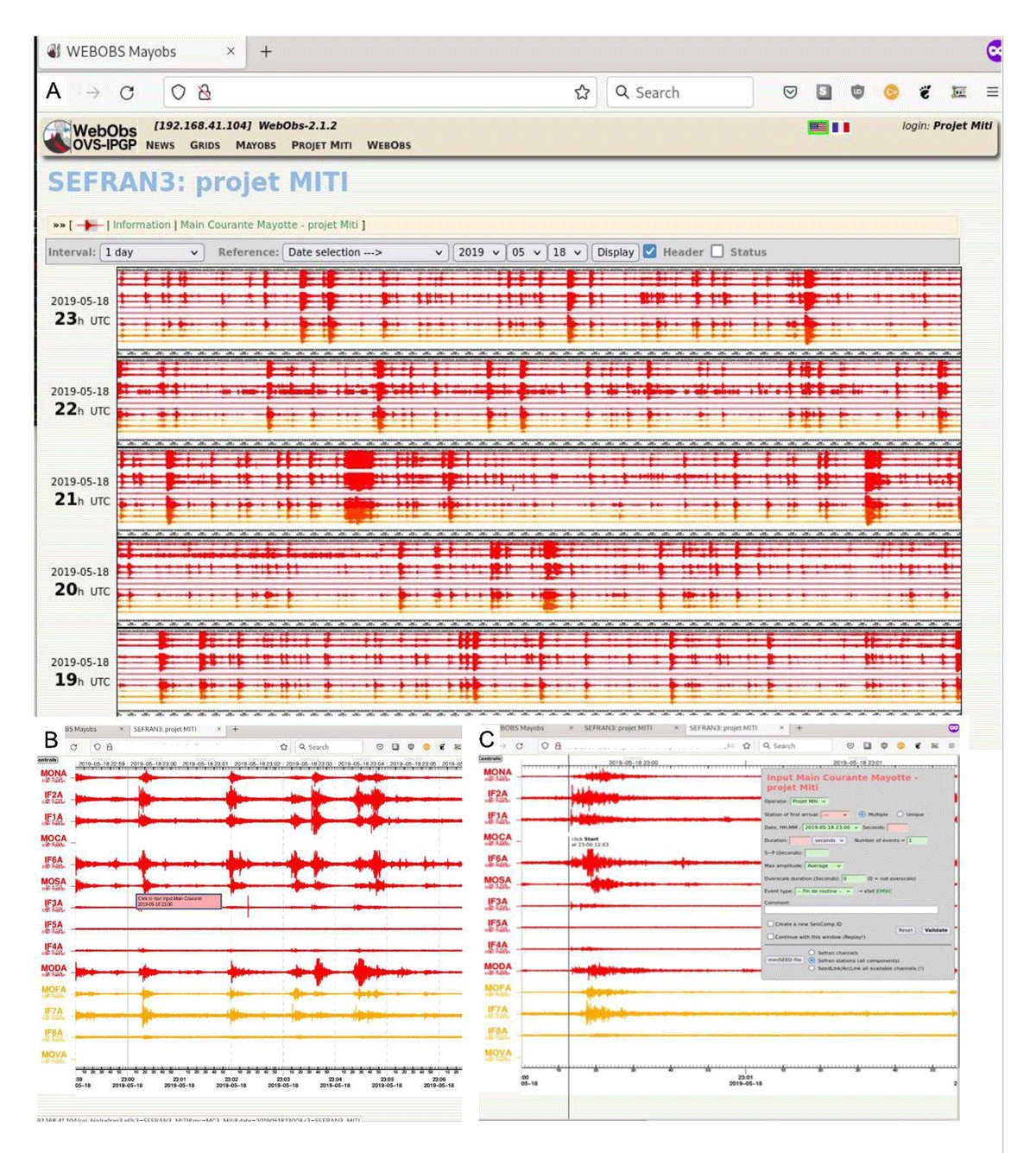
Figure 2
Screenshots of the interface used to identify seismic events. a) Main page with hourly windows for one day. b) The second interface focuses on one chosen hour. c) The final window focuses on a chosen event, where the identification is undertaken.
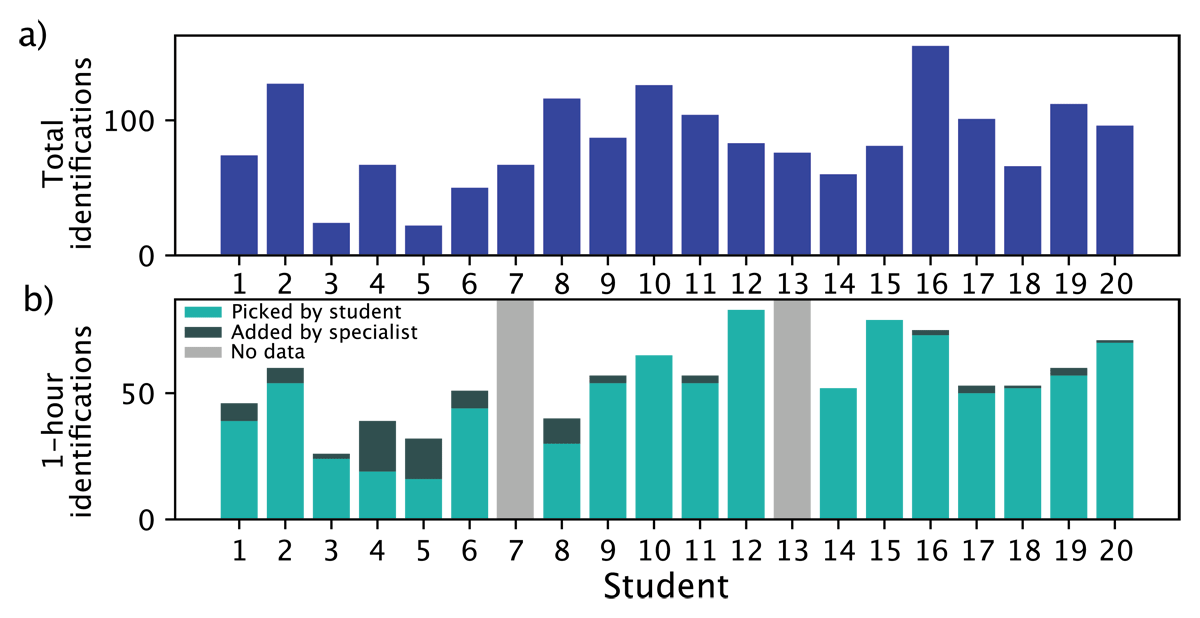
Figure 3
a) Total number of events identified per participant. b) Total number of events identified per participant during the first hour in green. The dark green part of the bar shows the number of events added by an expert. Gray bars show participants for which this characterization could not be done.
Table 1
The main results from the interviews. Left column: topics presented in this section. Central column: number of interviews where this topic is spontaneously evoked by the interviewees. Right column: examples of quotes from the interviewees (with the corresponding interviewee’s group in brackets).
| TOPIC (NUMBER IN THE TEXT) | NUMBER OF OCCURRENCES | EXAMPLES |
|---|---|---|
| 1-Interviewees’ deference to science | 9 | “Let’s keep a scientific mind !” (group b) “I was very interested because I work in environmental policy. At a scientific level I was also very interested” (group c) “So on my behalf I am not part of the skeptic people, I do believe that there is a volcano” (group c) |
| 2-Mayotte’s society as structured by the coexistence of various social groups | 10 | “There is a public who has understood that the earthquakes come from a volcano; another one who prefers other sources of information; and a last one who is not informed at all” (group c) “There are always two sides: people who went to school, who understand scientific explanations, and those who refer to God” (group c). |
| 3-Traumatic character of the seismic crisis | 10 | “We have to tell it was a traumatism for Mayotte” (group b) “It was violent” (group b) “It was very frightening” (group b) |
| 4-Latent anxiety regarding Mayotte’s future | 11 | “They always told us: one day, Mayotte will collapse and will not exist anymore. Maybe it is the moment?” (group b) |
| 5-The volcano as an opportunity for Mayotte’s development | 4 | “This is a chance for Mayotte. A newborn volcano, it is the first time, no? Mayotte’s population should benefit from it” (group c) |
| 6-Interest of the inhabitants for the new volcano, and the need for scientific explanation | 15 | “There is a need for information. People were waiting for information” (group b) “At the beginning, there were some practical instructions, but people were totally panicked because they were not given any answer: what is happening ?” (group b) |
| 7-The search for petroleum as an alternative explanation to the seismic swarms | 4 | “The most probable hypothesis was the petroleum” (group b); “Within the scientific hypothesis, there was the fact of having offshore petroleum extractions” (group c). |
| 8-The lack of scientific information as a driver of alternative explanations | 2 | “The State has taken so much time to give information that people thought it was lying” (group d) “If there would have been scientific information, it would have diminished a lot the fantasms” (group b) |
| 9-Role played by scientific findings about the volcano to eliminate those alternative explanations | 8 | “When the first scientific missions has started and that the population has seen it was a volcano, [the alternative explanations] have vanished” (group b) “When the scientific team revealed the hypothesis of the volcano, people believed it” (group b) “The hypothesis of the volcano imposed itself when scientists made a press communication” (group c) |
| 10-Role of the material/scientific evidence | 8 | “After, there were these images, with the volcano which was perfectly localized” (group b) “They arrived with evidence, rocks, photos, analysis” (group b) “When the boat arrived for scientific research, people started to trust scientists” (group c) |
| 11-Strategies to engage Mayotte’s population | 8 | “You should pass by school. It is from that point that the population will get interested. It will create a new dynamic, in terms of emotions” (group e). |