
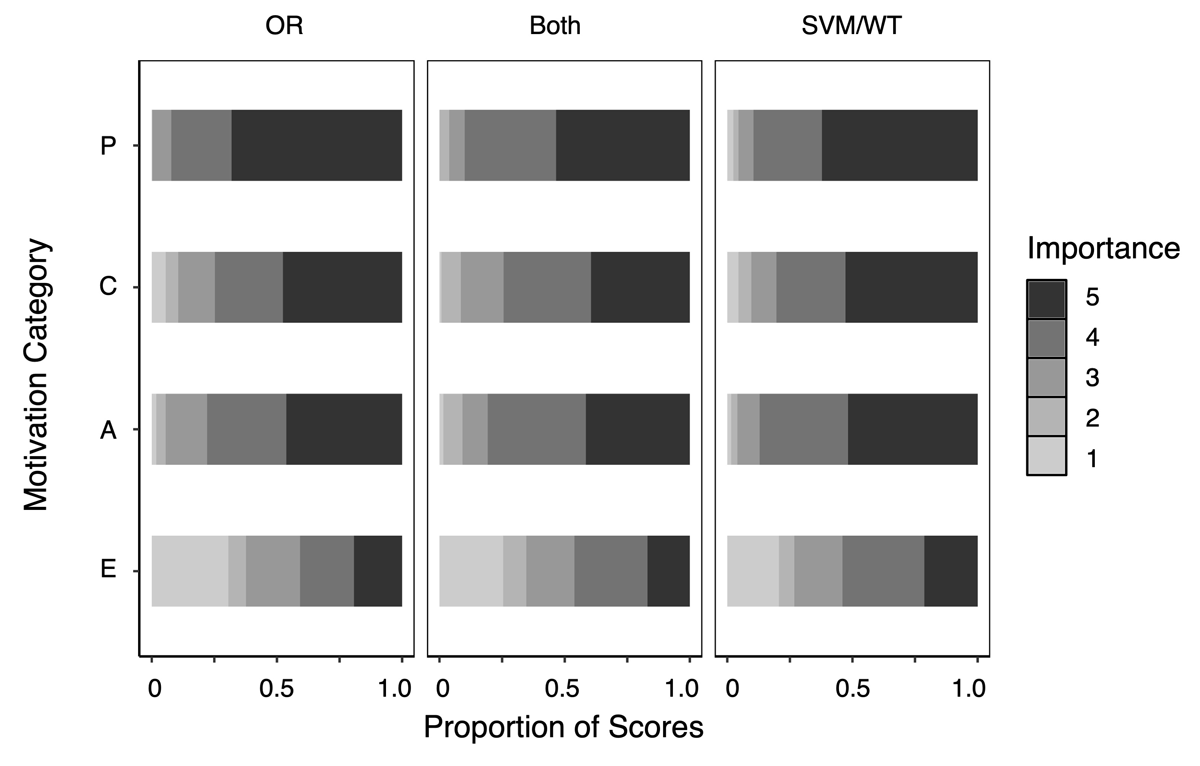
Figure 1
Results from Likert-scale survey. Importance to participants (N = 98) of four different types of motivation (E: Egoistic, A: Altruistic, C: Collectivistic, P: Principlistic) according to which program type(s) they volunteer in (OR: Oyster Recovery, Both: Oyster Recovery and one of the more intensive PPSR programs, SVM/WT: one of the more intensive PPSR programs only). Higher importance values indicate motivations that are more important for their volunteer work. People in all programs ranked egoistic motivations lower than all other types (p < 0.0001). People involved in the more intensive programs (SVM/WT) scored egoistic (p < 0.0001) and altruistic motivations (p < 0.05) higher than people involved in the OR program.

Figure 2
Top ten motivations (ranked by highest number of 4 and 5 scores) among all participants (N = 98) from the Likert-scale survey. Higher importance values indicate motivations that are more important. Motivation categories are indicated with letters on the right of each bar (P: Principlistic, C: Collectivistic, A: Altruistic, and E: Egoistic).

Figure 3
Results from Measuring Environmental Motives, a tool to assess the reasons for participants’ (N = 98) general concerns about the environment. Participants ranked their concern for the environment based on egoistic, social, and biospheric reasons with higher scores indicating a greater level of concern. (a) Concern scores varied by concern type with biospheric concerns ranking higher than social concerns (p = 0.016) and higher than egoistic concerns (p < 0.0001) and egoistic concerns ranking lowest (p < 0.0001). (b) Concern scores also varied based on PPSR program type (OR: Oyster Recovery, Both: Oyster Recovery and one of the more intensive PPSR programs, SVM/WT: one of the more intensive PPSR programs only) with people in the Oyster Recovery program articulating higher levels of overall concern (across all concern types) than people participating in SVM/WT (p < 0.0001) or in both types of programs (p = 0.0002).