Table 1
Grade band and country of students submitting projects.
| BY AGE/GRADE BAND | N (OUT OF 203) | % |
|---|---|---|
| Lower primary (grades k–2, ages 5–8) | 5 | 2% |
| Upper primary (grades 3–5, ages 8–11) | 9 | 4% |
| Middle school (grades 6–8, ages 11–14) | 82 | 40% |
| Secondary school (grades 9–12, ages 14–18) | 106 | 52% |
| Undergraduate | 1 | <1% |
| BY COUNTRY | N (OUT OF 207) | % |
| United States | 128 | 62% |
| Outside United States (IVSS only) | 79 | 38% |
Table 2
Literature sources for GLOBE investigation codes.
| SOURCE | EXAMPLE CATEGORIES |
|---|---|
| Bonney et al. 2009 | project type; defining questions; interpreting data; developing explanations; disseminating conclusions |
| Chase and Levine 2016 | biophysical and geographical factors; geographical scale; temporal scale; group self-organization; protocol training; collection methods; social factors |
| Edelson et al. 2013 | designing solutions; communicating information |
| Freitag et al. 2016 | planning phase; prior training; assistance from professional; validation; cross-comparison |
| Kastens 2014a | unstructured observation; student-collected data sets; well-structured problems |
| Kastens 2014b | direct knowledge; mediated knowledge; creation of representation; interpretation of representation |
| NASEM 2018 | ground truthing; action project; education project; scientific practices |
| NACEPT 2016 | community engagement; filling gaps in data sets; scale |
| Phillips et al. 2018 | interest; self-efficacy; inquiry skills; stewardship behavior; community action |
| Shirk et al. 2012 | degree of participation |
| Tweddle et al. 2012 | analysis and reporting; share data; take action in response to data; evaluate/reflect |
| The GLOBE Program 2018a, b | spatial scale; GLOBE protocols; context and relevance; connecting to a STEM professional; interscholastic connections; engineering solutions |
| Wiggins and Crowston 2011 | action/conservation; data validity |
Table 3
Summary of theme and sub-theme areas of final code list.
| THEME AREA | SUB-THEME AREAS (IF APPLICABLE) |
|---|---|
| Increased engagement/interest | |
| Increased knowledge | |
| Increased skill | |
| Increased student self-efficacy/behavior change | Behavior change |
| Self-efficacy change | |
| Key aspects of the scientific process | Pre-investigation |
| Carrying out | |
| Finalizing | |
| More sophisticated aspects of the scientific process | Data limitations |
| Data quality, validation, calibration or investigation | |
| Using data and results | |
| Broader scientific context | |
| Engineering principles | |
| Gathering data | Data collected |
| GLOBE fidelity | |
| Deviations from GLOBE | |
| Technological collection aids | |
| Human senses | |
| Geographic scale | Local |
| Beyond local | |
| Temporal scale | Temporal scale driven by topic |
| Temporal scale driven by length of data collection | |
| GLOBE sphere(s) | |
| Goals/type of investigation | Exploring a natural system |
| Continuity/gap filling | |
| Student-driven | |
| No investigation | |
| Interdisciplinary | |
| Motivation/context for selection of topic | Relevance to people |
| Relevance of people to environment | |
| Continuation | |
| Current events | |
| About GLOBE | |
| Not a GLOBE project | |
| Broader relevance of subject | |
| Planned vs. open-ended | Planned |
| Unplanned | |
| Student organization | Self-organized |
| Joined larger effort | |
| Team/roles identified | |
| Complexity of hypothesis | Simple hypothesis |
| Complex hypothesis | |
| Weak understanding | |
| Variable control | Controlled variables |
| Observed variables | |
| Statistical analysis | Basic stat analysis and interpretation |
| No stat analysis or poor analysis/interpretation | |
| Sophisticated stat analysis/interpretation | |
| Coherence between research question and conclusions | Proper conclusions/successfully addressed |
| Over-stretched or erroneous conclusions | |
| Level of structure | Unstructured data |
| Structured/systematic data | |
| Problem with structured scope/range—simple | |
| Problem that is unstructured/less structured | |
| Mediation of knowledge through representations | Direct knowledge |
| Mediated knowledge | |
| Mis-mediated | |
| Connection from idea to complete investigation | Weak connections |
| Reasonable connections | |
| Low/medium complexity | |
| High complexity | |
| Careers | |
| STEM professional relationship | |
| Interscholastic collaboration | |
| Considerations of impact/stewardship | Ignored impact |
| Local impact | |
| Actionable but no action | |
| Local to global | |
| Next steps | |
| Action taken |
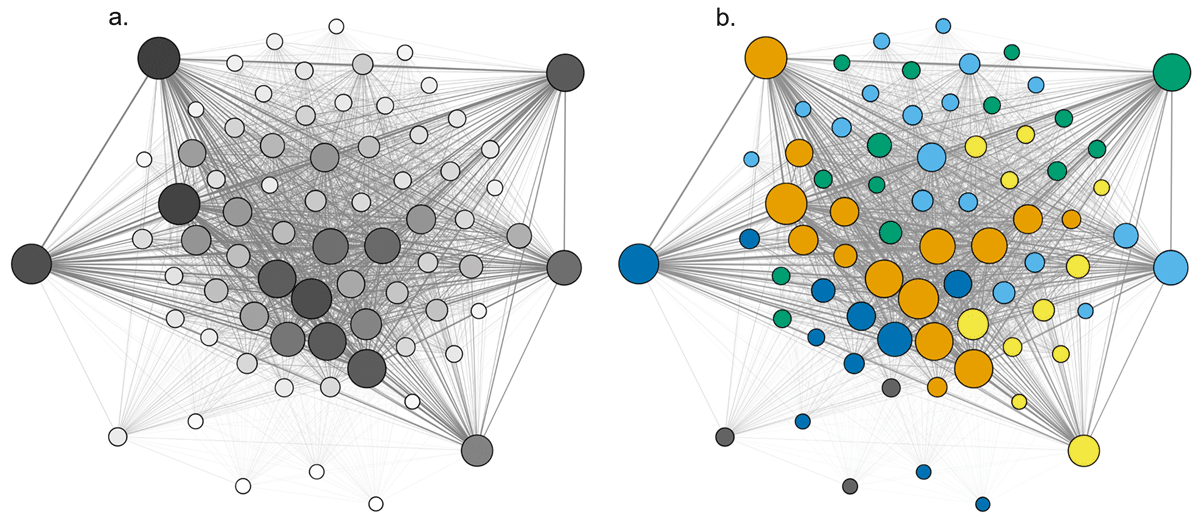
Figure 1
(a) Network mapping of individual codes before cluster analysis, and (b) codes once assigned to clusters based on the network analysis modularity technique and second-cycle theoretical coding of clusters. Color legend is as displayed in Figure 2.
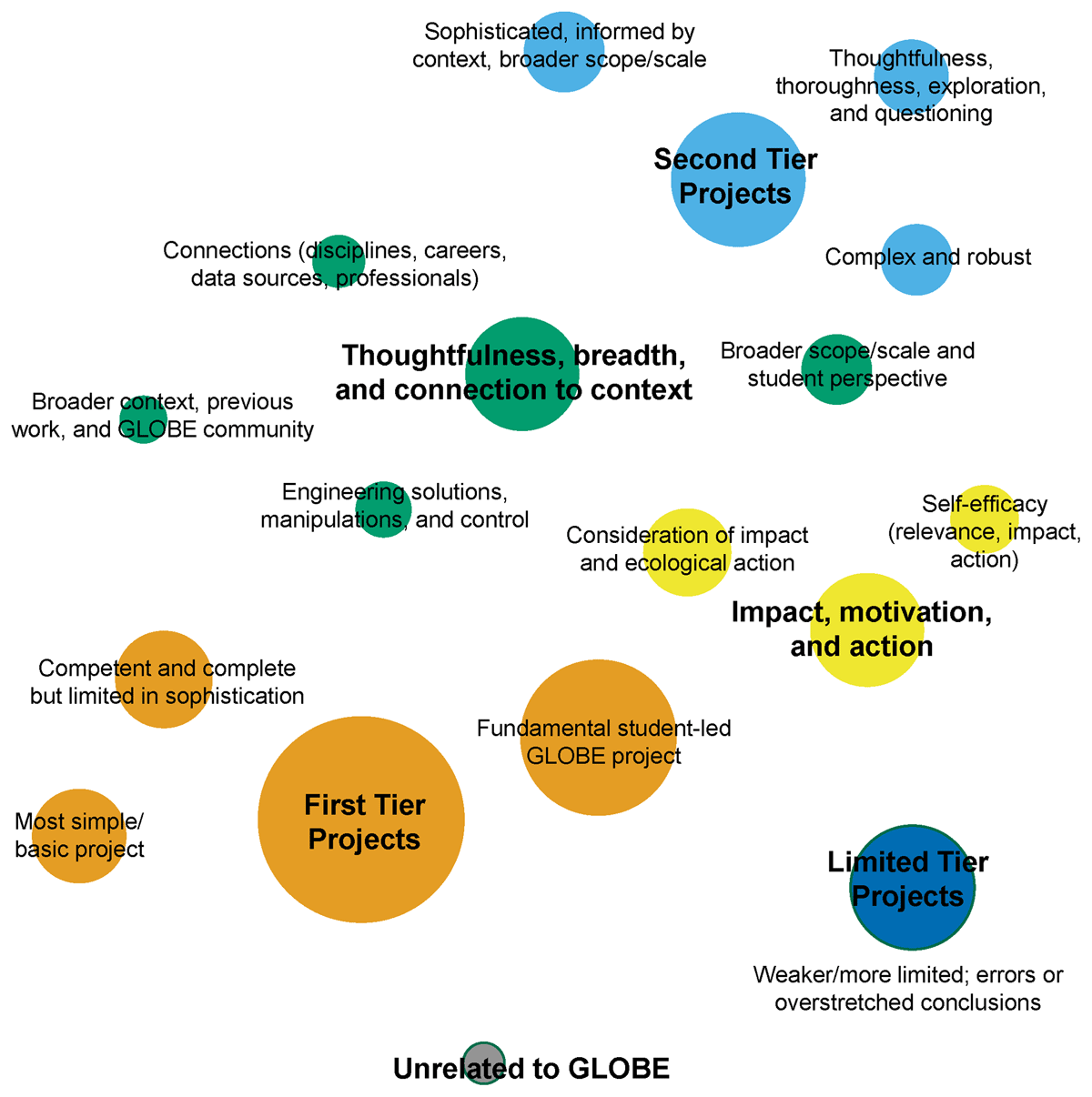
Figure 2
Concept map framework of project typologies based on cluster analysis and theoretical coding.
Table 4
Frequency of project alignment with identified clusters and sub-clusters.
| CLUSTER AND SUB-CLUSTER | N (OUT OF 207) | % |
|---|---|---|
| Project unrelated to GLOBE | ||
| Project unrelated to GLOBE | 29 | 14% |
| Limited-tier projects (limited sophistication) | ||
| Weaker/more limited project with errors, overstretched conclusions, or fundamental weaknesses of design and structure | 37 | 18% |
| First-tier projects (more sophisticated) | ||
| Demonstrates fundamentals of student-led GLOBE investigations | 179 | 87% |
| Most simple/basic project | 57 | 28% |
| Competent and complete project but limited in sophistication | 67 | 32% |
| Second-tier projects (most sophisticated) | ||
| Complex and robust project | 27 | 13% |
| More sophisticated project that is informed by context and reflects broader scope/scale and data literacy elements | 22 | 11% |
| Reflective of student thoughtfulness, thoroughness, exploration, and questioning | 9 | 4% |
| Additional characteristics: indicators of impact, motivation, and action | ||
| Student consideration of impact and ecological action | 64 | 31% |
| Student self-efficacy and translation of project into relevance, impact, and action | 15 | 7% |
| Additional characteristics: indicators of thoughtfulness, breadth, and connections to context | ||
| Investigation involves control/manipulation or engineering solutions | 36 | 17% |
| Investigation connects to a broader context, previous work, or the larger GLOBE community | 10 | 5% |
| Investigation demonstrates student connection (disciplines, careers, data sources, context, and STEM professionals) | 10 | 5% |
| Investigation reflects broader scale/scope and broader student perspective | 32 | 16% |
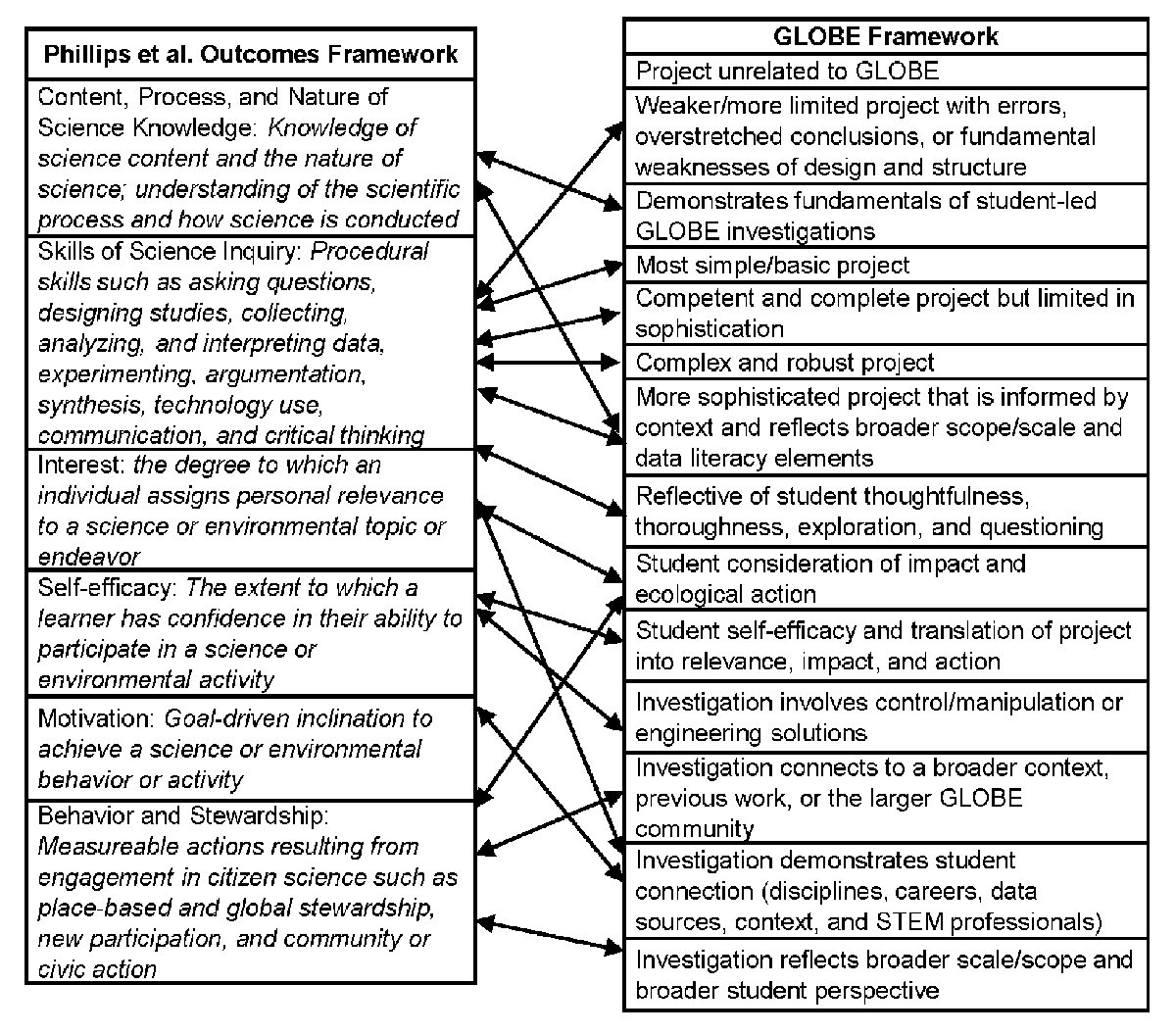
Figure 3
Alignment between the GLOBE citizen science investigation framework and Phillips et al. (2018) framework for individual outcomes resulting from citizen science participation.