
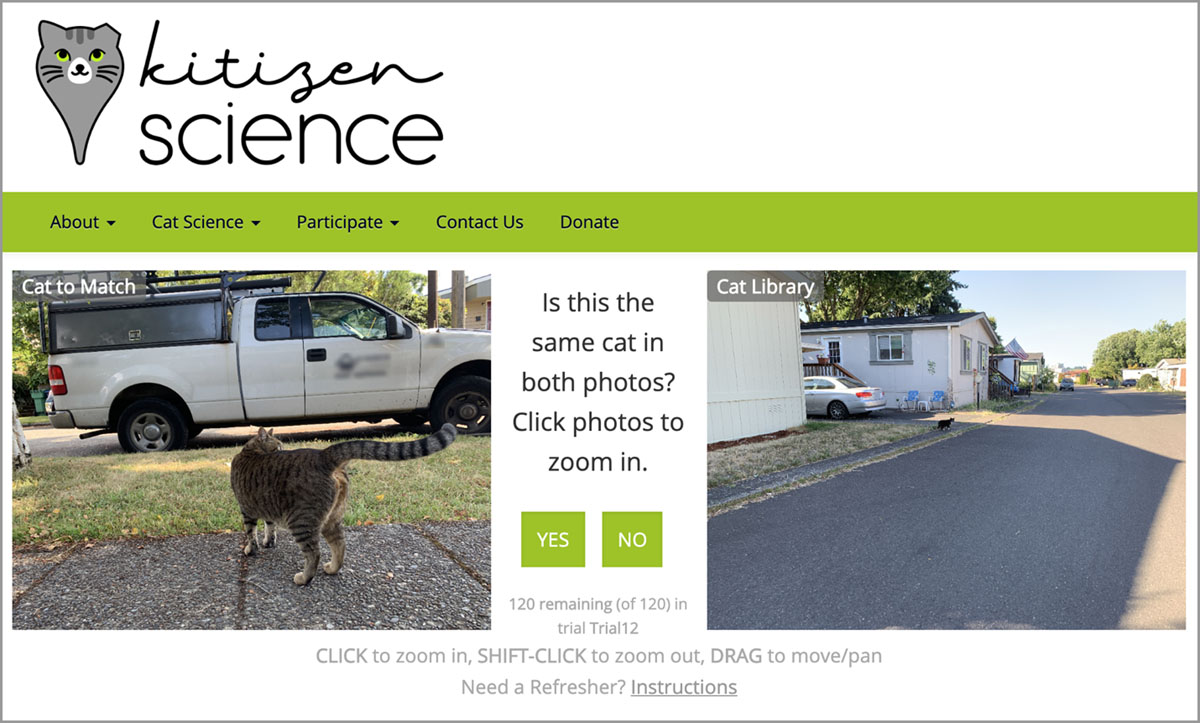
Figure 1
A screenshot of our study website that presented volunteers with two cat photos for comparison. Users could zoom/pan to explore detail.
Table 1
A summary of survey responses from volunteers.
| CAT ADVOCATES | STUDENTS | |
|---|---|---|
| Number | 151 | 17 |
| Are you currently involved in volunteering with cats in some way? | ||
| Yes | 57.6% | |
| No | 24.5% | |
| Not now, but in the past | 17.9% | |
| Do you have a disability or personal limitation (such as being a parent/caregiver) that prevents you from volunteering with cats in a typical offline setting like a shelter? | ||
| Yes | 8.6% | |
| No | 78.2% | |
| Sometimes | 13.2% | |
| Do you currently have a cat/cats in your care? | ||
| Yes, a pet cat/cats | 58.3% | 58.8% |
| Yes, I care for feral/free-roaming cats | 3.3% | 0.0% |
| Yes, a pet cat/cats AND Yes, I care for feral/free-roaming cats | 31.8% | 0.0% |
| No | 6.6% | 41.2% |
| Have you ever participated in an online citizen science project doing image identification or classification? | ||
| Yes | 7.9% | 23.5% |
| No | 92.1% | 76.5% |
| Have you ever volunteered to do image identification or classification as part of research that is NOT online citizen science, such as viewing camera trap images for UW wildlife researchers? | ||
| Yes | 17.6% | |
| No | 82.4% | |
| Age | ||
| Mean (range) | 47.1 (19–76) | 23.9 (18–50) |
| Retired | ||
| Yes | 21.2% | 0.0% |
| No | 78.8% | 100.0% |
| Gender | ||
| Man | 8.0% | 11.8% |
| Woman | 90.7% | 82.3% |
| Nonbinary/Other | 1.3% | 5.9% |
| Race/ethnicity | ||
| White | 90.1% | 70.6% |
| All other options (including mixed race selections that included white) | 9.9% | 29.4% |
| Highest level of education | ||
| Less than bachelor’s degree | 33.8% | |
| Bachelor’s degree or higher | 66.2% | |
| What is your current standing in school? | ||
| Undergraduate | 82.3% | |
| Master’s Student | 5.9% | |
| Doctoral Student | 11.8% | |
Table 2
Models predicting which personal traits affect cat advocacy citizen science volunteer’s accuracy in matching cat photos, ranked by AICc values. AICc values are used in model comparison and selection. The lowest score represents the most plausible model of those considered. The weight values are the relative likelihood of a model.
| MODELS | DF | AICC | WEIGHT |
|---|---|---|---|
| GLMMS | |||
| user + pet_cats + volunteer_ever + degree | 5 | 691.5 | 0.289 |
| user + pet_cats + volunteer_ever + degree + feral_cats | 6 | 692.6 | 0.170 |
| user + pet_cats + degree | 4 | 693.2 | 0.127 |
| user + pet_cats + degree + feral_cats | 5 | 693.3 | 0.119 |
| user + pet_cats + volunteer_ever | 4 | 694.4 | 0.071 |
| user + pet_cats | 3 | 695.1 | 0.050 |
| user + pet_cats + feral_cats | 4 | 695.1 | 0.048 |
| user + pet_cats + volunteer_ever + feral_cats | 5 | 695.3 | 0.045 |
| user + pet_cats + time_viewing | 4 | 695.3 | 0.044 |
| user + pet_cats + citsci | 4 | 697.0 | 0.018 |
| user + pet_cats + gender | 5 | 698.7 | 0.008 |
| user + pet_cats + volunteer_ever + degree + feral_cats + gender + citsci + time_viewing | 10 | 699.9 | 0.004 |
| user + degree | 3 | 700.7 | 0.003 |
| user + time_viewing | 3 | 702.1 | 0.001 |
| user + feral_cats | 3 | 702.4 | 0.001 |
| user + volunteer_ever | 3 | 703.0 | 0.001 |
| user + citsci | 3 | 704.1 | 0.001 |
| user + gender | 4 | 705.9 | 0.000 |
| GLMs | |||
| intercept-only null model | 1 | 880.4 | 0.000 |
Table 3
Models predicting which cat photo traits were linked to accurate matching by cat advocacy citizen science volunteers, ranked by AICc values. AICc values are used in model comparison and selection. The lowest score represents the most plausible model of those considered. The weight values are the relative likelihood.
| MODELS | DF | AICC | WEIGHT |
|---|---|---|---|
| GLMMS | |||
| photo + black | 3 | 337.6 | 0.366 |
| photo + black + prop_frame | 4 | 338.2 | 0.263 |
| photo + black + time_viewed | 4 | 339.5 | 0.139 |
| photo + black + prop_frame + time_viewed | 5 | 339.9 | 0.113 |
| photo + black + tip_or_collar | 4 | 339.9 | 0.113 |
| photo + black + face + prop_frame + tip_or_collar + time_viewed | 8 | 345.8 | 0.006 |
| photo + tip_or_collar | 3 | 351.7 | 0.000 |
| photo + prop_frame | 3 | 351.9 | 0.000 |
| photo + time_viewed | 3 | 352.2 | 0.000 |
| photo + face | 4 | 352.9 | 0.000 |
| GLMs | |||
| intercept-only null model | 1 | 558.0 | 0.000 |

Figure 2
The four least identifiable cat photos in our study, all of which had solid black fur.
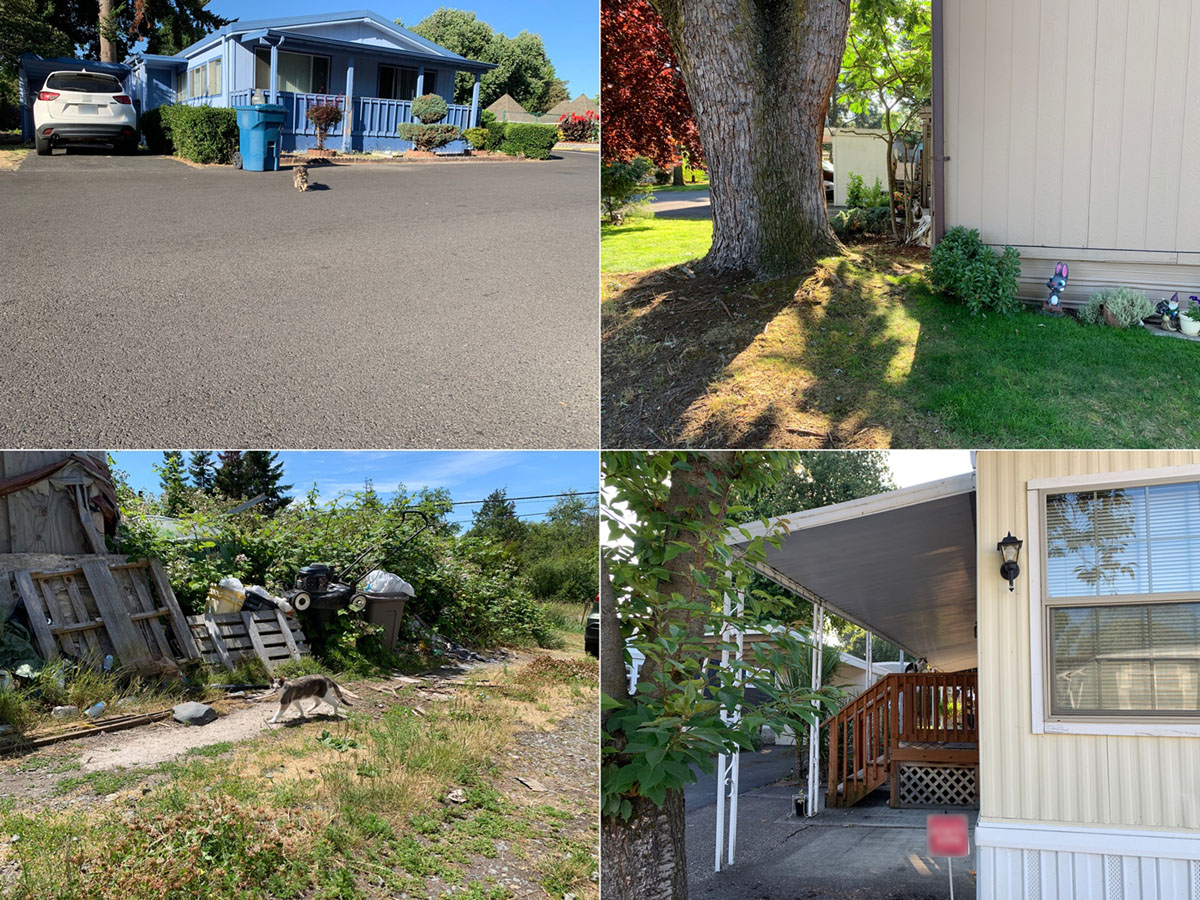
Figure 3
The four most identifiable cat photos in our study, none of which had solid black fur. We share these sets of images to illustrate that by-eye identifiability among domestic cats does not require a cat to be close to the camera, uniform in its pose, or even easy to initially notice within the frame.