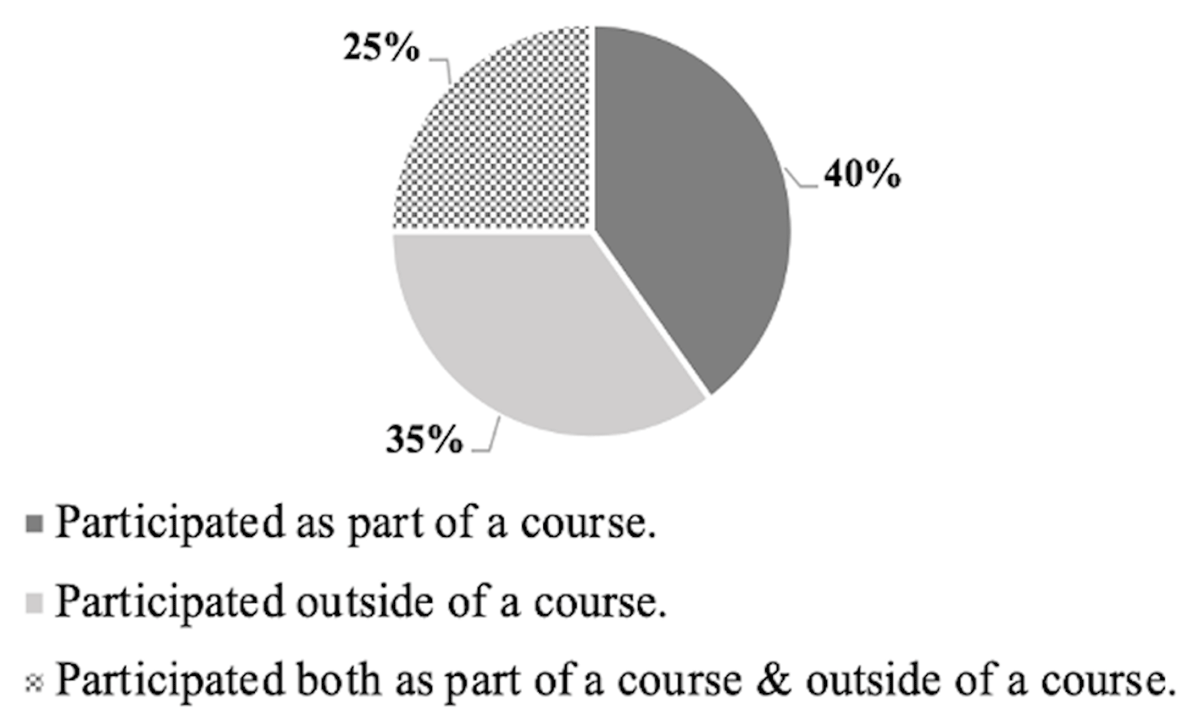
Figure 1
Nature of citizen science participation for undergraduate students at NC State University (n = 143).
Table 1
Participation in citizen science based on students’ demographic information and academic major.
| CHARACTERISTIC | PARTICIPATED IN CITIZEN SCIENCE (N = 52) | HAS NOT PARTICIPATED IN CITIZEN SCIENCE (N = 90) | TOTAL NUMBER OF PARTICIPANTS | NC STATE FALL 2019 UNDERGRADUATE POPULATION (N = 25,973) |
|---|---|---|---|---|
| Gender identity | ||||
| Men | 26.9% | 35.2% | 46 | 52.5% |
| Women | 65.4% | 59.3% | 88 | 47.5% |
| Sexual and/or gender minority | ||||
| Yes | 34.6% | 22.0% | 38 | N/A |
| No | 59.6% | 73.6% | 98 | N/A |
| Underrepresented students of color | ||||
| Yes | 15.4% | 12.1% | 19 | 12.5% |
| No | 84.6% | 87.9% | 124 | 74.3% |
| First-generation college student | ||||
| Yes | 23.1% | 16.5% | 27 | N/A |
| No | 76.9% | 83.5% | 116 | N/A |
| Disability status | ||||
| Yes | 17.3% | 11.0% | 19 | 3.6% |
| No | 75% | 81.3% | 113 | N/A |
| Academic major | ||||
| STEM | 69.2% | 42.2% | 74 | 57.2% |
| Non STEM | 30.8% | 57.8% | 68 | 29.5% |
[i] Note: Data on North Carolina (NC) State fall 2019 undergraduate population pulled from the following sources:
Office of Institutional Research and Planning. n.d. “NC State University—Fall 2019 Enrollment Report” NC State University.
Disability Resource Office. n.d. “DRO Demographics” NC State University.
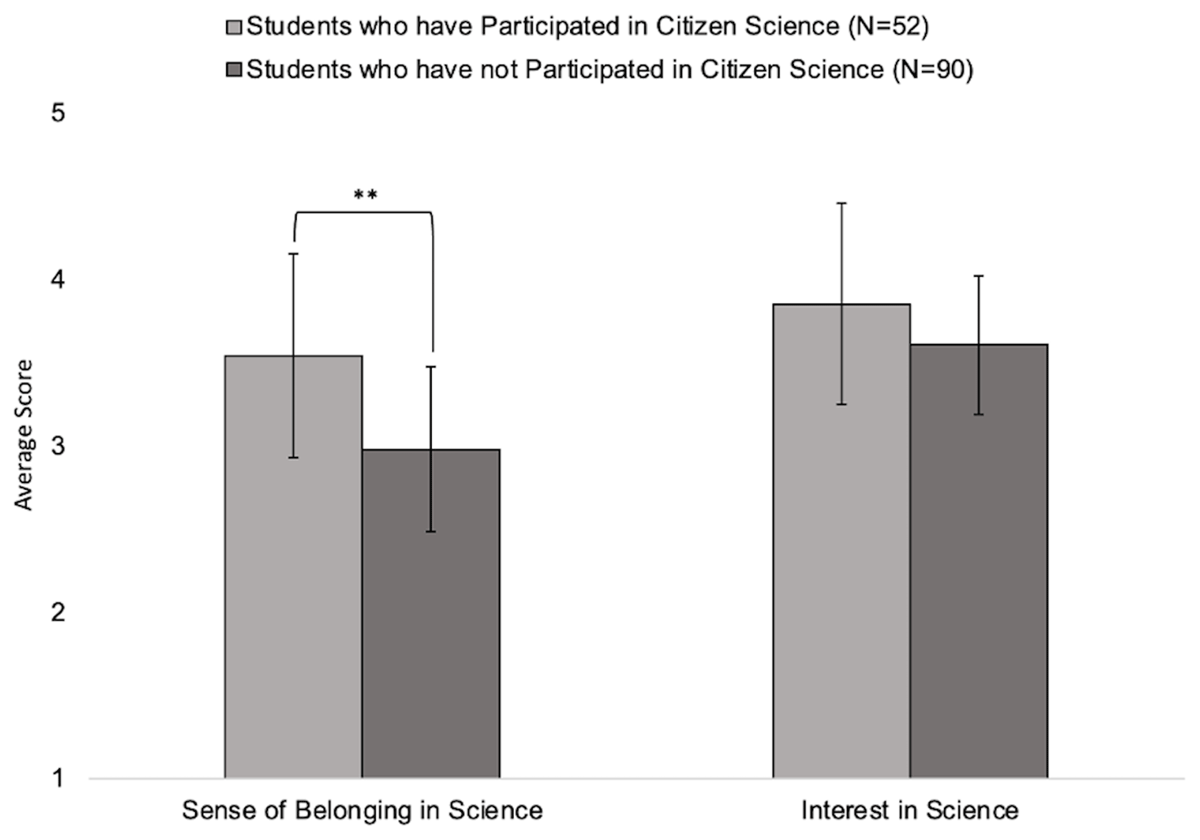
Figure 2
Students’ mean sense of belonging and interest in science based on participation in citizen science compared using two-sample t-tests. * = p < 0.05; ** = p < 0.01.
Table 2
Logistic regression model showing associations between citizen science participation, demographic attributes, and interest and belonging in science among undergraduates at the study institution.
| PREDICTOR | MEAN | B | SE(B) | ODDS RATIO |
|---|---|---|---|---|
| Woman | 0.66 | 0.37 | 0.45 | 1.45 |
| Underrepresented student of color | 0.12 | 0.15 | 0.64 | 1.16 |
| Sexual and/or gender minority | 0.28 | 1.08 | 0.49 | 2.93* |
| First generation college student | 0.19 | 0.25 | 0.55 | 1.29 |
| Disability status | 0.14 | 0.64 | 0.62 | 1.90 |
| STEM major | 0.52 | 0.75 | 0.62 | 2.11 |
| Science interest | 3.70 | –0.43 | 0.28 | 0.65 |
| Science belonging | 3.19 | 0.61 | 0.28 | 1.83* |
| Model summary | ||||
| n | 121 | |||
| df | 8 | |||
| X2 | 17.28* | |||
| Pseudo-R2 | 0.11 |
[i] *p < 0.05.
Table 3
Key codes and example quotes of interview analysis of college students who participated in citizen science.
| CODE | DESCRIPTION | EXEMPLAR QUOTE(S) |
|---|---|---|
| Citizen science beneficial to students with a strong personal interest in science | Association of participation in citizen science with personal interest in science; describing interesting in science beginning at early age; positive feelings towards science. | “…it has always been a passion of mine to discover different things.” “So there’s not always a- there’s a little bit of a personal element to that too, that that kind of, you know. I want to help, you know, I want to help researchers, and I want to help people give out life saving information to other human beings. But I actually really want to see this for myself because this is exhilarating to me.” |
| Lack of belonging in science, how citizen science mitigates this. | Women and gender minority respondents indicating feelings of exclusion and uncomfortableness; feelings of being ignored in science communities as a result of gender identity. Descriptions of viewing citizen science as a challenge to stereotypes of who scientists are and where science is done; viewing the participatory aspect of citizen science as making science more accessible. | “It’s like male dominated field is all about STEM. So, it’s like a female presenting individual going into that – it’s like, are they going to believe anything I say? Are they going to listen to me? Who knows?” “…this particular conference was predominantly white men and it made me feel very uncomfortable because it was like me and one other girl.” “It [citizen science] made me realize that the scientific community is more inclusive, like in the sense that they often allow the public to participate. And I mean, it kind of gives you the platform to go out, not do whatever you want, but like explore any avenue that you find interesting.” “So instead of thinking that like, oh, I can’t be a scientist because I’m not that old white guy, through citizen science, that understanding that your contribution, regardless of where you’re from, matters.” |
| Lack of citizen science opportunities in higher education | Noting a lack of citizen science opportunities on campus, viewing the lack of opportunities as a limiting factor to their participation. | “…awareness of ongoing research projects being done by professors, graduate students or undergraduate researchers like yourself, would be very important because sometimes it’s hard to find information on that.” “I mean, I kind of wish maybe there was a little bit more [citizen science], because I feel like we do a lot of closed off assignments or projects that are in the class, but they don’t exactly go any further than that assignment’s due date.” “I just wish there was more of it.” |