
Figure 1
Number of possible birdwatchers in Brazil represented by WikiAves users (WikiAves 2018). WikiAves is the most popular website for bird record sharing used by Brazilian birdwatchers. The figure highlights distribution of WikiAves users by Brazilian states (data from 11 August 2018). Photo: Eduardo R. Alexandrino.
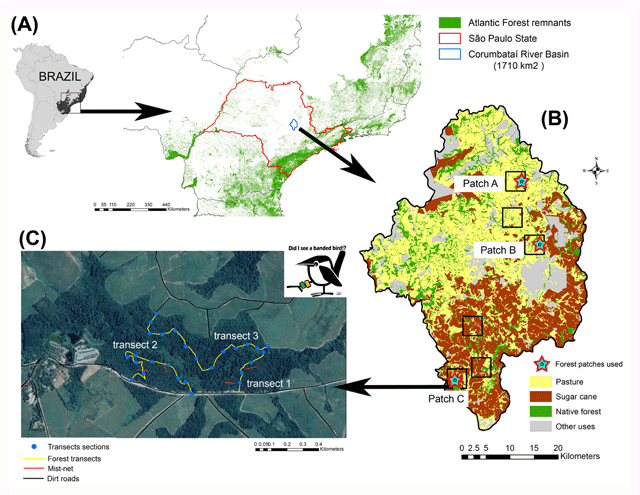
Figure 2
A) Location of the Corumbataí River Basin in southeastern Brazil in São Paulo state. Only a few remnants of the original cover of the Atlantic forest biome (dark grey in 2a) are left after years of human impact. B) Now, Corumbataí River basin is predominantly an agricultural landscape. Black squares are focal landscapes used by research since 2011, composed of 70% of matrix and 10% of native forest. Three forest patches were originally targeted for this project, but only patch “C” was used. C) The Santa Olímpia forest patch, where our project “Did I see a banded bird?” was carried out. The forest patch lies within a sugarcane matrix. Birdwatching transects (yellow) were subdivided into sections (blue points) of 150 meters. Red lines represent mist netting stations for bird banding. Satellite image from Google Earth. Project logo was created by Luccas Longo, reproduced here with his permission.
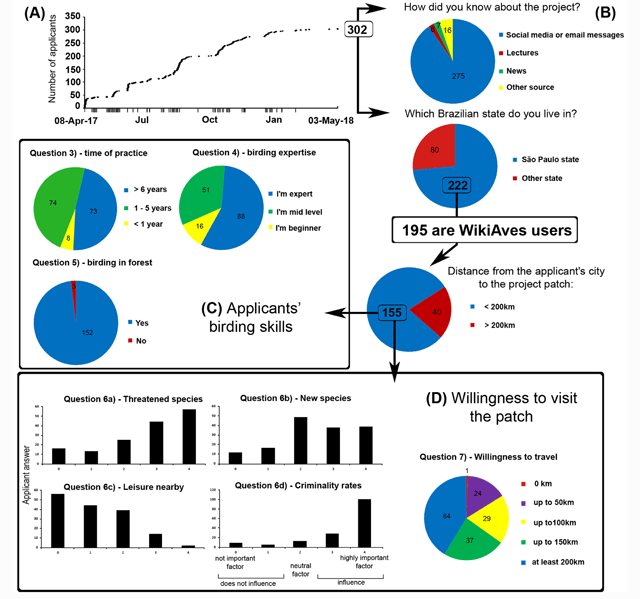
Figure 3
Results from our questionnaire. A) Accumulation of the number of new applicants in the project. Marks on the x axis represent a day with project advertisement, totaling 128 days. B) Answers from the 302 applicants. C) The birding skill of 155 applicants who were WikiAves users and residents of areas less than 200 km from the forest patch. These applicants had high potential to both visit the patch and correctly identify birds during survey. D) Willingness of the 155 applicants to visit the forest patch. In question 6, answers were on a 0–4 scale. Answers with a 0 or 1 count mean the specific factor would not influence the applicant’s willingness to visit the patch, while answers with a 3 or 4 count mean that the specific factor would influence the applicant’s willingness to visit the patch. See supplementary file for the complete questions.