
Introduction
Citizen science is an increasingly prominent method in environmental research, policy, and practice, valued for its potential to generate data at scale, democratise knowledge production, and connect people with environmental issues and scientific outcomes that affect their lives. With this prominence comes the need to demonstrate impact to funders and others, to show that projects deliver benefits not only for research, but also for participants, communities, the environment, and wider society. Evaluation is, therefore, a feature of many citizen science initiatives, though it can often be challenging and burdensome, both for those conducting it and for project participants. Frameworks and resources have been developed to support evaluation. Kieslinger et al. (2018) identify three core dimensions for citizen science evaluation: scientific, participant and socio-ecological, and economic. Phillips et al. (2014) is a helpful guide for evaluating learning outcomes from citizen science, and the MICS (measuring the impact of citizen science) platform supports measuring the impact across multiple domains (MICS undated). Realistic approaches are needed that gather meaningful data within project budgets and in ways that are not onerous and off-putting to participants. Sharing case studies of what has worked and not worked in project evaluations can help to develop these pragmatic approaches.
A challenge for evaluation is that impact often happens beyond the life of the project. This makes it harder to evaluate impact because 1) teams seldom have funds or capacity to track impact after the project ends; 2) participants and partners move on to other pursuits and it is not reasonable to continue to request feedback from them; and 3) the more time that elapses, the harder it is to isolate changes that are a direct result of the project, rather than influenced by other drivers. During the planning and implementation phases, limited attention is given to what will happen after the project ends. For example, how benefits will be sustained, relationships maintained or responsibly concluded, and learning and findings carried forward. These questions of legacy are often treated as secondary or aspirational, rather than integral to project design and assessment. However, they are critically important in conversations around impact assessment and evaluation.
In this essay, we share our experiences of project evaluation and legacy planning. While evaluation involves recording what is noticed, valued, and learned during a project, legacy planning is thinking about how those learnings can be carried forward once funding, formal activities, or institutional support come to an end. When evaluation focuses narrowly on outputs or shorter-term outcomes, it can fail to recognise and realise longer-term forms of value that matter to participants as well as funders, such as confidence, connection, and agency. When legacy is not considered early, projects risk extractive endings, lost relationships, and unrealised potential for sustained impact. Drawing on our nearly two decades of reflective practice, we explore how evaluation, particularly formative, participatory, and ethically informed approaches, can actively support more sustainable participant-centred legacies in citizen science.
Background and Positionality
All authors are members of the Inclusive Citizen Science research group at Stockholm Environment Institute (SEI) York centre, based at the University of York in the United Kingdom. Our views stem from our experience designing, implementing, and evaluating citizen science and participatory research projects related to various aspects of sustainability. Our projects have involved diverse participants, and we have collaborated with various types of actors, including policy-makers, educators, charities, local authorities, and academics. Inclusion, participation burden, power, ethics, and project sustainability are central themes for us.
Our group was founded through the pioneering citizen science project OPAL (Open Air Laboratories) led by Imperial College London and the Natural History Museum, London, with partner universities across the UK (OPAL 2016). SEI York’s involvement was led by Professor Mike Ashmore, an air quality researcher who was passionate about engagement. Community scientists across England were hired to engage people with their local environments (OPAL 2016), with a focus on engaging those who were hard to reach and underrepresented in environmental activities. These community scientists included authors Sarah West, Alison Dyke, and Rachel Pateman. As OPAL came to an end, we sought and gained other funding to continue citizen science and other participatory research work. Our 43 projects to date have involved diverse participants, including groups that are often underrepresented in environmental research and decision-making, such as young people, communities in the Global South, parents, and people with limited prior engagement in science.
Our professional and disciplinary backgrounds include environmental sciences, ecology, political ecology, geography and geology, material sciences, environmental and experiential education, and architecture. Our professional roles cover research, communications, teaching, project management, and technical support. All of these perspectives have affected our understanding of the role of evaluation: not just as a means of demonstrating impact, but as an approach to learning while implementing projects, adapting, centering participants, and planning for responsible closure.
Aims
This essay is a reflective account of how our approaches to evaluation have evolved (see Figure 1). Our intention is to support others when planning their own evaluation, and to introduce legacy as a central component of citizen science. Our approaches have developed through practice, dialogue, and reflective learning, often through what has not worked as much as what has. We draw on multiple projects to illustrate our insights on how evaluation of inclusive citizen science is carried out, what ethical and methodological challenges arise, how evaluation can be used not only to evidence impact but to inform responsible soft endings and longer-term impact, and how a focus on inclusive and ethical practice has impacted this. We then introduce legacy planning as part of evaluation, asking how projects can leave something of value behind when formal activities end, and finish with some recommendations.
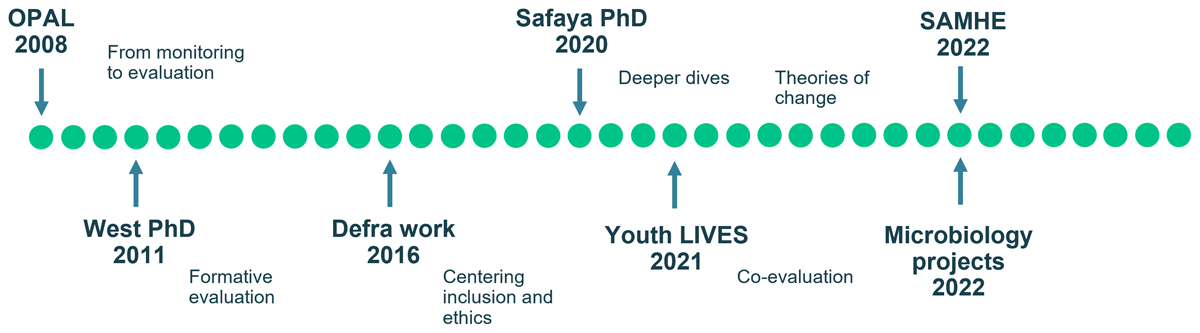
Figure 1
A timeline of the Stockholm Environment Institute (SEI) Inclusive Citizen Science group, showing some important projects and the influences they had on our practice.
Evolution of Our Approach
Moving from monitoring to targeted evaluation
Early evaluations of citizen science projects tended to focus on monitoring participant numbers, metrics relating to activities, and numbers of outputs (Phillips et al 2019). This was largely the case in the OPAL project. We monitored the number and types of events we participated in and how many people attended, and estimated demographic data (which always felt rather problematic). This monitoring was supplemented by surveys designed centrally by the project and administered by the community scientists. These included questions about enjoyment and how much people felt they had learned. In addition, one partner undertook some in-depth qualitative research that resulted in case studies of change (OPAL 2016). Sarah was intrigued by why such a large amount of money was being invested without much evidence of its impact on science or participants, and so pursued a PhD researching evaluation practices of environmental educators (the term “citizen science” was not widely used at that time) (West 2013). She uncovered a mismatch: Practitioners wanted their work to have an impact—real change in people’s attitudes and behaviours towards nature—but their evaluations were measuring how much people enjoyed the activities and whether they would recommend them to others. Consequently, many practitioners rarely used their evaluation results, which Sarah thought was inefficient and unethical: Time and energy had been spent by participants completing monitoring or evaluation activities (usually in the form of surveys).
Within our own practice, this was the beginning of the process of developing and refining our evaluation approaches. While we recognised that monitoring can generate useful information (e.g., to demonstrate to funders that targets have been met), our key learning was to think carefully about the information we needed to collect within the specific context of a project and to plan evaluation to capture that.
The importance of formative evaluation
Evaluation requires investment from both practitioners and participants; it is important to think carefully about where (often limited) resources are best invested. While it can be tempting to attempt to document all outcomes of a project, this can result in a huge amount of duplication of effort in the field. Rigorous impact-focussed evaluation is complex, expensive to conduct, and often best left to well-funded, long-term studies that go beyond the scope of a single project. In addition, there is no need to continue to prove something where there is already good evidence. For example, it is now well evidenced that being outside in nature is good for people’s health and wellbeing (Coventry et al. 2019; Pocock et al. 2023), so small projects connecting people with nature shouldn’t need to spend time attempting to demonstrate this again, particularly because many outcomes will occur after funding for evaluation has ceased.
For us, and many other practitioners (West 2015a; Davis et al. 2022), getting feedback from participants during the project, which can be used to improve it, is essential. As the team grew, we were able to have reflective conversations about what was and wasn’t working in our projects, and this, combined with informal conversations with participants, allowed us to improve projects during their lifetime. Recognition of the value of this reflective approach echoed another conclusion of Sarah’s PhD research: the need to focus as much (if not more) on formative as well as summative evaluation (West 2015b). Davis et al (2022) reviewed the evaluation practice of citizen science project leaders and found considerable use of evaluation data to improve projects. Formative evaluation can be particularly helpful when co-designing elements of the project, for example, software (see Herodotou et al. 2018), and when refining protocols and participant training (Davis et al 2022). Summative evaluation should not be disregarded, however. Evidencing the outcomes of projects is often necessary to give feedback to funders and to generate evidence that can be persuasive when seeking future funding or to engage partners, and it can help to contribute to the collective evidence for the impact of citizen science. However, unless significant resources are available, then the focus should be on setting and evaluating sensible, measurable outcomes that have the potential to be achieved within the lifetime of a project.
Centering inclusion and ethics
Our experience on OPAL showed us that the usual participants in environmental citizen science projects in the UK were white and well educated, and that, whilst we could reach other demographic groups, this required considerable effort. We sought to evidence this and conducted a study, funded by Defra (Department for Environment, Food & Rural Affairs), which found this underrepresentation was consistent across UK environmental citizen science projects (West, Pateman, and Dyke 2016). This seemed unethical to us: Why should only a certain, already privileged, group of people gain the health and wellbeing benefits, social connection, and increased knowledge and skills about environmental issues that can come with participating in citizen science? This set us on a path to focus on inclusive and participant-centred citizen science, and therefore co-created and collaborative forms of it. This evolution of our group is reflected in a shift in the field more widely, with many projects now seeing the benefit of involving participants in stages of the scientific process beyond just data collection. Funders such as the EU are encouraging co-creation (Stier and Smit 2021), and co-created citizen science projects now cover a wealth of topics, including microplastics in homes (Sardo et al. 2025), marine environments, and plastic pollution (Robinson, Delany, and Sugden 2024).
In terms of evaluation, this shift impacted our practice in two ways. Firstly, we wanted to gather information about who was participating in our projects, how they were experiencing the project and its outcomes (both positive and negative), and how this differed between demographic groups. This was crucial to learn about who we were reaching and to inform our approaches to making our projects inclusive. Secondly, we began to consider more carefully how to approach evaluation ethically. We intentionally plan our projects, including our evaluation of them, to be inclusive, considering how participants might benefit from all our activities and the power dynamics involved in evaluation. Other ethical issues include data ownership and publication, the tension between wanting to understand who our participants are whilst not being intrusive, and how to co-create evaluation without overburdening participants. We’ve spent considerable time thinking about how to collect demographic information from participants in an ethical and inclusive way (Laptain et al. 2026).
On our Antimicrobial Resistance project, which asked participants to swab home-grown lettuces to explore bacterial presence, we chose to make the pre-survey a joining requirement, as our funders were particularly keen to demonstrate changes in knowledge through the project. This, however, set up some tricky power dynamics, with some participants feeling like they were being tested before they took part. We quickly amended the explanatory text for each question to demonstrate why they were being asked, but this feeling remained. Another issue with this approach was that some potential participants may have been put off joining the project in the first place (Pateman et al 2025a).
Another key ethical issue with citizen science projects is that most have a finite end point, when those running projects will move onto other work. It is important to plan for this with soft endings rather than an abrupt finish (see Evaluation and Legacy below) and to talk to participants throughout to understand what they would like to see at the end of the project. We found that regularly seeking feedback helps open up these conversations.
Developing theories of change
A significant shift in our practice has been the adoption of a theory of change (ToC) to guide our work (Weiss, 1995). This involves developing a logical model of the work, from inputs to impact, via activities, outputs, and outcomes, and situating this within the broader context of the actors in the system, the assumptions underpinning any intended action or change, the risks, and unintended outcomes (Center for Theory of Change, undated). SEI conducts sustainability research and, over the past decade, has introduced a ToC approach to demonstrate the ultimate goal of our work to funders and partners. The Inclusive Citizen Science group first decided on desired impact, then established a list of expected outcomes to track progress towards impact achievement (see Supplemental File 1: Figure S1). Our aim is “Social and environmental improvement through citizen science theory and practice research that is inclusive, ethical, sensitive to existing power dynamics, and that equally centres both research and citizen.” This acts as our north star, guiding the projects we bid for, the opportunities we say yes to, and approaches we take to our work.
We also develop a ToC for many of our projects, following the same approach: We think first about the overall impact we’d like the project to have, the outcomes that we can measure, and then the activities that we will do to achieve those outcomes. From this, we develop an evaluation plan, using intended outcomes to define indicators that can be measured at periodic intervals. These include indicators of potential longer-term impact, such as increased ownership and continued collaborations.
When developing a ToC, we find it helpful to think about outcomes in different domains: data and knowledge generation, individuals and communities, wider society and science, and decision-making and action. Within these broad domains, there may be many different outcomes and pathways to achieving them (Pateman and West 2023).
Pragmatic methods
Once we’ve developed our ToC, we create our evaluation plan, which is pragmatic based on factors such as resources, funder requirements, interests of our participants, and project length. For a short-term, small project, we might just conduct internal reflection as we go along, or do some participant polls in meetings to do a “temperature check” of how people are finding the project. At the end of projects, we are encouraged by SEI to conduct an end-of-project evaluation, where the team reflects on what worked, what could have gone better, and whether we achieved our goals. Any feedback we gained from participants along the way or formal evaluation we’ve conducted can feed into this, but it’s primarily a team reflection so it does not burden our participants. We have found reflective diaries, conducted online, to be a good way of tracking team members’, and sometimes participants’, thoughts about the project as it progresses, and these can be used as formative evaluation to improve the project, and also in summative evaluation (see Price et al. 2023).
Experience of what does and does not work in evaluation has led us to take a more pragmatic approach. Although pre- and post-project surveys can objectively measure change over time, they are often impractical. Completing them is time consuming for participants and problematic when participants don’t complete one or other of the surveys. We often design our projects to be able to cope with people dropping in and out of activities, depending on their interests and capacity, and this flexibility makes repeat surveys challenging. It also requires collection of personal information (e.g., name or email address) so that comparison is possible, which then requires secure storage. In the parent-led Parenting Science Gang project, run using Facebook, we repeatedly reminded people to complete the pre-survey. But participants who joined later often missed this, and at the end of the project, only those still actively using the group saw the notifications, meaning our sample was biased towards those most engaged (West et al. 2026). Despite high attrition between repeat surveys, if there are sufficient paired responses, statistical tests can be used to see if change has occurred (e.g., Safaya et al. 2026). Our experiences with the different forms of evaluation have highlighted the value of taking a mixed-methods approach, especially when you have a small sample size, so that if one approach doesn’t work for your group, another one will. For example, in the Exploring the Chopping Board Microbiome project, we conducted pre- and post-participation online surveys and focus groups with participants. We had disappointing levels of survey completion, which limited their value. However, the focus groups provided an excellent resource for us to understand the impact of the project on participants and to assess its strengths and weaknesses from their perspective.
When using digital tools or communicating with participants online, there are different inclusion, ethical, and evaluation considerations. In the SAMHE (Schools’ Air quality Monitoring for Health and Education) project, our work on indoor air quality is online, large scale, and with time-poor teachers, so we use Google Analytics data and other tracking data to monitor engagement with the project. This limited what we knew about how teachers actually used the tool and what improvements could be made. Activities in our co-designed web app (see West et al. 2023) include short questions designed to assess accessibility, enjoyment, and understanding, and a teacher-only survey explores how they use the web app (see Supplemental File 2: Table 1). Very few people completed these, however, so data tracking how many users start and finish each activity was vital for seeing where changes needed to be made. Occasionally, we emailed teachers and asked them how they were using the project, and responses were used as testimonials to help recruit other schools to take part. Ultimately, as this work aims to improve indoor air quality in classrooms, the data from the air quality monitors can be used to evaluate overall efficacy.
Co-evaluation
Other project evaluations have had much greater involvement from participants, for example, Youth LIVES. This project aimed to embed youth voices in mental health research, and our ToC centred young people’s ownership of the research process and their confidence to shape decisions that affected them. The funder provided funds for a six-month project extension, giving time for sessions with the young co-researchers to revisit key decisions made by the project team, including those relating to structure, safeguarding, ethics, payment, logistics, content, and language. This process of shared reflection formed a co-evaluation of the project that will become a co-authored paper outlining their recommendations for running future projects.
In the CAREERS project, which seeks to use citizen science to help create a more diverse environmental science workforce in the UK, co-evaluation allowed participants to set questions that addressed their own agendas and shifted the focus of the project. It was clear to participants how the evaluation could make an immediate difference to them, or to people like them.
Evaluation with others
We have also found it valuable to conduct evaluation with those outside of the project. In the City Health and Wellbeing Initiative, we ran co-created citizen science projects exploring environmental challenges faced by residents in low-income neighbourhoods in Nakuru, Kenya and Udon Thani, Thailand (Pateman et al. 2025b). The projects aimed to provide evidence to decision-makers in the city, who had been consulted in the early stages of the project. When the projects ended, we held workshops with officials from the city authorities, presented findings, and asked them (1) to consider how they could use the findings to inform their decision-making, (2) to reflect on the effectiveness of the approach for information generation and community consultation, and (3) to consider if they could take these methods forward in their own practice.
Deeper dives
It is important to be able to evidence the value of citizen science approaches for participants, and we have conducted work which has deep-dived into this. For example, Rachel and Alison worked with health researchers to explore wellbeing outcomes of citizen science participation (Coventry et al. 2019). Using quantitative standardised scales, they explored the impact of a citizen science survey of trees on short-term wellbeing, showing an increase in happiness and energy and a decrease in stress after participation. Another example was Smriti’s research exploring the outcomes of participating in citizen science activities for Hong Kong and UK school pupils. She used a variety of methods (including participant observation, pre- and post- surveys, and semi-structured interviews) to understand if and how environmental citizen science experiences impacted how secondary school students thought, felt, and took action for the natural environment (Safaya 2022; Safaya et al. 2026). Working closely with the teachers led to a more cohesive experience for the students, encouraged teachers to incorporate citizen science in their pedagogical approach, and opened the doors for future collaboration on a youth participatory action research project about climate change education (Safaya et al. 2021).
Evaluation and Legacy
While evaluation of outcomes is now much more commonplace in citizen science (Schaefer et al. 2021; Wehn et al. 2021; Davis et al. 2022), relatively little attention has been paid to how to maximise the chances of impacts beyond the life of the projects. Questions around the sustainability of projects, ownership of products, ongoing engagement, and ethical project conclusion are vital to ensuring impacts continue to occur outside the funding period.
Whilst some citizen science projects run over decades, for example, the UK Butterfly Monitoring Scheme, most will operate on a much shorter time frame, and the impact across different domains usually arises after the project ends, through the legacy of the project. But how do you design projects such that the legacy of the project continues to work towards impact? And how do you measure, or predict, the impact that the legacy work can have? This is where formative evaluation can be invaluable—getting feedback from participants and reflecting on practice throughout the project means we can plan activities to try and maximise the legacy of our projects.
A lesson learned across our projects is that successful delivery does not necessarily equate to impact. Projects can meet their milestones, recruit participants, deliver activities, and produce outputs, yet still fall short of achieving the desired longer-term changes. For us, this has been particularly apparent in projects with aims related to participant ownership and agency. These outcomes may only begin to happen towards the end of a project. This has implications for how we think about evaluation. Over time, we’ve started asking not only whether activities are working, but whether they are creating conditions for longer-term change. Early evaluation activities, whether informal, reflection, passive tracking of engagement, feedback, or team discussions, can surface insights about what participants value, what they want more of, and what they hope will be the impact beyond the project. Considering these, and planning for legacy, allows greater control over the impact that is realised post-project. In practice, this means using evaluation to notice when participants are beginning to take ownership, form networks, or express ambitions that extend beyond the original project scope. It also means being open to the idea that meaningful legacy may not always align neatly with originally planned impact.
How to plan for legacy?
The approaches we often take when planning for legacy are shown in Box 1.
Box 1 Ways we embed legacy into citizen science projects
– Planning for soft and responsible project endings
– Signposting to related organisations
– Supporting ongoing participant networks
– Providing accessible participant-facing outputs
– Maintaining digital and other participant resources beyond project end
– Continuing post-project communication with participants
– Supporting the use of findings in policy and decision making
One aspect of legacy is planning for soft endings. Abrupt project endings (which can often happen given the nature of funding and staff contracts) can undermine the trust of participants, and leave them feeling that their involvement was extractive rather than truly valued. Project ends can be a challenging time as often we are scrambling to finish papers, disseminate findings, and submit new research proposals to continue our own contracts. In all of this, participants can be forgotten. Wherever possible, our plan to soften endings includes spending time with our participants to learn what they hope for post-project and supporting their continued interest in the topics. Of course, there will be some participants who have no continued interest in the topic, but for others, legacy infrastructure plans are important, with the legacy activities determined through conversations with participants. For example, Youth LIVES participants expressed the desire to share their learnings in the form of a podcast, for which we then secured additional funding.
Signposting participants to related projects, local groups, learning opportunities, or funding routes, as we did in OPAL, can help sustain and/or support interest beyond the life of a single project. Facilitating the development of relationships during projects, and then enabling them to continue into ongoing networks, even through informal contact lists or online spaces, can support continued confidence, collaboration, and shared learning. Providing clear and accessible outputs, such as short summaries, visual materials, or participant facing reports, allows communities and partners to use project knowledge after activities have finished, and recognises participants’ contributions. Projects that create digital or other public resources need to consider what happens to these once funding ends, including basic maintenance and ownership, so that broken links and/or outdated information do not undermine trust in the project outputs. This was important during SAMHE; because the air quality monitors would continue to work past the lifetime of the project, we budgeted for continued website maintenance. Continuing communication with participants after formal activities conclude, for example through emails, newsletters, or social media, such as in Parenting Science Gang, can help share findings, explain how results are being used, and acknowledge ongoing impact. Where projects seek to inform decision-making, legacy may also involve ensuring that evidence remains visible and usable, including sharing results with relevant organisations or supporting participants to contribute to policy discussions. These methods not only support the legacy of the project for participants, but also for those in wider society who may be interested in the findings. Together, these practices can help extend the value of citizen science beyond the funded period in ways that remain proportionate and participant-centred.
We have also learned to be realistic and transparent about what legacy is possible, and manage the expectations of participants. In the Youth LIVES project, the soft ending afforded by the bridging funding allowed conversations about the funding landscape and helped manage expectations about what could be achieved with limited funds. It led to a successful application (Youth VOICES) for disseminating findings via a podcast. When participants understand the funding landscape and the limitations to post-project support, they are less likely to feel undersold, and may seek ways in which they can lead or find funding for follow-on activities.
Recommendations
Drawing on our experience, we have some practical recommendations on how to practice inclusive evaluation and to evolve evaluation practices (see Box 2).
Box 2 Recommendations for inclusive evaluation
– Be intentional and pragmatic about what evaluation is fore, and what can be measured.
– Include formative, reflective and mixed method approaches that can support learning during the project.
– Design evaluation methods that are ethical, inclusive, and are centred on the needs and wants of the participant.
– Plan evaluation and legacy from the start of the project, taking into account impacts that may occur after the formal end of the project.
– Continue to lean about evaluation methods and share learnings with the citizen science community.
Be intentional and pragmatic about evaluation
Evaluation is most effective when it has a clear purpose and realistic expectations; developing a ToC can support planning, guide decisions, and help determine which data to collect. Realistically, project evaluation will need to balance participant needs, your capacity, and what your funder or organisation requires. In many of our projects, we produce a ToC and use this to build a monitoring and evaluation plan from the start.
Use a mix of approaches
Formative feedback gathered through conversation, team reflections, and surveys helps projects adapt during their lifetime to improve accessibility, relevance, and participant experience. During SAMHE, we used reflective diaries within the team to continually evaluate progress. This was useful, as issues were highlighted early and allowed action to be taken. Summative evaluation is important and often necessary for funders, but so is communicating outcomes to the field as a whole; therefore, a mix of approaches should be used.
Design ethical, inclusive, and participant-centred evaluation
Ethical and inclusive considerations shape every aspect of evaluation. What is asked, how it is asked, and how often, can influence the experience of participants and power dynamics. Evaluation can avoid being extractive if it is designed to minimise burden, be transparent, and create opportunities for reflection. Involving participants directly in the design of evaluation methods can sometimes (project dependent) support an increased sense of ownership and relevance. When using scales to measure changes in participants values and attitudes (such as the 2-MEV [Bogner and Wiseman 2006] or Nature Relatedness [Nisbet, Zelenski and Murphy 2009] scales), consider who these scales were tested on, whether they are applicable for your participants, and how they could be adapted to better suit the context of project participants.
Plan evaluation and legacy from the start
Like all other methods used across the lifecycle of a research project, evaluation should be planned at the start of the project. This allows formative evaluation to occur, but also allows legacy planning. Outcomes usually occur towards the end of (or after) projects, therefore embedding legacy in the project, and soft endings where possible, from the onset can help support this. Considering evaluation and legacy together can help sustain relationships, knowledge, and opportunities for continued engagement.
Learn and share
As a community of practice, there are areas of evaluation that still require more study. Longitudinal research that follows participants beyond project completion would deepen understanding of longer-term outcomes. New ways of maintaining projects and resources after funding ends is needed, along with better ways of connecting participants with related opportunities once a project has finished. Continuing to reflect on practice, test new approaches, and share learning openly within the citizen science community are important for evolving ethical and inclusive evaluation.
Conclusion
Herein, we have reflected on how our approaches to evaluation have developed through practice across a range of citizen science projects since 2008, and how this has led us to consider legacy as part of impact. We have moved away from evaluation that mainly monitors activity, towards evaluation that is more intentional, more focused on learning, and more attentive to ethics and inclusion. Across our work (like Davis et al. 2022), we have found that formative feedback and team reflection can often be the most useful forms of evaluation because they allow changes to be made during delivery, while mixed methods can help capture different kinds of outcomes.
A key lesson is that outcomes, particularly those linked to participant or community ownership and confidence, may begin to emerge only towards the end of a project or after funding ends. This makes it important to plan evaluation and legacy together from the start, so that legacy actions such as soft endings, signposting, networks, accessible outputs, and maintained resources are not add-ons, but part of doing participant-centred citizen science well.
Supplementary Files
The Supplementary files for this article can be found as follows:
Supplementary File 1
Figure S1: Inclusive Citizen Science Group Theory of Change. DOI: https://doi.org/10.5334/cstp.1005.s1
Supplementary File 2
Table 1: Questions in the SAMHE Web App. DOI: https://doi.org/10.5334/cstp.1005.s2
Data Accessibility Statement
No new primary data were generated to support the publication of this manuscript. Data for the projects referenced is available as follows:
Data for the OPAL project is available at: https://www.imperial.ac.uk/opal/data-download/.
Data for the SAMHE (EPSRC, EP/W001411/1) project is available for researchers with legitimate interests via Imperial College London (Dr Henry Burridge).
Data for the Citizen Science and AMR (BBSRC and Food Standards Agency, BB/W009072/1) project are deposited within the University of York Research Database: DOI: 10.15124/8fd11d9d-00e6-4e00-ba7e-cdac89cd0d3c.
Data for the Exploring the chopping board microbiome (BBRSC and Food Standards Agency, BB/W008955/1) project are deposited in the Aston University Research Data Explorer database. DOI: 10.17036/researchdata.aston.ac.uk.00000639.
Data for the Youth LIVES (UKRI, BB/V012126/1) project in the form of project outputs are available at: https://youthlives.york.ac.uk/outputs.
Ethics and Consent
These reflections are drawn from experiences of 43 past projects, each of which received appropriate institutional ethics approvals, and whose participants consented to take part in the projects.
Acknowledgements
We would like to dedicate this essay to the memory of Mike Ashmore who started all this work off. We would like to thank all our project partners and participants—we have all learned so much over the past nearly two decades.
Author Contributions
RA and SW conceptualisation, writing – original draft, review, and editing. RP conceptualisation, writing – original draft, and review. All other authors: writing – original draft. All authors consented to the submission of the manuscript.