
Introduction
Neurodiversity, or neurological diversity, is a highly debated, but widely used, social concept that originated in the 1990s (Singer 2016; Baron-Cohen 2017; Botha et al. 2024). In the broadest interpretation, neurodivergence is a difference in mental or neurological function from what is considered statistically typical, or neurotypical (Goldberg 2023). It includes innate and acquired nervous system differences, which may or may not result in disability or a medical diagnosis such as autism, attention deficit hyperactivity disorder (ADHD), dyslexia, colour blindness, stroke, anxiety, post-traumatic stress disorder (PTSD), depression, and chronic fatigue syndrome (CFS) (Baron-Cohen 2017; Goldberg 2023; Jones and Orchard 2024).
Neurodivergence is not a medical, diagnostic term, but describes the reality that people do not conform to one standard way of interacting with their environment. People with similar cognitive, communicative, and sensorimotor profiles, sometimes described as sharing a neurotype, may experience similar challenges and strengths and may benefit from similar support and accessibility accommodations. Doyle (2020) uses the term “neurominority” to describe such groups in social context. Support needs vary depending on their condition and the demands of the environment.
Citizen science (CS) engages members of the public in scientific research, fostering collaboration, knowledge creation, and more inclusive scientific practice (Robinson et al. 2018; ECSA 2020; Vohland et al. 2021; Cooper et al. 2021). Digital citizen science (DCS) refers to CS participation mediated through digital tools and platforms, including online interfaces, mobile applications, project discussion spaces, and web-based research tasks. Examples include platforms such as Zooniverse, iNaturalist, the European Citizen Science Platform, CitSci, and SciStarter.
DCS can remove barriers to face-to-face research participation, including travel demands, real-time social pressure, inflexible schedules, and sensory overload. It also presents accessibility demands, some specific to digital environments and others shared with traditional research: learning project rules, interpreting instructions, sustaining attention, tolerating uncertainty, managing repeated tasks, and communicating online. Although DCS platforms can draw on globally recognised accessibility standards such as the Web Content Accessibility Guidelines 2.2 (WCAG) (W3C 2024), which are already used within CS web environments (The Open University 2026), neurodivergent contributors’ perspectives have rarely been treated as a distinct design lens. As a result, digital research environments may unintentionally reflect neurotypical assumptions about attention, communication, processing speed, sensory tolerance, and comfort.
This article reports the accessibility strand of the study related to the 2024 “Zooniverse Participatory Research Platform as a Neuro-Shared Online Space: A User Survey” (Apreleva et al. 2027, in prep.). The survey collected data about the experiences of 7,873 neurodivergent and neurotypical people contributing to projects on the Zooniverse CS platform. As part of this survey, participants could opt in to join the Zooniverse Neurodiversity Task Force, a network for staying connected and engaging with research, opportunities, and developments related to neurodiversity in DCS.
While the full 2024 study remains in progress, a subset of accessibility-related responses is analysed here. Survey responses indicated that many volunteers experienced Zooniverse participation as accessible and meaningful because it allowed slow-paced, remote, and often asynchronous contribution to science. Respondents also described barriers including long texts, colour-dependent tasks, precise clicking demands, anxiety about mistakes, overwhelming layouts, insufficiently specific instructions, and the need for prompts to take breaks.
In response to these findings, and with funding from the IMPETUS accelerator, we established Neuro(Minorities)Science, an international working group of adult neurodivergent citizen scientists and allies with experience across DCS platforms. The group analysed accessibility-relevant data from the 2024 Zooniverse study, expanded the context from Zooniverse to DCS more broadly, reviewed resources and existing practices, and developed a neuro-inclusive accessibility framework for DCS.
The primary practical outcome is The List of Accessibility Features for Neuro-inclusive Digital Citizen Science (hereafter referred to as The List, see Supplemental file 1: The List of Accessibility Features for Neuro-inclusive Digital Citizen Science), a practical resource for DCS platform teams, project owners, project managers and science communicators. The Background section places the study within neurodiversity, open scholarship, DCS, and accessibility research. The Methodology section describes the participatory co-creation process and the use of the two datasets. The Results section presents the accessibility framework and interprets the recommended features. The Discussion section considers neuro-inclusive accessibility as a methodological component of DCS practice. The Conclusions section summarises the contribution of this work to DCS research, accessibility practice, and CS.
Background
This section situates neurodiversity within DCS and existing accessibility practice. It identifies the DCS-specific gap and outlines the aims of the Neuro(Minorities)Science collaboration.
Neurodiversity, open scholarship and citizen science
Research on neurodiversity in educational settings (Dawson 2022; Mousa, Ayoubi, and Puhakka 2024; Waisman, Alba, and Green 2022) and the workplace (Doyle 2020; Rollnik-Sadowska and Grabińska 2024) has grown substantially in recent years, yet research on neurodiversity within DCS remains limited.
Langhans et al. (2025) provide the first evidence of systemic barriers to participation for racially minoritised, disabled, and neurodivergent people in CS. Drawing on focus groups with people who engage in nature-based activities but do not currently participate in CS, they identify accessibility barriers, economic constraints, and lack of belonging as impeding factors, and note that while motivations and barriers to participation have been examined for other demographic groups, little empirical evidence addresses disabled and neurodivergent participants.
This scarcity of DCS-specific, neuro-inclusive evidence is notable given that DCS has matured into a substantive mode of scientific inquiry. Systematic reviews and large-scale analyses show that citizen-generated data contribute to peer-reviewed research across the natural sciences, biomedicine, climate science, ecology, and the humanities (Marshall, Lintott, and Fletcher 2015; Blickhan, Trouille, and Lintott 2020; Finger et al. 2023; Yu et al. 2025). Responding to the “societal desire to participate more actively in knowledge production, knowledge assessment and decision-making” (Robinson et al. 2018), CS is often understood as part of open science.
Phan et al. (2025) argue that neurodiversity and open scholarship share core values of accessibility, equity, and transparent knowledge-making by fostering environments that recognise diverse ways of thinking and learning. Neurodivergent contributors may bring attention to detail, reduced cognitive conformity, and a strong sense of justice, while open scholarship can reduce barriers by supporting accessible writing, open materials, and flexible participation. This paper’s framework holds that CS becomes more genuinely open when neurodivergent people can participate not only as data contributors, but as collaborators in research design, interpretation, and practice.
Digital citizen science as a neuro-shared participation environment
DCS can be understood as a neuro-shared space, extending Bertilsdotter Rosqvist, Brownlow, and O’Dell’s (2013) concept of environments where autistic and non-autistic people coexist without one group being expected to adapt disproportionately to the other. We use the term more broadly to describe DCS environments where diverse cognitive and communicative styles participate on equal terms.
Several features of DCS already support neurodivergent participation. Contributors often choose when and where to engage, process information at their own pace, avoid travel, work independently, and communicate asynchronously through text, images or project tools rather than real-time interaction, making scientific participation possible for people excluded from laboratory, fieldwork, or in-person public engagement settings.
However, DCS also creates distinctive accessibility challenges. Platforms and projects ask volunteers to learn unfamiliar scientific concepts, interpret detailed instructions independently or with asynchronous assistance, repeat classification tasks, manage uncertainty, navigate feedback, and sometimes interact with researchers or other volunteers in public forums. Design choices around task structure, pacing, feedback, moderation, and interface customisation therefore shape not only whether volunteers can access a project, but whether they can participate comfortably, safely, and sustainably.
Existing accessibility guidelines and the digital citizen science–specific gap
Neuro-inclusive web design has been addressed in prior research and practitioner guidance, primarily through general accessibility principles applicable across digital contexts. WCAG 2.2 provides an essential baseline for inclusive digital design (W3C 2024). Several WCAG (2025) criteria are directly relevant to barriers reported by neurodivergent users: audio control can reduce sensory overload; adjustable timing can reduce pressure and error anxiety; pause, stop, and hide controls can reduce the impact of moving or flashing content; predictable input behaviour, consistent navigation, and consistent identification can reduce confusion and cognitive load.
AbilityNet (n.d.) also provides practical digital accessibility resources, including disability-specific resources for dyslexia, hearing loss, Parkinson’s disease, dementia, and multiple sclerosis. Such resources offer an important foundation, but are not specific to DCS participation, where volunteer engagement is shaped by task structure, feedback, moderation, and interface customisation. This distinct interaction context requires accessibility guidance addressing not only web compliance, but research participation as a social, cognitive, and methodological process.
Prior work supports this need for context-specific design guidance. Dehn (2017) argues that the heterogeneity of CS projects makes a fully generalisable platform design model difficult to achieve. Liu et al. (2021) conceptualise platforms as “instruments” for CS and identify usability and design as key challenges for platform builders. They also highlight the importance of human-centred platform design and relative openness, noting that highly guided, low-autonomy interfaces can frustrate participants, whereas simpler interfaces allowing greater user autonomy may support sustained engagement.
The Neuro(Minorities)Science collaboration contributes to this line of research by providing a lived-experience-informed accessibility framework developed specifically for neuro-inclusive DCS. It responds to the gap identified by Phillips et al. (2019), who note that few studies have qualitatively characterised CS engagement across multiple projects from participants’ perspective. The primary stakeholders for this work are DCS platform teams, project owners, project managers, and science communicators. To our knowledge, Neuro(Minorities)Science is the first lived-experience collaboration focused on neuro-inclusive DCS accessibility.
Research aims
The Neuro(Minorities)Science collaboration had three aims: (1) to identify accessibility challenges in DCS faced by neurodivergent people; (2) to raise awareness of these barriers among platform developers, project owners, and the wider CS community; and (3) to produce an actionable framework of accessibility guidelines for neuro-inclusive DCS projects and platforms.
Methodology, Aims, and Process
This section describes the participatory study design, recruitment, and data collection processes. It then outlines the collaborative analysis and framework development.
Study design and ethics
This study employed a participatory, collaborative qualitative design, facilitated by the first author, a neurodivergent researcher affiliated with the Zooniverse research group at the University of Oxford. The working group was not positioned as a sample of research subjects or informants, but as co-researchers contributing to the design, analysis, interpretation, and writing of the study. The facilitator’s role was organisational, methodological, and supportive: maintaining work structure, ensuring accessibility and safety, preparing materials, coordinating analysis, and consolidating outputs.
The study received research ethics approval (R94294/RE001) from the Central University Research Ethics Committee at the University of Oxford. Consent was obtained from participants in the 2024 Zooniverse survey for use of their responses. The accessibility-relevant survey data were de-identified before being shared with the working group. Before contributing to the written brainstorming activity that generated Dataset 1, working group members were informed their responses might be communicated publicly for research and advocacy purposes. Members’ contributions were tracked for acknowledgement and incentive administration.
Working group recruitment and participation
Adults aged 18 or older with experience of contributing to DCS who self-identified as neurodivergent and/or allies were invited to join the Neuro(Minorities)Science working group. Invitations were extended in May and June 2025 via direct group emails to existing neurodiversity networks like the Zooniverse Neurodiversity Task Force and NASA’s Neurodiversity Network; and professional organisations such as the Association for Advancing Participatory Sciences and the European Citizen Science Association. Collaborators were also invited through the Zooniverse Talk forum, a public-facing webpage dedicated to the project, a conference presentation, and Zooniverse social media channels.
The working group had 89 registered members, referred to as “working group members” and “collaborators.” Participation was remote, voluntary, and asynchronous, using tools including a Jisc mailing list, Miro, Jisc Surveys, and Google Workspace. Members could join or leave at any point, and contribution levels varied. Primary communication took place via the mailing list, through which the facilitator circulated new tasks, assignments, and updates. Two-way communication also occurred through members replying to the mailing list, addressing the group, or contacting the facilitator directly.
A small incentive, a £30 gift card, was available to those who preferred to claim it; members could alternatively donate the amount to an accessibility charity. Most chose donation, resulting in £630 being donated to AbilityNet.
Data collection and preparation
During the first stage of the collaboration, working group members responded in writing to the prompt: “What accessibility features must citizen science projects and platforms have to enable neurodivergent people to participate more actively and more comfortably in online citizen science?” Participants also shared relevant resources, examples of existing practice, and domain knowledge relating to digital accessibility. These contributions produced 84 working-group entries, resulting in a lived-experience, practice-oriented Dataset 1 (see Supplemental file 2: Dataset 1).
To strengthen the empirical breadth of the findings, the study then incorporated Dataset 2: a pre-filtered, de-identified subset of responses from the wider 2024 Zooniverse Neurodiversity Survey (Apreleva et al. 2027, in prep.). The full 2024 survey collected responses from 7,873 Zooniverse volunteers. For the present accessibility strand, the facilitator prepared a subset of 1,669 free-text responses to the question: “Do you think Zooniverse research experience could be improved for people with neurodivergent conditions? If so, how?” This subset was designated Dataset 2 (see Supplemental file 3: Dataset 2) and made available to the working group for analysis. The broader qualitative analysis of the 2024 survey remains in progress and is not reported here.
Dataset 1 provided the working group’s initial lived-experience, interpretive, and practice-oriented material. Dataset 2 was incorporated to expand the evidence base, preserve direct volunteer accounts of accessibility barriers, and allow the collaborators to compare their emerging recommendations against a larger body of survey responses.
Thematic text analysis and framework development
We used thematic text analysis (TTA) to identify and interpret patterns across both datasets. TTA is a qualitative method used to identify, organise, and interpret recurrent meanings across a body of textual data (Braun and Clarke 2006; Nowell et al. 2017). It was appropriate for this study because the aim was exploratory and framework-building: to identify accessibility barriers, participation needs, and design recommendations grounded in neurodivergent citizen scientists’ accounts. This method allowed analytical structure to emerge from the data rather than from preset categories.
The analysis was inductive, without predefined codes. The working group members identified text segments relevant to neuro-inclusion, accessibility barriers, participation needs, safety, usability, and support, generating short codes or quoted phrases for each idea. Collaborators received guidance on thematic analysis in accessible written, video, and audio formats, and were introduced to the shared Miro board used for coding and organising data. For accessibility, collaborators could also submit codes and comments to the facilitator by email rather than working directly on Miro. The facilitator participated in all stages of the analysis alongside working group members.
Dataset 2 was divided into segments of 100 responses and assigned to the 17 working group members who volunteered for this additional work after completing Dataset 1. The analysis followed the six phases outlined by Braun and Clarke (2006). During phases 1–4, the datasets were analysed separately to accommodate the different workflows of the two analyst groups, then merged for phases 5–6. Each phase lasted several weeks to support asynchronous collaboration.
Familiarisation. Collaborators read and re-read the assigned data, noting recurring ideas, barriers, needs, and possible recommendations.
Generating initial codes. Collaborators identified relevant text segments and created short codes, sometimes using exact wording from the datasets. Each code was added as a note on a shared Miro board, e.g. “using simple language,” “increased attention to user reports,” “insert break reminders (optional),” “flexible screen layouts.”
Searching for themes. The facilitator grouped the codes with similar or adjacent meanings into an initial set of “themes,” e.g. “colour-blind features,” “cross-device accessibility,” “support,” “integrity,” “community.” Each theme was represented as an area on the Miro board (Figure 1).
Reviewing themes. This matching of codes to themes happened in multiple iterations for each dataset. Working group members could create or rename themes and move codes until no further changes were suggested. The facilitator did not make any changes to the boards at this point.
Defining and naming themes. The facilitator reviewed the final themes from both datasets, transferred them into a spreadsheet, and consolidated semantically overlapping themes into 11 functional domains corresponding to practical accessibility areas. This stage integrated the two datasets. Collaborators reviewed and commented on the developing list until no further substantive changes were suggested. Where ambiguities or conflicting interpretations remained unresolved, the facilitator made the final consolidation decision to maintain methodological coherence.
Producing the report. Collaborators used a shared Google Document to draft and refine the manuscript and develop The List.
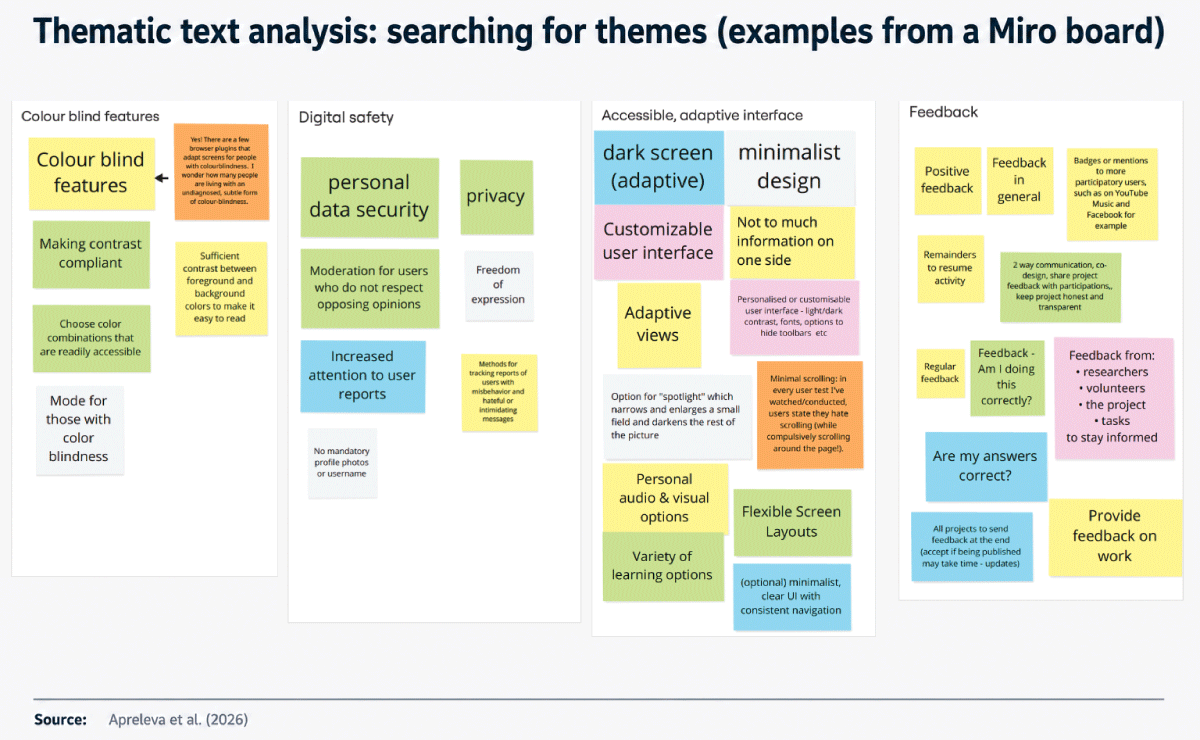
Figure 1
Thematic text analysis: searching for themes (examples from a Miro board).
Collaborative, cyclic review strengthened credibility and reduced interpretive blind spots. Although group analysis does not remove subjectivity, it improves rigour through reflexive triangulation: multiple perspectives interrogating the same data (Nowell et al. 2017). Across iterations, collaborators refined themes, compared findings across datasets, and cross-checked them against existing accessibility guidance. The resulting framework combines survey evidence, lived neurodivergent expertise, collaborative interpretation, and practical design.
Results
This section presents the 11 domains of the neuro-inclusive DCS accessibility framework. It follows the participation lifecycle from entry, and task engagement to research relationships and sustained participation.
Main empirical outcome
The Neuro(Minorities)Science collaboration produced a structured accessibility framework for neuro-inclusive DCS, supported by qualitative analysis of two datasets. The primary empirical outcome is The List, which captures 91 features identified as essential for comfortable, safe, and successful neuro-inclusive participation. The full feature-level framework is provided in Supplemental file 1: The List of Accessibility Features for Neuro-inclusive Digital Citizen Science. The Results synthesise the functional domains rather than reproducing the complete list.
The 91 recommendations include technical user-facing features (e.g., display customisation, interaction modes, break reminders) and social-organisational practices (e.g., communication style, moderation, feedback framing, transparency about research processes). They are organised into 11 functional domains:
Onboarding
Project Instructions
Task Presentation
Integrity
Co-design
Project Management
Safety
Human Value
Web Interface (Technical Functionality): General
Web Interface (Technical Functionality): Opt-in Features
Outreach
The domains describe where accessibility barriers arise across the DCS participation lifecycle, from first contact with a project through active task engagement, community interaction, and sustained contribution. Several recommendations extend beyond general web-accessibility guidance by addressing DCS-specific participation conditions: repeated classification, uncertainty management, volunteer-researcher communication, public discussion spaces, task matching, moderation, and the emotional consequences of perceived error. Others align with existing accessibility guidance, including clear navigation, consistent labelling, alternative input methods, adjustable timing, control over moving or flashing content, and compatibility with assistive technologies.
The framework does not replace established accessibility standards. It translates them into the socio-technical context of DCS and extends them through neurodivergent citizen scientists’ lived experience.
The Results present these domains according to their practical function across the DCS participation lifecycle (Figure 2). The Discussion then interprets them through two interdependent dimensions of neuro-inclusive participation—autonomy and collaboration—and offers a staged, resource-aware approach to implementation.
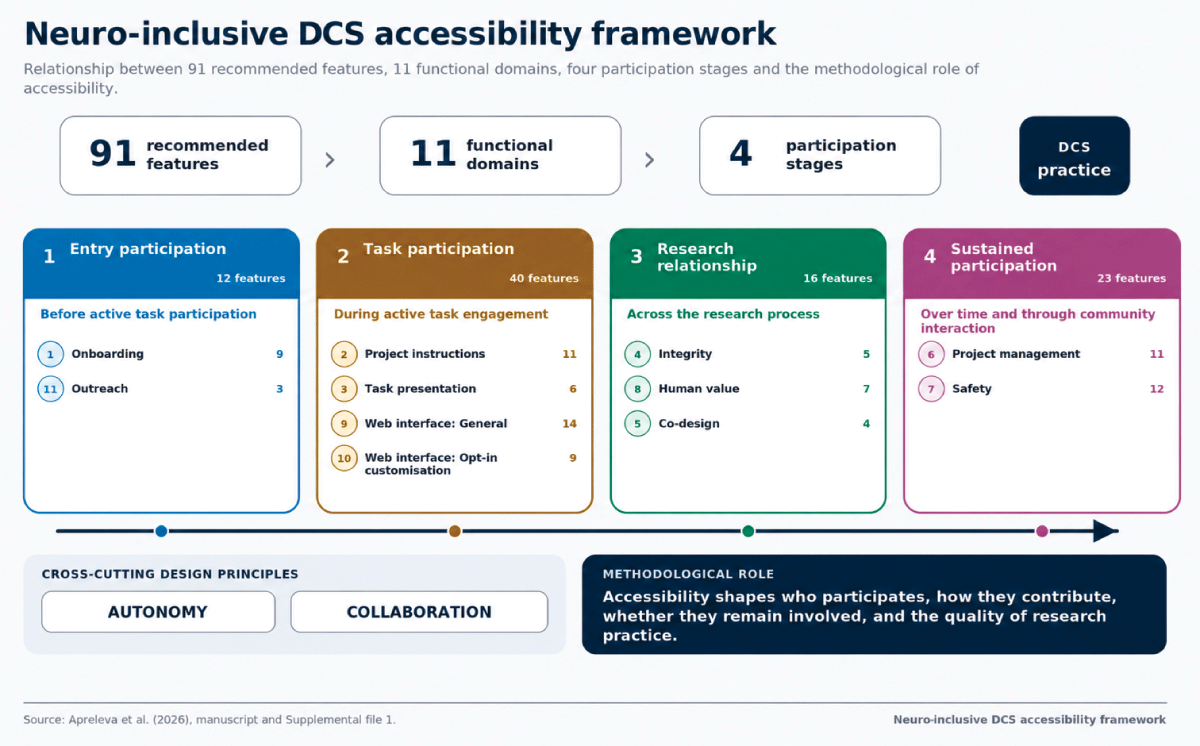
Figure 2
Neuro-inclusive digital citizen science accessibility framework.
Entry participation: Onboarding and Outreach
The Onboarding and Outreach domains show that accessibility begins before task participation. Volunteers first encounter an invitation and landing page, where they decide whether participation appears feasible, safe, and intended for them.
Onboarding
The Onboarding domain addresses volunteers’ first contact with a platform or project page. Recommended features include neurodiversity-welcoming language or symbols, accessibility statements, task previews or demos, trigger warnings about a project’s content, plain descriptions of expectations, easily discoverable help, and clear information about required skills. The collaborators emphasised that early signals of welcome and predictability can influence whether neurodivergent volunteers perceive participation as possible or safe. Examples of visible inclusion may include the sunflower symbol for invisible disabilities (Hidden Disabilities Sunflower n.d.), the rainbow infinity sign commonly associated with neurodiversity (Xu et al. 2025), or explicit written statements welcoming neurodivergent contributors.
This finding is consistent with CS focus-group evidence that a lack of visible belonging and cultural welcome can discourage participation even when projects align with participants’ interests and skills (Langhans et al. 2025). Visible acceptance is therefore not treated as decorative inclusion, but as an access feature that can reduce uncertainty and the need for “masking,” or suppressing authentic behaviours to appear neurotypical. Although research has focused primarily on autistic masking (Pearson and Rose 2021), participants in our study indicated that masking pressures extend across neurodivergent conditions, leading to burnout, anxiety, and identity fragmentation. As one working group member explained:
“Masking is how we manage in public… it’s truly exhausting and not always successful.”
Outreach
The Outreach domain addresses how projects are framed and communicated beyond existing DCS communities. Recommended features include direct outreach to relevant groups, raising awareness of CS among specific population groups, empowering and non-stigmatising language, partnerships with neurodivergent-led advocacy organisations, and avoidance of reductive disability labels or generalisations. Working group members noted that neurodivergent and disabled people may self-exclude when accessibility cues are absent or when outreach relies on generic recruitment language:
“Targeted advertising should be done with extreme care and sensitivity, using empowering and positive language (e.g., ‘Your detailed focus or interest is a strength’). I suggest prioritising partnerships with advocacy organisations led by neurodivergent people, rather than relying solely on broad digital ads. This is an important topic, as the internet is currently full of misinformation about neurodivergence.”
Task participation: Project Instructions, Task Presentation and Web Interface
The Project Instructions, Task Presentation and Web Interface domains address the design, structure and technical functionality of DCS participation. They emphasise clear instructions, accessible task workflows, robust baseline accessibility, and opt-in personalisation for individual cognitive, sensory, and motor needs.
Project Instructions
The Project Instructions domain addresses how scientific tasks are explained. Recommended features include concise, segmented and multimodal instructions, plain language, correct and incorrect examples, edge-case guidance, access to instructions during tasks, and reassurance that occasional mistakes will not “ruin” the project. These features matter because many DCS tasks require learning unfamiliar scientific concepts, repeated judgements, and tolerance of ambiguity. Unclear instructions or punitive-feeling feedback can become accessibility barriers rather than minor usability issues. 2024 survey participants explained:
“This one is hard to explain but autistic and ADHD people have a hard time completing tasks if they’re not 100% aware of what is required of them.”
“Finding words or terms not listed in the project guidelines can be difficult.”
“If your writing can be understood by a 9-year-old, then you’re doing a great job. It’s not about dumbing down, but about being absolutely clear in what you’re asking of people. This is really handy for those with autism, ADHD and who identify as AuDHD.”
“For me, I have a problem with making sure what I do is correct. I don’t want to make a mistake and I look for feedback because I want the work I do to matter and not affect a study.”
Task Presentation
The Task Presentation domain addresses task structure during participation. Recommended features include short, step-by-step tasks, reduced clicking, options to skip or flag ambiguous tasks, high-quality media, and workflows organised by task type or skill level. These features support pacing, motor accessibility, attention regulation, and task matching for volunteers experiencing fatigue, dyspraxia, error anxiety, or difficulty sustaining focus in visually complex environments. As one 2024 survey participant explained, “as someone with ADHD, some tasks look fun to do, but when I click on a task to learn what I have to do and I see lots of rules to read, I tend to lose interest really quickly because I don’t want to read; I just want to get into the task and learn along the way.”
Web Interface (Technical Functionality): General
The Web Interface (Technical Functionality): General domain covers baseline technical accessibility across neurotypes. Recommended features include WCAG-informed evaluation, consistent layouts, visible accessibility statements, assistive-technology compatibility, multiple input methods, cross-device and mobile accessibility, smooth zoom, video controls, search and help tools, and project filtering or recommendations by interest, task complexity, expected time and required skills. These features align with established accessibility practice (W3C 2024; WCAG 2025; AbilityNet n.d.) but were interpreted through DCS-specific needs, including repeated task performance, task matching, and sustained attention. This is consistent with prior research emphasising usability, human-centred design, and the heterogeneity of CS projects (Dehn 2017; Liu et al. 2021).
Web Interface (Technical Functionality): Opt-in Features
The Opt-in Features domain focuses on personalisation. Recommended features include adjustable element size, hiding non-essential elements, font and colour choices, minimalist modes, screen masking or spotlight tools, dark mode, dyslexia supports, colour-blind contrast options, and custom session limits. Collaborators emphasised that no single configuration works for all neurodivergent users. Customisation therefore provides a technical foundation for neuro-inclusive DCS, allowing volunteers to adapt the research environment to their sensory, cognitive, and motor needs without imposing the same interface on everyone.
Some opt-in recommendations overlap with existing accessibility resources, including adjustable contrast for colour-blind users (WebAIM n.d.), font and layout customisation for dyslexic users (Braille Institute n.d.; Barstow 2021; Staake 2022), and ADHD-friendly design guidance aimed at reducing distraction and supporting focus (Bureau of Internet Accessibility 2021). Other recommendations, including participation limits, break reminders, and optional positive feedback, address DCS-specific patterns such as repetitive classification and risks of hyperfocus or fatigue. Hyperfocus may enhance performance while obscuring exhaustion and increasing the risk of abrupt withdrawal (Ashinoff and Abu-Akel 2021). In the words of a 2024 survey participant:
“Having a timer on the session could help people know just how much time they are devoting to this, and could remind them to take breaks if they work for hours without respite. I used to work for hours without taking a break, and this would have been a useful feature to make me get up and clear my mind.”
Participants also discussed gamification, including leaderboards, points, milestone notifications, and pop-up congratulations. The group treated these features as potentially useful but not universally accessible: while positive reinforcement can support motivation, competitive systems may create pressure or reduce motivation for some volunteers. Gamified features should therefore be optional rather than default, and DCS teams should draw on existing research when considering their use (Greenhill et al. 2016; Sailer et al. 2017; Satrio, Kleiman, and Janssen 2025).
DCS developers can consult open-access resources on neurominority needs, including Rusakova (2020), the ADHD-Friendly design guide (Bureau of Internet Accessibility 2021) and disability-specific resources offered by AbilityNet (n.d.).
Research relationship: Integrity, Human Value, and Co-design
Neuro-inclusive accessibility in DCS is not limited to accessible interfaces. It also depends on whether volunteers can locate their work within a meaningful and trustworthy research process.
Integrity
The Integrity domain highlights transparency about research aims, data use, task purpose, project progress, and outcomes. Recommended features include honest explanations of research purpose and, where relevant, AI use; transparency about data and process; and sharing publications or results with contributors. Collaborators wanted to understand why their participation mattered and how their contributions were being used, emphasising the preference for “honest active researchers”:
“I intentionally avoid the word ‘professional’ because ‘honest + active’ is what’s needed. Emphasizing honesty and activity over professional status highlights the importance of transparency and engagement from researchers. This approach can foster trust and collaboration, as participants feel their contributions are valued and used ethically”
Human Value
The Human Value domain addresses recognition of volunteer labour and collective scientific impact. Recommended features include thanking volunteers, validating contributions, providing respectful feedback, connecting individual contributions to wider research outcomes, and offering opt-in certificates, badges, or public recognition, and incentives where appropriate. One 2024 survey participant favoured “feedback from the researchers encouraging those already taking part — brief updates rather than having to wait for official announcements.”
Co-design
The Co-design domain reflects the CS principle that citizen scientists may participate in multiple stages of the scientific process (Robinson et al. 2018). Neuro-inclusive accessibility needs are heterogeneous and context-dependent and cannot be fully anticipated from a single design perspective, regardless of the designer’s neurotype. While WCAG 2.2 (W3C 2024) provides an essential foundation, effective implementation requires neurodivergent testers with diverse lived experience. Involving neurodivergent citizen scientists throughout the project lifecycle, particularly when developing instructions, tutorials, and task interfaces, enables early identification of participation risks and complements guideline-based design. Where possible, participants should be compensated or otherwise recognised for their expertise. As one Neuro(Minorities)Science group member explained:
“All projects could be ‘user tested for clarity’ by neurodiverse test teams with no experience of and totally unfamiliar with the project being tested. Too often user testers are involved, familiar, biased or too close to be objective. Testers need to be rotated to avoid group think.”
Sustained participation: Project Management and Safety
The Project Management and Safety domains address the organisational, relational, and environmental conditions for neuro-inclusive DCS. Unlike initial access or task engagement, sustained participation depends on how these conditions are maintained over time.
Project Management
The Project Management domain covers organisational and relational practices shaping participation over time. Recommended features include responsive help and question-and-answer spaces, moderated communities, moderator training, codes of conduct, low-interaction updates, private volunteer-to-researcher communication, and optional events. Collaborators emphasised that project coordinators and moderators play a critical role in sustaining neuro-inclusive participation, particularly when they are mindful of diverse communication styles, uncertainty, and support needs among neurodivergent and disabled contributors. Training and ongoing awareness among project teams are central to creating predictable, respectful, and supportive participation environments.
Safety
The Safety domain addresses social, sensory, cognitive, and emotional safety in DCS. Recommended features include data-security safeguards, mechanisms for reporting harmful behaviour, trigger warnings and opt-out settings, controls to disable autoplay, anxiety-reducing error messages, smaller work segments, break alerts, structured communication rules, and no forced socialisation.
Social safety includes clear reporting routes, consistent moderation, and protection from hostile or exclusionary behaviour. Volunteers should have accessible, private mechanisms for reporting concerns, which must be handled consistently and transparently, as the absence of clear safeguards can exacerbate anxiety and discourage participation. Sensory safety includes content warnings, control over autoplay, options to skip distressing material, and avoidance of flashing or unexpected sensory stimuli. Cognitive and emotional safety includes optional, user-controlled break reminders, small task segments with visible progress indicators, reassuring feedback, and error messages that do not imply that occasional mistakes undermine the research.
Working group recommendations show that DCS safety extends beyond data security and online conduct to conditions supporting regulation of attention, emotion, sensory exposure, and uncertainty. One participant described the consequences of inaccessible project guidance:
“One remark springs to mind: never put important information in parentheses in the guidelines (my autistic mind overlooked one such piece of information on my first attempt at classifying, and when I realized my mistake, and its consequences, I had a meltdown that prevented me from trying anything again on zooniverse for a couple of months).”
Neurodiversity-aware moderation should support respectful interaction across communication styles, addressing technical issues while ensuring volunteers feel safe and understood. Moderators should recognise that neurodivergent and neurotypical communication styles can differ in tone and expression. Direct language used by some autistic people may be perceived as abrupt or sarcastic, while differences in phrasing or formality can cause mutual misunderstanding. Volunteers with limited mobility or dyspraxia may produce frequent typos or inconsistent spelling. These variations do not reflect a lack of intelligence or respect. Neurotypical participants, moderators, and project teams can benefit from understanding neurodivergent communication styles and barriers, supporting authentic expression and valued participation.
Together, the 11 domains show that accessibility barriers across the DCS participation lifecycle require platform- and project-level responses spanning technical, communicative, relational, and organisational conditions of participation.
Discussion
Our findings shift attention from individual accessibility features to the conditions shaping participation in DCS. In this context, neuro-inclusive accessibility becomes a methodological component of research practice rather than solely an interface-design question.
Neuro-inclusive accessibility as a methodological framework
DCS platforms are complex socio-technical systems involving sustained cognitive effort, repeated tasks, rule learning, uncertainty management, and interaction with researchers or other volunteers. When these demands intersect with neurodivergent differences in language processing, attention regulation, and tolerance of ambiguity, accessibility beyond baseline web standards is required.
Prior work shows that project design, interface usability, and participation structures influence engagement, retention, and data quality in CS (Phillips et al. 2019; Liu et al. 2021; Downs et al. 2021). Accessibility barriers may cause volunteers to disengage or self-select out, affecting data completeness and timelines. Le Cunff et al. (2025) identify six areas shaping cognitive load in online learning for neurodivergent students: format, environment, delivery, instruction, support, and research, emphasising clearer structure, flexible formats, and participatory development. Research on neurodiverse-friendly preschools similarly identifies spatial predictability, diversity, and transitional and retreat spaces as supports for self-regulation (Aminpour, Skattebol, and Katz 2026). Although outside DCS, these studies support our emphasis on predictable task presentation, sensory control, pacing, and user-adjustable settings.
This study presents a lived-experience-informed neuro-inclusive accessibility framework for DCS, operationalised through the 11 domains of The List. Neuro-inclusive design and management should therefore be understood not simply as matters of inclusivity or social justice, but as part of DCS methodology, shaping who participates, how they contribute, and the reliability and quality of scientific knowledge produced.
Implementing neuro-inclusive design across participation stages
Two interdependent dimensions of participation emerge from the findings. Autonomy is supported by clear onboarding, structured instructions, predictable task presentation, interface customisation, and user-controlled environments, enabling independent and comfortable participation. Collaboration is supported by transparent communication, inclusive project management, ethical recognition, and safe neuro-shared spaces, helping volunteers understand their contributions and remain connected to the wider research effort. Together, these dimensions contribute to what Phan et al. (2025) describe as “an environment that benefits all and is crucial to some.”
While customisable technical design is central to supporting volunteer autonomy, neuro-inclusive participation also depends on how projects are organised, supported, and managed over time. Interface-level accessibility is therefore necessary but not sufficient. Technical features, communication practices, and moderation systems need to be implemented across multiple layers of project design and operation, in stages that fit project capacity.
CS project managers often view engagement as something that “happens,” rather than something that needs proactive design, management, and evaluation, while simultaneously reporting limited time, resources, and institutional support to engage with volunteers (Collins, Sullivan, and Bray 2022). The guidelines are therefore adaptable rather than prescriptive, supporting staged implementation based on impact and feasibility. Many measures require neither specialist web development nor substantial technical changes, but can be implemented through clearer project descriptions, transparent expectations, accessible communication, and consistent recognition of volunteer contributions. Advanced customisation may instead require technical expertise and dedicated funding. This variation allows incremental progress toward neuro-inclusive practice rather than treating accessibility as all-or-nothing.
Relation to existing accessibility guidance
Many recommendations in The List align with existing guidance from AbilityNet (n.d.) and WCAG (2025). The framework extends into DCS-specific participation conditions that general accessibility guidance does not fully capture, including repeated classification, uncertainty management, volunteer-researcher communication, public discussion spaces, task matching, and the emotional consequences of perceived error. These conditions shape whether participation is sustainable.
Under the European Accessibility Act (Online ADA 2024) and Americans with Disabilities Act (U.S. Department of Justice 2022), WCAG compliance is increasingly a legal requirement. Most operating systems offer font-size, colour-contrast, and interaction settings, yet research and user feedback show that volunteers value webpage-level options that are clearly communicated and easily found, for example through an accessible settings panel.
Fine-grained customisation may sometimes be achieved through web accessibility overlays, technologies intended to improve website accessibility. For example, the National Autistic Society website (National Autistic Society n.d.) uses the Recite Me accessibility toolbar. It allows users to customise contrast, text size, fonts, and spacing, and use screen-reading or translation tools. However, experts have raised concerns that third-party accessibility overlays may not always meet accessibility standards and can introduce new barriers including risks to data protection and conflicts with assistive technologies (Overlay Fact Sheet n.d.). Where an overlay is itself accessible, easy to use, and does not interfere with assistive technologies, it can be an empowering tool. Accessible base design should come first; overlays should not compensate for avoidable design failures.
For further guidance, we refer readers to The List and established open-access resources (AbilityNet n.d.; WCAG 2025). Langhans et al. (2025) provide considerations for project managers and moderators seeking more inclusive CS through organisational practices supporting accessibility and belonging. Together, these resources support DCS teams and developers seeking to strengthen neuro-inclusive participation.
Conclusions
This study provides a neuro-inclusive accessibility framework for DCS grounded in the lived experience of neurodivergent citizen scientists. Its central contribution is to demonstrate that accessibility is not only a matter of compliance or inclusion, but a methodological condition that shapes who participates, how they contribute, and whether participation can be sustained over time. The List translates this framework into 91 actionable features organised across 11 functional domains and the participation lifecycle (Figure 2).
The framework contributes to DCS research by extending accessibility beyond interface design to include onboarding, task participation, research relationships, sustained participation, and outreach. It also clarifies that neuro-inclusive practice depends on both autonomy and collaboration, supported through predictable structure, transparent communication, sensory and cognitive control, and project-level care. Together, these features expand viable participation styles, strengthening research robustness, data continuity, and long-term volunteer engagement.
The implications extend beyond DCS to participatory research, online collaboration, public engagement, education, and human-computer interaction, where people contribute through diverse cognitive, communicative, and sensory styles. Accessibility should therefore be understood as design for participation, not only compliance. The same choices that support neurodivergent contributors can also improve conditions across languages, ages, abilities, and access contexts (Cooper et al. 2021).
The framework should not be transferred uncritically to all settings. It offers an adaptable starting point for staged implementation, co-design, and local revision. For platform teams, project owners, moderators, and science communicators, the framework provides a basis for improving participation quality, retention, and trust. For funders and institutions, it positions accessibility as research infrastructure rather than an optional add-on. Future work should test how these principles travel across different forms of CS, participatory research, and digital environments, and how they may support broader participation beyond DCS. Consistent with Phan et al. (2025), we view the development of genuinely participatory and neuro-inclusive research environments as an important aspiration for open, equitable, and socially grounded scientific discovery.
Supplemental Materials
Supplemental File 1. The List of Accessibility Features for Neuro-inclusive Digital Citizen Science. DOI: https://doi.org/10.5281/zenodo.22751252
Supplemental File 2. Dataset 1. DOI: https://doi.org/10.5281/zenodo.22752391
Supplemental File 3. Dataset 2. DOI: https://doi.org/10.5281/zenodo.22752527
Ethics and Consent
The study received research ethics approval (R94294/RE001) from the Central University Research Ethics Committee at the University of Oxford. All participants provided informed electronic consent before completing the online survey.
Data Accessibility Statement
All qualitative datasets and the accessibility framework are available via Zenodo at the DOIs listed above. Files are publicly accessible without restriction.
Author Contributions
AA led conceptualisation, analysis of Datasets 1 and 2, review, writing, supervision. AMHA, RA, JC, GF, AMG, IH, FH, CH, CK, HHFdM, IT, CAT contributed to conceptualisation, analysis of Datasets 1 and 2, review, writing. MC, ACG, RFJ, MLK contributed to conceptualisation, analysis of Dataset 1, review, writing. RG, MKJ contributed to conceptualisation, analysis of Dataset 1, review. KL contributed to conceptualisation, analysis of Datasets 1 and 2, writing. MTG contributed to conceptualisation, writing. BN contributed to analysis of Datasets 1 and 2, review, writing. MR contributed to review, writing. SS contributed to review. CL, LT, SB contributed to conceptualisation, review, writing, supervision. Not all participants in the Neuro(Minorities)Science working group elected to be listed as authors.