
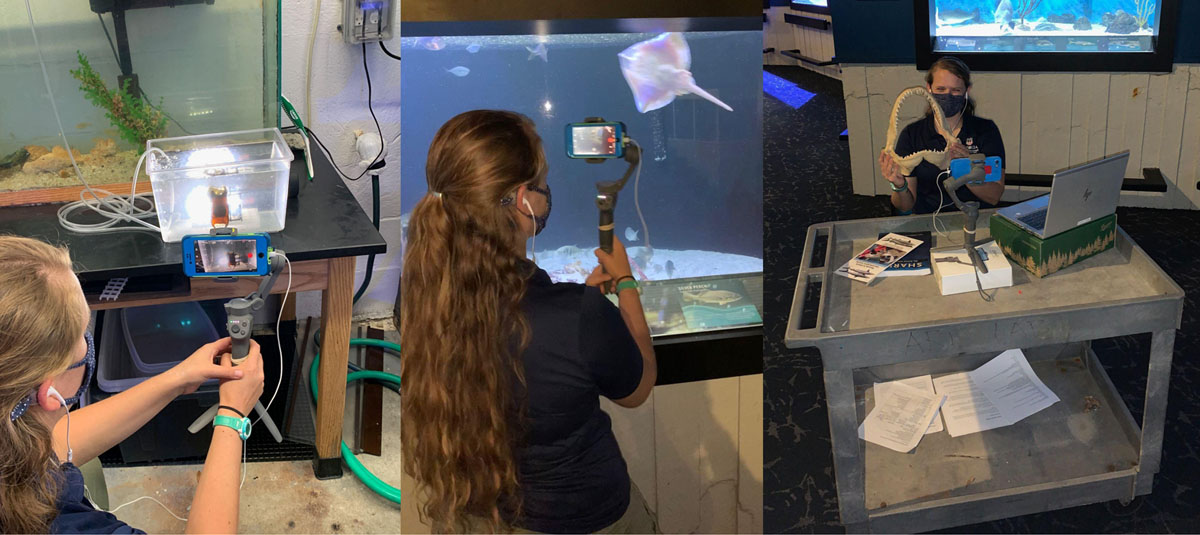
Figure 1
Equipment set up for the Sharks and Rays 101 virtual public program.
Figure notes: The public program was filmed from an iPhone SE cellphone. The grey device holding the phone is called a gimbal and was used to hold the video image steady, allowing the educator to move around the tanks and behind the scenes while filming. Phone headphones with a built-in microphone were used for both the audio input and output. When narrating the slide presentation, the educator sat at a rolling cart with the gimbal set up on a small tripod. A computer was available as a backup device but was not needed in this program.
Table 1
Sharks and Rays 101 Lesson Outline. Note the right column indicates where Ocean Literacy Principles, OLP, were incorporated.
| TIMING | ACTIVITY | CONCEPTS COVERED | OLP |
|---|---|---|---|
| 30 min | Educators log on in a practice session to test audio and visuals. | N/A | N/A |
| 5 min | Polls, using maps and photos on PowerPoint (PPT) to locate a sense of place relative to the world’s ocean | Understanding participant’s prior knowledge, connecting how the ocean impacts inland and coastal attendees | # 1# 3 |
| 15 min | Virtual stingrays and skate visits at aquarium exhibits, sketches, polls, pre-recorded video of skate eggs and juveniles, film behind the scenes | Adaptations, local species, common characteristics of elasmobranchs, practicing observations | # 5 |
| 10 min | Humans and elasmobranch interactions, PPT with global and local information, Showing fishing gear with best practices | Extinction and endangered species, fishing regulations, best practices for recreational fishing in inshore waters | # 6 |
| 15 min | PPT presentation from shark researcher, sharing maps and graphs, attendees interpret the data visuals using the chat box to respond | Identifying nursery habitats, role of science in informing conservation, importance of estuaries, interpreting graphical and spatial information | # 5# 7 |
| 10 min | Q & A with researcher | ||
| 5 min | Wrap up & exit polls | What did we learn? |
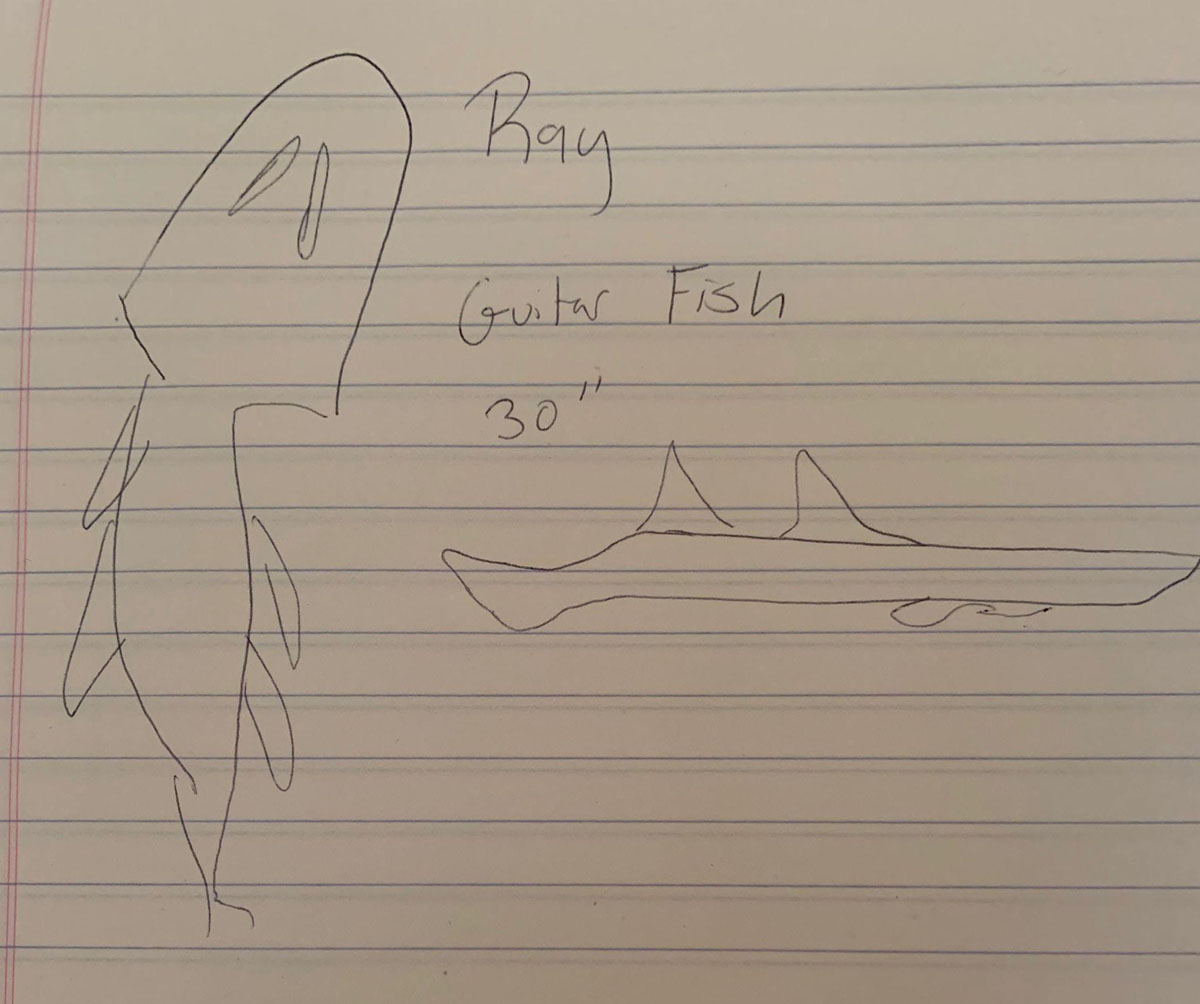
Figure 2
Guitarfish drawing.
Figure notes: Sample work from the Sharks and Rays 101 public program showing a drawing of an Atlantic guitarfish by an adult attendee drawn during a virtual exhibit visit.
Table 2
Lesson Learned for Webinars from Sharks and Rays 101. Note that there are existing published rubrics of best practices for webinars, including for STEM classroom programs (Mitchell, Culbertson & Sutton, 2015) and for extension audiences (Robideau & Matthes, 2021). The Sharks and Rays 101 educators found that their successes occurred when they followed these practices most closely. These guides, listed in the citations, may be useful to other presenters.
| LESSONS LEARNED FOR FUTURE WEBINARS | ||
|---|---|---|
| SUCCESSFUL ASPECTS | FUTURE CHANGES | EVALUATION |
|
|
|