
The provenance of artefacts in European museums is often complex and interwoven, and researching it at times depends on chance. Between 1911 and 1913, the German archaeologist Ernst Herzfeld (1879–1948) conducted excavations in Samarra. During these excavations, he frequently travelled to Baghdad, and on one such trip, he happened upon an Arabic manuscript, by mere coincidence, that he acquired for the Hamburg City Library. In search of further information on this acquisition, we consulted an archival file on the Samarra excavations at the Central Archive of the Berlin State Museums. There, again by coincidence, we discovered a letter in which Herzfeld described to his superiors in Berlin how he planned to acquire antiquities for the Royal Museums. He wrote that wall decorations had to be carved out, that originals were to be sent to Berlin labelled as copies, and that the local authorities were to be deceived. The passage read almost like the plot of an art heist.
For several decades in the ninth century, Samarra (Figure 1) functioned as the principal residence of the Abbasid caliphs, before the court eventually returned to Baghdad. In the early twentieth century, during Herzfeld’s excavations, the ruins of Samarra were part of the Baghdad province in the Ottoman Empire. The two campaigns – the first from January to December 1911 and the second from November 1912 to July 1913 – were formally registered by Friedrich Sarre (1865–1945), who headed the Islamic Department at the Royal Museums in Berlin, but Herzfeld directed the operations on site. Today, Herzfeld’s excavations at Samarra hold a prominent place in the history of Islamic archaeology, both for the scale and complexity of the site and for their pioneering role in shaping the study of Islamic material culture.1
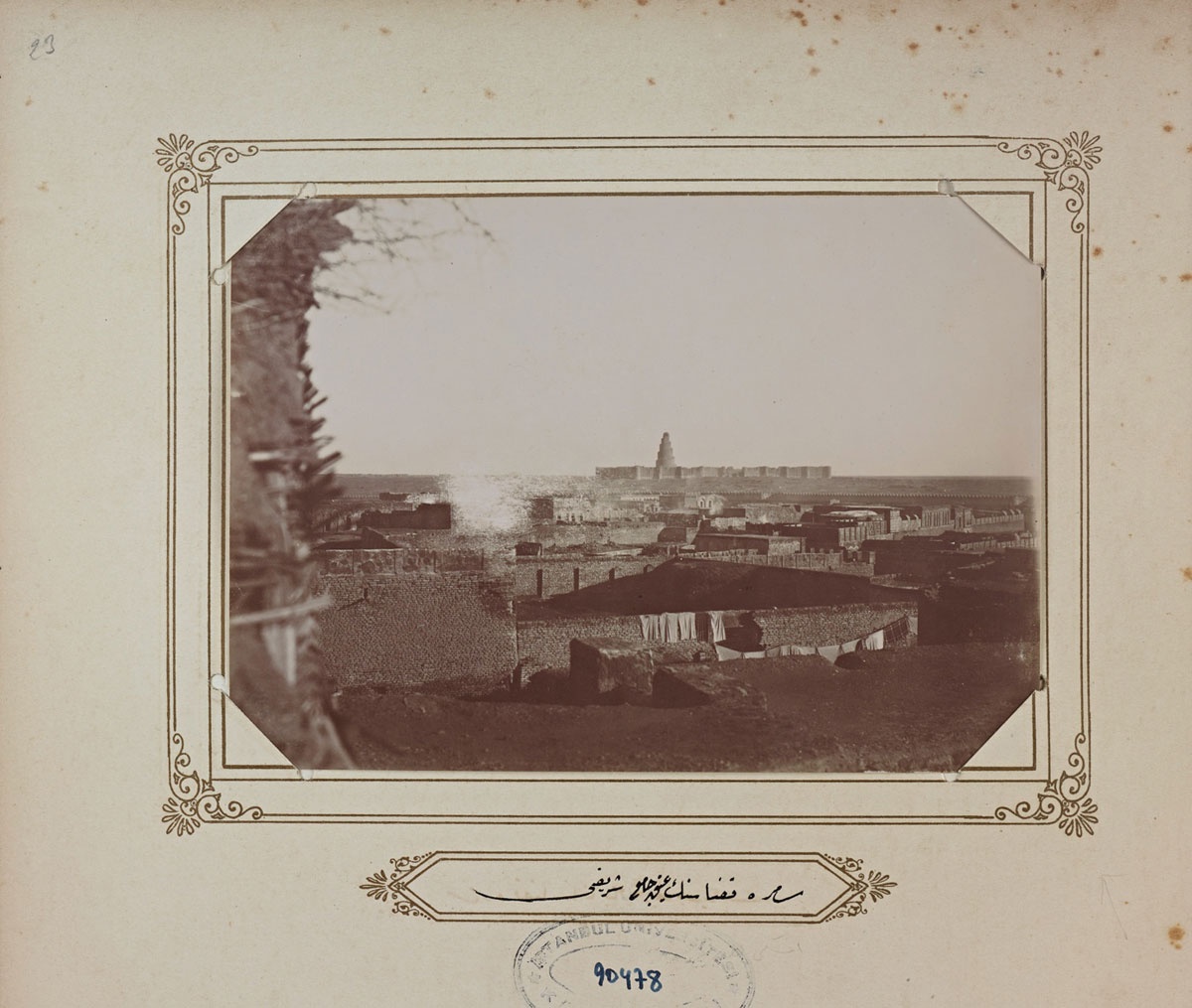
Figure 1
Sāmarra qażāsınıñ ʿAtīq Cāmiʿ-i Şerīfi [The ancient mosque of the Samarra district], late nineteenth century, İstanbul Üniversitesi Nadir Eserler Kütüphanesi, 90478/0045, II.Abdülhamid Han Fotoğraf Albümleri, © İstanbul Üniversitesi Kütüphanesi.
The two German scholars were motivated by an interest in analysing and collecting material relevant to this emerging discipline.2 The excavations unearthed numerous artefacts; Herzfeld recorded 1,161 objects in his records.3 A significant number of these finds are today held at the Museum of Islamic Art in Berlin, while others became part of collections in Istanbul, London, New York, Cairo, and Boston. Of particular art-historical importance are the excavated stucco wall decorations from former residential buildings and palaces.4 It is these pieces that, according to Herzfeld’s letter, may have reached Berlin under questionable circumstances.
However, in reviewing a range of museum publications, we observed a striking continuity: the transfer of the Samarra finds is consistently presented as a legally unambiguous process and remains largely unproblematised. In 2009, then director, Claus-Peter Haase, justified the presence of finds in Berlin with an official division of finds.5 Similarly, the 2013 exhibition ‘Samarra – Centre of the World’ stated that such a division had taken place within the framework of Ottoman antiquities law:
‘Today’s exhibition presents a large selection of the finds that made their way to the Berlin museums under the then prevailing antiquities law, by which the found objects were divided up, with half retained by the local country and half removed by the country responsible for financing and conducting the dig.’6
In the accompanying exhibition video, the museum’s current director, Stefan Weber, referred to the 1899 ‘secret agreement’ between the German and Ottoman Empires, which he argued entitled the Berlin museums to acquire fifty per cent of the Samarra finds.7 The same framing of a lawful division persists in more recent institutional publications.8 A position paper published in 2022, which emphasised the museum’s awareness of global contexts of injustice, likewise referred to a legal division of finds.9 This narrative also extends beyond the Berlin museum, appearing, for instance, in a Metropolitan Museum of Art blog post.10 Taken together, these examples reveal the persistence of an institutional narrative presenting the collection as the product of a lawful division. Yet none of these accounts offers a detailed examination of the events in Samarra or substantiates that claim with supporting evidence.
Academic scholarship on the Samarra excavations has already noted that unauthorised transfers of finds took place during both campaigns. Thomas Leisten referred to Herzfeld’s secret shipment of certain objects to Berlin, while Jens Kröger likewise mentioned instances of artefacts being transferred covertly to Berlin.11 Although both scholars brought significant archival evidence to light, the legality of these shipments has not yet been explored in depth, either by them or in later research on the Samarra excavations.12
Given the recent surge of scholarship on the history of archaeology in the Ottoman Empire, this absence appears all the more striking.13 A substantial body of literature has examined the imperial dimension of archaeology.14 Recent studies have shifted away from a narrow focus on European archaeologists and museums, highlighting the importance of Ottoman actors and local agency.15 In the case of German archaeological excavations between 1898 and 1918, Sebastian Willert has demonstrated that the deception of Ottoman authorities by German archaeologists constituted a characteristic feature of their practice.16
In light of this growing body of scholarship and the first indications from the archive, the case of Samarra appeared to warrant closer examination. While reviewing archival material of the Staatliche Museen Berlin (SMB), we realised that previous scholarship could be usefully complemented by additional perspectives. To this end, we requested access to documents from the Samarra Archive, a dedicated subsection within the museum archives. In March 2024, the directorate of the SMB’s Central Archive refused our request for access, invoking ongoing internal research as justification. As we discuss below, this is not an isolated experience, but one shared by other independent researchers whose work critically engages with the history of archaeological excavations conducted by the Berlin museums.
Our article must be read methodologically against this background of restricted access. Prevented from consulting the Samarra Archive directly, we re-examine the excavations through sources that remain accessible elsewhere.17 Based on these materials, we identify substantial evidence supporting our central argument: that the export and appropriation of the Samarra finds violated Ottoman antiquities legislation, and that the objects in question should be regarded as illegally removed property.
Between Ambition and Regulation
A central aim of the excavations in Samarra was to secure objects for the Berlin Royal Museums. Sarre sought to expand the Islamic Department, which was constrained by a limited budget. As high prices on the European art market made acquisitions difficult, archaeological excavations became an effective means for Sarre to obtain new artefacts for the museum.18 The Samarra excavations were therefore largely driven by the ambition to enlarge Berlin’s museum collections. Herzfeld’s excavation contract explicitly stipulated that, in addition to the archaeological investigation of the city’s ruins, his task was ‘to recover finds and secure them for the Royal Museums.’19 The collection of antiquities was therefore an integral part of his mission. While the excavations had to serve Berlin’s interests, neither Sarre nor Herzfeld mention the Ottoman museums as beneficiaries of finds. This plan conflicted with the objectives of the Ottoman Antiquities Administration. Its directors, Osman Hamdi Bey (1842–1910) and, subsequently, Halil Edhem Bey (1861–1938) (Figure 2), sought to expand Ottoman museum collections while restricting the export of cultural heritage from the empire through new legislation. The Ottoman Antiquities Law of 1906 declared all excavated artefacts to be property of the state.20 In particular, the law referred to Islamic objects for the first time.21 The special importance attached to Islamic objects and monuments increased further in the wake of the constitutional revolution of 1908. Influenced by nationalist ideas, Halil Edhem was particularly committed to the protection of antiquities from various Islamic periods.22 In this context of intensifying claims to the Ottoman heritage, foreign archaeological excavations like Samarra were met with suspicion.
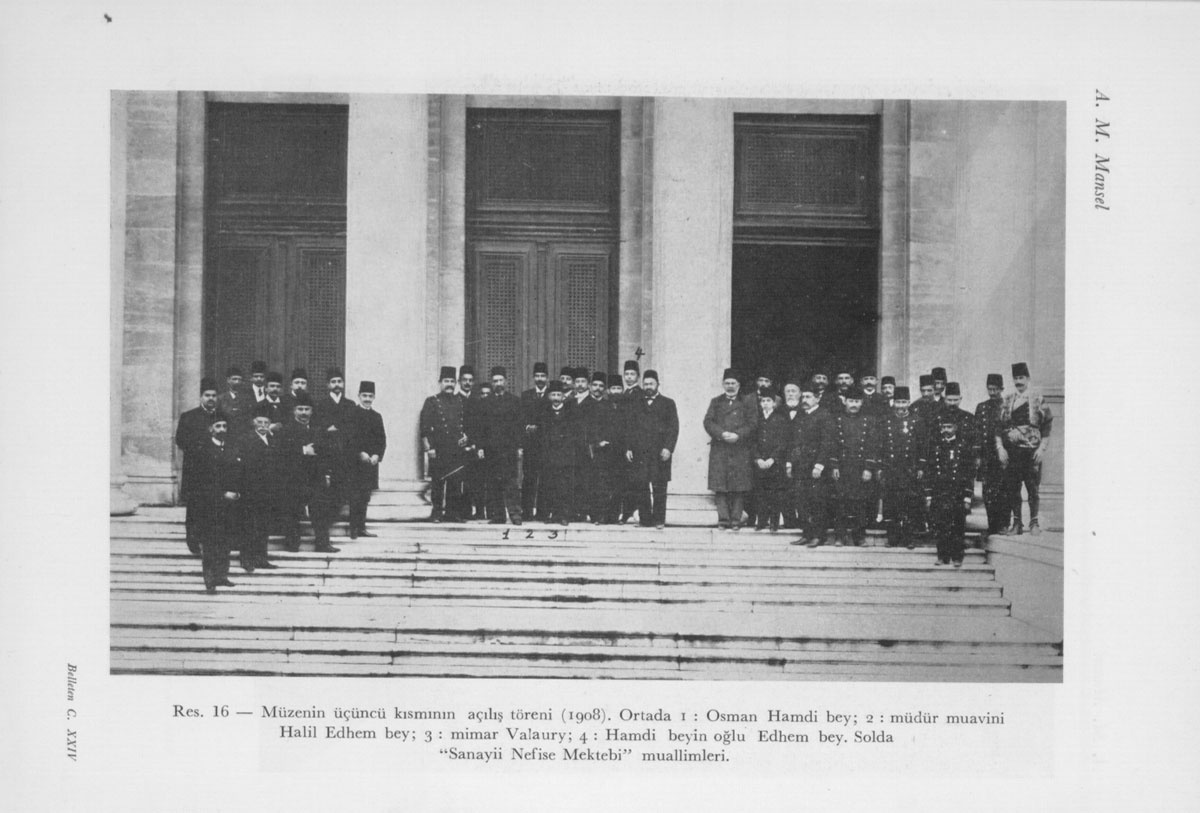
Figure 2
Opening ceremony of the third section of the Ottoman Imperial Museum, 1908. Salt Research, Harika-Kemali Söylemezoğlu Archive, APO00185.
Sarre and Herzfeld were well aware of the provisions of Ottoman antiquities legislation. Even before the excavation began, detailed discussions took place on how artefacts could be obtained despite strict regulations. One strategy that emerged from these discussions was to register the excavation as a private enterprise rather than as an official museum excavation. In a letter to Wilhelm von Bode (1855–1929), Director General of the Berlin Royal Museums, Sarre explained this move by referring to the ‘more favourable prospects’ associated with a private enterprise.23 This was further explained by Bode:
‘Professor Sarre’s Samarra expedition had to be presented to the Turkish government as a private expedition since the latter—given the many excavations it already permitted the Royal Museums to conduct in Asian Turkey—would have been very reluctant, if at all willing, to grant permission and would in any case have regarded the expedition with suspicion.’24
The decision to register the excavation as a private enterprise can thus be understood as an attempt to act discreetly and avoid further strain on the already tense relationship with the Ottoman antiquities administration.25 This, however, was merely a formality. As both Bode and Sarre acknowledged, the expedition was private only on paper: it was co-financed and supported by the German state and ultimately served the collection interests of a state institution—the Royal Museums.26
The discussions also reveal that despite the 1906 Antiquities Law, Sarre still hoped for a lenient interpretation of the law and for concessions regarding the surrender of finds. In August 1910, he wrote to Bode:
‘As far as the finds are concerned, Halil and Hamdy told me two years ago that they would be accommodating if I were to carry out an excavation. In any case, I will come back to this when I see Halil, but it is very doubtful whether such concession is still possible under the new regime.’27
Indeed, when the permission for the first Samarra excavation was issued on 18 August 1910, Sarre’s hopes were shattered. The official document makes no mention of a partition of finds and states:
‘According to the Antiquities Regulations, any antiquities that are extracted belong entirely to the Imperial Museum of the Ottoman Empire.’28
Reacting to the issued permit, Sarre expressed his disappointment to Theodor Wiegand (1864–1936), who, as foreign director of the Berlin Royal Museums in Istanbul, supported the Samarra excavations logistically: ‘Halil does not want to agree to the official handover of finds; I am astonished—given his usual kindness—by his rigorous position.’29 The excavation permit and Sarre’s statements document the position of the Ottoman authorities that the finds were to remain in the Ottoman Empire. At the same time, Sarre’s language reveals his hope that Halil Edhem, despite the clear provisions of the Ottoman Antiquities Law, would kindly grant antiquities based on his own behest. This attitude towards Ottoman officials reflects a broader strategy among German collectors in the Ottoman Empire: to negotiate issues of export and appropriation of antiquities through personal relationships, while resisting the formalisation of such processes in law.30
Alongside the excavation permit from the central government in Istanbul, permission from the local authorities was also required. Herzfeld, however, only received the Baghdad permit on 10 January 1911—one day after the official start of the excavation.31 According to Herzfeld, permission from Baghdad was delayed because the local authorities supported the French archaeologist Henry Viollet (1880–1955), who had started excavations in Samarra.32 Lacking an official permit from Istanbul, Viollet was forced to abandon his work under pressure from the Ottoman Antiquities Administration, following German diplomatic intervention.33 This case demonstrates not only the imperial competition between Germany and France but also illustrates the divergent interests of the authorities in Istanbul and Baghdad. Both asserted authority over excavations in Samarra and pursued conflicting interests, which consequently led to intra-imperial tensions.
These tensions also affected Herzfeld’s collaboration with the local authorities in Baghdad and Samarra.34 In letters to Eduard Meyer (1855–1930) and Max von Oppenheim (1860–1946), Herzfeld repeatedly complained about ‘terrible hostility’, ‘difficulties, hassles and harassment’, ‘intolerance and uninformed hatred’, ‘blind and stupid xenophobia.’35 He was particularly outraged by what he described as the ‘xenophobic’ stance adopted by the new provincial governor of Baghdad, Ahmed Cemal (1872–1922), and began to see himself as a victim of state discrimination.36 As we shall see, this growing resentment towards the Ottoman authorities set the stage for his subsequent disregard for and eventual violation of the Ottoman Antiquities Law.
Excavating beyond Legality
Despite the prohibition of the export of artefacts stipulated in the 1906 Antiquities Law and the absence of any contrary permission in the 1910 and 1911 excavation permits, the German archaeologists and museum officials were eager to obtain finds. Among the most desirable finds unearthed in the Samarra excavations were the wall decorations that had once adorned the palaces and residences of the Abbasid caliphs.37 Contemporary reports highlighted them as being ‘of outstanding art-historical significance.’38 The ‘unique’ and ‘rich’ decorations even prompted Herzfeld to characterise Samarra as an ‘Islamic Pompeii.’39 As the wall decorations were part of the ruins, they were legally defined as ‘immovable antique objects’ and thus subject to special protection under Ottoman Antiquities Law.40 Even though technically demanding, transforming these wall decorations into transportable objects for museum display was a particular concern of the excavation. Once Herzfeld recognised their significance, he requested assistance from a specialist of the Berlin Royal Museums. The technician Theodor Bartus (1858–1941), already known for his work removing and exporting wall paintings for the Turfan expeditions, was sent to Samarra.41 Upon his arrival in Samarra in October 1911, he began removing the wall decorations and producing casts (Figure 3). After two weeks, Herzfeld reported to Berlin that Bartus had already taken off so many pieces that twenty-one boxes were full.42 While it is not entirely clear whether the removal of the decoration was technically required for producing the casts, Herzfeld and Bartus opted for this invasive method.43 By carving out the decorations from the walls, they knowingly accepted their partial destruction (Figure 4).44
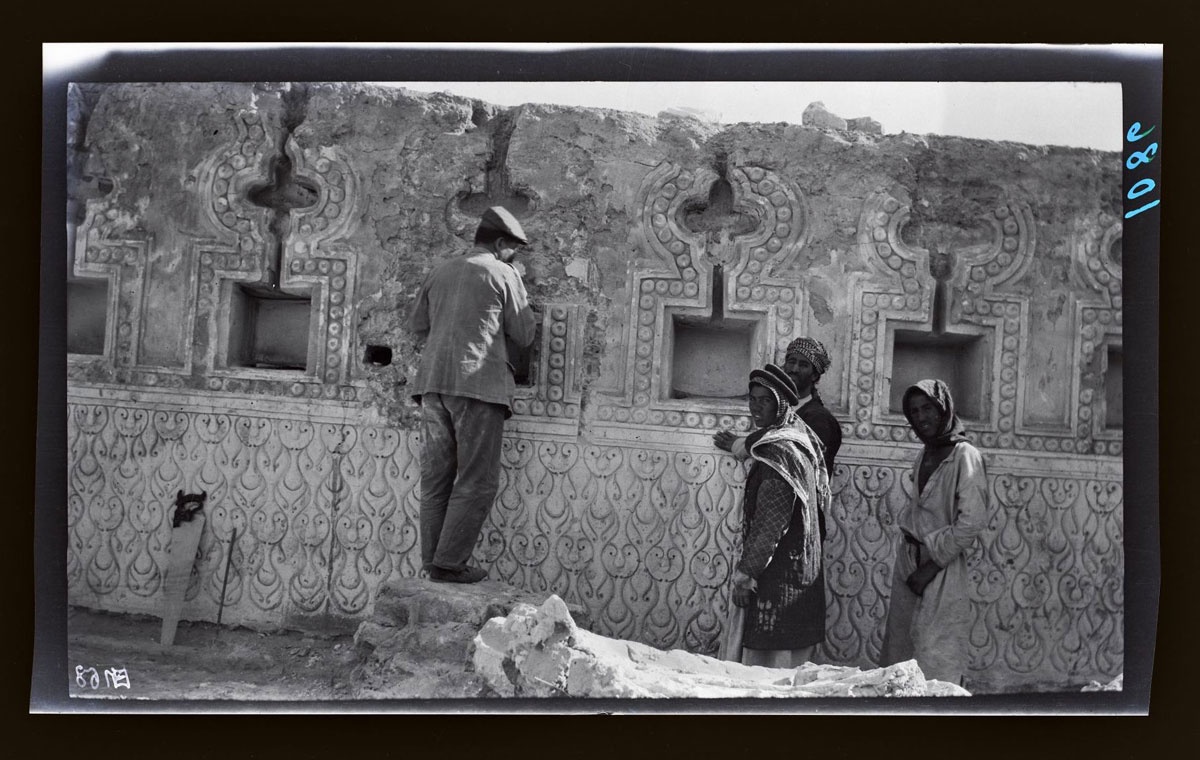
Figure 3
Bartus removing wall decoration, Samarra, 1912. SMB, Museum für Islamische Kunst, Pl. Sam 1086.
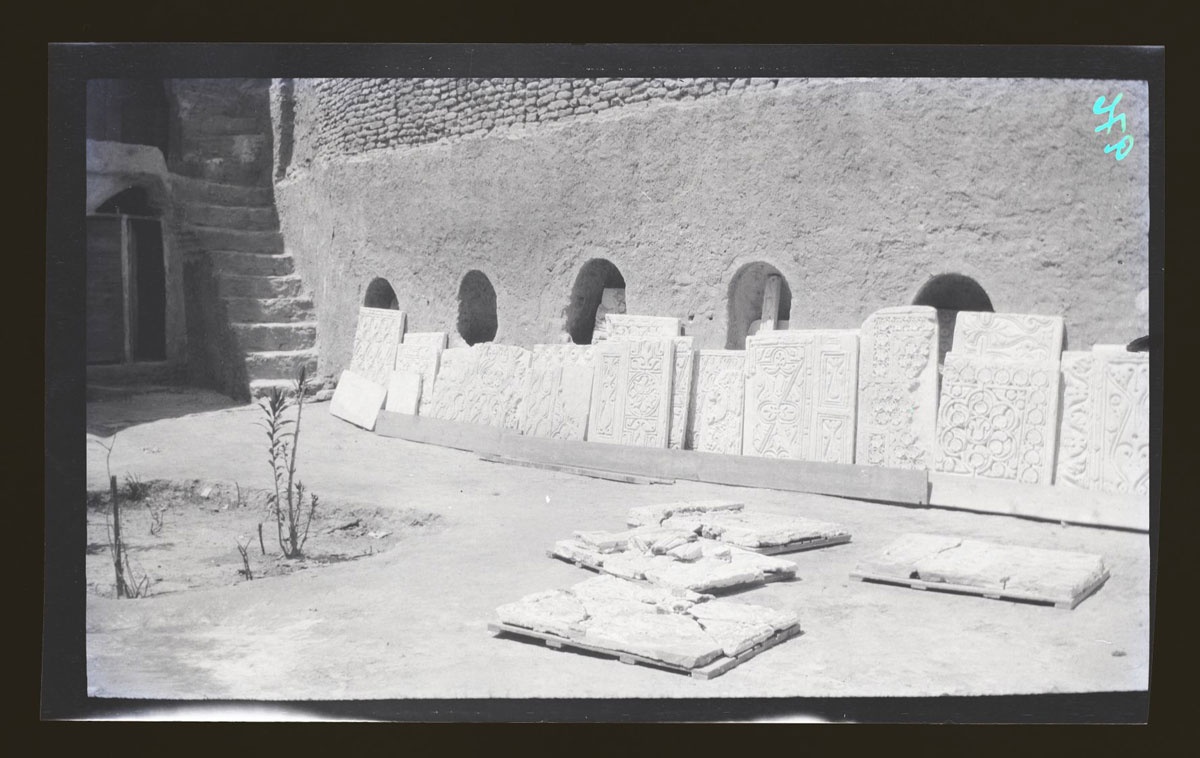
Figure 4
The removed wall decorations and casts, Samarra, 1912. SMB, Museum für Islamische Kunst, Pl. Sam 976.
In the letter, previously unknown to scholarship, which we referred to at the beginning of this article, Herzfeld outlined to the General Administration his strategy of producing casts as a means to deceive Halil Edhem and the Ottoman Antiquities Administration:
‘I am fairly confident that we shall succeed in exchanging the originals for the casts, thereby adding a great treasure to the Berlin museums. I intend to write to Halil Bey [to say] that for the mouldings the originals would have to be removed and [in doing so] would be partially ruined. However, without this [happening], they would by no means survive the next winter. Since two casts can easily be produced from a single mould, it would be easy to make a second cast at once for Constantinople: He should let me know whether he wishes this and, if necessary, make arrangements for the transport. If he agrees to this, as I expect, he will of course receive the casts of which we will make only one copy, and we take the moulds and the originals. People here can hardly tell them apart anyway.’45
The quote again reveals Herzfeld’s condescending attitude toward the local officials and suggests that the production of casts was initially intended to conceal the unlawful appropriation of the originals. This practice of deceiving the Ottoman authorities is further attested by other reports.46
Additional evidence, drawn from Herzfeld’s correspondence with his colleagues Meyer, von Oppenheim and Carl Heinrich Becker (1876–1933), complements the intended strategies of smuggling. In a letter to Meyer in September 1911, he wrote:
‘In addition to the moulds I hope to bring many originals to Berlin. After everything I have experienced here, I do not feel morally hindered by the inherently foolish Turkish Antiquities Law.’47
This quotation, which had remained unknown to previous scholarship, clearly reveals the intentional disregard of the antiquities legislation.
Preparing for the second excavation campaign in March 1912, Sarre still hoped for Halil Edhem’s export permit for the original wall decoration.48 Herzfeld, however, in a letter to Oppenheim, ruled out any possibility of legal export:
‘We had such extraordinarily rich finds that decisive action was necessary. Any question of partial export […] was out of the question given Halil’s lack of energy and the terrible sentiment of the Young Turks towards us. Ultimately, I thus don’t see any legal way of obtaining anything.’49
By June 1912, the General Administration of the Berlin Royal Museums had approved Herzfeld’s strategy:
‘[A]fter consultation with Bode and Wiegand, the problem remains the same: the originals must be declared and exported as casts.’50
However, the deception of the Ottoman authorities is not only evident in the case of the wall decorations, but also in relation to numerous other valuable, smaller artefacts.51 For instance, Herzfeld deliberately withheld certain artefacts from the Ottoman commissioner overseeing the excavation, keeping them out of sight.52 In March 1912, Herzfeld outlined another bold strategy for concealing artefacts from the authorities in a letter to Oppenheim:
‘In Sam[arra], I have retained our house, where some of the finds have been securely walled in, to protect them from the Turkish authorities.’53
This practice of removing and concealing objects may account for the discrepancy between the 1,161 objects recorded in Herzfeld’s personal records and the 1,004 finds documented by the Ottoman authorities.54
However, the most obvious breach of the Ottoman Antiquities Law and the Samarra excavation permits occurred when artefacts were transported to Berlin. This is the case for the shipment of some of the ‘best pieces.’55 In September 1911, Herzfeld wrote that he had sent two particularly valuable and almost completely restorable faience bowls ‘secretly’ to Berlin as registered letters.56 In addition to these ‘museum pieces in the best sense,’ he also sent the fragments of a third bowl, which he described as ‘the most beautiful ceramic that I know of.’57 Since the export was carried out ‘secretly,’ it is reasonable to conclude that Herzfeld smuggled artefacts without Ottoman permission.58 Ten years after the excavation, Herzfeld freely admitted in a report to the Prussian Cultural Ministry that he had ‘secretly exported a whole series of small finds, especially ceramics, to which there was no claim whatsoever.’59
In March 1913, Herzfeld sent three boxes to Berlin containing, among other things, pieces of pottery and painted wall plaster, the arrival of which was confirmed by Sarre.60 Finally, in May 1913, 34 boxes weighing more than 6 tonnes were shipped by sea to Hamburg. This considerable shipment included both originals and casts of the wall decorations as well as a range of smaller artefacts.61 While the shipment appears to have undergone some form of legal export procedure, it remains unclear whether the Ottoman authorities were aware of the full extent of the transport, or whether they were misled into believing that the cargo contained only copies rather than originals.62 As indicated in his diary, Herzfeld had waited for the end of the excavation, as an earlier export would have endangered the excavation itself.63
The export of finds to the German Empire before the completion of the two excavation campaigns is therefore well documented. Nevertheless, in May 1922, Herzfeld claimed that ‘all finds had been handed over to the Turkish authorities upon completion of the work.’64 Unless contrary evidence emerges, this article documents that, in light of the explicitly cited passages above, the exports were deliberately and illegally orchestrated.
The only known evidence of an official export licence is a letter from Halil Edhem to Herzfeld preserved in the Samarra Archive. As direct access to the original letter was denied, we cite it here from Kröger and emphasise the limited evidentiary value of this incomplete passage:
‘You request specimens of marble paving, stucco with paint and ceramics to be sent to Berlin for technical examination; I have given instructions on this matter to the Director of Public Instruction in Baghdad and to your Commissioner. Please be so kind as to select these pieces and show them to the Director of Public Instruction, who will draw up a list and give you these fragments to be shipped.’65
This document authorised the export of a limited number of objects for technical examination in Berlin. The wording does not suggest a transfer of ownership in the form of a donation. This is further substantiated by an Ottoman document cited in Terzi’s study, which indicates that the Ottoman authorities agreed to lend the finds to the excavators on the grounds of their reliability in ensuring their return.66 In another letter dated 1921, Halil Edhem confirmed that he had authorised the export of ‘material samples from Samarra for technical examination in Berlin.’67 Once again, Halil Edhem’s authorisation was explicitly limited to this specific, temporary purpose and did not constitute a transfer of ownership. The evidence suggests that the artefacts remained the property of the Ottoman state and were therefore only on loan,68 and further shows that they never reached Berlin before the First World War, ultimately becoming part of the Istanbul collection.69 Thus, ironically, the only artefacts for which an export license had been granted never left the Ottoman Empire.
Justifying Ownership
In contrast, the finds remaining in Samarra at the end of the excavation in July 1913 followed a different trajectory: they were drawn into the turmoil of the First World War and the imperial reorganisation of the Ottoman Empire. In 1917, the British Empire occupied Iraq and, with the establishment of the ‘War Trophy Committee’, seized cultural artefacts for the museums of the British Empire.70 From 1921, Iraq was administered under a British mandate. That same year, the Samarra finds were shipped to London in 79 boxes and stored at the British Museum.71 In London, Herzfeld examined the collection in 1921 and recommended that parts be distributed among Samarra, Istanbul, and Berlin, the latter receiving eight boxes in 1922.72 However, Istanbul and Samarra were left out.73 As a result, Berlin came into possession of Samarra artefacts that were seized by the British Empire as spoils of war. This London ‘detour’ underscores the shift in imperial power relations after the First World War. Before 1914, German archaeologists had to negotiate with Ottoman officials in Istanbul and Samarra; in 1921, the redistribution of Samarra artefacts was decided in London, without Ottoman or Iraqi participation. In the aftermath of the war, the cultural heritage from the former Ottoman territory itself had become a token of imperial bargaining.
As the discussions in London unfolded, questions emerged about the legality of the Berlin finds. In a report to the Prussian Cultural Ministry from May 1922, Herzfeld stated that the Ottoman Antiquities Law had prohibited the export of finds and that the ‘special circumstances’ had made it impossible ‘to obtain even a part for the excavators.’74 While Herzfeld conceded that finds had been exported without authorisation, he claimed that Sarre had subsequently secured authorisation for the export of the wall decorations and the remaining finds.75 The primary purpose of these retrospective authorisations was to support claims of ownership in the London negotiations over the remaining material.76 Herzfeld himself emphasised that in the discussions at the British Museum, he could refer only to ‘rather vague promises’ of the Ottoman government.77
Nevertheless, previous studies have referred to these ‘retrospective authorisations’, seemingly implying that the transfer to Berlin was legal.78 Although any such authorisations would do little to cast the illicit export in a more favourable light, they remain of central importance for assessing the legal status of the artefacts. Documents produced during the Samarra excavations offer no indication that an attempt was ever made to legitimise the exports retrospectively, and later evidence for the actual existence of such authorisations is scant, though not entirely absent. Apart from Herzfeld’s report, the only reference to a retrospective authorisation for some of the finds in Berlin appears in a 1921 letter from Sarre to Wiegand:
‘With regard to Samarra, I discussed the matter with Halil: he knows that I have original pieces of ceramics etc. here, and has subsequently given his consent to this.’79
As documentary evidence for any Ottoman approval is missing, this passage raises more questions than it answers. Which ceramics was Halil Edhem aware of? Did he know of the entirety of the Samarra collection in Berlin, including the original wall decorations? In what manner did he give his consent, and would such approval be legally binding? In any case, given the substantial documentation of smuggling and legal infringement presented in this article, it seems highly questionable to invoke such anecdotal evidence to justify the substantial unauthorised export of artefacts to Berlin.
As outlined in the introduction, publications related to the Berlin museums often explain the presence of Samarra finds in their collections by reference to a division of finds allegedly stipulated in the so-called ‘secret agreement’ of 1899. Sebastian Willert has convincingly demonstrated that this agreement did not constitute a legally binding right for Germany to obtain artefacts, but rather represented a concession granted by the Ottoman authorities.80 Moreover, discussions surrounding the 1906 Antiquities Law indicate that the Ottoman Antiquities Administration was largely unaware of any such agreement, casting serious doubt on its validity.81
Crucially, with regard to Samarra, Sarre and Herzfeld—despite actively seeking ways to obtain artefacts—never at any moment before, during, or after the excavations referenced a division of finds, nor did they invoke the 1899 ‘secret agreement’ as justification for their claims. Equally, Arzu Terzi’s article, which reconstructs the excavations from the perspective of the Ottoman administration, makes no mention of a division of finds between Istanbul and Berlin, nor of any agreement other than the actual excavation permissions which, as shown above, stated that the finds belong entirely to the Ottoman Imperial Museum. In fact, when in 1914, Bode and Wiegand attempted to rely on the 1899 ‘secret agreement’ to claim artefacts in the context of the Boğazköy excavation, Halil Edhem explicitly dismissed the notion, noting that it was pointless to respond to the German request: ‘The Germans themselves are well aware that this so-called treaty rests on no solid foundation.’82 Based on the documentation presented here, any claim of a legal division of finds is unsupported and must therefore be regarded as lacking scholarly foundation.
Archival Gatekeeping
Recognising the need to clarify the legality of museum acquisitions derived from archaeological excavations, the SMB appears to have shifted away from the narrative of a lawful transfer of Samarra finds to Berlin. From March 2023 to August 2025, the project ‘Legal – illegal?’ has been investigating the history of three German excavations in the Ottoman Empire, including Samarra. Preliminary reports and a first article suggest that legal issues have been identified, though not addressed with full clarity.83 A central objective of the project is to develop guidelines for researching the provenance of archaeological collections originating from problematic excavations.84
This development reflects a growing consensus that the histories of collections and the circumstances under which objects were acquired require more rigorous investigation.85 This consensus, however, rests on fragile ground within an otherwise polarised debate. The most contentious issues concern questions of ownership and the legitimacy of restitution. As the denial of archival access in our case demonstrates, disputes also extend to the very conduct of provenance research itself—particularly regarding access to archival materials, the interpretation and presentation of research outcomes, and the question of who should be entrusted with conducting such work.
In Germany, provenance research is carried out primarily by museum and library staff, usually within the framework of temporary projects. Internal provenance research offers practical advantages, as curators possess detailed knowledge of collections and have direct access to objects and acquisition records. However, our findings indicate that provenance studies conducted exclusively within institutional frameworks carry certain risks: for an extended period, the museum advanced unsubstantiated claims regarding the legality of their museum holdings, even after research had produced initial evidence to the contrary.
In light of this, the exclusion of external or independent researchers from key archival material on the grounds of ‘internal research’ appears all the more problematic—particularly since our case is by no means an isolated one. With regard to ethnological collections, several German museums refused archival access to Glenn Penny in the 1990s. Penny recalls regarding the SMB:
‘The director of Berlin’s Museum für Völkerkunde in Dahlem, for example, told me that he had an employee working on the history of their museum, and he did not want that person to face any competition. So, he would not let me see the documents. That was an interesting dodge.’86
In recent years, growing public pressure has compelled museums to make their collection histories increasingly transparent. In Germany, the 2019 open letter ‘Open the inventories!’, led to the online publication of the SMB’s acquisition books.87 Responding to public pressure, the ethnological collections have taken a leading role, digitising their archival holdings and making them available online.
By contrast, access to the archives of the archaeological collections in Berlin remains restricted. Sebastian Willert was denied access to several holdings in the SMB Central Archives as well as to the archive of the German Orient Society (DOG), with the reason given that the material was reserved for internal research.88 Similarly, Mirjam Brusius reported in the Süddeutsche Zeitung that archival holdings from the Babylon excavations, whose finds are part of the SMB, were once again declared inaccessible citing the same justification.89 While further instances are likely, the documented refusals already point to a recurring practice.
Although an SMB position paper declares the institution’s aim to share ‘as much existing knowledge as possible in museums’ and to ensure ‘the transparency of the provenance of archaeological artefacts’,90 the denial of access to external researchers directly contradicts this commitment.91 In practice, it restricts external perspectives on the history of the collections and thus narrows public discussion regarding their provenance.
When our request to access the Samarra archive was denied, we were uncertain whether relevant material could be located elsewhere or whether it would be meaningful to continue our research. At the same time, we consulted peers and senior scholars, all of whom shared our surprise and concern. With the support of a supervisor, we contacted the archive in the hope of having the decision reconsidered, but without success. Nevertheless, we were able to continue our research thanks to the support of other scholars, our general familiarity with German archives, and the absence of language and administrative barriers. When we later decided to publish our findings and openly address the denial of archival access, we were cautioned that, as early-career researchers, we might incur opportunity costs and face potential repercussions for our future prospects. This advice pointed to the broader problem faced by external provenance researchers, who may be compelled to critique the very institutions upon which they depend for employment, archive access, and professional networks.
These structural dependencies become even more pronounced for researchers from the Global South, who often depend on institutions in the Global North for archival access and funding. For such scholars, raising critical questions about institutional practices can entail greater professional and personal risks. Moreover, access to archives held in the Global North is frequently obstructed by additional language and administrative barriers, including lengthy and often unpredictable visa procedures. In practice, these asymmetries further narrow the range of voices able to participate in provenance debates, reinforcing existing inequalities in knowledge production.
This case study, therefore, illustrates a systemic problem within provenance research. Despite public commitments to transparency, museums continue to grapple with entrenched institutional logics, vested interests, and the burden of their own problematic legacies. For provenance research to serve as a genuinely critical instrument of historical accountability, open and equitable archival access must be recognised as a foundational requirement: archival materials must be made more widely available, including in digital form. External researchers—especially those from countries and societies of origin—should not only be systematically included in provenance projects but should also be able to shape them independently. Without such structural changes, the reassessment of collection histories remains incomplete and risks reproducing the very inequalities and exclusions that critical provenance research seeks to address.
Notes
[1] Alastair Northedge, “Ernst Herzfeld, Samarra, and Islamic Archaeology,” in Ernst Herzfeld and the Development of Near Eastern Studies 1900–1950, ed. Ann Gunter and Stefan Hauser (Brill, 2005).
[2] Jens Kröger, “Ernst Herzfeld and Friedrich Sarre,” in Ernst Herzfeld and the Development of Near Eastern Studies 1900–1950, ed. Ann Gunter and Stefan Hauser (Brill, 2005).
[3] Smithsonian Institute, Freer Gallery of Art and Arthur M. Sackler Gallery Archives, Ernst Herzfeld Papers, FSA A.06 07.01: S-1: “Samarra Fundjournal”.
[4] Ernst Herzfeld, Der Wandschmuck der Bauten von Samarra und seine Ornamentik, Die Ausgrabungen von Samarra, 1, Forschungen zur Islamischen Kunst, II (Dietrich Reimer Verlag, 1923); Thomas Leisten, Excavations of Samarra. Architecture. Final Report of the First Campaign 1910–1912, Baghdader Forschungen 20 (Philipp von Zabern, 2003), 1:29; Simone Struth, “Nur Dekor? Die abbasidischen Stuckarbeiten von Samarra. Vergleichende transregionale, material- und medienübergreifende Analyse” (PhD thesis, Otto-Friedrich-Universität Bamberg, 2024).
[5] Claus-Peter Haase, “Das Museum für Islamische Kunst und seine Sammler. Frühe Begegnungen mit der islamischen Kunst – das Bild des Orients und das Fremde,” in Zum Lob der Sammler. Die Staatlichen Museen zu Berlin und ihre Sammler, ed. Andrea Bärnreuther and Peter-Klaus Schuster (Nicolaische Verlagsbuchhandlung GmbH, 2009), 129.
[6] “Samarra – Centre of the World: 101 Years of Archaeological Research on the Tigris, 18 January 2013 to 26 May 2013,” Pergamon Museum Berlin, n.d., accessed November 2, 2025, https://www.smb.museum/en/exhibitions/detail/samarra-centre-of-the-world/.
[7] ‘Especially through a treaty in 1899 it was possible to not only excavate and take the objects to the newly founded Imperial Museum of Istanbul but to take half of the objects with them due to the special relationship with the Ottomans.’ Samarra – Zentrum Der Welt: 100 Und 1 Jahr Archäologische Forschung Am Tigris – Teil 6, https://www.youtube.com/watch?v=Sc393CozJFY.
[8] Miriam Kühn and Martina Müller-Wiener, Lüsterkeramik, Schillerndes Geheimnis (Michael Imhof Verlag, 2022), 16.
[9] “International Research & Cooperation 2010–2020,” SMB, Museum of Islamic Art, 2021, https://islamic-art.smb.museum/wp-content/uploads/2022/03/Web_Bro_Research-Cooperation.pdf.
[10] Rebecca M. Lindsey, “Ernst Emil Herzfeld (1879–1948) in Samarra,” New York: The Metropolitan Museum of Art, Heilbrunn Timeline of Art History, May 2016, https://www.metmuseum.org/toah/hd/herz/hd_herz.htm.
[11] Leisten, Excavations of Samarra. Architecture, 1:29; Jens Kröger, “Chronik Der Ausgrabungen von Samarra 1911–1913. Eine kulturhistorische Studie zur Forschungs- und Förderungsgeschichte der islamischen Archäologie Im 20. Jahrhundert.,” in Beiträge zur Islamischen Kunst und Archäologie, ed. Julia Gonella et al., 4 (Dr. Ludwig Reichert Verlag, 2014), 290–91. In earlier publications, Kröger also referred to a division of finds; a point he did not reiterate in his 2013 publication, Jens Kröger, “Die Ausgrabungen in Samarra 1911–1913,” in Islamische Kunst in Berliner Sammlungen. 100 Jahre Museum für Islamische Kunst in Berlin, ed. Jens Kröger and Desirée Heiden (Parthas Verlag, 2004), 145; Jens Kröger, “Friedrich Sarre und die islamische Archäologie,” in Das große Spiel: Archäologie und Politik zur Zeit des Kolonialismus (1860–1940), ed. Charlotte Trümpler (DuMont, 2008), 281.
[12] Northedge, ‘Ernst Herzfeld, Samarra, and Islamic Archaeology’; Kröger, ‘Ernst Herzfeld and Friedrich Sarre’; Kröger, ‘Friedrich Sarre und die islamische Archäologie’; Christoph B. Konrad, ‘Die Funde der Grabung Ernst Herzfelds 1911–1913 aus Sāmarrā’, in Beiträge zur Islamischen Kunst und Archäologie, 1 (Dr. Ludwig Reichert Verlag, 2008); Filiz Çakır Phillip, ‘Ernst Herzfeld and the Excavations at Samarra’, in Scramble for the Past. A Story of Archaeology in the Ottoman Empire 1753–1914, ed. Zainab Bahrani et al. (Salt, 2011); Arzu Terzi, ‘Samarra Excavations in Ottoman Bureaucracy’, in Beiträge zur Islamischen Kunst und Archäologie, ed. Julia Gonella et al., 4 (Dr. Ludwig Reichert Verlag, 2014).
[13] Zainab Bahrani et al., eds, Scramble for the Past: A Story of Archaeology in the Ottoman Empire 1753–1914 (Salt, 2011); Alev Koçak, The Ottoman Empire and Archaeological Excavations: Ottoman Policy from 1840–1906, Foreign Archaeologists, and the Formation of the Ottoman Museum (The Isis Press, 2011); Günay Uslu, ‘Homer, Troy and the Turks: Heritage and Identity in the Late Ottoman Empire, 1870–1915’ (PhD thesis, Amsterdam University, 2017).
[14] Charlotte Trümpler, ed., Das große Spiel: Archäologie und Politik zur Zeit des Kolonialismus (1860–1940) (DuMont, 2010); Suzanne L. Marchand, German Orientalism in the Age of Empire: Religion, Race and Scholarship (Princeton University Press, 2009).
[15] Zeynep Çelik, About Antiquities: Politics of Archaeology in the Ottoman Empire (University of Texas Press, 2016); Artemis Papatheodorou, ‘Ottoman Policy-Making in An Age of Reforms: Unearthing Ottoman Archaeology in the 19th and Early 20th Centuries’ (PhD thesis, University of Oxford, 2017).
[16] Sebastian Willert, Kulturbesitz: Konflikte um archäologische Objekte in der deutsch-osmanischen Politik 1898–1918 (Wallstein Verlag, 2024).
[17] We quote documents from: Zentralarchiv der Staatlichen Museen zu Berlin (SMB-ZA), Geheimes Staatsarchiv Preußischer Kulturbesitz Berlin (GStA), Berlin-Brandenburgische Akademie der Wissenschaften (BBAW), Stiftung Rheinisch-Westfälisches Wirtschaftsarchiv zu Köln (RWWA), Staatsbibliothek zu Berlin (SBB-PK), T.C. Cumhurbaşkanlığı Devlet Arşivleri Başkanlığı Istanbul (BOA), Türk Tarih Kurumu Arşivi Ankara (TTK Arşivi), and the Freer Gallery of Art and Arthur M. Sackler Gallery Archives, Smithsonian’s National Museum of Asian Art Washington D.C. (FSA Archives).
[18] SMB-ZA I/IM, 15, fol. 76, Copy of a letter from Sarre regarding the Samarra excavation, 16 December 1910.
[20] Antiquities Law, 23 April 1906, Article IV. The Law is cited in: https://transllegisl.hypotheses.org/uebersicht/osmanisches-reich-10-04-1907. See also Koçak, The Ottoman Empire and Archaeological Excavations, 160–62; Willert, Kulturbesitz, 212–35.
[21] Sebastian Willert, ‘The Invention of ‘National Antiquities’ in the Late Ottoman Empire. Archaeological Interrelations between Discourses of Appropriation, Preservation and Heritage Construction’, Diyâr 2 (2021): 315, https://doi.org/10.5771/2625-9842-2021-2.
[22] Willert, Kulturbesitz, 267–68. This development culminated in 1914 with the founding of today’s Turkish and Islamic Arts Museum Istanbul, where some Samarra finds are displayed.
[23] SMB, Samarra-Archiv, Sarre to Bode, 22 August 1910, cited in Kröger, ‘Chronik der Ausgrabungen von Samarra’, 290.
[24] SMB-ZA, I/IM 15, fols. 93–95, Bode to the Prussian Ministry of Spiritual, Educational, and Medical Affairs (hereafter: Prussian Cultural Ministry), 28 March 1911.
[26] Bode characterised the excavation as a ‘private expedition funded by the state,’ SMB-ZA, I/IM 15, fols. 93–95, Letter Bode to the Prussian Cultural Ministry, 28 March 1911; SMB, Samarra-Archiv, Sarre to Bode, 22 August 1910, cited in Kröger, ‘Chronik der Ausgrabungen von Samarra’, 290.
[27] SMB, Samarra-Archiv, Sarre to Bode, 22 August 1910, cited in Kröger, ‘Chronik der Ausgrabungen von Samarra’, 290.
[28] ‘Āsār-ı ʿ Atīḳa Niẓāmnāmesi aḥkāmına tevfīḳan iḫrāc olunacaġı āsār-ı ʿatīḳa kāmilen devlet-i ʿ aliyye müzesine ʿ āʾ id olacak.’ Permission for the first Samarra excavation, see BOA, Müze-i Hümāyūn Müdüriyetli, 68/2, 18 August 1910. See also Terzi, ‘Samarra Excavations in Ottoman Bureaucracy’, 16. The exact same wording is repeated in the permission for the second Samarra excavation BOA, Müze-i Hümāyūn Müdüriyetli, 68/3, 6 May 1912. See also Terzi, ‘Samarra Excavations in Ottoman Bureaucracy’, 17. We would like to thank Nimet İpek for deciphering parts of the document.
[29] SMB, Samarra-Archiv, Sarre to Wiegand, 16 October 1910, cited in Kröger, ‘Chronik der Ausgrabungen von Samarra’, 290.
[31] SMB, Samarra-Archiv, Hesse an Herzfeld, 10 January 1911, cited in Kröger, ‘Chronik der Ausgrabungen von Samarra’, 266.
[34] Herzfeld reported that relations had been ‘very cold’ and that ‘there was still some resistance to overcome before we could begin digging.’ BBAW, Nachlass Eduard Meyer, Herzfeld to Meyer, Samarra, 23 January 1911.
[35] BBAW, Nachlass Eduard Meyer, Herzfeld to Meyer, Samarra, 30 December 1911; Stiftung Rheinisch-Westfälisches Wirtschaftsarchiv zu Köln, Nachlass Max von Oppenheim, Nr. 229, Schriftwechsel Grabung Tell Halaf, Herzfeld to Max von Oppenheim, Samarra, 25 October 1911.
[38] SBB-PK, Generaldirektion, Handakten Krüss: Kaiser-Wilhelm-Gesellschaft, Allgemeines (I.2 1910–1912), Bl. 108–110, Sarre to Adolf von Harnack, Report of the excavation in Samarra, Baghdad, 9 January 1912.
[39] Ernst Herzfeld, Erster vorläufiger Bericht über die Ausgrabungen von Samarra (Dietrich Reimer Verlag, 1912), 15.
[41] Albert von LeCoq, Auf Hellas Spuren in Ostturkistan: Berichte und Abenteuer der II. und III. deutschen Turfan-Expedition (Hinrichs, 1926), 116.
[42] SMB, Samarra-Archiv, Herzfeld to Sarre, 19 October 1911, cited in Kröger, ‘Chronik der Ausgrabungen von Samarra’, 286.
[43] A photograph from the excavation, for instance, suggests that casts could be produced with the decoration still in place, SMB, Museum für Islamische Kunst, Pl. Sam. 459, https://id.smb.museum/object/2752591.
[44] In letters to Bode, Herzfeld reported that the ‘removed parts were always broken’ into ‘often very small fragments’, from which only ‘massive fragments’ were collected, SMB, Samarra-Archiv, Herzfeld to Bode, Samarra, 17 October 1911, cited in Kröger, ‘Chronik der Ausgrabungen von Samarra’, 286–87.
[45] SMB-ZA I/IM, 16, fols. 141–143, Report by Herzfeld to the General Administration of the Berlin Royal Museums, Samarra, 9 October 1911.
[46] ‘For each such packed cast and for every bundle of packed fragments, a good piece disappears into a box as an alleged plaster cast. […] I strongly hope that we shall be able to export everything truly good as a plaster cast.’ SMB-ZA, Samarra-Archiv, Herzfeld to Sarre, Samarra, 19 October 1911, cited in Kröger, ‘Chronik der Ausgrabungen von Samarra’, 287.
[48] ‘Halil refuses for the time being to hand over originals of our [sic!] stucco walls from Samarra, but told me on parting that he would think the whole thing over.’ SMB, Samarra-Archiv, Sarre to Wiegand, 26 March 1912, cited in Kröger, ‘Chronik der Ausgrabungen von Samarra’, 290.
[49] RWWA, Nachlass Max von Oppenheim, Nr. 229, Schriftwechsel Grabung Tell Halaf, Herzfeld to Oppenheim, Berlin, 3 March 1912.
[51] Leisten, Excavations of Samarra. Architecture, 1:29; Kröger, ‘Chronik der Ausgrabungen von Samarra’, 290–91.
[52] ‘The commissioner has indeed seen the sherds, but he does not know that they belong together and has absolutely no idea of their value. I hope, on the occasion of the forthcoming change of commissioner, to make the sherds disappear.’ SMB, Samarra-Archiv, Herzfeld to Sarre, June 30 1911, cited in Leisten, Excavations of Samarra. Architecture, 1:200.
[53] RWWA, Nachlass Max von Oppenheim, Nr. 229, Schriftwechsel Grabung Tell Halaf, Herzfeld to Oppenheim, Berlin, 3 March 1912.
[58] This also applies to the shipment of ‘samples of pre-Islamic pottery’ Herzfeld sent from Samarra to Oppenheim at Tell Halaf in April 1913, Willert, Kulturbesitz, 372. Finds—especially less intact ceramics—were often destroyed in transit to Berlin. Theodor Bartus exported an unspecified quantity of finds on his return from Samarra in 1912. See Kröger, ‘Chronik der Ausgrabungen von Samarra’, 261, 291. Similarly, Fritz Ludloff brought two boxes of finds to Berlin. See FSA Archives, Ernst Herzfeld Papers, FSA.A.06/07/S-9, Tagebuch Samarra 2te Campagne, p. 46, 20 February 1913.
[59] SMB-ZA I/IM, 16, fols. 88–89, Copy of a report by Herzfeld to the Prussian Cultural Ministry, 1 May 1922.
[61] ‘The 34 boxes contained 100 wall decorations (originals and casts) and 17 boxes each with two wall paintings, together with small finds. In total, the crates weighed more than six tonnes when they arrived on the Westphalia on 8 September 1913.’ See Kröger, ‘Chronik der Ausgrabungen von Samarra’, 291.
[62] FSA Archives, Ernst Herzfeld Papers, FSA.A.06/07/S-9, Tagebuch Samarra 2te Campagne p. 71, 26 May 1913.
[63] ‘Any attempt to transport the decorations could endanger both the continuation of the excavation and the decorations themselves. It should only be undertaken once the excavation is complete and high-quality moulds and casts of all originals truly exist.’ FSA Archives, Ernst Herzfeld Papers, FSA.A.06/07/S-6, Samarra Tagebuch 1, p. 67, 3 December 1911.
[64] SMB-ZA I/IM, 16, fols. 88–89, Copy of a report by Herzfeld to the Prussian Cultural Ministry, 1 May 1922.
[65] SMB, Samarra-Archiv, Halil Edhem to Herzfeld, 9/22 March 1922, cited in Kröger, ‘Chronik der Ausgrabungen von Samarra’, 292, footnote 374. Material analyses were carried out in the spring of 1914, SMB-ZA I/IM, 2, fols. 10–16.
[66] ‘The ancient finds to be sent would definitely not get lost since Prof. Sarre and Dr. Herzfeld are highly respected and trustworthy persons.’ Translation in Terzi, ‘Samarra Excavations in Ottoman Bureaucracy’, 14.
[67] SMB, Samarra-Archiv, Halil Edhem to Herzfeld, 20 August 1921, cited in Kröger, ‘Chronik der Ausgrabungen von Samarra’, 292.
[68] The case recalls the Christian manuscripts from the Qubbat al-khazna, sent to Berlin in 1902 as a loan for scholarly examination. As with the Samarra finds, a formal handover protocol was drafted, and the manuscripts were declared state property. While the German scholars construed the loan as a donation, Ottoman authorities in Istanbul and Damascus demanded their return. Only after renewed pressure did the German side relinquish its delaying tactics and sent the materials to Istanbul. The case illustrates how temporary loans were used as instruments of de facto appropriation of cultural property. See Cüneyd Erbay and Konrad Hirschler, “Writing Middle Eastern Agency into the History of the Qubbat al-Khazna: The Late Ottoman State and Manuscripts as Historical Artefacts,” in The Damascus Fragments: Towards a History of the Qubbat al-Khazna Corpus of Manuscripts and Documents, ed. Arianna D’Ottone Rambach et al. (Ergon-Verlag, 2020).
[69] Terzi, ‘Samarra Excavations in Ottoman Bureaucracy’, 14; Kröger, ‘Chronik der Ausgrabungen von Samarra’, 292.
[70] Magnus Bernhardson, Reclaiming a Plundered Past: Archaeology and National Building in Modern Iraq (University of Texas Press, 2005), 74–76.
[73] The British Museum exchanged the remaining finds with 17 institutions worldwide, notably the Victoria and Albert Museum and the Louvre. See Bernhardson, Reclaiming a Plundered Past, 83.
[74] SMB-ZA I/IM, 16, fols. 88–89, Copy of a report by Herzfeld to the Prussian Cultural Ministry, 1 May 1922.
[75] ‘At the time, I passed off a large number of casts as originals, and Professor Sarre, through his good relations with the Ottoman museums, subsequently obtained official permission for this. […] I had also, unofficially, exported a considerable number of small finds, especially ceramics, for which there was no entitlement whatsoever; for these too, Professor Sarre later secured retrospective authorisation.’ SMB-ZA I/IM, 16, fols. 88–89, Copy of a report by Herzfeld to the Prussian Cultural Ministry, 1 May 1922.
[76] For a similar incident, see İdris Yücel, “Between Science and Empire: The Diplomatic Struggle over Mesopotamian Antiquities in Lisbon (1914–1926),” Mediterranean Historical Review 31, no. 2 (2016): 171–73, https://doi.org/10.1080/09518967.2016.1234105.
[77] SMB-ZA I/IM, 16, fols. 88–89, Copy of a report by Herzfeld to the Prussian Cultural Ministry, 1 May 1922.
[79] SMB, Samarra-Archiv, Sarre to Wiegand, 9 December 1921, cited in Kröger, ‘Chronik der Ausgrabungen von Samarra’, 288.
[82] TTK Arşivi, Halil Ethem Eldem Koleksiyonu, comment below a letter from Bode, Berlin, 9 May 1914.
[83] Stefanie Janke, “Von Samarra nach Berlin: Die Wege der Stuckdekorationen von der Kalifenresidenz in Samarra zur Islamischen Abteilung der Königlichen Museen in Berlin,” Museum für Islamische Kunst – Sammlungsgeschichte, 10 April 2024, https://islamic-art.smb.museum/story/from-samarra-to-berlin; Mustafa Kemal Baran et al., “Wie kamen die Objekte ins Museum?,” Antike Welt, 2025; Stefanie Janke, “»von allen Gattungen ein gutes Specimen«: Mechanismen der Translokation von Objekten der Samarra-Ausgrabungen 1911–1913 an die Spree,” Jahrbuch der Berliner Museen 65 (2025), https://doi.org/10.57894/jbm.2024.1.114353. The latter was published in December 2025, after submission of the present article, and could therefore not be taken into account. Drawing on material from the Samarra Archive, it confirms and partly complements several of our findings. However, by again invoking retrospective authorisations, it does not conclusively clarify the legal status of the finds now in Berlin, leaving significant questions unresolved.
[84] See the project description: https://www.smb.museum/en/museums-institutions/zentralarchiv/research/provenance-research/legal-illegal-the-circumstances-of-the-excavation-and-export-of-archaeological-objects-from-samal-didyma-and-samarra/.
[85] Jakob Wigand, “Unearthed, Smuggled and Decontextualized: Carl Schmidt and the Provenance of Hamburg’s Papyrus Bilinguis 1,” Philological Encounters 9, nos 3–4 (2024): 224–60, https://doi.org/10.1163/24519197-bja10055; Vincent Engelhardt, “From Private Libraries in Late Ottoman Palestine to ‘Abandoned Property’: Reconstructing the Dajānī Family Manuscript Collections in the National Library of Israel,” Manuscript Studies: A Journal of the Schoenberg Institute for Manuscript Studies 10, no. 2 (2025): 395–456, https://doi.org/10.1353/mns.2025.a974089.
[86] H. Glenn Penny, In Humboldt’s Shadow: A Tragic History of German Ethnology (Princeton University Press, 2021), 179.
[87] Publishing the Acquisition and Accession Logs of the SMB Online, https://www.smb.museum/en/research/research-projects/provenance-and-collections/ (last seen: 20 August 2025).
[89] Mirjam Brusius, “Hand in Hand – Wissenschaft und Museen dekolonisieren,” Süddeutsche Zeitung, 26 January 2024, https://www.sueddeutsche.de/kultur/wissenschaft-und-museen-dekolonisieren-hand-in-hand-1.4772201.
[90] Position Paper Issued by the SMB on Dealing with Its Archaeological Collections and Their Provenance Histories, May 2023, https://www.smb.museum/fileadmin/website/Nachrichten/2023/05/Positionspapier_archaeolog_Provenienzen_EN.pdf (last seen: 20 August 2025).
[91] The denial of access contradicts the SMB Central Archive’s conditions of use, which state that its holdings are ‘open to everyone […] for use,’ Benutzungsordnung, Central Archive of the SMB, 8 July 2012, https://www.smb.museum/fileadmin/website/Institute/Zentralarchiv/Ueber_uns/Dokumente/Benutzungsordnung_Zentralarchiv_2012.pdf (last seen: 31 October 2025).
Acknowledgements
We would like to thank Ulrike Freitag, Markus Friedrich, Konrad Hirschler, and Selma Schiller for reading earlier drafts, providing us with valuable feedback and important edits.
Author Contributions
Vincent Engelhardt and Jakob Wigand contributed equally to all aspects of the research, including archival research, literature review and writing. Both authors reviewed and approved the manuscript.