
Introduction: Ethiopia in Archaeology and Archaeology in Ethiopia
Ethiopia, located in the Horn of Africa, is one of the oldest nations in the world and the only sub-Saharan African nation to have a literary culture dating back to antiquity. It is very rich in archaeological evidence, dating from the Early Stone Age to the contemporary periods, that reflects the long history of the region. The country is largely unexplored from an archaeological point of view. Until recently, only a few areas have been more extensively researched in northern, eastern, central, and southern Ethiopia. Few sites were properly excavated, and very few detailed stratigraphic sequences are available.1
Moreover, research mainly focused on specific topics such as early prehistory, rock art, megalithic sites, and early historical and medieval monuments. The Early and Middle Stone Age in the Rift Valley and Somali plateau and the Pre-Aksumite and Aksumite periods (ca. 1000 BC–1000 AD) on the northern Ethiopian plateau have been more extensively investigated.2 The late prehistory (ca. 10000–2000 BC) and the later periods (ca. 1000–1600 AD) on the plateau have long been neglected, save for rock art, megaliths, rock-hewn churches, and, recently, selected Islamic sites associated with medieval periods.3
Unlike other countries in Africa, archaeology in Ethiopia was an occasional engagement of foreigners, sometimes supported by contemporary Ethiopian rulers, up until the end of the 19th century. Given that Ethiopia is the only African country not colonized, archaeological fieldwork has a recent history,4 as do trainings in universities. Field archaeology, since its inception by the Deutsche Aksum-Expedition in 1906, has been the effort of archaeologists from Europe, the UK, and the US. Only in the past few decades have Ethiopians gotten training abroad and started to lead projects in collaboration with their international partners.5
Also, the discipline’s reach varies geographically and thematically across time. Accordingly, archaeological research began in 1906 from the Aksum area in the north and in the 1920s from the south.6 Thus, for a long time, archaeological research was restricted to the more accessible areas along the main roads, and many regions were not explored before the 1960s. From the 1960s, research began on the prehistoric and paleoanthropological sites along the rift in the lower Awash and Lower Omo valleys, which includes the discovery of the famous Lucy in 1974.7 Likewise, the study of megalithic sites has received proper attention since the 1970s in Central and Southern Ethiopia.8 The last two decades have also shown considerable progress in the north, with a particular focus on the previously obscure post-Askumite and medieval periods.9
Currently, the country is leading the continent in the number of universally valued (UNESCO) heritage sites it possesses.10 Paradoxically, however, the heritage management industry has yet to develop. For example, archaeology as a field of study in universities is a recent development,11 and departments dedicated to archaeological studies are rare as well. Formal training in archaeology in higher education began at the master’s level in 2002 at Addis Ababa University in the Department of History.12 It is now running at about seven universities.
The central highlands of Ethiopia, which include areas of North Shewa and South Wollo in the Amhara region, are the focus of the present paper (see Figure 1). The area has been distant from these aforementioned research efforts. This region has been the hub of diverse religious and political upheavals since the medieval period. Recent archaeological investigations show that there was once a glorious pre-Christian society, later called the Shay culture, known for its gigantic tumuli and associated megalithic structures. This was followed by the revival of Christian politico-religious groups in the late 13th century that eventually overran these pagan establishments and practices. In the escarpment and adjacent parts of the Rift Valley, the Islamic kingdoms of Shewa (c. 9th–13th C. CE) flourished and were followed by the sultanate of Ifat (c.13th–16th c. CE), identified through their burial grounds and mosque ruins, as well as by the living Islamic communities and practices in the area.13
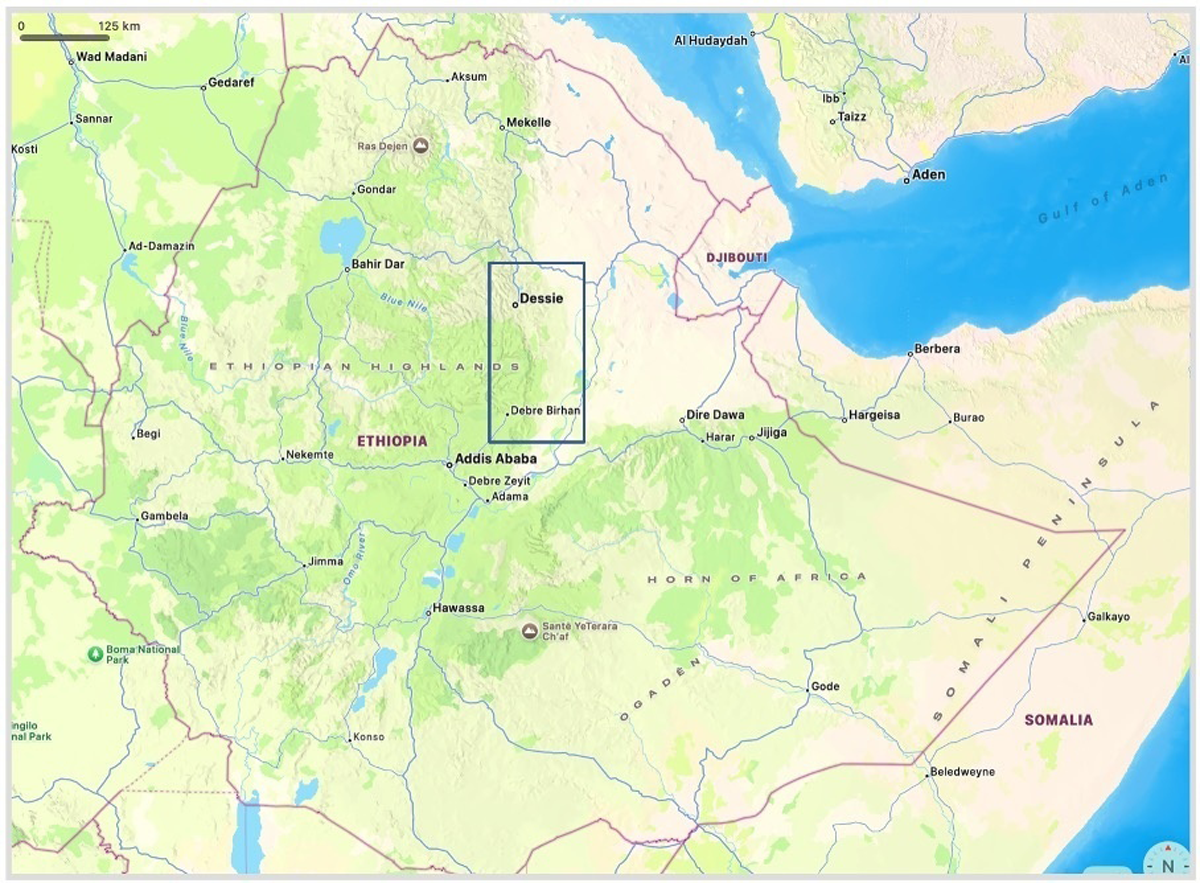
Figure 1
The project area in the Central Highlands of Ethiopia – dark blue (by the author).
Although travelers had navigated the region as they passed from the north to the seat of the Christian kingdom since the medieval period, archaeological research began very recently, in the 1990s (see Figure 3). Since then, there has been tremendous work done by the French-Ethiopian teams. These archaeological campaigns encompass all the aforementioned three cultural groups that prevailed in the region. This instigated recent comprehensive works, particularly of the megalithic monuments that belong to the pre-Christian phase. Moreover, these preceding works made cross-cultural and regional examinations possible.14
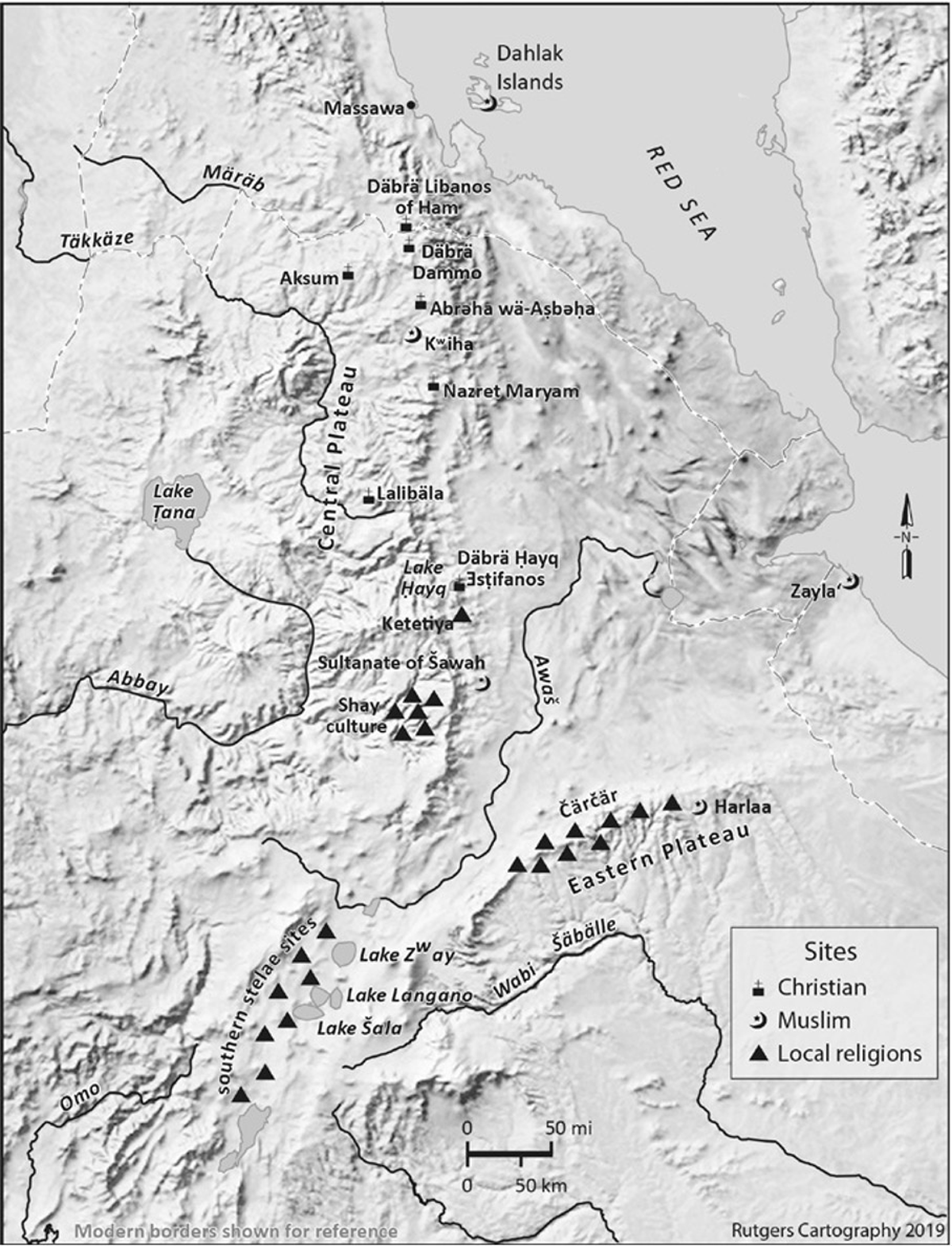
Figure 2
The Christians, Muslims, and local religious groups in Medieval Ethiopia (after Kelly, 2020).
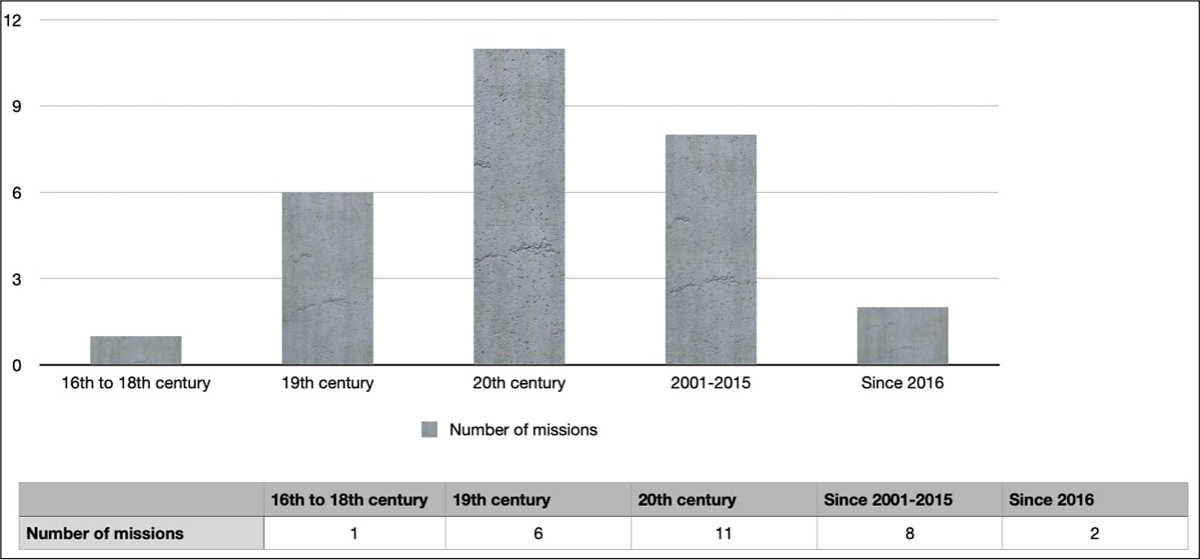
Figure 3
Figurative summary of missions discussed in the article.
The peculiarity of the major archaeological research works, so far undertaken in the region, is their multi-disciplinary composition. This is mainly the case for projects on the sites that belong to the Christian phase, while there is scant historical information for the Islamic part and almost none for the pre-Christian phase.
Despite all these dynamics, there has been no attempt so far to synthesize the research trends and present the potential for further research. This paper attempts to fill this lacuna by defining the major issues that are left unexplored and worth future consideration, such as the geology and socio-economic dimensions of the megalithic culture in the region. In doing so, the genesis of archaeological research in the region is presented in three major phases as follows. The approach is chronological, while the organization into phases signifies the impact of the project on our understanding of the development in the field. However, the breakdown into sub-topics within a phase helps to distinguish a project or group of them from the others.
Phase 1. Travelers and Early Archaeological Surveys in the Central Highlands of Ethiopia
Travelers, explorers, and others
As stated in the preceding section, being the center of the Christian kingdom, the region was frequented by foreign travelers and explorers. The major ones are described as follows.
Francisco Alvarez, a Portuguese missionary and explorer who worked in Abyssinia, left the earliest extant account. Though Pedro de Covilham, the explorer of King John II, who was dispatched from Portugal in May 1487, reached Abyssinia more than thirty years before him, de Covilham does not appear to have left any written memorial of his long residence in that country. The special significance of Alvarez’s work lies in the fact that he wrote a lengthy account of his eventual six-year stay (1520–26) in highland Ethiopia (which includes his visit to Aksum, Lalibela, and royal churches in Amhara). It is the first comprehensive eyewitness description of the country by a European.15
In 1843, during a voyage to Ethiopia, the lieutenant Theophile Lefebvre observed a large isolated stone sculpture of a lion in an area called č̣ǝqaberet16 near Kombolcha. He described it as follows: ‘A kind of sphinx, carved in the rock, which dominates a lake and seems ready to throw itself into it. It is perfectly sculpted, yet isolated from all other monuments.’17 The site was probably an early settlement area dating back to the post-Aksumite or Early Solomonic periods, between c. 8th and c. 16th century.
Antonio Cecchi was an Italian explorer previously made frequent visits to various ports in the Red Sea. He was chosen by the Italian Geographic Society to aid the mission that arrived in Šawa in 1876, led by Orazio Antinori. He reached Antinori in 1877 and, leaving him at Lǝṭ Marafiya near Ankober (the geographical base station that ase Ménilék had granted to the Italian explorers) in May 1878, he moved southwards.18 In his travel report, he indicated that on his way, before arriving in Addis Ababa, he paid attention to the ‘Grāñ stones’ that he could see not far from Debre Berhan.19 He was possibly referring to the stelae located in Debre Berhan.
Paul Soleillet, a French traveler and trader, was the first to support the construction of a railway through Ethiopia. In 1882, Paul Soleillet also came across the stelae of Debre Berhan. He described them as follows:
Here, in the surrounding area (I’ve seen them before and since), there are quite a few standing stones in the middle of the fields; they have the appearance of the megalithic monuments known as peulvans or menhirs. Some are simple long stones set in earth; others have a roughly rounded head; the educated natives claim they are the graves of Ahmed Grāñ’s companions; the locals say they are stakes he had planted to tie his horses.20
Although other travelers traversed the region in the 19th century, such as Isenberg and Krapf, they left us the sketches of the daily life of the people, the landscape, churches, and royal courts of the region, but not about the archaeological sites.21
Researchers who traveled to the region in the 20th century and spent months in the area, like Dr. Domenico Brielli, an Italian physician who lived in Dessie for over two decades (1913–1933/4), also left a good corpus on the history and heritage of the area.22 An American sociologist, Donald Levine, also conducted field research in the areas of Menz between 1958 and 1960 using mainly anthropological evidence he collected for his main work on Amhara culture, which, however, gave us no significant information on the archaeological and historical sites.23 In the 1960s, Volker Stitz, a geographer, in his study of the cultural geography of central Ethiopia, attempted to trace the historical geography of the area since the 16th century. He showed the exceptional place of the Menz as a Christian stronghold after the civil war and the Oromo population movement of the early 16th century.24
These travelers who traversed the region since the 16th century, mainly during the 19th and 20th centuries, were not inspired by historical and archaeological traces in the region. They rather noted and gave passing remarks on sites that they encountered on their way. Though non-professional and off-target, these references are found to be useful to understand the location of sites, which are not present today entirely or partly. The local memories noted are particularly of interest to see the synonymity of understanding across time.
Early Archaeological Research Attempts
Emperor Menelek II’s (r.1888–1913) archaeological project can be seen as a pioneering amateur work, aiming to uncover the vanished medieval glory in the former kingdom of Amhara. The emperor commissioned this archaeological mission to the medieval churches and royal camps in the central highlands of Ethiopia, mainly present-day South Wollo and central Shewa, which led to the excavation of a dozen sites. He commissioned excavations25 of the ruins of churches that had been built by medieval Ethiopian emperors and later destroyed during the civil war in the 16th century.26 In 1881, for example, he ordered excavations of the ruins of Dabra-Nagwadgwad, Atronsa-Maryam, Ta’eka-Nagast, and Mekana-Sellase, located in present-day South Wollo. Using material and structural evidence recovered, he affirmed the cultural and historical continuity of his Christian dynasty and justified his annexation of the area.27
This mission was targeted at realizing political and religious visions. Politically, the emperor wanted to ensure his “Solomonic” lineage by uncovering the hidden treasures of the medieval royally commissioned establishments. The findings were also elaborated in a way that ensured the deep-rooted Christian culture of the region before the conquest and subsequent population movements that brought Islam to the region. There are chapters in the chronicle of the emperor that state this archaeological mission and the reflections upon it.28
The royal patronage of Christian heritage had been a common practice for a long time, since the Aksumite period up until the end of the imperial regime in 1974. For example, almost all of the kings who reigned during the medieval and post-medieval periods used to donate, grant lands, and restore the cathedral of Aksum Tsion,29 and other churches and monasteries built previously by kings of the Solomonic dynasty.30 That is also why Emperor Menelek II built his capital on the hilltop of Entoto on the traces of the royal camp of a 15th-century King Dawit.31
Experts from the then Center for Research and Conservation of Cultural Heritage (now the Ethiopian Heritage Authority after the Authority for Research and Conservation of Cultural Heritage) of Ethiopia and Addis Ababa University conducted archaeological surveys. Namely, Cherinet Tilahun in 1985 and 1988 and Kebede Geleta in 1996, noted the Islamic sites in the Rift Valley area of the Central Highlands. The team led by Tekle Hagos focused on the stelae field in a valley called Gadiloméda. These works were primarily intended to inventory the Islamic and megalithic sites in the region, respectively, with no subsurface interventions.32
Francis Anfray was the first (French) archaeologist to visit the Menz area in the central highlands, based on the notes from the travelers such as Paul Soleillet and Théophile Lefebvre. He visited sites in South Wollo, namely the monolithic lion sculpture at č̣ǝqaberet and a ruin with monolithic pillars at Qeneda33 in October 1964 and January 1966, respectively. The former was previously visited by the explorer Theophile Lefebvre in 1843.34 Anfray’s quick survey in North Shewa, particularly Menz and Debre Berhan areas, took place in November 1980, partly based on the notes of Paul Soleillet taken a century before.35 His exploration report on the church ruins and megalithic (tumuli and stelae) sites in selected areas served as stepping stones for the latter major archaeological undertakings in the region.36 A mission led by Bertrand Hirsch took place in December 1992, September–October 1993, and September-October 1994, in č̣aqata (Borâna, Wâllo).37
An Ethio-French team visited the mosque of Fäqi Däbbis, remarkable for its apparent state of preservation, which had already been reported in 2000. Chernet Tilahun described the results of two Center for Research and Conservation of Cultural Heritage (CRCCH) missions in 1985 and 1988 and supplied drawings of some remarkable wooden architectural elements. Kebedde Geleta subsequently reported on another CRCCH mission in 1996. Before reaching the entrance to the mosque, he pointed out two huts, one of which was said to house the objects of the famous Sheikh Fäqi Ahmäd. These include seven spears and an iron-tipped staff, surrounded by cloth, a drum (locally known as a dibé), a circular straw tray, and a mortar. In May 2000, a Franco-Ethiopian mission targeted the interior mosque.38
In 2005, Mengesha Retie undertook a series of field visits to the medieval sites that are located particularly in Wäräilu, which resumed in the summer of 2010 for his master’s thesis work, partly supported by the ARCCH.39 Also, in 2006, Deresse Ayenachew conducted a field mission to this area for his PhD project that focused on the administrative history of the medieval kings.40
Ashenafi Girma conducted an archaeological survey and test excavation of the areas where the ruined churches were located in 2007–2008 as part of the fulfillment of his master’s thesis at Addis Ababa University. His research gave due emphasis to examining traces of Menilek’s excavation and assessing the overall structure of the church of Makana-Sellase. This work was supported by Addis Ababa University (Graduate School Research Fund) and the French Centre for Ethiopian Studies.41
In 2008, a Franco-Ethiopian team composed of experts from CRCCH and the Centre français des études éthiopiennes (CFEE) conducted an archaeological survey in the Dessie area. The mission included the survey of a monolithic lion statue in the č̣ǝqaberet area near Kombolcha and the quick review of artifact collections in the Dessie Museum.42
Following these, several surveys were conducted by history and heritage management students enrolled in the bachelor’s and master’s programs at Debre Berhan and other universities in Ethiopia, including those supervised by the present author.43
In 2015, there was an accidental discovery of a hypogeum by the villagers in a grazing field at the locality called Gulboarba, 10 km east of Chefa Robit. It was followed by a brief survey conducted by Gashaw Belay from the Amhara Culture and Tourism Bureau. The human remains and ceramic collections were deposited in the bureau in Bahir Dar and at the cultural center in Kemisse, respectively.44
Phase 2. Major archaeological undertakings
The preliminary documentation and research trials conducted by travelers and researchers, including the graduate students mentioned in the first phase above, led to the development of three major projects carried out mainly in the last decade of the 20th century.
Gabriel project
Ifat project
Shay culture project
These projects were initially launched in 1997 by Bertrand Hirsch, the then-director of CFEE. It was primarily targeted to study pagan, Christian, and Islamic traditions that prevailed in the Central Highlands during the medieval period, particularly the Menz and Ifat areas.45 The missions were funded by the French Ministry of Research and institutions that involved INRAP, CFEE, and Université Paris 1 Panthéon-Sorbonne. They were conducted in collaboration with Ethiopian researchers, who were involved through the Ethiopian Heritage Authority and Culture and Tourism Offices at various levels.46
Apart from the question of accessibility, the delay in the implementation of this type of archaeological project in the region partly stems from the interest of previous regimes. For example, while historical sites received special attention during the imperial period, the subsequent Derg Regime (1974–1991) promoted prehistoric and paleontological sites. In the latter case, the communist ideology, coupled with the accidental discovery of prehistoric sites, might have contributed to this tendency. Afterwards, most of the research works by the British Institute in Eastern Africa, Italians, and Germans were more attracted to the area of the famous Aksumite civilization in the North. The medieval past of the country received particular emphasis when the CFEE was chaired by Bertrand Hirsch, and was accommodated by medieval historians and archaeologists. The presence of several hundred Ge’ez (classic Ethiopic) manuscripts in the Bibliothèque nationale de France, Paris, in other European libraries has instigated dozens of students to pursue their PhD studies on Medieval Ethiopia. To this end, as the hub of the medieval history of Ethiopia, the central highlands received primary attention.
Alongside this, challenges to Eurocentric perspectives on Africa’s past have emerged, stemming from theories such as Orientalism and the expansion of post-processual archaeology since the 1990s. This was the case not only among scholars in universities and research centers based in the US and the UK, but also throughout the rest of Europe. That is also why researchers like Francis Anfray, a pioneer among French archaeologists in Ethiopia, shifted their attention. After a series of archaeological campaigns on ancient and megalithic sites, they turned their focus to this region, which encouraged later scholars to follow in their footsteps. Start-up projects by the aforementioned scholars from the then CRCCH in the 1990s and early 2000s also highlighted this area. These cumulative efforts culminated in the emergence of significant projects discussed below.
One of the peculiarities of these projects is the combination of history and archaeology in both team compositions and the research techniques. These elements were particularly helpful in studying the Christian and Islamic vestiges, which contributed to understanding the megalithic pagan society that lacks historical evidence. Experts in cartography, anthropology, and prehistory also collaborated with the teams at various stages of artifact analysis. Cross-cultural reconstruction of the three cultural groups that occupied the region during the medieval period is also another specialty of the projects (see Figure 2). The findings from one of these projects served as a base for the other, the Gabriel project for the Shay, for example. Moreover, the team composition was more or less consistent with changing roles in these projects.
Thus, compared to other research projects on Ethiopia’s past, these projects were particular in their thematic, geographic, and temporal scopes. The projects were also fruitful, yielding three solid monographs along with accompanying articles. Nevertheless, these works, particularly the monographs, are in French, although English abstracts and a few articles are in English. This synthesis paper is also targeted to help English readers get a glance at these major archaeological accomplishments conducted in the region.
A. Gabriel Project
Co-directed by Marie-Laure Derat & Anne-Marie Jouquand, the Gabriel Project47 was principally targeted at a site called Meshale Maryam. The site is composed of the ruins of a royal church and a camp that belonged to, and was commissioned by, King Ba’ǝde Maryam (r.1468–78). The site survey was conducted in 1997, which was followed by a series of excavation missions until 2001. The excavations were carried out at Gabriel in 2000 and 2001. The study made an essential contribution to our understanding of medieval church architecture, the liturgical functions of ecclesiastical spaces, burial methods, and the material wealth of a ruined church.48
A range of artifacts, including ceramics, metal implements, and beads, were collected from the excavated sites at Meshale Maryam and the nearby church ruin at an Amba called Gabriel. Furthermore, prehistoric artifacts such as stone tools were noted. C-14 chronology was also established, based on a total of ten samples, of which five are human remains and the other five are charcoal that yield a date range from the 4th to the late 18th centuries. All these and related artifacts, ecofacts, and features were investigated by their respective experts and presented in a comprehensive monograph directed by the aforementioned scholars, published in an open edition in 2012.49
Principally based on primary historical sources and archaeological evidence, this particular project is an important contribution to Ethiopia’s historical archaeology. It has clearly shown the potential in reconstructing the medieval history of Ethiopia, combining both material and textual evidence. It can be seen as one of the pioneer projects in Ethiopia with such an approach, which was continued by Marie-Laure Derat, further north in Lalibela,50 and by others elsewhere in Northern Ethiopia. This is because the Christian past has rich written and oral traditions compared to the rare cases in the study of medieval pagan Islamic traditions with limited historical evidence. Thus, this project can be regarded as the turning point in the genesis of (historical) archaeology in the Central highlands of Ethiopia, in particular and in Ethiopia, in general.
B. Ifat Project
Two Islamic sites, Goze and Faqi Dabbis, received special attention during a couple of missions in Ifat in the year 2000. The archaeological mission, conducted by an Ethio-French team, lasted a total of about two weeks in March and May. This was the first comprehensive archaeological campaign to Islamic sites in Ethiopia that paved the way for the recent focus being given to Islamic sites in both eastern and northern Ethiopia.51
Goze is a medieval mosque that continues to function, while Faqi Dabbis is in ruins. This disparity between the sites has allowed the team to examine the cases comparatively. The major components of the discussion from the first monograph published in 2011 are the different architectural elements of the mosques and artifacts, mainly ceramics, recovered from test pits.52
Another series of archaeological missions took place in 2007, targeting other Islamic sites in Ifat, Nora, and Gandabelo. This program was supported by CFEE, Agence Nationale de Recherche (ANR) and the Centre Nationale de la Recherche Scientifique (CNRS). The major preoccupation of this particular mission was to conduct a topographic survey that led to the excavation of four test pits at the mosque of Nora and its surroundings.53 A year later, this preliminary archaeological mission led to another comprehensive mission at the same site.
The 2008 excavation was conducted at Nora, one of the landmarks of the medieval kingdom of Ifat. It was financed by la Commission des Fouilles du Ministère de l’Europe et des Affaires étrangères, ANR, and the CFEE. The mission was directed by François-Xavier Fauvelle, the then-director of CFEE, and involved team members of the previous year’s Nora mission. The objective of this project was to further understand the Sultanate of Ifat through an in-depth investigation of Nora sites. The findings of this mission yielded a monograph published in 2024 with the support of the HornEast project.54
This in-depth investigation of a particular area was selected wisely after comprehensive research of an extensive Islamic area of Ifat. It provides a zoomed-out view of the Islamic civilization that prevailed from the late 13th to the beginning of the 16th century in the Rift Valley side of the Central Highlands of Ethiopia. This period corresponded to the early phase of the Solomonic period and the last phase of the Shay (pagan) tradition in the plateaus of the region. Thus, this mission helps to better understand the inter-religious and intra-regional developments exemplified in the shared material and monumental features of these three groups present in the area.
C. Shay Culture Project
The Shay culture55 project in the central highlands focused principally on the areas of North Shewa and South Wollo. Directed by François-Xavier Fauvelle and Bertrand Poissonnier, the mission was supported by the CFEE, Institut national de recherches archéologiques preventives (INRAP), and ARCCH. The team was composed of eleven experts from different institutions and areas of expertise. The project was an extension of the comprehensive project that began in 1997 with the leadership of Bertrand Hirsh.56
Although over ninety tumuli were identified from 1999 to 2006, only four sites were test excavated, namely Meshale Maryam, Tatar Gur, Qopros, and Ketetiya. While the first three sites are located in the plateau of Menz, the fourth one is a hypogeum found near Kombolcha in South Wollo. This permitted a panoramic view of the Shay culture that persisted in the Christian and Islamic surroundings of the central highlands during the medieval period.57
Apart from the mass burials uncovered, the mission recovered artifacts of different types, special stylised ceramics, beads of both local and exotic origins, metal, and stone implements. Furthermore, an ethno-archaeological experiment was made to better understand the engravings on the ceramic objects with the human and animal tattoo tradition of the Mursi58 in the Omo Valley area of Southwest Ethiopia.59 The findings of these comprehensive works are presented in a monograph60 and articles, including one written in English.61
In a book chapter that he recently published, Bertrand Poissonnier presented a mission that he led to Gadiloméda. Following the initial observation led by Tekle Hagos, discussed in phase 1, two archaeological campaigns were carried out on 27 March and between 20 and 22 May 2000 at this site by the Franco-Ethiopian team. In the first case, a topographical survey of the site was conducted and the stelae were numbered, while the latter one aimed to collect organic material that could be used to date this structure using radiocarbon dating, but also to better understand its purpose. Nevertheless, the idea of dating remains in vain as the team could not recover any organic samples associated with the stelae.62
What makes this particular project special is the introduction of a previously unknown pagan culture in an area presumed to be the heart of Christianity, with Islamic traditions at its eastern fringes. It is an addition to the corpus of Ethiopian megalithic culture in general and medieval studies of the region in particular. Moreover, the project paved the way for the latter PhD project by the present author and is still a source of inspiration for the multi-disciplinary research project detailed in the section below.
Phase 3. Recent Developments and Future Projections
In this phase, emphasis is given to the developments in archaeological research since 2016. A PhD project entitled: “Megaliths, Landscapes and Society in the Central Highlands of Ethiopia” by the present author ran from 2016–2020.63 It emerged from the need to further work on the research outcomes entertained in phase two above, with a focus on the Shay culture. The program, including the fieldwork, was supported by an ANR project called EthioChrisProcess,64 CFEE, and the French Embassy in Ethiopia, as well as Ethiopian Institutions such as Debre Berhan University, ARCCH, and Zonal and district-level Culture and Tourism departments.65
As it is indicated in the monograph and papers published by the Shay culture study team, the work was far from complete. To this end, this particular project paid attention to determining the spatial expanse of the culture dotted by megalithic structures, typo-morphological features of the monuments, local memory,66 and architectural and symbolic ties with the neighboring Christian and Muslim religious structures and with megalithic sites elsewhere.67
The archaeological survey under this project covers the plateau and the escarpment in the central highlands, which includes sites that lie between Dessie and Debre Berhan Cities. Under this study, over 320 monuments and sites were documented, including most of the 90 sites that were located by the previous team. Apart from the commonly known megalithic structures, which are mainly tumuli but also stelae, enclosures of varying size and morphology that mark settlement traces of the megalithic builders were found in the vicinity of some of the megalithic sites. The survey was accompanied by surface collection and inquiries into the memory of the locals in association with the megalithic structures.68
Books were authored on the medieval history of the region based on the projects discussed in phase two69 and preceding PhD research, including one authored in Amharic.70 There are also projects in progress aimed at understanding inter-religious dialogues in the region.71
Conclusion
The central highlands were a melting pot of medieval culture and tradition in Ethiopia. Recent archaeological research has revealed that it was occupied by three groups: pre-Christian pagans, Christians, and Muslims. Based on travelers’ notes and indications, as well as archaeological overviews, the past three decades have seen a tremendous surge in research engagement, as Figure 3 illustrates above. The three major archaeological projects by Franco-Ethiopian teams, in particular, brought to light the medieval culture of the three groups through the implementation of a multi-disciplinary approach.
The case of the Shay culture is quite particular as it came to light and was identified to be a pre-Christian tradition for the first time. While the other two categories, Christian and Islamic sites, are known from the continued religious practices in their respective areas, the Pagan tradition was sealed with myths and incorrect historical associations with the 16th-century war. Hence, these recent studies added an important corpus to Ethiopian megalithic culture in general and medieval studies in particular. The publications also raise the awareness of the people on the rich multi-cultural heritage of the region and initiate researchers in the field, and have been the subject of discussion and debate. The findings also initiated studies of intra- and inter-regional networks among peoples and cultures during the medieval period.
The research engagements so far have permitted awareness raising to the local community and to the responsible public offices to take care of them. Due to demographic pressure and associated socio-economic needs, as well as war, however, the monuments are vulnerable to various kinds of destruction. There are also growing tourism-related activities in the region that are slowly including these megalithic monuments in the commonly known Christian and Islamic pilgrimage sites.
Thus, the lateral (comparative) and vertical research requirements are still important works to be pursued. Given the wider distribution of the megalithic structures and the rich grave good compositions that each monument has, there is a need for a comprehensive long-standing project that centers on the Megalithic structures with a comparative observation of the Christian and Islamic sites of the area. Likewise, development works that ensure the preservation of the monuments with a socio-economic impact on the local community are essential.
Appendices
Appendix
Appendix
Inventory of the major figures mentioned in the article.
| S.NO | SUBJECT | COUNTRY | PROFESSION | TIMELINE | PROJECT AREA | TYPE OF SITES/FIELD OF STUDY |
|---|---|---|---|---|---|---|
| Travelers, explorers and experts from allied fields | ||||||
| 1 | Francisco Alvarez | Portugal | Missionary | 1520s | Northern and Central Highlands | Christian sites |
| 2 | Theophile Lefebvre | France | Traveler | 1840s | Southeast Wollo | Megalithic |
| 3 | Antonio Cecchi | Italian | Explorer | 1878 | Shewa-Ankober, Debre Berhan | Megalithic |
| 4 | Paul Soleille | France | Traveler and Trader | 1882 | Shewa – Debre Berhan | Megalithic |
| 5 | Isenberg and Krapf | British | Travelers | 1840s | Central Highlands | Historical |
| 6 | Dr. Domenico Brielli | Italian | Physician | 1913–1933/4 | South Wollo | Historical |
| 7 | Sir William Cornwallis Harris | British | Explorer | 1841–43 | North Shewa | Historical and Cultural Landscapes |
| 8 | Donald Levine | American | Sociologist | 1958–1960 | Shewa -Menz | Anthropological |
| 9 | Volker Stitz | German | Geographer | 1960s | Central Highlands- Shewa and Wollo | Historical geography |
| Preliminary archaeological interventions | ||||||
| 1 | Emperor Menelek II’s | Ethiopia | Public- Amateurs | 1880s | Central Highlands- Shewa and Wollo | Church and Royal Camp ruins |
| 2 | Cherinet, Kebede, Tekle | Ethiopia | History, Heritage, and Archaeology experts | 1985 & 1988; 1996, 1986 | Ifat, Tegulet-Bulga | Megalithic and Islamic sites |
| 3 | Francis Anfray | France | Archaeologist | 1964, 1966, 1980 | Menz and Debre Berhan area | Megalithic; Church and Royal Camp ruins |
| 4 | Bertrand Hirsch | France | Historian-Archaeologist | 1992, 1993, 1994 | č̣aqata (Borâna, Wâllo) | Churches |
| 5 | BertrandPoissonnier | France | Archaeologist | 2000 | Fäqi Däbbis | Islamic sites |
| 6 | Mengesha Retie | Historian | 2005, 2010 | Wäräilu | Churches and Royal Camp ruins | |
| 7 | Deresse Ayenachew | Ethiopia | Historian | 2006 | Central Highlands- Shewa and Wollo | Royal Camps |
| 8 | Ashenafi Girma | Ethiopia | Archaeologist | 2007–2008 | Makana-Sellase | Church ruins |
| 9 | François-Xavier Fauvelle | Franco-Ethiopian | Archaeologist-Historian | 2008 | Dessie area | Megalithic sites and collections |
| 10 | Gashaw Belay | Ethiopia | Archaeologist | 2015 | Southeast Wollo | Hypogeum |
| Major archaeological undertakings | ||||||
| 1 | Marie-Laure Derat & Anne-Marie Jouquand | Franco-Ethiopian | Historian- Archaeologist | 1997–2001 | Menz-Shewa | Churches and Royal Camp ruins (Gabriel) |
| 2 | François-Xavier Fauvelle | Franco-Ethiopian | Historian- Archaeologist | 2000–2008 | Ifat | Islamic sites |
| 3 | François-Xavier Fauvelle and Bertrand Poissonnier | Franco-Ethiopian | Historian- Archaeologist | 1997–2006 | North Shewa-South Wollo | Megalithic sites (Shay culture) |
| Recent developments | ||||||
| 1 | Alebachew Belay Birru | Ethiopia | Archaeologist | 2016–present | Central Highlands | Megalithic sites |
Acknowledgements
I am very grateful to the GATES project of the Université Grenoble Alpes for the time and facilities to work on this paper, and Debre Berhan University for granting the research leave. My gratitude also goes to the two anonymous reviewers for their constructive feedback. The APC waiver support and feedback from the BHA team are much appreciated.
Notes
[1] Niall Finneran, The Archaeology of Ethiopia (Routledge, 2007).
[2] David W. Phillipson, Foundations of an African Civilisation: Aksum and the Northern Horn, 1000 BC – AD 1300 (Boydell & Brewer, 2012).
[3] Getachew Meressa Nigus, “Ethiopian Archaeology: Retrospect and Prospect,” Nyame Akuma 77, no. 1 (2012).
[4] Departments of archaeology in the universities in East Africa, such as Makerere and Nairobi, have their history from the 1920s and 1950s, respectively. The foundation of these departments belongs to the colonial period.
[5] Alebachew Belay Birru, “Developer-Led Archaeology in Ethiopia: Reflection on the Field,” African Archaeological Review, (2025), https://doi.org/10.1007/s10437-025-09615-x; Alemseged Beldados and Caroline Robion-Brunner, “Introduction,” Annales d’Éthiopie 35, no. 1 (2024), https://doi.org/10.3406/ethio.2024.1731
[7] Commonly known as Lucy or Dinkʼinesh (Amharic:  lit. ‘you are marvelous’), it comprises 40 percent of the skeleton of a female Australopithecus afarensis. It was discovered at Hadar, a site in the Awash Valley of the Afar Triangle, by Donald Johanson, a paleoanthropologist. Asamerew, “Primary and Current Prehistoric and Aksumite Archaeological Research in Ethiopia.”
[8] Roger Joussaume and Jean-Paul Cros, Mégalithes d’hier et d’aujourd’hui en Éthiopie (Éditions Errance, 2017).
[9] Derat, Marie-Laure, Emmanuel Fritsch, Claire Bosc-Tiessé, Antoine Garric, Romain Mensan, François-Xavier Fauvelle, and Hiluf Berhe. “Māryām Nāzrēt (Ethiopia).” Cahiers d’Études Africaines 60, no. Cahier 239 (3 (2020): 473–508.
[10] Ethiopia currently has 12 tangible and 6 intangible heritages registered by UNESCO, which is a leading figure in Africa.
[11] With the order of Emperor Haile Selassie, a department of Ethiopian archaeology was established in 1952 as a part of theEthiopian National Library, later transformed into the Ethiopian Archaeological Institute, which is now the national museum of Ethiopia. However, it offers no formal training in archaeology.
[13] Bertrand Hirsch and François-Xavier Fauvelle, “L’Éthiopie médiévale. État des lieux et nouveaux éclairages.” Cahiers d’études africaines 166, no. 2 (2002), https://doi.org/10.4000/etudesafricaines.145.
[14] Alebachew Belay Birru, “Megaliths, Landscapes, and Society in the Central Highlands of Ethiopia: An Archaeological Research,” (Doctoral thesis, University of Toulouse-Jean Jaurès, 2020).
[15] Francisco Alvarez, Narrative of the Portuguese Embassy to Abyssinia during the Years 1520–1527 (Hakluyt Society, 1881).
[17] Théophile Charlemagne Lefebvre, Voyage en Abyssinie: exécuté pendant les années 1839, 1840, 1841, 1842, 1843 (Arthus Bertrand, 1845), 423; Francis Anfray, “Notes archéologiques,” Annales d’Ethiopie 8, no. 1 (1970): 34, https://doi.org/10.3406/ethio.1970.881.
[18] Antonio Cecchi. Da Zeila alle frontiere del Caffa (Ermanno Loescher & Co, 1886).
[19] Francis Anfray, “Premières études,” Annales d’Éthiopie 12, no. 1 (1982): 44, https://doi.org/10.3406/ethio.1982.1179.
[20] Translated from Paul Soleillet, Voyages en Éthiopie (janvier 1882-octobre 1884): notes, lettres & documents divers (E. Cagniard, 1886), 125; Anfray, “Premières études,” 45; It refers to the conflict between the Christian highland kingdom and the Muslim Sultanate in the lowland that took place from 1527–43.
[21] Charles William Isenberg and Johann Ludwig Krapf, Journals of the Rev. Messrs. Isenberg and Krapf, Missionaries of the Church Missionary Society, Detailing Their Proceedings in the Kingdom of Shoa, and Journeys in Other Parts of Abyssinia, in the Years 1839, 1840, 1841, and 1842 (Seeley, Burnside, and Seeley, 1843); William C. Harris, The Highlands of Ethiopia (J. Winchester, 1844).
[22] Domenico Brielli, “Ricordi Storici dei Uollo con Note di C. Conti Rossini,” in Studi Etiopici, ed. Raccolta da C. Conti Rossini, (Istituto per l’Orient, 1945).
[23] Donald N. Levine, “On the History and Culture of Manz,” Journal of Semitic Studies 9, no. 1 (1964): 204, https://doi.org/10.1093/jss/9.1.204.
[24] Volker Stitz, “Studien zur Kulturgeographie Zentraläthiopiens,” (Doctoral thesis, University of Bonn, 1974).
[25] A kind of amateur archaeological mission conducted by the local elites, with no single expert trained in archaeology.
[26] Gabra-Sellase Wolda-Aregay, Tarika Zaman Za Dagmawi Menilek Negusa Nagast Za Ityopya [Chronicle of the reign of Menilek II, king of kings of Ethiopia] (Artistic Publishing, 1959).
[27] Ashenafi Girma Zena, “Archaeology, Politics and Nationalism in Nineteenth- and Early Twentieth-Century Ethiopia: The Use of Archaeology to Consolidate Monarchical Power,” Azania: Archaeological Research in Africa 53, no. 3 (2018): 404–7, https://doi.org/10.1080/0067270X.2018.1513242; Bertrand Hirsch and François-Xavier Fauvelle. “Aksum après Aksum: royauté, archéologie et herméneutique chrétienne de Ménélik II (r. 1865–1913) à Zär’a Ya‘qob (r. 1434–1468.” Annales d’Éthiopie 17, no. 1 (2001): 60, https://doi.org/10.3406/ethio.2001.991; Wolda-Aregay, Tarika Zaman, 100.
[28] Chapter 30 and 31 of the chronicle focus on these archaeological campaigns commissioned by the emperor.
[29] The Church of Our Lady Mary of Zion is an ancient site in Axum, believed to house the Ark of the Covenant.
[30] Solomonic Dynasty is a line of Ethiopian emperors until 1974 who, according to tradition, were descended from Menilek I, the son of Solomon and the Queen of Sheba (Makeda). Their rule was supposed to have been continuous, save for the contested period of the Zagwe Dynasty (12th–13th centuries).
[32] Begashaw Kassaye, “The Archaeology of Islam in North East Shewa,” in Proceedings of the 16th International Conference of Ethiopian Studies, ed. Svein Ege, Harald Aspen, Birhanu Teferra, and Shiferaw Bekele, Vol. 1, (Department of Social Anthropology, Norwegian University of Science and Technology, 2009); Geleta Kebedde, “A survey on Argobba sites in northern Shoa,” Annales d’Éthiopie 16, no. 1 (2000), https://doi.org/10.3406/ethio.2000.974; Tekle Hagos, “Preliminary Notes on the Stelae of Efrata and Gidim of Northern Shoa,” Annales d’Éthiopie 16, no. 1 (2000), https://doi.org/10.3406/ethio.2000.961; T. Cherinet, “Traces of Islamic Culture in North-Eastern Shoa,” in Proceedings of the First National Conference of Ethiopian Studies: Addis Ababa, April 11–12, 1990, ed. Richard Pankhurst, Ahmed Zekaria, and Taddese Beyene (Institute of Ethiopian Studies, Addis Ababa University, 1990).
[34] Anfray, “Notes archéologiques,” 34–36.
[35] Francis Anfray, “Tumulus, pierres levées et autres vestiges dans le Menz en Éthiopie,” In Ethiopian Studies: Dedicated to Wolf Leslau on the Occasion of his seventy-fifth birthday, November 14, 1981, by friends and colleagues, ed. Stanislav Segert and Andras J.E. Bodrogligeti, (O. Harrassowitz, 1983), 507–518.
[36] Anfray, “Premières études,” 43–48.
[37] Hirsch, Bertrand, and Tafari Abate. “A Program of Historical Research in Tchaqata.” In Bulletin De La Maison Des études éthiopiennes | Novembre 1993. N°3, edited by Jacques Bureau. Addis-Abeba (Centre français des études éthiopiennes, 1993); Marie-Laure Derat, “La formation du domaine royal éthiopien sous la dynastie salomonienne (1270–1527). Espace, pouvoir et monachisme,” (Doctoral thesis, Université Paris 1 Panthéon-Sorbonne, 1998); Marie-Laure Derat, “Gäbrä ʽEndreyas de Däbrä Qozät et les généalogies monastiques du XVe au XIXe siècle: réécritures et réemplois,” Annales d’Éthiopie 17, no. 1 (2001), https://doi.org/10.3406/ethio.2001.1002; Marie-Laure Derat and Anne-Marie Jouquand. Gabriel, une église médiévale d’Éthiopie. Interprétations historiques et archéologiques de sites chrétiens autour de Mesḥāla Māryām (Manz, Éthiopie), XVe-XVIIe siècles (Centre français des études éthiopiennes, 2012), 1.
[38] Bertrand Poissonnier, Deresse Ayenachew, Régis Bernard, and Bertrand Hirsch. “Les mosquées médiévales de Goze et Fäqui Däbbis (Ifāt).” In Espaces musulmans de la Corne de l’Afrique au Moyen Âge, ed. François-Xavier Fauvelle-Aymar and Bertrand Hirsch (Centre français des études éthiopiennes, Éditions de Boccard, 2011).
[39] Mengesha Retie Endalew, Rethinking Amhara through Heritage in Ethiopia: A Focus on the Patrimonial Sites of Bétä-Amhara in Wasil (VDM Verlag, 2011), 75.
[40] Deresse Ayenachew, “Le Kätäma: La Cour et Le Camp Royal En Éthiopie (XIVe-XVIe): Espace et Pouvoir” (Doctoral thesis, Université Paris 1 Panthéon-Sorbonne, 2009).
[41] Ashenafi Girma Zena, “An Archaeological Survey on the Archaeological Programs of Emperor Menilek II” (MA thesis, Addis Ababa University, 2008).
[42] Habtamu et al., “Le lion de Kombolcha et le léopard d’Aksum: des félins rupestres paléochrétiens?” Annales d’Éthiopie 26, no. 1 (2011), https://doi.org/10.3406/ethio.2011.1442; Habtamu et al., “Découvertes archéologiques aux environs de Dessié (Éthiopie),” Annales d’Éthiopie 25, no. 1 (2010), https://doi.org/10.3406/ethio.2010.1418.
[43] Over a dozen master’s thesis works were taken up on a range of topics associated with sites in the Central Highlands of Ethiopia.
[44] Birru, “Megaliths, Landscapes, and Society”; A.L. Goujon, “Inventory and Study of the 35 Potteries Collected in Walkie Hypogeum” (Unpublished manuscript. 2017).
[45] Hirsch and Fauvelle, “L’Éthiopie médiévale”; François-Xavier Fauvelle-Aymar, and Bertrand Poissonnier, eds., La culture Shay d’Éthiopie (Xe-XIVe siècles): Recherches archéologiques et historiques sur une élite païenne (Centre français des études éthiopiennes, 2012).
[46] Apart from notes from the preceding researchers and explorers, the publications note that the push and encouragement of experts present at the then-CRCCH and Addis Ababa University, Dr. Teferi Abate, Ato Arega Bereded, Berhanou Abebe, and Kalamawark Araya, was immense in the completion of these missions.
[47] The project gets its name after the oral tradition that there was a church called this, and the ambā to-date called Gabriel, Derat and Jouquand, Gabriel, 12.
[48] Derat and Jouquand, Gabriel, 9–12; Marie-Laure Derat, “La géographie légendaire d’un « camp royal » éthiopien du XVe siècle. Histoire d’une construction mémorielle,” Afriques. Débats, méthodes et terrains d’histoire, no. 02 (2010), https://doi.org/10.4000/afriques.764.
[50] The projects, such as EthioChrisProcess and recently Sustainable Lalibela, directed by Marie-Laure Derat, have followed\similar approaches of combining archaeological and historical evidence.
[51] Timothy Insoll, “First Footsteps in the Archaeology of Harar, Ethiopia,” Journal of Islamic Archaeology 4, no. 2 (2017), https://doi.org/10.1558/jia.35273; Loiseau et al., “Bilet and the Wider World.
[53] Fauvelle-Aymar et al., “A Topographic Survey and Some Soundings at Nora, an Ancient Muslim Town of Ethiopia,” Journal of Ethiopian Studies 39, no. 1–2 (2006), https://doi.org/10.13140/2.1.3731.5206.
[54] Fauvelle, François-Xavier, and Romain Mensan, eds. Nora, ville islamique de l’Éthiopie médiévale (fin du XIIIe-début du XVIe siècle): les fouilles de 2008. In Nora, ville islamique de l’Éthiopie médiévale (fin du XIIIe-début du XVIe siècle) : les fouilles de 2008. Centre français des études éthiopiennes, 2024. https://doi.org/10.4000/12ixt ; https://horneast.hypotheses.org/.
[57] François-Xavier Fauvelle and Bertrand Poissonnier, “The Shay Culture of Ethiopia (Tenth to Fourteenth Century AD): ‘Pagans’ in the Time of Christians and Muslims,” African Archaeological Review 33, no. 1 (2016), https://doi.org/10.1007/s10437-016-9214-2; Fauvelle-Aymar and Poissonnier, La culture Shay d’Éthiopie; Fauvelle-Aymar et al., “Les monuments mégalithiques du Mänz (nord-Shoa): Un inventaire provisoire.” Annales d’Éthiopie 23, no. 1 (2007): 329–98. https://doi.org/10.3406/ethio.2007.1513.
[58] The Mursi are a Surmic ethnic group in Ethiopia. They principally reside in the South Omo Zone of the Southern Nations, Nationalities, and People’s Region, near the border with South Sudan.
[59] Fauvelle and Poissonnier, “Shay Culture of Ethiopia”; Fauvelle-Aymar and Poissonnier, La culture Shay d’Éthiopie.
[61] Fauvelle and Poissonnier, “Shay Culture of Ethiopia”; Fauvelle-Aymar and Poissonnier, La culture Shay d’Éthiopie; Fauvelle-Aymar et al., “Les monuments mégalithiques.””
[62] Poissonnier, Bertrand. “Les stèles de Gadiloméda (Éthiopie).” Le gai sçavoir: Mélanges en hommage à Jean-Loïc Le Quellec (2023): 230–245.
[63] It was undertaken for a PhD in archaeology at the Université Toulouse – Jean Jaurès, université under the supervision of Professor François-Xavier Fauvelle.
[64] It was a project funded by ANR with a focus on Christianisation processes and religious interactions in Ethiopia, headed by Marie-Laure Derat (Orient et Méditerranée, texts – archéologie – histoire).
[66] It includes practices such as religious feasts performed in association with the megalithic site and community perceptions on the origins and composition of the sites.
[67] Fauvelle and Poissonnier, “Shay Culture of Ethiopia”; Fauvelle-Aymar and Poissonnier, La culture Shay d’Éthiopie.
[68] Birru, “Megaliths, Landscapes, and Society”; Alebachew Belay Birru. “Interim Remarks on Newly Discovered Stelae in the Efrātā and Gǝdǝm Woreda, North Shewa.” Annales d’Éthiopie 33, no. 1 (2020): 189–201. https://doi.org/10.3406/ethio.2020.1694.
[69] Samantha Kelly, ed., A Companion to Medieval Ethiopia and Eritrea (Brill, 2020).
Competing Interests
The author has no competing interests to declare.