
The Business of Egyptian Archaeology
In 1862, the archaeologist Alexander Henry Rhind reported that the ‘retailing of relics’ was being encouraged by international visitors to Egypt, nearly all of whom had the ‘tendency to become buyers of some extent’.1 Rhind and many other excavators shared this tendency. Egyptologist Stephen Quirke has observed that archaeology’s ‘traditionally pure genealogy’ is complicated by ‘the direct and enthusiastic involvement of its heroes in the antiquities trade’.2 While archaeologists’ role as purchasers has been acknowledged, the extent of their involvement in the market and their role as suppliers has remained underexamined.3 This article assesses the symbiosis of archaeology and the antiquities trade during the height of British-led excavations in 1880s–1930s Egypt and Sudan. It demonstrates that supplying and selling antiquities was not a ‘side hustle’ or ‘moonlighting’,4 but a fundamental feature of the business of archaeology.
Discussion centres on Sir William Matthew Flinders Petrie (1853–1942), John Garstang (1876–1956) and Charles Trick Currelly (1876–1957). These men were active in British-led excavations in Egypt and Sudan, had differing financial arrangements, and were integral to developing the collections of National Museum Scotland, the main case study of this research. These men were not anomalies; as such, evidence of their contemporaries is also referenced. I term these individuals ‘excavator-suppliers’ to emphasise their dual roles, not applicable to modern archaeologists. This corresponds to the ‘explorer’ title once given to excavation leaders and avoids the polite ‘collector’ title prevalent in Egyptological literature.5
During the 1882 British invasion of Egypt, Augustus Henry Lane Fox Pitt Rivers acknowledged a desire for limited antiquities exports but cautioned against their appropriation as ‘trophies of war’.6 Consul-General Evelyn Baring later warned E. A. Wallis Budge that the occupation ought not provide an ‘excuse for filching antiquities’ to supply museums.7 Simultaneously, the newly founded Egypt Exploration Fund (henceforth EEF and later the Egypt Exploration Society, EES) publicly accepted Egypt’s antiquities laws, stating that research, not export, was their aim.8 They soon shifted to mass antiquities export and legal distribution, expanding from statuary to smaller finds as they too became museum commodities.9 As the Fund grew, so did its backers’ expectations for exports, establishing a supply-demand dynamic between these parties akin to the antiquities market, which shaped subsequent collecting practices.10 Financial support became a way to guarantee supply, reinforcing the excavators’ debt to their donors.11 This led to the supply of museums and the ‘obtain(ing) portable antiquities’ becoming the publicly stated aims of the EEF and Petrie.12 The Egyptian Antiquities Service (Service des Antiquités de l’Égypte) was also in need of an income stream and conducted excavations with the aim of finding small objects that could be sold in the Bulaq/Giza/Cairo Museum sale room (Salle de Vente).13
The late 19th and early 20th century extraction of antiquities from Egypt and Sudan can be interpreted as an ‘antiquities rush,’ which Suzanne Marchand defines as a period when individuals and states exploit an ‘opportune moment’ to extract and export antiquities from source countries to destination markets.14 Such rushes prosper under imbalanced economies that facilitate exploitation through illicit excavation, suppressed market pricing and corruption, driven by collector and state pressure. Additional factors in Egypt and Sudan included imperial foreign policies, colonial administration, and labour market control.15 Anglo-French competition for the control and extraction of antiquities had also become deeply embedded. This was most keenly felt in the frequent tension between the British imperial administration of the country as a ‘veiled protectorate’ and the predominantly French-run Egyptian Antiquities Service.16 This rush coincided with the professionalization of archaeology, the introduction of European-dictated heritage legislation and other means of controlling on-site labour.17
Other rush economies provide apt comparisons to the antiquities rush in Egypt. For example, the California Gold Rush also relied on underpaid diggers, tensions between labour and capital fused with racist ideology, and escalating funding demands.18 The extraction of archaeological materials in Western Honduras by North American excavators, collectors and businesses has not yet been labelled a rush but it employed diplomatic pressure and source market manipulation to enable export in the same way as acknowledged archaeological rushes. Many of the Honduran assets that were exported were the result of post-excavation division, echoing the processes of Egyptian archaeology. The Honduran business of archaeology also blurred the lines between science and commerce, as excavator-suppliers bought and sold objects and catered their aims to the interests of their patrons.19
A Cycle of Capital
In art market studies, Neil Brodie has proposed a model of the modern antiquities trade that maps de facto antiquities ownership and money flow between source and destination countries.20 His model maps production, distribution, and consumption stages to highlight academics’ influence in destination markets.21 To track the entangled historic market and archaeology, I propose a cyclical model of production for the business of archaeology in Egypt and Sudan that follows the extraction and transfer of capital (financial and archaeological) between funders, excavator-suppliers, and consumers (Figure 1), through the production stages of funding, acquisition, export, and distribution. Failure at any stage jeopardised the cycle. This cycle became entrenched as archaeology expanded into Egypt alongside free labour capitalism.22
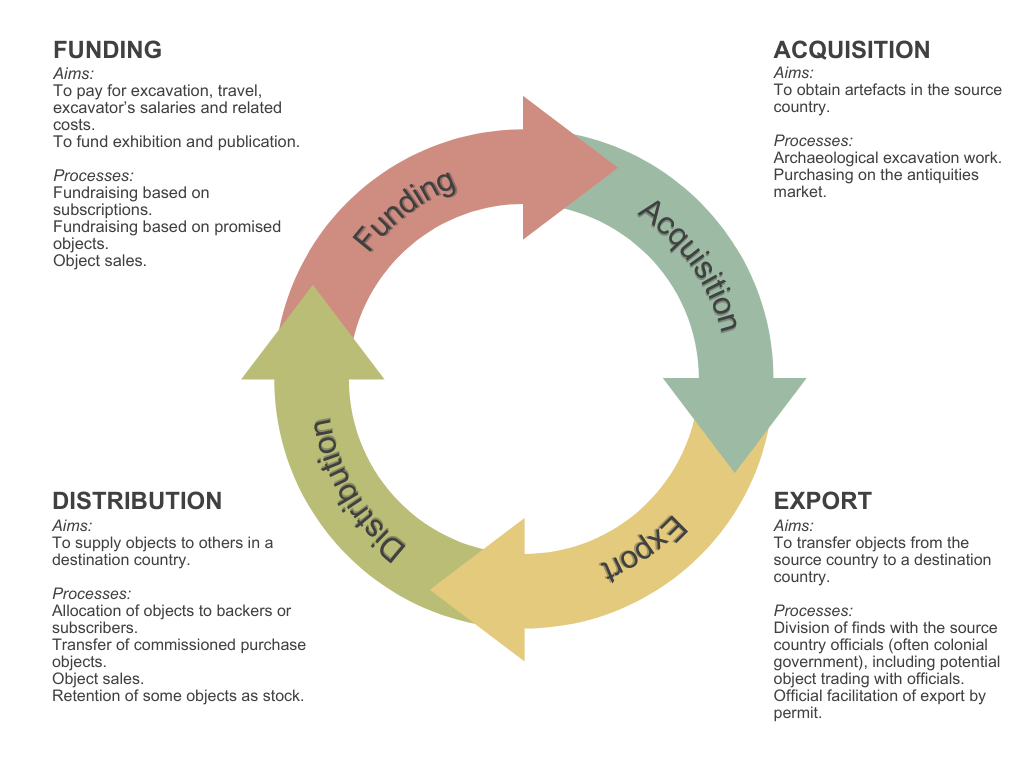
Figure 1
A cyclical model of the business of archaeology in Egypt and Sudan, 1880s–1930s, representing the extraction and transfer of capital through four distinct production stages, noting the aims and processes of each stage. (Author)
Funding
Securing funds to cover excavation costs, salaries, transport, the exhibition and publication of finds was the first business need. Though early British archaeology in Egypt often relied on familial wealth, excavator-suppliers later became paid employees/contractors of archaeological funds (EEF and the British School of Archaeology in Egypt, BSAE), excavation committees (John Garstang) or direct engagement (Howard Carter and Lord Carnarvon, Petrie with Jesse Haworth/H. Martyn Kennard). As salaried workers, excavation was rarely excavator-suppliers’ sole income. For example, around 1908, Petrie and Garstang both combined university and excavation employment to earn upwards of £600–700 p.a., comparable to the wages of the UK civil service museum or the Egyptian Antiquities Service, and well above the UK national average (£70 p.a.).23 Part-time employees, like Currelly, regularly earned above this average, while others volunteered or received expenses.24 Records suggest that £50 was an informal base rate for seasonal assistants, though arrangements varied. Currelly also claimed to make money helping others purchase objects.25
Throughout his autobiography, Petrie insisted that he would work regardless of wealth, due to his interest, enjoyment, and skill.26 Before his UCL employment, he reported £110 income, which he supplemented with museum sales.27 Sidney Smith described such sales as a ‘practical solution’ to guarantee Petrie’s independence.28 Quirke has identified five stages of Petrie’s career, which reflect his primary funding arrangements: 1) Self-funded work at Giza 1880–82, 2) EEF-funded work in the Nile Delta 1883–86, 3) Work funded by Jesse Haworth and H. Martyn Kennard 1886–92, 4) Professorial work funded by the EEF and his Egyptian Research Account (ERA) 1893–1905, and 5) BSAE excavations 1905–30. When Petrie quit the EEF and founded the BSAE in 1905, public statements and private discussions debated whether the EEF and BSAE were diverting funds and popular support from each other.29 Petrie even claimed that the EEF actively deprived him of funds in their ‘rotten system of business’.30 With his BSAE, he exercised increasing personal control over all four stages of production.
After he was sacked from his ERA studentship, John Garstang began organising Egyptian excavations via a committee, as he had done for Romano-British sites.31 His 1903 ‘Committee for Excavations in Egypt’ supplied objects to its backers and asserted that no finds were sold, implying that others conducted sales.32 In 1904, he founded the Liverpool Institute of Archaeology (LIoA), and the committee became associated with it in 1905.33 Individual members bought annual shares of the committee’s excavations, e.g. Hittite Excavation Committee, Sudan Excavation Committee (henceforth SEC), in return for an equal share of objects. Early committees were dominated by businessmen, but later expanded to include easier-to-satisfy museums.34 Contracts outlined the shareholders, payment terms, agreed expenses, Garstang’s responsibilities, the division of exported finds, and other key points. Surviving examples of these documents show the committee’s changing affiliation with the University of Liverpool and variations in Garstang’s working months, and the remuneration of assistants.35 This arrangement and the habit of members calling their committee a ‘syndicate’ have led to Garstang being called ‘an organiser with a positive genius for finance’ and ‘unabashedly business orientated’, a nature that some speculated was a reflection of Liverpool’s mercantile nature.36
Charles Trick Currelly first excavated with Petrie and the EEF in 1902 and was a Fund employee until 1907. In 1902, he also began purchasing objects and acquiring undistributed EEF finds to build a museum collection for Toronto that became the Royal Ontario Museum (ROM).37 By 1906, Currelly was employed as ‘Collector of Archaeological Remains’ for the University of Toronto, becoming a ROM Curator in 1907.38 Though his autobiography emphasised financial sacrifice and sensible spending, his London-based purchase account was stocked by major donors who topped it up when Currelly feared overspending would send him to gaol.39
Acquisition
Object acquisition was the primary aim of most work in Egypt and Sudan. Excavation permits granted de facto control over an area’s archaeological products, turning them into competitive ‘financial resources’ for their holders.40 To maximise returns and meet export demands, excavator-suppliers commonly dug multiple sites in one season, though this became restricted in 1912.41 In 1903, Petrie proposed that Currelly excavate an additional cemetery site to provide more ‘distributing stuff’ for museums.42 EEF excavations at Sawama in 1914, euphemistically described as ‘the research of anticas’, intended to supply American museums.43 Joseph Grafton Milne also planned excavations to secure ‘reasonable return(s)’ that would be lacking from Édouard Naville’s work at the Osireion.44 If excavations failed to yield enough objects, purchases could supplement this stage of production, creating a ‘dual strategy for collecting’.45 Purchase funds were often integrated into budgets or reclaimed as expenses, with many backers prioritising delivery of objects over acquisition method. Some purchases appeared in excavation memoirs but were inconsistently labelled.46
Petrie viewed his on-site purchasing as a ‘part of the necessary machinery of working’ that ensured finds were tendered to him, and kept undesirable dealers away.47 He imposed deflated prices on vendors through an aggressive, single-offer approach that he also recommended to tourists.48 He justified this on the basis of racial stereotyping, citing a supposed oriental inability to refuse visible cash, and associated ‘training’ dealers with training dogs.49 Petrie’s forceful price setting led to his frustration with the ‘fancy prices’ of the Bulaq/Cairo Museum sale room (Salle de Vente), which were ten times the local price, limiting his purchasing of objects retained by the Museum.50 Currelly claimed that he inherited Petrie’s local rates.51 EEF leaders appreciated his purchases as they supplied small museums, who became subscribers and ‘replenish(ed the EEF) Treasury’,52 though he also once threatened to throw surplus objects ‘in the nearest canal’ if the EEF Committee restricted his methods.53 Petrie’s dual strategy provided vast numbers of exports and bolstered his reputation as a reliable supplier. Nevertheless, his approach was not universally supported; in February 1890, Riamo d’Hulst wrote that the Frenchman Eugène Grébaut’s decision to restrict foreign-led excavations and go to ‘war’ with the EEF was a reaction to Petrie’s ‘kind of exploration or antiquity-dealing-business on a large scale’.54 Naville ascribed Grébaut’s dislike of the EEF to Petrie’s sales.55 Grébaut’s response was likely influenced by Anglo-French rivalry, both political and personal.56 It may also have been a reflection of his personal attitude to dealing that was enacted in his high-profile, but ultimately failed, attempts to curb the antiquities trade in Egypt which included night raids on vendors across the country.57 During his time as Director of the Egyptian Antiquities Service (1892–1897), he also refused Evelyn Baring’s proposal for private excavators to sell finds to fund their work.58 Despite such opposition, Petrie rarely acknowledged any impact of his purchasing beyond its influence on his work.59
Export
Acquisitions were only valuable if they could be exported. Samuel Birch of the British Museum chose not to support the early EEF’s ‘sentimental excavations’ as they did not guarantee export.60 During post-excavation division of finds, horse-trading between excavator-suppliers and representatives of the Egyptian Antiquities Service was common, with objects used as makeweights to secure others for retention or export,61 a process that Petrie likened to ransom.62 Excavation leaders often boasted to backers about their success in divisions and the Egyptian state’s generosity. In 1909, Garstang noted trading objects with an Inspector before retaining ‘fully 5/6ths’; that same year, Petrie exchanged objects with the Antiquities Service to enable his retention of the complete ‘Qurna Queen’ burial group.63 In 1924, under stricter export laws, Petrie proposed offering objects to Cairo to work ‘against our finds in division’.64 George Reisner also returned exported finds to Egypt in exchange for desired newly excavated material of equivalent value.65
A key export agreement was privately struck between Petrie and Gaston Maspero, Director of the Egyptian Antiquities Service, following a ninety-minute Parisian meeting on 7 November 1883.66 It made Petrie a purchasing agent of portable objects for the Bulaq Museum; he would purchase objects on-site, transport them to Cairo, receive cost price reimbursement for Maspero’s selections, and be allowed to export the rest for the EEF.67 Maspero signed Petrie’s summary of the agreement ‘vue et apprové’. He preferred not to formalise conditions that others might request, but later clarified the details in writing.68 Petrie portrayed the agreement as benefitting the Bulaq Museum and Maspero, but later documents reveal his real motive: an ‘exclusive claim to antikas’ that increased exports for himself and the Fund.69 This can be interpreted as a crypto-colonising agreement, i.e. one framed as benefitting the colonised nation that actually serves the coloniser by fostering effective dependence.70 Two years later, Petrie wrote to Edwards arguing Britain ought to have the right to excavate and export as it desired due to British contributions to the state and the carelessness of Bulaq Museum staff.71
Édouard Naville opposed the Petrie-Edwards ‘system of plunder’ that aimed to export many small objects for UK museums. He believed that this resembled the antiquities trade, which was not the Fund’s purpose, risking its ‘entente cordiale’ with the Egyptian Antiquities Service and disrupting the established Khedival ‘don gracieux’/‘gifts of the ruler’ transfers.72 Though content to see objects in European museums, he urged reducing exports and hoped that subscribers would ‘give up the idea of digging for objects’.73 His related proposal to display finds in the Giza Museum so supporters could see what they had funded, while leaving ‘in Egypt what belongs to Egypt’, was dismissed by Amelia Edwards.74 Nevertheless, export pressures weighed on Naville and he sought to please the EEF with objects.75
The necessity for exports explains the strong negative reactions of several excavator-suppliers to nationalist legislative and administrative changes that sought to control Egypt’s archaeological capital.76 Some advocated for archaeology’s future in research rather than museum supply,77 others sought new archaeologically-rich markets to exploit, where there was reduced competition, generous partage (division) and sympathetic labour agreements.78 This expansion into new territories where production could be controlled may also be viewed as a consequence of the capitalist rush economy.79
In 1909, Garstang communicated his intention to ‘retire’ from Egypt and focus on Asia Minor, but the Adana Massacre led him to accept an invitation to excavate at Meroë, Sudan, where British military control safeguarded generous division terms suited to the site’s archaeological potential.80 Following years of success at Meroë, where shareholders habitually received objects that exceeded the value of their shares, finds and exports began to decline to the point that ‘no contributor on the average can have got back more than 50% in value’. As such, the Sudan Excavations Committee pivoted to site conservation and renamed what they had previously labelled as ‘shares’, ‘donations’.81 In contrast to the former ‘waiting list of collectors and museums’, Garstang’s post-war excavations in Mandatory Palestine and Asia Minor relied on fewer patrons, perhaps due to reduced distribution of the ‘spoils’.82 During the formation of mandatory territories, European powers instituted favourable antiquities laws to appease museums’ insistence for partage and Garstang unsuccessfully proposed reversing previous agreements to give excavators the first choice of finds.83 Excavator-suppliers continued to fear that authorities might invoke their legal right to half the finds, and worried about what ‘reasonable’ returns for funding were.84 Petrie openly left Egypt for Mandatory Palestine to benefit from favourable partage, enabling continued museum sales and annual exhibitions while marketing his work as ‘Egypt over the border’.85 In 1934, Petrie again complained about his inability to export objects for his annual exhibition.86
Distribution
The historian David Gange has discussed the tendency of archaeologists to portray their rivals negatively as inadequate or unscientific excavators who wasted funding.87 Failure to provide distributable objects was an undesirable quality for an excavator-supplier; for example, Petrie claimed that Naville would not voluntarily return with small, exhibitable and distributable objects, so he suggested focusing on Griffith and Cowan’s work, which would not ‘fail… in that way’.88 At several times in the EEF/EES history, it was made clear that American subscriptions were contingent on exports, making it perennially ‘imperative… to discover something’ exportable so as not to disrupt funding.89
It was essential that funders receive a ‘proportionate amount’ of the ‘spoils’, matching their level of financial support.90 A pro-rata dispersal system was developed to account for this, in which objects were assessed, categorised, and valued in consideration of market prices before distribution.91 The highest funders made the first selection of objects, as described by Francis Griffith in 1913, when the largest donor, the Ny Carlsberg Glyptotek, Copenhagen, placed what he viewed as ‘an enormous order!’.92 Lower funders then had descending preference, with museums grouped hierarchically according to comparative bands of support.93 Shortly after the 1922 BSAE exhibition, Petrie told Winnifred Crompton that Manchester Museum’s allocation ‘fairly fill[ed] up’ the subscription. Other object groups could be sent, but they were valued roughly at £10–70 each, so Manchester would need to ‘pull on more interest’, i.e. provide more funds.94 Though more cash was deemed unlikely, Crompton requested more information on the groups. Guy Brunton replied, listing the value of the remaining undistributed groups (matching Petrie’s valuations precisely) and maintained that if Manchester Museum received additional objects, they would ‘overbalance’ the subscription.95
Precious metals were frequently assayed as bullion, sold, and quickly converted to financial capital. Petrie made a point of weighing gold and silver on-site and paying close to market value to the finder.96 Bullion was also valued independently to ‘antikas’ in his transactions with Maspero.97 The EEF sold gold and silver on several occasions, for example, ‘rough gold & silver’ was sold for £12/5/5 in 1886,98 and a share of gold found at Amarna was sold to the Bank of England at ‘standard price’ for £200 in 1932.99 Similar processing was undertaken by Garstang on behalf of the SEC following the excavation of a hoard at Meroë, Sudan. After the 50/50 division with the Sudanese Antiquities Department, in which gold, coins and high-value objects were divided separately from other finds,100 SEC members were able to receive their share as a sample of the bullion, its value in credit for the next year’s excavation, or to use it to produce facsimiles.101
Having traded coins in his youth, buying and selling objects became a fundamental part of Petrie’s career.102 During his 1880–82 Giza Survey work, Petrie acquired objects for the British Museum and purchased others as ‘speculation’ or ‘investments’ for sale in the UK.103 This continued during excavations, for example, at Hawara 1887–88, he targeted funerary portraits due to their European market appeal.104 Petrie bought for or sold to Heidelberg University (via Herman Ranke and Victor Goldschmidt), the Royal Scottish Museum, the Brooklyn Museum, the V&A, Penn Museum and likely other institutions, as well as private individuals, his backers, family and friends.105 His financial arrangements for such transactions are unclear, but he once stated that funds would go into the ERA, implying other monies may have been described similarly.106 He may also have sold to dealers in Egypt.107 In 1885, Petrie proposed that the sale of duplicate ‘scarab moulds, tetradrachm, pottery’ to EEF subscribers from his excavations ‘should be announced viva-voce’ at a meeting so that it would be less ‘likely to be heard of in Egypt, if that is feared’.108 In 1886, he was keen to spell out that not selling duplicates did not mean that the Fund got ‘nothing worth selling’.109 In 1903, he again suggested that ‘hundreds of rough little bronze Osiris figures, + ushabti, lying surplus’ could be placed in a tray at a meeting for EEF members to take, apparently gratis.110 This ad hoc dispersal and sale of small objects, shabtis in particular, was also undertaken by the EEF/EES.111
Early in his career, Garstang purchased objects during excavations and included some in his publications.112 His Abydos excavations notebook records several years of purchasing for his patrons Rev. William MacGregor, Francis Chatillon Danson, George Francis Legge, and James Rea. Danson and MacGregor provided yearly sums for this. This notebook also shows purchases made for Robert Gurney (his brother-in-law), Elizabeth Smith (the wife of his future backer James Smith), Aberdeen University and the Albany Museum, South Africa.113 Funds were treated variably: Aberdeen University’s 1905 cheque was directed to LIoA, whereas Danson paid Garstang directly in 1909 as a ‘private affair’.114 In 1906, Garstang’s colleague Percy Newberry (himself an active purchaser, advisor and agent) expressed apprehension that publicly selling objects via an agent might create friction with the Egyptian Antiquities Service.115 Nevertheless, LIoA continued intermittent private sales under terms agreed in 1905.116
By the 1920s, many of the LIoA’s key supporters had died and comparable financial backing was hard to source amid international financial crashes. LIoA sought to balance its budget by selling ‘duplicates’, and had T. Eric Peet send priced lists of objects to potential institutional buyers.117 In 1928, Garstang proposed that the American Colony Store act as an agent to facilitate the sale of the LIoA Collection in the United States.118 The $60,000-$115,000 valuation was tempting, but administrative deficiencies, discussions on which objects could be sold and the lack of a basic catalogue meant that no bids materialised and the agreement expired.119
Currelly bought for, and sold to, the RSM and the Fitzwilliam Museum several times, with early payments transferred through the EEF.120 When he raised funds from William MacKay Laffan at Deir el-Bahari, these were divided between EEF work and his casting of the Punt reliefs for the Metropolitan Museum of Art, New York (MMA).121 Currelly and the artist William Tyndale also produced a duplicate set for the ROM and sold select casts to the RSM.122 In 1906, he and Joseph Grafton Milne collected lithics and ostraca from the Theban hills. The scheme enabled Currelly to collect for the ROM, donate to the MMA, and trade with the National Museum of Ireland and Musée d’Archéologie Nationale, Saint-Germain-en-Laye.123 Petrie condemned this ‘simple loot’, collected without ‘history or place’, comparing it to Heywood Walter Seton-Karr’s methods.124 Ironically, Petrie later ran a similar ‘flint job’ at Wadi Ghazzal.125
Conclusions
Egyptian and Sudanese archaeology of the late 19th and early 20th centuries was not isolated from economic forces; however, Egyptological historiography has often overlooked the financial transactions behind excavation funding and object supply. Buying and selling antiquities was not just pervasive in the excavator-supplier community but was fundamental to the business of archaeology that relied on the extraction and transfer of financial and archaeological capital. When Egypt’s Law no. 14 of 1912 outlawed antiquities hunting, licensed excavations and surveys remained exempt from this, even though securing exportable objects remained one of their primary needs. Financial capital drove the competitive business cycle, funding activities at home and abroad, meaning that financial valuation of objects became customary; the active correlation of funds to finds was a key representation of this monetisation.126 Petrie admitted that ‘£1 is £1 in whatever way it comes’, whether as objects, finance or subscribers.127 A deeper examination of archaeological acquisition at this time makes it clear that there is indeed ‘no black and white picture of financing’.128 It also requires us to consider these archaeological heroes not simply as beneficent archaeologists, but as excavator-suppliers. Their work produced scientific knowledge but simultaneously contributed to the commodification of Egyptian and Sudanese antiquities and promoted their sustained extraction and export.
Additional File
The additional file for this article can be found as follows:
Appendix 1
Identified Contracts for John Garstang’s Excavation Committees. DOI: https://doi.org/10.5334/bha-736.s1
Notes
[1] Alexander Henry Rhind, Thebes, its Tombs and Their Tenants, Ancient and Present (Longman, 1862), 247–49.
[2] Stephen Quirke. Hidden Hands: Egyptian Workforces in Petrie Excavation Archives, 1880–1924. (Duckworth, 2010), 54.
[3] Fredrik Hagen and Kim Ryholt, The Antiquities Trade in Egypt 1880–1930: The H. O. Lange Papers (Det Kongelige Danske Videnskabernes Selskab, 2016), 11, 45.
[4] Gregory Fewster, “Two Letters from B.P. Grenfell to C.T. Currelly in the Royal Ontario Museum Archive: New Evidence for the Acquisition of Egyptian Antiquities in Canada,” Mouseion: Journal of the Classical Association of Canada 64, no. 1 (2023): 70, https://doi.org/10.3138/mous.20.1.03; Peter Der Manuelian, Walking Among Pharaohs: George Reisner and the Dawn of Modern Egyptology, (Oxford University Press, 2023), 64, https://doi.org/10.1093/oso/9780197628935.001.0001.
[5] For example, the Egypt Exploration Fund described excavation leaders as ‘explorers’; Garstang self–reported his occupation as ‘Professor of Archaeology + Explorer’ in the 1911 census.
[7] Ernest Alfred Wallis Budge, Nile and Tigris: A Narrative of Journeys in Egypt and Mesopotamia on Behalf of the British Museum Between the Years 1886 and 1913, Volume I, (John Murray, 1920), 81.
[9] Margaret S. Drower, “The Early Years,” in Excavating in Egypt. The Egypt Exploration Society 1882–1982, ed. Thomas Garnet Henry James, (British Museum Publications, 1982), 9–37; Alice Stevenson, Scattered Finds: Archaeology, Egyptology and Museums (UCL Press, 2019), 10, 27, https://doi.org/10.14324/111.9781787351400.
[10] Amara Thornton, “ ‘… a certain faculty for extricating cash’: Collective Sponsorship in Late 19th and Early 20th Century British Archaeology” Present Pasts 5, no. 1 (2013): 2, https://doi.org/10.5334/pp.55; David Gange, “The Ruins of Preservation: Conserving Ancient Egypt 1880–1914”, Present Pasts 226, no. 10 (2015): 86, https://doi.org/10.1093/pastj/gtu025.
[12] Stevenson, Scattered Finds, 10; W. M. Flinders Petrie, Methods & Aims in Archaeology, (Macmillan and Co., 1904), 33.
[14] Suzanne Marchand, “The Dialectics of the Antiquities Rush,” in Pour une histoire de l’archéologie xviie–1945, ed. Annick Fenet and Natacha Lubtchansky, (Ausonius Éditions, 2015), 191–206, https://doi.org/10.4000/BOOKS.AUSONIUS.5870.
[15] Wendy Doyon, “The History of Archaeology through the Eyes of Egyptians,” in Unmasking Ideology in Imperial and Colonial Archaeology: Vocabulary, Symbols, and Legacy, ed. Bonnie Effros and Guolong Lai, (Cotsen Institute of Archaeology Press, 2018), 175–178, https://doi.org/10.2307/j.ctvdjrrt0.15.
[16] This division was codified in article one of The Franco-British Declaration, 1904, known commonly as the ‘Entente Cordiale’.
[17] Thornton, “Collective Sponsorship”, 1; Quirke, Hidden Hands, 34–36; Wendy Doyon, “Egyptology in the Shadow of Class” in Forming Material Egypt: Proceedings of the International Conference: London, 20–21 May, 2013, ed. Patricia Piacentini, Christian Orenigo and Stephen Quirke, Egyptian & Egyptological Documents, Archives, Libraries 4 (2013), 262.
[18] Daniel Cornford, “‘We All Live More like Brutes than Humans’: Labor and Capital in the Gold Rush,” California History 77, no. 4 (1998): 78–104, https://www.jstor.org/stable/25462509.
[19] Christina Luke, “Diplomats, Banana Cowboys, and Archaeologists in Western Honduras: A History of the Trade in Pre-Columbian Materials,” International Journal of Cultural Property 13, no. 1 (2006): 25–57, https://doi.org/10.1017/S0940739106060036.
[20] Neil Brodie, “Congenial Bedfellows? The Academy and the Antiquities Trade,” Journal of Contemporary Criminal Justice 27, no. 4 (2011): 428, fig. 5, https://doi.org/10.1177/1043986211418885.
[21] For further discussion of the academic influence on the market, particularly in relation to textual objects, see Neil Brodie, “Consensual relations? Academic involvement in the illegal trade in ancient manuscripts,” in Criminology and Archaeology, ed. Penny Green and Simon Mackenzie, (Hart, 2009), 41–58; Neil Brodie, “Scholarly Engagement with Collections of Unprovenanced Ancient Texts,” in Cultural Heritage at Risk: The Role of Museums in War and Conflict, ed. Kurt Almqvist and Louise Belfrage, (Axel and Margaret Ax:son Johnson Foundation, 2016), 123–142.
[23] UCL professorial salary after 1900 was £600 p.a. per F. M. L. Thompson, ed. University of London and the World of Learning, 1836–1986 (Bloomsbury, 1990), 74; Garstang earned £400+ p.a. as Professor and £300 p.a. from excavations, P. Hebblethwaite to Garstang, 22/1/1907, John Garstang Archive, University of Liverpool Special Collections and Archive (henceforth JGA), FC-1-1-1; “Institute of Archaeology Finance and Executive Committee Book”, JGA S152: Beni Hasan Excavation Fund 1903–04, clause 4; Gavin Thompson, Oliver Hawkins, Aliyah Dar and Mark Taylor, Olympic Britain: Social and Economic Change Since the 1908 and 1948 London Games (House of Commons Library, 2012), 43.
[26] W. M. Flinders Petrie, Seventy Years in Archaeology (Henry Holt and Co., 1931), 18, 41–42.
[28] Sidney Smith, “William Matthew Flinders Petrie, 1853–1942” Obituary Notices of Fellows of the Royal Society 5, no. 14, (1945): 5, https://doi.org/10.1098/rsbm.1945.0001.
[29] “The British School of Archaeology in Egypt” The Times, 14 June, 1905, 10. John Evans, “The Egypt Exploration Fund” The Times, 17 June, 1905, 4; Petrie to Emily Paterson, 12 July 1905, Lucy Gura Archive, EES.COR.007.a.2, Egypt Exploration Society, (henceforth EES).
[31] Garstang to Percy Newberry, 10 October 1900, Percy Newberry Collection, Griffith Institute, University of Oxford (Henceforth GI) NEWB19/4; Thornton, Collective Sponsorship, 2, 4–5.
[32] John Garstang, Tombs of the Third Egyptian Dynasty at Reqâqnah and Bêt Khallâf (Constable, 1904), 11; William Bruce Moir, “Recent Antiquarian Discoveries in Egypt” The Scotsman, 23 February, 1903, 7.
[33] [Arthur Frank Shore], “The School of Archaeology and Oriental Studies, University of Liverpool” 1985, JGA FC-1-1-3; Copy of “Proposed Affiliation of Excavations in Egypt Committee with Institute” 10 September 1905. World Museum Archive, National Museums Liverpool (henceforth WMA).
[34] Tine Bagh, Finds from the Excavations of J. Garstang in Meroe and F. Ll. Griffith in Kawa in the Ny Carlsberg Glyptotek, (Ny Carlsberg Glyptotek, 2015), 24.
[35] See Appendix 1 for transcriptions of the following identified contracts:
Beni Hasan 1902–1903 / 1903–1904, JGA, JG-2-2; Abydos 1906–1907 and Abydos 1908–1909, Danson Family Archive, D/D/V/4/3, National Museums Liverpool Archives Centre.
[36] Herbert Walter Fairman, “Prof. John Garstang”, University of Liverpool Recorder, 12 (October 1956): 6; Stevenson, Scattered Finds, 13, 223; Ramsay Muir, An Autobiography and Some Essays (Lund Humphries, 1943), 80.
[37] Charles Trick Currelly, I Brought the Ages Home (Royal Ontario Museum, 1956), 130; Lovat Dickson, The Museum Makers: The Story of the Royal Ontario Museum (University of Toronto, 1986), 13.
[38] “1906 Report of the Toronto University”, University of Toronto Archives and Records Management Services: No.13, 42.
[39] Donors: Sir Byron Edmund Walker, Sir Edmund Boyd Osler, Sir Robert Mond, Mrs H. D. Warren (Sarah Trumbull Van Lennep), and Sigmund Samuel. Currelly, I Brought the Ages, 148, 165, 194; Dickson, The Museum Makers, 40; Currelly Museum Account, Departmental Archive, RG12.41, Royal Ontario Museum.
[40] Ralph Greenberg and Yannis Hamilakis, Archaeology, Nation and Race: Confronting the Past, Decolonizing the Future in Greece and Israel, (Cambridge University Press, 2022), 53, https://doi.org/10.1017/9781009160247; Samuel J. M. M. Alberti, “Molluscs, Mummies and Moon Rock: The Manchester Museum and Manchester Science” Manchester Region History Review 18, (2007): 147.
[41] ‘Article 4 of Ministerial order no. 52 of 8 December 1912, Concerning the Regulation of Excavations’ limited each dig leader to two sites maximum; Adrienne L. Fricke, “Appendix II: A New Translation of Selected Egyptian Antiquities Laws (1881–1912)” in Imperialism, Art and Restitution, ed. John Henry Merryman (Cambridge University Press, 2006), 189.
[42] Petrie to Herbert Appold Grueber, 4 September 1903, EES.COR.001.h.9; Petrie to John Evans, 4 September 1903, EES.COR.005.j.12; Petrie to Grueber, 19 January 1905, EES.COR.001.h.01.
[43] Joseph Grafton Milne to Chester I. Campbell, 29 October 1912, EES.COR.013.e.28; Frederic George to Joseph Grafton Milne, 30 October 1912, EES.COR.013.e.29; Gerald Avery Wainwright, Balabish, (Egypt Exploration Society, 1920), v.
[45] Stephen Quirke, “Archaeologist; Collector and Seller of Antiquities; University Teacher: Flinders Petrie in Egypt 1881–1926” presented at Buying Power: The Intersection of Archaeology and the Antiquities Trade, National Museum of Scotland, Edinburgh, 16 February 2024.
[46] Manuelian, Walking Among Pharaohs, 71, 79; “rough statement” by W. M. Flinders Petrie, 15 June 1885, EES.COR.016.f.85–2; W.M. Flinders Petrie, Koptos (Bernard Quaritch, 1896), 23–26, 33–34 openly mark several purchases but others are not described as being bought, e.g. a granite obelisk fragment naming King Nakhthorheb, UC14522: Petrie notebook 53, Koptos/Quft 1895–96, Petrie Museum Archives, UCL (henceforth PMA); Petrie, Koptos, 17, pl.XXVI.
[47] Petrie to Reginald Stuart Poole (henceforth Poole), 24 June 1886, EES.COR.016.f.132; W. M. Flinders Petrie, “Method” in How to Observe in Archaeology: Suggestions for Travellers in the Near and Middle East, ed. George Francis Hill, (British Museum, 1920), 24.
[50] Petrie, Seventy Years, 245; Contra to Petrie, guidebooks stated that it often undercut dealers, Hagen and Ryholt, The Antiquities Trade, 47–48.
[56] For an insight into Grébaut’s clashes with the British authorities in Egypt, see: Stéphanie Prévost, “Dialogues With the Dead, and With the Living too! British Egyptology Societies and the Politics of Preservation (1882–1898)” in Geographies of Contact, ed. C. Lehni, F. Moghaddassi, H. Ibata, and N. Nasiri-Moghaddam (Presses Universitaires de Strasbourg, 2017), 215–233. https://doi.org/10.4000/books.pus.6080.
[58] Donald Malcolm Reid, Whose Pharaohs? Archaeology, Museums, and the Egyptian National Identity from napoleon to World War I, (University of California Press, 2002), 181–182, http://www.jstor.org/stable/10.1525/j.ctt1ppdp5.
[60] Samuel Birch to Edwards, 14 March 1882, EES.COR.003.j.34; Naville to Edwards 14 February 1887, EES.COR.005.e.8.
[61] For example, Bernard Grenfell suggested offering Byzantine papyri to the Egyptian Museum as ‘a sop’ to facilitate other exports, Todd M. Hickey and James G. Keenan, “At the Creation. Seven Letters from Grenfell, 1897” Analecta Papyrologica 28 (2016): 361 quoting EES.DIST.15.04.
[66] Petrie diary 3, 1883–1884, PMA; Margaret S. Drower, Flinders Petrie: A Life in Archaeology. Victor Gollancz, 1985, 71; the proposal was discussed before the meeting by Petrie to Poole 31 October 1883, EES.COR.016.f.3.
[68] Petrie to Poole 28 January 1884, EES.COR.016.f.17 summarises and discusses the document, which was returned to Maspero.
[69] Quirke, Hidden Hands, 122; Petrie to EEF, 31 July 1884, EES.COR.016.f.38 which suggested labelling some EEF exports as ‘presented to the Fund by the Egyptian government in recognition of the removal of monuments to Bulak by Mr Petrie.’
[70] Michael Herzfield, “The Absent Presence: Discourses of Crypto–Colonialism,” The South Atlantic Quarterly 10, no. 4 (2002): 901–03, https://doi.org/10.1215/00382876-101-4-899; Greenberg and Hamilakis, Archaeology, Nation and Race, 42–74
[71] Alice Elizabeth Williams, “Exhibiting Archaeology: Constructing Knowledge of Egypt at Temporary Exhibitions in London, 1884–1939” (PhD diss., University of Oxford, 2019), 21.
[72] Naville to Edwards 14 February 1887, EES.COR.005.e.8; Naville to Poole 14 March 1887 and 7 April [1890], EES.COR.005.e.14 and EES.COR.003.j.86; Donald Malcolm Reid, “Representing Ancient Egypt at Imperial High Noon (1882–1922), Egyptological Careers and Artistic Allegories of Civilization,” in From Plunder to Preservation: Britain and the Heritage of Empire, c.1800–1940, ed. Astrid Swenson and Peter Mendler, (British Academy, 2013), 188–192, https://doi.org/10.5871/bacad/9780197265413.003.0009.
[73] Naville to Poole 11/6/[1887], 7 /4/[1890] and 8/4/1912, EES.COR.005.e.24, EES.COR.003.j.86 and EES.COR.013.e.6.
[74] Naville to Poole 3 January 1889, EES.COR.005.g.1; Naville quoting from Arthur Henry Bagnold, “Account of the Manner in which Two Colossal Statues of Rameses II at Memphis were Raised,” Proceedings of The Society of Biblical Archaeology 10 (1888), 452–463.
[75] Thornton, “Collective Sponsorship”, 1; Naville to Poole, 6 July [1885], EES.COR.005.c.24; Marie Vandenbeusch, “Les premières fouilles de l’Egypt Exploration Fund: Edouard Naville à Tell el–Maskhuta,” Le Bulletin de la Société d’Égyptologie, Genève 28 (2008–2010), 158 quoting Naville to [Poole], 30 January [1883], EES.COR.004.e.13.
[76] Henning Franzmeier, “Where Have All the Shabtis Gone? The Effects of Petrie’s Project Funding for Research in the 21st Century,” in Mit archäologischen Schichten Geschichte schreiben: Festschrift für Edgar B. Pusch zum 70. Geburtstag, ed. Henning Franzmeier, Thilo Rehren and Regine Schulz (Gerstenberg, 2016), 106.
[77] Thomas Eric Peet to Herbert Appold Grueber, 10 April 1911, EES.COR.013.b.7; Manuelian, Walking Among Pharaohs, 664.
[79] Marchand, “Antiquities Rush” 10; Quirke, Hidden Hands 34–36 discussing Rosa Luxemburg’s model of the accumulation of capital.
[80] Garstang to Henry Solomon Wellcome, 2 July 1909, Wellcome Collection Archive, WA/HSW/AR/Gen/1/2.
[81] Garstang to Sir Francis Reginald Wingate, 18 February 1914, Sudan Archives, SAD.189/2/39–46, University of Durham; For further discussion on excavator-suppliers’ discourse around funding and the supply of objects, see: Daniel Michael Potter, “Myths of the Excavator-Supplier: Valuation and Justification of Transactions in Egyptian and Sudanese Archaeology” (in preparation).
[82] ‘Institute of Archaeology Special Meeting’, 2 July 1945, “Institute of Archaeology Finance and Executive Committee Book”, JGA S151, 35.
[83] Griswold, Sarah. “Locating Archaeological Expertise: Debating Antiquities Norms in the A Mandates, 1918–1926,” In Experts et expertise dans les mandats de la société des nations: figures, champs, outils, ed. Norig Neveu and Chantal Verdeil (Presses de l’Inalco, 2020), 19.
[84] Charles Sills, “Cultural Imperialism and the American Scramble for Antiquities in Mandate Syria, 1920–1939,” Middle Eastern Studies (2023): 8–9, https://doi.org/10.1080/00263206.2023.2240242.
[85] W. M. Flinders Petrie, “Exploration in Palestine: Plans for the Winter” The Times, September 28, 1926, 15; W. M. Flinders Petrie, “Egypt over the Border. Work of the BSAE”, Ancient Egypt 12, no. 1 (1927): 1–8; Rachael Thyrza Sparks, “Publicising Petrie: Financing Fieldwork in British Mandate Palestine (1926–1938),” Present Pasts 5, no. 1 (2013): 3, http://doi.org/10.5334/pp.56.
[86] Thornton, “Collective Sponsorship”, 6; W. M. Flinders Petrie, “Archaeology in the East” The Times, July 11, 1934, 15.
[89] William Copley Winslow to Herbert Appold Grueber, 29 November 1892, EES.COR.003.d.3; Stevenson, Scattered Finds, 149; Brendan Haug, “Politics, Partage, and Papyri: Excavated Texts Between Cairo and Ann Arbor (1924–1953),” American Journal of Archaeology 125, no. 1 (2021): 154, https://doi.org/10.3764/aja.125.1.0143.
[91] Stevenson, Scattered Finds, 16; Franzmeier, “Where Have All the Shabtis Gone?”, 108–109. Alice Stevenson, “Circulation as Negotiation and Loss: Egyptian Antiquities from British Excavations, 1880–Present,” in Mobile Museums: Collections in Circulation, ed. Felix Driver, Mark Nesbitt and Caroline Cornish, (UCL Press, 2021), 270.
[92] Francis Llewellyn Griffith to Winifred Crompton, 8 July 1913, Manchester Museum ID192 (henceforth MMID); for details of the material acquired by the Ny Carlsberg Glyptotek from the excavations that year see Tine Bagh, Finds from W.M.F. Petrie’s Excavations in Egypt in the Ny Carlsberg Glyptotek, (Ny Carlsberg Glyptotek, 2011), 70–75.
[96] His process included reference to gold prices in The Times, accounting for dirt and chlorination and the use of reliable Austrian dollars for measurement, Drower, Flinders Petrie, 399; Petrie notebook 74f, PMA; Tanis 1883–84, GI PetrieMSS 1.3, 203; Naucratis 1884–85, GI PetrieMSS 1.4, 141.
[98] ‘To be sold. 4 packets silver, 1 packet gold, bullion.’ EES.DIST.09.09a; Francis Llewellyn Griffith to Hellier Gosselin, 4 December 1886, EES.COR.003.b.81; Egypt Exploration Fund Annual Report 1886–7 recorded as ‘Sale of Old Silver’.
[99] Katherine Piper, “Rediscovering Pendlebury’s ‘Crock of Gold’”, accessed April 22, 2024, https://www.ees.ac.uk/resource/rediscovering–pendlebury–s––crock–of–gold–.html; Graciela Gestoso Singer, “The Gold and Silver Hoard From Tell El–Amarna”, Aula Orientalis 3, no. 2 (2013): 249–59; EES “General Committee Minutes”, 1927–1941, 121.
[100] Garstang to Henry Solomon Wellcome 2 July 1909, Wellcome Collection Archive, WA/HSW/ARCH/Mer/12.
[101] Garstang to the SEC, 5 April 1911, JGA; Edward Bleiberg, “John Garstang’s Three Kushite Jewels: How Many Reproductions?,” in Joyful in Thebes: Egyptological Studies in Honor of Betsy M. Bryan, ed. Richard Jasnow and Kathlyn M. Cooney, (Lockwood Press, 2015), 43–48, https://www.jstor.org/stable/j.ctvvncsx.12.
[103] Giza 1880–81, GI PetrieMSS 1.1, 170, 287; Giza/Nile Voyage 1881–82, GI PetrieMSS 1.2, 74, 138; Petrie to Charles Gatty, 29 March 1883, WMA.
[104] David Brügger, “Petrie at Hawara: Pioneering Debatable Standards?,” Bulletin of the History of Archaeology 32, no. 1 (2022): 5, https://doi.org/10.5334/bha-666; Hawara 1887–88, GI PetrieMSS 1.7, 84.
[105] Paolo Del Vesco, “Day after day with Flinders Petrie. Pocket diaries from the archive of the Petrie Museum of Egyptian Archaeology, University College London,” in Talking Along the Nile: Ippolito Rosellini, Travellers and Scholars of the 19th Century in Egypt, ed. Marilina Betrò and Gianluca Miniaci, (Pisa: Pisa University Press, 2013), 87–88; Ashley Cooke, “Flaxman Spurrell’s Experimenting with Painting Materials,” in Egyptology in the Present. Experiential and Experimental Methods in Archaeology, ed. Carolyn Graves–Brown (The Classical Press of Wales, 2015), 2–3, https://doi.org/10.2307/j.ctvvnbgg.5; Drower, Flinders Petrie, 128; Petrie notebook 43a, 1914, PMA; Petrie diary 25, 1904–1905, PMA.
[107] For example, Petrie notebook 6, PMA, records objects ‘sold to Gizeh men for £30’, likely referring to the excavator-dealers in Kafr el-Haram.
[111] Dispersals in 1899 and 1925: Stevenson, Scattered Finds, 14; Sale example, William Amhurst Tyssen Amherst, 1st Baron Amherst of Hackney paid £0/1/0 for shabti figures in 1900, see: Amherst of Hackney Papers, University of Toronto Archive: CA OTUTF MS COLL 00206, Box 19, Edwards, Amelia (1831–1892).
[112] Garstang, Tombs of the Third Egyptian Dynasty, 14, pl.31; Accession Register, WMA, 105, lists objects (2.12.04.6–8) purchased for £20/0/0, though it is unclear how the seller, Richard D. Radcliffe, received them from Garstang.
[114] Assistant Secretary to Nora MacDonald, 18 December 1905, JGA FC-1-4-5. Liverpool Institute of Archaeology, Annual Report 1905–6, 8. Garstang to Francis Chatillon Danson, 18 June 1909, WMA.
[115] Garstang to Francis Chatillon Danson, 7 September 1906, Danson Archives PF#12, National Museums Liverpool.
[116] “Institute of Archaeology Finance and Executive Committee Book”, JGA S152, 26:
‘VI Agreed that the Hon: Sec: be empowered to offer for sale such duplicate antiquities as may be deemed surplus, at a price to be determined at his discretion, and be empowered to issue with each such antiquitiesy sold, a certificate of its antiquity.’
[117] “Executive Committee Book”, JGA S152, 146 and 153, 30 November 1919– 26/2/1920; Liverpool Institute of Archaeology, Annual Report 1928, 13.
[120] RSM/NMS: A.1906.347–384 and A.1907.622–674; Fitzwilliam commissions in 1903–04 and 1908 per Currelly Account, ROM Departmental Archive, RG12 and RG.12.41; Montague Rhodes James to [Emily Paterson], 8 February 1904, EES.COR.005.k.47.
[123] Currelly, I Brought the Ages Home, 151; Lovat, Museums Makers, 25; Currelly to Byron Edmund Walker, 5 July 1909, ROM Departmental Archive; Alan Henderson Gardiner, Herbert Thompson and Joseph Grafton Milne, Theban Ostraca: Edited from the Originals, Now Mainly in The Royal Ontario Museum of Archaeology, Toronto, and The Bodleian Library (University of Toronto Library, 1913), preface and 2.
[125] Rachael Thyrza Sparks “Flinders Petrie through Word and Deed: Re-evaluating Petrie’s Field Techniques and their Impact on Object Recovery in British Mandate Palestine,” Palestine Exploration Quarterly 145 (2013): 149–150, https://doi.org/10.1179/0031032813Z.00000000049.
Acknowledgements
My thanks go to all the colleagues in museums and archives whose kind and collegiate help has enabled me to work on this subject. I particularly wish to highlight the work of the ‘Buying Power’ project partners: Ashley Cooke (National Museums Liverpool), Carl Graves and Stephanie Boonstra (Egypt Exploration Society), and Anna Garnett (Petrie Museum of Egyptian and Sudanese Archaeology, UCL). Thanks also to Campbell Price (Manchester Museum), Laura Fox (Royal Ontario Museum) and to all those who participated in the digital discussion sessions, subject specialist day and symposium associated with the project. My greatest thanks go to Margaret Maitland (National Museums Scotland) who has not only read over several drafts of this article but has always provided enthusiastic support, probing discussion of the topic, and friendship. I am grateful for the comments of the two anonymous authors.
Competing Interests
The author has no competing interests to declare.
Author contributions
This contribution was produced solely by the named author.