
Introduction
History is an iridescent thing on an island nation like Jamaica. It changes color, in the metaphorical sense, depending on how it is viewed. On the one hand, it is a simpler proposition than some of its continental counterparts. In the United States or Mexico, for example, where geopolitical land borders have been drawn ex nihilo and redrawn repeatedly over the years, it is sometimes difficult to discern the true geographic extent of a place.1,2 On a Caribbean island like Jamaica, the borders present themselves. On the other hand, though, the question remains of beginnings and endings. Does one start at the most recent beginning, with the inauguration of the island as an independent nation-state in 1962?3 Or with the inception of ‘Jamaica’ as a British colony in 1655?4 The name ‘Jamaica’ comes from an Arawak toponym, Xaymaca, meaning ‘land of wood and water’.5 Does Jamaica’s beginning lie with the arrival of the first Arawak-speaking Taíno communities on the island, around AD 800 — or even earlier, with the arrival of the island’s first human inhabitants 200 years before?6 In other words, who is Jamaican, starting when, and why?
These are the sort of questions that Jamaican archaeology is uniquely poised to answer, as a historical discipline not bound by the idiosyncrasies or the recency bias of the written record. Equally, these are the same questions that have shaped the history of archaeology on the island of Jamaica in the first place. This article attempts to consider these questions from both the archaeological and the historiographical perspectives. It does so with the understanding that despite persistent narratives of Indigenous extinction on the island, Jamaica’s Indigenous communities and culture were not wiped out by processes of European colonization, but rather persist into the present. Particularly, this article attempts to interrogate the history of Jamaican archaeology from the perspective of the tripartite typology of archaeological practice pioneered by the Canadian archaeologist Bruce Trigger in his 1984 article, ‘Alternative Archaeologies: Nationalist, Colonialist, Imperialist.’7
Trigger, a widely published Canadian academic with varied research interests and a penchant for intellectual self-reflection, has cast a long shadow over the past several decades of archaeological theory.8 Perhaps his most famous work, A History of Archaeological Thought, has been cited thousands of times in both editions, and continues to be stocked in thousands of libraries around the world.9 In particular, however, Trigger’s division of all modern archaeology into three geopolitical ‘modes’ — nationalist, colonialist and imperialist — has made a lasting impact.10 Trigger’s typology, described by his contemporary Leo Klejn as the ‘first of its kind,’11 was an innovative historiographical framework when Trigger first published it in 1984. It continues to be taught in college classrooms today. Essentially, Trigger’s thinking goes that archaeological praxis reflects the geopolitical landscape from which it emerges. Since the modern discipline of archaeology developed coevally with the ‘modern world-system’ (as Trigger calls it)12 of countries, nation-states, economic systems and empires that characterize the planet today, archaeology itself — meaning the types of research questions scholars choose to ask, and ultimately the type of research that tends to get published — reflects the politics of that same modern world-system. In this way, according to Trigger, three main archaeological research modes tend to arise. Work in the nationalist mode tends to justify the existence of a country’s current population by researching the historical connections between its citizens and the land. Trigger gives the example of the Instituto Nacional de Antropología e Historia (INAH) in Mexico, or research funded by Napoleon III into France’s Celtic past.13 Work in the colonialist mode, meanwhile, tends to do the opposite, erasing colonized and Indigenous populations by historicizing them and undermining their connection to the land. Here Trigger cites the famous example of the racist ‘mound-builder myths’ that circulated in the nineteenth-century United States.14 The myths suggested that the Indigenous peoples of North America lacked the intellectual capacity to build the monumental sculptural mounds and earthworks that dot the eastern half of the continent. Several attempts were made by early American archaeologists to attribute the mounds to a ‘lost white race’, at once erasing the mounds’ Indigenous history and writing off contemporary Indigenous populations as inferior to whites, and generally obsolete in an evolutionist sense.15 As will be made clear below, colonialist archaeology has had an outsized impact in Jamaica, where narratives of Indigenous erasure still dominate today, despite the persistence of Indigenous Taíno people on the island.16 Finally, work in Trigger’s ‘imperialist’ mode tends to stem from the intellectual hegemony of a single country, and tends to overlook or ignore unique elements of past cultures in favor of grand, universal truths. Here, Trigger gives the example of Soviet archaeology in the twentieth century, or the neo-evolutionist thinking of certain predominant British scholars at the end of the nineteenth century.17
However, even Trigger himself believed that these were ‘ideal types.’18 In the spirit of Trigger’s own ability to slide so seamlessly between particularist historical analysis and broader anthropological generalization, I suggest that it may well be useful to test the limits of Trigger’s typology by applying it to less-than-ideal historical examples. In this article, I will consider the implications of the typology for small, postcolonial nations in the Global South, with Jamaica as the case study.19 I find that while Jamaican archaeology started in the museum-centered colonialist mode typical of late nineteenth-century European scientific endeavors in the new world, it never quite advanced through a clear progression of the Trigger typology. Even in the post-independence era, attempts at a nationalist archaeology have faltered in the face of renewed research interest from scholars in Europe and North America, several of whom continue to work in the same vein as the foreign and colonial archaeologists of the early twentieth century.
Jamaica: A Brief history of the island
The earliest evidence for humans on Jamaica is currently dated to about AD 600, several thousand years later than the earliest dates found on neighboring islands like Cuba and Hispaniola, where human presence appears to date as far back as 4000 BC.20 The possibility always looms that this anomaly is simply a reflection of under-sampling (in other words, that earlier occupations exist, and simply have not been found).21 But the consensus among researchers today (reflected in the publications of archaeologists like Richard Callaghan and Peter Siegel)22 is that the late arrival of humans on Jamaica can be attributed mainly to paleoclimatic and environmental factors. For instance, hurricane activity along the coast would have made Jamaica particularly difficult to reach. Lake cores from the island also suggest that xeric conditions persisted there throughout much of the Holocene, likely making Jamaica difficult for humans to settle.23
In any case, while there has historically been some uncertainty surrounding the cultural identity of the island’s first inhabitants,24 by AD 800 at the latest, the island’s population seems to have coalesced into the singular, Taíno-speaking Arawakan people that persists on Jamaica today.25,26 Pre-contact Taíno life on Jamaica revolved around approximately 100 large to mid-size villages, likely consisting of anywhere from several hundred to several thousand people each.27 As with elsewhere in the West Indies, the pre-contact Jamaican Taíno were well-practiced agriculturalists, with maize, manioc and sweet potato being among the most common crops.28 By all accounts, Jamaica was quite densely populated by the time Columbus arrived in 1494, with population estimates ranging from 600,000 to more than a million.29
Also similar to elsewhere in the West Indies, however, things changed rapidly with the arrival of the Spanish at the end of the fifteenth century. European pathogens, together with concerted efforts at genocide (for which the Spanish had recently acquired a taste in the similar island environment of the Canaries, in 1496)30 reduced Jamaica’s Taíno population to a shadow of its former size by the mid-seventeenth century. Processes of creolization initiated by the Spanish also worked to severely marginalize Taíno culture on the island during this time, by isolating multiethnic people from their Indigenous heritage.31
Despite aggressive efforts at expansion into the island’s hinterlands, the initial Spanish colony on Jamaica remained relatively small, and was important mainly as a waypoint along maritime routes.32 When Britain annexed the island in 1655, however, under the auspices of Oliver Cromwell’s so-called ‘Western Design’,33 the Atlantic world was deep in the throes of the sugar revolution.34 Among other things, this meant that England had finally perfected the brutal economy of scale required for traditional plantation agriculture. Over the next two centuries, British sugar planters brought well over one million enslaved individuals to the island from West Africa via the transatlantic slave trade.35 This process not only generated exorbitant profit margins for the island’s white colonial elite, but also fundamentally reshaped Jamaica’s population into that of a slave society, where class and race were inextricably intertwined, and both of them lashed to the social dynamics of sugar production. Indeed, even after the abolition of slavery in Jamaica in 1838, the island’s defining social and economic structures persisted.36 For instance, the British parliament granted Jamaica full independence in 1962, but to this day the country remains a part of the Commonwealth, with the English monarch as its official head of state.37
Although other industries have cropped up on the island over the years (particularly the export of bauxite, an ore of aluminum),38 sugar production has remained central to the Jamaican economy, and the ghost-scaffold of eighteenth-century plantation agriculture continues to define many aspects of the country’s race and class relations.39 With all of this history in mind, one can return to the origins of Jamaican archaeology.
Early jamaican archaeology: The british colonial paradigm
Attempts are occasionally made to equate the use of ancient artifacts in the pre-contact Americas to a sort of ‘alternative early archaeology’ (one oft-cited example is the preservation of ancient Olmec artifacts by Mexica people at Tenochtitlan during the fourteenth century).40 As it stands, making such an analogy for the history of archaeology on Jamaica would likely require further outreach to (and collaboration with) the island’s living Taíno community, in order to better incorporate their traditional knowledge systems and relationship to the material past.41 Whether this is possible in the first place, or whether the discipline of archaeology as it exists today is a prohibitively Western construct, rooted as it is in European Enlightenment notions of science, remains an open and contested question.42 Regardless of the answer, however, the common narrative holds that archaeology on Jamaica only truly began in 1879, with the founding of the Institute of Jamaica (IOJ) in Kingston by the then-British colonial governor, Anthony Musgrave.43
Earlier milestones exist, of course. From at least the second half of the eighteenth century, Jamaica’s white British colonial residents were excavating and collecting pre-contact objects. In 1774, a judge and outspoken pro-slavery advocate by the name of Edward Long excavated and documented a Taíno burial in Carinosa Gardens.44 In 1792, the barrister and antiquarian Isaac Alves Rebello recovered a trio of now-famous meter-high Taíno carved wood figurines in a cave on Carpenter Mountain.45 But these people were hobbyists and art collectors; it was not until the founding of the IOJ in 1879 that Jamaican archaeology began moving towards professionalization. Specifically, the shift was spearheaded mainly by the arrival from Britain of Frank Cundall and J.E. Duernden, the IOJ’s librarian and head curator, respectively. While neither were formally trained as archaeologists, both men arrived in Jamaica with pedigreed backgrounds in museum curation, at a time when natural history museums were the main nexus for archaeological research.46 Throughout the last few decades of the nineteenth century and into the twentieth, the two men sponsored a number of research projects, and Cundall in particular penned several lengthy monographs, perhaps the most famous being a history of the island entitled Historic Jamaica.47
From an epistemological perspective, the work of Cundall and Duernden can be read as a fairly straightforward example of Trigger’s ‘colonialist’ archaeology. The two men’s research at the IOJ dealt almost exclusively with Jamaica’s pre-contact history; their writings (for example Duernden’s 1897 monograph on Taíno burials, or Cundall’s Historic Jamaica)48 often refer to the Jamaican Taíno in the past tense, implicitly denying the existence of the living community of Jamaican Taíno that has persisted on the island to this day.49 Thus, their work can be seen as an effort to ‘fossilize’ the Taíno people by relegating them to history in a manner that also served to alienate the contemporary Taíno from their homeland, and re-asserted British colonial control of the island.50 Notably, there is also very little effort in this early work to understand the material as part of a broader Caribbean tradition. The men made minimal reference to patterns of migration and settlement between the islands of the Greater Antilles, a topic that has since proven to hold answers to many important questions asked by later scholars (for instance Irving Rouse, among others).51 Cundall and Duernden’s failure to frame things within the context of the wider Caribbean world had the effect of further isolating the Jamaican Taíno from their broader cultural context. This research outcome was in line with the ongoing colonial project, which even during the Spanish occupation of the island in the sixteenth and seventeenth centuries had always sought to promote a narrative of Taíno extinction in Jamaica by relegating the Taíno to the past tense in government documents and published histories.52 The impacts of this erasure are still being felt in Jamaica today, where as one writer put it ‘Taíno disappearance has been concretized throughout decades of academic literature and has only more recently been approached as a matter of debate.’53 The scrutiny received by modern-day Jamaican Taíno scholars like Erica Neeganagwedgin is further evidence of this.54
Jamaican archaeology did not continue unchanged until independence, however. Following the Second World War, as the United States began exercising its newfound imperial power over Latin America and the Caribbean, archaeology on the island saw a brief escapade into what Trigger might call an American ‘imperialist’ mode.55 The start of this imperialist archaeology can be traced back at least to the late 1940s, when the arrival of the archaeologist Robert Randolph Howard to Jamaica as a Yale graduate student (under the mentorship of the aforementioned Irving Rouse) kickstarted a period of American-driven research into the island’s pre-contact Taíno sites.56
Albeit the work of Howard and his colleagues was not strictly in line with Trigger’s vision of American imperialist archaeology. For Trigger, imperialist archaeology only arrived in the United States with the advent of New Archaeology in the 1960s. Like most imperialist archaeologies, for Trigger, American imperialist archaeology was defined by an ‘explicitly anti-national’ outlook.57 In other words, its imperialism lay in its obsession with synthesizing all archaeological data into a set of nomothetic truisms. It denied the uniqueness of any one people, and thus often worked to subvert cultural pride among the descendant populations of the communities it studied. This was not necessarily the case with Howard, who (if one is to infer from his limited body of published work — he died unexpectedly young) seems to have seen the through-line from Jamaica’s pre-contact Taíno to the contemporary Indigenous communities of the broader Caribbean.58 And of course, Howard himself can also be understood as an individual actor, in addition to an agent of the larger American imperial project. For example, his work with the local community at the White Marl Taíno Midden site in Spanish Town resulted in the construction of a museum there that still stands today.59 Nonetheless, however, the IOJ’s ties to the Museum of the American Indian in New York during this time, as well as the export of large collections of Taíno archaeological material to the US more generally, created an ‘all roads lead to Rome’ dynamic between Jamaica and the US that is characteristic of Trigger’s ‘imperialist’ archaeology.60
Out of many, one people: Jamaican archaeology after 1962
According to the Trigger typology, the advent of independence in modern postcolonial nation-states should be marked by a shift away from a colonialist and towards a more ‘nationalist’ archaeology. For Trigger, this usually means a pivot towards more recent historical archaeology, typically in an effort to draw connections between the country’s living communities and its archaeological record, with an eye to enforcing the new nation’s rights to the land.61 Such a progression is certainly visible in Jamaican archaeology after the country gained independence in 1962. However, the way in which this progression occurred was also thoroughly shaped by the island’s British colonial past. While a degree of creolization did occur during the colonial period, the British racial hierarchy in Jamaica tended to be quite fixed.62 In the nearby Spanish island colonies of Cuba and Santo Domingo, for instance, intermarriage and genetic admixture between European, Taíno and enslaved African-descendant communities were relatively common, resulting in a postcolonial population with high levels of Taíno ancestry. As recent genomic evidence has confirmed, this was not the case in Jamaica, where Taíno mitochondrial DNA haplogroups appear with a frequency of less than 0.5 percent in the country’s modern-day population.63 Instead, the British model for Jamaican sugar production meant that by the time the country gained independence in 1962, nearly the entire population was descended from enslaved Africans.64 Thus, while postcolonial Cuba eagerly mined the archaeologies of Taíno resistance in its search for national heroes, Jamaican archaeology turned instead to the island’s often-mythologized original maroon communities.65 These were groups of escaped enslaved people and their descendants who had taken up residence in difficult-to-reach places on the island during the colonial period, and maintained their independence via a series of wars and tenuous peace treaties with the British.66 Several historical maroon leaders (e.g. Queen Nanny) were already household names by 1962, and many of them were deeply associated with the island landscape on which they had lived, via monuments and commemorative toponyms (consider, e.g., Queen Nanny’s namesake ‘Nanny Town’, or Accompong in Saint Elizabeth).67 In that sense, the maroons were a perfect research topic for a nation-state in search of a new identity. Moreover, very few written accounts of maroon life exist from the colonial period.68 Thus, archaeology was uniquely equipped to provide insight into what was otherwise a black box for traditional historians.69
Despite these conditions, though, Jamaica’s relatively small population, combined with the country’s socio-economic struggles in the decades immediately following independence, meant that it took several years for the nascent nation-state to begin developing an archaeological tradition of its own.70 The breakthrough came in 1987, when a British barrister, Edward Moulton-Barrett, whose family had made their fortune as sugar planters on Jamaica before Britain abolished slavery, endowed a lectureship in archaeology at the University of the West Indies, Mona (UWI Mona), in Kingston.71 The inaugural lecturer was a Ghanaian archaeologist by the name of Kofi Agorsah.72 He arrived in Jamaica fresh from a similar postcolonial research environment in his native Ghana, which had itself only gained independence from the British in 1957, and immediately set to work investigating the history of Jamaica’s maroons. Within months, Agorsah had established a number of fruitful inter-agency collaborations, including the UWI Mona Archaeological Research Project (UMARP), as well as the Maroon Heritage Research Project (MHRP).73 The MHRP in particular facilitated a large number of excavations in a relatively short period of time.74 It became especially famous for using a Jamaica Defense Force (JDF) helicopter to airlift researchers into the rugged terrain of the Blue Mountains, in order to access a maroon archaeological site at Old Nanny Town (Figure 1).75
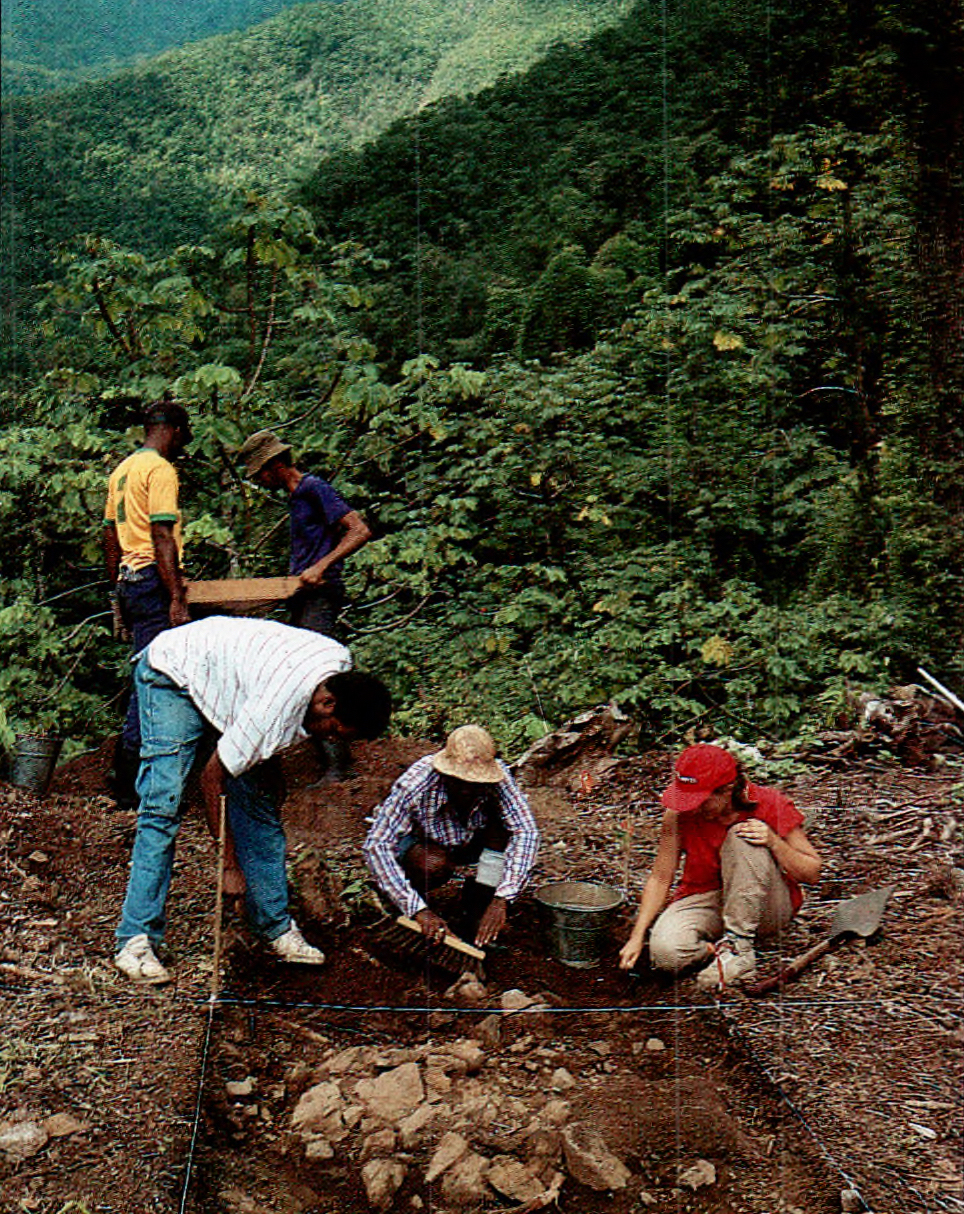
Figure 1
Students excavating a maroon habitation site at Old Nanny Town in the early 1990s, as part of the Maroon Heritage Research Project (MHRP). Image copyright Institute of Jamaica, reproduced with permission.76
This collaboration between the MHRP and the JDF hints at the ideological alignment between Agorsah and elements within Jamaica’s young postcolonial government. Throughout the 1980s, figures like Edward Seaga within the ruling Jamaica Labour Party were particularly keen on the idea of strengthening national identity through history and ‘folk culture’.77 While Seaga’s concern with building a folk history of Jamaica arose primarily from his conservative nationalist political interests, it nonetheless synced up well with Agorsah’s research vision, which tended to cast the maroons as resourceful, resilient, and thoroughly Jamaican.78 Meanwhile, Agorsah himself was known to be a meticulous excavator, and under his leadership the MHRP unearthed maroon occupational sequences at Nanny Town dating back at least to the early Spanish colonial period.79 This work strengthened the position of maroons in the Jamaican national imagination as symbols of longstanding anti-colonial resistance, and in 1994 the Jamaican mint even put Queen Nanny on the country’s 500 dollar note.80
Notably, the rise of Agorsah’s ‘nationalist’ maroon archaeology during the 1980s and 90s, alongside Jamaica’s general postcolonial political climate, also worked to marginalize the sort of research into Jamaica’s pre-contact Taíno population that had so characterized Trigger’s ‘colonialist’ and ‘imperialist’ modes.81 The founding of the government agency known as the Jamaica National Heritage Trust (JNHT) in 1996 pushed domestic Taíno research further to the margins, by heavily regulating ownership of pre-contact Taíno artifacts.82 Thus, even after Agorsah moved to Portland State University in the mid-1990s, very little Taíno material was published from Jamaica, with researchers instead choosing to focus on the archaeologies of marronage and enslavement.83 By the year 2000, less than 15 percent of the more than three thousand archaeological sites in the JNHT register were Taíno.84 This is unlike the situation in, say, the US, where a large portion of the archaeological material handled by the cultural resource management industry is of Indigenous origin.85 Such a difference makes sense: in a majority-white settler-colonial nation like the United States, whose goals have always been more colonialist and imperialist than nationalist, the concern of non-academic archaeologists is bound to be more wrapped up in administering occupied Native lands, as opposed to synthesizing a single, cohesive national identity via historical archaeology.
The way it goes: The state of jamaican archaeology today
Jamaica is a small island, however, and it has never been home to any particularly long-lasting archaeological infrastructure. Much of Jamaican archaeology in the late twentieth century revolved around Agorsah, and in some respects, his move to Portland State University in the mid-1990s can be seen as marking the beginning of a slightly fallow period for archaeology on the island. Since his departure from Jamaica, Agorsah’s students have all gone to ply their trade elsewhere — one of the most prolific of them, the archaeologist Cheryl White, chose to focus on the maroon communities of Suriname, in northern South America.86 While the MHRP has inspired similar efforts in other parts of the Caribbean (consider, for example, elements of the archaeologist Justin Dunnavant’s recent research on the US Virgin Island of Saint Croix) maroon archaeology has nonetheless gone somewhat quiet in Jamaica itself.87 Furthermore, the only archaeology program on the island (with the exception of the JNHT) is currently nested in the history department at UWI Mona, which offers a bachelor’s degree in ‘history and archaeology’, but lacks an archaeology PhD program. This dearth of opportunity has invited the return of European research teams to Jamaica, and precipitated a revival of research into the island’s pre-contact past. Universities from Canada, England, Sweden, Germany and the Netherlands have all sponsored or otherwise endorsed excavations in Jamaica since 2010.88 Over the last decade, researchers from Leiden University in the Netherlands (in collaboration with others) have also conducted several seasons’ worth of excavations at the White Marl Taíno Midden site in Spanish Town, following initial work there by Robert Howard in the 1940s and 50s.89 This interest and investment from scholars in the Global North should not necessarily be equated with Trigger’s ‘imperialist’ or ‘colonialist’ modes. However, it is worth noting that work at the White Marl site has stalled since 2024, due among other things to the alleged illegal sampling of Taíno human remains by Dutch researchers.90 Of course, this was an isolated case, involving individual scholars, and it must be assessed in context. But from the perspective of the history presented in this article, one may also understand these (alleged) actions by the Dutch researchers as acts of extraction, made possible by histories of European colonialism, and therefore performed within the colonialist mode.
Meanwhile, although the JNHT remains active, nationalist archaeology on the island has waned, leaving Jamaican archaeology in a place that largely defies the Trigger typology. This confusion also comes at something of a tipping point for Jamaica more generally: the country has recently seen efforts from across the political spectrum to remove Jamaica from the British Commonwealth and establish a fully independent republican government; the decriminalization of cannabis production in 2015 is also having a series of ripple effects on the island’s economy.91 Trigger’s typology was certainly useful as a guide for thinking about the history of Jamaican archaeology up to the end of the twentieth century. But as the modern ‘world-system’ (to once again borrow Trigger’s term)92 continues to evolve, it is important to interrogate the typology’s relevance. Especially in small postcolonial states like Jamaica, where the entire national archaeology at any one given time often flows from the work of individual scholars (like Cundall, Howard, Agorsah, etc.), colonial, imperial and nationalist archaeologies must be understood now more than ever as emergent properties, driven by various agents at various scales.
Notes
[1] David J. Weber, Foreigners in Their Native Land: Historical Roots of the Mexican Americans (Albuquerque: UNM Press, 2003); Laura E. Gómez, Manifest Destinies, Second Edition: The Making of the Mexican American Race, Second (New York: New York University Press, 2018), https://doi.org/10.18574/nyu/9781479835393.001.0001.
[2] For an ongoing example of this phenomenon, consider the Guyanese territory of Esequibo. Longstanding postcolonial borders place the territory under Guyana’s control, but the neighboring state of Venezuela — and possibly Venezuelans themselves, if one is to believe the results of a recent referendum in that country — have laid claim to Esequibo for years, with tensions escalating as Venezuelan President Nicolás Maduro becomes more covetous of the natural resources there. For more on this, see Joe Daniels, ‘“I Don’t Want to Be Venezuelan”: Guyana Region on Edge over Annexation Threat,’ Financial Times (December 12, 2023), https://www.ft.com/content/f53f360e-7dd2-43d4-b9dc-660c959e4ce9; Vanessa Buschschlüter, ‘Essequibo: Venezuelans Back Claim to Guyana-Controlled Oil Region,” BBC News (December 4, 2023), https://www.bbc.com/news/world-latin-america-67610200.
[3] Orlando Patterson, The Confounding Island: Jamaica and the Postcolonial Predicament (Cambridge: Harvard University Press, 2019): 29, https://doi.org/10.4159/9780674243064.
[4] Trevor Burnard, “European Migration to Jamaica, 1655–1780,” The William and Mary Quarterly 53, no. 4 (1996): 769–96, https://doi.org/10.2307/2947143.
[5] Zahra H. Oliphant et al., “Jamaica: Science Communication in the Land of Wood and Water,” in Communicating Science: A Global Perspective, ed. Toss Gascoigne, Bernard Schiele, Joan Leach, Michelle Riedlinger, Bruce V. Lewenstein, Luisa Massarani, and Peter Broks (Acton ACT, Australia: ANU Press, 2020).
[6] Richard T. Callaghan, “On the Question of the Absence of Archaic Age Sites on Jamaica,” The Journal of Island and Coastal Archaeology 3, no. 1 (2008): 54–71, https://doi.org/10.1080/15564890801928615; Kit W. Wesler, “Jamaica,” in The Oxford Handbook of Caribbean Archaeology, ed. William F. Keegan, Corinne L. Hofman, and Reniel Rodríguez Ramos (Oxford University Press, 2013), 250–263, https://doi.org/10.1093/oxfordhb/9780195392302.013.0082.
[7] Bruce G. Trigger, “Alternative Archaeologies: Nationalist, Colonialist, Imperialist,” Man 19, no. 3 (1984): 355–70, https://doi.org/10.2307/2802176.
[8] See the following publications, among many others: Ronald F. Williamson and Michael S. Bisson, Archaeology of Bruce Trigger: Theoretical Empiricism (Montreal: McGill-Queen’s Press – MQUP, 2006); Pamela Jane Smith, “Necrology: A Reflection on Bruce and Barbara Trigger Based on Oral-Historical Interviews and Personal Correspondence,” Bulletin of the History of Archaeology 17, no. 1 (2007): 52–55, https://doi.org/10.5334/bha.17116; Stephen Chrisomalis and André Costopoulos, “Bruce Trigger: Citizen Scholar,” in Human Expeditions: Inspired by Bruce Trigger, ed. Stephen Chrisomalis and André Costopoulos (Toronto: University of Toronto Press, 2013), xiii–xx.
[9] This is according to citation data from Google Scholar and library availability data from Worldcat.org.
[10] Consider, e.g., Denis Byrne, “Western Hegemony in Archaeological Heritage Management,” History and Anthropology 5, no. 2 (1991): 269–76, https://doi.org/10.1080/02757206.1991.9960815; Robert J. Foster, “Making National Cultures in the Global Ecumene,” Annual Reviews Anthropology 20 (1991): 235–60; Rodney Harrison, Heritage: Critical Approaches (London: Routledge, 2012), https://doi.org/10.4324/9780203108857; Oliver J. T. Harris and Craig Cipolla, Archaeological Theory in the New Millennium: Introducing Current Perspectives (London: Taylor & Francis, 2017).
[11] Leo Klejn, “Bruce Trigger in World Archaeology,” Bulletin of the History of Archaeology 18, no. 2 (November 19, 2008): 11, https://doi.org/10.5334/bha.18202.
[15] Jennifer Raff, Origin: A Genetic History of the Americas (New York: Grand Central Publishing, 2022): 42.
[16] Shenhat Haile, “Investigating Discourses of Indigeneity and Taino Survival in Jamaica,” Caribbean Quilt 6, no. 1 (2021): 26–35, https://doi.org/10.33137/cq.v6i1.35960.
[19] I use the term ‘Global South’ here as defined by the geographer Sebastian Haug, meaning ‘a general rubric for decolonised nations located roughly south of the old colonial centres of power.’ See Haug, Sebastian. “What or Where Is the ‘Global South’? A Social Science Perspective.” Impact of Social Sciences, September 28, 2021. https://blogs.lse.ac.uk/impactofsocialsciences/.
[20] Although the Bahamas, which lie to the north of the Antilles, have also been found to have a relatively late human arrival date, similar to Jamaica’s. See Matthew F. Napolitano et al., “Reevaluating Human Colonization of the Caribbean Using Chronometric Hygiene and Bayesian Modeling,” Science Advances 5, no. 12 (2019): eaar7806, https://doi.org/10.1126/sciadv.aar7806.
[22] Callaghan, “On the Question of the Absence of Archaic Age Sites on Jamaica”; Peter E. Siegel et al., “Paleoenvironmental Evidence for First Human Colonization of the Eastern Caribbean,” Quaternary Science Reviews 129 (2015): 275–95, https://doi.org/10.1016/j.quascirev.2015.10.014.
[23] Siegel et al., “Paleoenvironmental Evidence for First Human Colonization of the Eastern Caribbean.”
[24] Robert R. Howard, “The Archaeology of Jamaica: A Preliminary Survey,” American Antiquity 22, no. 1 (1956): 45–59, https://doi.org/10.2307/276166; Irving B. Rouse, “Robert Randolph Howard, 1920–1965,” American Antiquity 32, no. 2 (1967): 223–24, https://doi.org/10.1017/S0002731600097067.
[25] Areej Bukhari et al., “Taíno and African Maternal Heritage in the Greater Antilles,” Gene 637 (30, 2017): 33–40, https://doi.org/10.1016/j.gene.2017.09.004.
[26] Although Jamaica’s contemporary Indigenous population persists only in relatively small numbers proportional to neighboring Caribbean islands, and not without controversy as to the meaning of ‘indigeneity’ in Jamaica in the first place. For literature on this see Erica Neeganagwedgin, “Rooted in the Land: Taíno Identity, Oral History and Stories of Reclamation in Contemporary Contexts,” AlterNative: An International Journal of Indigenous Peoples 11, no. 4 (2015): 376–88, https://doi.org/10.1177/117718011501100405; Bukhari et al., “Taíno and African Maternal Heritage in the Greater Antilles.”
[28] Jaime R. Pagán-Jiménez and Hayley L. Mickleburgh, “Caribbean Deep-Time Culinary Worlds Revealed by Ancient Food Starches: Beyond the Dominant Narratives,” Journal of Archaeological Research 31, no. 1 (2023): 55–101, https://doi.org/10.1007/s10814-021-09171-3.
[29] Frank Cundall, Historic Jamaica (Kingston: Institute of Jamaica, 1915): 292; Neeganagwedgin, “Rooted in the Land,” 378. Note that paleodemographic estimates are notoriously difficult to produce, and should be interpreted as such (see, e.g., L. Antonio Curet, Caribbean Paleodemography: Population, Culture History, and Sociopolitical Processes in Ancient Puerto Rico (Tuscaloosa: University of Alabama Press, 2005)). However, the population of Jamaica today, in the post-industrial era, remains well under three million people, according to reporting by the United Nations (UN DESA, “World Population Prospects – Population Division – United Nations,” United Nations Department of Economic and Social Affairs, Population Division (2022), https://population.un.org/wpp/DataSources/388).
[30] Howard W. French, Born in Blackness: Africa, Africans, and the Making of the Modern World, 1471 to the Second World War, First edition (New York: Liveright Publishing Corporation, A Division of W. W. Norton & Company, 2021): 56.
[32] James Robertson, “Late Seventeenth-Century Spanish Town, Jamaica: Building an English City on Spanish Foundations,” Early American Studies 6, no. 2 (2008): 346–90.
[33] Carla Gardina Pestana, “English Character and the Fiasco of the Western Design,” Early American Studies 3, no. 1 (2005): 1–31.
[34] B. W. Higman, “The Sugar Revolution,” The Economic History Review 53, no. 2 (2000): 213–36.
[35] Nicholas Radburn, Traders in Men: Merchants and the Transformation of the Transatlantic Slave Trade (New Haven: Yale University Press, 2023).
[36] Orlando Patterson, The Sociology of Slavery: Black Society in Jamaica, 1655–1838 (Medford: Polity, 2022).
[37] Suman Seth, “Materialism, Slavery, and The History of Jamaica,” Isis 105, no. 4 (2014): 764–72, https://doi.org/10.1086/679423.
[38] Diane J. Austin, “Jamaican Bauxite: A Case Study in Multi-National Investment,” The Australian and New Zealand Journal of Sociology 11, no. 3 (1975): 53–59, https://doi.org/10.1177/144078337501100312.
[39] Jamaica’s totemic Cold War prime minister, Michael Manley, famously declared in 1976 that ‘we have our people, we have bauxite, we have tourism… and we [still] have sugar’. (See CTV News, 1976 Interview with Jamaican PM Manley on Political Violence, 2020, https://www.youtube.com/watch?v=blD-I1B9xgw).
[40] Bruce G. Trigger, A History of Archaeological Thought (Cambridge: Cambridge University Press, 2006): 42. Often, these examples are part of a broader effort to tie the Western discipline of archaeology to an innate and universal human desire to understand the past through the material world. For examples of this line of thinking throughout the history of the discipline, see the following, among others: Douglas E. Van Buren, “Archaeologists in Antiquity,” Folklore 36, no. 1 (1925): 69–81, https://doi.org/10.1080/0015587X.1925.9718311; Yunchiahn C. Sena, Bronze and Stone: The Cult of Antiquity in Song Dynasty China (Seattle: University of Washington Press, 2019), https://www.jstor.org/stable/j.ctvd7w7c7.
[41] For a scholar working in this mode already, see, for example, Neeganagwedgin, “Rooted in the Land.”
[42] For more on this question, see, among others: Chris Urwin, “Indigenous Cultures Have Archaeology Too,” SAPIENS Magazine, SAPIENS, August 11, 2020, https://www.sapiens.org/archaeology/archaeology-oral-tradition/.
[44] Phillip Allsworth-Jones, Pre-Columbian Jamaica (Tuscaloosa: University of Alabama Press, 2008): 8.
[45] James Edwin Duerden, Aboriginal Indian Remains in Jamaica (Kingston: Institute of Jamaica, 1897): 28.
[50] For more on the theme of ‘living fossils’ as a crutch for scientific racism and colonial thinking, see, e.g., Anna Lowenhaupt Tsing, The Mushroom at the End of the World: On the Possibility of Life in Capitalist Ruins (Princeton: Princeton University Press, 2015).
[51] Irving B. Rouse, “Arawakan Phylogeny, Caribbean Chronology, and Their Implications for the Study of Population Movement,” Antropologica 63, no. 64 (1985): 9–21, https://biblat.unam.mx/hevila/AntropologicaCaracas/1985/no63-64/3.pdf.
[52] Erica Neeganagwedgin, “Caribbean Indigenous Experiences of Erasure: Movement, Memory and Knowing,” Analecta Política 12, no. 22 (2022): 1–17, https://doi.org/10.18566/apolit.v12n22.a01.
[55] Caroline Elkins, Legacy of Violence: A History of the British Empire (New York: Knopf, 2023).
[64] Specifically, African mitochondrial DNA haplogroups are present in approximately 98.5 percent of Jamaica’s population (see again Bukhari et al.).
[65] Examples of Taíno-focused Cuban archaeology include Jorge Ulloa, “Archaeology and Rescue of the Aboriginal Presence in Cuba and the Caribbean,” KACIKE: The Journal of Caribbean Amerindian History and Anthropology, 2002, 1–11; David Cintron, “The Taino Are Still Alive, Taino Cuan Yahabo: An Example Of The Social Construction Of Race And Ethnicity” (Master’s Thesis, University of Central Florida, 2006), https://stars.library.ucf.edu/etd/997; William F. Keegan and Lisabeth A. Carlson, Talking Taino: Caribbean Natural History from a Native Perspective (Tuscaloosa: University of Alabama Press, 2008).
[67] Lacy Risner, “Queen Nanny, a Case Study for Cultural Heritage Tourism: The Archaeology of Memory and Identity” (Master’s Thesis, Murray State University, 2019), https://digitalcommons.murraystate.edu/lbacapstone/4.
[68] Cheryl White, “Kumako: A Place of Convergence for Maroons and Amerindians in Suriname, SA,” Antiquity 84, no. 324 (2010): 467.
[69] Interestingly, however, a recent genetic analysis has uncovered evidence of Taíno admixture into Jamaica’s present-day maroon communities, potentially offering an opportunity to bridge the divide between ‘Indigenous’ and maroon archaeology. Narratives detailing cultural continuity between Jamaica’s Taíno and maroon communities have persisted for generations, but it will be interesting to see how the advent of modern genomics changes things in the coming years. For the genetic analysis, see Harcourt Fuller and Jada Benn Torres, “Investigating the ‘Taíno’ Ancestry of the Jamaican Maroons: A New Genetic (DNA), Historical, and Multidisciplinary Analysis and Case Study of the Accompong Town Maroons,” Canadian Journal of Latin American and Caribbean Studies/Revue Canadienne Des Études Latino-Américaines et Caraïbes 43, no. 1 (2018): 47–78, https://doi.org/10.1080/08263663.2018.1426227.
[71] E. Kofi Agorsah, “Seaman’s Valley and Maroon Material Culture in Jamaica,” Proceedings of the 17th Congress of the International Association for Caribbean Archaeology 7 (1997): 285–300; Keril Wright, “Remembering Edward Moulton-Barrett,” Jamaica Observer, March 1, 2007, https://www.jamaicaobserver.com/western/remembering-edward-moulton-barrett/.
[72] Scott Fitzpatrick, “Obituaries – 2022,” The International Association for Caribbean Archaeology, 2022, https://blogs.uoregon.edu/iaca/francais-avis-de-deces/.
[73] E. Kofi Agorsah, “Archaeology in Jamaica: Recent Developments,” Proceedings of the 14th Congress of the International Association for Caribbean Archaeology (1991): 416–424; https://ufdcimages.uflib.ufl.edu/AA/00/06/19/61/00498/14-32.pdf; E. Kofi Agorsah, “Archaeology and Resistance History in the Caribbean,” African Archaeological Review 11, no. 1 (1993): 175–95, https://doi.org/10.1007/BF01118147.
[74] E. Kofi Agorsah, “Nanny Town Excavations: Rewriting Jamaica’s History?,” Jamaican Geographer 5, no. 8 (May 1993).
[75] Agorsah (1995).
[76] The photograph in Figure 1 originally appeared in E. Kofi Agorsah, “Archaeology and the Maroon Heritage in Jamaica,” Jamaica Journal 24, no. 2 (1995): 3.
[77] Edward Seaga, “The Significance of Folk Culture in the Development of National Identity,” Caribbean Quarterly 43, no. 1–2 (March 1997): 82–89, https://doi.org/10.1080/00086495.1997.11829562.
[78] Fitzroy Ambursley, “Jamaica: From Michael Manley to Edward Seaga,” in Crisis in the Caribbean ed. Fitzroy Ambursley and Robin Cohen (London: Routledge, 1984): 72–104.
[79] Agorsah, “Nanny Town Excavations: Rewriting Jamaica’s History?”; for notes on Agorsah’s personal excavation style, see Fitzpatrick, “Obituaries – 2022.”
[80] Erin M. Fehskens, “Nanny of the Maroons,” in Dictionary of Caribbean and Afro-Latin American Biography, ed. Franklin W. Knight and Henry Louis Gates Jr. (Oxford: Oxford University Press, 2016): 4, https://doi.org/10.1093/acref/9780195301731.013.74644.
[81] Zenzi Moore-Dawes, “The Third Maroon War: Indigenous Archaeology and the Fight Against Neocolonialism in Jamaica,” paper presented at the American Anthropological Association Annual Meeting, Tampa, FL, November 22, 2024.
[83] Kristen R. Fellows and James A. Delle, “Marronage and the Dialectics of Spatial Sovereignty in Colonial Jamaica,” in Current Perspectives on the Archaeology of African Slavery in Latin America, ed. Pedro Paulo A. Funari and Charles E. Orser Jr., SpringerBriefs in Archaeology (New York: Springer, 2015), 117–32, https://doi.org/10.1007/978-1-4939-1264-3_8.
[84] ABC News, “Archaeologists Preserve Jamaica’s Past,” ABC News, July 6, 2000, https://abcnews.go.com/Travel/story?id=118928&page=1.
[85] Thomas Carl Patterson, Toward a Social History of Archaeology in the United States (Fort Worth: Harcourt Brace College Publishers, 1995), 106.
[86] Cheryl White, “Material Beginnings of the Saramaka Maroons: An Archaeological Investigation” (Doctoral Dissertation, University of Florida, 2007).
[87] Justin P. Dunnavant, “Have Confidence in the Sea: Maritime Maroons and Fugitive Geographies,” Antipode 53, no. 3 (2021): 884–905, https://doi.org/10.1111/anti.12695.
[88] Sarah Elliott et al., “The Legacy of 1300 Years of Land Use in Jamaica,” The Journal of Island and Coastal Archaeology 19, no. 2 (2022): 312–43, https://doi.org/10.1080/15564894.2022.2078448.
[89] Hayley L. Mickleburgh et al., “Precolonial/Early Colonial Human Burials from the Site of White Marl, Jamaica: New Findings from Recent Rescue Excavations,” International Journal of Osteoarchaeology 29, no. 1 (2019): 155–61, https://doi.org/10.1002/oa.2707; Simon Van Barneveld, “Modelling Archaic Age Settlement Patterns on Jamaica’s Southwestern Coast Using the Ideal Free Distribution” (Master’s Thesis, Simon Fraser University, 2022), https://summit.sfu.ca/item/35741.
[90] Martin Enserink, “Report Slams Dutch Archaeologist Couple for Intimidation, Abuse of Power, and Theft of Human Remains,” Science Insider, May 20, 2024, sec. Archaeology, https://www.science.org/content/article/report-slams-dutch-archaeologist-couple-intimidation-abuse-power-and-theft-human.
[91] Traci-Ann Wint, “Straddling Empires, Jamaica Navigates Road to Republic Status,” NACLA Report on the Americas 55, no. 3 (2023): 266–71, https://doi.org/10.1080/10714839.2023.2247752; Felipe Neis Araujo, “Ganja and the Laws of Men: Cannabis Decriminalization and Social (In)Justice in Jamaica,” Contemporary Drug Problems 50, no. 2 (2023): 202–16, https://doi.org/10.1177/00914509231156608.
Acknowledgements
This article grew out of research conducted for a Yale University Archaeology course taught by Professor Richard L. Burger in the fall of 2023, and it would not have been possible without the feedback of Professor Burger and Teaching Fellow Michael Maddox. That said, all arguments made, and any errors perceived therein, are the author’s own.
Competing Interests
The author has no competing interests to declare.