
Twenty million people are underfed, but literally everyone in England has access to a radio.1
Introduction
This study examines the international broadcasting output of prehistorian Vere Gordon Childe. Childe’s work is usually approached through his writings, but here examination concentrates on his career in radio and television. Whilst the focus will be the BBC, the study also examines Childe’s broadcasts in India, Australia, America, and the Soviet Union. Childe’s involvement in radio and television, hitherto neglected, was as important as his print output in spreading his ideas and reputation; given the size of his international audience, it may even have surpassed it.
Investigating Childe’s media output sheds new light on his work as a committed popular educator and public communicator in both archaeology and the history of science. Childe’s relationship with the BBC was complex. His interactions could be negative and ill-tempered, but he was nonetheless conscious of the organisation’s power and influence. These interactions – and his broadcasts – were also tinged by his radical left-wing politics. Examination of Childe’s broadcasting career reveals an intriguing dichotomy: Childe was both an influential Establishment figure and a radical political outsider. It also reveals the frequently paradoxical nature of his behaviour and attitudes.
A generation of archaeologists used radio and television to promote their views, educate the public, and challenge ‘alternative’ archaeologies. They worked actively, even aggressively, to ensure their message dominated the airwaves. This included Childe. A political radical who challenged authority outside archaeology, he was ruthless in seeing off rivals who presented alternative narratives within it. Radio and television increased the prestige and popularity of archaeologists, but the BBC did not adopt their ideas unquestioningly. A carefully negotiated dialogue ensued, with the BBC retaining strong creative control of both process and output. The media archaeology that resulted was a sophisticated partnership. As broadcasting advanced, experts like Childe, chosen for their intellectual gravitas, were gradually replaced by more charismatic individuals like Glyn Daniel, capable of entertaining as well as educating.
Childe’s Broadcasting Output: Sources & Reconstruction
Gordon Childe (1892–1957) was one of the most influential prehistorians of the twentieth century. An Australian by birth, Childe was Abercromby Professor of Archaeology at Edinburgh University from 1927 to 1946, and Director of the London University Institute of Archaeology between 1946 and 1956. Childe combined his primary field of research, European prehistory, with a pioneering interest in archaeological theory and is particularly well known for his Marxist interpretations of archaeology.2
Childe’s public engagement has traditionally been examined in terms of print media. He authored bestselling books, Man Makes Himself and What Happened in History, and articles for magazines, science journals, newspapers, and guidebooks.3 This print focus has obscured his wider, cross-media public engagement: lectures; museum exhibitions; fieldwork, and site tours. The quantity and diversity of his radio and television output, reconstructed in Table 1, indicates that we also need to include these newer forms of engagement.
Table 1
Vere Gordon Childe: Radio and Television Broadcasts.
| TITLE | DATE | DURATION | BROADCASTER, COUNTRY & REGION | MEDIUM (RADIO/TELEVISION/PRINT) | OUTPUT – SCRIPT/ARTICLE/CHAPTER | RECORDING | SOURCE |
|---|---|---|---|---|---|---|---|
| ‘A prehistorian’s interpretation of diffusion’ | 10 September 1936: 9.30–11.30 | 30 minutes (within session of 2 hours with 4 speakers) | W1XAL World Wide Broadcasting Foundation, Boston (USA) | Radio | Book chapter (see below) | No | Harvard University Tercentenary Week. Broadcast over W1XAL World Wide Broadcasting Foundation. Broadcast Schedule. In: Scientific Papers contributed to the Harvard Tercentenary Conference of Arts and Sciences, August 31–September 12, 1936, other than those related to the three collaborative symposia published by the University. [A collection of reprints from various periodicals.] British Library General Reference Collection 7005.r.8. |
| ‘A prehistorian’s interpretation of diffusion’– written version of broadcast above | 1937 | N/A | N/A | Book Chapter | N/A | Independence, Convergence and Borrowing in Institutions, Thought and Art: 3–21 (Harvard Tercentenary Publications). Cambridge, MA: Harvard University Press. | |
| Professor ‘G’ Gordon Childe and Watson Davis, Life in the Stone Age. | 23 March 1937: 17.15–17.30 | 15 minutes | WEEI – Boston. Science Service (USA) | Radio | No | No | The Portsmouth NH Herald, Tuesday March 23 1937, p. 7. Radio Programs. |
| ‘Life in a Stone Age Village’. Part of series ‘Digging for History’ | 4 July 1937: 16.00–16.15 | 15 minutes | BBC Regional Programme Scotland | Radio | No | No | BBC Genome https://genome.ch.bbc.co.uk/4d58c53785d849f999c445dae33d3cf0 |
| ‘Chronicles in Stone’ | 26 November 1937: 18.45 – 19.00 | 15 minutes | BBC Regional Programme London | Radio | No | No | BBC Written Archives Index: Childe, V. Gordon BBC Genome https://genome.ch.bbc.co.uk/cc60b1e4317a4ee5a1c122bae045f9d4 |
| ‘Chronicles in Stone’ | 8 December 1937 | N/A | BBC Magazine | Magazine Article | N/A | The Listener 18 (465) Wednesday 8 December, 1937, pp. 1245–6 | |
| ‘The Birth of Science’. 1st lecture in George Orwell Series ‘Science and Politics’ | 2 June 1942: 11.15–11.45 | 30 minutes | BBC Indian Service | Radio (recorded) | Book chapter (see below) | No | BBC Written Archives Index: Childe, V. Gordon Davison, P. 1998, pp. 256, 265, 245, 319 BBC Written Archives. Talks Book Requisition. Childe. |
| ‘Science and Magic’ – written version of broadcast above | 1943 | N/A | N/A | Book Chapter | N/A | Forster et al (eds.) 1943, pp, 65–72 | |
| Your Questions Answered | 1 June 1945: 16.30–17.00 | 30 minutes | BBC Light Programme/Forces Education | Radio | Script | No | BBC Written Archives Index: Childe, V. Gordon |
| Your Questions Answered | 31 August 1945: 18.00–18.30 | 30 minutes | BBC Light Programme/Forces Education | Radio | Script | No | BBC Written Archives Index: Childe, V. Gordon |
| ‘Plants and Animals’. 1 of 6 in series ‘Man Takes Over’ | 17 October 1945: 10:40 – 11.00 | 20 minutes | BBC Light Programme/Forces Education | Radio | Script | No | BBC Written Archives Index: Childe, V. Gordon BBC Genome https://genome.ch.bbc.co.uk/2a236e842abb42cea72fc467278fa5e0 |
| ‘The Influence of Metals’. 2 of 6 in series ‘Man Takes Over’ | 24 October 1945: 10.40–11.00 | 20 minutes | BBC Light Programme/Forces Education | Radio | Script | No | BBC Written Archives Index: Childe, V. Gordon BBC Genome https://genome.ch.bbc.co.uk/68bd7651e7124f2bb0327311bc2c9f6f |
| ‘The Division of Labour’ 3 of 6 in series ‘Man Takes Over’ | 31 October 1945: 10.40–1100 | 20 minutes | BBC Light Programme/Forces Education | Radio | Script | No | BBC Written Archives Index: Childe, V. Gordon BBC Genome https://genome.ch.bbc.co.uk/47cfb7abdb8643d2b6050e45c153a3cd |
| ‘Calling Australia’ | 06 November 1945: 19.30–19.45 | 15 minutes | BBC Pacific Service | Radio (recorded) | Script | No | BBC Written Archives Index: Childe, V. Gordon Otago Daily Times Issue 25993 6 November 1945, pp. 1. |
| ‘The Effect of Iron Tools’ 4 of 6 in series ‘Man Takes Over’ | 7 November 1945: 10.40–11.00 | 20 minutes | BBC Light Programme/Forces Education | Radio | Script | No | BBC Written Archives Index: Childe, V. Gordon BBC Genome https://genome.ch.bbc.o.uk/481f732cfb30461e874f34d155f67e16 |
| ‘New Ways of Living’ 5 of 6 in series ‘Man Takes Over’ | 14 November 1945: 10.40–11.00 | 20 minutes | BBC Light Programme/Forces Education | Radio | Script | No | BBC Written Archives Index: Childe, V. Gordon BBC Genome https://genome.ch.bbc.co.uk/a33005fe07a544599d8268fabee3269f |
| ‘Machines and Social Orders’ 6 of 6 in series ‘Man Takes Over’ | 21 November 1945: 10.40–11.00 | 20 minutes | BBC Light Programme/Forces Education | Radio | Script | No | BBC Written Archives Index: Childe, V. Gordon BBC Genome https://genome.ch.bbc.co.uk/ea231184bf38432a808bc28486bd11b9 |
| ‘The Romance of Archaeology’ | 8 December 1945 | N/A | BBC London Calling | Magazine Article | N/A | BBC London Calling 323, pp. 13 and 16 Karntner Nachrichten 176, 8 December 1945, p. 4. | |
| ‘Australians in Britain. The Purpose of Archaeology’ | 14 June 1946: 17.15–17.30 | 15 minutes | BBC Pacific Service | Radio | Script | No | BBC Written Archives Index: Childe, V. Gordon |
| ‘Your Questions Answered’ | 11 October 1946: | BBC Light Programme/Forces Education | Radio | Script | No | BBC Written Archives Index: Childe, V. Gordon | |
| ‘Archaeology and History. By Gordon Childe’ 8 in series ‘The Archaeologist’ | 1 December 1946: 18:45–7.00 | 15 minutes | BBC Third Programme | Radio | Script | No | BBC Written Archives Index: Childe, V. Gordon BBC Genome https://genome.ch.bbc.co.uk/9d557f05be6f46f5b09ffed092f4c975 |
| ‘The Study of Mankind’ | 5 December 1946: 15.30–15.45 | 15 minutes | BBC Eastern Service (Purple Network) | Radio | Script | No | BBC Written Archives Index: Childe, V. Gordon |
| ‘Archaeology and History’ | 19 December 1946 | N/A | BBC Magazine | Magazine Article | N/A | The Listener 36 (939), Thursday 19 December 1946, pp. 882–883 | |
| ‘Social Evolution’ | 23 April 1952: 21. 00–21.20 | 20 minutes | BBC Third Programme | Radio (recorded) | Script | No | BBC Written Archives Index: Childe, V. Gordon BBC Genome https://genome.ch.bbc.co.uk/deb4d2b7ac4344be84331ae42943e536 |
| ‘Social Evolution’ (repeat of the above) | 12 August 1952: 18.00–18.20 | 20 minutes | BBC Third Programme | Radio | Script | No | BBC Genome https://genome.ch.bbc.co.uk/6951ee5d68e749d18743ebfdfb0e548d |
| ‘Economic Prehistory’ | 20 May 1952: 20.30 – 20.50 | 20 minutes | BBC Third Programme | Radio (recorded) | Script | No | BBC Written Archives Index: Childe, V. Gordon BBC Genome https://genome.ch.bbc.co.uk/883844f16c2f4ee88268e58a753a72b2 |
| ‘Economic Prehistory’ (repeat of the above) | 22 May 1952: 11.30–11.50 | 20 minutes | BBC Third Programme | Radio | Script | No | BBC Genome https://genome.ch.bbc.co.uk/c064e48cb49e4a6b98e25b439670e2cc |
| Anonymous review of ‘Prehistoric Europe: The Economic Basis’ by J. D. G. Clark | 17 July 1952 | N/A | BBC Magazine | Magazine Article | N/A | The Listener 48 (1220), Thursday 17 July 1952, p.115. BBC Written Archives: Internal BBC Memo, Gilbert Phelps, 25 April 1952 | |
| In panel television series ‘Animal, Vegetable, Mineral’ | 23 October 1952: 21.45–22.15 | 30 minutes | BBC Television | Television | Filming directions, no script | No | BBC Genome https://genome.ch.bbc.co.uk/6d3e187ac65643adbd515280c08fc45c BBC History (photo) https://www.bbc.co.uk/programmes/p018by0n/p01866g0 |
| Childe describing his impressions of a recent visit trip to Central Asia | 30 September 1953 | ? | Russian Radio Service for Britain (Soviet Union) | Radio | No | No | BBC Monitoring Report 4401 TNA. KV2/2149, 93a: Childe |
| ‘Neolithic Britain’ | 15 June 1954: 20.10–20.30 | 20 minutes | BBC Third Programme | Radio | Script | No | BBC Written Archives Index: Childe, V. Gordon BBC Genome https://genome.ch.bbc.co.uk/a74379fc25c24af8b79fc9024849a4a7 |
| ‘Neolithic Cultures of the British Isles’ | 24 June 1954 | N/A | BBC Magazine | Magazine Article | N/A | The Listener 51 (1321), Thursday 24 June 1954, p. 1089 | |
| ‘The Challengers: National Museum Prague (Narodni Museum V Praze)’. In panel television series ‘Animal, Vegetable, Mineral’ | 3 May 1956: 21.30–22.00 | 30 minutes | BBC Television | Television | Filming directions, transcript of programme & recording | Yes | BBC Written Archives Index: ‘Animal, Vegetable, Mineral’ BBC Genome https://genome.ch.bbc.co.uk/18b38c9d027b425092255ac76a441b86 BBC Iplayer https://genome.ch.bbc.co.uk/p017gfng |
| ‘Prehistory in India’ | May 6 1957: 21.15–21.30 | 15 minutes | Calcutta (A). All India Radio (India) | Radio (recorded) | No | No | The Times of India May 6, 1957, pg. 9 |
| ‘Bronze Age Economics Created European Society’ | 13 October 1957: 19.15 | ? | Australian Broadcasting Commission (ABC) (Australia) | Radio (recorded) | Edited Transcript | No | Australian Archaeology 30, 1990, pp. 26–28. |
The dominance of information relating to the BBC examined here reflects not only the institution’s monopoly over public broadcasting in Britain and its Empire until 1955, but also the quality and availability of its records.4 Childe also participated in radio programmes for other overseas media organisations, but the full picture of his international broadcasting is less certain. More radio broadcasts may await discovery, particularly in the countries of the former Soviet Union, where Childe was well-known.
Regrettably, no recordings of Childe’s radio broadcasts survive and only one of his television appearances is known, in the series Animal, Vegetable, Mineral in 1956.5 Although some of Childe’s other broadcasts were recorded, for example his talk on Social Evolution, first broadcast on 23 April 1952 and repeated on 12 August 1952 (see Table 1), this has not guaranteed their survival, merely their contemporary transmission and repetition. Fortunately, broadcasting has never been a discrete medium. Transmitted voices are accompanied by written documents, and in the case of Childe, surviving documents locate his broadcasts in the complex relationships between the BBC, broadcasters, and audiences. Listening is also shaped through print texts, notably the Radio Times (the world’s first weekly broadcasting magazine), and The Listener (the BBC’s weekly illustrated educational journal), in addition to newspaper articles, and reviews.6
Written archives, including indices of broadcasts, correspondence, and scripts, provide details about Childe’s broadcasts and his interactions with the BBC. Childe also authored articles for The Listener and London Calling, a monthly magazine for the BBC World Service. Almost all programmes were scripted until well into the 1950s7 and the 16 surviving scripts of Childe’s BBC radio broadcasts, one rare BBC television transcript, and one transcript from the Australian Broadcasting Commission (ABC) are particularly valuable (see Table 1). Scripts were the result of careful negotiation between writer/broadcaster and producer, a process visible in Childe’s radio scripts and correspondence (Figure 1).8
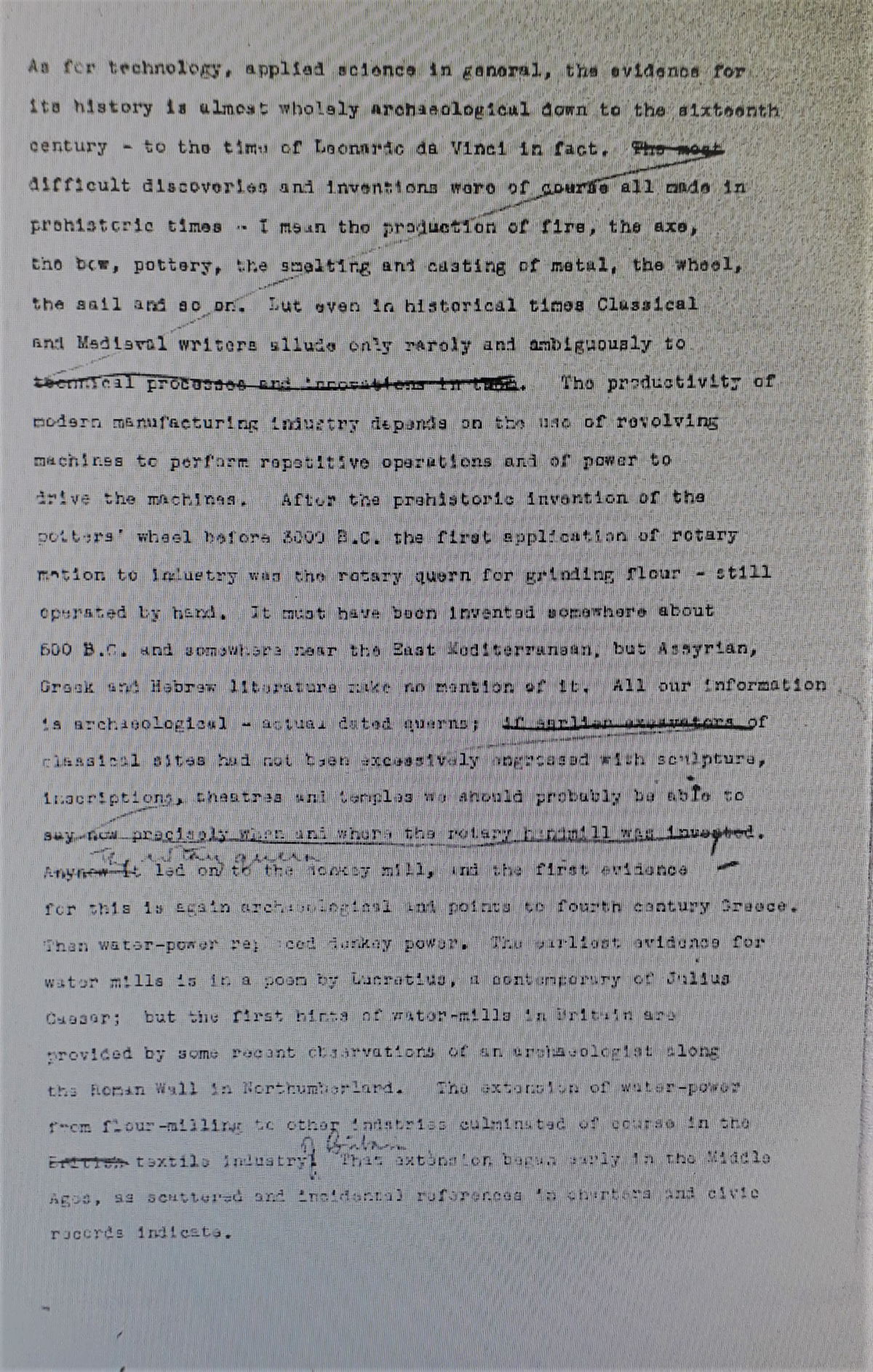
Figure 1
Page 5 (with corrections by Childe) of Childe’s script for the radio broadcast ‘Archaeology and History’, episode 8 of the Third Programme series ‘The Archaeologist’, broadcast on 1 December 1946. Credit: © BBC Written Archives. Reproduced from Scripts microfiche.
The Development of Archaeological Broadcasting: Childe in Context
Audio-visual archives represent one of the most important cultural and social resources of the twentieth century.9 The importance of radio and television as sources of archaeological information is widely acknowledged, particularly their role in the formation of multiple, individualised attitudes to the past. Nonetheless, the history of archaeological broadcasting has traditionally been neglected, and detailed studies have focused predominantly on television.10 This neglect, perhaps symptomatic of the traditional focus on theories, excavations, and research rather than relationships with the public, has been detrimental to the history of the discipline.11 Fortunately, recent studies by Lewis and Maloigne have done much to reverse it. Their work has shed new light on the relationship between archaeologists and the BBC, and the role played by broadcasting in both the formation of archaeology as a modern discipline and its promotion to the public.12
This study, like Maloigne’s examination of C. Leonard Woolley, looks at the broadcasting work and relationships of an archaeologist within the wider context of the development of the discipline and the manoeuvrings of archaeologists to control communication of their subject to the public. Similar themes can be recognised, particularly the entanglement of reading and listening.13 However, this study moves beyond the BBC, using Childe’s overseas broadcasting to examine the global promotion of the work of British archaeologists by radio and television, and its resulting popularity and prestige. The study also sheds light on the political use made of archaeology in broadcasting. With Childe, politics and archaeology were irrevocably intertwined in ways largely missing from the work of his contemporaries. Arguably through broadcasting as well as print, Childe’s particular, Marxist interpretations were to profoundly affect global public understanding of prehistory.
Radio, television, and archaeology have enjoyed a long and fruitful relationship. The first British radio ‘archaeology’ talk, broadcast on 2 February 1924, a mere two years after the foundation of the BBC, was on Mesopotamia, as part of the series Scholar’s Half-Hour; early archaeological radio reflected public interest in Egypt and the ancient Near East. Glyn Daniel, himself a respected media industry insider, constructed the first narratives about early archaeological broadcasting in Britain: outlining broad trends, innovations, and industry practices, and identifying important early figures.14 However, Daniel attributed the beginnings of ‘serious and sustained broadcasting’ in archaeology to the post-war Third Programme, thus ignoring the rich inter-war period. ‘Television’ archaeology began early, in May 1937, only six weeks after the launch of the first television service.15
Daniel claimed that British prehistory had ‘less than its fair share of space’ on the radio before World War II, a contention supported by the surviving evidence. Lewis has identified 143 broadcasts relating to archaeology between 1924 and 1939. Whilst additional examples may be concealed beneath general titles such as Man and His Past – the Age of Bronze, only 15 broadcasts relating to named aspects of British and European prehistory, e.g. Stonehenge, are listed, compared to 69 relating to Egypt and the Ancient Near East. Prehistory and heritage did, however, form vibrant elements of regional BBC radio services, particularly Western region, Wales, and Scotland, frequently intertwined with history, folklore, and geography/topography.16 The first series addressing British prehistory, Ancient Britain Out of Doors by Jacquetta Hawkes, was broadcast in April 1935. Radio ‘prehistory’ developed slowly during the 1930s as part of wider interest in British archaeology. The influence of the new ideas of the inter-war generation of archaeologists is suggested by programmes on local fieldwork and excavation, key to their vision of the discipline, e.g., William F. Grimes’ radio series, How To Read the Welsh Countryside.17 This change in emphasis reveals both the growing control of public narratives about archaeology by this new generation of archaeologists and the importance that the BBC placed on association with dynamic new disciplines.18
Engagement with radio, television, and news reels offered archaeologists a wealth of new possibilities. Media interest in archaeology was not limited to Britain; for example, AB Radiotjanst, Swedish national radio, broadcast at least 76 programmes categorised as archaeology during the period 1925–1950.19 Archaeologists were keen to become cross-media communicators, encompassing books, newspapers, exhibitions, lectures, radio and later television broadcasts. Their vision was altruistic and educational; writing in London Calling for a global radio audience, Childe stated: ‘I am convinced that the time has come when we archaeologists can and should make our results accessible to the general public’.20 It was also practical and financial. Archaeologists used radio to raise funds for excavations overseas, notably Leonard Woolley, a talented publicist.21
The educative vision of British archaeologists originated in nineteenth century middle-class aspirations to ‘improve’ working-class education and culture. This ‘patriarchal’ vision was shared by John Reith (1889–1971), first Director General of the BBC, who believed broadcasting should be a ‘public service’ for culture, knowledge, and education. The BBC began in 1922 as the British Broadcasting Company. The fledgling radio service faced opposition from established media interests, but in 1927 it became the British Broadcasting Corporation, its future secured by a monopoly over British radio and television that it retained until 1955. Although there were frustrations with the corporation’s tendency to place high-minded culture above light entertainment, the BBC became one of the most influential global cultural institutions of the twentieth century.22
Its potential for reaching mass audiences was unparalleled. By the end of 1926, at least 70% of the British population was within range of a radio station.23 In 1939, the BBC reached around 30–35,000,000 listeners out of a population of 48,000,000, or 73% of households.24 In 1951, 83% of households had access to radio sets.25 In the late 1940s, the Third Programme, which hosted most post-war archaeology broadcasts, had between 1,500,000 and 2,500,000 listeners, comparable with the readership of the Sunday Times or The Observer newspapers.26 The possibilities for engagement far outstripped those of traditional print media; Childe’s most successful book, What Happened in History, sold only 300,000 copies over 15 years.27
Childe and radio internationalism: contexts of science and professionalism
Childe’s radio broadcasts need to be examined within the context of the changing nature of twentieth century archaeology and his own politics. Childe was one of a generation of archaeologists that emerged between the wars, sometimes referred to as ‘the Golden Generation’. For them, archaeology was no longer a ‘hobby’ for amateur antiquarians, but a skilled profession. They established common ground-rules, set standards, and established epistemological values for fieldwork, excavation, and the curation of monuments and artefacts. They also established boundaries for the discipline, taking it upon themselves to decide what counted as archaeology, took control of key organisations, for example, the Prehistoric Society, and established new methods of communication, for example the journal Antiquity.28
These archaeologists shared a strong commitment to public education and the dissemination of accurate information, but also needed to counter alternative narratives about the past that they considered to be false and misleading. This involved the active marginalization of not only the esoteric enthusiasms of ley line hunters, ‘druids’, and mystics, but also older amateur antiquarians. Through site tours, excavations, lectures, newspaper articles, guidebooks, journals, and other popular writing, the group did much to market their vision of archaeology to the public as the ‘correct’ and ‘professional’ one. Radio offered the means of both increasing this ‘reach’ and tightening their control.29
Central to the group’s identity was their advocacy of archaeology as a ‘science’. This identification was ill-defined, categorised as both a social and a natural science.30 For Childe, the identification of archaeology as a science was important politically and intellectually, and broadly defined:
I take science not to be limited to an attempt to attain or construct a world of absolute truth from a systemization of experience, but to include also the search for partial systems upon which man can successfully operate.31
Childe’s initial interest in the history of science began in the late 1930s, through his involvement with the Social Relations of Science Movement (SRS). The SRS was an energetic network of leading left-wing scientists including John Desmond Bernal, Lancelot Hogben, JBS Haldane, Hyman Levy, and JG Crowther. Many were Marxists and Communists, admirers of the Soviet Union, and the importance assigned to science by the Soviet state. For them, science was the determining factor in human progress, and scientists needed to work within society to education the public, expose pseudo-scientific doctrines, construct policies, and promote technologies that would enable social improvement.32 Childe maintained that ‘the systematized observations inherited from prehistoric times’ ultimately led to the development of the sciences.33 His archaeological research was seen as key to understanding the role of science in human progress by his SRS colleagues. Hogben, for example, praised Childe for his research on Neolithic farming, which he classed as a ‘biological invention’.34 Their political approach to science in society in turn influenced both Childe’s writing and broadcasting. The SRS, with their eagerness to educate the public, shared much with their archaeological contemporaries.
Initially Childe was dubious about radio, stating ‘older experts like myself may indeed be incapable of appealing to a wide public’.35 Whilst he did not own a radio himself, at least as reported in the 1950s,36 he came to appreciate the power of the BBC. Discussing the newly-established Council of British Archaeology (CBA) with Kathleen Kenyon, he commented:
This business of publicizing archaeology is, though particularly difficult just now, also very urgent. In particular we have not hitherto sufficiently exploited the BBC that is the most far-reaching agent at the present time.37
Most of Childe’s broadcasting, like that of his British colleagues, was for the BBC. He delivered 18 radio broadcasts between 1937 and 1954. This output was comparable to that of Stuart Piggott, who delivered a total of 24 radio broadcasts between 1947 and 1970, and albeit over a longer period, to Leonard Woolley, who delivered 20 broadcasts between 1924 and 1937.38 This was more than OGS Crawford (who disliked radio) and Grahame Clark who delivered only 9 broadcasts each, but far less than Glyn Daniel, who delivered 82 broadcasts between 1946 and 1971.39 Unlike Leonard Woolley and Cyril Fox, Keeper of Archaeology at the National Museum of Wales, who had sustained media careers, Childe’s radio appearances were sporadic, occurring over many years.
Childe was not an exceptional broadcaster, but he was versatile, talking about both archaeology and the history of science. His first talk for the BBC, on 4 July 1937, Life in a Stone Age Village, was about Skara Brae, the well-preserved Neolithic village on Orkney where he had excavated between 1928 and 1930. The talk was part of Regional Programme Scotland’s fortnightly series Digging for History, which consisted of talks by ‘Scottish archaeologists either working at home or abroad’.40 Regional stations had been established to create local programmes as an alternative to the centralised, metropolitan service. By 1937 listeners in most parts of Britain and the Irish Free State, and many listeners in Europe, could listen to regional output. The Scottish Regional Station, which opened in September 1932, focused on Scottish history, music, arts, and sport.41 Regional stations became powerful cultural agencies and by the late 1930s, had contributed much to the new assertion of Scottish, Welsh, and Irish identities and the development of a plural approach to Britishness.42 Inter-war archaeologists like Childe and Cyril Fox, who broadcast extensively on local prehistory and heritage, contributed to the growing sense of complex and divergent British pasts (Figure 2).43
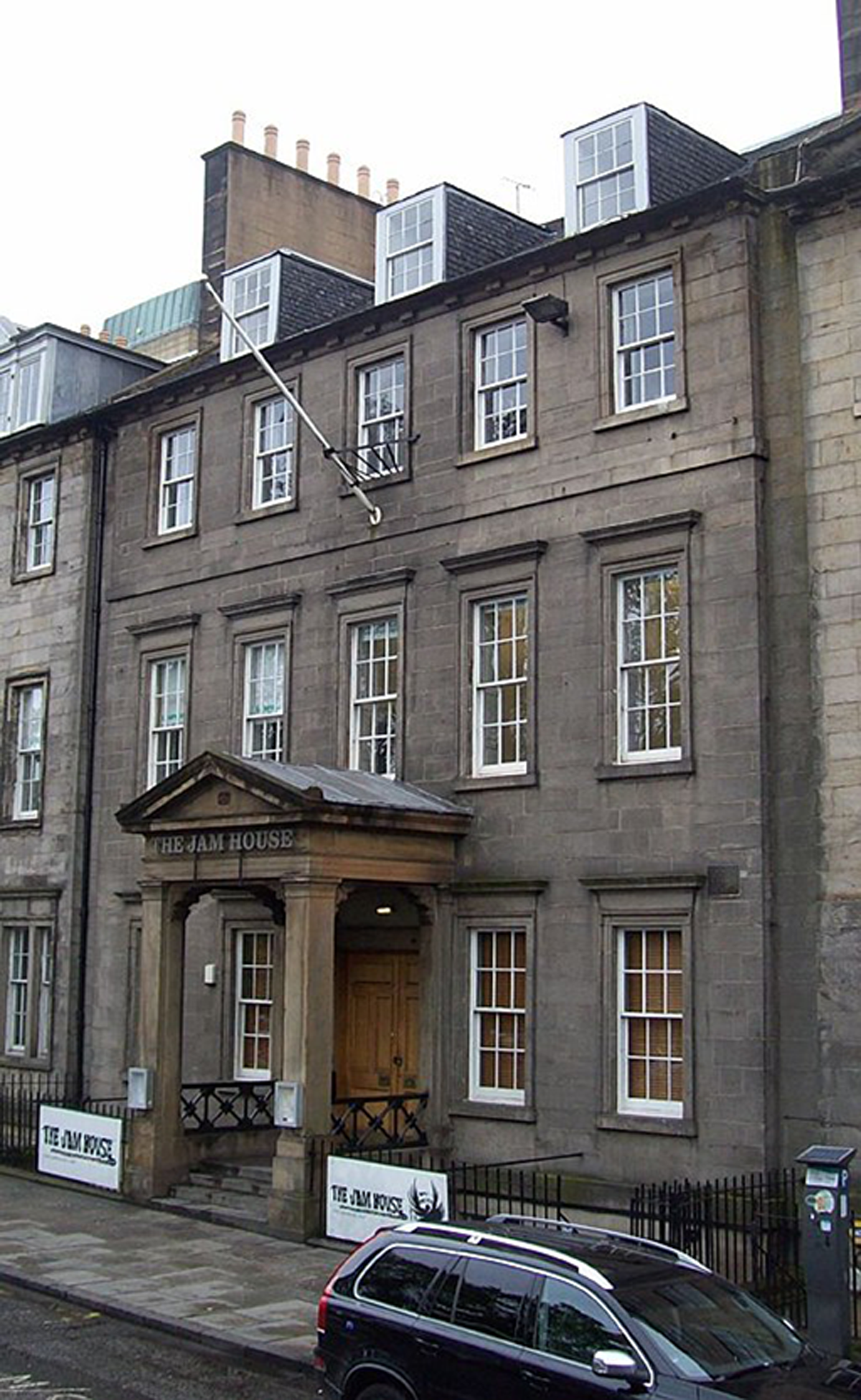
Figure 2
Broadcasting House, 5 Queen Street Edinburgh, where Childe recorded the majority of his broadcasts between 1937 and 1946. Losdedos, CC BY-SA 3.0 DE <https://creativecommons.org/licenses/by-sa/3.0/de/deed.en>, via Wikimedia Commons.
Childe worked with multiple BBC services, including Regional, National, Forces Education, Third Programme, and the Overseas Indian, Pacific, and Eastern Services. Although this is partly a consequence of the evolving nature of the corporation, the variety is remarkable, demonstrating the scope and size of Childe’s BBC audience.44 Childe also collaborated with international broadcasters in the Soviet Union, America, Australia, and India, beginning at the Harvard University Tercentenary in 1936. Harvard had arranged with Boston W1XAL World Wide Broadcasting to broadcast the celebrations across America and internationally. The ‘broadcast’, actually a live recording of Childe’s 30-minute lecture, went out on 10 September 1936 as part of a two-hour session on ‘Europe and the Near East’.45 The following year, on 23 March 1937, Childe participated in a discussion entitled Life in the Stone Age for the USA Science Service, when he was in the USA to attend the International Symposium of the Academy of Natural Sciences on Early Man.46
By 1932, Americans owned nearly half the radio sets in the world, but American radio was different to the public-service monopolies of the BBC, the Australian Broadcasting Commission, and All India Radio: American radio was commercial, haphazard, and primarily for entertainment, with limited interest in culture and education. Educational and public-service broadcasts were forced to occupy ‘low-cost’ or ‘no-cost’ parts of the service that advertisers were not interested in buying.47 It is likely, therefore that Childe’s talks reached only a limited audience in the USA, but they represent an important contribution to inter-war radio internationalism, fostering understanding over both geographical and social distances.48
The contrasting emphasis on scholarly interest in European prehistory and more popular focus on Stone Age Life, i.e. Skara Brae present in these American radio broadcasts demonstrates that the uneasy balance between spectacular finds and general syntheses, identified by Maloigne in BBC archaeological broadcasts, was part of a wider media trend.49 Childe owed much of his early international fame to discoveries at Skara Brae, but his work was also the subject of general overseas radio interest; Man Makes Himself was reviewed on Australian radio in September 1936 and Society and Knowledge on Indian radio in September 1957. Entanglement of print and radio was a global phenomenon, not confined to the BBC, and the tensions between education and entertainment beset commercial as well as national radio providers (Figure 3).50
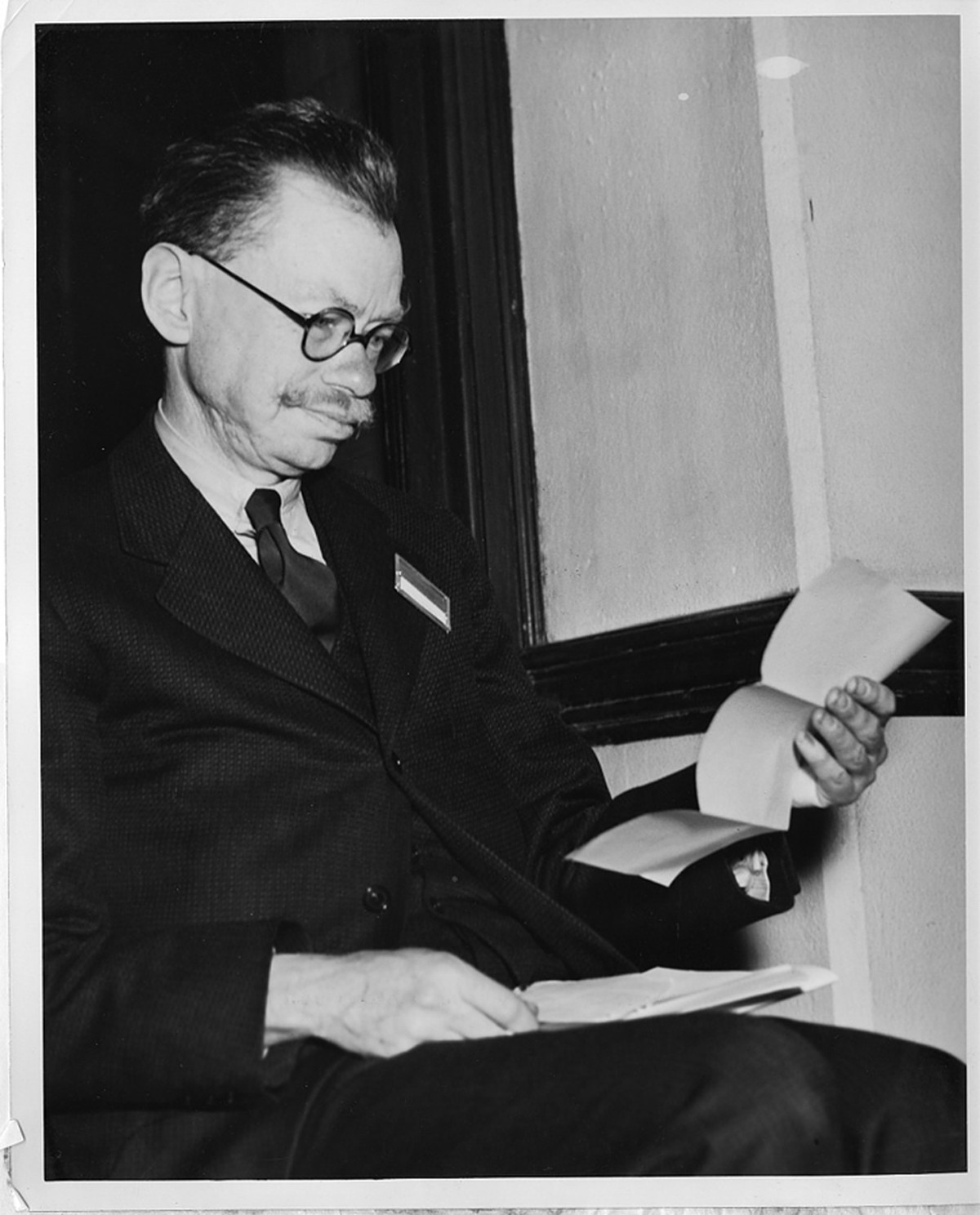
Figure 3
Childe at the International Symposium of the Academy of Natural Sciences on Early Man, Philadelphia, in March 1937. “Courtesy of Smithsonian Institution Archives”.
Childe as a Broadcaster: writing and talking
Childe is widely remembered as a poor lecturer, and he was similarly a poor broadcaster.51 Third Programme Talks producer Gilbert Phelps considered Childe unusually successful amongst archaeological broadcasters, but even he admitted that Childe was a ‘barely adequate broadcaster’ and ‘incidentally critical of the results’.52 Problems occurred during Forces Education broadcasts; an internal memo noted: ’many thanks for recording. Played back and enjoyed. It’s a pity so many interesting people have trouble with their teeth.’53 This may refer to Childe’s reported tendency to hiss his words between his teeth.54 Successful attempts were made to combat this ‘whistle’, reportedly by encouraging Childe to talk across the microphone at a 45-degree angle.55
Childe was aware of his limitations. When approached by Stephen Tallents, Controller of BBC Public Relations, to give a talk in 1937, he replied:
As to the said invitation I am always ready to make such knowledge as I have accumulated available to the general public through any channel that offers itself to me and am prepared to take great pains to make myself intelligible to plain and probably tired listeners. (I find this frankly difficult but in America can hold successfully audiences of 300 to 500).56
Childe was not alone in his difficulties. In a confidential report about the series The Archaeologist, Phelps lamented the difficulty of finding good broadcasters among archaeologists.57 Academics in general found radio challenging. They could not see their audience and were pressured to speak in shorter sentences and simpler language without the benefit of demonstration or illustration.58 Internal Third Programme memoranda contain scathing comments on the lack of ability of academic broadcasters.59
Childe’s broadcasts were 15 to 20 minutes in duration, standard for early BBC radio talks, and as was customary, he was paid to ‘write and read’, to both prepare scripts and broadcast them. Childe was initially dubious that talks of only 15 minutes could be kept ‘vivid and interesting’, and struggled with such brevity.60 His scripts were consistently too long and detailed, requiring him to revise them and BBC producers to make cuts, omissions, and alterations.61 His script for the Forces Education broadcast New Ways of Living was criticised as ‘so packed with material that one’s mind is apt to become overloaded with detail and then the general drift of his argument is lost’.62 Childe’s language had to be simplified by producers, who did not hesitate to make their concerns known, telling Childe that one of his scripts lacked direction and ‘somehow gave a rather wuzzy effect at the listening end’.63
Nonetheless, Childe was valuable; a renowned academic ‘very amenable to suggestions or alterations’.64 He developed good relationships with Archibald Clow of the Services Education Unit and Gilbert Phelps. Clow and Childe joked together, with Childe informing Clow that he had timed his talks by ‘reading them aloud to the sheep on the hills around Crawford’ while on fieldwork in Scotland.65 Clow wrote back: ‘it is an almost invariable rule that what the sheep of Crawford will absorb in fifteen minutes requires at least twenty minutes for the usual BBC audience’.66
Good relations were vital because getting scripts right was a balancing act necessary to ensure dispassionate, academic presentation that would entertain, but also legitimate content and ensure impartiality.67 Correspondence between Childe and his producers demonstrates these complexities. Childe constructed his talks in terms of word count; he worked out that a BBC talk equated to around 2500 words.68 However, this equation rarely transferred into a successful broadcast because he did not consider how a talk would sound to an audience, which was the primary concern of BBC producers. Phelps read one of Childe’s scripts aloud and disliked the sound of the ending, suggesting, ‘perhaps the addition of another sentence or two might round it off for the ear’?69 Childe, a professional academic, did not care about the performative aspect of his public engagement; Phelps, a professional broadcaster, in contrast, knew how important it was.
Childe’s radio broadcasts were produced by the BBC Talks Department, which played a significant part in early BBC schedules and developed talks on subjects across the cultural spectrum.70 Innovations in archaeological radio, for example broadcasts from museums or excavations, began only after his death and he delivered predominantly studio-based talks, recorded in the BBC’s studios in Edinburgh and London.71 Childe did, however, participate in scripted question-and-answer sessions for the Forces Education series Your Questions Answered and there are intriguing hints that this popular radio (and later television) style of panel discussion influenced education post-war. In December 1943, the Edinburgh Labour College advertised a series of forthcoming adult education talks on ‘culture in relation to social development’ based on the popular Brains Trust radio panel show. Childe was one of the participants.72 Mass media, particularly radio, now played a key role in the mediation of archaeological knowledge between academics and audiences, not only in message, but also medium.
Childe was no more successful on television, appearing twice on the popular game show, Animal, Vegetable, Mineral, on the first episode broadcast in 1952, and again in 1956. In the first show, Childe reportedly argued with Lionel Hale, the original show Chair, about a prehistoric pot live on air, causing Hale, who was ‘absolutely terrified of archaeology’, to resign.73 Daniel, who replaced Hale as Chair, commented that Childe lacked the ‘flair for the semi-sincere semi-insincere projection of a charismatic personality which is the essence of successful television’.74 Daniel in contrast, who became an exceptionally successful media archaeologist, ‘sparkled from the first programme’ (Figure 4).75
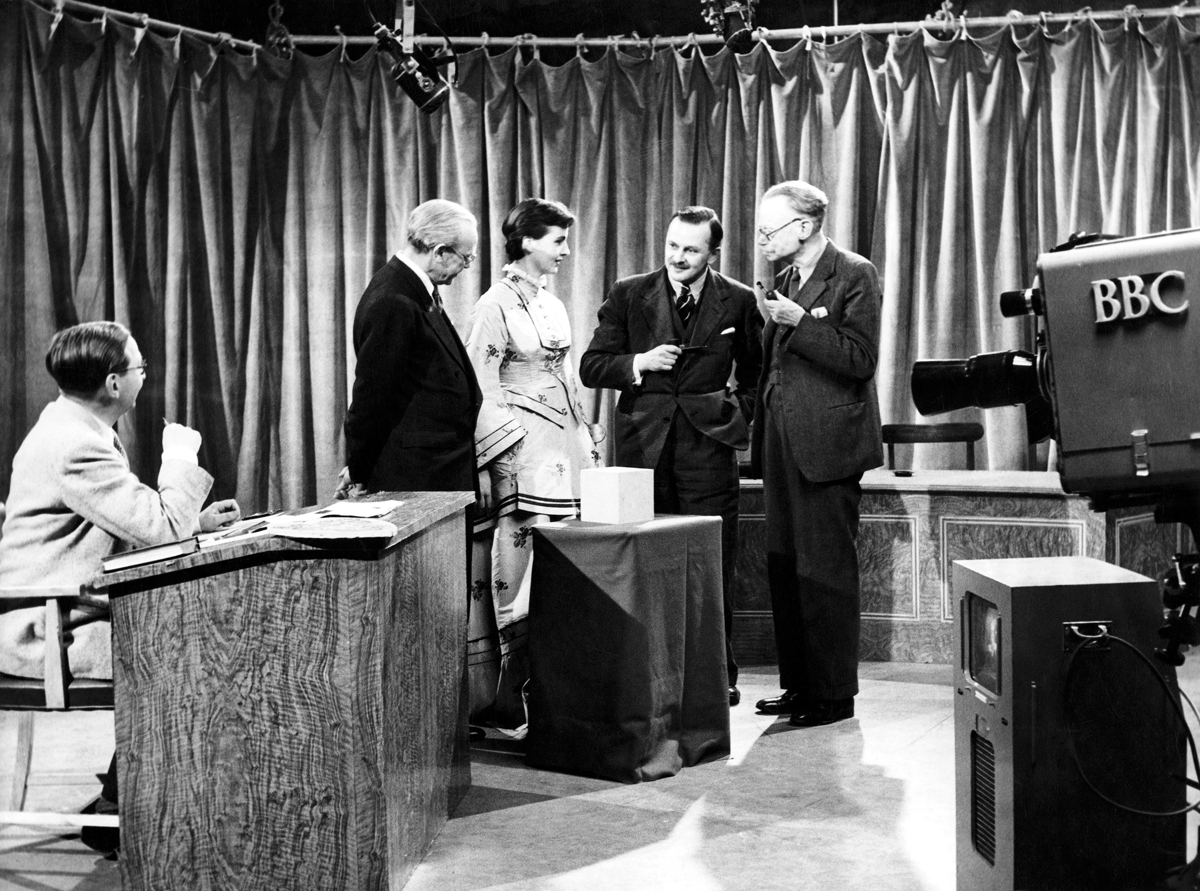
Figure 4
Childe as broadcaster, participating in the first television episode of Animal, Vegetable, Mineral? in 1952. Credit: © BBC Archive.
Media success was not necessarily desirable for serious academics. Arguably, Daniel paid for his media success with his academic reputation, as he was well aware. He wrote to Mortimer Wheeler, another charismatic performer:
You must know that my reputation among people who are not prepared to judge people fairly on their worth, was ruined years ago by appearing on Animal, Vegetable, Mineral and is going to be re-ruined in the new series we are starting called What? Where? Which? Surely the old boys totter around saying: “that dreadful man, Daniel, Charlatan; they tell me he is the Director of a Television Company and of a Theatre and a Restaurant and now a Tourist Agency. He can’t be any good.”76
Those who, like Daniel, performed well often found themselves relegated from ‘experts’ to ‘personalities’.77 Nonetheless, skill, negotiation and professionalism were necessary. Charismatic ‘personalities’ like Daniel, capable of understanding that performance was as important as message, became crucial for communicating archaeology to the public.
Childe and the BBC: political and intellectual control of broadcasting
Between the wars, the BBC’s public service ‘monopoly’ was widely criticised, seen as stifling free discussion.78 There was frustration in left-wing circles about the BBC’s ‘cultural elitism’; the corporation was seen as out of touch with the lives of many of its listeners.79 In 1937, the Left Review published the pamphlet The BBC Exposed by George Audit, the radio correspondent for the Communist Daily Worker, which denounced the corporation’s imperialist, pro-capitalist values.80 Childe initially shared these views, referring to ‘the monopolistic organ of the state, the BBC’.81 He also objected to the BBC as a ‘powerful instrument of propaganda’.82
In September 1937, the BBC broadcast a series of three talks entitled The Unchronicled Past by John Foster Forbes on their National Programme.83 Forbes was an untrained but enthusiastic ‘amateur’. He was a member of the Royal Anthropological Institute, had given a talk at the British Association for the Advancement of Science, and delivered public lectures.84 He promised ‘a coherent account intelligible even to those who know little about archaeology or anthropology’.85 However, his talks, reproduced in The Listener, instead reveal a fanciful, albeit unoriginal mix of ideas about Druid sun temples and hyper-diffusionist fantasies that Britain had been colonised by ‘Iberians’ and Egyptians.86
The BBC’s advocacy of Forbes’ work potentially undermined the progress the Childe and his colleagues were making in controlling public narratives about the past. They immediately went on the attack. Childe’s friend, Alexander Keiller, complained to The Listener that, ‘hardly a single sentence of this quasi-archaeological discourse is susceptible of archaeological proof’.87 He owned much of the prehistoric monument of Avebury and the surrounding land, and assisted by Stuart Piggott, had been excavating there since 1934. Forbes’ broadcasts revived antiquarian interpretations of Avebury, thus publicly challenging the authenticity not only of Keiller’s work, but also the wider agenda of the inter-war archaeologists.88 The broadcast came at a challenging time; in late 1937, the Avebury Preservation Plan was launched to raise funds to preserve the surrounding landscape, spearheaded by Keiller, Crawford, Piggott and colleagues.89 Forbes’ broadcasts thus challenged them in their bid to be both the interpreters of prehistoric archaeology and its custodians.
Childe had been in Turkey when Foster Forbes’ talks were broadcast. On his return, he read the articles in The Listener and sprang into action. He wrote to the BBC immediately to make an ‘emphatic protest’, claiming the talks had done ‘incalculable harm’ and offering to broadcast ‘the truths’ of archaeology instead.90 He marshalled his Establishment connections to pile on the pressure. He wrote to former Prime Minister Ramsay Macdonald, Combined Scottish Universities MP since 1936, demanding that he ‘defend the status of the Sciences against abuse by public functionaries’, claiming that the talk was ‘calculated to nullify the effects of Lord Abercromby’s benefaction to the University of Edinburgh’.91 Macdonald accordingly wrote to Reith on several occasions.92 Childe also involved the Royal Anthropological Institute: ’if archaeology is to secure the same status as geology or geography, such a lapse should not be allowed to pass in silence’.93 Their President, Hermann Braunholtz, duly complained, also criticizing the beleaguered BBC’s anthropological coverage.94 Childe may also have drummed up support from fellow members of the prestigious Athenaeum Club; one protest the BBC received came from eminent historian George Malcolm Young, a fellow member (Figure 5).95
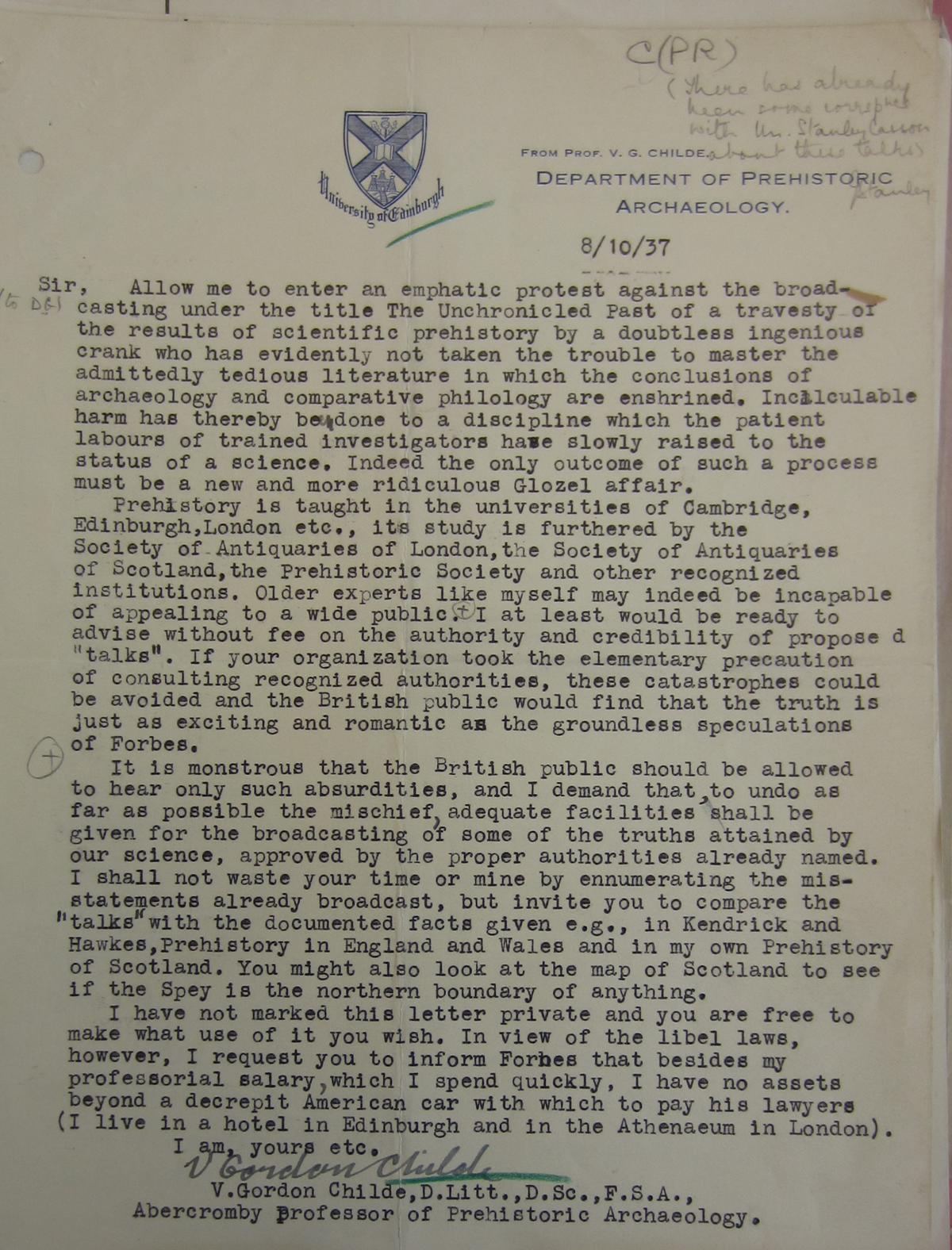
Figure 5
Outrage over Foster Forbes’ broadcast. Letter written by Gordon Childe to John Reith, Director General of the BBC, on 8 October 1937. BBCWAC/R41/209/1/PCS. Talks File 1. Credit: © BBC Written Archives.
The embattled BBC now needed to produce ‘a more academic account of British prehistory as a result of the outcry’.96 Stephen Tallents, Controller of BBC Public Relations, began working with James Fergusson, Programme Director Scottish Region, to persuade Childe that the corporation was anxious to make amends and give a talk about British prehistory.97 After further complaints about the lack of time and opportunity, Childe capitulated and delivered the talk Stories in Stone.98 No script survives, but the version in The Listener presents archaeology as an unromantic, practical and exact process:
To determine that accurately has taken years of tedious and exacting work – using trowels and toothbrushes as much as picks and shovels, intense scrutiny and comparison of unsightly little objects, the laborious compilation of maps, the co-ordination of geologists and chemists, of working potters and blacksmiths. But this work is yielding a picture of how man made himself master of surrounding nature and won Britain from the bogs and wolves and forest to be his home.99
Childe refused to present a second talk; instead, Stuart Piggott’s delivered a chatty but prosaic talk about tombs and temples, including Avebury.100 Forbes’ challenge over Avebury was thus smoothed over and narrative control regained. Nonetheless, neither Childe nor the BBC were happy. Richard Maconachie, Head of Talks, ignored Childe’s suggestion of a series of talks by ‘proper experts’ on ‘scientific prehistory’.101 Childe wrote bitterly to archaeologist Christopher Hawkes:
From the BBC point of view I’m sure the thing has been a grand success and they can now say when they next give Forbes the ether that he was blessed by 250 enthusiastic listeners while no one wrote in about a so called expert.102
At first sight, the choice of Foster Forbes is difficult to understand. The inter-war archaeologists now dominated BBC archaeology; Talks producer Mary Adams had even turned to the London Museum and Institute of Archaeology for assistance in pioneering television archaeology.103 However, the BBC probably used Foster Forbes for variety and entertainment. Hyper-diffusionist theories focusing on Egypt, although academically discredited, remained popular and culturally influential.104 This need for variety clashed with the archaeologists’ desire for control. Other professions and disciplines, notably medicine and music, were similarly anxious to control their radio narratives. However, the corporation was determined to maintain media autonomy, prioritising audience entertainment and seeing off attempts at disciplinary takeovers.105 The BBC’s gamble caused uproar amongst archaeologists, but it worked – Foster Forbes’ talks were popular.106
A year later, on 22 August 1938, Childe used his address as President of Section H (Anthropology) of the prestigious British Association for the Advancement of Science to publicly attack the BBC at the Association’s annual meeting in Cambridge. Childe was speaking out because Foster Forbes, emboldened by the popularity of his talks, had mounted a challenge to established prehistory. He had published a book of his Unchronicled Past talks, launched a monthly magazine, Archaic Britain, and delivered lectures about his new interest, the ‘lost continent of Atlantis’ as the source of global ‘high culture’.107
Childe’s initial pre-occupations, recorded in contemporary newspaper reports, were archaeological. He claimed the BBC had provided him with inadequate opportunities to refute and challenge Forbes’ talks. Furthermore, they had failed to distinguish between Childe’s academically-sanctioned, scientific approaches and Forbes’ alternative views, treating them both, ‘merely as rather querulous sects in some foolish cult’.108 He implied that the BBC did not understand the disciplinary importance of archaeology and was misleading the public through their ignorance.
However, as tensions in Europe reached crisis over Czechoslovakia in late 1938, Childe’s concerns about Forbes’ talks altered. The later version of his speech, published in the Association’s Report, demonstrates a clear shift in focus from the dangers of misleading the public to the political dangers of pseudo-science.109 For left-wing scientists like Childe, pseudo-science was becoming associated with political dogma, part of the ‘anti-scientific’ and anti-intellectual trend of Nazism; Forbes’ promotion of Atlantis, a favourite trope of Nazi ‘prehistory’, was particularly worrying.110 For Childe, Forbes’ talk was a real danger, not just to accurate narratives, but to intellectual freedom, a taste of things to come if archaeology was imposed by a ‘totalitarian British state’. He added:
…how slender is the thread that links prehistory to natural science has been demonstrated all too glaringly by the distortion of the subject that we can recognise beyond the Channel.111
Despite attempts by General Officers of the Association to suppress the talk amongst the Press, Childe’s comments seeped out. One journalist applauded Childe’s stance, claiming ‘everybody knows that nobody is allowed to challenge the BBC’. 112 Childe was quick to point out the dangers of the BBC misusing its monopoly politically, but ironically, he saw nothing wrong in linking intellectual freedom with control of archaeological narratives – as long as he was in control.
Childe’s fears of a government-approved takeover of archaeology by right-wing mystics were never realised and Forbes’ alternative prehistory, like Atlantis, sunk without trace. Nonetheless, Childe was one of the first archaeologists to recognise and respond to the complexities of establishing authenticity in the study of the past, particularly when faced with a media eager to engage multiple audiences and public interest in alternative archaeologies.113 His aggressive manipulation of his Establishment connections and the Press to force the BBC into retreat illuminate his political adroitness, his ruthlessness in ensuring that ‘scientific’ explanations of the past dominated public perceptions – and his failure to acknowledge the developing profession of broadcasting. They also reveal a paradoxical clash between his desire to control archaeological messaging and his left-wing political criticisms of the BBC’s ‘monopoly’ in similarly controlling political and cultural output on air (Figure 6).
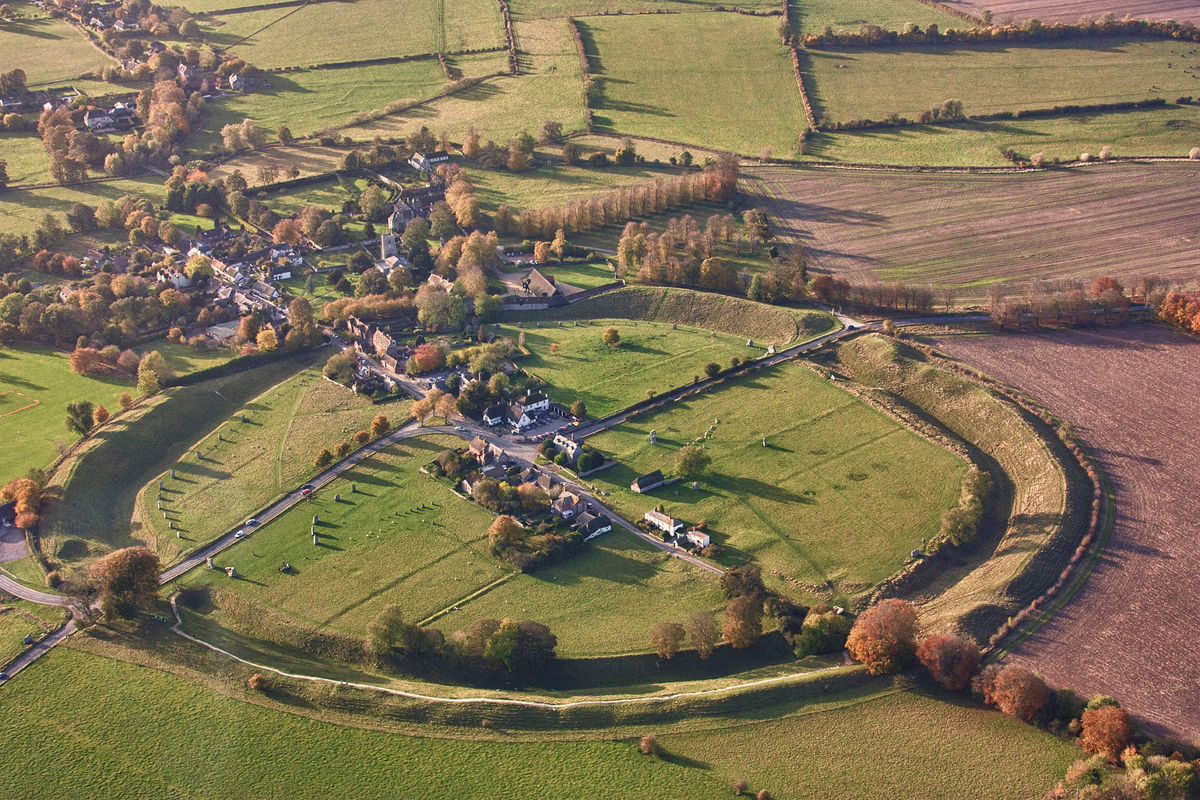
Figure 6
Avebury stone circle today, as reconstructed: the site of archaeological tensions in 1937. MikPeach, CC BY-SA 4.0 <https://creativecommons.org/licenses/by-sa/4.0>, via Wikimedia Commons.
Childe and Forces Education: Adventures in Archaeology and Broadcasting
In 1945, following Victory in Europe, the War Office began the Forces Education scheme to provide educational opportunities for military personnel as part of demobilisation.114 Radio provided a vital and affordable medium for Forces Education to reach British service personnel scattered throughout the world.115 The BBC secured government funding for 30 hours of educative broadcasts a week, covering music, literature, languages, current affairs, economics, and science.116
Childe was one of the scheme’s earliest broadcasters. It is likely that he started to work for Forces Education radio because of his personal contacts with the charismatic William Emrys Williams, Director of the Army Bureau of Current Affairs (ABCA) and former editor of Penguin books, mass-produced paperbacks that provided authoritative educative material in an accessible style, including Childe’s What Happened In History.117 The ABCA was predominantly left-wing and faced hostility from the army amidst concerns about connections with Penguin books, regarded by some as ‘extreme Left-Wing literature’, and the ABCA’s association with the Beveridge-Welfare-State-planned-economy vision of the future. The impact of this left-leaning educative vision on British military personnel was subsequently held responsible by some for the landslide Labour victory of 1945 and its post-war welfare reforms.118
Childe started with two appearances on the show Your Questions Answered, followed by his own series, Man Takes Over, in October and November 1945. His final broadcast, again in Your Questions Answered, was in October 1946 (see Table 1). Man Takes Over was developed with Archibald Clow and Childe’s only radio series. Divided into six broadcasts, it was linked together by the theme of ‘man’s co-operation with nature’:119
Plants and Animals
The Influence of Metals
Division of Labour
The Effect of Iron Tools (originally entitled ‘The Effect of Cheap Iron Tools’)
New Ways of Living
Machines and Social Orders
Childe began his examination in the Neolithic Near East and ended it in Medieval Europe. He linked socio-cultural developments to technological and scientific advances; religion and magic received scant attention. For Childe, the primary technological development was agriculture.120 This allowed for the production of ‘social surplus’ to support the development of urbanism, metallurgists, priestly administrators, ‘divine kings’, even Greek philosophers. Technological developments included pottery, cloth production, metals, wheeled vehicles, sailing ships, writing and alphabets, coinage, mathematics, and medicine. In the final lecture, Childe claimed that classical societies experienced an ‘extraordinary failure’ to expand productive technology and it was only in medieval Europe that the ‘urban proletariat’ and co-operative craft guilds drove progress forward once again.121
Childe used the series to reaffirm inter-war belief in science as the vehicle of progress, with the power to improve society, and promote humanistic values. His talks followed a Marxist model and built on themes visible in his contemporary writings about progress in archaeology, particularly in his recent popular best-seller What Happened In History. They also built on those of his colleagues in the SRS; his criticism of the technological failure of classical societies, for example, mirrors contemporary print criticism by Crowther.122 The influence of the SRS is not surprising as Archibald Clow, a chemist by training, was a friend of Lancelot Hogben and shared the attitudes of the SRS to science education.123 Childe’s radio series was part of the group’s greater vision of science and society.
These Marxist experiments on air need to be contextualised. At the end of World War II, enthusiasm for Britain’s war-time Soviet allies was at a height. The BBC even broadcast a special Your Questions Answered in September 1945 about a recent trip by British scientists to the Soviet Union. Childe, who had been part of this delegation, praised Soviet archaeological practice. For him, the future of science was Russian: ‘I got the impression that Russian is going to just as important in science and technology as German has been’.124 Childe’s personal style, which melded Marxism with traditional Western approaches, embodied the short-lived zeitgeist of cordial relations between the victorious allies from the end of World War II to the beginning of the Cold War. It also represented a personal shift from promotion of the disciplinary message of his archaeological colleagues to the political ‘science in society’ message of his SRS colleagues. Childe’s interests and influences were diverging from those of his archaeological friends and colleagues.
His radio broadcasts also offered new theoretical alternatives, based on Soviet Marxist theory, to traditional approaches to prehistory, now partly discredited by association with Nazi racial and pseudo-scientific thinking. In December 1946, Childe broadcast the Study of Mankind for the BBC Overseas Service, part of a series of ten talks on Anthropology. This complex talk attempted to reconstruct the dynamics of social change and long-range trends in the life of societies – new historical-developmental ways of exploring change in prehistoric societies. He claimed that this approach supplied ‘the historical refutation of that doctrine of national exclusiveness that was distinctive of Hitlerism’.125
Forces Education programmes were broadcast to both domestic audiences and service personnel, reaching as many as 500,000 listeners a day.126 Furthermore, people in Europe ‘eavesdropped’ extensively on the BBC; one third of Soviet urban adults and around half of East Europeans were also regular listeners to western broadcasts.127 Such extensive post-war radio coverage, far surpassing his print audience, increased Childe’s international fame. His autobiographical article in London Calling, for example, was picked up by both Kärntner Nachrichten, an Austrian newspaper, and The Lethbridge Herald, a provincial Canadian newspaper (Figure 7).128
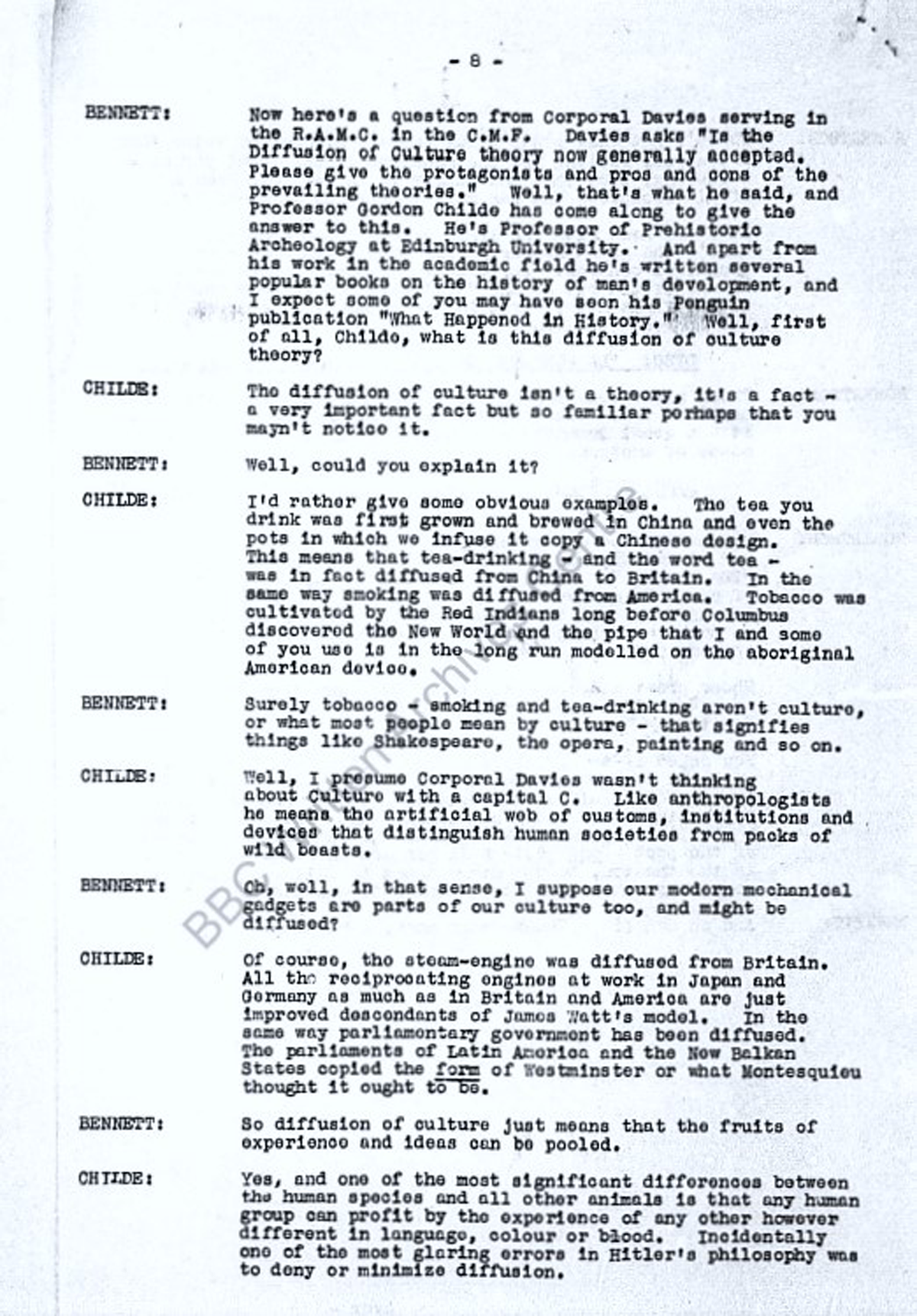
Figure 7
Page 8 of the script for the Forces Education series radio broadcast, Your Questions Answered, broadcast on 1 June 1945, with Childe’s scripted contribution. © BBC Written Archives. Reproduced from Scripts microfiche.
The success of Childe’s Forces broadcasts made him a sought-after overseas broadcaster. John Gough, Pacific Programme Organiser, wrote to Childe in 1945, asking him to contribute to the series Calling Australia. A second programme for an Australian audience entitled Australians in Britain followed in 1946 (see Table 1).129 Post-war, the BBC, reflecting the need to keep the crumbling Empire together, worked to project the image of an egalitarian, ‘people’s empire’, emphasising international co-operation, tolerance, and commitment to gradual self-rule. An increasing number of Dominion and colonial speakers, including Childe, were asked to give talks to emphasise this new egalitarianism.130
In the two broadcasts, Childe talked in a chatty, casual style about archaeologists, their work, and with apparent candour but in reality, few real details, about his own life. He revealed his love of Scotland and Scottish archaeology; his love of travelling and pleasure in exploring new countries and cultures is also articulated:
I have travelled all over Europe looking at museums and sites. Of course the museums aren’t open all day. So there is plenty of time to sit in cafes and chat with casual foreigners, to listen to the gipsies in Hungary, to sample the opera in Laibach or Malta, or the wines of the Moselle and the Caucasus.131
The imperial propaganda agenda of these broadcasts seems at odds with Childe’s left-wing radicalism. But they offered Childe an opportunity to reconnect with his family and homeland. His producer wrote to him, ‘I hope your sisters heard your broadcast and recognised your voice after so many years’ and arranged a complimentary copy of London Calling for him, perhaps to send to them in Australia.132 Here Childe is again a paradox; the personal apparently overcoming the political.
Childe did not broadcast for the BBC Overseas Service after 1946. As the Cold War developed, his Soviet sympathies became problematic. Nonetheless, he remained a sought-after international broadcaster. In 1957, he delivered a talk on Prehistory in India for All India Radio, probably recorded when he was visiting the country for a science congress.133 Childe’s final broadcast, also in 1957, was for the Australian Broadcasting Commission (ABC). The transcript of the talk, published decades after his death, demonstrates his continuing advocacy of science in past societies.134
Childe and Cold War Propaganda: Broadcasting Wars and Television Internationalism
In 1953, the BBC Monitoring Service picked up Childe ‘broadcasting’ for the Russian Radio Service for Britain. The report, entitled ‘Soviet Central Asia: No Russification’, made its way into the file kept on him by MI5.135 The broadcast is dated 30 September 1953, when Childe was visiting Russia, but it is not clear whether it is an excerpt from a longer broadcast by Childe, or a short statement to be read out by an announcer. In it, Childe discussed a recent trip to Soviet Central Asia and supported the Russification of the region. He stated that students at universities studied in their own languages, but needed to learn Russian, ‘the key to a much vaster and more varied literature’. To Childe, it was ‘uneconomical’ to publish scientific textbooks in the many languages of the USSR. He had seen no ’forcible Russification’ as claimed by the ‘American Press’:
In fact, in Tajikistan and Uzbekistan we found achieved in barely two years the same happy and reasonable compromise as has been achieved in Wales after years and centuries of struggle.136
Childe was happy to express his admiration for the Soviet Union, enthusiastically describing this same 1953 visit to Russia in a letter to The Times.137 But he was now, unwittingly or not, producing propaganda for Britain’s Cold War enemies. This aspect of Childe’s broadcasting internationalism catapulted him into Cold War ‘culture wars’, the use of cultural ‘soft power’ to promote rival ideologies, in which radio played a key role, notably the BBC, Radio Free Europe, and Radio Moscow.138
Transnational Soviet radio stations were designed to promote the Soviet Union and reach out to the international communist community. Childe’s talk was probably broadcast on Radio Moscow. Established in 1929, by 1945 Radio Moscow was broadcasting in 29 languages and expanded further as Cold War tensions escalated. By the 1960s, it was one of the largest broadcasters in the world, although the audience outside the Soviet Union was minuscule.139 Childe’s comments showed a willingness to promote Soviet agendas, represented a coup for the Soviets, and worried MI5, but audiences for Soviet radio were so small that few people outside the BBC Monitoring Service would have heard him; more people would have read his contemporary pro-Soviet letter to The Times. Certainly, there were no broadcasting repercussions. During the 1950s, Communist sympathisers frequently found the BBC closed to them, but not Childe.140 His Marxism was accepted and even deployed strategically by BBC producers. In 1952, Phelps was eager to get a Marxist review of Grahame Clark’s Prehistoric Europe: the Economic Basis and judged, ‘Professor Childe is certainly the best person to do it’.141
Post-war, universities worked closely with producers of the Third Programme, which provided a new, expanded venue for British archaeological broadcasting.142 Childe contributed an early talk to the ground-breaking Third Programme series, The Archaeologist, discussing the relationship between the disciplines of History and Archaeology.143 The London Institute of Archaeology, particularly Childe, Mortimer Wheeler, and Frederick Zeuner, Professor of Environmental Archaeology, made valuable contributions to the development of television archaeology and BBC Schools radio.144
Childe advised on the popular radio series How Things Began for BBC Schools Home transmission. How Things Began was first developed in 1941 to provide information for children aged 10–14. It was a wide-ranging, science-based series encompassing geology, human evolution, and prehistory.145 In 1951, Childe was approached to act as a paid consultant for the first ten scripts (Bronze and Iron Ages) of the summer (third school) term by producer Felicia Elwell. Emphasising links between Childe’s popular print output and broadcasting, Elwell added:
You may be interested to know that teachers have found your books ‘What Happened in History’, ‘Man Makes Himself’ and ‘The Bronze Age’ of great value in connection with How Things Began broadcasts.146
Childe made corrections to the scripts and suggested changes to the chronological arrangement.147 He subsequently consulted on broadcasts in 1953 and 1954, reviewing the book list, scripts, notes for teachers, and ‘wall pictures’.148 Talks for the third school term show clear signs of the influence of Childe’s writings and earlier archaeological broadcasts, including such themes as ‘farmers increase the food supply’ and ‘the coming of iron’.149 That Childe could present his idiosyncratic, Marxist-influenced interpretations to British children, at the height of the Cold War and through the medium of the BBC, attests to the power he wielded as a popular educator, and the extent to which his popular approaches to prehistory were embedded in contemporary perspectives on the past. Childe and his colleagues had been successful in their campaign to dominate public discourses about archaeology, Childe for all his political radicalism, perhaps most of all.
On 3 May 1956, Childe participated in his last broadcast for the BBC, an episode of the popular television panel show, Animal, Vegetable Mineral. The surviving recording provides our only opportunity to see Childe at work as a broadcaster, indeed, to see and hear him ‘live’.150 Animal, Vegetable Mineral saw three experts confronted with a selection of unusual objects from a museum, which they had to identify. The Chair, originally Lionel Hale and later Glyn Daniel, ensured fair play.151 The combination of talk and thought by experts, the wild guesses, and the charisma of Daniel and Mortimer Wheeler, made the show an instant hit.152 At its height, the show drew audiences of 5,000,000, around 10% of Britain’s population, and has been credited with completing the democratisation of archaeology, cementing its relationship with the public and the media (Figure 8).153
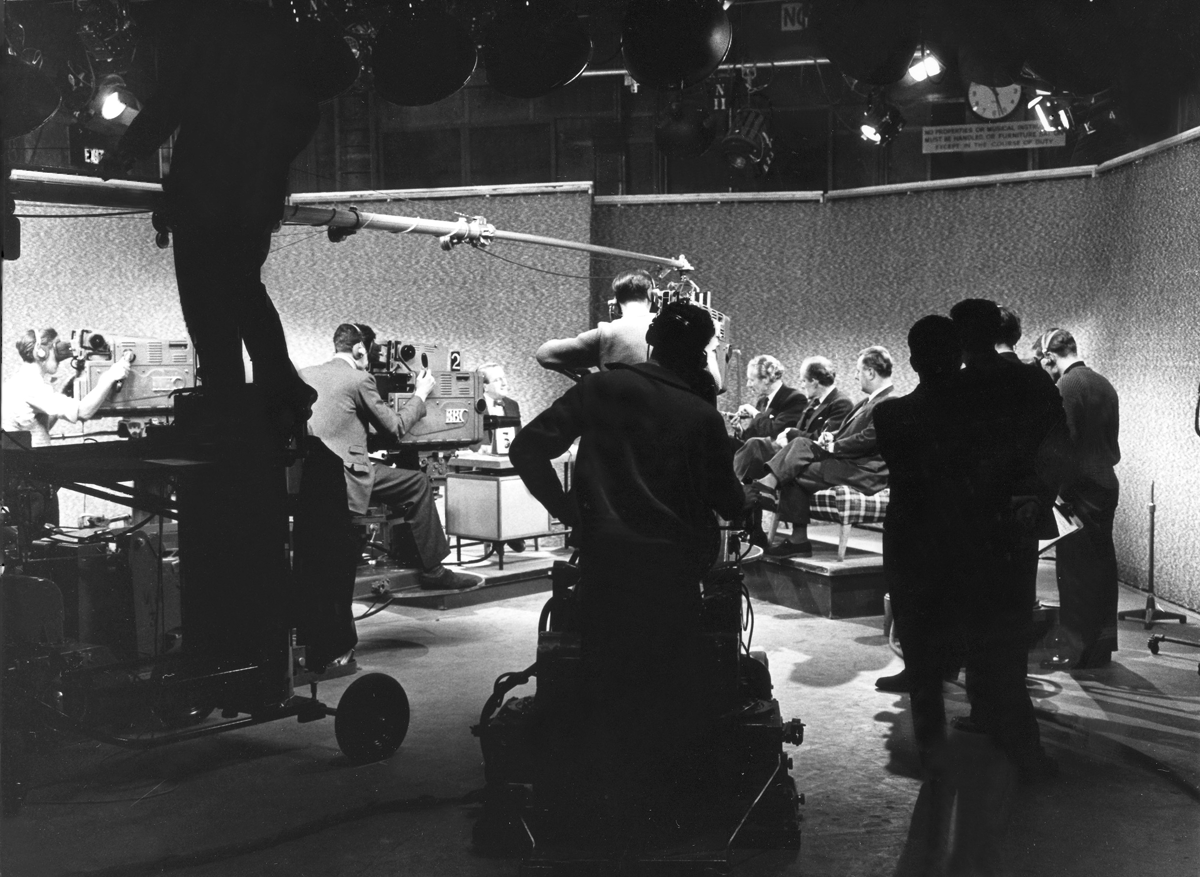
Figure 8
Filming Animal, Vegetable, Mineral? Credit: © BBC Archive.
Every week, a different museum ‘challenged’ the panel. Childe participated in its most significant coup, a ‘challenge’ from the National Museum in Prague (Narodni Museum V Praze), Soviet Czechoslovakia.154 Plans for the episode had been made in March 1956, when Mary Adams, Head of BBC Television Talks, was visiting Czechoslovakia. She met Jiří Neustupný, Director of the National Museum, at a reception and pursued the connection, ‘alive to the interest which such co-operation would create both in Britain and in your country’.155 Neustupný needed little persuasion. For him, it ‘makes a great propaganda for my well-beloved science, the Prehistory of Mankind’. He added playfully, ‘I shall write nothing about it to Professor V. Gordon Childe who is a great connoisseur of Central European prehistoric antiquities’.156
Childe, a friend of Neustupný, was a natural choice for the panel. He appeared alongside Daniel, Wheeler, and the Irish prehistorian Sean P. O’Riordain, a friend of Childe and Daniel. The group had dinner together at Beoty’s Restaurant in London before the show; the show was relaxed and good-humoured; the objects were subsequently put on display at the British Museum. A ‘tele-recording’ was made to be presented to the Czechoslovak television service and although it was not customary to script ‘live’ television, a transcript was also made.157
Beneath the surface cordiality, political complexities were at work. The show was an exercise in British cultural ‘soft power’. The transnational nature of radio allowed the BBC to broadcast behind the Iron Curtain and project a Western counterpoint to Soviet propaganda, often using material provided by the Foreign Office. Poland and Czechoslovakia were particular targets, considered key to keeping relations between West and East Europe alive. In Czechoslovakia, the BBC already had a committed audience. Even after the Communist coup of 1948, one out of every two radio owners listened to the BBC, which had a bigger audience than the Czechoslovakian Broadcasting Service.158
It thus appears that Childe was participating in propaganda against the Soviet regime he so openly admired. This could be taken as naivety, or as with his broadcasts to Australia, evidence of his ability to overlook propaganda agendas at will. It could also be regarded as evidence of his growing disillusionment with Soviet Communism.159 However, it is more likely that Childe, like the BBC, was responding to the new, post-Stalinist spirit of East-West engagement abroad in the spring of 1956, particularly in countries on the European periphery of the Soviet Union.160
Museums from Denmark, the United States, Ireland, Australia, France, and Switzerland had contributed objects and the show hosted visiting experts from America, Canada and Denmark.161 Here, the BBC was using archaeology and entertainment to explore the new Soviet media openness in association with Czechoslovakia, a nation that was re-asserting its independence within the Soviet Union and favourably disposed towards Britain and British broadcasting.162 It was certainly successful in building better relations; Neustupný was to return to the BBC in 1958 to record a special memorial broadcast for Childe with other friends.163
This was not therefore the paradox of Childe the Communist fellow traveller taking part in a BBC soft-power exercise. Rather Childe provided the ‘glue’ that bound the episode and its tricky political complexities and aspirations together, symbolically uniting his radical left-wing political beliefs, his educative influence, his media experience, and his global connections with the aim of building a new international future for archaeology. Childe, once so wary of radio, had by the end of his life thoroughly embraced broadcasting’s unique combination of power and intimacy to promote international education and interest in archaeology throughout the world.
Conclusion: Archaeology for the People?
Gordon Childe’s success in popular education and public communication has long been familiar through his print output. Examination of his career in radio and television adds a new dimension, allowing us to see the role that broadcasting internationalism played in both the spread of his ideas during his life-time and the formation of his enduring legacy. Although Childe was not a talented broadcaster, he was a prolific and influential one, valued by his producers for his flexibility and authoritative originality, both an Establishment academic and a popular ‘science’ communicator.
Initially Childe worked within the context of the desire of the new generation of inter-war archaeologists to control public narratives about the past, and see off alternative archaeologies. Both Childe and his colleagues were ultimately successful in this aim. However, BBC personnel, forming their own identities as public service entertainment and education providers, did not allow them to dominate broadcasting unquestioningly. The media archaeology that emerged was a sophisticated synthesis that by Childe’s death, required a particular type of ‘media archaeologist’ to be successful. Childe’s played a crucial role in this process by establishing the need for authenticity and academic veracity in broadcasting. Although this is still frequently an unresolved battle fought by archaeologists with the media, Childe’s tough response to the BBC and their subsequent climb down established an important precedent for the production of educative content about the past.
For Childe, public engagement was always as much political as archaeological, and we see his radical, left-wing politics and ideas about science and society at work alongside archaeology. There is a tendency to regard Childe’s radicalism as the politics of eccentricity or failure, but this was not entirely the case. Childe acted with SRS colleagues to promote the political education of service personnel, and ultimately, through the left-leaning curriculum developed, contributed to the creation of the post-war Welfare State. His well-known sympathies for Communism and personal connections helped smooth the way for the promotion of better relations between Britain and Soviet-dominated Czechoslovakia, as embodied in the Prague episode of Animal, Vegetable, Mineral.
The common thread that united all Childe’s broadcasts – political, scientific, and archaeological – was his drive to share knowledge about the past, albeit as he saw it. Broadcasting proved to be a transformative agent; post-war radio and television, just as much as print, spread his particular ideas about prehistory to all within reach of a radio. Childe maintained that intellectual study would earn archaeology ‘a more secure position than can be earned by sensational finds and even witty wireless programmes’.164 In this, he may have been mistaken. Today, mass media plays a vital role in ensuring people’s interest and education in the subject.
Notes
[1] George Orwell, The Road to Wigan Pier (London: Victor Gollancz, 1937), 89–90.
[2] Sally Green, Prehistorian. A Biography of V. Gordon Childe (Bradford on Avon: Moonraker Press, 1981).
[3] Vere Gordon Childe, Man Makes Himself (London: Watts, 1936); Peter Gathercole, Terry Irving, and Margarita Diaz-Andreu, “A Childe Bibliography: A Hand-List of the Works of Vere Gordon Childe,” European Journal of Archaeology 12, nos. 1–3 (2009).
[4] Asa Briggs, The History of Broadcasting in the United Kingdom. Volume 4. Sound and Vision (Oxford: Oxford University Press, 1979), 881. All BBC Written Archives [henceforth BBCWAC] are housed at the Written Archives Centre in Caversham, Berkshire.
[5] The only legal copy is available (to UK TV licence holders) through BBC iPlayer at https://www.bbc.co.uk/iplayer/episode/p017gfjd/animal-vegetable-mineral-03051956. Other illegal copies are more widely available through YouTube.
[6] Josephine Dolan, “The Voice that Cannot Be Heard. Radio/Broadcasting and ‘The Archive’,” The Radio Journal. International Studies in Broadcast and Audio Media 1, no. 1 (2003); Alexandra Lawrie, “The Appreciative Understanding of Good Books’: The Listener, Literary Advice and the 1930s Reader,” Literature & History 24, no. 2 (2015): 38–39.
[7] Jacquie Kavanagh and Adam Lee, “Accessing TV History: Accessing BBC Archives,” Critical Studies in Television 5, no. 2 (2010): 68; Paddy Scannell and David Cardiff, A Social History of British Broadcasting. Vol. 1. 1922–1939. Serving the Nation (Oxford: Basil Blackwell, 1991): 162–163.
[8] Asa Briggs, The History of Broadcasting in the United Kingdom. Vol. 2. The Golden Age of Wireless (Oxford: Oxford University Press, 1995): 10.
[9] Dolan, “The Voice,” 63; Joanne Garde-Hansen, Media and Memory (Edinburgh: Edinburgh University Press, 2011); Billy Smart and Amanda Wrigley, “Television History: Archives, Excavation and the Future. A Discussion,” Critical Studies in Television 11, no. 1 (2016): 99.
[10] Timothy Clack, and Marcus Brittain, “Introduction. Archaeology and the Media,” in Archaeology and the Media, ed. Timothy Clack and Marcus Brittain (London: Routledge, 2016), 19–20; Karol Kulik, “A Short History of Archaeological Communication,” in Archaeology and the Media, ed. Timothy Clack and Marcus Brittain (London: Routledge, 2016), 117; Sara Perry, “Archaeology on Television, 1937,” Public Archaeology 16, no. 1 (2017): 3–18.
[11] Asa Gillberg, “Archaeology on the Air. Radio and Archaeology in Sweden 1925–1950,” Current Swedish Archaeology 14 (2006): 26.
[12] Jan Lewis, “Mediating the Past: BBC Radio Broadcasting, 1922–1966” (PhD diss., Bournemouth University, 2021); Hélène Maloigne, “‘Striking the Imagination through the Eye’: Relating the Archaeology of Mesopotamia to the British Public, 1920–1939” (PhD diss., UCL, 2020), especially chapter 4, 113–139; Hélène Maloigne, “Breaking New Ground. C. Leonard Woolley’s Archaeology Talks on the BBC, 1922–1939,” Media History (2023): 338–352.
[14] Glyn Daniel, “Archaeology and Broadcasting,” The Archaeological Newsletter 2 (1948): 1–2; Glyn Daniel, “Archaeology and Television,” Antiquity 28, no. 112 (1954).
[16] Daniel, “Archaeology and Broadcasting,” 1; Lewis, Mediating, appendix 1; Maloigne, Imagination, 130–131; William F. Grimes, “How to Read the Welsh Countryside. 1. The Ancient Tracks and Roads”, Radio Times, June 22, 1939: 63, https://genome.ch.bbc.co.uk/search/0/20?q=grimes+ancient+tracks#top; William F. Grimes, “How to Read the Welsh Countryside. 2. Ancient Camps and Strongholds”, Radio Times, July 14, 193: 65, https://genome.ch.bbc.co.uk/search/0/20?q=grimes+ancient+camps#top; William F. Grimes, “How to Read the Welsh Countryside. 3. Caves”, Radio Times, August 05, 1939: 71, https://genome.ch.bbc.co.uk/search/0/20?q=grimes+caves#top.
[20] Vere Gordon Childe, “The Romance of Archaeology,” London Calling 323 (1945): 13.
[21] Amara Thornton, Archaeologists in Print (London: UCL Press, 2018), 43–44; Maloigne, “Breaking New Ground”.
[22] Asa Briggs, The History of Broadcasting in the United Kingdom. Vol. 1. The Birth of Broadcasting (Oxford: Oxford University Press, 1995) 7–8; Briggs, History, Vol. 2, 14.
[24] Allan Clive Jones, “Speaking of Science. BBC Science Broadcasting and Its Critics, 1923–1964” (PhD diss., UCL, 2010), 60–61.
[25] David N. Smith, “Academics, the ‘Cultural Third Mission’ and the BBC: Forgotten Histories of Knowledge Creation, Transformation and Impact,” Studies in Higher Education 38 no.5 (2013): 669–670.
[27] Vere Gordon Childe, What Happened in History (Harmondsworth: Penguin, 1942); Peter Gathercole, “Childe Among the Penguins,” Australian Archaeology 50 (2000): 10.
[28] Lewis, Mediating, 43–44; Maloigne, Imagination, 30–35; Adam Stout, Creating Prehistory: Druids, Ley Hunters and Archaeologists in Pre-War Britain (Malden, MA & Oxford: Blackwell, 2008), 20. Stout, Creating Prehistory, 19, 38–39.
[30] Charles F. C. Hawkes, Archaeology and the History of Europe. An Inaugural Lecture delivered before the University of Oxford on 28 November 1947 (Oxford: Clarendon Press, 1948), 4–5.
[31] Vere Gordon Childe, “The Oriental Background of European Science,” The Modern Quarterly 1 (1938): 105.
[32] Robert E. Filner, “The Social Relations of Science Movement (SRS) and J. B. S. Haldane,” Science & Society 41, no. 3 (1977): 303–316; John G. Crowther, The Social Relations of Science (New York: Macmillan, 1941).
[34] Lancelot Hogben, Science for the Citizen (London: George Allen & Unwin, 1938), 776.
[35] Vere Gordon Childe to Stephen Tallents 14 October 1937. BBCWAC/910/CHI; Ben Harker, “‘The Trumpet of the Night’: Interwar Communists on BBC Radio,” History Workshop Journal 75 (2013).
[36] “Memorial Programme for Professor Gordon Childe,” The Archaeologist 58 (1958), BBCWAC Scripts.
[37] Vere Gordon Childe to Kathleen Kenyon 23 March 1944. Council for British Archaeology Archives, Correspondence 1944–1948, Box 2.
[40] “Digging for History. Archaeology in Scotland”, Radio Times 712, May 23, 1937, 24. https://genome.ch.bbc.co.uk/schedules/service_rt_regional_scottish/1937-05-23#at-17.30.
[42] Thomas Hajkowski, The BBC and National Identity in Britain, 1922–1953 (Manchester: Manchester University Press, 2010), 3–4, 135–137.
[45] World Wide Broadcasting Foundation, Harvard University Programmes. Tercentenary Week. Broadcast Over W1XAL (Boston: World Wide Broadcasting Foundation, 1936), 3.
[46] George Grant MacCurdy, “Foreword,” in Early Man. As Depicted by Leading Authorities at the International Symposium, The Academy of Natural Sciences, Philadelphia March 1937, ed. George Grant MacCurdy (Philadelphia: Books for Libraries Press, 1937), 7–8; “Radio Programs. Professor G Gordon Childe and Watson Davis, Life in the Stone Age,” The Portsmouth NH Herald March 23, 1937: 7.
[47] Marcel C. Lafollette, “A Survey of Science Content in U.S. Radio Broadcasting, 1920s through 1940s. Scientists Speak in Their Own Voices,” Science Communication 24, no. 1 (2002); Jones, Speaking, 126–127.
[48] Simon J. Potter, Wireless Internationalism and Distant Listening: Britain, Propaganda and the Invention of Global Radio (Oxford: OUP, 2020), 92.
[50] “Today’s Radio,” Sydney Daily Telegraph September 17, 1936, 19; Vere Gordon Childe, Society and Knowledge (London: Allen & Unwin, 1956); “Radio Programmes, Calcutta. ‘Knowledge and Society’ by Gordon Childe – Discussion of his book ‘Society and Knowledge’,” The Times of India 11 September 1957, 5.
[51] E.g. Howard Kilbride-Jones, “From Mr. Howard Kilbride-Jones 6 April 1992. Postscript. Three Recollections of Childe the Man,” in The Archaeology of V. Gordon Childe. Contemporary Perspectives, ed. D. R. Harris (London: UCL Press, 1994), 136.
[52] G. Phelps, “Internal Memo. Comparison of Archaeological and Radiocarbon Datings 23 January 1951”, BBCWAC/910/CHI; Lewis, Mediating, 282.
[53] “E.J. Davy to Alasdair Dunnett 18 June 1946”, BBCWAC/910/CHI.
[56] Gordon Childe to Stephen Tallents 14 October 1937, BBCWAC/910/CHI.
[59] David N. Smith, “Academics, the ‘Cultural Third Mission’ and the BBC: Forgotten Histories of Knowledge Creation, Transformation and Impact,” Studies in Higher Education 38, no.5 (2013): 671, DOI: 10.1080/03075079.2011.594502.
[60] Gordon Childe to Stephen Tallents 20 October 1937, BBCWAC/910/CHI.
[61] Harry Hoggan to Archibald Clow 14 November 1945, BBCWAC/910/CHI; Harry Hoggan to Archibald Clow 21 November 1945, BBCWAC/910/CHI; Harry Hoggan to Archibald Clow 7 November 1945, BBCWAC/ 910/CHI; Gilbert Phelps to Gordon Childe 12 May 1952, BBCWAC/910/CHI; Gilbert Phelps to Gordon Childe 1 April 1954, BBCWAC/910/CHI.
[62] Archibald Clow to Harry Hoggan 9 November 1945, BBCWAC/910/CHI.
[63] Archibald Clow to Gordon Childe 1 November 1945, BBCWAC/910/CHI.
[64] Harry Hoggan to Archibald Clow 14 November 1945, BBCWAC/910/CHI.
[65] Gordon Childe to Archibald Clow 29 October 1945, BBCWAC/910/CHI.
[66] Archibald Clow to Gordon Childe 26 November 1945, BBCWAC/910/CHI.
[68] Gordon Childe to Gilbert Phelps 27 March 1952, BBCWAC/910/CHI.
[69] Gilbert Phelps to Gordon Childe 1 April 1954, BBCWAC/910/CHI.
[72] “Study Courses,” Edinburgh Evening News, December 30, 1943: 2.
[73] David Attenborough, Interview with Sir David Attenborough Personal Histories, University of Cambridge, 12th of October 2009 interviewed by Pamela Jane Smith. http://www2.arch.cam.ac.uk/personal-histories/attenborough/Site/Home_files/FinalAttenboroughTranscript.pdf Personal Histories 12 October 2009.
[74] Glyn Daniel, Some Small Harvest (London: Thames & Hudson, 1986), 248–249.
[76] Glyn Daniel to Mortimer Wheeler 17 October 1962. UCL Special Collections, Wheeler Archive B/4/3.
[79] Simon J.Potter, This is the BBC: Entertaining the Nation, Speaking for Britain? 1922–2022 (Oxford: Oxford University Press, 2022), 50; Harker “Trumpet”, 85.
[80] George Audit, The BBC Exposed (London: The Left Review, 1937); John Mullen, “What Questions Need to Be Asked About the History of the BBC?,” Revue Francaise de Civilisation Britannique/ French Journal of British Studies 26, no.1 (2021): 2 ; Harker “Trumpet,” 85–86.
[81] Vere Gordon Childe, “Freedom of Criticism. BBC Censorship. Democracy and Liberty,” The Scotsman, March 10, 1941: 7.
[82] “Criticism of BBC Talks. ‘Heresy’ Instead of Scientific Views,” The Times, August 23, 1938: 12.
[83] John Foster Forbes, “The Unchronicled Past. Archaeology,” Radio Times, September 10, 1937: 64, https://genome.ch.bbc.co.uk/schedules/service_rt_national_programme_daventry/1937–09-10#at-22.00; John Foster Forbes, “The Unchronicled Past. The Bible in Stone,” Radio Times, September 12, 1937: 72, https://genome.ch.bbc.co.uk/1cb82576252840db855586d7e72b3548; John Foster Forbes, “The Unchronicled Past. Circles and Hieroglyphs,” Radio Times, September 19, 1937: 43, https://genome.ch.bbc.co.uk/f772162ed8a244678d193a86a7c61767
[84] Patrick Benham, “John Foster Forbes,” My Brighton and Hove, https://www.mybrightonandhove.org.uk/people/peopchar/colourful-charactera-8; John Foster Forbes, “Megalithic Circles and Monolithic Monuments of North-East Scotland,” Report of the Annual Meeting of the British Association for the Advancement of Science 1935 (1935); “Origin of Culture,” Aberdeen Press and Journal, October 26, 1937: 6.
[85] John Foster Forbes, The Unchronicled Past (London: Simpkin Marshall, 1938), 64.
[86] John Foster Forbes, “This England – 4000 Years Ago,” The Listener 18, no. 453 (1937): 563–4; John Foster Forbes, “Monuments of the Stone Age,” The Listener 18, no. 454 (1937): 621–623; John Foster Forbes, “Circles and Hieroglyphs,” The Listener 18, no. 456 (1937): 737–738.
[87] Alexander Keiller, “The Unchronicled Past,” The Listener 18, no. 455 (1937): 685. For shorter discussions of Foster Forbes and Childe, see Lewis, Mediating, 158–161 and Maloigne, Imagination, 30–35.
[88] Mark Gillings and Joshua Pollard, “Authenticity, Artifice and the Druidical Temple of Avebury” in Landscape Biographies. Geographical, Historical and Archaeological Perspectives on the Production and Transmission of Landscapes, eds. J. Kolen, H. Renes, and R. Hermans (Amsterdam: Amsterdam University Press, 2015), 117–142.
[89] Osbert Guy Stanhope Crawford, “The Plan for Avebury. An Appeal to the Nation,” Antiquity 11, no. 44 (1937): 385–386.
[90] Gordon Childe to John Reith 8 October 1937. BBCWAC/R41/209/1/PCS. Talks File 1.
[91] Gordon Childe to Ramsay Macdonald, 8 October 1937. BBCWAC/R41/209/1/PCS. Talks File 1.
[92] Ramsay Macdonald to John Reith 12 October 1937; Ramsay Macdonald to John Reith, 18 October 1937. BBCWAC/R41/209/1/PCS. Talks File 1.
[93] Gordon Childe to the Council of the Royal Anthropological Institute 16 October 1937. Royal Anthropological Institute Archives RAI Archives 18/10/134.
[94] Hermann Braunholtz to John Reith, 25 October 1937. Royal Anthropological Institute Archives RAI Archives 18/10/137.
[95] Stephen Tallents to Richard Maconachie. BBC International Circulating Memo 25 October 1937. BBCWAC/ 910/CHI.
[96] Stephen Tallents to Gordon Childe, 21 October 1937, BBCWAC/910/CHI.
[97] James Fergusson to Richard Maconachie, 19 October 1937. BBCWAC/910/CHI; Stephen Tallents to Gordon Childe, 21 October 1937. BBCWAC/R41/209/1/PCS. Talks File 1; Christopher Salmon to James Fergusson, 11 October 1937. BBCWAC/R41/209/1/PCS. Talks File 1.
[98] Gordon Childe to Stephen Tallents, 25 October 1937. BBCWAC/910/CHI; BBC Talks 1. Booking Form. Stories in Stone 3 November 1937 BBCWAC/ 910/CHI; Christopher Salmon to Gordon Childe, 22 October 1937 BBCWAC/910/CHI ; Stephen Tallents to Gordon Childe, 21 October 1937 BBCWAC/910/CHI; Gordon Childe to Stephen Tallents, 14 October 1937 BBCWAC/ 910/CHI.
[99] Vere Gordon Childe, “Chronicles in Stone,” The Listener 18, no. 465 (1937): 1245.
[100] Stuart Piggott, “Tombs and Temples 4000 Years Ago,” The Listener 18, no. 466 (1937).
[101] Gordon Childe to John Reith 20 October 1937. BBCWAC/R41/209/1/PCS. Talks File 1.
[102] Gordon Childe to Christopher Hawkes 2 December 1937. British Museum Central Archives. Correspondence File 1937 A–E.
[104] David Bradshaw, “Beneath the Waves. Diffusionism and Cultural Pessimism,” Essays in Criticism 63, no. 3 (2013).
[106] John Foster Forbes, “The Unchronicled Past: Letters,” The Listener 18, no. 456 (1937): 743; Frances Varley to John Reith 27 October 1937. BBCWAC/R41/209/1/PCS. Talks File 1.
[107] Foster Forbes, The Unchronicled Past; “Lost Continent of Atlantis. Striking Points by Mr J. F. Forbes”, Aberdeen Press and Journal, Saturday January 15, 1938, 9; “Archaic Britain. A Monthly Review,” Nairnshire Telegraph and General Advertiser for the Northern Counties, December 7, 1937: 2.
[109] Vere Gordon Childe, “The Orient and Europe,” British Association for the Advancement of Science, Report of the Annual Meeting, 1938.
[110] Marianne Sommer, “Biology as a Technology of Social Justice in Interwar Britain: Arguments from Evolutionary History, Heredity, and Human Diversity,” Science, Technology, & Human Values 39, no. 4 (2014); Patrick Maynard Stuart Blackett, “The Frustration of Science,” in The Frustration of Science, eds. D. Hall, J.G. Crowther, and J.D. Bernal (London: George Allen & Unwin, 1935), 139; Eric Kurlander, Hitler’s Monsters. A Supernatural History of the Third Reich (New Haven, Yale University Press, 2017).
[112] Dominic Bevan Wyndham Lewis, “Standing By….One Thing and Another,” The Bystander, September 7, 1938: 364.
[113] Cornelius Holtorf and Timothy Schadla Hall, “Age as Artefact: On Archaeological Authenticity,” European Journal of Archaeology 2, no. 2 (1999); Sian Jones, “Negotiating Authentic Objects and Authentic Selves. Beyond the Deconstruction of Authenticity,” Journal of Material Culture 15, no. 2 (2019).
[114] Penelope Summerfield, “Education and Politics in the British Armed Forces in the Second World War,” International Review of Social History 26, no. 2 (1981): 135; S. P. Mackenzie, Politics and Military Morale: Current Affairs and Citizenship Education in the British Army 1914–1950 (Oxford: Oxford University Press, 1992), 60.
[115] Sian Nicholas, “The People’s Radio: The BBC and its Audience, 1939–1945,” in Millions Like Us? British Culture in the Second World War eds. Nick Hayes and Jeff Hill (Liverpool: Liverpool University Press, 1999), 62–92; Asa Briggs, The History of Broadcasting in the United Kingdom. Vol. 3, The War of Words (Oxford: Oxford University Press, 1970): 644.
[116] Allan Jones, “The Rise and Fall of Adult Education on the BBC,” French Journal of British Studies XXVI, no. 1 (2021): 5; Nicholas, “People’s Radio”, 813; Briggs, History, Vol. 3, 644.
[117] Summerfield, “Education,” 143; Peter J. Bowler, Science for All. The Popularization of Science in Early Twentieth-Century Britain (Chicago & London: The University of Chicago Press, 2009), 141–142.
[118] Mackenzie, Politics, 99; Sander Meredeen, The Man Who Made Penguins: The Life of Sir William Emrys Williams, Editor-in-Chief, Penguin Books, 1936–1965 (Stroud: Darien-Jones Publishing, 2008), 142–143.
[119] Childe. Scripts for Man Takes Over, 1–6. Forces Education, 1945. BBCWAC Scripts. All surviving Childe scripts are on microfiche of varying quality. Those for Man Takes Over are largely illegible.
[120] Childe. Script for Plants and Animals. Man Takes Over 1. Forces Education, 1945. BBCWAC Scripts.
[121] Childe. Script for Machines and Social Orders. Man Takes Over 6. Forces Education, 1945. BBCWAC Script.
[123] Jared R. Keller, A Scientific Impresario. Archie Clow, Science Communication and BBC Radio, 1945–1970 (PhD diss., Imperial College, 2017).
[124] Childe, Script for Your Questions Answered 31 August 1945. Forces Education. BBCWAC Scripts, 8.
[125] Childe, Script for The Study of Mankind, 5 December 1946. BBC Eastern Service. BBCWAC Scripts.
[127] Briggs, History, Vol. 3, 445; Linda Risso, “Radio Wars: Broadcasting in the Cold War,” Cold War History 13, no. 2 (2013): 145.
[128] Childe, “Romance,”13–14; “Romantik in der Archaeologie”, Kärntner Nachrichten 176, December 8, 1945, 4; “Picture of Life in Stone-Age Scotland,“ Lethbridge Herald 39 (25), January 11, 1946, 13–14.
[129] Lewis, Mediating, 196–198; John Gough to Gordon Childe 3 October 1945, BBCWAC/ 910/CHI.
[130] Hajkowski, National Identity, 52–60; Wendy Webster, Englishness and Empire 1939–1965 (Oxford: Oxford University Press, 2007), 29.
[131] Childe, Script for Calling Australia, 6 November 1945. BBC Pacific Service. BBCWAC Scripts.
[132] E. J. Davy to Gordon Childe, 20 November 1945. BBCWAC/910/CHI.
[134] Vere Gordon Childe, “Bronze Age Economics Created European Society,” Australian Archaeology 30 (1990): 26–28.
[135] BBC Monitoring Report 4401 in National Archives TNA: KV2/2149, 93a: Childe.
[136] Vere Gordon Childe, “Visitors to the Soviet Union. Letters to the Editor,” The Times, September 15, 1953, 7.
[138] Alban Webb, London Calling Britain, the BBC World Service and the Cold War (London: Bloomsbury Academic, 2014), 4; Michael Nelson, War of the Black Heavens. The Battles of Western Broadcasting in the Cold War (Syracuse: Syracuse University Press, 1997); Daniel Srch, “The Communist Party of Czechoslovakia and the Voice of America: A Contribution to the Battle for Hearts and Minds at the Beginning of the Cold War,” DVACÁTÉ STOLETÍ 1 (2014): 35; Risso, “Radio Wars,” 147.
[139] Mark D. Winek,”Radio as a Tool of the State: Radio Moscow and the Early Cold War,” Comparative Humanities Review 3, no. 9 (2009); Kristin Roth-Ey, “How Do You Listen to Radio Moscow? Moscow’s Broadcasters, ‘Third World’ Listeners, and the Space of the Airwaves in the Cold War,” The Slavonic and East European Review 98, no. 4 (2020).
[140] Andy Croft, Comrade Heart. A Life of Randall Swingler (Manchester: Manchester University Press, 2003), 190–195.
[141] Gilbert Phelps, Internal BBC Memo. Third Programme. Prehistoric Europe. Review-Talk by Professor Gordon Childe, 25 April 1952. BBCWAC/910/CHI.
[143] Childe, Script for Archaeology and History. The Archaeologist 1 December 1946. Third Programme. BBCWAC Scripts.
[146] Felicia Elwell to Gordon Childe, 23 February 1951. BBCWAC/910/CHI.
[147] Felicia Elwell to Gordon Childe, 19 March 1951. BBCWAC/910/CHI.
[148] Felicia Elwell to Gordon Childe, 16 December 1953; Felicia Elwell to Gordon Childe, 6 January 1954, BBCWAC/910/CHI.
[149] “Schools. How Things Began: Farmers Increase the Food Supply.” Radio Times, April 25, 1954, 16, Accessed March 29, https://genome.ch.bbc.co.uk/92baff04ad80b76c8b5fcb5e6fcdab41; “Schools. How Things Began: The Coming of Iron.” Radio Times, June 3, 1951, 16, Accessed March 29. https://genome.ch.bbc.co.uk/cbef2012f5b90719d650154991ab5654.
[150] BBC. 1956. “Animal, Vegetable, Mineral? 03/05/1956”.
[151] Attenborough, interview, Personal Histories, 2; Paul Johnstone, “Museums’ telecast with 5,000,000 fans ‘ANIMAL, VEGETABLE, MINERAL’?”, UNESCO Courier, September 1956, 30–31.
[155] Mary Adams to Jiří Neustupný, 3 March 1956, BBCWA/TV Talks. Animal, Vegetable, Mineral (Museums O–P) 1952–1959.
[156] Jiří Neustupný to Mary Adams, 5 April 1956, BBCWAC/TV Talks. Animal, Vegetable, Mineral (Museums O–P) 1952–1959.
[157] Gordon Childe to Paul Johnstone, 27 March 1956, BBCWAC/TV Talks. Animal, Vegetable, Mineral (Museums O-P) 1952–1959; “Extensive plans by BBC. Challenge from Prague,” The Birmingham Post, Wednesday 18 April 1956, 7; “Objects of Ancient Art from Prague. Display on Television,” The Times, May 4, 1956, 13.
[159] Leo S. Klejn, Soviet Archaeology. Trends, Schools and History (Oxford: Oxford University Press, 2012), 168.
[162] Aiko Watanabe, “Cultural Drives by the Periphery: Britain’s Experiences,” History in Focus 10 (2006). Accessed 28 March, http://www.history.ac.uk/ihr/Focus/cold/articles/watanabe.html.
[163] “Professor Vere Gordon Childe. His Life and Work. The Archaeologist.” Radio Times, June 17, 1958, 34. Accessed 29 March. https://genome.ch.bbc.co.uk/page/95726f2fdd514e67bfc91d9b27ac60d9.
[164] Vere Gordon Childe, “Valediction,” University of London Institute of Archaeology Bulletin 1 (1958), 8.
Acknowledgements
Many thanks to the staff of the BBC Written Archive Centre at Caversham, particularly archivist Kate O’Brien. Other thanks to staff at the many archives referenced here, to Mardi Kennedy for the Childe recording at the Harvard Tercentenary celebrations, and to Maxime Brami for commenting on the manuscript.
Funding Information
Funding for the article is provided by UCL Open Access Team.
Competing Interests
The author has no competing interests to declare.