
Introduction
In 1922, the Antiquities Service in Egypt granted the British School of Archaeology in Egypt (BSAE) permission to start excavations at a site called Qau el-Kebir (hereafter ‘Qau’). Located about 45 km south of Asyut in Middle Egypt, this archaeological concession was situated near the town of Tema on the edge of the Eastern Desert, bordering the Nile’s eastern floodplain. Founded in 1905 by Edwards Professor of Egyptology at University College, London, William Matthew Flinders Petrie, the BSAE formalized a de facto field school he had run since 1893.1 By 1923, the BSAE’s primary objectives were still ‘to train students and to provide museums with material.’2 The BSAE financed its excavation projects by entering into a finds-for-capital exchange with museums.3 The selection of Qau did not originate with the BSAE, but with the Service itself. Gerald Averay Wainwright, Chief Inspector of Antiquities for Middle Egypt and one-time BSAE field assistant, had urged Petrie to conduct excavations in this part of his administration on account of its ongoing subjection to looting.4 The BSAE would spend four seasons in the broader Qau-Badari region, from 1922 to 1925, and again in 1927.5
In this article, I turn to the archaeological labour that made this project a success in the season of 1922–23, but which has found little to no acknowledgement in the excavation reports. The year 1922 was one of significant geopolitical shifts in which the British Government decided to unilaterally declare Egypt’s independence. Whilst this ended the British protectorate, Britain imposed several restrictions that enabled it to remain as a colonial power until the Suez War of 1956, in which Egypt won its full independence.6 After his appointment as Director-General of the French-run Antiquities Service in 1914, Pierre Lacau sought to protect Egypt’s rights to its own archaeological resources. He openly disputed the post-season division system (‘partage’) enshrined in Egypt’s 1912 antiquities law, in which half the finds passed to the Service and the other half – or its value – to the excavation body. In the new ‘independent’ nation-state of Egypt, Britain’s reserved powers failed to cover archaeology. Lacau’s viewpoints better matched these novel political circumstances. He soon revealed his plans to diverge from the antiquities law, not by adjusting the law itself but by changing the terms of the concession contract between the Service and excavator.7 Since Egypt’s Ministry of Public Works granted its excavation permits following the proposal of Lacau, which itself was subject to the approval of a ‘Committee of Egyptology’ he headed, an excavator was forced to accept the amendments. One revision stipulated that the Service would now claim everything found. Even if the Service could still choose to award antiquities, the BSAE lost its right to half of the finds. This risk of losing objects posed a direct threat to the BSAE’s financial support system. Petrie protested, stayed in England, and appointed his chief assistant Guy Brunton as field director.8 In a season lasting from 1 December 1922 to 4 April 1923, the report lists and details the work of European staff such as Guy and his wife Winifred Brunton, Henri Bach, Leslie Starkey, and for six weeks, Henri Frankfort. By contrast, the Egyptian staff remains unidentified and unaccredited, apart from ‘our old Fayumi workman, Ali es Suefi’ – in fact, Petrie’s chief foreman (Arabic: ra’ῑs) since the 1890s.9
Even if the field documentation (tomb cards, photographs, notebooks, diaries, drawings, maps) of the Brunton-led BSAE project at Qau-Badari could inform on archaeological labour, it is missing. But along with fieldworkers came private cameras, writing and drawing paper, diaries, and postcards that were likewise applied to ‘record’ archaeological findings or fieldwork. Such ‘informal’ products were not part of the BSAE’s official recording strategy but were aimed at personal use. ‘There is something appealingly veridical’ about unpublished material such as this in the sense that their contents can ‘with a certain immediacy, disclose machinations or reveal discrepancies and thus nudge the kaleidoscope into unexpected and novel configurations.’10 Indeed, Stephen Quirke has used a photo album of Henri Frankfort to gain valuable insights into Egyptian labour at Qau in 1922–23. It mentions hitherto unknown names of Egyptian workers, as well as the work they engaged in left unrecognized in Brunton’s reports.11 It also refers to the presence of Quftis, a group of highly skilled archaeological ‘go-betweens’ from the village of Qift/Quft in Upper Egypt.12 Though indispensable to the BSAE’s projects, the report fails to acknowledge them.
The potential of such material to disrupt Brunton’s carefully crafted reports has impelled me to find the descendants of the BSAE’s European participants and to inquire about relevant material in their possession. In visiting Wendy Slaninka, granddaughter of Briton James Leslie Starkey (1895–1938; hereafter ‘Leslie’), I was shown a small collection of postcards and photographs from his time as a BSAE field assistant at Qau-Badari in 1922–24. After studying Egyptology at University College, London, in 1920–22, the 1922–23 season at Qau represented Leslie’s first fieldwork experience.13 Most postcards (16 in total) pertain to this first season and are addressed to his fiancée Marjorie [Madge] Rosaline Rice and her mother Jessie Eliza Rice (née Chatfield).14 Written from 16 November to 7 December, Leslie describes his plans, movements, and activities. His first time abroad, he recounts his journey to his fellow fieldworker Charles Henri Gladstone Bach in France at whose parental home in Paris he was to spend the night. After seeing the sights, he and Bach travelled by train to Marseilles to take the steamship S.S. Sphinx to Alexandria. Following a week of touring in and around Cairo, Leslie journeyed on to Asyut, Tema, and finally Qau, where he details his first week of work. The postcards are reproduced in the Appendix, along with transcripts of their written messages and other information.15 Each postcard is numbered and referred to in this article as ‘PC [number]’.
In this paper, I take a holistic approach to understand these postcards as multimodal and multifaceted entities by tracing their unfolding meanings and materialities in their trajectories through production, circulation, reception, and inheritance. Afterwards, I contrast this unpublished material with the official archaeological reports to explore their shared and distinct ways of representing archaeological labour at Qau. Specifically, I focus on two issues raised by the postcards. First, in detailing the ‘domestic’ work of setting up camp they help decentre the excavation ground as the exclusive field of indigenous archaeological labour. Second, they further expose how reports occlude indigenous contributions in the collective effort of archaeology by misrepresenting Egyptian autonomy in fieldwork.16 In the process, I reconsider the purposes of archaeological reports and how a sole reliance on them favours a legacy of ‘heads and hands’ in conventional histories of archaeology.
Producing postcards
First produced in 1869 by the Austrian Post Office, the postcard’s invention filled the need for a simpler and briefer form of communication than the conventional letter. Letters required the selection and folding of paper, the acquisition, filling, and closing of envelopes, and the adding of stamps. Writing conventions demanded lengthy messages, beyond bare communications.17 Measuring 3.5 by 5.5 inches, Leslie’s 16 postcards are of a format that was first introduced by the British Post Office in 1902. The verso is divided into a space for the address, postmark, and stamp on the right, and a space for the message on the left. The recto is occupied by an image.18 This ‘divided-back’ format proved incredibly popular across social classes in Britain, giving rise to the ‘Golden Age of Postcards’ (ca. 1895–1920).
Leslie’s postcards were manufactured by four publishers/printers in France: two in Paris (‘Lévy Fils et Cie’; ‘Lévy et Neurdein Réunis’) and two in Marseilles (‘H. Grimaud et Cie’; ‘Phototypie T. Olive’). Though the latter remain obscure, the entangled histories of the Paris-based firms – responsible for 14 postcards here – have been studied.19 Lévy Fils et Cie (ca. 1915–1920) and Lévy et Neurdein Réunis (ca. 1920–1932/33) shared roots in the 19th century studio ‘Léon & Lévy’, whose acronym ‘LL’ lasted as the firm’s trademark. Their postcards were made using a costly and time-consuming photomechanical printing process called ‘collotype’.20
Postcards were capitalist commodities and attended to the desires of the buyer. Postcards were promoted as parts of subject-specific series, which together were imagined ‘to “cover” the world, to constitute an archive of all possible places and people.’21 Leslie’s postcards form parts of series called ‘Paris’, ‘Cluny’, ‘Musée Cluny’, ‘Marseille’, ‘Cairo’, and one on French steamships. The LL postcards were produced by Europeans as commodities for Europeans, the transnational audiences targeted by their English and French image captions. The images of Cairo are European representations of its sights and local inhabitants, instances of Edward Said’s ‘exteriority’ and products of orientalism and colonialism.22 Where postcards of Paris, Marseilles, and steamships identify modernity and progress with the French, those of Cairo identify the past and backwardness with the Egyptians.23 Egypt is represented in contrast to Europe, as its Other. The images sell Cairo as exotic and different, but simultaneously as poor, inferior, and uncivilized compared to Europe (PC 8, 12). A negative depiction of Egyptians invited, rationalized, and legitimated colonialism, a civilizing mission. In certain monumental images, however, it is their absence that justified colonialism by representing Egypt as an up-for-grabs, vacant space – the effect of photography from afar (PC 9) or deliberate expulsion (PC 11).24 Such artifice is laid bare in an LL postcard image of the Tombs of the Kalifs (Figure 1).25 It shows the photography of a wedding procession traversing Cairo’s al-Qarafa, whose resultant images were later printed on LL postcards (Figure 2). If Figure 2 appears to capture real life, Figure 1 exposes it as staged and engineered. The wedding procession is stationary, put there at the photographer’s bidding, whilst a gathered audience is kept out of the camera’s field of vision. It produces ‘a space of constructed visibility that allows particular objects to be seen in determinate ways’, shaping the imaginative geographies of Orientalism.26 The Egyptian men and animals in PC 14 are similarly staged before the Sultan Barkuk Mosque. In reproducing a pictorial motif of earlier Orientalist paintings, their postures suggest ignorance, an inability to value the mosque’s aesthetics. Only the European behind the camera can truly appreciate its worth. The photographer thus claimed colonial authority, the ability to recognize a monument’s value, as well as colonial legitimacy, the right to be there and appropriate Egypt.27
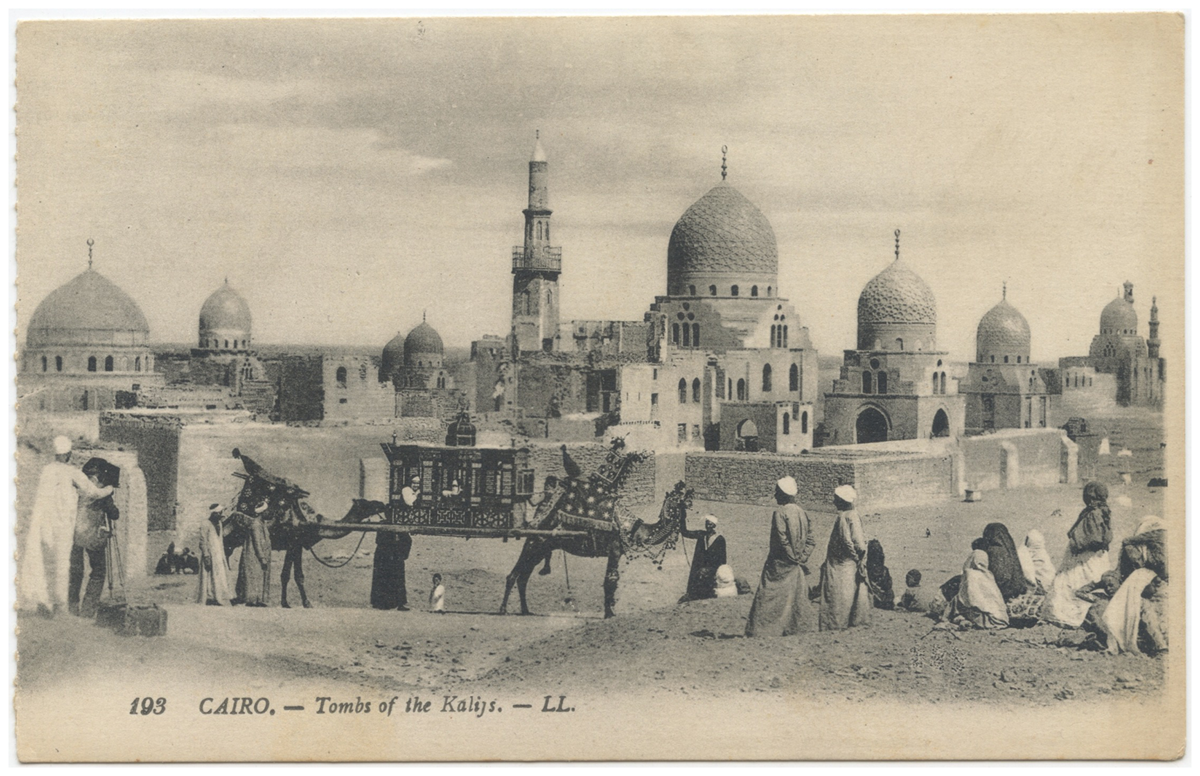
Figure 1
LL postcard image of the ‘Tombs of the Kalifs’ in Cairo. Scan by author, private collection.
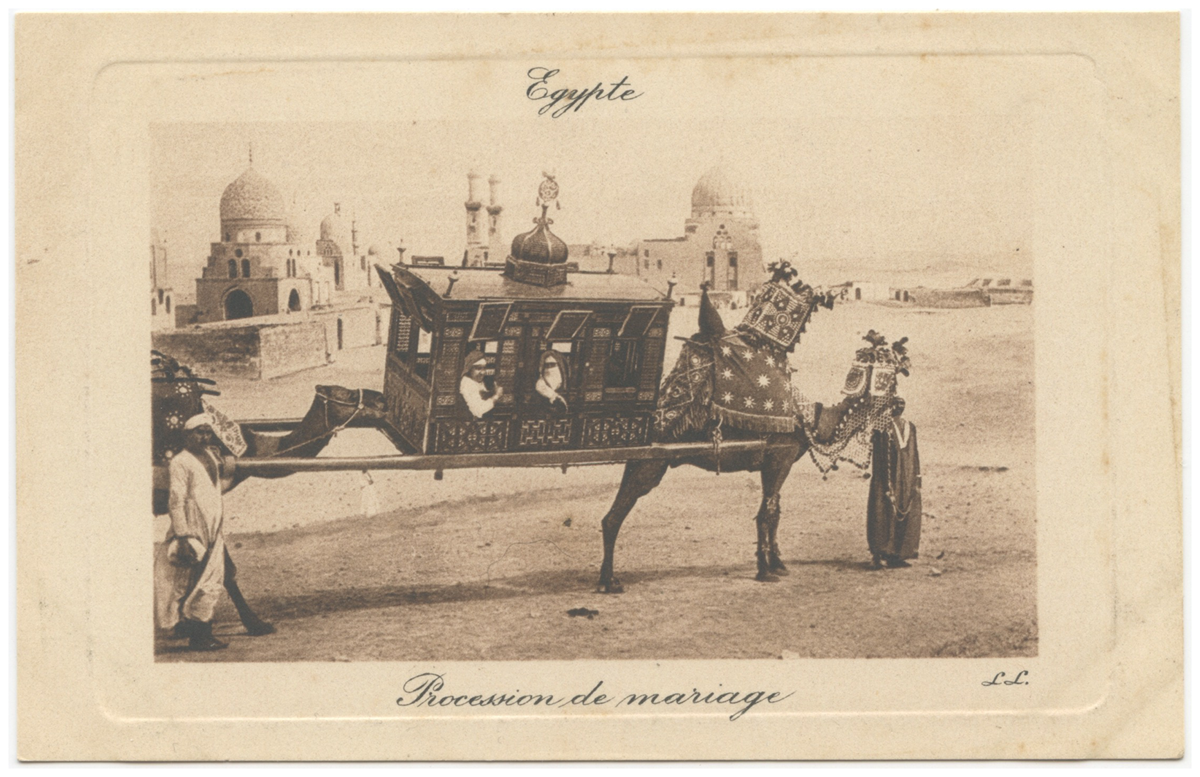
Figure 2
LL postcard image of a wedding procession in Egypt. Scan by author, private collection.
Buying and circulating postcards
The 16 postcards probably form a fragment of the communications Leslie participated in during the 1922–23 season. He does not refer to dyadic communication in his messages, probably since his postcards were written at times of high mobility. His long-term stay at Qau almost certainly changed this, with the post office in Tema acting as his local address. By the time Leslie had sent his last postcard, however, he had only spent a week (1–7 December 1922) at Qau. Correspondence might simply not have reached him yet.
Postcards were not his only means of communication. On postcard 2, Leslie promises to ‘post a P/C [postcard] when I leave tomorrow afternoon for Marseilles + write a long letter when on the boat [S.S. Sphinx].’ It attests to his use of two communication technologies, letters and postcards, and to their symbiotic relationship. Postcards were commonly used to announce and confirm the arrival of letters. Leslie suggests that sending postcards was insufficient. Letters may have been more valued by the receiver as a sign of greater effort by the sender: they were longer, more private, and more expensive to dispatch than postcards. Postcards acted as an ‘in-between’ communication. Their brevity, inexpensiveness, and informality made them the ideal vehicle for quick updates between letters, as stopgaps.28 Still, some of Leslie’s postcards exhibit characteristics more commonly associated with letters, which suggests the existence of a certain flexibility rather than mutual exclusiveness between these two forms of communication.
Following his arrival in Paris, Leslie habitually wrote Madge postcards once or twice a day. After boarding the S.S. Sphinx, this rate dropped, apparently a consequence of taking up letter-writing. This practice may explain the lack of postcards from Cairo, where he stayed 23–30 November, and his recounting of matters in medias res when he resumed his daily postcard routine upon departing for Asyut (PC 6/8). The S.S. Sphinx and Cairo provided lengthy stopovers, creating the right conditions for writing long messages. Postcards, however, were entwined with mobility, allowing Leslie to quickly write and post a note on-the-move. As small, stiff, light, and highly portable entities, their materialities allowed postcards to be inscribed at any opportunity.29 There was no standard for how to write postcards. Like many others, Leslie had an informal writing style: scrawled handwriting, usually absent salutations, less punctuation, less attention to spelling, and a truncated writing style (omitting pronouns).30
Letters did not fully outstrip postcards, as those penned on board the S.S. Sphinx demonstrate (PC 6–7), since they did not deliver the allure of the image.31 Prior to his arrival in Egypt, Leslie carefully chose his postcards, or rather their images, to match with his projected messages. This multimodality is apparent from the way in which his messages not only explicitly comment on these images, but also implicitly incorporate them using deictic references, such as ‘here’ or ‘this place’ (PC 3–4).32 It seems Leslie wanted Madge to be able to ‘see’ the places he visited through these images, to share in his experience by proxy. In the multimodal combination of image and message, he endeavoured to shape her ‘imaginative travel’ to faraway places.33
In other cases, however, there was no such marriage of image and message. One cause of this disconnect may be sought in anticipatory actions, in which Leslie purchased postcards ahead of a journey (PC 5, 7). This pre-emptive strategy is most evident in Egypt. Prior to leaving Cairo, Leslie acquired a booklet of detachable Cairo-themed LL postcards (PC 8–16). Each card was torn off along the recto’s left side, leaving a ragged edge. The image-message disconnect they evince raises the question as to whether these images still held any relevance. Leslie writes the first two postcards on-the-go and then one each day of his first week at camp until, it seems, he had run out. If postcards took precedence over letters at this time, perhaps their images were not irrelevant but constituted gifts in themselves. This seems especially so since these postcards gradually take on qualities commonly attributed to letters.
The sedentary qualities of camp appear to suit the practice of letter-writing, and indeed, after a week Leslie seems to have stopped writing postcards. It is remarkable, though, that none of his final seven postcards (PC 10–16) was posted individually. They were not stamped or postmarked and were likely posted inside envelope(s). Leslie also marked the cards with consecutive numbers.34 This suggests that they were batch-sent, the numbers communicating their chronological order to the reader. But this plan only formed gradually. His first three postcards still bear Madge’s address, implying his intention to post these individually. On his next two postcards, however, the address space is left blank. His final two postcards see his writings sprawl onto the address/stamp space. This postal regulation violation turned the verso into nothing but a writing surface. By this time then, Leslie had resolved to post his postcards inside one or two envelopes. The image-message disconnect, the use of envelopes, and the longer, sprawling messages are qualities these postcards share with letters. Leslie’s motivations remain speculative. His week-long accrual of postcards may suggest intermittent access to the Tema post office. In the end, it would have been cheaper to post them inside envelopes – like letters.35
Receiving and inheriting postcards
After receiving his postcards, Madge gathered, organized, and preserved them inside a postcard album. She similarly kept hold of Leslie’s love letters from their courting days. The letters and postcards would nevertheless come to different fates. Upon her death in 1952, the letters were deemed too private and burnt. Several archaeology-related belongings were collected by Olga Tufnell, who had worked with the Starkeys.36 As entities that were not too private, but private enough to be excluded from formal archaeological records, the postcards and album managed to endure as family heirlooms.
Though the album has survived, its postcards have long since been removed. Its limited captions of place names do not match the places Leslie visited in 1922–23. This complicates an understanding of the organization of the 16 cards therein, and thus of how Madge viewed and appropriated them.37 The album retained a series of postcards bought by the Starkeys on their foreign travels, which abruptly ended with Leslie’s murder in 1938.38 Madge perhaps came to regard these cards as mementos of Leslie, of their lives together, and of places they had been abroad.39 After Madge’s death, a teenage Wendy modified the postcards for her hobby of philately before using them for genealogical research later in life.40
Archaeological labour
In this section, I contrast the postcards with the official reports to explore and understand their shared and distinct ways of representing Egyptian archaeological labour. I compare both on two distinct points: the setting up of camp and the autonomy of Egyptian staff in fieldwork.
Brunton wrote four archaeological reports on the BSAE’s work at Qau-Badari, of which the first is most relevant here: Qau and Badari I. The changing styles of writing site reports over time has been explored by Ian Hodder, who points to a ‘gradual shift from the contingent and contextualized in the 18th century to the modern, abstract, distanced and universal’.41 Brunton’s report echoes his portrayal of late 19th to early 20th century British reports. It offers a more abstract, distant, neutral, and decontextualized account, where the passive voice hides his own and the royal ‘we’ gives his accounts a semblance of the self-evident and universal. Moreover, it conceals the ‘contingency, uncertainty and non-linearity of the research process […] behind a timeless, certain, and linear account.’42 But this erasure is not absolute: the kinds of information that Brunton’s report otherwise masks remain acceptable in certain sections, such as its first five chapters.43
Leslie’s postcards offer a kind of account that differs in certain respects from that of the archaeological report. Leslie writes his postcards mainly from a first-person perspective and his messages are thus clearly distinguishable as his personal views. He talks about his feelings, wishes, impressions, and so introduces emotive and sensory details that the ‘objective’ report leaves out. The daily inscription and rapid posting of his postcards also means that Leslie had less time to rethink, redact, or write out his opinions. Instead, they reflect his thoughts and understandings on the day, written with a spontaneity and eagerness that betrays his first season of fieldwork. His desire to share his experiences resulted in a series of thick and contingent narratives. Conversely, in writing his report, Brunton took time to filter out ‘obsolete’ views and interpretations, contingencies, and dialogues on site and provide evidence to suit his final reading. A disputed, contingent, and non-linear research process was turned timeless, uncontested, and linear (that is, where ‘data’ is simply accrued over time and never reinterpreted).44 In revealing the personal, interim, active, and interpretive, postcards can offset the report’s tendency to black-box processes of knowledge production by apprehending the specificities of archaeological practices (even if deemed non-archaeological). In other words, they breathe a bit of life back into the research process.
Nevertheless, postcards are not necessarily more reflective of ‘reality’ than reports, since neither were their messages composed in a vacuum. The regulated materiality of these postcards both designated and restrained the writing space, affecting the length and detail of the message. Leslie wrote his messages as a young British middle-class man, an inexperienced field assistant, and, like Brunton, from an orientalist and colonialist perspective. The addressee also influenced his writing.45 Nevertheless, the individuality of the addressee did not mean an individuality of readership, though this seems one way to set postcards apart from reports. Reports did not just target academics but a broad public to boost BSAE revenues.46 If the recipient seems to render the postcard private, the postcard was in fact written in the knowledge that it was both private and public, ‘semi-public/private’. Whilst the addressee makes the postcard explicitly personal, the postcard is also implicitly public since its message is visible to a range of people during the postcarding process.47 This public nature was fully recognised in the early twentieth century. Postcards could be read by those posting on someone’s behalf, postal workers, members of the same household, or friends.48 Since Madge lived with her parents, there was a risk they could read Leslie’s postcards by mistake, intent, or invitation. Hence, even if some of his postcards were posted inside envelopes, they could still have been exposed to a wider readership. This possibility may thus have influenced his style and contents of writing.
Setting up camp
One area in which the postcards provide more extensive data than the reports is the setting up of camp. This subject was deemed private and non-archaeological and, hence, inappropriate to the abstract, distant, and decontextualized form an archaeological report was expected to take in the early 20th century.49 In this respect, it is unsurprising that Brunton’s discussions of camp are mostly limited to his introductory chapters, where statements of this nature were still admissible.50 But even here, his focus is mainly on the location of two camps erected during the BSAE’s four seasons at Qau-Badari, which Western staff lived in which camp, and when they did so. Bar one, the Egyptian workers are not recognised, with no mention of their camp, even if those locally hired lived nearby. The first season saw the creation and Western occupancy of ‘Qau camp’, which was re-used in 1923–24 and 1927.51 Brunton describes it as follows: ‘we camped in and around the largest of the terraced rock-tombs in the Qau cliffs, some 100 ft. up, with a fine southward outlook over all the desert bay. Water was obtained from a well which we dug in the edge of the cultivation at the foot of the hill-side.’52 Occupying rock-cut structures had long been common practice for Petrie,53 who recommended their use: ‘no better lodgings are to be had anywhere for solidity and equable temperature […] the tomb is the best.’54 Thus, repurposing a tomb at Qau was not exceptional. Neither should its cost-efficient benefits be overlooked, especially for the BSAE whose fieldwork relied on the efforts and success of fundraising.55 But there may also have been political contingencies. Not long before the start of the 1922–23 season, Lacau unveiled his proposals for a new set of terms and conditions for excavation. Petrie protested these changes, one of which prohibited organisations from raising ‘any shelters or structure without submitting plans to be approved.’56 Inhabiting a local tomb may simply have avoided a lot of hassle. It is unknown when the choice for the tomb of governor Wahka II was made, but it matched Winifred Brunton’s demands for camp: not too close to a village, near a market town for supplies, close to a good water supply, and not too far from the excavations.57
The postcards confirm Brunton’s statement that the project had started on 1 December 1922.58 But Brunton fails to mention that he and Winifred only arrived the next day at 3 pm. The project had, in fact, been launched by his field assistants Bach and Leslie, five Egyptian men, and five Egyptian boys (PC 10–11). Leslie further suggests that Bach had covered for Brunton’s absence on 30 November. On 29 November, the Bruntons had participated in a restricted, first official viewing of the newly accessed Antechamber of Tutankhamen’s tomb.59 Leslie confirms that Brunton had gone to Luxor for this exact occasion, only returning to Asyut on 1 December, 12:15 a.m. – without Winifred (PC 9). Bach took his place, it seems, travelling to Asyut ahead of Leslie, who arrived there 30 November. Together with Gerald Wainwright, the Chief Inspector of Antiquities based at Asyut, he ventured out somewhere but ‘missed there [sic] train back [to Asyut] + were too late for dinner’ with Leslie and a tardier Brunton (PC 9). Their journey is left unexplained but perhaps involved a concession visit, the search for a camp site, dealings with local authorities, and arranging to meet with the ten Egyptians the next day. On 1 December, Bach and Leslie went to Tema, met up with the Egyptians, purchased supplies, and proceeded directly to their preselected camp site. By self-timer or Egyptian hand, Figure 3 turns their arrival into a European feat, purging the Egyptians and their efforts. Perhaps awaiting his wife, Brunton stayed behind in Asyut. His report, however, suggests otherwise. Here, he lists the season’s duration and its ‘party’ of Western participants, thereby suggesting his continual presence and leadership throughout a season of nonstop work – even if the Bruntons again visited Luxor in February.60 Consequently, Leslie’s postcards offer a contrast to Brunton’s carefully crafted official report. Delivering an assistant’s perspective, they attest to a director’s absence and to subordinates taking charge. Brunton, perhaps wary of the potential impact on his image as a field director, left their efforts uncredited. Stringent hierarchies represented one reason for the invisibility of assistants.61
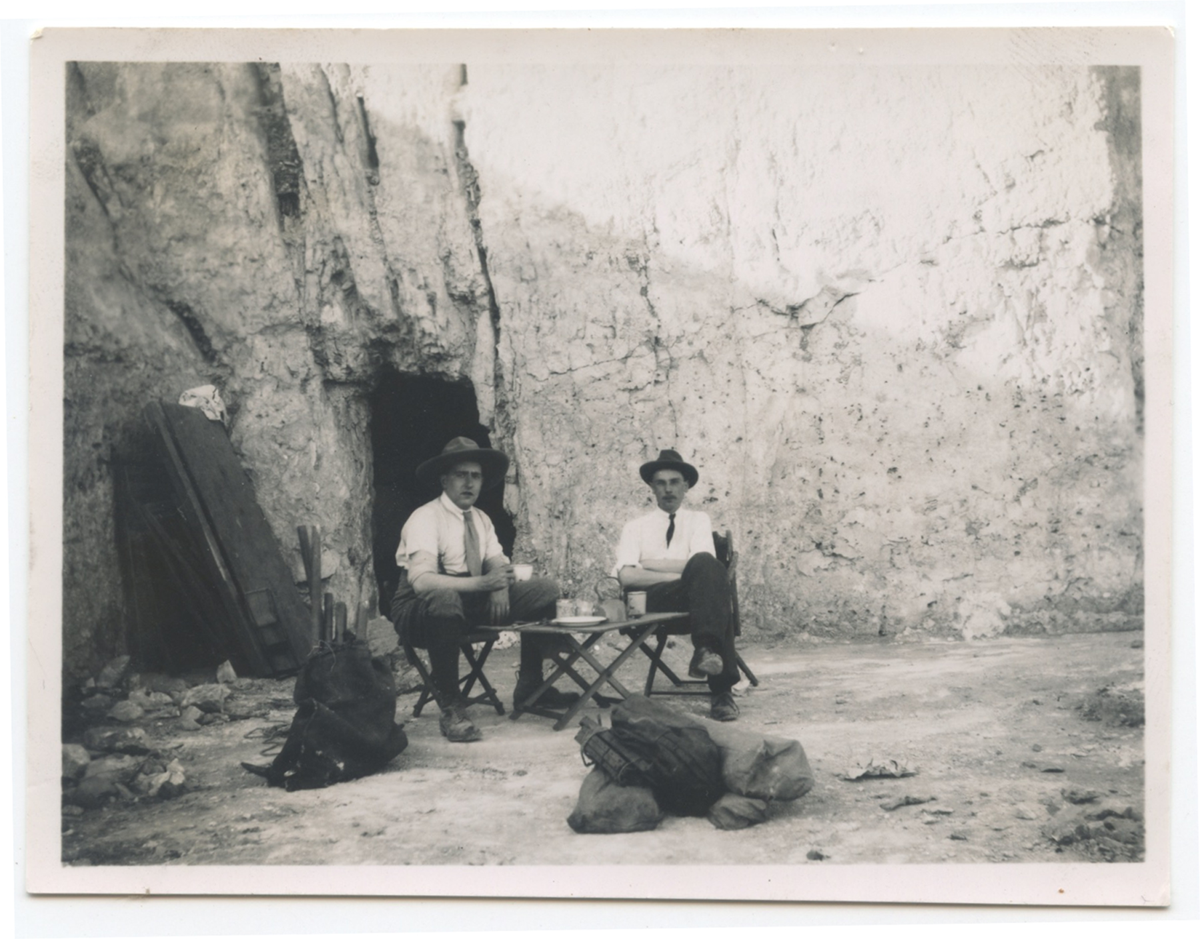
Figure 3
Photograph of Henri Bach and Leslie Starkey in the lower court of Wahka II’s tomb. Scan by author. Private collection of Wendy Slaninka, courtesy of Wendy Slaninka.
The report’s exclusionary practices culminate, however, in its neglect of Egyptian staff. Brunton’s ‘party’ was select, open only to those of European lineage. His disregard of Egyptians subscribed to an orientalist discourse in which this supposedly racially and culturally inferior people had no meaningful role in the making of ‘scientific’ knowledge, despite the essential nature of their work on site.62 The knowledge presented in the report was not something to which Egyptians had contributed. The only Egyptian named was chief foreman Ali es Suefi. This unusual move has been linked to Brunton’s insecurity as a new field director; though not his first archaeological report, Qau and Badari I was based on the first excavations conducted in his name.63 To gain public and academic esteem, he seemed set on authenticating the ‘scientific’ nature of his excavations by explaining his methods of recording and, paradoxically, by name-dropping a well-known and experienced workman.64 When he does cite other Egyptians, they are anonymized, engaged in manual and menial labour, and presented negatively.65 Such orientalist and colonialist discourse is equally apparent in Leslie’s postcards. Unlike with Europeans, he leaves Egyptians nameless, defining them by age, gender, and work. The colonial hierarchies are laid bare in the trip from Tema to Wahka II’s tomb (PC 10). The Europeans ride donkeys, whilst their purchases are carried by Egyptian boys on foot. Egyptian men get soaked transferring the Europeans dry across a channel, but only the abnormal plunge of a Frenchman merits comment (PC 10). Even Ali es Suefi is not exempted, albeit on an undated photograph (Figure 4).66 In this staged image (like some postcard images discussed), Leslie and Ali pose on their donkey-back journey to the Qau cliffs beyond, purposely juxtaposed by forced perspective. Part of a ‘visual repertoire of empire’, it deliberately centres Leslie to perform the narrative of the white hero-archaeologist leading the colonial inferior in the exploration of their own exotic land.67 In a caption, Leslie represents Ali as his nameless servant, disregarding his deeper archaeological experience: ‘Returning from Market Note the box carried by my native attendant behind – revolvers just arrived!’ (Figure 5). Ali’s custody of the revolvers nevertheless betrays his actual authority, just as Leslie’s leadership is destabilised by his awkward riding posture and reliance on an unidentified Egyptian person to control his donkey.
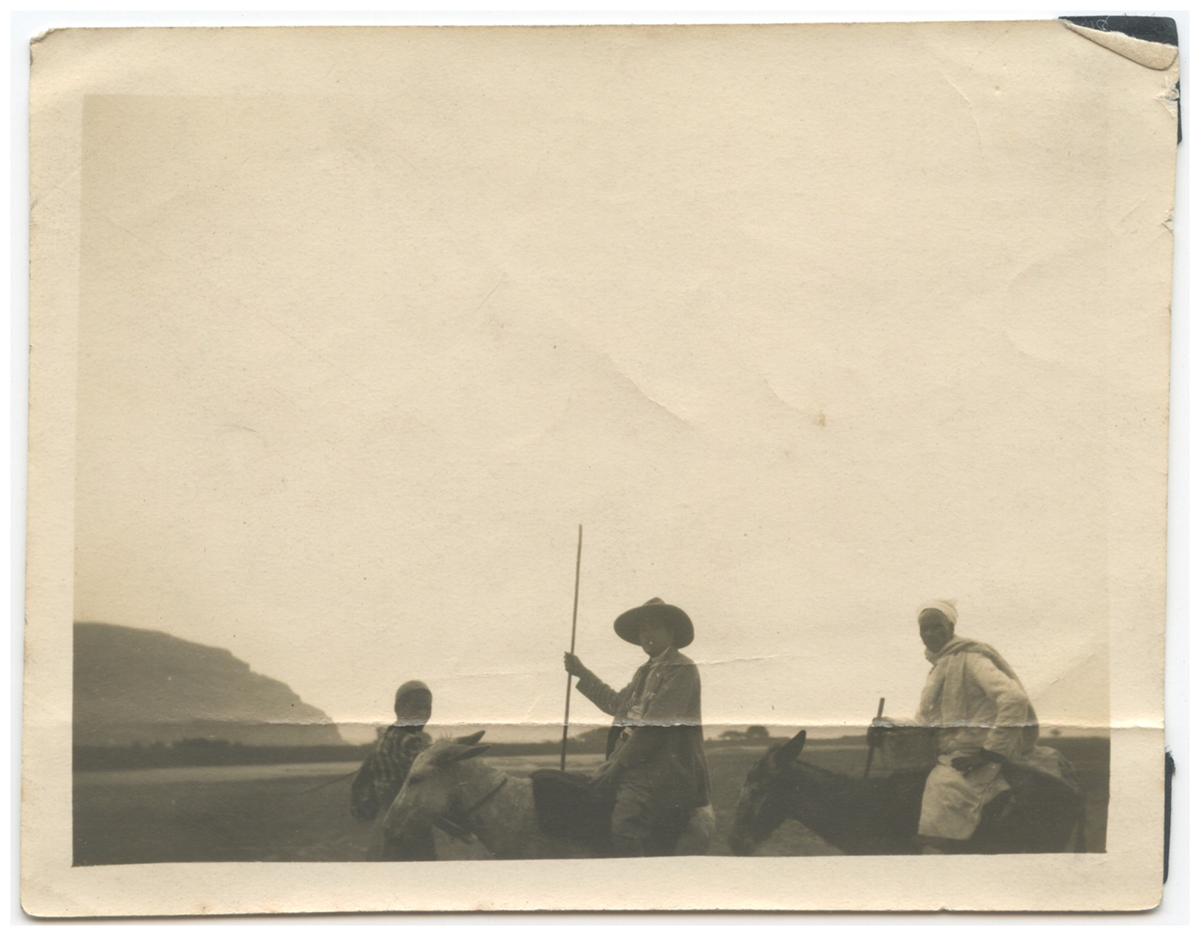
Figure 4
Photograph of Ali es Suefi, Leslie Starkey, and an unidentified Egyptian person on their way to Qau camp. Scan by author. Private collection of Wendy Slaninka, courtesy of Wendy Slaninka.
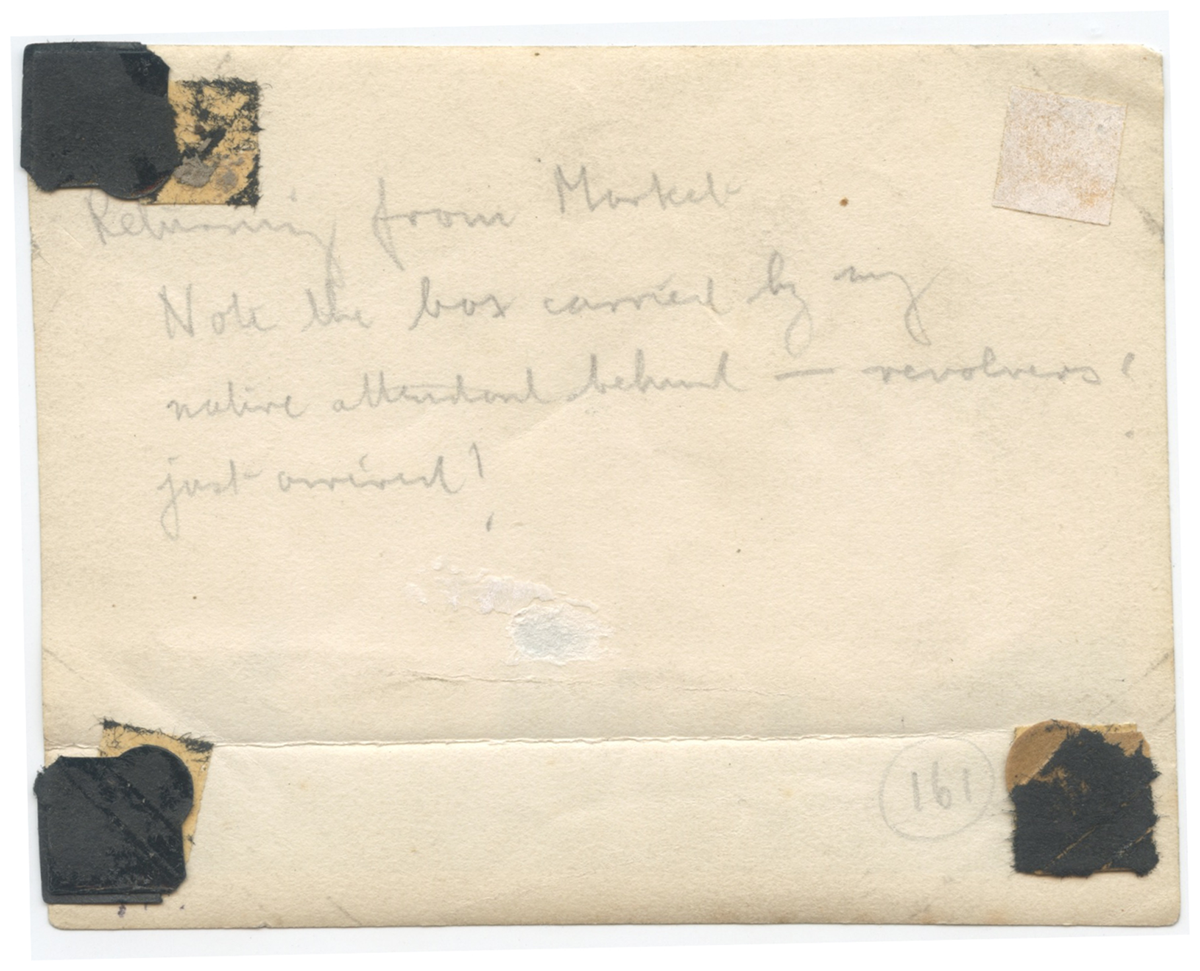
Figure 5
Leslie’s written caption on the verso of Figure 4’s photograph. Scan by author. Private collection of Wendy Slaninka, courtesy of Wendy Slaninka.
The postcards deliver details that do not just supplement the report’s account, but also inadvertently disrupt the orientalist and colonialist imaginaries that permeate it. Brunton’s account of Wahka II’s tomb-as-camp hides the effort put into making it fit for purpose. Leslie’s postcards prove more exhaustive:
Mr + Mrs Brunton arrived this afternoon at 3-oc by which time we had got the rock chamber cleared of debris which is to be our dining room, general store + Bruntons’ bedroom. (PC 11)
Todays [sic] work has been to sink a well at the foot of the cliff so as to have our water supply handy, + to build a mud brick wall accross [sic] the main chamber so as to form a separate room for the Bruntons. (PC 12)
Besides the well, Leslie describes the clearing of a rock chamber. Situated at the back of the tomb’s lower court on the lower terrace, this 17.6 by 3.2 metre chamber was cut into the rock below the upper terrace’s portico (Figure 6).68 Its three entrances perhaps inspired its modern reuse for three purposes, even if internal divisions were absent. Instead, a mudbrick wall was built across the chamber to divide off the Bruntons’ bedroom from the more public, yet exclusively European, areas. The interior of the repurposed chamber is revealed in a photo taken from this public space, showing Winifred Brunton sitting in front of the wall (Figure 7). Like Brunton, however, Leslie’s use of the passive voice and the royal ‘we’ hides the ones who had likely carried out the well digging and debris clearing: the ten unnamed Egyptians. The royal ‘we’ did not just emphasize the universal and the self-evident,69 but was also used to obscure and to take/share credit.
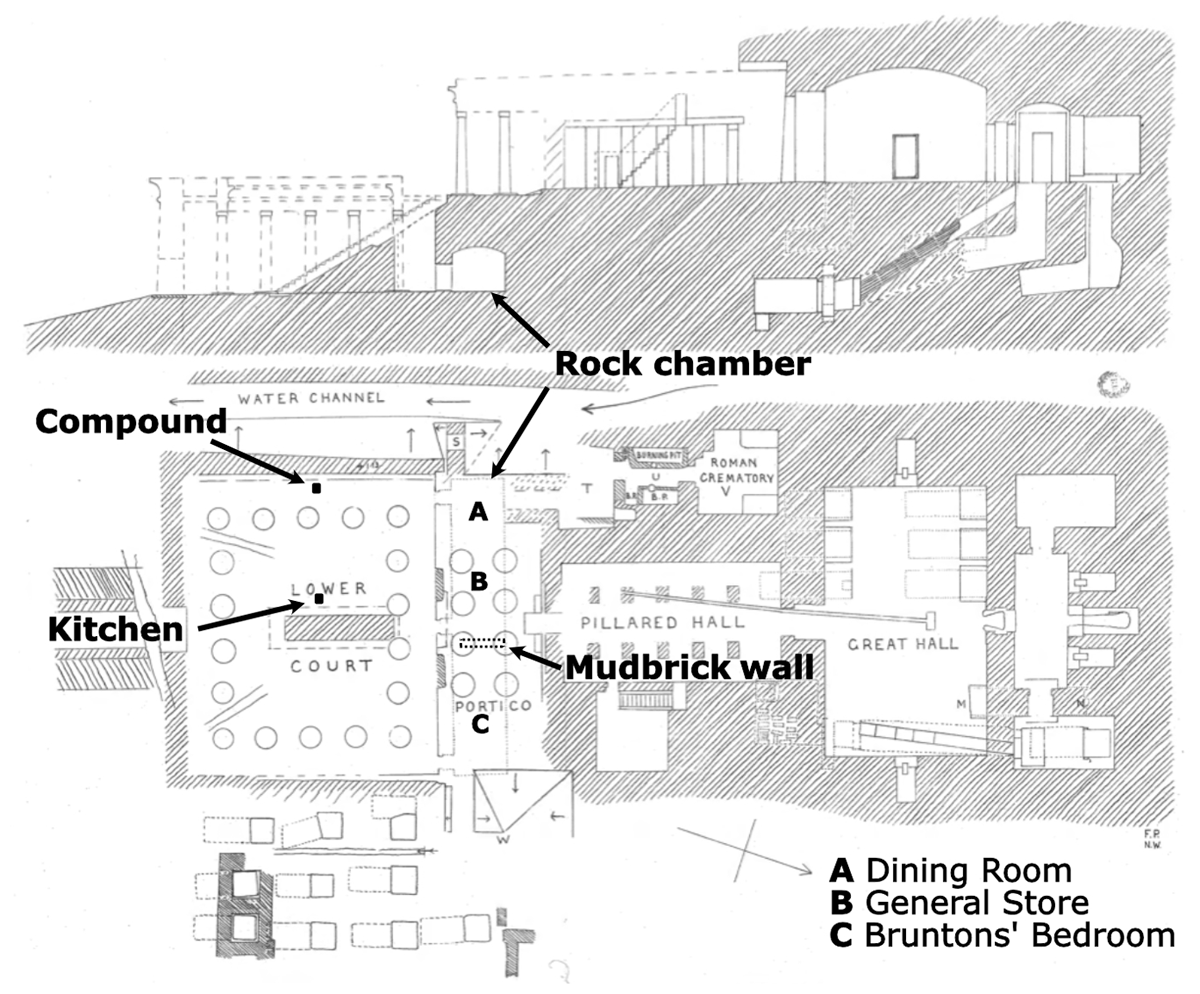
Figure 6
Petrie’s plan of Wahka II’s tomb, modified to pinpoint the rock chamber, kitchen, and compound. Original plan published in: William Matthew Flinders Petrie, Antaeopolis: The Tombs of Qau (London: British School of Archaeology in Egypt, Bernard Quaritch, 1930), pl. VI. Modifications have been made by the author.
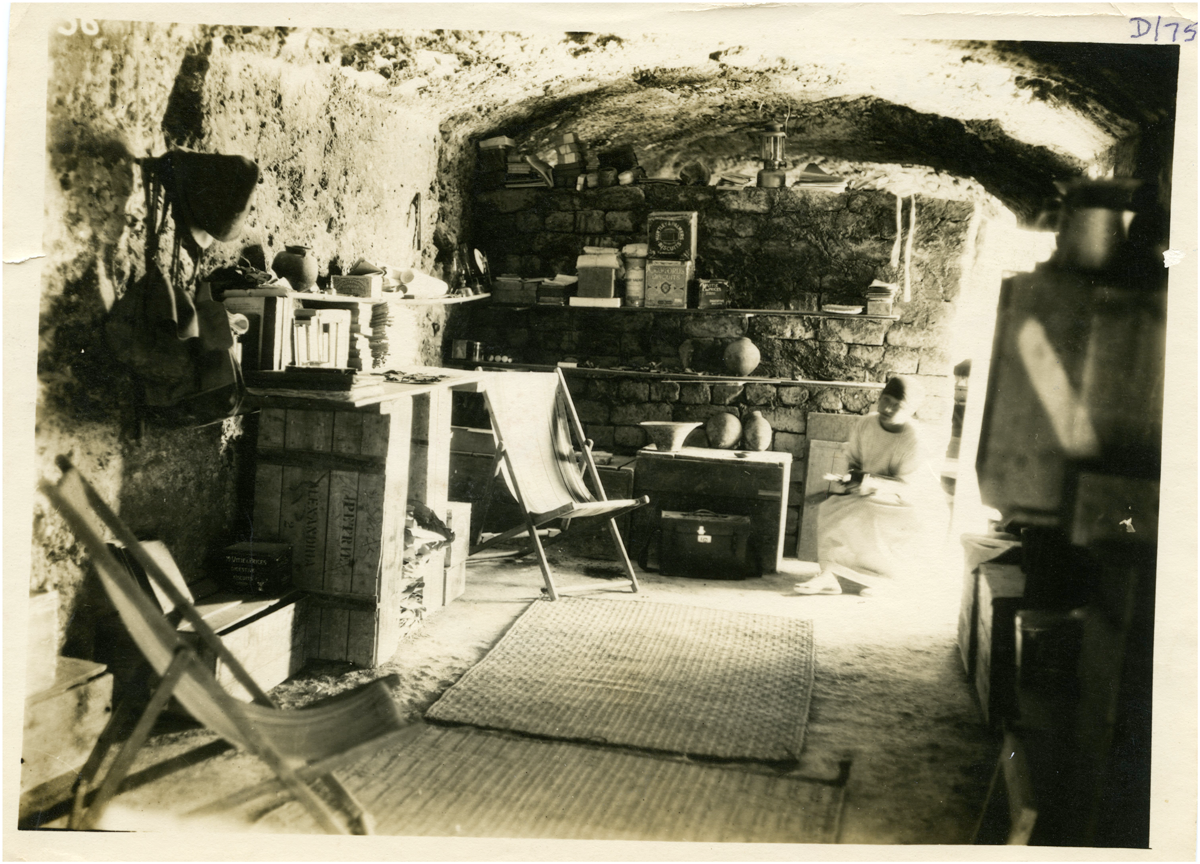
Figure 7
Photograph of the ‘general store’ inside the rock chamber of Wahka II’s tomb. Original photographic print (entitled D75: ‘Tomb at Qua used as a living room’) is located in a ring-binder of images used by Margaret Drower in her biography of William Matthew Flinders Petrie, Egypt Exploration Society archives, courtesy of the Egypt Exploration Society.
In postcard 13, however, Leslie takes a different turn, exclusively crediting the Egyptian ‘men’ with the building of a kitchen and compound using widely sourced materials:70
The men built of mud brick from a ruined tomb of the Roman period our kitchen with its wire gauge window from Cairo + a compound having a low wall for our tool store to contain ropes, rope ladders tents, sives [sic] + empty boxes for which we have no use. The kitchen is roofed over with corrugated iron sheets […]
Photos made during the BSAE seasons locate these structures within the lower court in front of the rock chamber (Figures 6, 8).71 Where Brunton mentions the digging of the well, he omits the construction of these facilities. In addition to an effort to silence Egyptian work, he might have feared allegations by his readers of desecrating Wahka II’s tomb. Another motive might be related to the facilities’ assembly from a Roman tomb’s mudbricks. Even if this practice followed Petrie’s early advice to construct a dig house ‘out of mud and stones and ancient sculpture and Roman bricks and anything else that can be had’,72 no record of the Roman bricked tomb would ever be published.73 Since archaeological recording was upheld as ‘the absolute dividing line between plundering and scientific work,’74 Brunton may have excluded this recycling activity to avoid potential charges of ‘unscientific’ conduct by his readers.
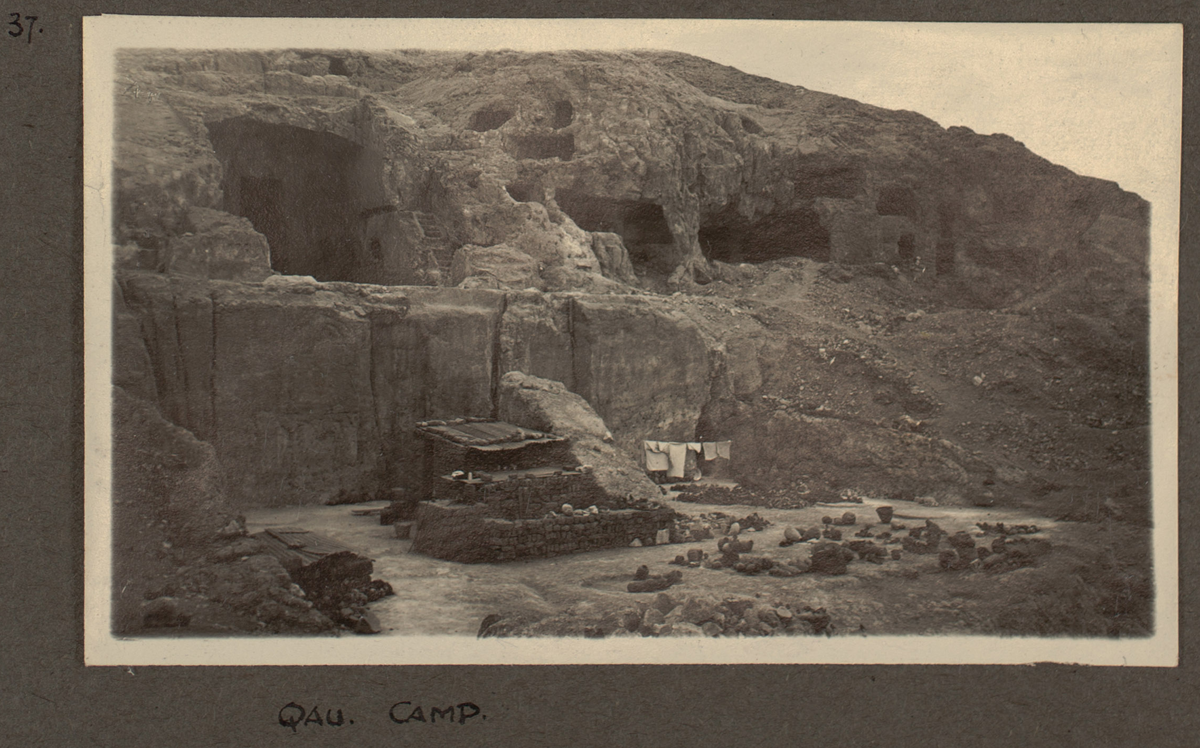
Figure 8
Photograph of the compound and kitchen in the lower court of Wahka II’s tomb. From Gertrude Caton-Thompson’s photo album, 1924, PMA/WFP1 115/15/2, Petrie Museum archives, courtesy of the Petrie Museum of Egyptian and Sudanese Archaeology, UCL.
In writing about camp, Leslie lifts a tip of the veil on the unacknowledged labour of the Egyptian workforce outside of fieldwork. Fieldwork or excavation was central to British archaeology’s disciplinary culture, with all other activities seen as supplementary and to require no explanation.75 Their description better suited the pages of popular magazines.76 Leslie subscribed to this notion, characterizing excavation as the ‘work proper’ and the setting up of camp as ‘doings […] of a domestic nature’ (PC 11–12). The rigour of this division may have affected archaeological standards when archaeological finds were made during such ‘domestic’ work. Leslie claimed that he ‘spot many fossil bones of a hugh [sic] extinct animal’ during the rock chamber clearance (PC 11). Earlier projects had found ‘fossil’ bones near other rock-cut tombs at Qau, and the BSAE would find further deposits in tomb shafts in Qau Bay.77 Whilst Brunton’s reports detail the contexts of the latter,78 Petrie’s report only vaguely contextualizes the bones Leslie mentions as ‘scattered in the tombs’.79 Though detailed contextual data may have been reserved for an unrealized memoir on the bones,80 such data may simply not have been recorded during this non-archaeological, ‘domestic’ clearance.
Just as Petrie’s report employed the passive voice to eradicate the personal, contingent, and contextual details apparent in Leslie’s postcard, Leslie’s use of ‘I’ and the royal ‘we’ effaced the Egyptians’ part in clearing and detecting the bones. The obscurity of Egyptian ‘technicians’ in the production of knowledge can be related to writing styles of archaeological reports, hierarchical structures, and colonialist and orientalist mind-sets.81 Categorising archaeological staff as ‘heads and hands’ stressed the ‘incongruity of physical and intellectual labor’, devaluing Egyptians and severing them from archaeological knowledge in the report.82 But even if European staff were named in the report’s introduction, they could not be linked to specific archaeological data therein. Instead, such knowledge could only be associated with the author of the report, who had erased debates, dialogues, and contingencies to provide ‘objective’ and ‘indisputable’ interpretations.83 In this way, even an absent Petrie could receive credit for finding the bones that Leslie first documented.84
Egyptian autonomy
A second point of contrast between Brunton’s report and Leslie’s postcards is regarding Western supervision over the Egyptian workforce. In a chapter entitled ‘method of recording’, Brunton is adamant and boastful about both the incessancy and pervasiveness of supervision in fieldwork:
In the first place, the workmen were never working without one of the staff on the spot, although the diggings were often over half an hour’s walk from the camp. One or two of us would start out before sunrise with the men, taking breakfast with us. To ensure the maximum of supervision, work was never carried on in more than one place at a time.85
This need for supervision betrays colonialist and orientalist sentiments of distrust and the desire to control the Egyptian Other, whilst at the same time rendering archaeology as an achievement of European management and expertise. Anxieties about theft or the planting of antiquities, and desires to optimize archaeological practices to obtain accurate, contextual information emerge regularly in Brunton’s reports. Moreover, in stressing the distance to camp, a European refuge, Brunton conjures the orientalist image of a heroic European holding his own amongst a group of devious Egyptians. This representation of absolute supervision is at odds with the day-to-day accounts of the postcards, however. Even if Leslie confirms that the Egyptians started their day at sunrise, his cryptic subordinate clause ‘by which time we are all well on the move’ fails to clarify whether they were indeed escorted by Western supervisors (PC 13). But in two postcards describing the events of 5 and 7 December, Leslie makes this Western absence crystal clear:
After lunch 2–30 we left our nest to join the men who had gone out early morning to try a cymetery [sic] which had been badly plundered by the natives of an ajoining [sic] village. Upon our arrival we found two graves waiting to be recorded & cleared. (PC 14)
Up at 6 AM Breakfast […] Brunton Bach v myself left about 8oc to join the men who had left at 6–30. By 11–30 we had not found them after walking many miles so had a light lunch […]. At 2–30 we located where they were + soon joined them. (PC 16)
Notwithstanding the anonymity of the European ‘we’ in the first quote, the fact that two graves were waiting to be recorded and cleared upon their arrival suggests that the Egyptians had been working by themselves until then. Recording was the exclusive task of European men: ‘it is the general rule that when the remains of a burial were found, no object or bone is moved until the recorder is on the spot. It is then for him to decide whether the workman shall continue the clearance, or whether he shall do it himself.’86 The report claims that the recording of graves was shared between Bach, Brunton, and Leslie.87 No Egyptian was trusted to take up this responsibility.88
Whilst Leslie does not detail the activities and methods of Egyptians in the field, he does describe the contents of the graves they had excavated. In contrasting his descriptions to the data provided in the reports, one of the graves that had been dug up, recorded, and cleared on Tuesday, 5 December, was Predynastic grave 102 (PC 14).89 The numbering system awarded each new cemetery a round hundred number (e.g., 100), and each new grave in that cemetery a consecutive number (e.g., 101) – however, not all graves excavated were numbered, recorded, or published.90 Nevertheless, number 102 would have been one of the first numbers to be given out in the first cemetery they worked on, Cemetery 100.91 According to Leslie, it was one of a total of five graves that day (PC 14). Whilst of interest in assessing the tempo of excavation, this numbering system also lays bare a particular method of excavation.
No digging would take place the following day, Wednesday, 6 December. This was the local souk or market day, the one day in the week the Egyptians had off (PC 15).92 On Thursday, 7 December, the excavation carried on, but not in Cemetery 100, even if its number of recorded burials would ultimately exceed five.93 Instead, a new terrain was sought out, which became known as the location of Cemetery 200. Based on Leslie’s description of burial goods, two of the graves unearthed there that day were Roman grave 201 and Predynastic grave 203 (PC 16).94 But these were not the only ones, for ‘many roman burials were found which in the main were very unproductive’ (PC 16). This account stands in contrast to the mere two Roman burials Brunton would eventually come to publish.95 Productivity is the key concept here. The BSAE’s field methodology was to retrieve and then distribute valuable antiquities to foreign museums in exchange for their sponsorship. Whilst the field site ‘provided a point of reference for extrapolating sequences’ of dug up objects, the archaeological formation of this site was not considered of much interest.96 Brunton demonstrates the same kind of focus on objects in his reports. In a brief and incomplete sketch of how excavations proceeded, Brunton justifies the abandonment of areas at Qau due to their ‘unproductive’ or ‘poor’ nature.97 Elsewhere, he defends his methodology in more detail: ‘much of the ground covered was found to be devoid of antiquities, though a very thorough examination was made; some of the sites were too poor or too plundered to make their complete excavation worth while.’98
Archaeological fieldwork focused on finding object-rich areas. In mirroring Brunton’s own assessment of Cemetery 100, Leslie notes how it ‘had been badly plundered by the natives of an ajoining [sic] village’ (PC 14).99 The fact that this cemetery was believed to be lacking objects may explain the decision to go elsewhere, even if a subsequent return is supported by the total of 52 graves later published for this cemetery.100 In this respect, Leslie’s repeated statement of ‘trying’ cemeteries gains salience. It suggests these cemeteries were initially probed to gauge whether sustained digging would be worthwhile in terms of object revenue (PC 14, 16). Yet, what Leslie’s postcards reveal is that the Egyptian workforce did not just have the autonomy to dig without foreign supervision but, more importantly, they had the authority and ingenuity to seek out and excavate new areas within the concession. It adds a new twist to Brunton’s tribute to Ali es Suefi’s skills: ‘his experience was invaluable in detecting the sites of the cemeteries, which were often almost invisible on the surface.’101 Whilst there might have been prior agreement on the Cemetery 100 area, in the case of Cemetery 200, the Egyptian staff had evidently not updated their foreign colleagues of their decision to go and dig there. Instead, the Europeans walked for hours to find them. What this demonstrates is an epistemic trust in the Egyptian workforce that does not emerge in the report, most likely ensured through proxy supervision by trusted ‘old hands’ like Ali es Suefi.102 More importantly, it brings into focus just how much the search for and excavation of archaeological sites depended on the Egyptian workers. Their editing role in the production of knowledge was, in this sense, constitutive since they selected the sites on which knowledge could be formed, and the remains that could be allowed to enter the archaeological archive.103
Conclusion
A decade ago, Alejandro Haber observed: ‘there is a disciplinary hard core that frames what is called archaeology, who are the archaeologists, and what object is named as archaeological.’104 In this article, I have addressed these three points for the BSAE’s excavation project at Qau in 1922–23. Official reports are contrasted to a series of peripheral, unpublished, and semi-public postcards that were neither part of the BSAE’s formal recording strategies nor written in adherence to prevailing archaeological standards. Different individuals stood behind these distinct genres of archaeological recording: one a new director but a veteran excavator, the other an inexperienced field assistant. The postcards draw attention to Haber’s points that both align with, and disrupt, accounts given in the reports. First, the postcards represent archaeology as something primarily happening in the field, highlighting the centrality of fieldwork in this archaeology’s disciplinary culture. The areas the excavations concentrated on disclose what the BSAE desired as its archaeological object. Poor and unproductive cemeteries were rejected in favour of object-rich cemeteries that could boost the yield in antiquities to take home, where they could serve disciplinary interests and financial survival.
Setting up camp is characterised as the opposite of fieldwork, as a ‘domestic’ activity. This view is endorsed by Brunton, whose report pays little attention to it. Fears of appearing to defile Wahka II’s tomb by covering it with facilities built from mudbricks of an unpublished Roman tomb may have played a part. But neither did his report need to state these activities, as they were not believed to relate to the production of ‘scientific’ knowledge presented therein. Where he did do so, sparingly, he used the royal ‘we’ to obscure and take credit. Ironically, this ‘we’ could only be linked to those his report named: the Europeans who were credited for the report’s archaeological knowledge. Brunton emphasizes this orientalist discourse when he offers a discussion of the method of recording to justify ‘how my conclusions were obtained at Qau and Badari.’105 It was the European act of recording that culminated in knowledge; the Egyptians just exposed what needed recording. Theirs was a task of ‘hands’ not ‘heads’, of ‘diggers’ not ‘excavators’. And so, a whole slew of Egyptian activities was either discounted or merely stated in passing. European assistants did not escape Brunton’s editing either. Their role in covering for the director, in launching the project, or in setting up camp was equally withheld to protect Brunton’s leadership image, or otherwise.
Leslie’s postcards are similarly permeated by orientalism and colonialism, whether in their images or messages. But in their spontaneity, thoroughness, their non-disciplined character, and attention to the contingent, his messages also destabilise these imaginaries. The report renders Egyptians ignorant, untrustworthy, and negligent, in need of constant European micromanagement. Conversely, in the peripheral records of postcards, the Egyptian workforce is left unobserved, trusted and relied upon to find and excavate new areas elsewhere. It was by virtue of their ‘heads and hands’ that sites could enter the archaeological archive.
Additional File
The additional file for this article can be found as follows:
Appendix: Reproduction and transcription of Leslie Starkey’s postcards
Scanned and prepared by author. Private collection of Wendy Slaninka. Courtesy of Wendy Slaninka. DOI: https://doi.org/10.5334/bha-704.s1
Notes
[1] “The British School of Archaeology in Egypt,” Times, 14 June 1905, 10; Margaret Drower, Flinders Petrie: A Life in Archaeology, 2nd ed. (Madison: The University of Wisconsin Press, 1995), 202, 295; Rosalind Janssen, The First Hundred Years. Egyptology at University College London 1892–1992 (London: UCL Press, 1992), 5.
[3] Alice Stevenson, “Artefacts of Excavation: The British Collection and Distribution of Egyptian Finds to Museums 1880–1915,” Journal of the History of Collections 26, no. 1 (2013): 94.
[4] Guy Brunton, Qau and Badari I (London: British School of Archaeology in Egypt, Bernard Quaritch, 1927), 78.
[5] Brunton, Qau I, 1; Ernest Mackay, Lankester Harding, and Flinders Petrie, Bahrein and Hemamieh (London: British School of Archaeology in Egypt, Bernard Quaritch, 1929), 36.
[6] Donald Malcolm Reid, Contesting Antiquity in Egypt: Archaeologies, Museums & the Struggle for Identities from World War I to Nasser (Cairo: The American University in Cairo Press, 2015), 1–9.
[7] James F. Goode, Negotiating for the Past: Archaeology, Nationalism, and Diplomacy in the Middle East, 1919–1941 (Austin: University of Texas Press, 2007), 67–97; Antoine Khater, Le régime juridique des fouilles et des antiquités en Egypte (Cairo: Institut français d’archéologie orientale, 1960), 288; Félix Relats Montserrat, “De la fouille au musée. Les partages des antiquités égyptiennes au début du xxe siècle à travers l’exemple de Médamoud,” Bulletin de correspondence hellénique moderne et contemporain 3 (2020): 43–46; Christina Riggs, Photographing Tutankhamun: Archaeology, Ancient Egypt, and the Archive (London: Bloomsbury, 2019), 21–24; Alice Stevenson, Scattered Finds: Archaeology, Egyptology and Museums (London: UCL Press, 2019), 145–146.
[8] Khater, Régime juridique, 288, 295; William Matthew Flinders Petrie, Seventy Years in Archaeology (Cambridge: Cambridge University Press, 2013 [1931]), 249–250; Reid, Contesting Antiquity, 65, 81–83.
[9] Brunton, Qau I, 1–2; Stephen Quirke, Hidden Hands: Egyptian Workforces in Petrie Excavation Archives, 1880–1924 (London: Duckworth, 2010), 75, 301.
[10] Nathan Schlanger and Jarl Nordbladh, “General Introduction: Archaeology in the Light of its Histories,” in Archives, Ancestors, Practices: Archaeology in the Light of its History, ed. Nathan Schlanger and Jarl Nordbladh (Oxford: Berghahn Books, 2008), 3.
[12] Photo album Henri Frankfort, 1922–23, Lucy Gura Archive, Egypt Exploration Society, London. For a history of the Quftis, see Wendy Doyon, “On Archaeological Labor in Modern Egypt,” in Histories of Egyptology: Interdisciplinary Measures, ed. William Carruthers (New York, London: Routledge, 2015); Wendy Doyon, “The History of Archaeology through the Eyes of Egyptians,” in Unmasking Ideology in Imperial and Colonial Archaeology: Vocabulary, Symbols, and Legacy, ed. Bonnie Effros and Guolong Lai (Los Angeles: Cotsen University Press, 2018).
[13] Registry file James Leslie Starkey, UCL Records Office, London. For a short biography on Leslie, see Morris L. Bierbrier, ed., Who Was Who in Egyptology, 5th rev. ed. (London: Egypt Exploration Society, 2019), 442.
[15] Transcripts conform to the written messages. The layout of the Appendix is inspired by Julia Gillen, “Writing Edwardian Postcards,” Journal of Sociolinguistics 17, no. 4 (2013): 488–521.
[16] For ‘collective effort’, see Christina Riggs, “Shouldering the Past: Photography, Archaeology, and Collective Effort at the Tomb of Tutankhamun,” History of Science 55, no. 3 (2017): 336–363.
[17] Nigel Hall and Julia Gillen, “Purchasing Pre-Packed Words: Complaint and Reproach in Early British Postcards,” in Ordinary Writing, Personal Narratives: Writing Practices in the 19th and Early 20th Century, ed. Martin Lyons (Berne: Peter Lang, 2007), 102; Naomi Schor, ““Cartes Postales”: Representing Paris 1900,” Critical Inquiry 18, no. 2 (1992): 210; Frank Staff, The Picture Postcard and its Origins, 2nd ed. (London: Lutterworth Press, 1979), 44–45.
[18] Gillen, “Edwardian Postcards,” 489; Schor, “Cartes Postales,” 212; Staff, Picture Postcard, 49, 66.
[19] John Cameron and Janice Schimmelman, The Glass Stereoviews of Ferrier & Soulier 1852–1908 (Rochester: The Collodion Press, 2016), 77–93.
[21] David Prochaska, “Thinking Postcards,” Visual Resources 17, no. 4 (2001): 391; David Prochaska, “The Archive of Algérie Imaginaire,” History and Anthropology 4 (1990): 374–375.
[22] Peter Burns, “Six Postcards from Arabia: A Visual Discourse of Colonial Travels in the Orient,” Tourist Studies 4, no. 3 (2004): 270; Prochaska, “Algérie Imaginaire,” 376; Edward Said, Orientalism (New York: Pantheon Books, 1978), 20–21.
[24] Jennifer A. Baird, “Photographing Dura-Europos, 1928–1937: An Archaeology of the Archive,” American Journal of Archaeology 115 (2011): 433–434; Derek Gregory, “Emperors of the Gaze: Photographic Practices and Productions of Space in Egypt, 1839–1914,” in Picturing Place: Photography and the Geographical Imagination, ed. Joan M. Schwartz and James R. Ryan (London, New York: I.B. Tauris, 2003), 206–207.
[27] Gregory, “Emperors of the Gaze,” 197–198, 202, 206–207, 224; William J.T. Mitchell, “Holy Landscape: Israel, Palestine, and the American Wilderness,” in Landscape and Power, ed. William J.T. Mitchell, 2nd ed. (Chicago, London: Chicago University Press, 2002), 265–266; Nicholas Tromans, “The Orient in Perspective,” in The Lure of the East: British Orientalist Painting, ed. Nicholas Tromans (London: Tate Publishing, 2008), 105.
[28] Konstantinos Andriotis and Mišela Mavrič, “Postcard Mobility: Going Beyond Image and Text,” Annals of Tourism Research 40 (2013): 29–30; Julia Gillen, “‘I Should Have Wrote a Letter Tonight’: A Literacy Studies Perspective on the Edwardian Postcard,” in Was ist ein Brief? Aufsätze zu epistolarer Theorie und Kultur/What is a Letter? Essays on Epistolary Theory and Culture, ed. Marie Isabel Matthews-Schlinzig and Caroline Socha (Würzburg: Königshausen & Neumann, 2018), 137–140.
[29] Andriotis and Mavrič, “Postcard Mobility,” 21; Julia Gillen and Nigel Hall, “Any Mermaids? Early Postcard Mobilities,” in Mobile Methods, ed. Monica Büscher, John Urry, and Katian Witchger (London: Routledge, 2010), 25.
[30] Julia Gillen and Nigel Hall, “Edwardian Postcards: Illuminating Ordinary Writing,” in The Anthropology of Writing: Understanding Textually-Mediated Words, ed. David Barton and Uta Papen (London: Continuum, 2010), 174–175; Hall and Gillen, “Pre-Packed Words,” 107–108.
[34] The number 4, however, is repeated on three postcards, and Leslie apparently corrected one to the number 5.
[35] In 1914, the postage for letters of up to 20 g to Great Britain was 10 millième, and for a postcard 4 millième. By 1929, the postage had doubled for postcards, but remained the same for letters. See Karl Baedeker, Egypt and the Sûdân: Handbook for Travellers, 7th ed. (Leipzig: Karl Baedeker, 1914), xix; Karl Baedeker, Egypt and the Sûdân: Handbook for Travellers, 8th ed. (Leipzig: Karl Baedeker, 1929), xx.
[36] John Green and Ros Henry, Olga Tufnell’s ‘Perfect Journey’. Letters and Photographs of an Archaeologist in the Levant and Mediterranean (London: UCL Press, 2021).
[38] Josef Mario Briffa, “The Murder of James Leslie Starkey near Lachisch. A Different View from a Colonial Office File,” Palestine Exploration Quarterly 153, no. 3 (2021): 173–190.
[39] Bjarne Rogan, “An Entangled Object: The Picture Postcard as Souvenir and Collectible, Exchange and Ritual Communication,” Cultural Analysis 4 (2005): 4–5, 12.
[40] Wendy Slaninka, “James Leslie Starkey, Archaeologist: Part I: Background and Early Career,” Filming Antiquity (blog), 9 February 2020, https://www.filmingantiquity.com/.
[41] Ian Hodder, “Writing Archaeology: Site Reports in Context,” Antiquity 63, no. 239 (1989): 272; Ian Hodder, The Archaeological Process: An Introduction (Oxford: Blackwell Publishers, 1999), 173–174.
[45] Jan-Ola Östman, “The Postcard as Media,” Text 24, no. 3 (2004): 430.
[46] Quirke, Hidden Hands, 13; Rachael Sparks, “Publicising Petrie: Financing Fieldwork in British Mandate Palestine (1926–1938),” Present Pasts 5, no. 1 (2013): 10.
[54] William Matthew Flinders Petrie, “A Digger’s Life,” The English Illustrated Magazine (March 1886): 440–441.
[57] Winifred Brunton, “An Archaeologists’ Camp,” Egypt and the Sudan (1929): 31.
[59] Christina Riggs, Treasured: How Tutankhamun Shaped a Century (London: Atlantic Books, 2021), 81.
[61] Allison Mickel, Why Those Who Shovel Are Silent: A History of Local Archaeological Knowledge and Labor (Louisville: University Press of Colorado, 2021), 34.
[66] His identification is suggested by a comparison to photographs of him in Henri Frankfort’s album, see Quirke, Hidden Hands, 289–290, figs. 9.26, 9.28–9.29.
[67] Baird “Photographing Dura-Europos,” 432, 436; Riggs, Photographing Tutankhamun, 157; Riggs, “Shouldering the Past”.
[68] William Matthew Flinders Petrie, Antaeopolis: The Tombs of Qau (London: British School of Archaeology in Egypt, Bernard Quaritch, 1930), 3–4.
[70] By then, an anticipated 21 additional men, possibly Quftis, had joined the project (PC 11–12). On 7 December, a few young girls and two more men (all local?) were hired (PC 16).
[73] Guy Brunton, Qau and Badari III (London: British School of Archaeology in Egypt, Bernard Quaritch, 1930), 25–26, pl. XXXIX.
[74] William Matthew Flinders Petrie, Methods & Aims in Archaeology (London: MacMillan, 1904), 48.
[75] The male excavator was central, see Petrie, Methods & Aims, 1–8; Stephanie Moser, “On Disciplinary Culture: Archaeology as Fieldwork and Its Gendered Associations,” Journal of Archaeological Method and Theory 14 (2007): 235.
[77] Eric Welvaert, “The Fossils of Qau el Kebir and Their Role in the Mythology of the 10th Nome of Upper Egypt,” Zeitschrift für Ägyptische Sprache und Altertumskunde 129 (2002): 167–169.
[82] Mickel, Those Who Shovel, 34; Petrie, “Cares of Archaeological Discovery,” Ancient Egypt 13 (1928): 67.
[89] Guy Brunton and Gertrude Caton-Thompson, The Badarian Civilisation and Predynastic Remains near Badari (London: British School of Archaeology in Egypt, Bernard Quaritch, 1928), pls. XXX, XXXIV, 1.
[91] Cemetery 000 may have been dug up later. Its location to the south of Qau Bay does not conform to ‘the centre of the bay’ visited on 4 December 1922 (PC 13). See Brunton and Caton-Thompson, Badarian Civilisation, 42.
[98] Brunton, Matmar (London: Bernard Quaritch, 1948), 2–3.
[102] For later projects, Brunton noted that ‘much of the success of the expedition was due to [Ali’s] knowledge and supervision’ and that Ali ‘saw to it that our workmen fully earned their wages.’ Guy Brunton, Mostagedda and the Tasian Culture (London: Bernard Quaritch, 1937), 1; Brunton, Matmar, 1. For an in-depth discussion of epistemic trust in archaeological labour, see Allison Mickel and Nylah Byrd, “Cultivating Trust, Producing Knowledge: The Management of Archaeological Labour and the Making of a Discipline,” History of the Human Sciences 35, no. 2 (2022): 3–28.
[104] Alejandro Haber, “Un-Disciplining Archaeology,” Archaeologies: Journal of the World Archaeological Congress 8, no. 1 (2012): 63.
Acknowledgements
I am most grateful to Wendy Slaninka for kindly letting me study and publish parts of her personal collection, and to Jayne Gifford and Lorna Richardson for their support in writing this article. I am thankful to the Egypt Exploration Society and the Petrie Museum for letting me reproduce photographs from their archives. Finally, I want to express my gratitude to Allison Mickel and Sam Holley-Kline for giving me the opportunity to publish this article, and for their and the anonymous reviewers’ constructive feedback.
Competing Interests
The author has no competing interests to declare.