
Introduction
Julie K. Stein is a name, for many archaeologists, that is synonymous with a distinctive and rigorous use of geoscience approaches to archaeological problems. She was among the first generation of researchers to recognise the importance of scientific analysis of sedimentary deposits to understanding archaeological site formation. Her detailed publications on the deposit as an important unit of archaeological analysis drew the attention of a broad audience of archaeologists. As one of the first women in geoarchaeology in the United States, her career has spanned, and profoundly influenced, several generations of researchers and debates on applications of earth science to archaeology. On the occasion of her retirement as the Executive Director of the Burke Museum in Seattle, Washington in 2022, we conducted a series of interviews with Stein to document her experiences in establishing an influential career in a then-new field, and navigating the numerous challenges of being a woman in a male-dominated community.
Stein’s lively reflections tracing her career are an inspiration for students and junior scholars. Her candid accounts of her professional activities and interactions with other notable scholars of the early years of geoarchaeology illuminate the development of issues that remain of central importance to the discipline. This interview documents the central elements of her approach to geoarchaeology, especially those that might not be obvious from reading her scholarly works. One element that stands out as particularly prescient and worthy of emulation is her thoughtful and immensely pragmatic engagement with communities ranging from the international community of geoarchaeology to the Indigenous tribes in the San Juan Islands that she worked with in the later half of her career.
In this paper we firstly contextualise Stein’s work with a brief summary of her educational and professional background. We briefly describe some of her key publications to trace the trajectory of her scholarly work and prepare the reader for her references to these in the interview. Our interview transcript was prepared from conversations between Stein and DiCiro and Mitchell conducted at the Burke Museum during December, 2021. Those that have met Stein will know that she has a distinctive, engaging and lively conversational style and vocal cadence, and we have attempted to preserve this as much as possible in the transcript, with only light edits for clarity and length. The photos accompanying the interview were provided by Stein, and the captions were written by her.
Education
Julie Stein graduated from Western Michigan University with a Bachelor of Arts degree in archaeology and geology in 1974 (Figure 1). She attended the University of Minnesota completing her Master of Arts in 1976 and Doctor of Philosophy in geoarchaeology in 1980. Stein’s PhD research investigated a 6,500 year old shell midden at Green River, Kentucky. Stein used manual coring to collect samples to study the context and integrity of the deposition at the site (Figure 2). She used geological and pedological laboratory methods, such as pH, phosphorus, organic carbon, and carbonate analysis, to reconstruct the pre-occupation landscape. Her key findings were that, at the time of occupation, the settlement was on an old lake plain, created during the Pleistocene. With these analyses, she determined that various human, rather than natural, activities created the shell midden. The dark shell-free strata in the deposit were settlement periods where people did not collect shells. Her success using the geoscience methods, picked up during her graduate training1,2, inspired her to pursue an academic career in the application of geological methods to archaeological problems.
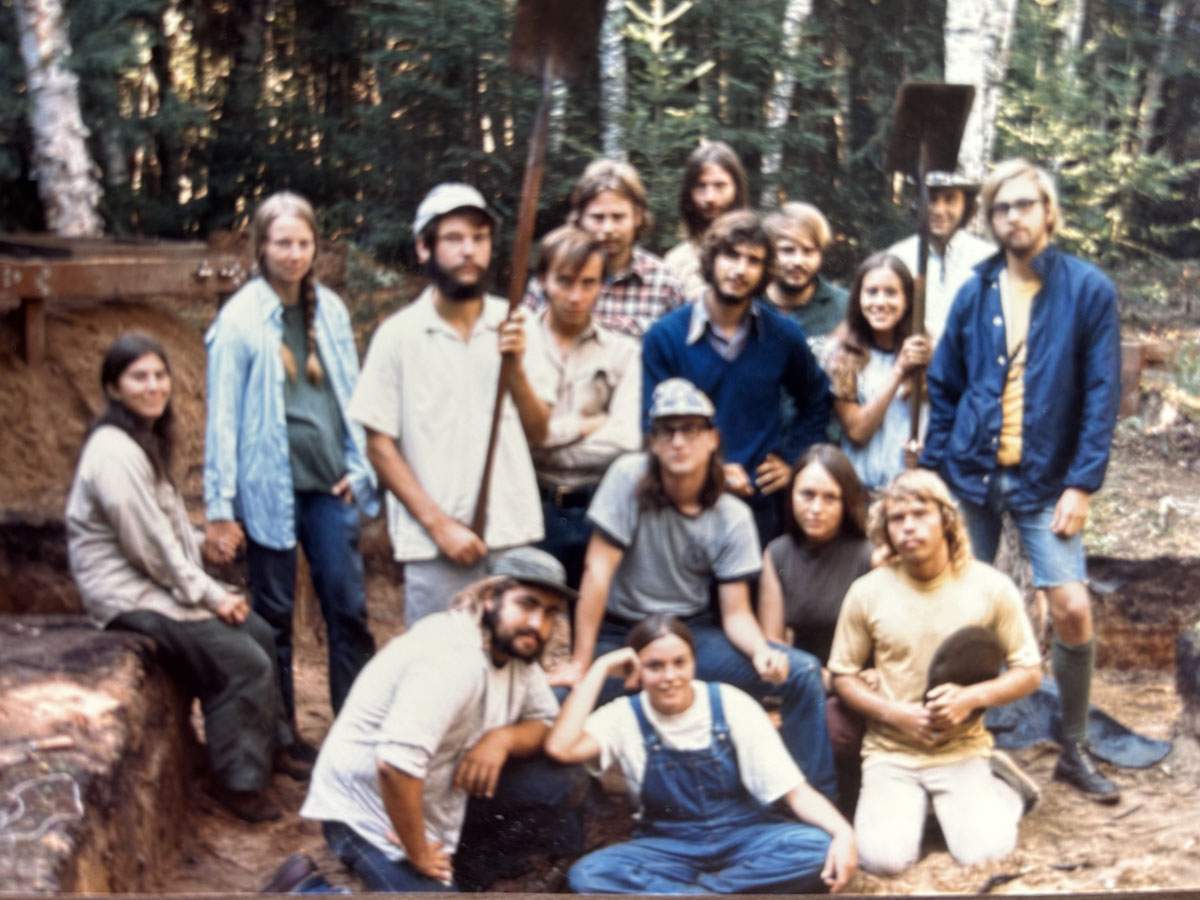
Figure 1
Julie Stein Julie (front center) on a Western Michigan University field school in 1972, Garden Peninsula, Michigan.
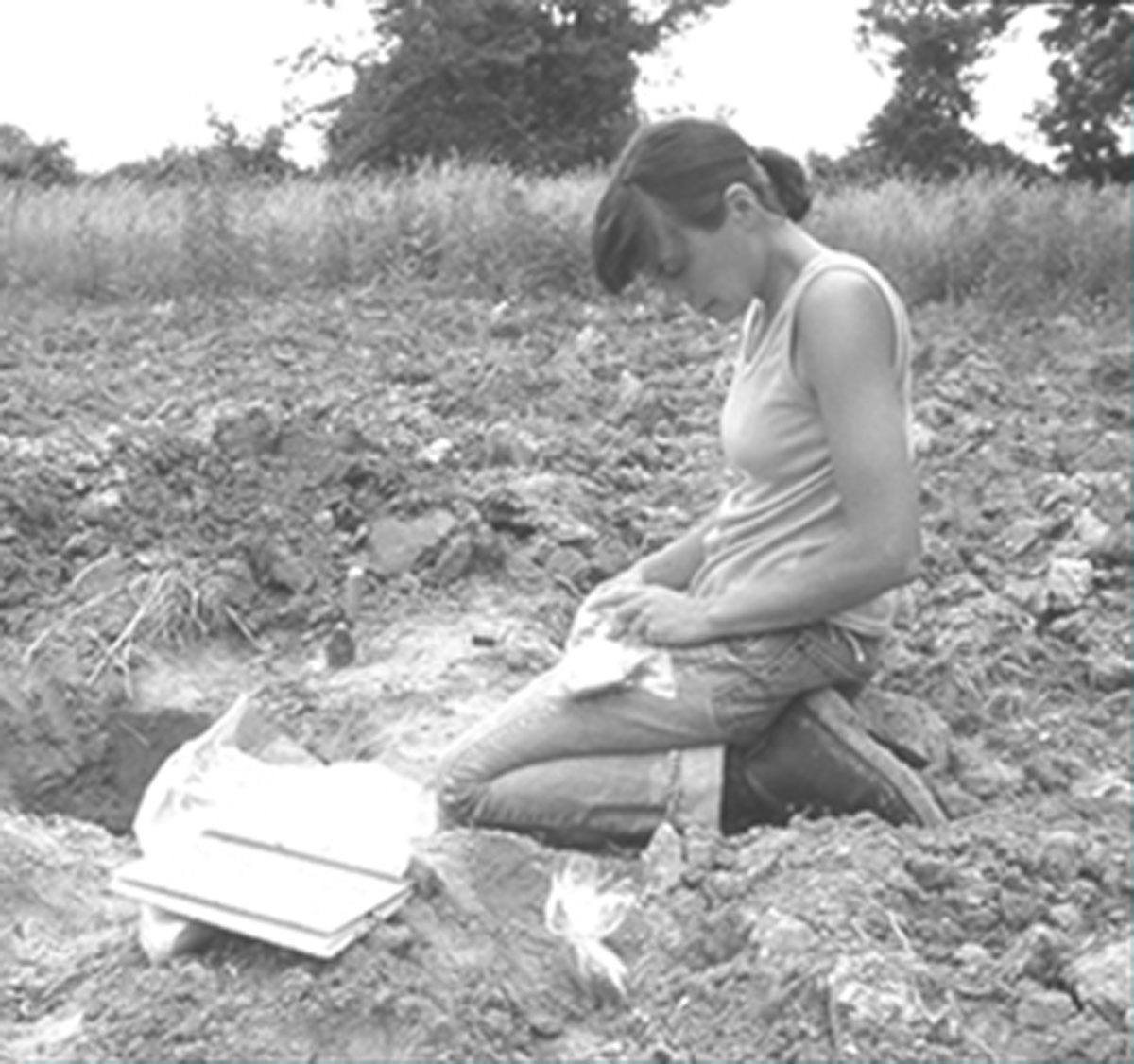
Figure 2
Julie Stein collecting sediment samples from shovel-test pits in the Green River lake plain in 1976.
Professional work
After completing her PhD, Stein began her professional career at the University of Washington. She started as an Assistant Professor in 1980, with promotions to Associate (1986) and full Professor in 1994. Her scholarly output included numerous articles, book chapters, and the book, Exploring Coast Salish Prehistory: The Archaeology of San Juan Island,3 which summarized her long-term research program in the island archipelago in the Pacific Northwest (Figure 3). Stein’s research in the region local to the University enabled convenient integration of research and teaching, with multiple seasons of field schools and site visits to San Juan Island by geoarchaeology students (Figure 4).
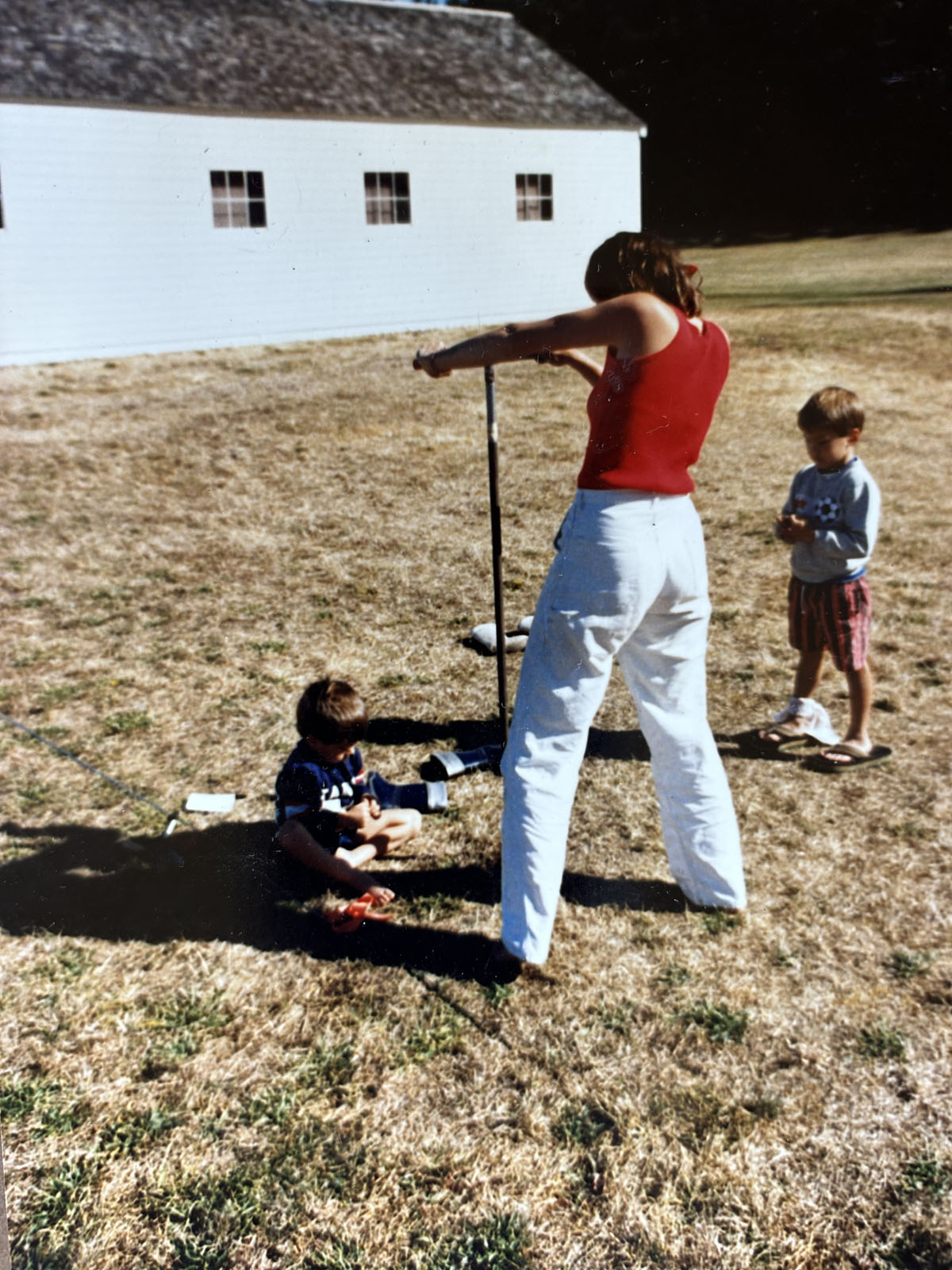
Figure 3
Julie Stein with her two sons in 1985 using bucket auger at San Juan Island National Historic Park to reconstruct the paleotopography.
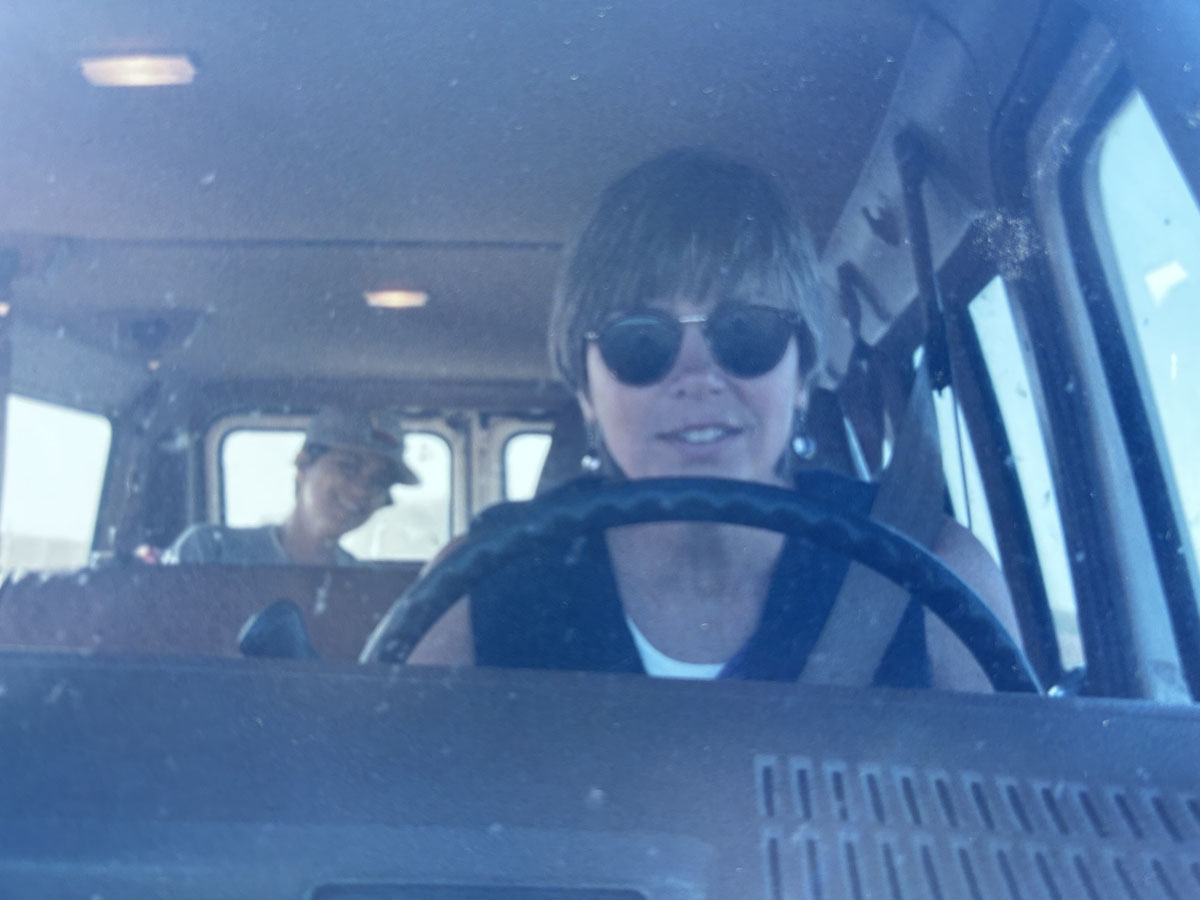
Figure 4
Julie Stein driving UW students in 1998 to San Juan Island for geoarchaeology class.
One of her most impactful articles, Deposits for Archaeologists,4 with over 100 citations, details the different areas of study in geology that archaeologists can use to investigate and understand rocks, minerals, and their accumulations at archaeological sites. Stein summarizes how archaeologists and geologists analyze deposits worldwide to show how researchers can use both sedimentary geology methods and vocabulary to summarize findings effectively. Stein synthesized research on archaeological deposits from the 1970s through to the mid 1980s to show how geology and archaeology can and should work together.
This paper is important for understanding Stein’s position in the broader context of intellectual currents in archaeology, at a time when the range of scientific techniques being employed by archaeologists was rapidly expanding. During the 1970s and 80s several scholars argued for archaeology as a distinctive science, for example in the United States Binford,5 Schiffer6 and Dunnell7 proposed ways of practicing archaeology as a science. Stein’s work at this time is motivated by two themes emerging from these proposals: that the environmental context of past human activity is important, and that the archaeological record is not a static snapshot of past human behaviors and relationships, but the result of ongoing human and natural processes. Stein’s thinking is most closely aligned with Schiffer’s emphasis on investigating site formation processes as a central focus of archaeological research.
In drawing archaeologists’ attention to site formation processes, Schiffer made a distinction between cultural and non-cultural processes that contribute to the formation of the record. In Stein’s view the proper organization of these processes was not in parallel, equally worthy of investigation, as Schiffer proposed, but hierarchical, with cultural processes as a subset of natural processes. She writes “The most difficult change… is for archaeologists to think of human beings as just one of the many natural agencies involved in deposition. Cultural activities conform to the laws of nature. Thus culture is only one of the many types of biological or mechanical agents of transport and deposition.”8 This is the basis of her key proposal that the deposit is the most appropriate unit of archaeological analysis, not the artifact, because the deposit includes artifacts and many other elements that are important for a robust interpretation of the record. Given this claim, attributes of deposits that are studied by Earth scientists, such as particle size distributions and micromorphology, should also be incorporated into archaeological analyses, and applied to artifacts directly, as well as the sediments surrounding them.9 The extent to which these perspectives resonated with archaeologists can be seen in the current status of geoarchaeology as a vibrant international research community, with geoarchaeological research routinely published in a variety of international journals, and well-established professional communities in the Geoarchaeology Interest Group of the Society of American Archaeology and the Geoarchaeology Division of the Geological Society of America.
In 1990 Stein became a Curator of Archaeology at the Burke Museum, while continuing her duties as an Associate Professor. During this time, she published several papers centered around macromorphological methods of geoarchaeology, the importance of scale,10 and defining the field.11,12 Notable among these is her advocacy of translating academic geoarchaeology to benefit salvage archaeology projects necessitated by industrial developments. For example, she argued that coring can benefit Cultural Resource Management archaeologists (CRM, the US equivalent of contract or commercial archaeologists) because of how rapidly it can characterize the depositional characteristics of large areas. Also during this time, Stein published several articles dedicated to shell middens around the Pacific Northwest, using geoarchaeological methods to understand how coastal tribes lived in pre-contact times.
From 1999 to 2005, Stein joined the Dean’s Office in the College of Arts and Sciences and became the Divisional Dean of Research Facilities & Computing at the University of Washington. During this time she intensified her focus on archaeological projects around the Pacific Northwest.13,14,15,16,17,18 One of the most notable activities during this time was her work on The Ancient One (formerly known as the Kennewick Man).19 The Ancient One was discovered by chance in 1996 at the shore of Lake Wallula in Kennewick, Washington, and dated to 9300 years old. This has been one of the most written about and studied ancient human skeletons ever found in the Americas, with numerous articles in the popular media, documentaries in the US, Europe, and Asia, and at least four books. The attention was in part due to the potential of the find to contribute to questions about the peopling of the Americans, and also due to debates surrounding the application of the Native American Graves and Repatriation Act (NAGPRA), a US law enacted in 1990 that addresses ownership and treatment of the remains of Indigenous peoples. As part of a program of scientific analysis on the skeleton prior to its eventual reburial in 2017, Stein and colleagues used thin-section and micromorphology analysis, granulometry, X-ray diffraction, and thermogravimetry to determine that natural burial by rapid flooding was unlikely and instead that humans buried the skeleton. This study provides an illuminating application of how archaeologists use the physical properties of sediments to hypothesize past human behavior and site formation processes.
During 2005-2022 Stein served as the Executive Director of the Burke Museum of Natural History and Culture (Burke Museum), a natural history museum in Seattle, that was established in 1899 as the Washington State Museum. She continued to publish in geoarchaeology,20 and conduct fieldwork locally21 (Figure 5) and elsewhere22 (Figure 6). The geoarchaeology laboratory and curriculum that she established at the University of Washington has continued as a research and teaching facility under the direction of Ben Marwick who was hired in 2008. Marwick and his students have been active as geoarchaeologists contributing to projects in Australia,23 Africa,24 and Asia.25 Many of Stein’s PhD students, including Bob Kopperl, Amanda Taylor, Jennie Deo Shaw, Roger Kiers, and Chris Lockwood, are active as prominent professional archaeologists in the CRM industry in the Pacific Northwest. Their work continues Stein’s efforts to translate academic geoarchaeology into north American CRM archaeology, for example at the extensive excavations at the Bear Creek site in Redmond, Washington where the stratigraphy has been reported in detail.26
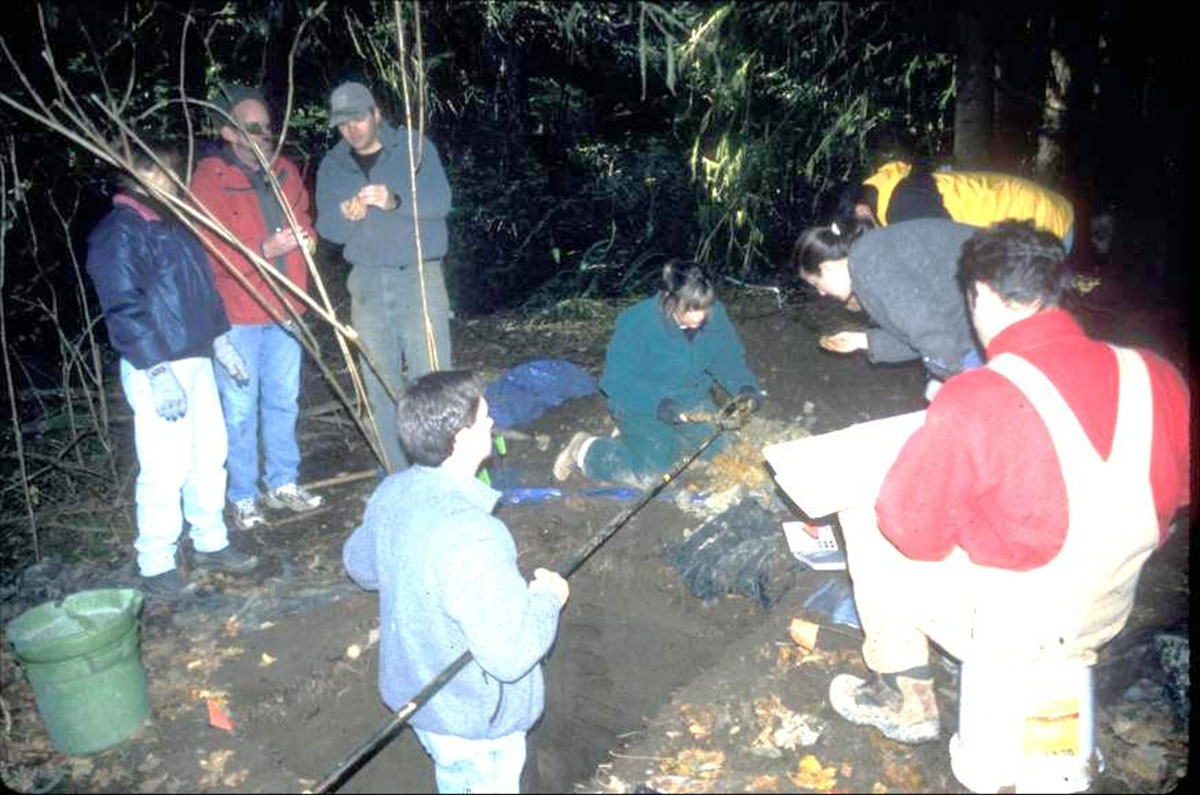
Figure 5
Julie Stein (in green rain gear) with geoarchaeology class surrounding an excavation to discover Lewis and Clark’s latrine.
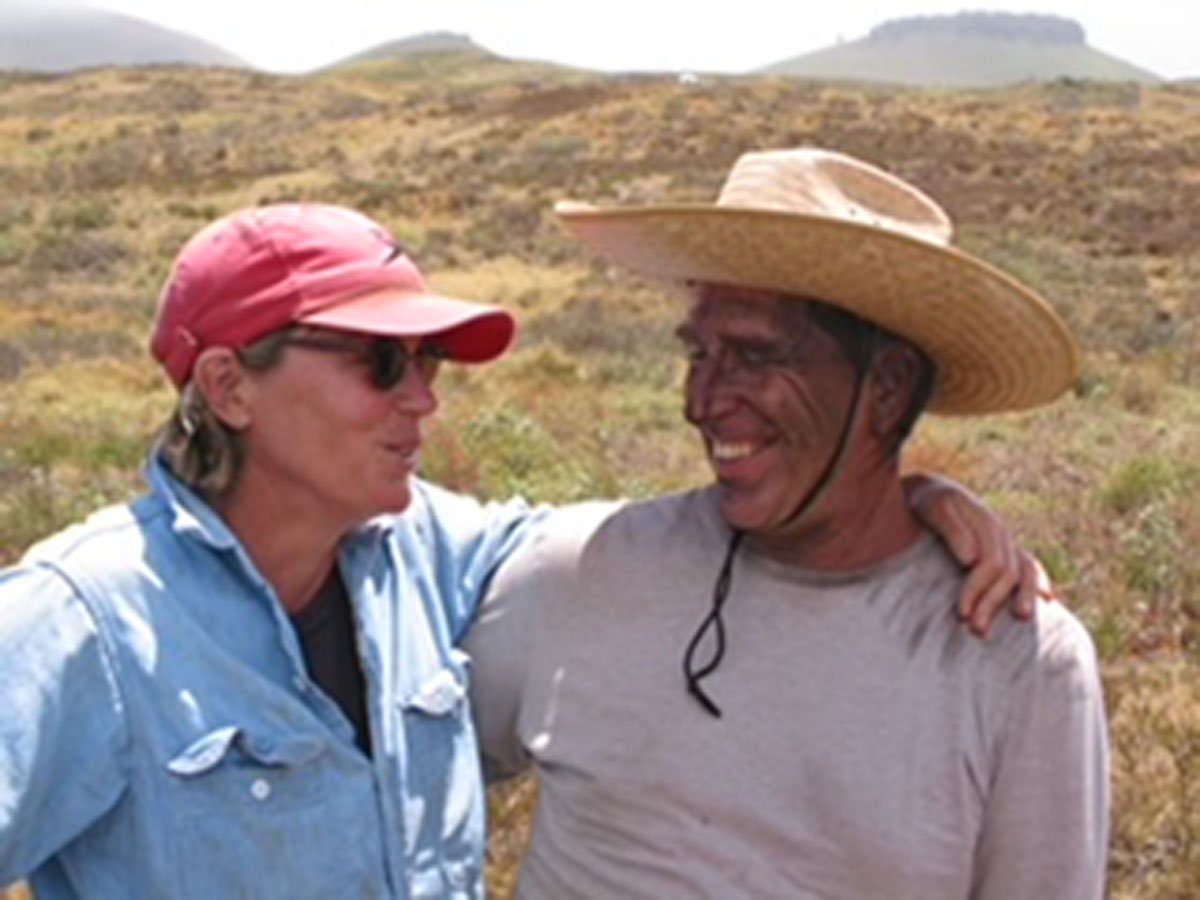
Figure 6
Julie Stein in 2005 collaborating with Michael Graves on geoarchaeology of the Kohala Hills, Hawaii.
One of Stein’s most distinctive accomplishments in the Executive Director role was overseeing the demolition of the old Burke museum building and the construction of a new museum nearby that presents a brighter, more open, and inviting look. A distinctive design feature of the new Burke Museum that Stein championed is the many transparent glass interior walls that allow visitors to view curators and students working on their research in the Museum’s laboratories while they walk through the galleries. Movable panels in the glass walls provide researchers direct contact to visitors, which allows them to explain and show their work to the public. Stein retired as Executive Director in March 2022.
Interview
DiCiro: How did you get into archaeology as an undergraduate?
Stein: I was an undergraduate at Western Michigan University. They didn’t have a great Anthropology department, but I didn’t know anything about Anthropology or Archaeology. I just knew that I loved what the Leakey’s were finding in Olduvai Gorge,27 and I thought that was Archaeology.
I wrote a paper in high school saying that I wanted to be an archaeologist. You would think that the paper would have alerted me to what archaeology was, as opposed to paleoanthropology, but somehow that didn’t get into my head. So, I was excited when I got to Western to see that there was a class in Archaeology, but I couldn’t take it the first semester I was there because I had all these other things I had to take. Then in the second semester, I took Geology. Then I found out that I could take the [archaeology] field school during the summer without taking the Archaeology class. So, I took a Geology class and then took field school, excavating in Northern Michigan (Figure 1). [The site] was on a beach ridge of sand that represented the ancient shorelines of Lake Michigan and the Upper Peninsula. First, we found pottery and lithics. Then we hit this layer of rounded cobbles embedded in clay at the bottom. I said, “what do we do?” And my TA, whose master’s thesis this was, instructed us, “that’s the beach, so stop digging.”
At that time, I had the background of one geology class and looked at the rounded cobbles in clay, and said, “that is not a beach.” And I thought to myself, wow, he doesn’t know about geology, does he? So, here we were on this beach ridge, ancient Michigan, lakes rose and fell, glaciers came and went. I thought this could be something that I could do because I love geology, classes taught by great professors. The geology department was great, but the Anthropology department wasn’t so good. But I liked archaeology because I liked working in teams out in the field. So, I asked my geology professor (Dave Kuenzi) if he thought I could do geology and archaeology. He said that he didn’t think there was such a thing. Then he came to me and said that the Geological Society of America, the national conference, would be held in Minneapolis that year, and there was a session on Archaeological Geology. He said, “there’s a van going from Kalamazoo, Michigan to Minneapolis Minnesota. He and the Chair, Lloyd Schmaltz were driving graduate students and professors; do you want to go? You can stay in a hotel with the two other female graduate students. You pay for your room and food, and we will pay for the conference and the van”.
When I arrived, there was every single famous geoarchaeologist. [For example, there was] Bill Farrand, Roald Fryxell, Chris Kraft and Donald L. Johnson, and Rip Rapp, who was the one who organized it, and every single person that did this kind of work. They all presented, and I was sitting as an undergraduate, thinking that I should go to graduate school. Then Bill Farrand talked to me, while Rip asked who I was because I kept sitting there the entire time. So I went back to Kalamazoo, and the next year, I wrote every geoarchaeologist from that conference a letter asking about their graduate programs. Some wrote back, and others didn’t. The next year at GSA [Geological Society of America], I went again, knowing that I wanted to do stratigraphy, and I liked sediments, but that’s all that I saw geoarchaeology being.
Rip was doing these big cores involving big machinery, and I was not interested. So, I went to Minnesota because he got me this incredible fellowship with free tuition and $600 a month for room and board. I also got into Arizona to work with Vance Haynes, but there was not as much money there, so I went to Minnesota.
Mitchell: How did you choose your PhD project once you got to Minnesota?
Stein: Rip recruited me with the carrot of joining the Minnesota Messenia Expedition28 in Greece. So he said that I should go to Minnesota and take these classes, and in the following summer, I would go to Greece, and do my master’s thesis on the Bronze Age site in southern Greece. Which sounded really cool, but I knew nothing about Greek archaeology. So, many of my courses that first year were about Greek archaeology.
Rip Rapp’s ability to wheel-and-deal was interesting, meaning finding out who has the power and money and going and getting it, and talking them into giving it to him. That is an unbelievable skill. The excavation in Messenia thrived because Rapp was the co-director and William McDonald was the lead archaeologist. McDonald was not a wheeler-dealer, Bill just loved archaeology and everything about it, so the two of them were magic. Bill got all the people together to do the archaeology, the experts, most of them from England, Italy, Greece, Canada, and worldwide. Rapp built an excavation house for us to live in, (which is now a resort, by the way).
For the time Rapp was in Greece, he did little Geoarchaeology. It was the last year of the permit, and the reason he recruited me to go was because he knew there was more to do, and he needed a report about Geoarchaeology. He had done some things. [For example he had] sourced the rock they used in the foundations in the Bronze Age mudbrick houses. Since he was a mineralogist, he also sourced metals they found, and rocks they used as mortar and pestles. However, there was this village, and little had been done.
I said, “I like sediments, so where did all the mudbricks go? I mean, what is a mudbrick? If they built all these houses that you only see from their foundations, they must have had mudbrick. How much sediment is in a mudbrick house? Well, there’s one over there.” So, I measured that one. Then I figured out how far down the hill the sediment went. “Well, it filled the gully up. Well, how far does it fill? What must it have been when you take out all the houses’ ‘ at an estimate of how many houses? Then I figured out how to calculate the volume and subtract and put it all back on top of the hill, and that was my master’s thesis.29 I did it all by myself in Greece without Ripp’s help for three months because he wasn’t there.
I didn’t want to follow his way of doing Geoarchaeology fieldwork. He got all the money to do those cores, the equipment; don’t underestimate how much that cost. Then he paid everybody to do the analysis, but he didn’t do the field work. I wanted to do the fieldwork, and didn’t want to keep doing my PhD in Greece. It was really fun, but I am not a Classical Archaeologist. I wanted to get back to North America, so I switched my advisor from Rip Rapp, who was also moving to become a Dean at the University of Minnesota in Duluth, so it was a good reason to switch to Herbert E. Wright, who was a glacial geologist.
I was looking for a dissertation, and Herb said, “I have this friend Patty Jo Watson, she’s got this project in Kentucky”. She had asked Herb to come down and look at her site. Herb said, “I have this student looking for a dissertation.” So I went down to meet Pat and the team.
The way Patty Jo Watson figured out if she wanted to work with you was to take you caving. Mammoth Cave National Park is there and she was doing fieldwork in the caves. So you put on your little Spelunking helmet (with attached lamp) and go into Salts Cave. You crawl around in complete darkness, mapping prehistoric poop, (human poop), ancient burned torches, and bits of woven twine and shoes. She said, “Okay, you can be a part of the project.” It’s very interesting in Archaeology that very few people will take you on a project until they meet you. It’s not just meeting you; it’s seeing how you work with a team in adversity.
I was thrown into Kentucky’s Green River shell midden archaeology, doing a dissertation, and once again had to figure out what the questions were. I looked around thinking this doesn’t even look like a river. Then off I went. I don’t tend to think about theory very much; archaeology at that time changed to theory. I often went into the field and said, “How did this site get preserved, and where had the sediment come from? What can I know about the environment so that those people who find the artifacts can say whatever they want about the artifacts?” That’s why I like geoarchaeology.
DiCiro: What do you feel is the most important result from your PhD?
Stein: It turns out that it has had an unintended impact. In the midwest, the Great Continental Glaciers came from the north and moved to the south. As they did, they covered Michigan and carved out the Great Lakes. They got as far as the Ohio River, and then they stopped. That’s why the Ohio River is there because it’s part of the drainage of this great ice sheet from the north. What happened when it got to the southern part of Ohio, is that it blocked north-flowing rivers. Directly to the south of the state of Ohio, is Kentucky. In Kentucky, the rivers run from the uplands in the south and west, flowing to the north. They go to Ohio, which flows into the Mississippi and down into New Orleans. When the glacier came, it blocked those rivers flowing north. These rivers backed up and created huge lakes. Eventually, the ice would break, and they would drain, and over thousands of years as they drained they cut these deep valleys in this lake plain – a plain composed of incredibly fine-grain silts and clays. In Kentucky, we worked on the Green River, which flows through Mammoth Cave National Park [Kentucky], and was the source of shell for many Archaic shell middens.30 I realized the Green River doesn’t look like a river because it’s a river incised into a lake plain. This lakebed is huge and the Green River channel has cut this deep, steep-sided river channel with 6000 year old shell middens still sitting close to its banks. The river didn’t move much; it’s not like the Skagit or the Duwamish [in Washington state].
My dissertation concluded that unless you were very close to the new sediment channel, there is no real additional movement over the last few thousands of years.31 The cultural resource management people in Kentucky took my dissertation and said, “There’s no need to look for deep testing anywhere except this close to the channel.” This isn’t technically true; there are opportunities to have little dips and valleys and creeks. My PhD thesis gives them permission to not do any below-ground testing. Is that the most important thing I ever found? It certainly had the biggest impact, and I don’t think it’s positive. I didn’t think about what somebody would do with those findings in the future.
Mitchell: Why did you specialize in geoarchaeology after your PhD?
Stein: Well, my mother said, “you can do archaeology or geoarchaeology as long as you can pay your bills.” We were middle income, but lower middle income and my mom and dad did not have any money to give me. As long as I could get a job, I was going to keep doing geoarchaeology because it was pretty fun at the time. I just got a dissertation and I just got to do my master’s thesis and go to Greece, Turkey, and a lot of different places. Then I started applying to a lot of different academic jobs because at that time there were some CRM jobs, but they were few and far between and I really love teaching. I was a TA in graduate school, and I even was an undergraduate TA at Western. I loved teaching, I wanted to be in a university, so I applied for every academic job and said I was a Geoarchaeologist. I got an interview at the University of Washington in Seattle, and they asked what I could teach, and at the time I could do survey classes because UW had classes they wanted taught – world prehistory, North American, South American. I said I could do South American Archaeology because I had been there once, so I said “pshh, sure.”
The UW Anthropology department was led by Robert Dunnell, and he really believed in training graduate students broadly by learning a little bit about bones, what [Don] Grayson taught, and a little bit about ceramics, lithics, and geoarchaeology. The graduate students took them all. They hadn’t created a geoarchaeology class before they hired me, and he thought that was a very important way to round out the department. He taught theory, and I was happy about that, I did not engage that much there. He was very directed and he knew exactly what should happen, and if you let him be in charge you had no problems.
For the first few years that was pretty easy to do, except for one thing, I came in September, they hired me, and I got pregnant in November, and I told Dunnell and the archaeologists in December or January. I think they thought for sure that I would leave, because at that time – it’s 1980 – I was the third woman that was in the UW Anthropology Department out of 30 faculty members. Nobody was getting pregnant and the other two women in the department didn’t have children, and none of the other archaeologists had children.
It was typical in the department at that time for men to come up to me and touch my pregnant stomach and I was not comfortable to say “don’t do that,” because I didn’t have tenure. When I told Dunnell that I was pregnant, he said, “I really don’t think you should take maternity leave because it would look bad.” Even though the university officially allowed three months of maternity leave for faculty, I didn’t take any. Then I got pregnant again and had my second baby and they were sure I was going to leave, and was told again “you really shouldn’t take maternity leave because it would really look bad.” I ended up getting tenure, taught through the pregnancies and after the births, and took no time off to have two babies (Figure 3).
The department was kind of brutal at that time. I think that cultural anthropologists may have been nicer but not really, it just was not a good time for women in the academy at that time. There weren’t that many of us. All of my peer groups and friends were outside of the department or in cultural anthropology. One funny story: I was desperately looking for women to talk to about careers and children. I called Peggy Nelson (at SUNY Buffalo and later at Arizona State University) out of the blue and said, “I know you are a woman archaeologist that has children, will you meet with me at SAA because I just want to know another woman archaeologist that has children.” I think that I wasn’t prepared for how sexist it would be. It wasn’t just the archaeologists, it was the whole university and the whole system. But I am very stubborn so I just wouldn’t go away.
DiCiro: What other mentors influenced you as a junior scholar?
Stein: As an undergraduate, I think those two Geology professors [Kuenzi and Schmaltz] who arranged for me to get into the van. One taught sedimentology and the other was the chair of the department and I don’t know why they went out of their way for me, but they did, and it just makes me realize that you can really change a person’s life as a professor by just helping a student or listening to them. That, I think, was a very important thread throughout my career – was to really listen to students and try to say yes.
Then mentors in graduate school – I would have to say it was Herb Wright, the geologist who taught me to write, and Patty Jo Watson. Pat was incredible, funny, fun, hardworking, never say no. She was the one who I realized if you’re just really stubborn then you can get pretty much anything done. She was really focused, if you would come and say that you were really interested in bugs in the archaeological site, and can I come and go through this and look for bugs, and she would say “YES! Bugs are the answer!” She was always interested in everything people wanted to explore. She was amazing and really bright. She cared more about the origins of agriculture than anything else.
Green River shell mound was the site where I found the earthworms. Because these sites were on top of this lake plain, they rarely went underwater. So, there were these little islands of perfect habitat for earthworms. I wrote the article about earthworms, that was one of my first articles.32 I had to break the news that all these worms were eating her (early evidence of agriculture) seeds that were smaller than the diameter of their mouth. Any seed she was trying to find, charred seed, had been eaten by these earthworms over 6000 years, so she was very depressed.
Mitchell: How did you get into Pacific Northwest shell middens?
Stein: Babies. The honest truth is up until that point I had been thinking that after Kentucky I would go overseas or south. In Mesoamerica, there were people I knew that were working in Belize and I really wanted to go help with the origins of Mayan Agriculture, which was really cool. I wanted to work in the caves of Southern France because I had friends who were excavating caves. Then I had one baby and I realized you just can’t.
You can’t go to Southern France for two, three months with a baby and my wonderful husband could not take care of him alone. I thought, okay, I need a project nearby. At the time no one was working at the San Juan Islands [in western Washington]. Dunnell told me about this archaeological site at English camp that had been excavated by an undergraduate from the University of Washington. It had this really weird geological thing, it was all shell midden, but at the top the matrix was very light in color, and the shell on the bottom was surrounded by matrix that was very black. Nobody could figure out what caused that differential in color.
My husband and I and our baby went up to the San Juans, and I took a look and said, “wow there it is – light, dark, huh! I wonder what that is.” I took one of my classes to Whidbey Island, there was another shell midden there, light on the top, dark on the bottom. I thought this was a regional thing, what’s going on? Other archaeologists had proposed it was a cultural thing and it was produced by people who earlier deposited lots of oil from fish, and later they stopped dumping oil from fish in their shell middens. Which made no sense because there were fish bones everywhere.33 Then I started figuring out how to find the answer to this question, and my kids came up there with me, my husband and I could go for two weeks, I could go for a week, I could send people up there without me. I taught field school for nine years.
DiCiro: What were you excavating up there?
Stein: This was a village site of the ancestors of the, among others, Lummi people who now live in the mainland of what is now Washington State. These people, the Samish, and Canadian bands, lived throughout these islands in winter villages and in summer exploitation. Then, when Euromericans came, they pushed the international border and the Canada tribes had to go that way and the Lummi had to go to the reservation there. White people took over their traditional territories. It just so happened that this was such a great place to live for thousands of years that the English and the Americans were having a Pig War [a confrontation between the United States and Britain over the location of the international border in the San Juan Islands] and they located their encampment on the pre-historic site, the Native American site, and the Americans did the same in the American camp. There are archaeological shell middens on both of those national parks.
When I knew I wanted to do a field school with 20 students and TAs and camps and tents for eight weeks of summer quarter, I knew it would be easier to go to the National Parks Service to get a permit than to go to a private landowner and ask if twenty people could camp in their front yard for eight weeks of the summer. The [National] Park Service said yes, so that is why I went to English camp. It was beautiful too, if you can choose, why wouldn’t you choose a gorgeous place to go back to nine years in a row?
The same National Park Service people here in the Seattle regional office, who were giving me the permits to work in the San Juans, were also working at Fort Clatsop [the winter camp of the Lewis and Clark Expedition near the mouth of the Columbia River during 1805–1806, the expedition attempting to cross the western portion of the United States to identify transport routes]. They said, ‘we’re trying to find the privy, we’re trying to find the fort.”’ They still don’t absolutely know where the fort is. ‘Julie, will you come down and look? We think we found the privy.’ They sent me a bag of dirt and said, ‘Can you tell if this dirt came from inside the latrine?’ I said, ‘I can because I could measure the amount of phosphorus in it, but I need to compare a control sample to see if that’s the phosphorus signal of the local sediment or is it higher.’ Then Jim Thomson said, ‘Well come on down.’ I did, I brought the geoarchaeology class with me, and we did the analysis. I think we went down five or six years in a row, and it just became our project, looking for Lewis and Clark’s latrine (Figure 5).
I gave a lot of talks about how you find a latrine and why do we care about poop and what’s the signature of poop and why can’t we find it. Anyway, it was just a great research project, because in the end all these holes that people kept finding were tree tip ups or tree decomposed stumps.34 I know that many people think Lewis and Clark were kind of cool, but it’s also important to realize that native people can’t stand Lewis and Clark, since they brought death and destruction with them [the Lewis and Clark expedition helped open the western region of the US to white settlement and economic activity, resulting in many negative impacts on Indigenous communities, including removal from traditional lands to reservations, decimation by disease and poverty, and forced abandonment of language, religion and culture].
Mitchell: What are your preferred fieldwork methods, and how do you approach a site when you get there?
Stein: First of all, I want to know how did the dirt get here? That is the first most simplest question. Why is this site still here, and I know the artifacts got there by people dropping them but they usually get buried by sediment, so how did this sediment get there? Did people bring it like in Greece where they made mud bricks? People brought the sediment in the San Juans, I still don’t know where all that dirt came from, but I think it’s from them digging in the intertidal zone, scooping out shellfish and bringing the mud, sand, silt, and clay from the intertidal zone. That is usually the simplest and first question is, where did the dirt come from? Then there’s the question like ‘why is it light and dark, where is the privy’? There was a question that I had when I worked on a site in Minnesota, it was at Buffalo Jump, it was why aren’t there more buffalo bones, are there more bones buried? There’s usually a question that is unique to the location.
DiCiro: You and Edward Harris both published on archaeological stratigraphy. Can you comment on the differences between your approach?
Stein: Edward Harris and colleagues created the Harris Matrix while excavating in Winchester, England, and published their approach in “Principles of Archaeological Stratigraphy”.35 His matrix is very helpful for recording the temporal ordering of cross-cutting deposits. These are strata such as trenches that cut through house floors, and roads that cut through older walls. The matrix does not work particularly well in sites without complex architectural structures. In my shell midden excavations, I ended up with a simplistic matrices showing each layer on top of the previous one, with perhaps one layer cutting into older deposits. The concept, however, is important in that it reinforces the relationship between the lithostratigraphic unit and the chronostratigraphic unit, i.e., the physical characteristics of the deposits as opposed to the time in which they were deposited. Description versus time is what I emphasized in my deposits paper,36 and Harris did not think those should be separated. In his 1993 book he strongly criticized my geo-stratigraphic approach to archaeological stratigraphy. I attempted to reply to his criticism but found there to be no rebuttal other than to say that he was wrong. From that point on he simply ignored my publications in various talks, publications, and correspondence. I think this is now referred to as “ghosting” or “gender disparity in citation”. I chose not to fight this battle and moved on to other research projects. Sometimes I regret not fighting, but I am pretty sure I would have lost and had my reputation dragged through the mud. What good would that do? I believe this happens to many women and people of color and it flows from privilege and bullying.
DiCiro: What do you think are the most useful archaeological theories for geoarchaeologists to know and use?
Stein: This is a question about theory, and archaeology usually applies to how people behave and theory. Geology is related to how natural systems work and how materials, rocks and minerals, are created and destroyed. The theoretical concepts that I used were ones that were from the geological realm of scientific method, chemistry, physics, and mechanical processes, how things are transported. The theories of human behavior get (in my opinion) archaeologists or geoarchaeologists all messed up.
That’s why Michael Schiffer and I were such good friends because I thought his transformational processes were ridiculous. I mean it’s like saying that if a river carries this rock from here to there is a natural process but if I carry a rock from the exact same place to here then it’s a cultural process. Well, that’s ridiculous you just find the rock, right? But because he invented new phrases for these concepts, and he embedded them into the theoretical ethos of archaeology, he was very impactful. Which, I don’t mean to be disrespectful, that kind of high-impact approach brought great attention to geoarchaeology. Michael used to kid me a lot saying, “You know Julie if you just invented some new words, I could help you with that.” I tried with the deposits paper that I wrote in the Advances Series “Deposits for Archaeologists”, that was my attempt, for me to really say the unit is a deposit and that’s the fundamental unit.37 It wasn’t jazzy enough though, I don’t know why. There are people who do now see it as a foundational unit, but it just did not become the most popular archaeology jargon in the world.
DiCiro: What do you think explains the impact of your work?
Stein: Well, there’s a combination. I wasn’t into making up my own words [like Schiffer], but I also was a girl. At that time and place, you know, if I saw that Patty Jo Watson was just getting hammered, and I don’t like to get hammered. I just wrote my articles and did my thing, and then I had the opportunity to become a curator of archaeology. It was 1990 and NAGPRA had just passed, and I really liked to organize things. It got me out of the department because it was getting a little crazy at the time. I did that for nine years and then the Dean said, “Would you come to the Dean’s office and be the Divisional Dean of Research, Computing, and Facilities?” That was fun because those people, my colleagues – there were six of us – were the smartest, most honest, most straightforward, and helpful academics I have ever worked with in my life. No gamesmanship, let’s just see how we can get this thing done. How do we help everyone? How do we get it done? That was really fun.
I probably would have stayed there except the Dean was having so much trouble hiring a director of the Burke Museum and I was trying to help. He finally just said, “I’m so sick of this, why don’t you do it Julie? You would be the best person.” Then I applied. I think I was just bored with geoarchaeology, or I didn’t like banging my head against the wall, so I tried the Curatorship, you know you can only do that so long. The college administration work was pretty fun, I did not want to be a college president though. Then I thought ‘I love museums’, so I tried the directorship, but this path led me away [from geoarchaeology]. I couldn’t do this job I have now and do field work.
DiCiro: Do you miss geoarchaeology?
Stein: I miss the fieldwork. I do. Two of my students, Amanda Taylor and Bob Kopperl work for Willamette [A large CRM firm with offices in the Pacific Northwest]. Amanda was recently working on a site down on the Green River, down in Auburn. She said, “I don’t know what this thing is, Julie. Will you come and look at it?” That’s what I loved to do. Jump in the trench, look at the profiles, borrow a trowel from someone and just say “oh I know what’s going on here.” I have seen a lot of profiles in my life, and it usually jumps out at me, so I miss that. Amanda says when I retire, I get to come and see all of her profiles. I told her that I will do it for free. I don’t want to write a report, but I will draw a profile.
Mitchell: How can cultural resource management [CRM] most effectively use geoarchaeology?
Stein: If there is anything that has propelled geoarchaeology into prominence it is the CRM process, because they are trying to look at a location and predict where a site is going to be. And if they found a site, what is its lateral margins, depth, and how likely is it that there will be another one. That is all about the landscape, deposition, and erosion, that’s geoarchaeology. I am quite impressed that CRM has done more for geoarchaeology than anything else.
DiCiro: How do you think geoarchaeology has changed since you were introduced to the field?
Stein: The equipment is so much better. I literally drew all of my profiles on graph paper. Computers, photography, recording, imagery. We used to have to find aerial photos from the 30’s and the 40’s and the 60’s and now you can just put your drone up there and can get aerial photographs. I think that would be very fun to play with.
Mitchell: What do you think should be the core topics taught and practiced for geoarchaeology, if you had three key things to focus on geoarchaeology what would you focus on?
Stein: The deposit, and how it is described. What I taught is the essence of geoarchaeology: go to a site and describe what you see without using cultural interpretations. Don’t say it is a hearth. Tell me the size and shape of rocks, charcoal, ash, etc. I also think you have to see three dimensions into the ground through time. I do think seeing three-dimensionally below the ground and imagining how it changes through time is really important in geoarchaeology. Most geoarchaeologists can do it, because we stand at a site and look at a profile and start talking about where the surface was at this time, what was out of here, and what was out of there, how high is this, what is the source?
DiCiro: Could you tell us an experience you have had where geoarchaeology provided especially meaningful results?
Stein: Kentucky, I completely influenced that whole project, and the whole valley, and all of archaeology that has been done since that time. It was staring everybody right in the face for decades and it was obvious. This was not how a river should behave. It was just a matter of figuring it out. Now, how it has been misused has been unfortunate, but on the other hand I think it has been a huge contribution also. The misuse is by CRM people who were saying we don’t have to survey anything over there because there is nothing below the ground. They can write off acres and acres and acres and say, “well, we don’t have to look over there because Stein 1980 says there will be nothing over there.”
Mitchell: What do you think the future of geoarchaeology should look like?
Stein: I think it should be a part of every single field archaeologist training, and every single field archaeology field school. It somewhat is now, I think most people learned how to use a Munsell chart, and they are describing the color of the dirt, but we can do better than that. I think it is the fundamental practice of getting material out of the ground. It’s fundamental, you can’t get artifacts out of the ground if you don’t go through a geoarchaeological lens. You could do pottery analysis, and you can do animal bone analysis without doing the field work, but if you’re going to interpret the results then you’re going to need to understand how things were extracted from the ground, you have to know geoarchaeology.
Notes
[1] Julie K. Stein, “Environment of the Green River Sites,” in Archaeology of the Middle Green River Region, Kentucky, ed. William H. Marquardt and Patty J. Watson (Gainesville, FL: University Press of Florida, 2005), 19–40.
[2] Julie. K. Stein, “Formation Processes of the Carlston Annis Shell Midden,” in Archaeology of the Middle Green River Region, Kentucky, ed. William H. Marquardt and Patty J. Watson (Gainesville, FL: University Press of Florida, 2005), 121–152.
[3] Julie K. Stein, Exploring Coast Salish Prehistory: The Archaeology of San Juan Island (Seattle: University of Washington Press, 2000).
[4] Julie K. Stein, “Deposits for Archaeologists,” in Advances in Archaeological Method and Theory (Academic Press, 1987), 337–395.
[5] Louis R. Binford, “Behavioral Archaeology and the ‘Pompeii Premise’,” Journal of Anthropological Research 37, no. 3 (1981): 195–208.
[6] Michael Schiffer, Formation Processes of the Archaeological Record (Albuquerque: University of New Mexico Press, 1987).
[7] Robert C. Dunnell, “Evolutionary Theory and Archaeology,” in Advances in Archaeological Method and Theory, ed. Michael B. Schiffer (Academic Press, 1980), 35–99.
[9] Julie K. Stein, “A Review of Site Formation Processes and Their Relevance to Geoarchaeology,” in Earth Sciences and Archaeology, edited by Paul. Goldberg, Vance T. Holliday, and Reid Ferring, 37–51 (Springer US, 2001).
[10] Julie K. Stein and Angela R. Linse, eds., Effects of Scale on Archaeological and Geoscientific Perspectives, vol. 283, Geological Society of America, 1993.
[11] Julie K. Stein, “Coring in CRM and Archaeology: A Reminder,” American Antiquity 56, no. 1 (1991): 138–142.
[12] Julie K. Stein, “Sediments In Archaeological Context,” in Julie K. Stein and William R. Farrand, eds., Sediments In Archaeological Context (Salt Lake City: University of Utah Press, 2001).
[13] Gary Huckleberry, Julie K. Stein, and Paul Goldberg, “Determining the provenience of Kennewick Man skeletal remains through sedimentological analyses,” Journal of Archaeological Science 30 (2003): 651–665.
[14] Jenny Deo, John O. Stone, and Julie K. Stein, “Building Confidence in Shell: Variations in the Marine Radiocarbon Reservoir Correction for the Northwest Coast over the past 3,000 Years,” American Antiquity 69, no. 4 (2004): 771–786.
[16] Julie K. Stein, “A Review of Site Formation Processes and Their Relevance to Geoarchaeology.” In Earth Sciences and Archaeology, edited by P. Goldberg, V. T. Holliday, and C. R. Ferring (Springer US, 2001), 37–51.
[17] Julie K. Stein, Jenny Deo, and Laura S. Phillips, “Big Sites—Short Time: Accumulation Rates in Archaeological Sites,” Journal of Archaeological Science 30, no. 3 (2003): 297–316.
[18] Amanda K. Taylor, Julie K. Stein, and Stephanie A. E. Jolivette, “Big Sites, Small Sites, and Coastal Settlement Patterns in the San Juan Islands, Washington, USA,” Journal of Island & Coastal Archaeology 5 (2011): 287–313.
[19] Huckleberry, Stein, and Goldberg, “Determining the provenience of Kennewick Man skeletal remains through sedimentological analyses”.
[20] Julie K. Stein and Vance T. Holliday, “Archaeological Stratigraphy,” in Encyclopedia of Geoarchaeology, ed. A.S. Gilbert (Springer Netherlands, 2017), 33–39.
[21] Amanda K. Taylor and Julie K. Stein, Is it a House? Archaeological Excavations at English Camp San Juan Island, Washington (Seattle, WA: University of Washington Press, 2011).
[22] Thegn Ladefoged, Anna Preston, Peter Vitousek, Oliver Chadwick, Julie K. Stein, Michael Graves, and Noa Lincoln, “Soil Nutrients and Pre-European Contact Agriculture in the Leeward Kohala Field System, Island of Hawai‘i,” Archaeology in Oceania 53 (2018): 28–40.
[23] Chris Clarkson et al., “Human occupation of northern Australia by 65,000 years ago,” Nature 547 (2017): 306–310.
[24] Alex Mackay et al., “Putslaagte 1 (PL1), the Doring River, and the later Middle Stone Age in southern Africa’s Winter Rainfall Zone,” Quaternary International, vol. 350 (2014): 43–58.
[25] Ben. Marwick et al., “Adaptations to Sea Level Change and Transitions to Agriculture at Khao Toh Chong Rockshelter, Peninsular Thailand,” Journal of Archaeological Science 77 (2017): 94–108.
[26] Robert E. Kopperl et al., “The Bear Creek Site (45KI839), a Late Pleistocene–Holocene Transition Occupation in the Puget Sound Lowland, King County, Washington,” PaleoAmerica 1, no. 1 (2015): 116–120.
[27] Mary D. Leakey, Ron J. Clarke, and Louis S. B. Leakey, “New Hominid Skull from Bed I, Olduvai Gorge, Tanzania,” Nature 232, no. 5309 (1971): 308–312.
[28] Zhichun Jing, “Integration comes of age: A conversation with Rip Rapp,” Geoarchaeology: An International Journal 22, no. 1 (2007): 1–14.
[29] Julie K. Stein, “Archaeological Geology of the Site,” in Excavations at Nichoria Southwestern Greece, vol. 1, ed. George Rapp, Jr. and Stanley E. Aschenbrenner (Minneapolis: Univ. of Minnesota Press, 1978), 234–257.
[30] Morey, Darcy, Crothers, George, Stein, Julie K. et al. “The Fluvial and Geomorphic Context of Indian Knoll, an Archaic Shell Midden in West-Central Kentucky.” Geoarchaeology 17 (2002): 521–553. https://doi.org/10.1002/gea.10027.
[31] Stein, Julie K. Geoarchaeology Of The Green River Shell Mounds, Kentucky. Ph.D. diss., University of Minnesota, 1980. ProQuest Dissertations and Theses (303014833). ProQuest Dissertations & Theses Global. https://www.proquest.com/dissertations-theses/geoarchaeology-green-river-shell-mounds-kentucky/docview/303014833/se-2?accountid=14784.
[32] Julie K. Stein, “Earthworm activity: A source of potential disturbance of archaeological sediments,” American Antiquity 48, no. 2 (1983): 277–289.
[33] Julie K. Stein, Deciphering a Shell Midden (edited by Julie K. Stein; San Diego, CA: Academic Press, 1992).
[34] Julie K. Stein, Roger Kiers, Jenny Deo, Kate Gallagher, Chris Lockwood, and Scotty Moore. “A Geoarcheological Analysis Of Fort Clatsop, Lewis And Clark National Historical Park.” Unpublished report prepared for the Lewis and Clark National Historical Park Office, 2006.
[35] Ed C. Harris, Marley R. Brown, and Gregory J. Brown, eds., Practices of Archaeological Stratigraphy (London: Academic Press, 1993).
Competing Interests
The authors have no competing interests to declare.