
Introduction: Laboring Archaeology and Entangled Industries at Piedras Negras
The University of Pennsylvania’s Museum of Anthropology and Archaeology, or Penn Museum, conducted a series of archaeological excavations and extracted ancient Maya monumental objects from the site of Piedras Negras, Guatemala from 1931 to 1939.
Local Maya people worked in the project’s many activities. This included the building and maintenance of the archaeologists’ camp prior to the start of the actual field season, and clear-cutting, survey, and excavation during the season proper. Additionally, workers prepared the road and extracted various stone sculptures for the collections of the Museo Nacional de Arqueología y Etnología (MUNAE) and the Penn Museum.4 This work of monumental extraction, and the labor orders of private enterprise that led to their removal, reveal deeper components and complexities of the working archaeological camp.
Before work began on-site, archaeologists tapped into existent infrastructural orders to construct a road to funnel archaeological items northward, prepping the immediate landscape for the groundwork of archaeological enterprise. Here, the ‘groundwork’ is localized in the knowledge of Maya chicle and mahogany workers in their familiarity with the terrain, ability to navigate jungle paths, locate and relate Maya sites, and base findings from their lived experiences and expertise.
The expertise that Maya workers brought to the site and subsequent historical interpretations were rarely made public; instead, their knowledge was relegated to physical labor that was regarded as inexpert. The way that expertise is generally denied to Indigenous workers who historically worked on ancient Maya sites speaks to the general dissociation of living Maya from their past and material heritage, with archaeology functioning as a form of epistemic colonization of the Maya past.5
The discipline of archaeology has been described as ‘a western European development’6 born out of the epistemological and ontological processes and frames of Western thought and culture.7 The universalizing nature of knowledge produced from Western epistemes has determined who and what is valued, and how it is valued, and by these standards Indigenous people and their knowledges were deemed inferior. Yet, other scholars have shown how engagement, interpretation, and value of the material past for a political present has nearly always taken place across time and geographies, and argues that these activities, including the use of heirloom objects, and the passing of generational knowledge of sites and objects can be described as archaeological.8
We therefore practice ‘epistemic disobedience’9 by privileging the infrastructural systems, ideologies, and archaeological labor of Indigenous people to negate the idea that archaeology was produced solely within the boundaries of Western epistemology. Ordinarily this would mean learning from work produced directly by Indigenous people; unfortunately, any oral histories or other way of coding this knowledge did not make it into the materiality of the archaeological archive. Nevertheless, through a differential reading of the extant archives, or against ‘the priorities and perceptions of those who wrote them’ this can be achieved.10 We see the production of archaeology as a syncretic braiding of Indigenous and Western knowledges, technologies, and infrastructures happening within a context of coloniality.11
The purpose of this paper is to make visible these archival silences and to spotlight intellectual Indigenous labor at Piedras Negras. Their participation is robustly evident in the archives, yet it has been reduced in publication and other official renderings to traces: in-passing mentions,12 exotified characterizations13 and photographs where Maya people are used as size references for archaeological features.14 Local expertise and efforts left legacies in archaeological records with little accreditation in the end-products of the archaeological process: academic writing, publications, presentations, and museum exhibits. Yet, the expertise and efforts of Indigenous people is inextricable from the research process and observable in the on-the-ground interactions between Maya and American archaeologists. Colonial and racial power dynamics erased these interactions, making it seem as if American researchers had direct, unmediated, and entirely original insights into the Maya past. However, numerous archival instances plainly state that workmen often taught American archaeologists both techniques and interpretations that aided in acquiring archaeological items and knowledge.
Although this case is specific to one site in the Maya area, it has wider implications that are relevant to archaeology as a whole. Decolonial critiques have attended to anthropological research writ large informing and benefiting from imperialist and colonial projects,15 and justifying the colonial domination and the management of the non-European world.16 The connection between archaeology, colonialism and imperialism has also been previously explored.17 Yet understanding how the science of archaeology became influenced by the intersection of Indigenous, imperialist, and capitalist industries has only recently surfaced.18
This paper draws primarily from the Penn Museum Archives and the Carnegie Institution of Washington archives. We seek to make apparent and to fill silences around knowledge production and labor through tracking correspondence, payment rosters, and photographs to reveal more about the power dynamics of how knowledge and expertise were constructed, mediated, and publicly disseminated or silenced.
Site Background: Framing the Penn Museum Expedition
The ancient Maya site of Piedras Negras, Guatemala, is located on the banks of the Usumacinta River, in the department of Petén with the river serving as a natural border between Guatemala and Mexico.19 An urban center that thrived from the Early Classic through the Classic Period (350–600 AD) Piedras Negras was a powerful city-state, challenging its southern neighbor of Yaxchilan.20 In its heyday it rivaled the sites of Palenque, El Cayo, and other sites along the Usumacinta.21 It is characterized as an urban node due to its number of carved monuments, the extensive ‘site core’ of public architecture, and monumental masonry.22
By the 20th century, the site was most accessible from the town of Tenosique, up the river and across the border in the neighboring Mexican state of Tabasco, about two day’s ride by muleback.23 The existence of the site was long well-known to local woodcutters: the complex was given its name by Tenosique resident and lumber camp owner Emiliano Palma24 due to a nearby mass of blackish limestone rocks, or ‘piedras negras’ that served as a marker of the site.25 Due to its proximity to the site, Tenosique would prove a vital source of materials and personnel for archaeologists venturing southward to Piedras Negras. This was the case since the beginning of archaeological interest in the site, as Teobert Maler was the first archaeologist to hire Tenosiqueros, bringing four men on his 1895 expedition, a visit outlined briefly in Scientific American in 1903, and in more detail in a volume of Harvard University’s Peabody Museum Memoirs.26 Piedras Negras has since drawn an enormous amount of scholarly attention.27 Perhaps most significantly, objects the Penn Museum extracted became the source for one of the major epigraphic breakthroughs for reading ancient Maya script.28
The publication of the site in the early 20th century and the mention of hieroglyphic writing and extensive carving, piqued American attention in the midst of what historians of anthropology have classified as the ‘museum age’ from 1860 to 1920.29 Hieroglyphic writing on Maya stelae, lintels, and monuments became increasingly valued as prestige museum items collected under American imperial economic conditions.30
In particular, scholars have noted how in the 19th and 20th centuries United States institutions saw ancient Maya sites as unmined deposits of artifacts that could be collected specifically as ancient representation of the Americas. While European museums held items from Egypt, Greece, and other areas considered to be of ancient ‘western’ origin, increasingly U.S. museum institutions fought for artifacts that represented a deep American past arguing that they could only be appreciated by North American audiences.31 Philanthropists funded museum efforts to collect the finest objects of ancient America in order to elevate the prestige of institution and benefactor alike on the national and world stage.32
The Penn Museum was established in 1877. Thereafter, the Museum conducted large-scale archaeological excavations in the Middle East and Egypt, bankrolled by wealthy benefactors including John D. Rockefeller. Jr, as well as local business magnate Eldridge R. Johnson.33 The Piedras Negras Expedition’s first three years were financed by Johnson, co-founder of one of the biggest phonograph companies of its day, the Victor Talking Machine Company. In honor of their benefactor the Museum officially named the project the ‘Eldridge R. Johnson Expedition’ during the first three years of its nine-year duration.
In the words of project director John Alden Mason, the site was chosen ‘on account of the exquisite sculpture there which we hope to get out.’34 He assured Johnson that the site’s conditions were conducive to yielding a return on his investment: artistic and museum-value objects which Mason described as, ‘among the finest, if not indeed the most artistic Maya monuments ever known.’35 Mason reiterated this assurance after receiving continued financing from Johnson that ‘the results both in scientific information and artistic objects will please you and be worth far more than the costs of the work.’36
The transfer of impressive monuments was seen as a way to continue the accrual of more funding and more prestige for archaeologists involved.37 In the race to acquire ‘museum worthy’ pieces, archaeologists relied upon and solicited local knowledge from people engaged in a variety of expertise and industries.
At Piedras Negras, this extraction meant taking knowledge from locals who worked for mahogany and chicle companies, often sourced from Tenosique. When the Penn Museum archaeologists descended into the densely forested region alongside the Usumacinta River, they arrived at an area that had already been made navigable by the local workers in these respective industries. John Alden Mason, leader of the first expeditions, notes in publication that, ‘winding trails through the dense forest are used mainly by chicleros, natives who gather chicle sap for American gum chewers, and by mule trains taking supplies to lumber camps.’38
Chicleros were so knowledgeable of the regions they worked in that they were actively sought by archaeologist Sylvanus Morley, who printed flyers offering cash rewards to any chiclero who could lead him to an ancient Maya site (Figure 1).39
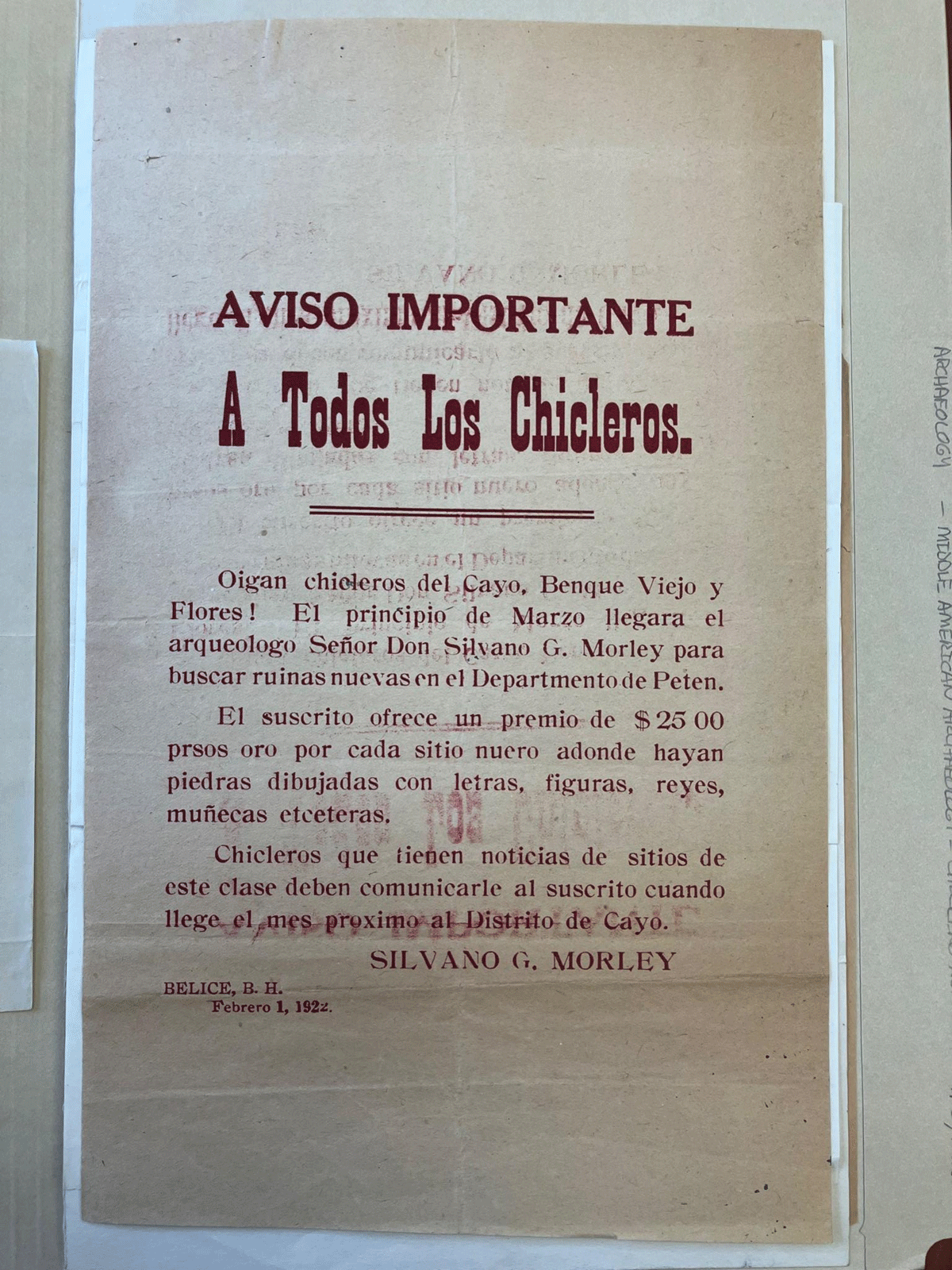
Figure 1
Archaeology- Middle American Archaeology Chiclero Notice 1922. L9/8. Carnegie Institution of Washington Administration Records, 1890–2003, Carnegie Institution for Science, Washington D.C.
Throughout field seasons at the site of Piedras Negras, archaeologists wrote in correspondence that chicle workers were often asked to provide knowledge of nearby sites and served as guides that in some cases worked between archaeological sites, bringing correspondence and supplies.40
Chicle, the ‘white gold’ of the Petén, was the economic foundation of this region from the 1890s to the 1970s, integrating the local economy into the global capitalist system.41 Chicle exploration cut trails through remote regions of the jungle which thereafter were used by archaeologists, a fact sometimes acknowledged in publication, both by the Penn Museum archaeologists42 and others whose explorations preceded theirs by several decades.43 Tulane University archaeologist Frans Blom lays out the relationship in detail, acknowledging that ‘chewing gum and Maya archaeology are closely related, strange as it may sound.’44 Eventually, the relationship between Maya archaeology and the chicle industry became one of active cooperation, as the American Chicle Company readily gave a ‘proffer of assistance’ to archaeologists in nearby Yucatán.45 Such was the importance of chicle to the archaeological enterprise that in 1943 Sylvanus Morley noted in publication that,
If some satisfactory substitute for chicle in chewing gum should be discovered, it would put an immediate end to the chicle business (for chicle has no other commercial use than chewing gum), which, in turn, would be followed by a total disappearance of all chicle trails and the consequent loss to knowledge of many important Maya sites.46
Mahogany extraction is also intrinsically tied to Piedras Negras. Teobert Maler learned about its location from men at the nearby lumber camp of El Cayo on an 1895 expedition.47 The discovery of the site’s first structures and monuments and its naming was credited to Emiliano Palma by archaeologists John Alden Mason,48 Linton Satterthwaite,49 and Sylvanus Morley.50 Palma was an ‘enterprising young lumberman’ at the time of this discovery, a byproduct of his efforts to establish lumber camps throughout the region.51 He was even rumored to have repurposed a stela to use as a table in a lumber camp, though Palma told Mason this was ‘only hearsay.’52 The lumber camp owner became a great asset to archaeology, readily corresponding with the Penn Museum archaeologists,53 and even contributing a description of the site and the circumstances of his discovery for one of Sylvanus Morley’s major publications.54
The men who worked for the mahogany industry showed the importance of their transferable skills most prominently in the first two years of the Penn Museum’s expedition, when the Museum extracted stelae and other monumental objects. Mason remarked on the removal of three-ton Stela 40, ‘It was no small job to box and load this, even for men accustomed to handling massive mahogany logs.’55 Penn archaeologists noted not only the energetics that it took to move these monuments, but also paid attention to the techniques with which lumbermen moved monuments.
In 1939, near the end of the Penn Museum’s excavation, project director Linton Satterthwaite describes in correspondence to Museum Director Horace Jayne an on-site incident in which the local workmen employed their forestry knowledges in the service of the archaeological enterprise:
People have often wondered how the Maya, without draft animals or power, managed the movement of stones weighing several tons. I enclose a film showing a model of a primitive winch, made by one of our boys, including the string which represents the rope, from materials in the forest. He tells me that in the lumber camps, if they lack rope they make it from the bark of a tree; and that they constantly use this winch, which is called a “tiger” because of its strength, in moving heavy logs around. I learned about it only because our block and tackle pulley system broke, and I wanted to move the largest fragment of stela 2, which weighs about a ton. The model is built as a replica of a “tigre” for six men. One man alone dragged the stela fragment about fifty feet for me, with another urging it along from time to time with a lever with strong rope. Apparently they can move almost anything with these winches. The Maya had rope (it is pictured on the monument). The “tigre” is simplicity itself, without knowledge of the wheel, in our sense, being necessary (Figures 2, 3).56
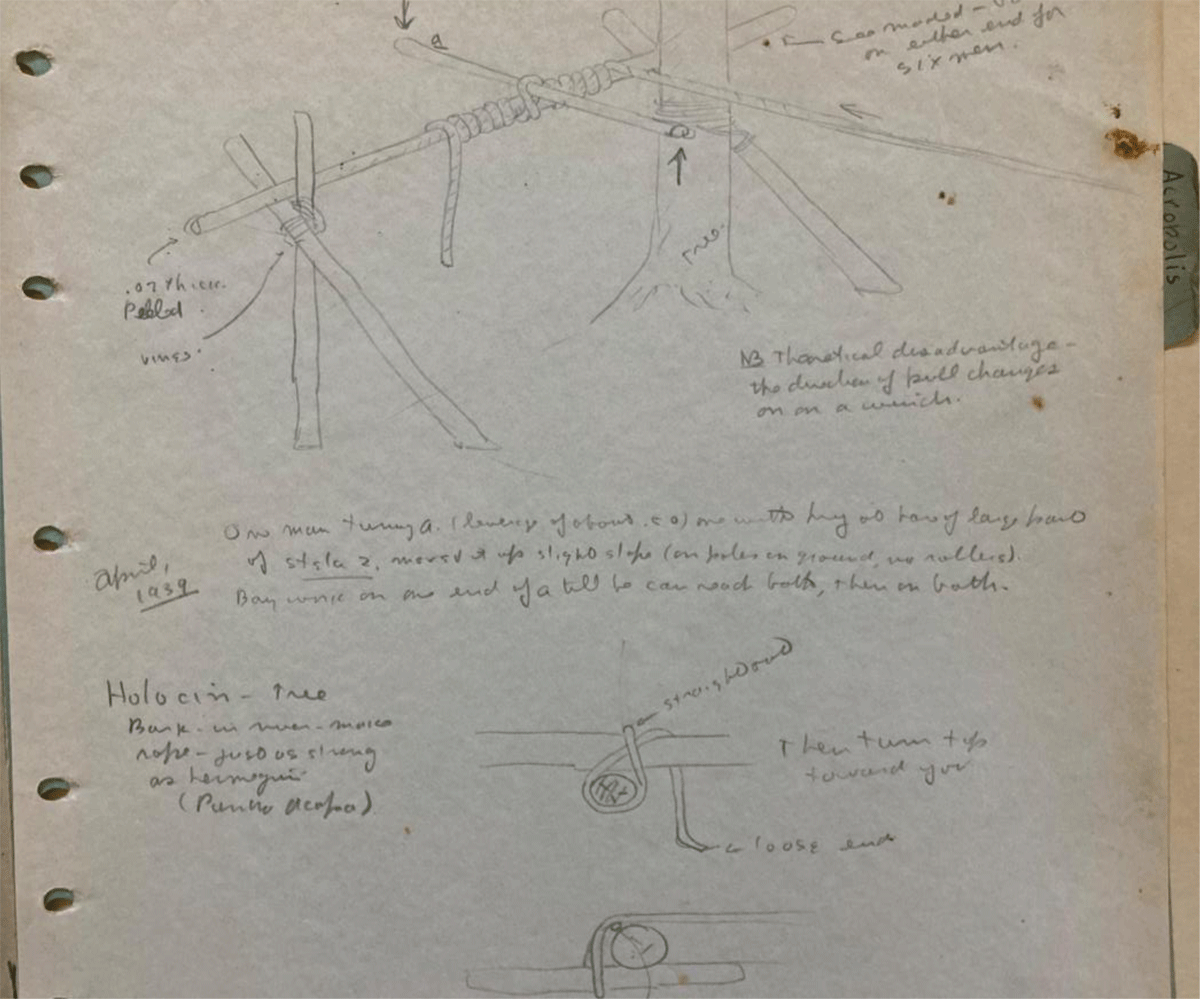
Figure 2
Drawing of “El Tigre” 1939. Piedras Negras Guatemala (1931–1939) Field Notes Notebook 9-PU 1939 L-S Field Notes, K-5. Box 7 Folder 3. University of Pennsylvania Museum Archives Piedras Negras, Guatemala expedition record. Courtesy of the Penn Museum.
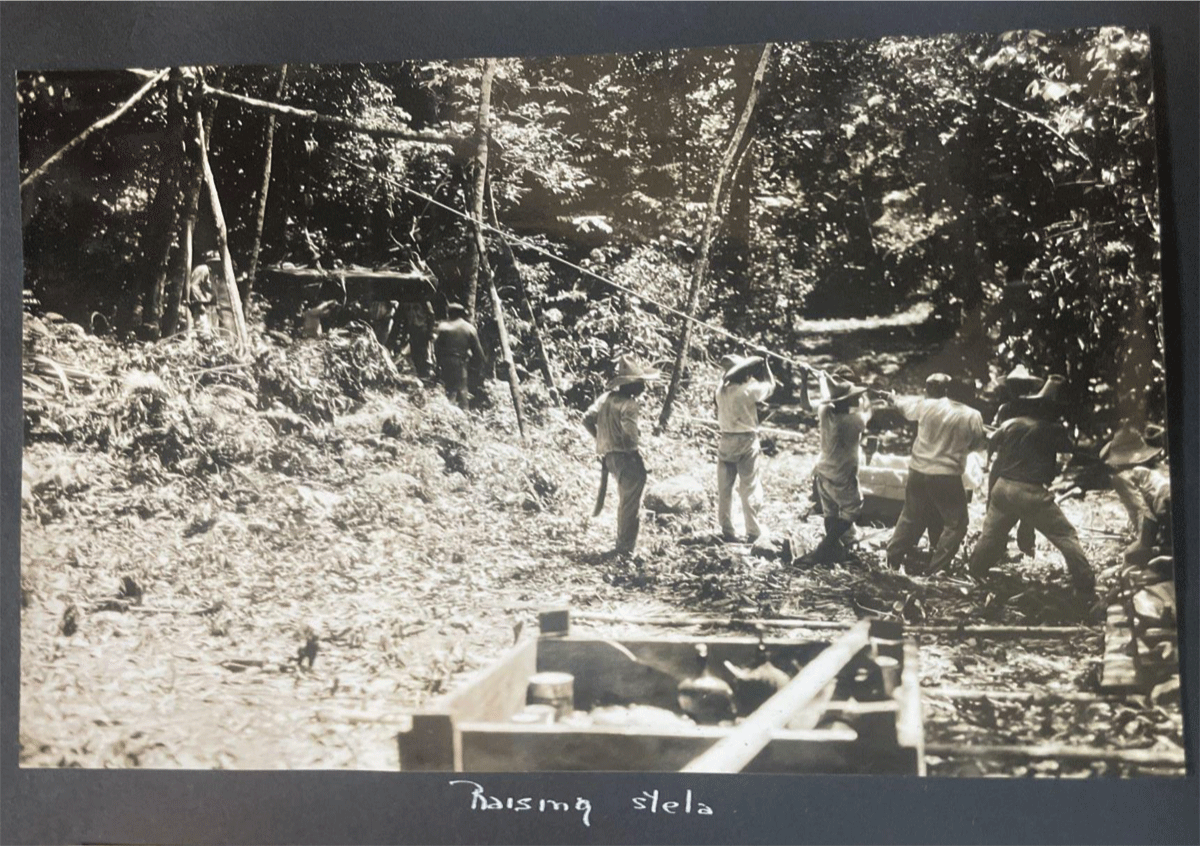
Figure 3
Maya workers moving Stela. 1932. Piedras Negras Guatemala (1931–1939) Mary Butler Personal Photo Album. University of Pennsylvania Museum Archives Piedras Negras, Guatemala expedition record.
This unpublished passage, buried within the folders and boxes of the Penn Museum archives, brings to light a historical ‘silence’ of how the transfer of monuments resulted from Indigenous engineering.57 While the efforts of the archaeologists are celebrated and elevated, the efforts and expertise of living Maya people in the study of their own past are ‘silenced.’ As Satterthwaite’s correspondence indicates, this is despite the fact that without the efforts and expertise of Maya workers, the logistical puzzle of moving monumental objects from in situ to gallery settings would not have occurred.58 Therefore, in the extraction of the monumental objects, the concept of ‘braided knowledges’ demonstrates the contribution of Indigenous Traditional Knowledge59 and how it interfaces with Western epistemologies.60 The literal act of braiding rope out of local plant life in the service of helping to pull these large stone objects turns the rope into a mutable, polysemic object representative of the ‘braiding’ of Western archaeology and Maya engineering.61
Local Indigenous people braided their expertise within key roles in the archaeological research, from supporting positions as camp builders, groundskeepers, cooks, trail guides, and muleteers to the actual archaeology as foremen, excavators, and surveyors. This expertise can be viewed as nexi around which new knowledges and techniques accrue; but simultaneously it can also be seen as extensions and iterations of pre-existing Indigenous traditional knowledges which were appropriated by capitalist industries in the 19th and 20th centuries and then again repurposed for archaeology. In many instances, American archaeologists were recipients, rather than instructors of, local archaeological techniques.
We analyze braided knowledges in two examples. In Part I, we analyze the construction of a road to the site as a project demanding varying industries and skills. In Part II, we demonstrate how scientific facts were forged and melded in the groundwork of archaeological labor.
Part 1: Building the Road to Extraction: on the Ground of Connective Infrastructures
As the process for planning the expedition first began, project director John Alden Mason speculated in a letter to Museum Director Horace Jayne that only about ‘25 of the 42 [stelae] discovered are worth taking out.’62 Extracting these objects required engineering roads, systems, and logistics that relied upon palimpsests of infrastructure and labor. Although the task of hauling stelae would be eased due to the area’s pre-existing infrastructure of the mahogany industry, Mason speculated that clearing a path for the traversal of people, vehicles, and the stelae would nevertheless require building upwards of thirty to forty miles of new road from the site to the river’s edge, from where the stelae would be floated on barges northward.63 This road, borrowing portions from an already existent mahogany mule cart, and starting from a section of abandoned railroad, was itself already a product of layered industries, in which archaeological extraction hinged on previous extractive enterprises (Figures 4, 5).64
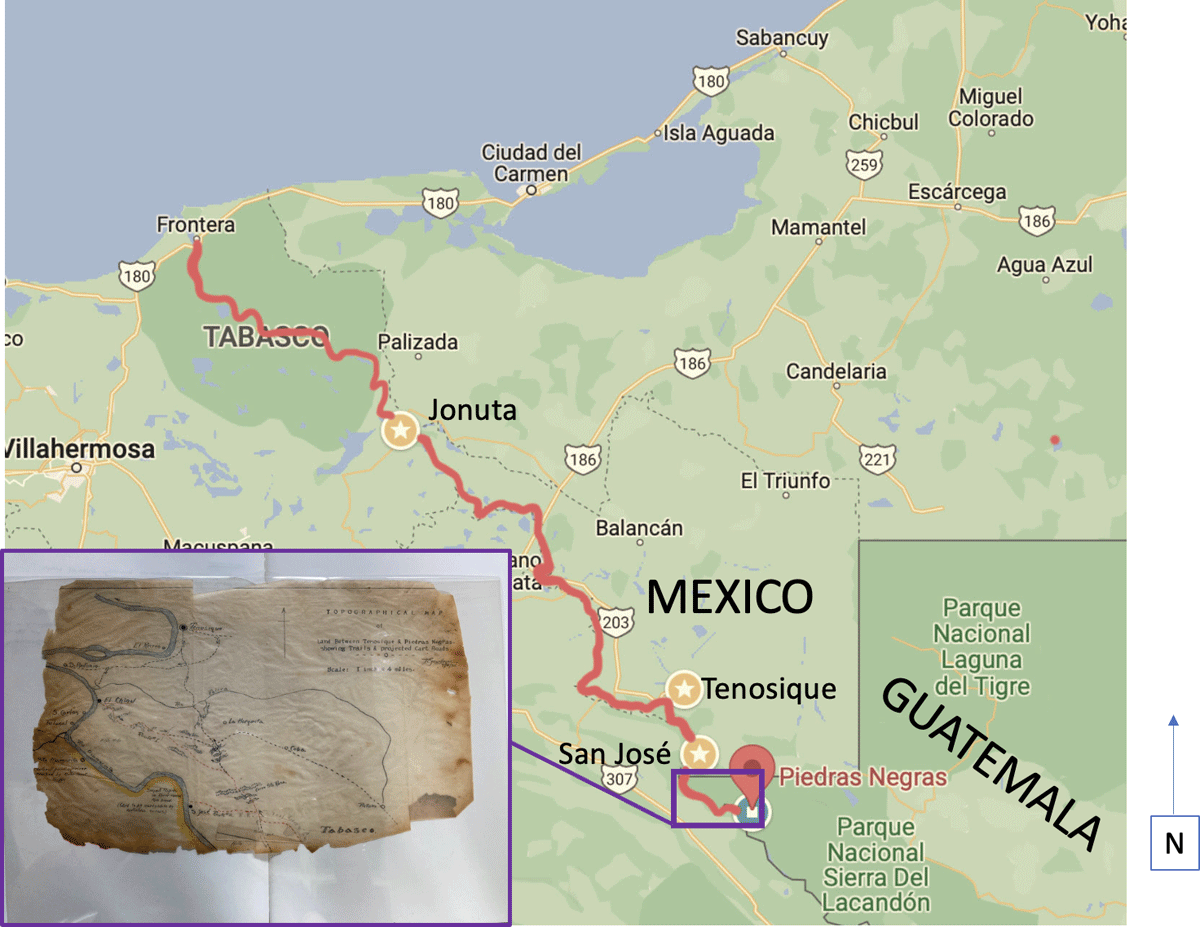
Figure 4
General Path of Stela Removal on Usumacinta River, Northward From Piedras Negras to San José, Tenosique, Jonuta, and Frontera. Box shows figure of archival map (see Figure 5) projecting road construction. Figure by Author.
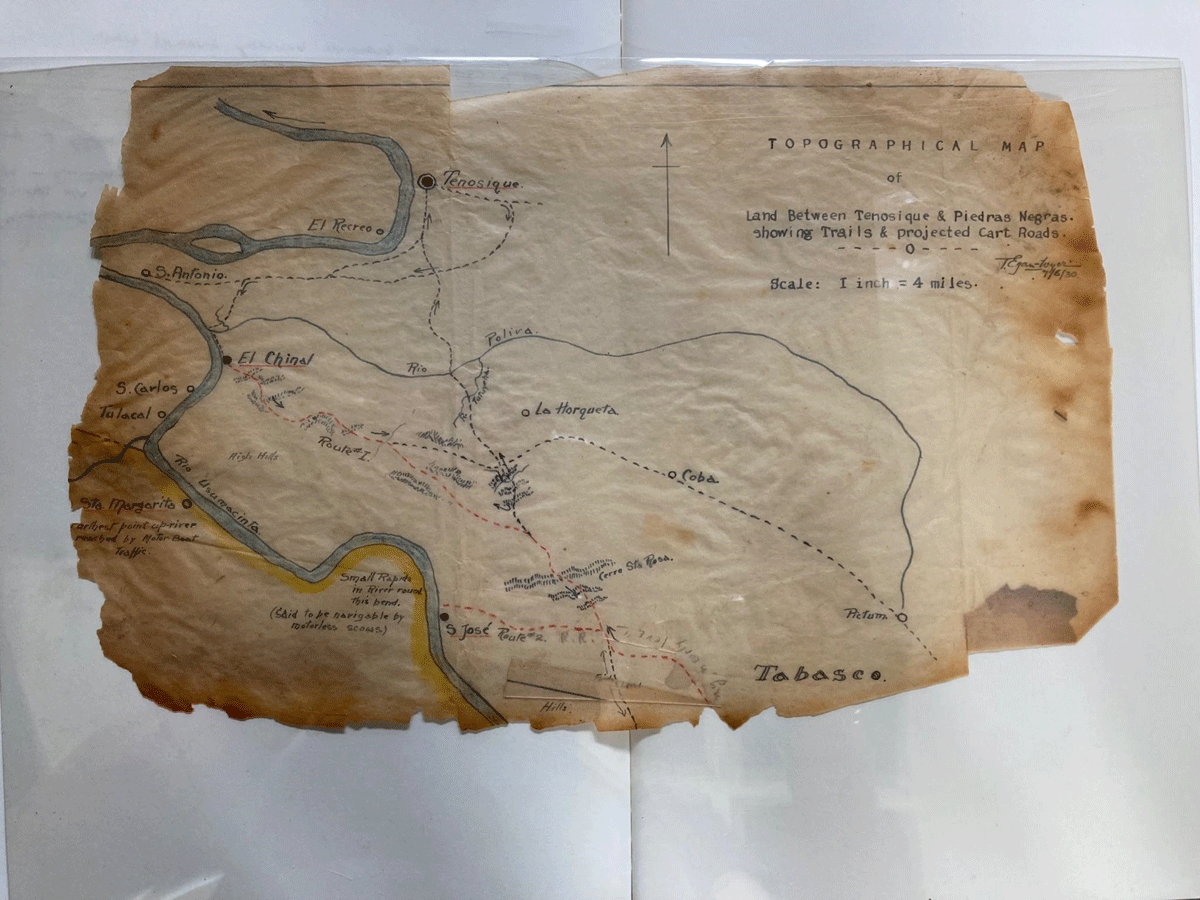
Figure 5
Topographical Map of Land Between Tenosique & Piedras Negras. Showing Trail and Projected Cart Roads. By Edgar T. Wyer. Folder 1 Box 1, University of Pennsylvania Museum Archives Piedras Negras, Guatemala expedition record. Box 1 Folder 5. Guatemala Expedition Record. Courtesy of the Penn Museum.
Several roads were proposed by engineer Terrence Egan Wyer, which would bring monuments to a couple of options of towns located along the Usumacinta River’s edge, including those of San José and Tenosique, both located in Mexico. Targeting these towns by road was the choice given that certain sections of the river had seasonal rapids with varying navigability.65 In an agreement with the Guatemalan government, these monuments would be ‘on loan’ to the Penn Museum for a period of ten years before being shipped to Puerto Barrios via a United Fruit Company ship to be displayed in Guatemala City.66
Mason reconciled the large task with the logics of labor and which bodies were accustomed for it. In his final sentences to Jayne, he attempted to assuage doubts of this gargantuan feat by stating,
Fortunately this is a mahogany country and workmen hereabouts are accustomed to making logging trails and to hauling heavy loads over them. After a road is made the task of sawing up the stelae into manageable sections and getting them to navigable water will not be great.67
This statement reveals how archaeology’s logistics and goals became dependent on specialized labor of mahogany camps. If the goals of the Piedras Negras projects were to extract the most ornate and heavy monuments for North American publics, these goals rested on the existence of pools of labor with many subsets of specialties. These specialties included how to engineer paths through topographically challenging areas, how to move and secure heavy loads, and how to navigate these paths in seasonal shifts; most notably, the shift in the dry and wet seasons, in which only April and May could be counted upon for dry road access.68 Correspondence, for instance, between M.C. Todd, an American engineer hired to construct the road, and John Alden Mason, reveals that Todd ignored the heeding of a mahogany lumberman who is referred to as Don Pancho, about the drastic seasonal shifts in the first season that affected the shipment of monuments. As Mason reprimands Todd,
I’m especially anxious to get monuments out because the government of Guatemala has not yet received any monuments and they may doubt our intentions and refuse to let us work more. You should have been prepared to get them out on the first floods last June. Apparently you guessed wrong on several points and Don Pancho was right. You said you could get them out at any time during the year and he said you couldn’t. Also he said the boxes would be under water in the floods where you left them and you said they wouldn’t. I hope the are not rotted so they will all have to be reboxed.69
Due to the proximity to the mahogany-rich forests, pay structures of the campsite were also based on this industry and its ebbs and flows of seasonal work. Taking advantage of off-seasonal unemployment, and later fledgling mahogany camps, archaeologists calculated labor wages of excavating, road construction, and engineering based off daily rates of sawing and transporting lumber, which were subject to cycles of demand. In 1931, Mason saw the plight of lumbering companies as a direct asset to the excavation’s labor pool. He wrote to Jayne,
All of the lumbering companies in this region have shut down and we are about the only organization at work here. This means that labor will be greater than the demand and consequently cheap, possibly $1/.50 or 1/.75 a day. Owing to the quietness in lumber we can probably buy almost anything we need from the rest of Sanborn’s equipment at almost our own figure.70
Mason’s reference to Cummings Sanborn reveals how not only labor pools but also equipment was borrowed from nearby sites. Specifically, correspondences show that Mason purchased equipment from Sanborn, the head of Campeche Mahogany company, after the Company’s concession with the Mexican government and operations in the area around Tenosique had ended.71 In total, Sanborn accepted an offer of $1400 for 14 items of equipment purchased at the University’s expense.72
The shipment of the monuments also followed the grooves that had been set in the shipping of lumber. Lumbermen hand-constructed boxes out of mahogany planks that were used to pack each stone.73 The stones were then loaded onto wagons, traveled about 35 miles along hand cut roads that mimicked and in some cases appropriated parts of existing mahogany trails, until they were dropped at the edge of the river. From there, the boxes waited until dry season, sometimes from May until January for the rapids to be low enough. Workmen would then load the boxes onto rafts of mahogany logs, sending them across the border to Mexico where they would travel in bond to the seaport of Alvaro Obregon (Frontera), before being loaded onto a steamer bound to New Orleans.74
As Mason’s correspondence to M.C Todd reveals, the timeline of archaeological work did not always graft onto industrial ones. The initial road that was started for camp did not get completed until the middle of May, forcing Mason to alter his timeline of getting monuments out of camp. This meant that for the first season, boxes of monuments were simply left at the river.75
In a report to the museum in 1933, it is revealed that in some cases the conditions of the river were too high to transfer the boxes for two field seasons in a row, meaning that some monuments spent two years boxed and waterlogged at the river’s edge – as the report mentions, ‘[A]ll were placed too close to river and were covered ten feet by flood, full of sand when opened, but had already spent a thousand years in the rain, so no damage done.’76
Throughout the correspondence of the first field season, one can see that ultimately the success of the season (at least as defined by the Penn archaeologists) hinged on the engineering, knowledge, and use of transportation structures to haul out the stelae. Their efforts occurred at varying scales, from figuring out how monuments would be shipped through various transportation networks and pass through customs, to the mechanics of uprooting and moving in situ monuments onto mule carts. In both instances, knowledges of local workmen and archaeologists meshed and collided in ways that influenced the production and choices around archaeological extraction.
Part II: The Groundwork- Archaeological Workers of Piedras Negras as Knowledge Makers
While workmen were responsible for the majority of the work entailed in the transportation of archaeological material, they were likewise responsible for archaeological excavation and discovery. However, like their efforts in the engineering and transportation side of the project, their archaeological knowledge-making was ostensibly censored from official publications. Infrastructures by definition rely upon the labor of meshed collective intelligence and technologies that bring projects into being.77 Despite the fact that archaeology requires ‘an intimate investment in the bodies that labor to produce its objects of knowledge,’ the contributions of living Maya who labored on site were lost or erased by colonial dynamics in archeological knowledge production.78 The centrality of labor as the focal node attempts to serve as a counterpoint to the fact that the end-results of archaeological research underplay or omit the reality that the majority of actual archaeological labor is done by local people.79 Although theorists have situated archaeology and its interpretation as socially and politically entrenched, the historical contributions of laborers’ technologies, skills, desires, and interpretations are often treated as ad-hoc and site-contingent.80
Conceptualizing the laborers as infrastructure of archaeological study therefore further sets up the possibilities for epistemic disobedience. In the case of the archaeology of Piedras Negras, centering the experience of Indigenous people who participated in the project by way of their documented labor allows for this disobedience despite the paucity of documents produced by workers themselves. Foregrounding the experiences of the workers on the ground affirms their epistemic rights as knowledge producers by identifying their specific efforts as part of the larger collective. Spotlighting their experiences also means understanding the social stage and logics that they constantly had to work within and against.
According to the logics of racial capitalism, the archeologists came into a world where racialized regimes of labor were already set, from which the American archaeologists directly benefited. These regimes were set in colonial times in accordance with the mechanisms of Spanish colonial rule which Anibal Quijano characterized as ‘the coloniality of power.’81 This refers to a racial caste system whose elements persist into the present, evidenced by 21st century rates of poverty in the Maya area82 and continuing Maya overrepresentation in the most menial forms of employment.83
Much like ancient Maya archaeology inherited the infrastructures and technologies of extractive industries to ease its work, archaeological science benefited from the way racial logics structured the workforce of these same industries. Andrew Bell, in particular, has noted how United Fruit Company officials employed segregated labor hierarchies at both their plantations but also in their archaeological projects, most notably at Quiriguá in the early 20th century.84 As Bell tracks, field correspondence reveals that certain tasks were racialized, including one instance in which Caribbean immigrants were responsible for cutting trees from site, while native Guatemalans worked on managing ropes and pulleys.85 Other examples abound. In correspondence with the curator of the Royal Ontario Museum concerning the logistics of organizing an archaeological project, Satterthwaite writes, ‘I have had no experience with the Belize Negro, rather than the Scotz Maya. Ledyard Smith, now at Peabody, could give you pointer. Anderson’s opinion of the negroes is very low — but personally I would expect them to respond to the proper approach.’86
The archival sources have demonstrated that there were details concerning the on-the-ground organization of the Penn Museum’s Piedras Negras project that have been unexamined. Piedras Negras workers exercised a heretofore unconsidered degree of agency within these oppressive systems when it came to the field work, and the outcome of working for multiple seasons meant that they displayed an increasing degree of specialization and responsibility over time. Certain individuals were hired over multiple seasons, becoming increasingly trained and seasoned in archaeological research, especially by 1939 when the project ended. It can therefore be argued that the workmen were, in fact, Indigenous archeologists by the project’s conclusion. Indigenous archaeologists’ negotiations and refusals conditioned the discipline and yet are rarely lauded. As Chip Colwell-Chanthaphonh reveals, Indigenous archaeologists were foundational to the discipline of archaeology, and yet had to work in unfair conditions of simultaneity, in which the accrual of data could lead to the dispossession of lands and heritage.87 In the case of the Indigenous archaeologists at Piedras Negras, this meant the literal removal of materiality from their own past.
The clearest example of this ‘Indigenous Archaeology’ was the discovery of the K-5 Stucco Mask. The mask was a large sculptured stone discovered at the end of the 1933 season in association with the temple of pyramid structure K-5.88 Mason makes reference to the mask in three publications and photographs of the mask appear in both National Geographic Magazine and in Anales de la Academia de geografía e historia de Guatemala.89 In the National Geographic article, the associated caption reads ‘Imagine the discoverer’s thrill when he unearthed this grotesque mask Figure 6.’90 The photograph produced in Linton Satterthwaite’s 1933 article appears to be the same as that in Mason’s 1935 article – however, the earlier article crops out a workman who is shown standing next to the structure in the 1935 publication (Figure 7).91
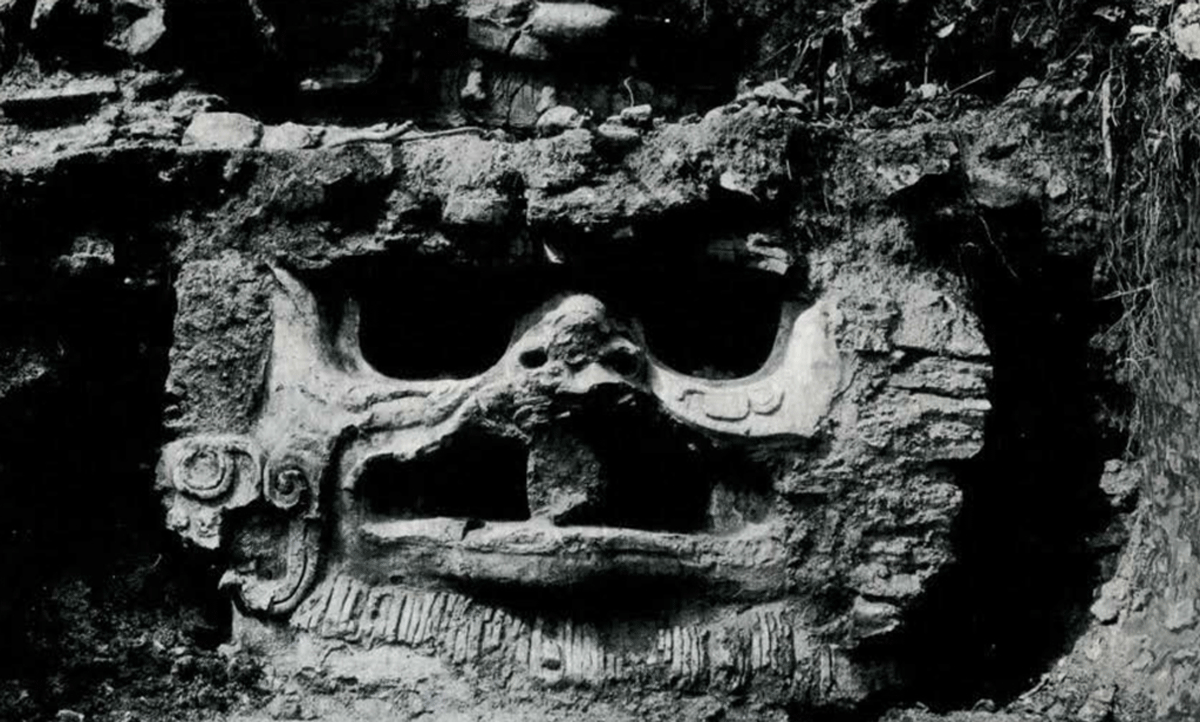
Figure 6
K-5 “Sun God” Mask as appears in Satterthwaite, Linton. 1933. “The Piedras Negras Expedition.” The University Museum Bulletin 4 (5): 120–26. Courtesy of the Penn Museum.
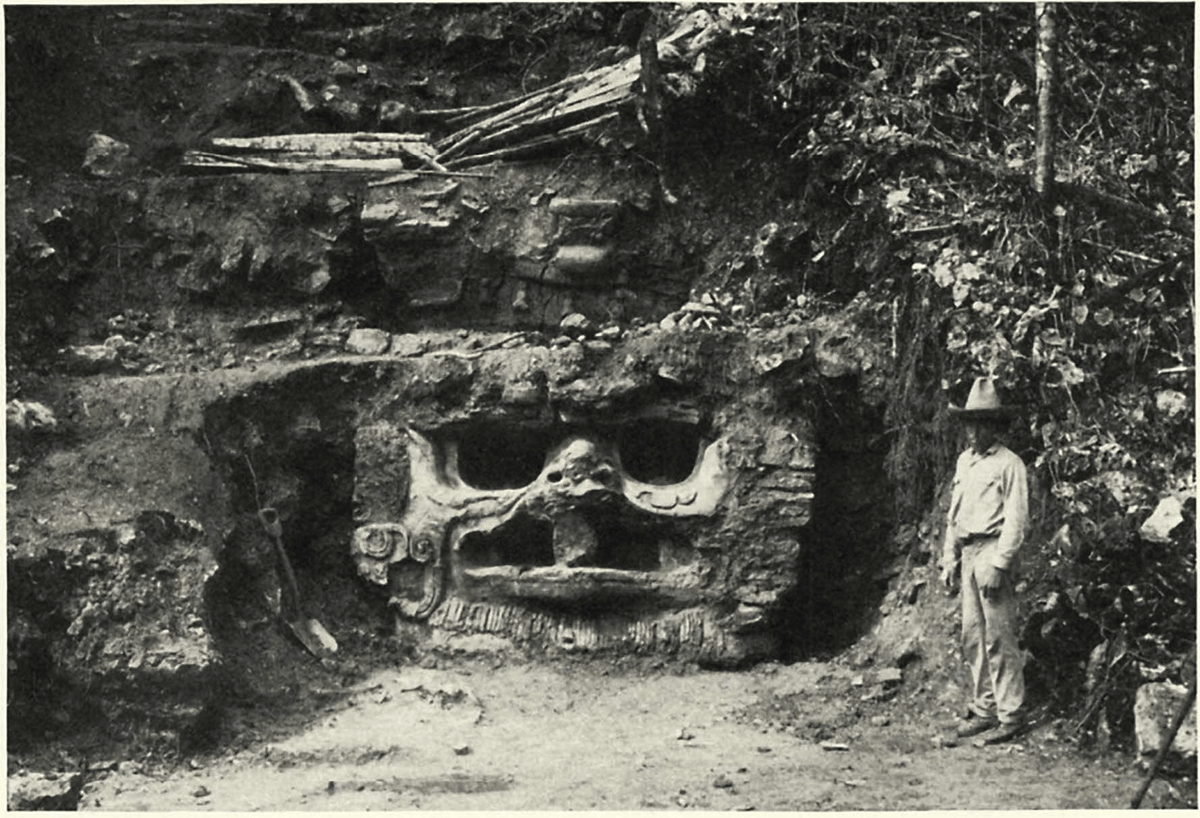
Figure 7
Photograph PN 33–155 Piedras Negras, Guatemala expedition record Photographs 1933 University of Pennsylvania Museum Archives. Also published in Mason, J Alden. 1935. “Preserving Ancient America’s Finest Sculptures.” National Geographic Magazine, November 1935. Courtesy of the Penn Museum.
The original set of photographs of the K-5 Stucco mask can be found within the archives inside an album, along with dedicated typewritten captions for each print.92 The unpublished caption devoted to the photograph 33–155 reads, ‘Above mask – note that the lower portion of another on the third terrace seems to be in line; Benjamin, who discovered it, at right.’93 Benjamin Aguirre, one of the most stalwart participants in the Penn Museum’s excavations, participated in at least the 1932 and 1939 seasons, and considering his discovery, also in 1933 (Figure 8). His importance to the project was such that he is once named in publication due to his acumen for archaeological interpretation – the only incidence out of all the Penn Museum’s published material that acknowledges a workman in this manner. This occurs in a paper written in 1944, but unpublished until 2005, in which Linton Satterthwaite describes Aguirre as ‘one of our sharpest eyed workmen’ who summoned him after spotting still more sculptured stone markers in association with structure K-5, whereupon they were ‘seen by the writer.’94
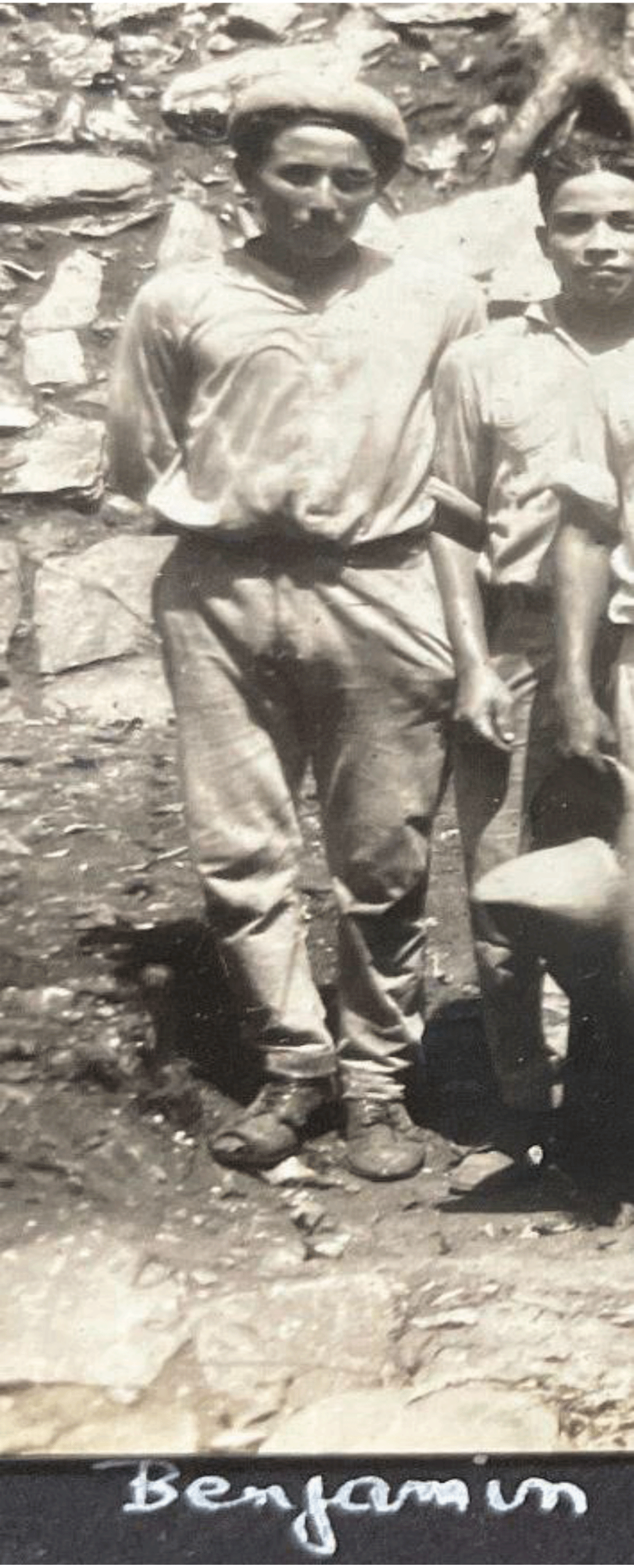
Figure 8
Benjamin Aguirre, Indigenous archaeologist and discoverer of the K-5 stucco mask. Mary Butler Personal Photo Album. University of Pennsylvania Museum Archives Piedras Negras, Guatemala expedition record. Courtesy of the Penn Museum.
At Piedras Negras, contributions to archaeological practice can be seen not only in the worker’s knowledge of archaeological techniques and interpretation, but also in their negotiation of work culture, the organization of camp logistics and workflows, and their contention with the power dynamics and consequences of racialization. The agency with which Indigenous archaeologists fought for more fair working conditions and engaged in acts of refusal greatly affected working culture and outcomes of the archaeological field seasons. The presence of additional industries also created new conditions and opportunities for negotiation. Satterthwaite laments to Horace Jayne,
In former years our men always worked right through feast days, though in general, in Mexico, they do not. Times seem to be changing here as elsewhere. The building of the railroad which will connect Campeche to Yucatan with the rest of Mexico has poured a considerable amount of money into Tenosique and it shows its effects in various ways, besides rising prices and wages. For instance, we used to be very careful not to let anything like a thumbtack lie on the floor, because nearly all feet were bare. This year there isn’t a single muchacho without shoes. The repair of the camp was delayed because the men sent out had to return for the week of carnival preceding lent and we had to complete them after our arrival. Today, Holy Thursday, to my surprise, nobody reported for work, nor will they tomorrow.95
Workers exercised their ability to refuse work not only by collectively deciding to observe holidays, but also by quitting outright. Just a couple of weeks after this event, six men simultaneously quit. This act of refusal forced Satterthwaite to reconsider the working conditions, even if marginally, on camp, through reducing work time, and through accomplishing more by allowing the more experienced members of the excavation to work independently without Satterthwaite’s constant surveillance. He writes:
I’m giving the men a seven instead of eight hour day, and they have promised to work a bit harder to make up for it. They will work from 6 to 11:30 as usual, with us on the ground; then rest till 12:00 and resume till 1:30, with us at camp unless something special is going on. With the force and experienced men I can leave them this long; will have the whole afternoon for work here, and they will be finished before the maximum temperature, which is about 2:30 by our day-light saving time.96
Two years later during the field season, workers enmeshed in railroad systems and other archaeological camps run by the Carnegie Institution system used competing base pay to collectively demand more payment from Satterthwaite.97 These powerful ruptures with site dynamics might be further explained with a deeper analysis of the identities of those who participated on site, who in many cases had greater collective archaeological experience and knowledge than the people who contracted and exploited them. In line with the idea that archaeological sites were not devoid from the political conditions that led to their knowledge production, there is clear evidence that Indigenous workers’ knowledge production was often unaccredited, especially if it intersected with physical work, which was seen as non-technical.
On the ground, the divisions of labor and working order of the camp was set by American archaeologists but constantly negotiated, protested, and intersected with Indigenous archaeologists. While each day varied, the general laboratory logics of the camp involved different work ‘gangs’, supervised by American archaeologists; Americans participated in the labor of excavating ad hoc, while Indigenous archaeologists were expected to continuously excavate until established breaks and meals, on the false justification that their bodies were more accustomed to physically demanding work due to their previous experience in other industries.98 The recording of field notes, photography, and map-making efforts were all conducted by American team members, though these tasks should not be seen as completely segmented; according to photographs and excavation diaries, Indigenous archaeologists helped stage photographs, measure architecture, and interpret findings. While largely erased in subsequent publications, their knowledge and specialties were entwined with archaeological work. Filtered through correspondence and excavation journals, individual knowledges and expertise can be located as crucial.
In 1932, project participant David Amram alluded to the technical expertise and mentorship of excavation member Lino Castro, a woodsman with extensive archaeological experience. Castro had been hired by foreman John Ross, who previously had been in the mahogany industry where he had tapped Castro’s expertise as a talented woodcutter. Castro possessed a considerable amount of regional archaeological knowledge; as Amram writes to his father, ‘He was with the Mexican government man at Yaxchilan, some three jornadas up the river from here, for three months. His experience was a great help to me, since I had to feel my way in the digging. Every once in a while he would suggest that he had seen something at Yaxchilan that corresponded to what was being turned up at the time and he was usually right.’99
Castro’s involvement in prior excavations at Yaxchilan gave him greater insight into the relationship between these two sites than most of the excavators on the Piedras Negras team. The rivalry between these two sites has since been well-established,100 but Lino Castro’s own observations that occurred in the 1930s never made it into subsequent publications; filtered through Amram’s correspondence, Lino Castro is often exoticized as having a body that was more acclimated to harsh labor and tropical environments, relegating his expertise to embodied, rather than acquired knowledge.101
The story of Eduardo Mendez and Lintel 12 further makes the case for worker retention that led to their increasing aptitude for archaeological specialization and interpretation. The circumstances of the discovery of Lintel 12 were interesting enough that they were detailed in publication no less than three times.102 These instances detail the story of how half of the lintel was found in association with Structure O-13 (or alternatively named Pyramid 27) in 1932. Archaeologist Linton Satterthwaite noticed it with his ‘eagle eye’ as an unusually shaped stone within the structure’s masonry and closer inspection revealed it to be a repurposed sculptured stone.103 The stone, however, was incomplete. It would have remained so, but an unnamed workman remembered tossing out another unusually shaped stone the previous year which was left nestled within the roots of a tree. This stone turned out to be the lintel’s missing half. The workman went unnamed in publication, but David Amram reveals in correspondence that it was Eduardo Mendez, captain of Satterthwaite’s group of workers.104
Workers’ names recovered from the archives demonstrate that several individuals were hired for at least two seasons (Table 1). Eduardo appears in records from both 1931 and 1932. Although archival evidence is insufficient to suggest anyone participated every single year, there is clear continuity of people who worked on the project multiple times. Mason and Satterthwaite’s archival notes feature several people who appear in different years, corroborating the assertion of the workmen’s increasing specialization. For example, Luis Aguirre, Carmen Acoba, and Annesetto Jimenez worked with Satterthwaite in 1931 and 1932, and Pancho Mota worked as a foreman those same years. Although names of workmen from the 1935 season could not be recovered, Satterthwaite writes back to Director Jayne that year retaining ‘seven men of other years, not counting two cooks.’105
Table 1
Names of Workers at Piedras Negras.
| 1931105 | 1932105 | 1936105 | 1937105 | 1939105 |
|---|---|---|---|---|
| Annesetto Jimenez | Alberto | José López | Antonio Hernandez | Anacelio |
| Efrain Quintero | Alfonso | Anacelio Jimenez | Anisteo | |
| Alberto | Amado | Aniceto | Augustin | |
| Alfredo | Annisetto | Carmen Acopa | Benjamin Aguirre | |
| Carmen Acoba | Arcenio | Francisco Rosado | Cesario | |
| Enrique, foreman | Benjamin Aguirre | Genaro Gonzalez | Jose Jimenez Moa | |
| Eduardo Mendez | Carmen | Israel Sanchez | Manuel | |
| Fausto Alderon | Estanislao | Jose Maria Rosado | Maximo | |
| Firpo | Eduardo | Manuel Osoria | Pancho Acopa | |
| Gregorio | Fausto | Remedios | Pedro Maños | |
| Luis | Gaspar | Rufino Ramos | Rufino | |
| Nico | Jesus | Socorro Castillo | Valentin | |
| Ramón | Julio César Hernández | Vicente | ||
| Reyes | Leocadio | Sixto | ||
| Rivas | Lorenzo | |||
| Salvador | Perez | |||
| Víctor | Sixto | |||
| Federico | Socorro | |||
| Pancho Mota | José López | |||
| Gaspar | ||||
| Socorro Castillo |
In 1939, Benjamin Aguirre, Pancho Acopa and Sixto participated in the final season. At this point, their proficiency is reflected in Satterthwaite’s notebook noting, ‘of old boys, we have only Benjamin, Anacelio and Sixto, but several bright new ones, including Pancho Acopa, who was a mess boy one year.’106 He also remarks that he had ‘a good boy combing the stairway looking for fragments of Lintel 7,’ indicating that some of the workmen displayed particular aptitude which allowed them to be prone to assignment of specific archaeological tasks.107
Although perhaps not Satterthwaite’s original intention, the nature of the work often meant giving the workmen a lot of independence. In the Preliminary Papers Satterthwaite writes ‘All trenches, and Pits 1 to 5, were dug during the first (1931) season when the writer and workmen were inexperienced; Pit 6 was done by an experienced worker at the end of the last (1939) season, but at a time when he could not be closely watched.’108 In his 1931 notebook, Satterthwaite notes that he is ‘feeling lousy’ and ‘went up late in A.M’ with ‘7 men on the acropolis temple,’ implying that there were times that the men worked independently, often with the foremen taking the lead whenever the American archaeologists desired breaks or were preoccupied elsewhere.109
Taken together, the retention of workmen, their assignment of specialized tasks, and their demonstrated ability to operate with minimal supervision by the ‘trained’ archaeologists implies the ongoing development of the workmen as archaeologists in their own right. This experience, compounded with the workmen’s local and traditional knowledges, thus exemplified ‘braided knowledges’ in another sense. Rather than syncretism between Indigenous traditional knowledge and Western epistemologies, the braiding is in Indigenous people themselves learning, engaging and rupturing the methods and logics of archaeological research. Furthermore, as Satterthwaite admitted, in the first season in 1931, he and the workmen were all inexperienced, meaning that over the project’s duration he developed in fieldwork experience alongside the workmen. In other words, the development of Maya workmen as archaeologists demonstrates that the role of the workmen was not a particular phenomenon of the site, but rather a process that developed over time and represented an interwoven meshwork of knowledge embodied in the Maya workers and their experiences before and during the Piedras Negras expedition (Figure 9).
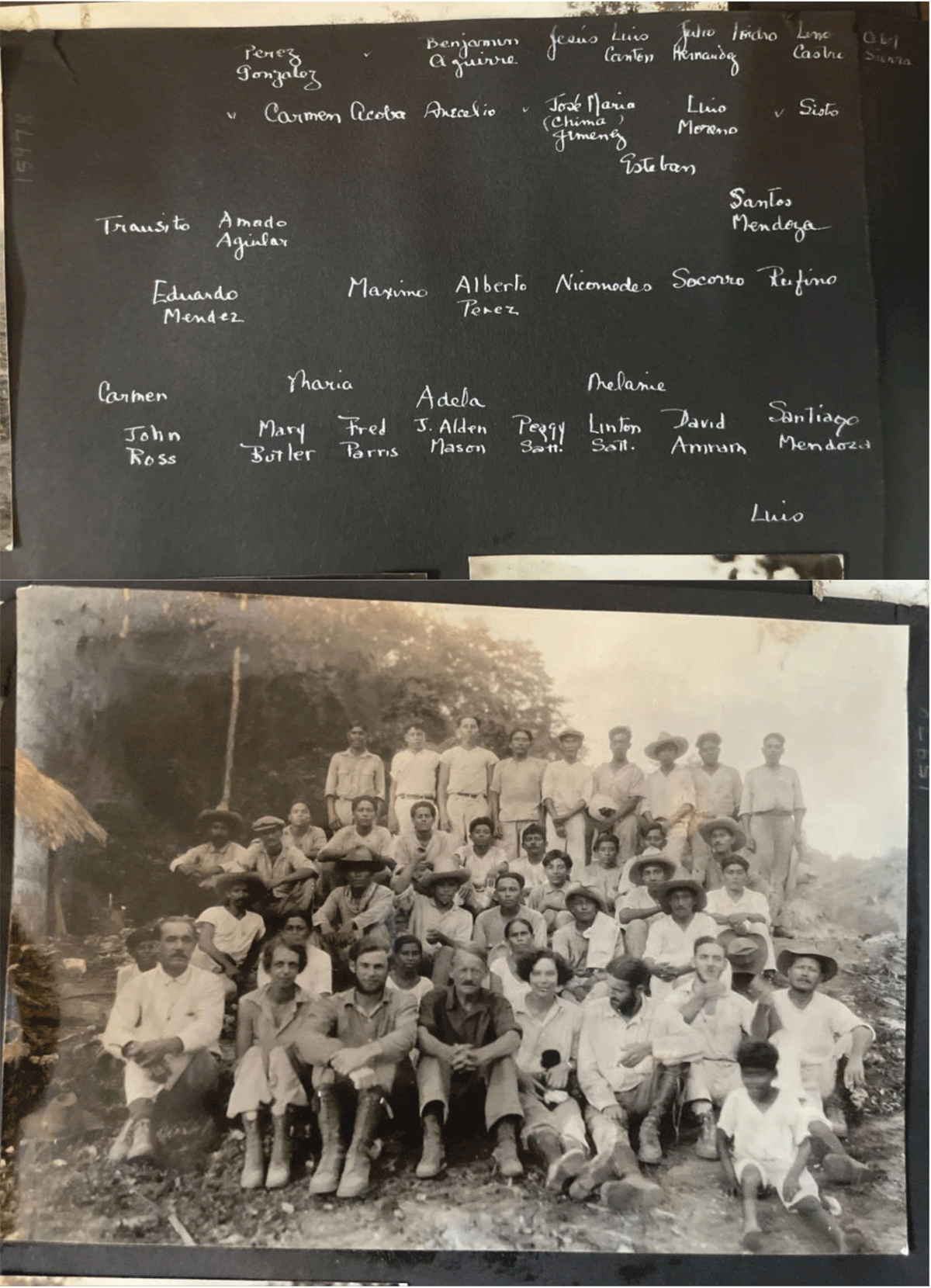
Figure 9
Piedras Negras Staff. 1932. Piedras Negras Guatemala (1931–1939) Mary Butler Personal Photo Album. University of Pennsylvania Museum Archives Piedras Negras, Guatemala expedition record. Courtesy of the Penn Museum.
Enmeshed in the practices around archaeological labor included the tasks that made that labor possible. This includes the aforementioned construction of the road, but also constructing camp structures, preparing meals on a factory-like schedule, gardening, and organizing and restocking camp supplies. The logics with which these labor tasks were divided were gendered and racialized, in ways that in some cases made what was classified as mundane or unskilled labor as dangerous, and in at least one case, fatal.
In May 1933, camp laundress Carmen May was carried away by the currents of the river and drowned.110 Her death is recorded only in correspondence,111 most poignantly in a hand-written letter from her mother Julia to Margaret Satterthwaitte requesting she be ‘done the favor of retrieving the clothes of my poor hijita Carmita.’112 (Figure 10) Yet it was May’s constant proximity to the river’s edge and altering currents in her employment as a laundress that would put her in frequent positions of danger. Her labor on site extended to more than washing clothes, and with her sudden loss, disarray ensued. In particular, because clothes washing, camp organization and cleaning, and providing drinking and bathing water had been labeled on camp as women’s work, workmen were reluctant and in some cases outright refused to perform these tasks in her absence.113
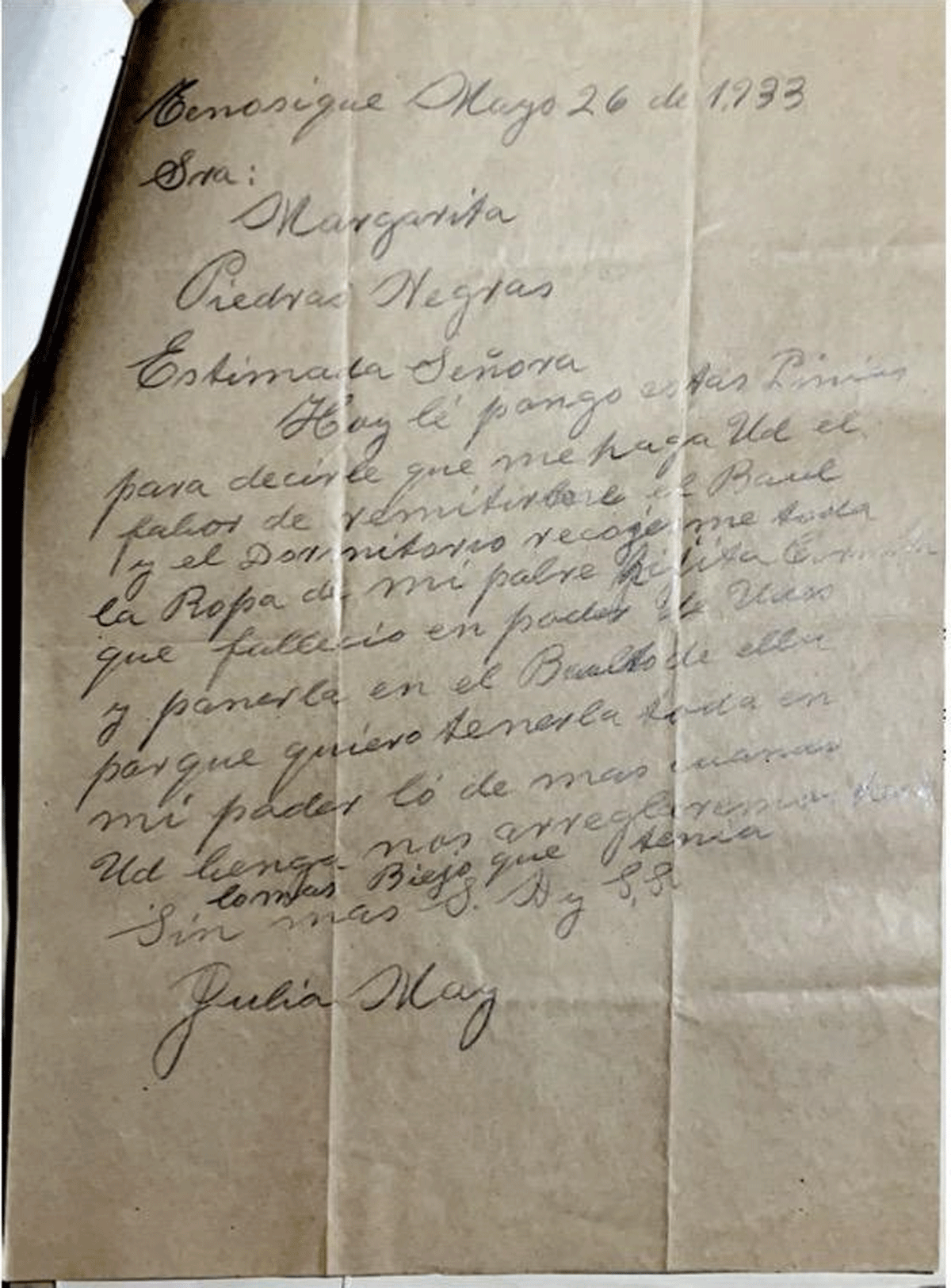
Figure 10
Letter from Julia May, Carmen’s mother to Margaret Satterthwaite asking for her daughter’s effects. May, Julia. 1933. “Julia May to Margaret Satterthwaite,” May 26, 1933. Administrative Records American Section L. Satterthwaite Box 10 Folder 15. University of Pennsylvania Museum Archives. Courtesy of the Penn Museum.
Understanding this refusal requires the lens of intersectionality in which May’s work was underscored by her gender and Indigeneity.114 The white women that engaged in archaeological work over several field seasons oscillated between overseeing camp-related logistics and intellectual labor. Unlike Indigenous women that helped run the camp, much of their labor seems to have been relegated to non-physical work, which white male excavation team members justified by their perceived lack of acclimatization and low threshold for hardship. In an extraordinary passage in which David Amram directly compares white women’s capacity for labor to that of the Indigenous washerwomen on site in the 1932 field season, he states, ‘this is no place for a white woman… there is very little a woman can do, except look after a campfire. It is really a severe physical life and a white woman can’t make the grade. We have two washwomen with us from Tenosique. One of them is a magnificent woman, with a good percentage of indian [sic] blood. Tall straight, fine featured, broad shouldered.’115
Amram’s correspondence, in addition to revealing an overtly sexualized way in which he viewed Indigenous female members of the excavation, also explains how surveillance was taken up by white women of camp since they were deemed unsuitable for physical labor. White women on camp, which included Margaret ‘Peggy’ Satterthwaite, Mary Butler, and Tatianana Proskiouriakoff, were often tasked with recording data and sometimes ‘surveying’ excavators. Such a position engrained the power dynamics of whiteness being the pre-requisite for a panopticon-esque way of enforcing order. Such was often the job of Margaret Satterthwaite.116 Married to Linton Satterthwaite, Margaret’s work was not compensated.117 Mary Butler studied and recorded the art of the monuments118 and participated in cleaning and preparing skeletal material and pottery for analysis,119 while Proksiourakoff went on to create architectural renderings and make glyphic breakthroughs in Maya decipherment.120 Records reveal that Proksiourakoff was paid half of what Linton Satterthwaite made.121
The intersectional elements of gender, race, and class cannot be ignored as engrained in the labor dynamics of the excavation at Piedras Negras. While white women were accredited for archaeological interpretations, their work was either uncompensated or drastically reduced. Indigenous women that kept camp logistics running and operational were both uncredited and unprotected from the danger of daily labor. Moreover, their words and efforts did not make it to publication and are even more scant in the archival record than that of their male counterparts.
Individuals involved in excavation work at the site of Piedras Negras, Guatemala, each added threads to the rope of braided knowledge produced on site. Instead of taking the resulting knowledge as produced solely by the epistemes of the Western archaeologist, the groundwork demonstrates that there were a myriad of hands and perspectives that went into creating a set of facts, narratives, and material consequences of the archaeological record. Each power dynamic on site was by no means a neutral or accidental choice, instead heavily influenced by the constructs of gender, class, and possessive logics that purposefully obfuscated the labor of Indigenous people in the name of scientific neutrality and the American as ‘expert.’
Conclusion: Archaeological Knowledge and Labor Palimpsests
This article has shown that the groundwork of Indigenous labor, from the construction of camp sites to road engineering, to stelae extraction, to archaeological discovery and interpretation, had lasting and yet long unacknowledged effects on archaeology at Piedras Negras. The labor order and equipment of the camp derived from localized knowledge, with some originating from chicle and mahogany industries that were appropriated for archaeological work. Though we have only analyzed one site, it is clear that Indigenous archaeologists circulated, and often with greater frequency than American counterparts, to a variety of Maya archaeological sites in a connected web of knowledge-making. Their movement not only between sites, but also between industries, such as railroad construction, also allowed Indigenous archaeologists to negotiate and demand fairer working conditions and greater pay, as their labor power became precious and scarce between competing industries. The palimpsest of industries, from mahogany cart trails that were retrofit for stelae extraction, to chicle scouts who reported sites and trails, became enmeshed in archaeological work that entrenched archaeology as but another extractive enterprise in a series of other American operated or exploited organizations.
Even though people engaged in these industries applied their expertise to archaeology, that their knowledge and expertise had originated elsewhere was seen as reason to deny them ownership and acknowledgement of intellectual property. Yet as we and other scholars have shown, there is no such thing as a pure archaeological laboratory devoid from our own standpoint epistemologies and political influence. Piedras Negras was a site around which Indigenous archaeologists constructed knowledge in ways that defined and characterized nearly a decade of intellectual enterprise with little accreditation. In filling these archival silences, we pedestal the intricacies of braided knowledge creation that occurred in the technical groundwork, restoring credit and expertise to those most engaged in, and with the greatest stakes in its production.
Data Accessibility Statement
Archival data is available by appointment at the Penn Museum Archives, and Carnegie Institute Archives in Washington DC.
Notes
[1] E.g., Walter D. Mignolo, “Geopolitics of sensing and knowing: On(de) coloniality, border thinking and epistemic disobedience,” Postcolonial Studies 14, no. 3 (2011): 273–83. https://doi.org/10.1080/13688790.2011.613105.
[2] E.g., Rosemary Joyce, “Thinking about pottery production as community practice” In Potters and Communities of Practice: Glaze Paint and Polychrome Pottery in the American Southwest, A.D. 1250 to 1700, eds. Linda S. Cordell and Judith A Habicht-Mauche (Tucson : University of Arizona Press, 2015), 4.
[3] E.g., Projit Bihari Mukharji, Doctoring Traditions: Ayurveda, Small Technologies, and Braided Sciences (Chicago: University of Chicago Press, 2016).
[4] E.g., Ellen Danien, Guide to the Mesoamerican Gallery at the University of Pennsylvania Museum of Archaeology and Anthropology (Philadelphia: Museum of Archaeology and Anthropology of the University of Pennsylvania, 2002); Megan E. O’Neil, Engaging Ancient Maya Sculpture at Piedras Negras, Guatemala (Norman: University of Oklahoma Press, 2012).
[5] E.g., Guillermo Bonfil Batalla, México Profundo: Reclaiming a Civilization (Austin: University of Texas Press, 2010); Avexnim Cojti Ren, “Maya Archaeology and the Political and Cultural Identity of Contemporary Maya in Guatemala,” Archaeologies 2, no.1 (2006): 8–19. https://doi.org/10.1007/s11759-006-0003–4.
[6] E.g., Gordon R. Willey and Jeremy A. Sabloff, A History of American Archaeology, 3rd ed. (New York: W.H. Freeman, 1993), 1.
[7] E.g., Alain Schnapp, Lothar von Falkenhausen, Peter N. Miller, and Tim Murray, eds. World Antiquarianism: Comparative Perspectives (Los Angeles, California: Getty Research Institute. 2013); Julian Thomas, Archaeology and Modernity (London; New York: Routledge, 2004); Yannis Hamilakis and P. G. Duke, eds. Archaeology and Capitalism: From Ethics to Politics, One World Archaeology Series 54 (Walnut Creek, Calif: Left Coast Press, 2007).
[8] E.g., Antonio Cuxil “My Life as a Kaqchikel Mayan Tour Leader and Maya Researcher in Guatemala,” in Being and Becoming Indigenous Archaeologists, ed. George Nicholas (Walnut Creek: Left Coast Press, 2010), 93–101; Bryon Hamann, “The Social Life of Pre-Sunrise Things: Indigenous Mesoamerican Archaeology,” Current Anthropology 43 no. 3 (2002): 351–82. https://doi.org/10.1086/339526.
[10] E.g., Ann Stoler, Along the Archival Grain: Epistemic Anxieties and Colonial Common Sense (Princeton, NJ: Princeton University Press, 2009), 46.
[12] E.g. Linton Satterthwaite, “Description of the Site, with Short Notes on the Excavations of 1931–1932.” In Linton Satterthwaite, Jr., Mary Butler, and J, Alden Mason, Piedras Negras Archaeology, 1931–1939, eds. John M. Weeks, Jane Hill, and Charles Golden (Philadelphia, PA: University of Pennsylvania Museum of Archaeology and Anthropology, 2005), 17; Linton Satterthwaite, “Palace Structures J-2 and J-6 with Notes on Structure J-6 2nd and Other Buried Structures in Court 1,” in Satterthwaite, Jr., Butler, and Mason, Piedras Negras Archaeology, 72.
[13] John Alden Mason, “Preserving Ancient America’s Finest Sculptures.” National Geographic Magazine, 68 no. 5 (November 1935): 537–570.
[14] E.g., James Scorer, “Photography and Latin American Ruins,” Journal of Latin American Cultural Studies 26, no. 2 (2017): 141–64; Sarah Kurnick, “Photographic Insights from Engaged Archaeology: Yucatan and Beyond,” Cambridge Archaeological Journal 33, no. 1 (2023): 39–53. For more on Indigenous archaeologists and the politics of photography, see Amy Cox Hall, Framing a Lost City: Science, Photography, and the Making of Heritage (Austin: University of Texas Press, 2010).
[15] E.g., Kathleen Gough, “Anthropology and Imperialism.” Monthly Review 19, no. 11 (April 2, 1968): 12; Talal Asad ed., Anthropology & the Colonial Encounter (London: Ithaca Press, 1973); Diane Lewis, “Anthropology and Colonialism,” Current Anthropology 14, no. 5 (1973): 581–602. https://doi.org/10.1086/201393.
[16] E.g., Jacques J. Maquet, “Papers in honor of Melville J. Herskovits: Objectivity in Anthropology,” Current Anthropology 5, no. 1 (1964): 47–55. https://doi.org/10.1086/200442; Asad, Anthropology & the Colonial Encounter; Jack Stauder, “Great Britain: Functionalism Abroad,” In Anthropology: Ancestors and Heirs ed. Stanley Diamond (New York: De Gruyter Mouton 1980), 317; Vine Deloria, Custer Died for Your Sins: An Indian Manifesto (Norman: University of Oklahoma Press, 1988); Peter Pels and Oscar Salemink, eds. Colonial Subjects: Essays on the Practical History of Anthropology (Ann Arbor: University of Michigan Press, 2000).
[17] E.g., Chris Gosden, Archaeology and Colonialism: Cultural Contact from 5000 BC to the Present, vol. 2 (Cambridge: Cambridge University Press, 2004); Bonnie Effros and Guolong Lai, eds. Unmasking Ideology in Imperial and Colonial Archaeology: Vocabulary, Symbols, and Legacy (Los Angeles: Cotsen Institute of Archaeology Press, 2018).
[18] E.g., Samuel Holley-Kline, Entangled Archaeology, Industry, and Labor in El Tajín, Mexico, 1880–2018. (PhD Diss., Stanford University, 2019); Sam Holley-Kline, “Archaeology, Wage Labor, and Kinship in Rural Mexico, 1934–1974,” Ethnohistory 69, no. 2 (2022): 197–221; Allison, Mickel, Why Those Who Shovel are Silent: A History of Local Archaeological Knowledge and Labor (Louisville, CO: University Press of Colorado, 2021).
[19] E.g., Sarah E. Jackson, “Writing as Material Technology: Orientation within Landscapes of the Classic Maya world,” in Writing as Material Practice, Substance, Surface and Medium, eds. Kathryn E. Piquette, and Ruth D. Whitehouse (London: Ubiquity Press, 2013), 45.
[20] Charles Golden, Andrew K. Scherer, A. René Muñoz, and Rosaura Vasquez, “Piedras Negras and Yaxchilan: Divergent Political Trajectories in Adjacent Maya Polities,” Latin American Antiquity 19, no. 3 (2008): 249–74. https://doi.org/10.1017/S104566350000794X.
[21] Oswaldo, M. Chinchilla and Stephen D. Houston, “Historia política de la zona de Piedras Negras: Las inscripciones de El Cayo,” Paper presented at the VI Simposio de Investigaciones Arqueológicas en Guatemala, Museo Nacional de Arqueología y Etnología, Guatemala, 1993; Arturo Rene Muñoz, “Power, Production and Practice: Technological Change in the Late Classic Ceramics of Piedras Negras, Guatemala.” (Ph.D. diss, The University of Arizona, 2006); Rafael Fierro Padilla, La cerámica como indicador de estatus social en contextos funerarios de la élite gobernante de Palenque, Piedras Negras y Yaxchilán (Ciudad de México: Instituto Nacional de Antropología e Historia, 2016); Vera Tiesler and Alfonso Lacadena García Gallo, “De cabezas y lenguas en los reinos mayas: cambios ‘versus’ permanencia durante y tras el colapso.” Revista Española de Antropología Americana 49 (2019): 157–82. https://doi.org/10.5209/reaa.64965.
[23] David Amram to “Father”, 24 March 1932. Box 2, Folder 3, Piedras Negras Guatemala Expedition Record, University of Pennsylvania Museum Archives, Philadelphia PA (hereafter PN-GER).
[24] Francisco Villanueva to Linton Satterthwaite, 6 June 1935. Administrative Records American Section, L. Satterthwaite, Box 10, Folder 11, PN-GER; John Alden Mason “Piedras Negras Mason 1932 Book 1,” 4 April 1932, Box 4, PN-GER.
[25] E.g., Charles C. Willoughby, “Piedras Negras, A Newly Discovered Prehistoric City in Guatemala.” Scientific American 89, no. 13 (1903): 221–22. https://doi.org/10.1038/scientificamerican09261903-221; Sylvanus Griswold Morley, The Inscriptions of Peten, vol. 3. (Washington, DC: Carnegie Institution of Washington, 1938).
[26] E.g., Teobert Maler, Researches in the Central Portion of the Usumacinta Valley: Report of Explorations for the Museum, 1898–1900, vol. 2. (Memoirs of the Peabody Museum of American Archaeology and Ethnology, Harvard University, 1903), 9.
[27] C. J. Antonio Villacorta, Arqueología Guatemalteca: Reproducida y Desarrollada. (Guatemala: Tipografía Nacional, 1927); William R. Coe, Piedras Negras Archaeology: Artifacts, Caches, and Burials (Philadelphia: University of Pennsylvania 1959); Stephen Houston et al., “Between Mountains and Sea: Investigations at Piedras Negras, Guatemala, 1998,” Mexicon 21, no. 1 (1999): 10–17; Satterthwaite, Jr., Butler, and Mason, Piedras Negras Archaeology; Megan E. O’Neil, Engaging Ancient Maya Sculpture at Piedras Negras, Guatemala (Norman, OK: University of Oklahoma Press 2012); María Concepción Obregón Rodríguez, Los Antiguos Reinos Mayas del Usumacinta: Yaxchilán, Bonampak y Piedras Negras (Ciudad de México: Fondo de Cultura Económica 2016).
[28] Tatiana Proskouriakoff, “Historical Implications of a Pattern of Dates at Piedras Negras, Guatemala,” American Antiquity 25, no. 4 (1960): 454–75. https://doi.org/10.2307/276633; Michael D. Coe, Breaking the Maya Code (London: Thames & Hudson, 2012).
[29] Regna Diebold Darnell, “The Development of American Anthropology 1879–1920: From the Bureau of American Ethnology to Franz Boas.” (PhD diss., University of Pennsylvania, 1970); Curtis M. Hinsley, Savages and Scientists: The Smithsonian Institution and the Development of American Anthropology, 1846–1910 (Washington, D.C: Smithsonian Institution, 1981); George W. Stocking, Objects and Others: Essays on Museums and Material Culture (Madison, Wis: University of Wisconsin Press 1985); David Jenkins, “Object Lessons and Ethnographic Displays: Museum Exhibitions and the Making of American Anthropology,” Comparative Studies in Society and History 36, no. 2 (1994): 242–70. https://doi.org/10.1017/S0010417500019046; Tony Bennett, “Introduction,” in Collecting, Ordering, Governing: Anthropology, Museums, and Liberal Government, eds. Tony Bennett et al. (Durham, NC: Duke University Press, 2017), 1–8.
[30] E.g., Lisa Munro, “Crafting the Secrets of the Ancient Maya: Media Representations of Archaeological Exploration and the Cultural Politics of US Informal Empire in 1920s Yucatan.” Bulletin of the History of Archaeology 31, no. 1 (2021): 1–14, https://doi.org/10.5334/bha-652.
[31] E.g., Miruna Achim, “Skulls and Idols: Antiquity Collections and the Origin of American Man 1810–1815,” in Nature and Antiquities: the Making of Archaeology in the Americas, eds. Philip L. Kohl, Irina Podgorny and Stefanie Gänger (Tucson: University of Arizona Press, 2014), 23–46; Stefanie Gänger, “A Thing of the Past: Representation, Material Culture, and Indigeneity in Post-Conquest Meso- and Andean South America,” in Transnational Perspectives on the Conquest and Colonization of Latin America, eds., Jenny Mander, David Midgley, and Christine Beaule (New York: Routledge, 2020), 114–125; Andrew Bell, “Archaeologists and American Foreign Relations in a World of Empire, 1879–1945.” (PhD diss., Boston University, 2020).
[32] E.g., Alessandro Pezzati, Jane Hickman, and Alexandra Fleischman, “A Brief History of the Penn Museum,” Expedition Magazine 54, no. 3 (2012): 4–19.
[33] E.g., Percy C Madeira Jr., Men in Search of Man: The First Seventy-Five Years of the University Museum of the University of Pennsylvania (Philadelphia, PA: University of Pennsylvania Press, 1964).
[35] John Alden Mason, “Maya Sculptures Rescued from the Jungle, Bulletin of the Pan American Union 68 (1934): 88.
[37] After the first field season, John Alden Mason instructed the following excavator Linton Satterthwaite, ‘Damn them if you want, but if you want them to believe you’re a capable archaeologist, bring them back enough pretty things to look at.’ John Alden Mason to Linton Satterthwaite, 14 March 1933. Box 11, Folder 8, PN-GER.
[39] Sylvanus Morley, ‘Chiclero ad.’ 1920. Box 6, Folder 4, Series 2: Departments Subseries 2B: Archaeology, Carnegie Institution for Science Administrative Archives, Washington, DC.
[40] See David Amram to ‘Father,’ 30 March 1932. Box 2, Folder 3, Correspondence Amram, David (1932) Letters to Family, PN-GER.
[41] Norman B. Schwartz, Forest Society: A Social History of Petén, Guatemala. (University of Pennsylvania Press, 1990).
[42] ‘…many or most of the cities can be reached only after days of arduous and difficult travel on muleback along forest trails made by chicle gatherers,’ Mason, “Maya Sculptures Rescued,” 88.
[44] Frans Blom, Tribes and Temples: A Record of the Expedition to Middle America Conducted by the Tulane University of Louisiana in 1925, vol. 1. (New Orleans, LA: Tulane University Press, 1926), 205.
[45] Sylvanus Morley to Woodward, 11 October 1920. Box 3, Folder 14, Series 2: Departments Subseries 2B: Archaeology, Carnegie Institution for Science Administrative Archives, Washington D.C.
[46] Sylvanus Griswold Morley, “Archæological Investigations of the Carnegie Institution of Washington in the Maya Area of Middle America during the Past Twenty-Eight Years,” Proceedings of the American Philosophical Society 86 no. 2 (1943): 214.
[49] Linton Satterthwaite “The Piedras Negras Expedition.” The University Museum Bulletin 4, no. 5 (1933): 120–26.
[57] E.g., Michel-Rolph Trouillot, Silencing the Past: Power and the Production of History (Boston: Beacon Press, 1995).
[58] ‘The upper part of #40 nearly had our two experienced lumbermen, Todd and Ross, stumped; it broke out 1 ¼ inch rope (old rope, I must admit) three times, but they finally got it on with the wire cable.’ John Alden Mason to Horace Jayne, 2 May 1932. Box 2, Folder 2, PN-GER.
[59] E.g., Stephen Augustine, “Traditional Aboriginal Knowledge and Science Versus Occidental Science,” (Biodiversity Convention Office of Environment Canada, 1997); Gregory Cajete, Native Science: Natural laws of Interdependence (Santa Fe, NM: Clear Light Publishers, 2000); Margaret Kovach, “Emerging from the Margins: Indigenous Methodologies,” in Research as Resistance: Revisiting Critical, Indigenous, and Anti-Oppressive Approaches, 2nd ed, eds. Susan Strega and Leslie Brown,(Canadian Scholars’ Press, 2015), 43–65.
[60] E.g. Glen S. Aikenhead and Herman Michell, Bridging Cultures: Scientific and Indigenous Ways of Knowing Nature (Don Mills, ON: Pearson, 2011); Maria L. Hamlin, “‘Yo Soy Indígena’: Identifying and Using Traditional Ecological Knowledge (TEK) to Make the Teaching of Science Culturally Responsive for Maya Girls,” Cultural Studies of Science Education 8, no. 4 (2013): 759–76. https://doi.org/10.1007/s11422-013-9514–7.
[61] Nicholas Thomas, Entangled Objects: Exchange, Material Culture and Colonialism in the Pacific (Cambridge MA: Harvard University Press, 1991); Mukharji, Doctoring Traditions.
[64] John Alden Mason to Sylvanus Morley, 10 September 1930, Correspondence. B: M384 John Alden Mason Papers, Morley, Sylvanus G. 1927–48, American Philosophical Society Archives, Philadelphia, PA.
[65] ‘the boxed stones are now at the end of our road by the river with only a small rapid intervening between them and the head of the river navigation. But the river is not so high that we cannot get them though the rapid.’ John Alden Mason to Manuel Gamio, 18 June 1931. Box 1, Folder 3, PN-GER.
[66] ‘Under our contract with the Guatemalan government, we were obliged to send half of the monuments to Guatemala City, and permitted to bring the other half to this museum for a loan period of ten years.’ Percy C Madeira Jr. to Samuel Zemurray, 8 January 1946. Box 3, Folder 5, Correspondence- General Correspondence (1946), Piedras Negras Guatemala (1931–1939), University of Pennsylvania Museum Archives, Philadelphia PA.
[71] Cummings Sanborn to John Alden Mason, 13 July 1930. Piedras Negras Correspondence, Sanborn, C.A. Guatemala (1931–1939), Box 1, Folder 6, PN-GER.
[73] ‘Reports’ 1933. New Maya Monuments at University Museum. Piedras Negras, Guatemala (1931–1939), Box 17, Folder 5, Reports and Publications, PN-GER.
[74] ‘Reports’ 1933. New Maya Monuments at University Museum. Piedras Negras, Guatemala (1931–1939), Box 17, Folder 5, Reports and Publications, PN-GER.
[75] ‘If you know Maler’s report on Piedras Negras, a few of the steale were divided so that we get 12, 14, and lintel 3, and stela 36, 6, lintel 4 go to Guatemala. The four parts of stela 12 are at the end of the road, and the others either on the road or in boxes ready to go.’ John Alden Mason to Manuel Gamio, 18 June 1931. Box 1, Folder 3, Correspondence, PN-GER.
[76] ‘Reports’ 1933. New Maya Monuments at University Museum. Piedras Negras, Guatemala (1931–1939) Reports and Publications, Box 17, Folder 5, PN-GER.
[77] E.g. Brian Larkin, “The Politics and Poetics of Infrastructure” Annual Review of Anthropology 42, no. 1 (2013): 327–343, https://doi.org/10.1146/annurev-anthro-092412–155522; Mukharji Doctoring Traditions.
[78] Mary Leighton, “Indigenous Archaeological Field Technicians at Tiwanaku, Bolivia: A Hybrid Form of Scientific Labor,” American Anthropologist 118, no. 4 (2016): 742, https://doi.org/10.1111/aman.12682.
[80] Eg., Karen Barad, Meeting the Universe Halfway: Quantum Physics and the Entanglement of Matter and Meaning. (Durham: Duke University Press, 2007); Robert Preucel, “Post-Processual Archaeology,” in Oxford Bibliographies in Anthropology, ed. Lee D. Baker (Oxford: Oxford University Press, 2018). https://doi.org/10.1093/obo/9780199766567-0188; Gavin Lucas, Writing the Past: Knowledge and Literary Production in Archaeology (London: Routledge, 2018).
[81] Anibal Quijano, “Coloniality of Power and Eurocentrism in Latin America.” International Sociology 15, no. 2 (2000): 533; 536; 549, https://doi.org/10.1177/0268580900015002005.
[82] E.g, Subcomandante Marcos, “Chiapas: The Southeast in Two Winds: A Storm and a Prophecy,” in Our Word Is Our Weapon: Selected Writings, (A Seven Stories Press 1st ed. New York: Seven Stories Press, 2001), 22–37; Henry Morales “Meanwhile, Maya Descendants Face Discrimination and Poverty,” Business Insider. December 2012; Carlos Underwood,“72% of the Indigenous Population in Mexico Live in Extreme Poverty Conditions.” The Yucatan Times. August 16, 2014.
[83] M. Bianet Castellanos, A Return to Servitude: Maya Migration and the Tourist Trade in Cancún (Minneapolis: University of Minnesota Press, 2010).
[86] Linton Satterthwaite to Kenneth E Kidd, 14 August 1958. Box 8, Folder 8, Administrative Records of American Section, L. Satterthwaite University of Pennsylvania Museum Archives, Philadelphia PA. Ledyard Smith was a Carnegie Institution archaeologist most known for his excavations at Uaxactun. For more on Smith, see John Weeks and Jane Hill, eds. The Carnegie Maya IV: Carnegie Institution Theoretical Approaches to Problems, 1941–1947 (Louisville: University Press of Colorado, 2012); Robert Sharer and Loa P. Traxler, The Ancient Maya, 6th ed. (Stanford, CA: Stanford University Press 2006); and Elizabeth Hill Boone and Gordon R. Willey, eds. The Southeast Classic Maya Zone (Washington DC.: Dumbarton Oaks Research Library and Collection, 1988).
[87] For more about Indigenous representation in archaeology and involvement in creating the moral foundations of the discipline, see Chip Colwell-Chanthaphonh, Inheriting the Past: The Making of Arthur C. Parker and Indigenous Archaeology (Tucson: University of Arizona Press, 2009).
[89] Mason, J. Alden. “Resultados cientificos de las excavaciones arqueológicas en la Zona de Piedras Negras.” Anales de la Academia de Geografía e Historia de Guatemala, 15 no. 2 (1938): 211.
[91] Mason, “Preserving Ancient America’s Finest Sculptures,” Plate II, np. https://www.penn.museum/sites/bulletin/1214/.
[93] Linton Satterthwaite, “Structure K-6: The West Group Ballcourt,” in Satterthwaite, Jr., Butler, and Mason, Piedras Negras Archaeology, 235.
[94] ‘They were seen in position by the writer when summoned by Benjamin Aguirre, one of our sharpest-eyed workmen, who noted that they were sculptured,’ Satterthwaite “Structure K-6,” 235. The Piedras Negras Preliminary Papers was a compilation of unpublished papers written largely by Linton Satterthwaite with contributions by Mary Butler, Frank M Cresson, and John Alden Mason.
[98] E.g. David Amram to ‘Father’, 14 April 1932. Box 2, Folder 13. Correspondence PN-GER; Mason, “Preserving Ancient America’s Finest Sculptures,” 546–547.
[100] E.g., Stephen Houston et al., “Between Mountains and Sea”; Golden et al. “Piedras Negras and Yaxchilan.”
[102] Mason, “Maya Sculptures Rescued from the Jungle,” 96–97; Mason, “Preserving Ancient America’s Finest Sculptures,” 549; Morley, The Inscriptions of the Peten, 3:28–29.
[108] Linton Satterthwaite, “The Plazuela of Structure V-1,” in Satterthwaite, Jr., Butler, and Mason, Piedras Negras Archaeology, 343.
[110] Linton Satterthwaite to John Alden Mason, 19 May 1932. Box 11, Folder 8, Correspondence, Piedras Negras, PN-GER.
[111] ‘I have to report, much to my regret, the accidental death by drowning of laundress, Carmen May, day before yesterday.’ Linton Satterthwaite to John Alden Mason, 19 May 1932. Correspondence, Box 11, Folder 8, PN-GER.
[112] Julia May to Margaret Satterthwaite, 26 May 1933. Box 10, Folder 15, Administrative Records American Section L. Satterthwaite, University of Pennsylvania Museum Archives, Philadelphia PA.
[114] Kimberlé Crenshaw, On Intersectionality: Essential Writings (New York: New Press, 2019).
[115] David Amram to his father, 27 April 1932. Box 2, Folder 3, Piedras Negras, Guatemala (1931–1939) Correspondence, Amram, David (1932) Letters to Family, PN-GER.
[116] Workers often circulated between various areas of sites; in Margaret Satterthwaite’s personal diary she references one day when one archaeological worker was asked to work another area of the site which frustrated her. She writes: ‘Watched the men and when Linton came a little later I was in a huff because one of the good boys had been taken from us.’ Page 28, 1931. ‘Field notes Diary 1931’ by Margaret C. Satterthwaite (2 of 2). Box 10, Folder 2, PN-GER.
[117] ‘Peggy, too, is always the best sport in the camp; I wish we could pay her expenses,’ John Alden Mason to Horace Jayne, 16 June 1932. Box 2, Folder 2, Piedras Negras Guatemala (1931–1939) Correspondence- Museum (1932), PN-GER.
[118] ‘Mary is studying the art of the monuments, and Peggy is running the camp,’ John Alden Mason, 28 March 1932. Box 2, Folder 2, Piedras Negras Guatemala (1931–1939) Correspondence- Museum (1932), PN-GER.
[119] See ‘Piedras Negras, Guatemala, The Eldridge R. Johnson Expedition. 1932.’ Box 17, Folder 4, Piedras Negras, Guatemala (1931–1939) Reports and Publications, Reports 1932, PN-GER.
Funding Information
The authors conducted this research under the following grants.
Francisco Diaz: Wenner Gren Dissertation Fieldwork 2021–2022 Gr. 10106.
Charlotte Williams: Wenner Gren Dissertation Fieldwork 2021–2022 Gr. 10165; 2.
Mellon Foundation, University of Pennsylvania, Dispossessions in the Americas: the Extraction of Bodies, Land, and Heritage from La Conquista to the Present Gr. 2009-09221.
Competing Interests
The authors have no competing interests to declare.
Author Contributions
Both authors conducted their own dissertation research and came together to collaborate on this piece. Each author contributed equally to the work of researching and writing of this submission.