
Soundtrack
‘After all, it is the field archaeologists who lay the foundation on which all of the grand theories based on archaeological evidence are built. Their contribution is both essential and valuable. Their perspective is unique.’ – Theresea Kintz, Radical Archaeology as Dissent
‘they can spread out my scheduled hours stretch me thin but still part time they can have my battered body but I won’t let them have my mind they don’t have to give me benefits or pay me a living wage but one day their burning fortunes will light a brighter age’ – Work Song, X Dirty Fingers, punk musician and field archaeologist1
Introduction
There is a lot of talk these days about the future of compliance archaeology in America, known more commonly as Cultural Resource Management (CRM). In 2023, the Society for American Archaeology (SAA) had two, 2-hour panels on the topic at their 88th Annual Meeting. This followed another 2-hour panel on the same subject that they hosted in February of the same year, via Zoom. Within the walls of test units and the offices of most any CRM firm, employees are worried about upcoming workloads, staffing, and pay. On social media and in podcasts, leaders in the industry are all talking about what feels like the edge of a precipice for an industry that has always felt like it is just barely holding on.
The summer of 2022 felt like a breaking point for many people working in the industry. In July, an archaeologist named Kaylen Gehrke died of heat stroke while on a project in Louisiana.2 It was her first day on the job. Her two coworkers were unable to resuscitate her. Archaeologists throughout the country were shaken. For a lot of us, it wasn’t because we couldn’t believe it, but because we all could see ourselves in that situation. We had all worked to points of exhaustion, for hours in heat waves, on projects that needed to get done. Some of us on the same day as the death of Kaylen Gehrke, all across the country’s vast south.
Many of us remembered how difficult our first day of work was. How we were handed a shovel and a screen and told to start digging. For most of us, it was only the day after we filled out the company onboarding paperwork.3 We remembered how our degrees didn’t prepare us for it. Remembering our own pasts, we knew what led to the death of Kaylen Gehrke. Knowing our pasts, we knew it could, and likely would, happen again.
The industry is experiencing a major labor shortage, part of a national trend following the initial years of the Covid-19 Pandemic.4 This labor shortage is only expected to get worse with the passage of three large infrastructure spending bills by the Biden administration, which will require cultural resource compliance reviews of construction projects.5 As the industry begins to reckon with the realities of this labor market, the tragic death of Kaylen Gehrke throws the unacceptable working conditions of archaeology’s most numerous and most vulnerable workers into sharp focus. For all of the regulatory minutiae of the historic preservation laws that define our day-to-day, CRM itself remains shockingly unregulated in terms of working conditions, particularly for archaeological technicians.6 In 2023, a major CRM project in Miami, Florida had to be temporarily shut down when it was revealed that archaeologists had been exposed to arsenic, tungsten, mercury, benzene, and other harmful chemicals for months on end.7
Archaeologists, both in CRM and academia, are outraged, frustrated, and calling for change, while at the same time lamenting the seemingly impossible task of coordinating any real action across a decentralized industry. It is not uncommon in these conversations, be they online or in the field, to hear this sentiment expressed by the phrase, ‘field archaeologists need a union, but it will never happen.’
In moments of collective grief and anger like this, it is important to reflect on how we got here if we are to keep this momentum from fizzling out into the discourse of accepted defeat. We offer a glimpse into the history of archaeological labor organizing in the United States through the digitized pages of The Underground zine, a 1990s grassroots publication by and for field technicians. This article discusses the creation of and the contents within The Underground Digital Archive as it is situated in the historical context of labor in archaeology. The goal of this paper, and of the creation of the Archive itself, is to dismantle the illusion of what Mark Fisher describes as capitalist realism,8 or the pervasive societal belief that there is no alternative to capitalism, which has become so entrenched that no alternatives can even be imagined. In the context of the for-profit, private CRM industry, this ideology constructs the current state of archaeological labor as an immutable reality. The Underground Digital Archive is an essential record of a burgeoning, class-conscious community of archaeological field technicians that was aggressively targeted by dominant professional organizations of the time with the result of both stifling the movement and ensuring it would quickly fade from memory, as poor working conditions eventually pushed many of the leading voices of the community out of archaeology entirely. The Archive can therefore be a powerful tool for challenging the manifestation of capitalist realism in CRM, by offering visions for the future in the echoes of the past.
A Brief Introduction on Cultural Resource Management in the United States
‘Ok, So we are not in it for the money, but !!??’ (The Underground, Issue 7)
Within the United States, the vast majority of archaeological projects take place as a part of the regulatory compliance process for construction and other major development projects. While cultural resources are addressed in a number of national and state environmental laws, most commonly, compliance archaeology takes place under the auspices of Section 106 of the National Historic Preservation Act (NHPA), enacted into law in 1966.9 Section 106, as it is colloquially known, requires federal agencies to consider the effects on historic properties for projects they carry out, assist, fund, permit, license, or approve throughout the country.10 It is the archaeologists’ duty to conduct studies that assess the potential effects that their project will have on cultural resources. In the 1930s, large archaeological projects had relied on a sizable labor force provided by federally funded work relief programs like the Works Progress Administration (WPA) and Civilian Conservation Corps. After WWII, however, fieldwork was increasingly carried out by trained archaeologists affiliated with academic institutions.11 However, the passage of the NHPA triggered the establishment of the private CRM industry and thus the need for a new pool of fieldworkers outside of the undergraduates that staffed most university-affiliated firms.
This new class of field technicians fit into a model of fieldwork already common in international settings – digging is done by skilled, usually seasonal, laborers while the tasks of research design and data interpretation are left to academically trained, ‘professional’ archaeologists.12 As it has become more common in American CRM for even temporary workers to hold at least a Bachelor’s degree in Anthropology, the contributions of these field technicians to the archaeological process continue to be downplayed by the archaeological establishment.
Within the disciplinary hierarchy, which already devalues CRM archaeology as a legitimate means of producing archaeological knowledge,13 field technicians rest solidly at the bottom of the pyramid.14
Professionalizing the Industry: The 1990s and the historical context of the zine
‘Try telling a field tech they aren’t a professional archaeologist’ – The Underground, Issue 1
In the 1990s, compliance archaeologists were working under increased pressure.15 The recession of the late 1970s and early 80s caused many small CRM firms and most university firms to go out of business. The economic policies of Reaganite America had shrunk the industry right before the economic boom times of the mid-1990s. This would be combined with the passage of the Native American Graves Protection and Repatriation Act (NAGPRA) in 1990, which drastically changed the way archaeologists in America conducted their excavations. The industry was changing and archaeologists, from the president of the SAA to field techs, were beginning to plan and organize their visions of the future of archaeology. During this time, the industry would see major organizational shifts, including the restructuring of existing professional organizations and the establishment of new ones. While these changes occurred from the top-down, archaeological field technicians were busy organizing from the bottom-up, building what would prove to be the most successful attempt at unionization in CRM to date.
One of the earliest and most prominent voices for professionalism and ethics in CRM had been the Society of Professional Archaeologists (SOPA), established in 1976.16 As the 1990s ushered in major industry changes, SOPA was eventually reorganized from a professional society into a membership organization, known as the Register of Professional Archaeologists (ROPA, or RPA). SOPA had certified archaeologists based on experience, including field experience, but as ROPA, they would no longer provide services to amateur archaeologists, or to working archaeologists who did not meet their new definition of a ‘professional archaeologist’. Instead, it would, ‘serve a narrowly defined group of professionals,’ in order to ‘enhance archaeology’s image as a true profession.’17
Furthermore, rather than certifying its members, it would simply list these new professional archaeologists on the Register, earning them the title of Registered Professional Archaeologist (RPA). These new standards, notably the possession of a Master’s degree, institutionalized the established industry attitude that field technicians had never really been professional archaeologists. They were at best like apprentices, working hard for a few years and learning the trade, before going back to graduate school to become true professionals. At worst, they were bums.
SOPA had once considered addressing labor abuses in the field through its Personnel Relations Committee, as well as a register of Technical Archaeologists, but those efforts were abandoned after its reorganization into ROPA.18 Fortunately, at the same time as the major archaeological societies in the country were defining ‘professional archaeologist’, a group of field technicians were envisioning their own future for the industry. In 1995, tired of the major archaeological societies’ inaction on the labor law violations rampant in the industry, a group of field technicians founded a labor union, the United Archaeological Field Technicians (UAFT; Local No. 141 of the Union of Operating Engineers).19 Their vision addressed common concerns including low pay, insufficient healthcare coverage, and lack of long-term career paths in archaeological fieldwork. Their training, apprenticeship, hiring hall, and continuing education plans were designed to foster an industry that cared for the craft of archaeology and worked against the deskilling of archaeological labor in America that had been an apparent threat since CRM’s beginning.20
During its years of operation, the UAFT faced backlash from company owners and managers who feared the demand for higher wages could potentially increase corporate opposition to the industry.21 This was because much of the work the UAFT had accomplished focused on issues of prevailing wage and back pay. Pushback to union efforts at the time was often organized by one of the other new trade associations for the cultural resource industry that was established in the 1990s, the American Cultural Resource Association (ACRA). Regarded by union organizers of the time as a ‘union for the bosses,’22 the formation of ACRA is jokingly considered the UAFT’s greatest accomplishment,23 because it was formed partly in response to the UAFT and the potential threat they posed. Information on how to legally deal with union organizing efforts was disseminated by ACRA’s Labor Relations Committee to its members.24 To combat the UAFT’s prevailing wage efforts and to maintain wages around $8.00 to $10.00 an hour, ACRA and several federal agencies organized a strategy to get the Department of Labor to recategorize archaeological technicians as unskilled/semi-skilled laborers.25
The pushback field technicians received for fighting for a living wage no doubt affected the way that undergraduate students since the 2000s have viewed the prospects of a career in CRM. One of low wages, without healthcare, no promise of retirement, and little respect for the ‘unskilled’ labor they performed. The UAFT’s vision was radically proletarian and could have created the kind of working-class archaeology that has been theorized and dreamed of by many archaeologists, but only realized on a few community archaeology projects.26 Unfortunately, this vision would not come to fruition. By the end of the 2000s, the union had largely disappeared from the industry, defeated by industry blacklisting,27 the rapid turnover of field technicians,28 and the difficulties of labor organizing under fast capitalism.29
An Interlude on the Term Shovelbum
By the 1990s, CRM archaeology’s proletarian class had been given a name: shovelbums. Originally coined in the 1980s by the mother of CRM archaeology jobsite creator R. Joe after hearing her son describe his work life,30 the term would quickly become part of the industry’s lexicon. In 1997, it was used as the name of a zine by archaeologist and comic artist, Trent de Boer, that chronicled the everyday life of field technicians.31 To this day, the term is still widely used. Shovelbums has been serving as a major job board since 1999, first as listserv, then as a Yahoo Groups message board, and finally in its current iteration as a website.32 The name shovelbum can still be seen on the artwork and memes of workers in the industry, often as a mark of commitment to the job/lifestyle, and like most memes, with a heavy sense of irony (Figure 1). Many terms, pejorative in their nature, were given to field archaeologists during the 1980s and 90s, such as ‘field animals,’ ‘grunts,’ and ‘digroes.’33 All were used to devalue a field technician’s labor. Shovelbum was the term created by field archaeologists; it was both a joke and an acknowledgement of the way the industry perceived and treated them. Their working conditions defined them; it also connected them.
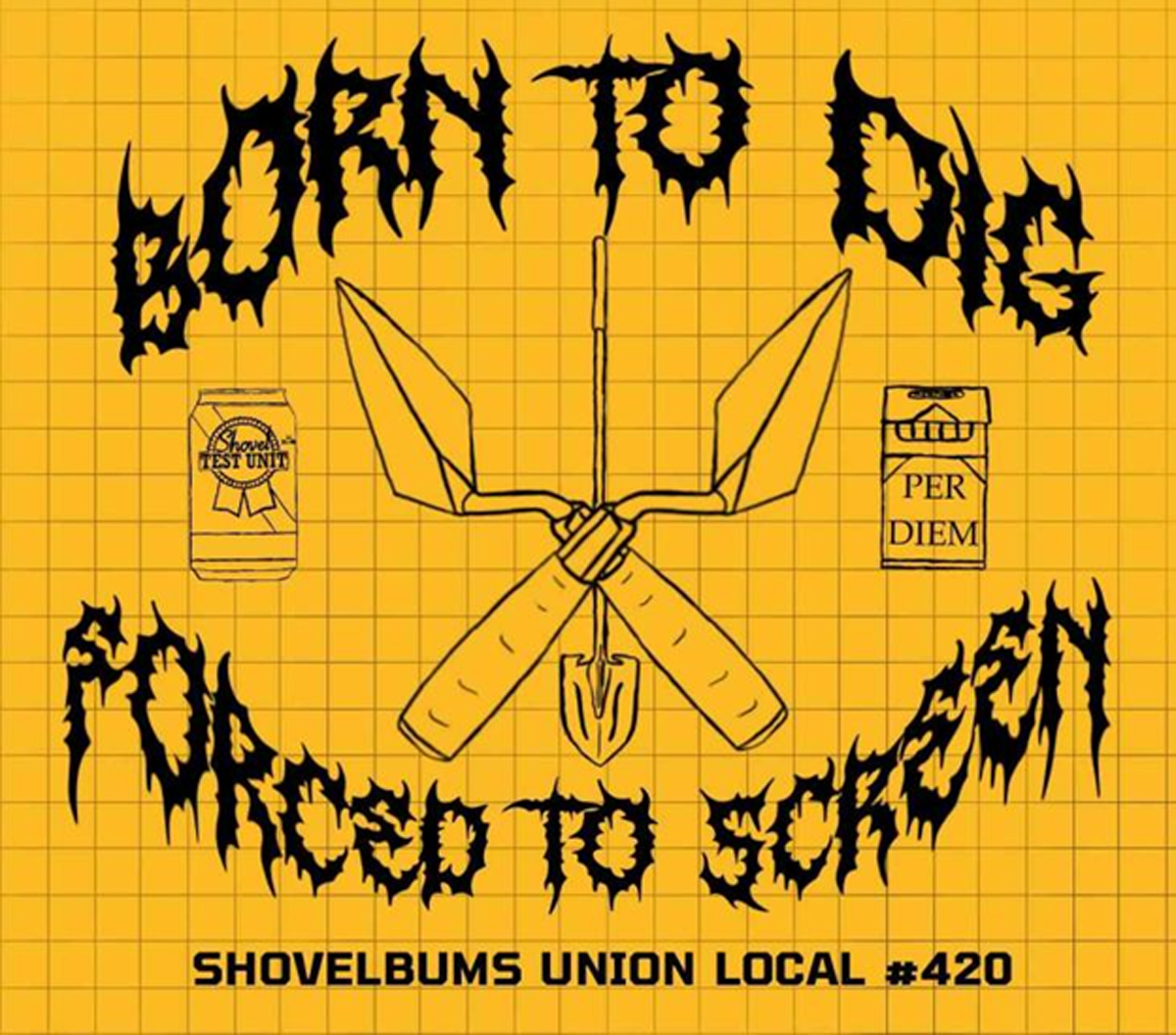
Figure 1
Contemporary internet art work using the term shovelbums. Image: X Dirty Fingers. Reproduced with permission of the author.
Throughout the world and throughout the history of archaeology, the labor of those who move the earth to produce archaeological knowledge has been devalued. Globally, the archaeological field labor conducted by local diggers, as opposed to the archaeological interpretation done by academically trained archaeologists, is seen as unskilled despite the expertise that the workers develop over many field seasons working on the same project.34 Additionally, their contribution to the production of archaeological knowledge, through physical labor, is erased in favor of narratives of discovery.35 In the 1990s, field technicians working in CRM were frequently devalued, seen in ‘stereotypical proletarian terms as alcoholic, childlike, and in need of firm discipline.’36 A similar devaluing of field archaeologists has been noted in British commercial archaeology, as well as the community and camaraderie that emerges from it.37 The denigration of field archaeologists and the skills and knowledge they bring to the production of archaeology is a serious problem. These perceptions are used against them in their efforts to create stable lives and receive a living wage. Dismantling the perception of field technicians as unskilled is therefore an important step towards successfully organizing for improved conditions in the industry. The editors of The Underground strove to change this perception.
The Underground Zine
The Underground was a monthly newsletter for the CRM industry that was self-published from 1993 to 1995. As described in its first issue, ‘The Underground [was] a newsletter designed to provide a forum for discussion of issues relating to field archaeology and to disseminate information of interest to field archaeologists’ and one ‘written by and for people who live in motels’ – referring to the project lodging most common for field archaeologists and the editors’ positions as field techs themselves. Created only through use of a typewriter and physical cutting and pasting, The Underground was inspired by the zines and DIY publications of the era, particularly the publications from the radical environmental movement and the Earth First! Organization.38
Within each issue of The Underground, readers would encounter news on archaeological societies and organizations, stories of terrible hotels, news on upcoming projects, original articles on issues in archaeology, helpful figures and charts that could be used to improve field work, and so much more. At its height, The Underground boasted over 400 subscribers – primarily archaeological technicians, but also CRM management and the occasional academic. Throughout its run, the zine became an important venue for archaeological technicians to communicate with one another, eventually playing a role in the dissemination of surveys and updates from the growing UAFT. However, as the Internet age began to hit its stride and communication between technicians grew easier, many of the roles played by The Underground could now be filled by email mailing lists and websites. The fact that its original editor left the field for full-time work writing for one of the radical inspirations of the zine, Earth First!, at the same time that the decidedly apolitical and self-deprecatingly titled ‘Shovelbums’ listserv was getting off the ground, is illustrative of the general regression in the organized labor movement in CRM at the turn of the 21st century.
In 2021, the senior author and the Black Trowel Collective began the process of archiving The Underground, motivated by the need to preserve documents related to the labor union movement and the early writings of anarchist archaeologies, respectively. Copies of the zine and related ephemera (such as the unemployment application referenced in Issue 9, address books, and samples from similar archaeological newsletters) were donated by one of the zine’s original editors and then digitized by a collaborator from the Black Trowel Collective. The Archive is currently hosted on The Digital Archaeological Record,39 where the process of uploading and curating the materials is ongoing. The creation of the Archive was as much a political effort as it was a curatorial one. As we described in the introduction, the archaeological labor crisis is reaching a boiling point with no satisfying solutions yet to be found. The Underground Digital Archive Project was created in part to help us do what archaeologists do best: learn from the past.
The Zine Medium and Archival Genres
In the broadest sense, zines are handmade, low budget, print publications that are circulated through subcultures and other small communities.40 The term ‘zine’ originates from ‘fanzine,’ referencing the medium’s origins in science fiction fan communities in the 1930s,41 but the flexibility of their content and form has allowed for their adoption into a variety of alternative cultural contexts including political activist movements, music scenes, the queer community, and in the 1990s, the archaeological technician community. As a medium, the zine is characterized by a collage-style collection of typed and handwritten text, photographs, and drawings from one or more authors, oftentimes with the inclusion of material reproduced from other sources.
Academic studies of the medium have highlighted how its existence outside of the institutional framework of mainstream publishing, both in its production and distribution, makes the zine an inherently anti-authoritarian and anti-capitalist means of communication.42 Of particular relevance are those studies which have considered zine archives and anthologies as distinct from the individual zines themselves, as our discussion relies on issues of The Underground that were digitized and compiled as part of a broader project on archaeological labor (see above). Zine archives are a critical record of marginalized and/or radical groups as told in their own voices.43
These collections preserve more than the historical information contained in individual publications, particularly when zines are scanned and digitized as a whole rather than their content transcribed and reproduced. The preservation of whole issues of zines into anthologies and physical or digital archives creates what Lymn describes as a distinct ‘archival genre’ that is unique because of its ability to document not only the content of zines, but also their physical form and the practices that surround their production and distribution.44 Given that in many cases, including this one, the person building the archive is a member of the community that the zine originated in, the construction of the archive itself can be considered a continuation of the practices associated with the zine.45 The zine archive therefore provides an opportunity for future readers to engage directly with the zine community of both the past and present.
Digging into The Underground
The Underground Digital Archive is comprised of 19 issues of the zine itself, along with related ephemera including samples from similar archaeological newsletters and zines from the time, address books, resources and documents referenced in the zine, and photographs from an assortment of CRM projects and zine community gatherings. Our discussion takes advantage of the unique ability of zine archives to preserve not only zine content (i.e., the topics and types of entries included), but also its material form and the practices involved in its production and circulation. We will begin by examining each of these elements in turn, before broadening our discussion to the content, form, and practice represented by the Archive itself in order to explore how The Underground can function as a living document within the archaeological labor movement today.
Content
Unlike traditional publications, individual issues of zines do not follow a set format, which allowed The Underground to address multiple community needs at once, often incorporating content directly from readers in the form of letters, illustrations, and articles (Figure 2). The resulting zines are therefore topically and structurally disparate, but the content can be generally categorized into three broad and occasionally overlapping themes: industry tips, archaeological theory and practice, and current events. The prevailing attitude of the wider discipline, as exemplified by a derisive letter printed in Issue 8 (Figure 3), is that archaeological. technicians are neither intelligent enough nor invested enough to make meaningful contributions to the field. Instead, the multivocal content featured in The Underground reveals a community of field technicians engaged in rigorous discussions on ethics and archaeological knowledge production that rise far above what one would expect from a ‘little fanzine,’ as it was described by David Rotenstein in what became an infamous letter within the zine community.
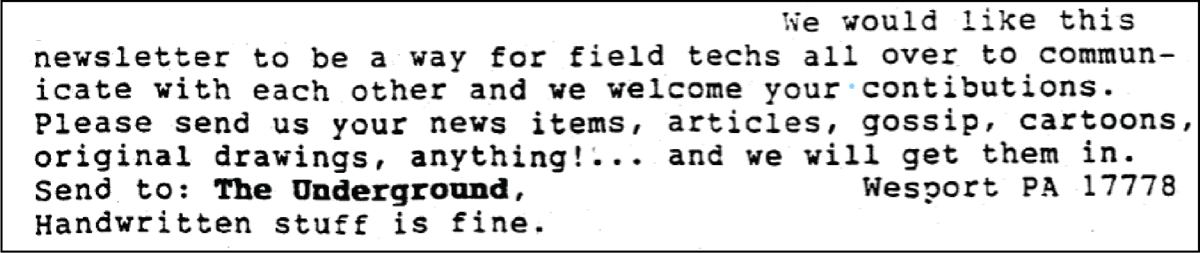
Figure 2
Call for submissions included on the front page of every issue of The Underground (mailing address has been redacted).
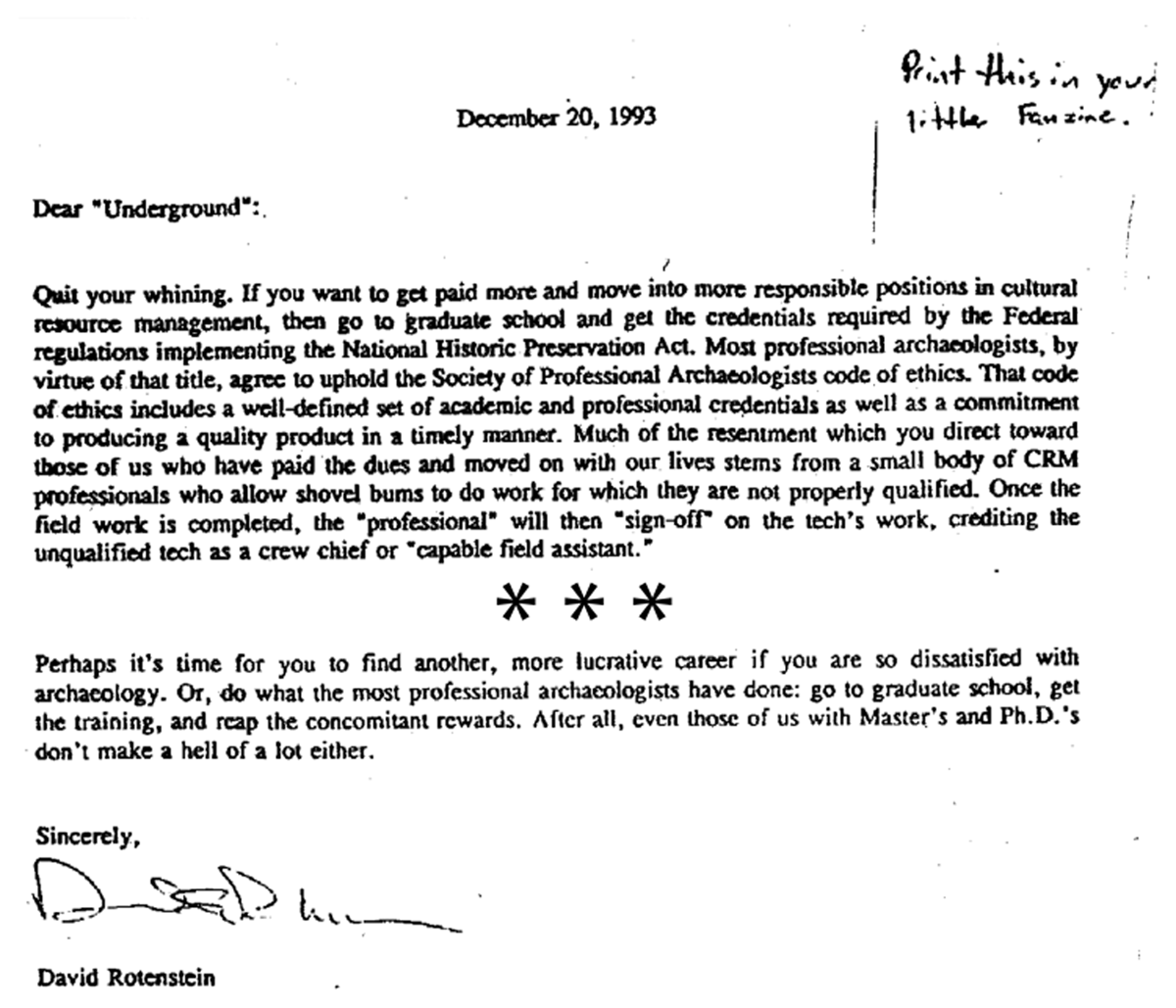
Figure 3
The ‘Rotenstein Letter,’ reprinted in Issue 8 of The Underground in 1994. For brevity’s sake, the letter has been abridged to include only the first and final paragraphs.
On a practical level, The Underground was a means of sharing information between field technicians who were, by necessity, geographically disconnected and, in the 1990s, communicatively disconnected as well. Some of this content pertained directly to the practice of field archaeology and was geared towards skill building and the general improvement of field methodologies. For example, Issue 9 reprinted a table of ceramic types from Ivor Noël Hume’s A Guide to Artifacts in Colonial America that was accompanied by descriptions to help identify the types included in the table. Issue 8 included a copy of a soil classification chart that had been sent in by a reader, with a note from the editor encouraging readers to reference it in the field.
Other issues included advice to help improve the experience of working as an itinerant archaeologist, such as a running series of reviews of the worst motels to stay at, updates about upcoming projects with potential work, and tips for getting hired. The Underground also circulated surveys in 1993 and 1995 that collected data on topics like pay rate, the best and worst companies to work for, and what field technicians considered to be the most pressing issues in the field (Issues 6 and 19).
In both survey results issues, the editors highlighted how the responses clearly demonstrate the commitment of archaeological technicians to the future of the profession. In fact, most issues included at least some content addressing the same complex topics circulating throughout the discipline, in both industrial and academic contexts. Book reviews and commentary on recent articles were not uncommon, for example, and conversations about archaeological ethics and activism are frequently included, often spanning multiple issues as back and forth exchanges amongst the readerships. Notably, The Underground Digital Archive reveals that field technicians were engaged in their own parallel discourse about some of the most pressing archaeological topics of the time, including what was then cutting-edge post-processual theory (Issue 18), and the implications of the newly passed NAGPRA (Issue 1). In the latter case, The Underground was significantly ahead of the times in terms of attitudes towards repatriation (Figure 4) and is, unfortunately, still more ethically robust than the opinions of many archaeologists today.

Figure 4
Editor commentary on the NAGPRA discussions at the 1993 Society for Pennsylvania Archaeology, from Issue 1 of The Underground.
The discussion of NAGPRA in the inaugural issue of The Underground foreshadowed what would become one of the primary roles of the zine and much of its content: current events in archaeology. As already noted, The Underground kept field technicians up to date on new legislation, upcoming projects, and the proceedings of important regional and national conferences. None of these news items remained as static updates but were almost always accompanied by a series of opinion letters that were reprinted as content in subsequent issues. Some issues were, in fact, entirely dedicated to content sent in by the readership – a testament both to the zine’s reach and its success as a means of fostering ongoing discussion in ways not possible in the confines of traditional publication venues like journals and edited volumes.
Of particular significance for the history of the labor movement in American CRM is The Underground’s role in disseminating information about the organizing efforts of the UAFT. The ability to have one-on-one conversations with fellow workers is widely considered critical to the successful formation of labor unions,46 a need often cited by organizers as one of the primary barriers to the unionization of archaeological technicians.47 Simply put, it is difficult to develop personal relationships with workers when the industry is built on short-term employment and a highly mobile workforce. However, the informal tone that characterizes zines like The Underground, and the active participation of the readership in collecting and/or producing content from its inception, allowed for pseudo-personal relationships to be formed between the editors and the readers and between members of the readership at large. In addition to actual physical meetings (discussed below in practice), the long-running inside jokes, confessional essays, and shared commiseration found within the pages of the zine established the trust and sense of community required to build the workplace solidarity foundational to labor unions.
Form
Zines are tangible, accessible, and easy/cheap to make, which made them an ideal medium for addressing The Underground’s original goals and eventually contributing to its success. This can be observed well within the Archive, both from the photocopied issues themselves and the related ephemera. In conversations with the original editor of The Underground it was stressed that the zine was always given away for free so that field archaeologists, who sometimes lived paycheck to paycheck, would always have access to it. This was a radical departure from more traditional and formal publications within the CRM industry at the time – i.e., academic publications, archaeological society publications, and the Grapevine newsletter from the CRM firm Gray and Pape – all of which required memberships. In the case of the Grapevine, which is the most similar in form and function to The Underground, subscription prices were laid out within the first issue.48
The difference between the production quality of The Grapevine and The Underground (Figure 5) is therefore more than a reflection of their relative budgets, but of the identity of the publishers and their intended audiences. The neatly typed Grapevine, with text boxes and figures evocative of the cut-and-paste style of zines but lacking the multivocality and subversion of publishing norms. In stark contrast, The Underground was produced on a field technicians’ budget with the budgets of other field technicians in mind; it was intentionally made affordably to be affordable. Original text was written on a typewriter, and the missing letter from faulty keys and handwritten addendums can be seen in many issues. Sharpies were used to censor profanity in reprinted letters to the editors (Figure 6). Reprinted text, like SOPA’s code of ethics in the first issue and the comics and infographics common in almost every issue were simply cut and pasted onto pages next to the original text. When in Issue 20, the form of The Underground changes, now with computer text, it still found ways of maintaining its affordability, by printing postage directly on the zine and eliminating the need for an envelope.
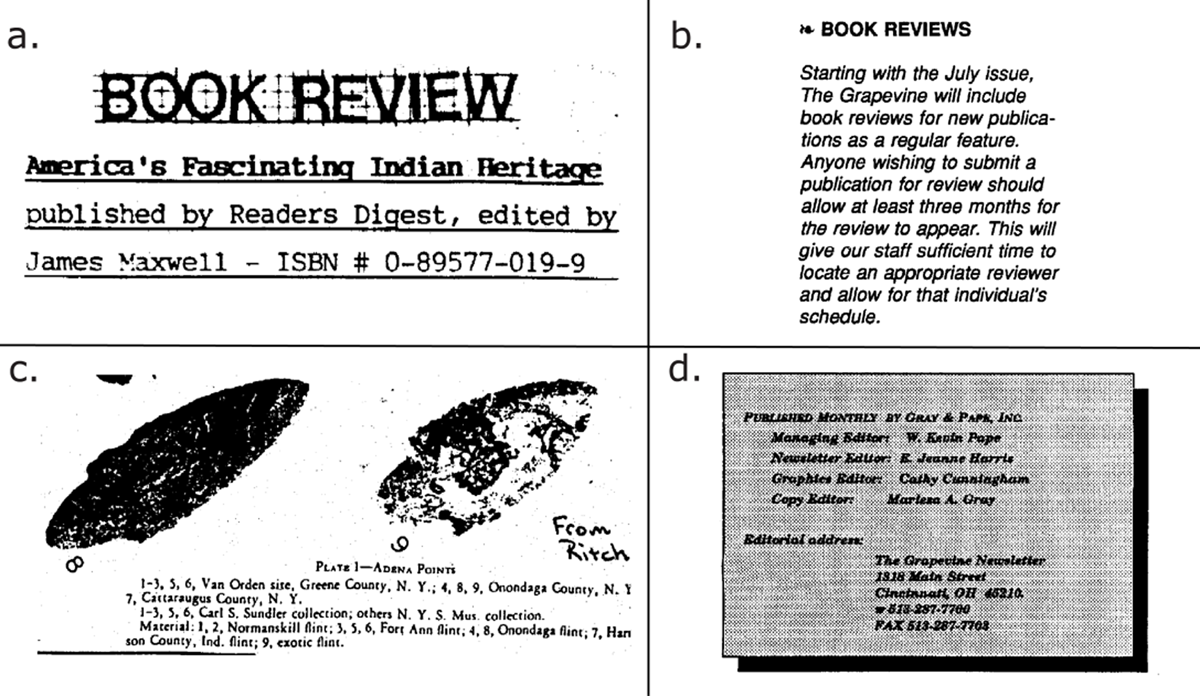
Figure 5
Excerpts from The Underground, Issue 3, August 1993 (a and c) and The Grapevine, Volume 6, Issue 3, June 1993 (b and d); a) Review of a popular anthropology book the editors found in a university bookstore; b) A description of the formalized submission and review process for book reviews in The Grapevine; c) Copied and pasted projectile point illustrations rearranged to fit on the page; d) A text box listing the editorial staff of The Grapevine.
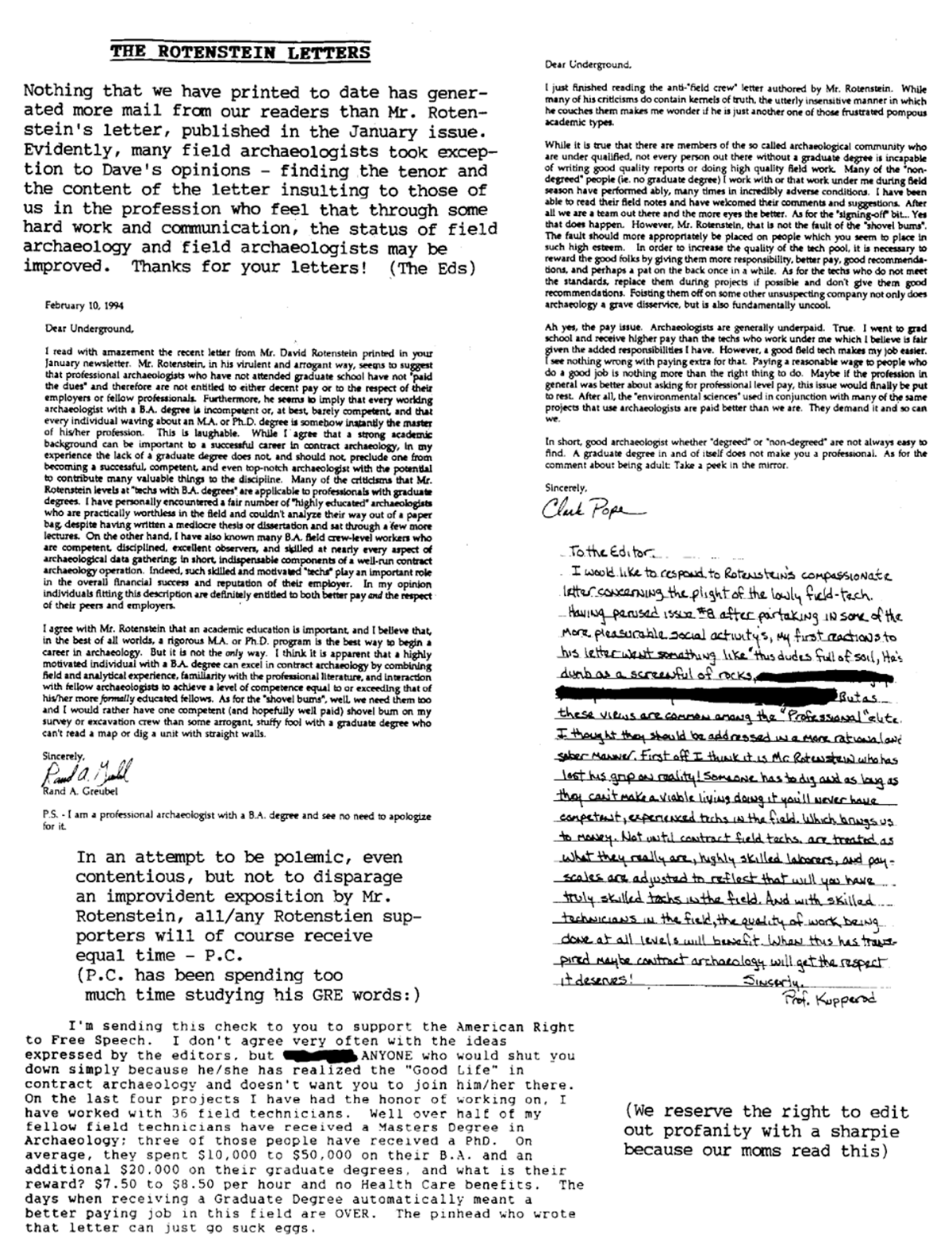
Figure 6
Reader responses to the letter from David Rotenstein (see Figure 3), printed in The Underground, Issue 10, ‘Letters to The Underground Extravaganza Issue’.
The zine’s affordability made it easy to spread amongst a community, and its use of copy/paste helped build that community. Not only did direct copying of their submissions make readers into co-producers of the zine’s content (see above), but it also preserved the individuality of the contributor in a way that typed transcriptions of letters cannot. The photocopier is an essential and important tool to zine making,49 a tool that would be used to great effect by the editors of The Underground. Reprinted images and text are common throughout every issue of The Underground. Often, what was reprinted were charts and infographics that could be used by field archaeologists to improve their work. A soil class triangle (Issue 1), lithic typologies and knapping techniques (Issues 2 and 7), a soil classification flow chart reprinted from the Journal of Agronomic Education (Issue 8), definitions of soil horizons and an architectural style identification chart (Issue 15), all could be studied, cut out, laminated, and referenced during fieldwork.
One might imagine being a green field archaeologist in 1994, being handed a copy of Issue 8 of The Underground by your crew chief so you can study the ribbon test for soil identification. Back at the hotel you cut it out and, using clear tape, you adhere and waterproof it onto your clipboard. It stays there for years. This kind of repurposing and reuse is encouraged by the form of zines. Within the zine itself is evidence of someone doing the same, cutting and pasting, finding new uses. The best example of this can be seen in Issue 10, the ‘Letters to The Underground Extravaganza Issue’, where numerous letters from fans and critics alike were copy-pasted into one big issue. The entire issue has this rapturous feeling of coming together. One page is devoted entirely to letters in response to the ‘Rotenstein Letter’ found in Issue 8. There is a solidarity in those letters, against the attitude, disrespect and ‘views common among the professional elite’ that the contributors had all experienced personally. In that same issue is a letter announcing the UAFT, as well as an update on the 1st Annual Field Archaeologists Conference, which the UAFT would present at. Collective action is a process, built in many small, everyday actions.
Practice
Zines are more than just the content of their pages or the ways they are printed, more than an object you pick up, ‘they are practices constituted through the production and consumption of everyday narratives, both drawing from, and expanding on, the communities that they exist within.’50 These practices include everything from the zine’s production and distribution to their role in the subcultures of their readers and even to the individual experience of reading them.
Imagine yourself as our proverbial field archaeologist, looking through what is left of your copy of The Underground after cutting out the soil guide. You read that month’s ‘The Worst Motel I Ever Stayed In’ and it reminds you of the shitty motel you are in now. Flip it over, and you see a letter reprinted from David Rotenstein (Figure 3) that makes your blood boil. In ‘Project Updates’ there is mention of a job not far from your grandparents’ house. You decide to apply, hoping you’ll have a better chance as someone ‘local.’ You see there is a bulletin for the ‘1st Annual Field Archaeologist’s Gathering/Conference/Party,’ maybe you’ll go. Your motel room is lonely. Traveling so much for the job is lonely. This feels like a community; it feels like solidarity. That is an experience that only the zine could have made – one inherent in its content and form.
While it cannot preserve those personal, experiential practices, The Archive is particularly useful for examining other practices associated with The Underground because of the additional relevant documents Theresa Kintz included when she donated the zine. These additional materials come from the years before, during, and after the publication life of the zine, making it possible to view the process of community building through a diachronic lens. These ephemera provide both historical context and glimpses at the life of the zine outside of its pages.
Issue 8 advertises the upcoming Field Archaeologist’s Conference; a scan of the editor’s personal photo album reads ‘”The Underground Arch Gathering” at our home in Clinton City, PA in 95. Everyone camped in tents about 50 field techs from all over’, accompanied by a photograph of a vividly green forest with tents in the distance, staked amongst ferns (Figure 7). Another frame shows a crowded hotel room of people that is reminiscent of a family photo, ‘the people we worked with most often (the techs) during the Underground years’ (Figure 8). A meticulously kept address book tracks The Underground’s social network as the geographic reach becomes more expansive with every page, eventually reaching as far as the UK, Australia, Germany, and Sweden.51 Printing receipts document the rapid growth of the readership over time – only 100 copies were printed of an issue from 1994, but by 1996 the editor was purchasing postage for 376 newsletters and 500 copies. The true number of people who read The Underground is likely much higher than that, because zines are, by nature, meant to be copied, re-copied, and shared outside of official distribution channels.
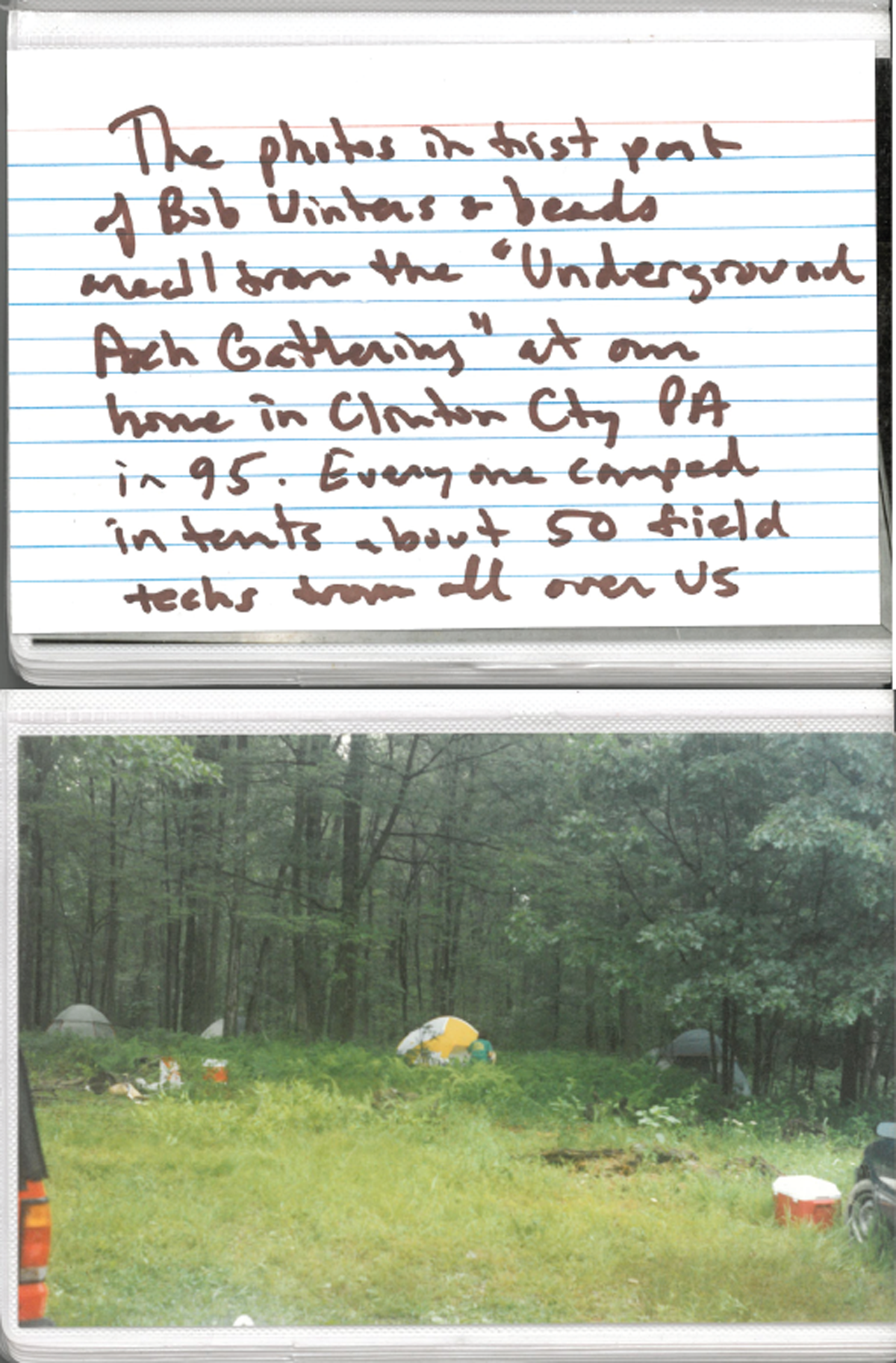
Figure 7
Photograph from the ‘Underground Arch Gathering’.
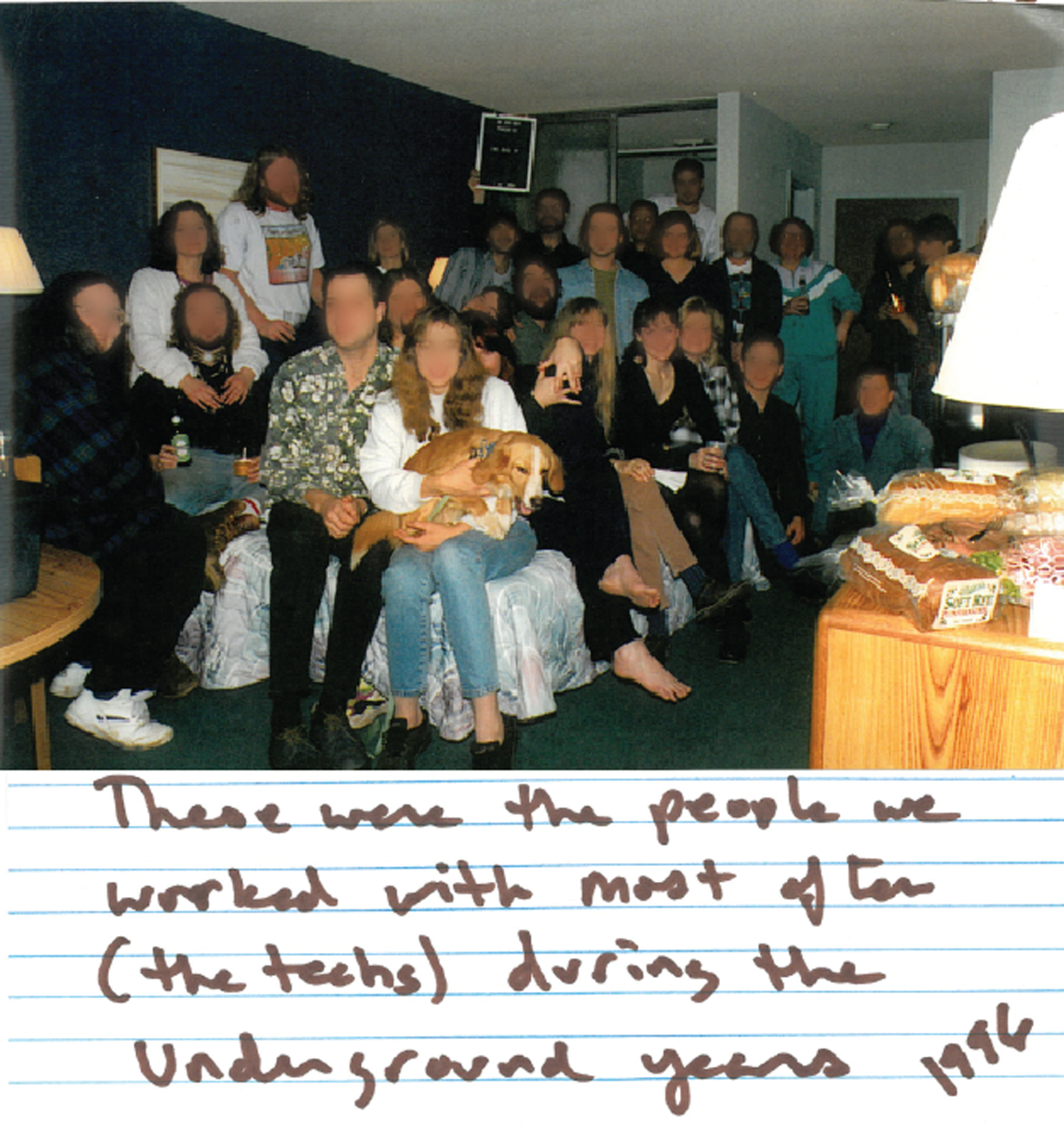
Figure 8
Group photograph of field technicians, taken in a motel room. Faces blurred for anonymity.
The geographically decentralized nature of the workforce in CRM is a major concern in organizing efforts today, which makes The Underground’s ability to rapidly expand its community of technicians prior to widespread use of the Internet somewhat remarkable. While The Underground did make appeals to potential subscribers through more mainstream publications like The Grapevine (Figure 9), their primary distribution network was established through face-to-face conversations amongst field technicians in motels, country bars, and test pits across the United States. The Underground actively sought out these kinds of connections by mailing stacks of zines to companies asking for them to be handed out to field technicians (Figure 10). As evidenced by the eventual formation of the UAFT, readers of The Underground were only part of a much larger community of archaeological field technicians who were invested in the long-term improvement of the industry. Discussions between technicians about the future of archaeology were not limited to the pages of the zine, nor to the specific practice of exchanging the actual material object. For every zine mailed out, there were an incalculable number of conversations. How many of them would have started without it?
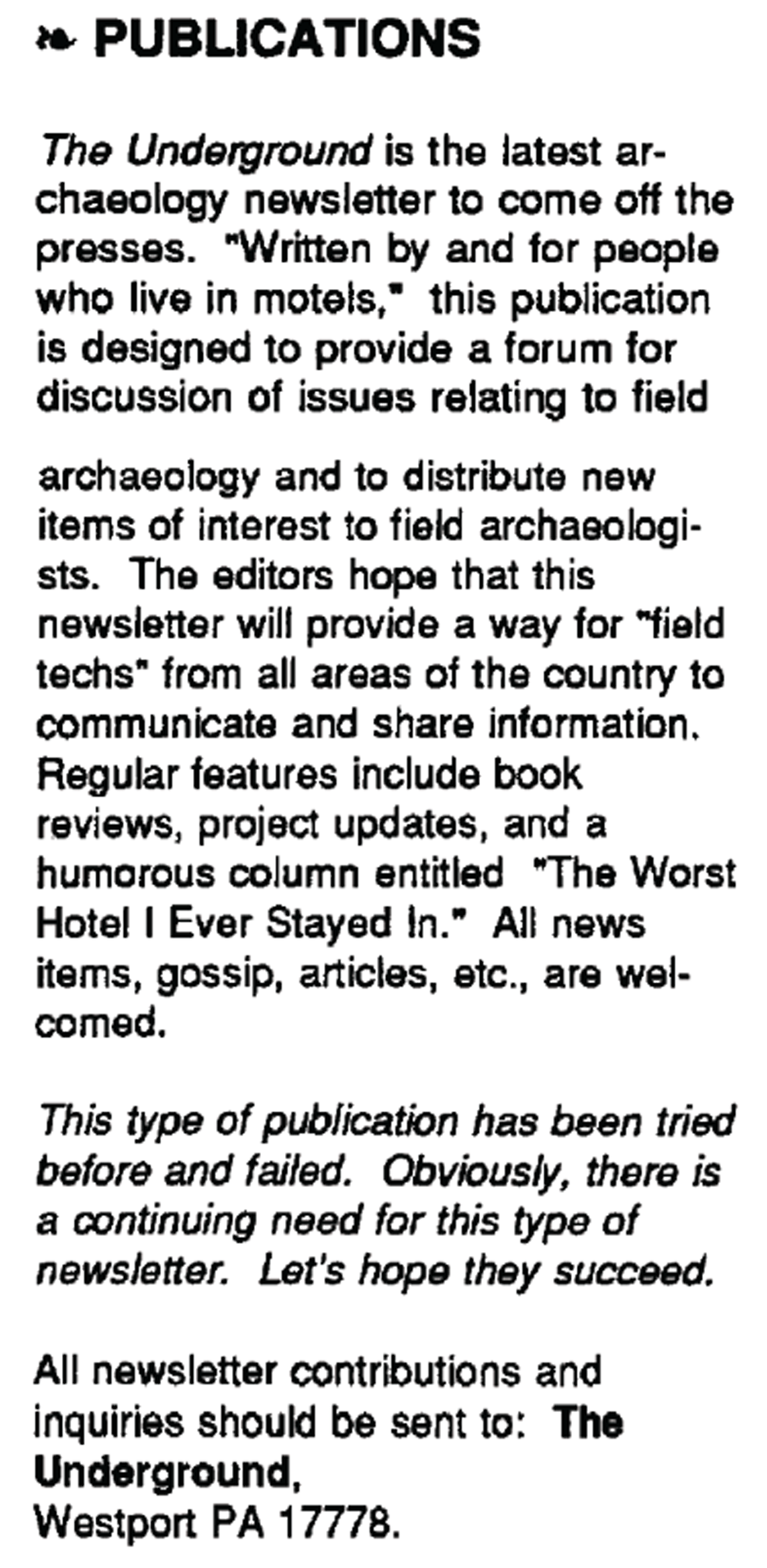
Figure 9
Announcement of The Underground published in Volume 6, Issue 3 of The Grapevine. (mailing address has been redacted).
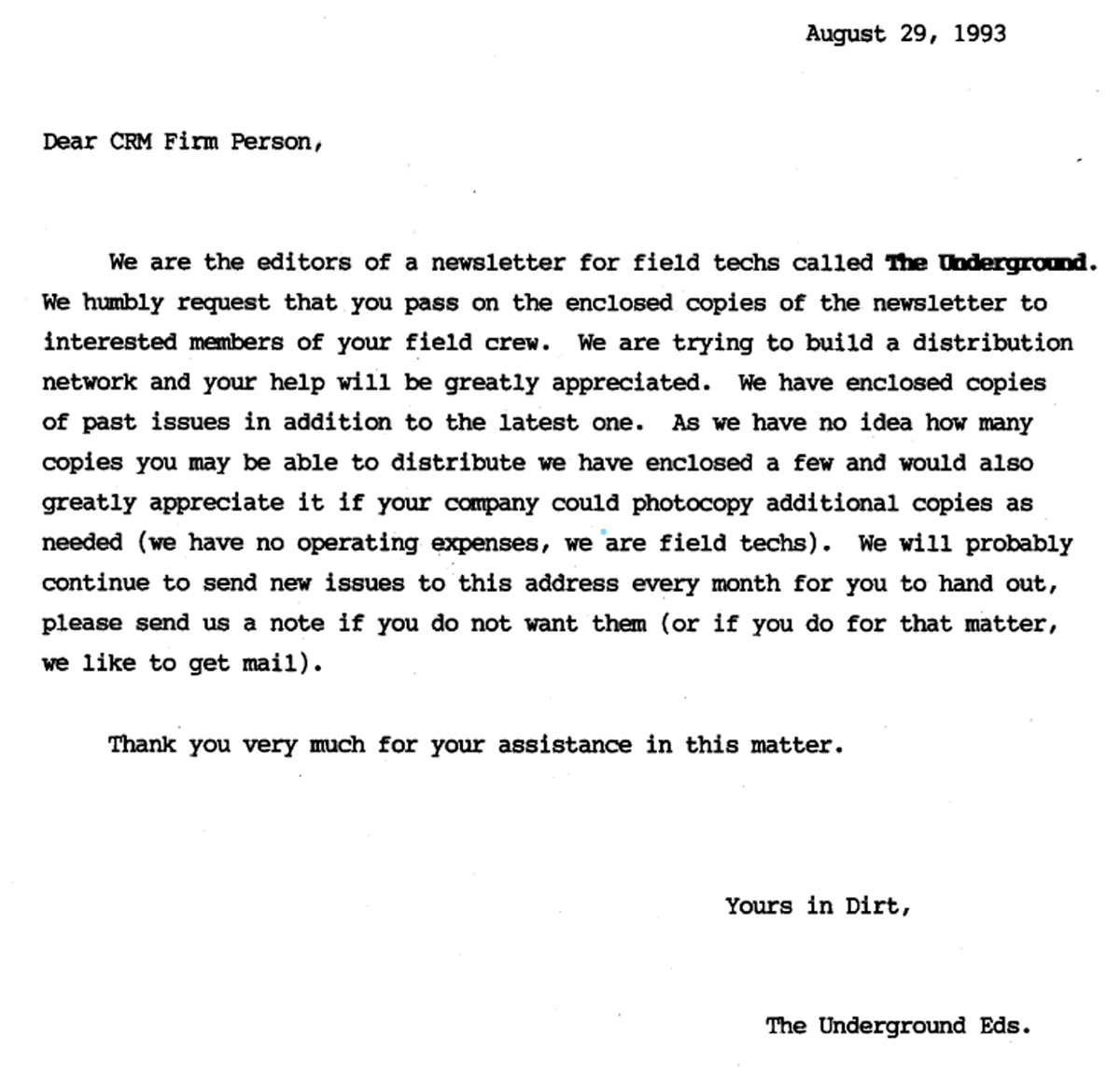
Figure 10
Letter from The Underground Editors.
Learning from The Underground
Woodbrook and Lazarro argue that ‘a zine archive is very much an “archive of feeling,”’52 because it captures the very personal experiences, hopes, and values of what are typically marginalized or otherwise peripheral communities. Particularly when these collections are brought together by the zinester/author or by members of the zine community, they are an extension of the zine’s life history as the act replicates the practices associated with zine culture. While zine archives preserve content, form, and practice in the archived materials themselves, their own content, form, and practice are homologous to those of the original zines and zine communities whose histories they document. Thus, the act of creating, maintaining, and engaging with zine archives directly integrates communities in the present with those in the past by relying on those same elements of the zine medium that make it so successful as a tool for building shared community identities. The act of archiving zines therefore functionally transforms the process of community-building from a synchronic process to an atemporal one, which creates continuity between the experiences of then and now.
The Underground Digital Archive is a curated collection of ephemera that the zine’s original editor felt were necessary for understanding the cultural place of The Underground in the archaeological labor movement. Like the zine itself, the Archive is an assemblage of materials from different authors, in different formats, selected by the editor to communicate to field technicians that they are not alone. There is historical context, certainly, but also personal context – photos of the crew she worked with, a handwritten address book, her application for unemployment. These items do not just illustrate the reality of the zine’s tagline, ‘for and by the people who live in motels,’ they personalize it. As we have discussed above, the personal connections encouraged through zine culture is part of why The Underground was able to grow such an active and invested community of field technicians. In the same way that the photocopier is an essential tool in zine production because it preserves the individuality of zine contributors and makes it cheap and easy to distribute, its use in the creation of the Archive by scanning and uploading documents and photographs welcomes a new generation of archaeologists into the community.
We said earlier that the Archive cannot preserve the unique, personal experiences of the people who read the zine during its circulation, but what it does do is offer contemporary readers the opportunity to know that feeling of finding community for themselves. This was certainly our own experience with the Archive. Reading through the pages of The Underground, we were surprised to see so many of the same issues and complaints we and our coworkers have today: low pay, temporary work, lack of healthcare, and fears about the quality of the archaeology coming out of CRM. But we also shared so many of the joys experienced by the contributors of the zine, like the way a terrible hotel is somehow almost more fun than a nice one. We saw the same techniques and resources we use today to make our lives at work easier. Most of all we saw that same radical spirit and academic drive that was always said to be antithetical to dirt archaeologists, to shovelbums, the spirit that makes us dream of radical futures for the work we love so much. We saw ourselves.
Years after The Underground stopped publishing, Theresa Kintz was living in the U.K., attending graduate school, and working as a digger on British and Norwegian compliance archaeology projects. At the 2001 Theoretical Archaeology Group conference, she presented a paper reflecting on her time as an editor for The Underground. She writes: ‘even though my family hopes I finish my PhD, put my trowel away and settle down into a decent-paying academic or management job somewhere, it’s more likely I’ll run into you in a hole somewhere because I remain firmly convinced that the work of field archaeologists is relevant and valuable in this world.’53
She included it in the archive, and we saw ourselves in it too.
Conclusion
The Underground Digital Archive was not created as an act of historic preservation; it was intended as an explicitly political act to counter the fatalistic belief in American archaeology that changing our labor practices through collective action is impossible. Few archaeologists under 40 years old know the history of CRM’s creation, and fewer still know about the efforts to unionize it. This is only exacerbated by the realities of fieldwork and unfair working conditions that have functionally ensured that those archaeologists who were working as field technicians during the 1990s labor movement have long since left the industry, or at the very least the field. This archive, the zine itself and all its ephemera, tell us a story of struggle and collective action through the experiences of the people involved.
Today, archaeologists find themselves having the same conversations, as well as writing articles, hosting panels, and dreaming of what needs to happen to save our industry. Some leaders in the industry have proposed that CRM and archaeology-related societies should prioritize the push for living wages, similar to recent successful efforts in British commercial archaeology.54 Others push for university programs to reorient educational training on the skills needed for a career in CRM.55 The RPA has initiated a task force composed of CRM, academic, and tribal government archaeologists to broaden their registration categories to better include all working archaeologists. But these calls for action do not center field archaeologists’ voices and agency; the proposed solutions are top down.
What we also have today are field archaeologists, struggling under similar working conditions and for similar pay as field archaeologists in the 1990s, still as temporary employees without healthcare and other benefits. Though we share many of the struggles as the field technicians we see in The Underground Digital Archive, they were in their own historical moment, and we are in ours. Today, unionization has never been more possible for field archaeologists in America. It is already a reality for archaeologists in Canada, Ireland, and the United Kingdom, where newly organized unions have won contracts resulting in increased wages.56 Unions have won important contracts throughout America in industries that are similarly affected by rapid turnover, and public support of labor unions has seen a massive resurgence in recent years.57 Even the infrastructure bills, whose workload the industry fears, are written to favor a unionized workforce.58
To say a unionized future for American compliance archaeology has never been closer would be inaccurate – it is, in fact, already here. One of the more widely publicized and historic union wins of 2023 was the contract secured with UPS by the International Brotherhood of Teamsters (IBT).59 A less publicized, but no less historic, IBT campaign from 2023 started with Teamsters Local 222 in Salt Lake City, Utah, when the local office of SWCA, one of the largest employers of field archaeologists in the United States, filed for a union election with the National Labor Relations Board (NLRB). At the time of this writing, more offices of the same firm are expected to file for elections, the Salt Lake City office of another large firm has filed for an election at the end of February, and workers for a company in northern California have started to sign union authorization cards. Almost none of these campaigns existed when we first began work on this article; the times are changing, and changing fast.
So, to the field technicians who are reading this, know that you are not alone. Talk to your coworkers, contact your nearest Teamsters Local (or any union you feel best fits your needs or values) about unionizing your workplace, and get out there and organize. Just like the community of archaeologists who grew around The Underground, field archaeologists today are dreaming of and fighting for the future of archaeology. The ongoing industry shortage in skilled field archaeologists makes the value of their labor clearer than ever. Their vision needs to be heard; it needs to be seen. Field archaeologists will need to fight for it. Which side are you on?
Soundtrack
‘Us poor folks haven’t got a chance
Unless we organize’ – “Which Side Are You On,” Florence Reece
Yours in dirt,
T.L.C. and E.H.
Data Accessibility Statement
The Underground Digital Archive is available at The Digital Archaeological Record. https://core.tdar.org/project/490563/the-underground-digital-archive.
Notes
[1] The idea of a soundtrack of quotes is something I first encountered in the article Excavation of a Slave Cabin: Georgia USA by Robert Ascher and Charles H. Fairbanks (1971). Though the concept is not foreign to most nonfiction writing, it was Ascher and Fairbank’s decision to call it a soundtrack that has always stood out to me. It has this forceful intention and ‘look at me’ attitude that I just loved. To me it felt punk. So in the spirit of zines, and the punk/diy culture behind them, I say ‘that’s cool, let me try!’-T.L.C.
[2] Jesse Wolfhagen et al., “The SAA Extends Our Sympathies to the Family of Kaylen Gehrke” (SAA News, July 18, 2022). https://www.saa.org/quick-nav/saa-media-room/saa-news/2022/07/18/saa-extends-our-sympathies-to-the-family-of- kaylen-gehrke.
[3] Most field archaeologists are hired as temporary employees by their companies. Hired for a project’s field work, expected to go from field project to project, and work for many companies. Trowels for hire.
[4] Gopi Shah Goda and Evan Soltas, “The Impacts of Covid-19 Illnesses on Workers” (Cambridge, MA: National Bureau of Economic Research, September 2022), https://doi.org/10.3386/w30435.; Katie Bach, “New Data Shows Long Covid Is Keeping as Many as 4 Million People Out of Work,” Brookings Metro, 2022, https://www.brookings.edu/research/new-data-shows-long-covid-is-keeping-as-many-as-4-million-people-out-of-wo rk/.
[5] Jeffrey H. Altschul and Terry H. Klein, “Forecast for the US CRM Industry and Job Market, 2022–2031,” Advances in Archaeological Practice 10, no. 4 (November 2022): 355–70, https://doi.org/10.1017/aap.2022.18; Lydia DePillis, “Federal Money Could Be Spur For More Jobs,” The New York Times, January 11, 2023, sec. A.; Miranda Willson, “An archeologist shortage could stifle the climate law” (Energywire, November 1, 2023), https://www.eenews.net/articles/an-archeologist-shortage-could-stifle-the-climate-law/.
[6] Åsa Berggren and Ian Hodder, “Social Practice, Method, and Some Problems of Field Archaeology,” American Antiquity 68, no. 3 (2003): 423–424.
[7] Alexandra Martinez, “Archaeologists at the ancient Tequesta site in Miami are getting sick, at risk of cancer” (Prism, May 24, 2023), https://prismreports.org/2023/05/24/miami-tequesta-archaeology-related-group-illness-cancer/.
[8] Mark Fisher, Capitalist Realism: Is There No Alternative?, Zero Books (Winchester, UK: Zero Books, 2009).
[10] Historic Properties are legally defined under the NHPA as resource/property that has been determined eligible for inclusion on the National Register of Historic Places.
[11] Bernard K. Means, ed., Shovel Ready: Archaeology and Roosevelt’s New Deal for America (Tuscaloosa: University of Alabama Press, 2013).
[12] Paul Everill, “British Commercial Archaeology: Antiquarians and Labourers; Developers and Diggers,” in Archaeology and Capitalism: From Ethics to Politics, ed. Yannis Hamilakis and Philip Duke, One World Archaeology Series 54 (New York: Routledge, 2007), 119–36; Paul Everill, The Invisible Diggers: A Study of British Commercial Archaeology, Heritage Research Series, no. 1 (Oxford: Oxbow Books, 2009). Sam Holley-Kline, “Archaeology, Wage Labor, and Kinship in Rural Mexico, 1934–1974,” Ethnohistory 69, no. 2 (April 1, 2022): 197–221 https://doi.org/10.1215/00141801-9522189; Allison Mickel, Why Those Who Shovel Are Silent: A History of Local Archaeological Knowledge and Labor (Louisville, CO: University Press of Colorado, 2021).
[13] Tiffany J. Fulkerson and Shannon Tushingham, “Who Dominates the Discourses of the Past? Gender, Occupational Affiliation, and Multivocality in North American Archaeology Publishing,” American Antiquity 84, no. 3 (July 2019): 379–99, https://doi.org/10.1017/aaq.2019.35.
[14] Daniel Eddisford and Colleen Morgan, “Single Context Archaeology as Anarchist Praxis.,” Journal of Contemporary Archaeology 5, no. 2 (2018): 245.
[15] Hester A. Davis, “Archaeologists Looked to the Future in the Past,” in Archaeology & Cultural Resource Management: Visions for the Future, ed. Lynne Sebastian and William D. Lipe, School for Advanced Research Advanced Seminar Series (Santa Fe, NM: SAR Press, 2009), 19–40.
[16] Timothy Darvill, “Society of Professional Archaeologists,” in The Concise Oxford Dictionary of Archaeology, ed. Timothy Darvill (Oxford, UK: Oxford University Press, 2008).
[17] Black Trowel Collective. 2022. “Unionizing North American Archaeology”. Panel with Veena Dubal, Sam Easy, Bryan West, David Schatz, and J. Doe moderated by Uzma Rizvi. Accessed February 10. https://www.youtube.com/watch?v=htNO27b9dcU.
[18] United Archaeological Field Technicians (UAFT), “United Archaeological Field Technicians Handbook: A Guide To Your Union” (UAFT Membership Committee, 1997), http://www.archfieldtech.com/handbook.html.
[20] Robert Paynter, “Field or Factory? Concerning the Degradation of Archaeological Labor,” in The Socio-Politics of Archaeology, ed. Joan M. Gero, David M. Lacy, and Michael L. Blakey (Amherst: University of Massachusetts, 1983), 17–30.
[21] Randall H. McGuire and Mark Walker, “Class Confrontations in Archaeology,” Historical Archaeology 33, no. 1 (1999): 170–76.
[24] The Grapevine Newsletter for Cultural Resource Management, October 1991–May 1996. Gray & Pape, Inc., Cincinnati, American Cultural Resources Association. 1991 (tDAR id:380991); doi: 10.6067/XCV80R9P2P.
[26] Ludlow Collective, “Archaeology of the Colorado Coal Field War, 1913–1914,” in Archaeologies of the Contemporary Past, ed. V. Buchi and G. Lucas (New York: Routledge, 2001), 94–107; Randall H. McGuire and Paul Reckner, “Building a Working-Class Archaeology: The Colorado Coal Field War Project,” Industrial Archaeology Review 25, no. 2 (November 2003): 83–95, https://doi.org/10.1179/iar.2003.25.2.83; Dean J. Saitta, The Archaeology of Collective Action, The American Experience in Archaeological Perspective (Gainesville: University Press of Florida, 2007); Mark Walker and Dean J. Saitta, “Teaching the Craft of Archaeology: Theory, Practice, and the Field School,” International Journal of Historical Archaeology 6, no. 3 (2002): 199–207. https://doi.org/10.1023/A:1020337204361.
[27] Black Trowel Collective, “Unionizing North American Archaeology”; Theresa Kintz, personal communication.
[30] R. Joe Brandon. “Shovelbums.” Accessed March, 2023. http://shovelbums.org/.
[31] Trent de Boer, Shovel Bum (Walnut Creek, CA: AltaMira Press, 2004).
[35] Nick Shepherd, “‘When the Hand that Holds the Trowel is Black…’ Disciplinary Practices of Self-Representation and the Issue of ‘Native’ Labour in Archaeology.” Journal of Social Archaeology 3, no. 3 (2003): 334–352.
[39] Many materials that are part of the physical archive will not be available in the digital archive in order to protect sensitive information. The Underground Digital Archive. (tDAR id: 490563).
[40] Janice Radway, “Zines, Half-Lives, and Afterlives: On the Temporalities of Social and Political Change,” PMLA 126, no. 1 (2011): 140–50; Jessie Lymn, “The Zine Anthology as Archive: Archival Genres and Practices,” Archives and Manuscripts 41, no. 1 (March 2013): 45–46, https://doi.org/10.1080/01576895.2013.769861; Rachel Woodbrook and Althea Lazarro, “The Bonds of Organization: Zine Archives and the Archival Tradition,” Journal of Western Archives 4, no. 1 (2013): 2–5; Red Chidgey, “Zine Culture,” in The International Encyclopedia of Gender, Media, and Communication, ed. Karen Ross et al., 1st ed. (Wiley, 2020), 1–5, https://doi.org/10.1002/9781119429128.iegmc052.
[42] Michele Knobel and Colin Lankshear, “Cut, Paste, Publish: The Production and Consumption of Zines” (State of the Art Conference, Athens, Georgia, 2001); Anna Poletti, “Self-Publishing in the Global and Local: Situating Life Writing in Zines,” Biography 28, no. 1 (2005): 183–92; Anna Poletti, “Auto/Assemblage: Reading the Zine,” Biography 31, no. 1 (2008): 85–102; Sandra Jeppesen, “DIY Zines and Direct-Action Activism,” in Alternative Media in Canada, ed. K. Kozolanka, P. Mazepa, and D. Skinner (Vancouver, BC: UBC Press, 2012), 264–81; Sandra Jeppesen, “Understanding Alternative Media Power: Mapping Content & Practice to Theory, Ideology, and Political Action,” Democratic Communiqué 27, no. 1 (2016): 1–24.
[43] Red Chidgey, “Zine Culture”; Woodbrook and Lazarro, “The Bonds of Organization”; Kirsty Fife, “Not for You? Ethical Implications of Archiving Zines,” Punk & Post Punk 8, no. 2 (June 1, 2019): 227–42, https://doi.org/10.1386/punk.8.2.227_1; Sarah Baker and Zelmarie Cantillon, “Zines as Community Archive,” Archival Science 22, no. 4 (December 2022): 539–61, https://doi.org/10.1007/s10502-022-09388-1.
[46] Industrial Workers of the World (IWW), “NARA External Organizer Manual” (Education Department Board, North American Regional Administration, 2020).
[48] Gray & Pape, Inc. “The Grapevine Newsletter for Cultural Resource Management, October 1991–May 1996,” 1991, https://doi.org/10.6067/XCV80R9P2P.
[53] Theresa Kintz “Notes From The Underground: Archaeological Fieldworkers Unite!” (Paper presented at Theoretical Archaeology Group, Dublin, Ireland, December, 15th 2001).
[54] Jeff Altschul, et al., “The Sad Truth About Archaeological Technician Wages – And What We Can Do About It,” (CfAS, March 26, 2023), https://www.archsynth.org/archaeological-technician-wages-are-low/.
[55] Altschul and Klein, “Forecast for the US CRM Industry,”; Jeffrey H. Altschul, et al., “Where Does Cultural Resource Management Fit in Higher Education?”(CfAS, November 8, 2023), https://www.archsynth.org/cultural-resource-management-and-higher-education/.
[56] Manek Kolhatkar, “Archaeologists in Quebec Are About to Sign Their First-Ever Collective Bargaining Agreement” (Jacobin, August 9, 2022), https://jacobin.com/2022/08/archaeologists-quebec-union-snaq-syndicat-national-des-archeologues-du-quebec; Unite, “Unite Archaeology” (Unite the Union: Ireland Region, 2023), https://unitetheunionireland.org/sectors-2/roi-construction-sector/archaeologists-in-ireland/; Prospect, “Prospect Archaeologists” (Prospect, 2023), https://members.prospect.org.uk/your-prospect/branch/181/public?_ts=1.
[57] Gallup, “Labor Unions.” (2023). https://news.gallup.com/poll/12751/labor-unions.aspx#:~:text=Trend%20in%20Americans’%20approval%20and,an d%2020%25%20said%20they%20disapproved.
[59] International Brotherhood of Teamsters. “Teamsters Ratify Historic UPS Contract.” (Press Release, August 2023). https://teamster.org/2023/08/teamsters-ratify-historic-ups-contract/.
Acknowledgements
The authors would like to acknowledge Dr. Lewis Borck’s help with archiving and digitizing the physical documents. As well as connecting the authors to the original editors of The Underground.
Competing Interests
The authors have no competing interests to declare.
Author contributions
Travis Corwin participated in the compilation of the archival materials discussed in the text and had extensive personal communication with the original editor of those materials that aided in the interpretation presented here. Both authors contributed equally to the contextual research and drafting of the work.