
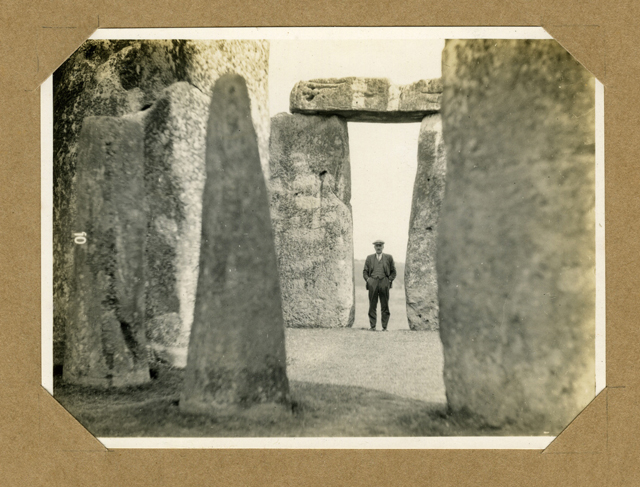
Figure 1
OGS Crawford photographed at Stonehenge in 1926. Crawford’s surviving appointments diaries, at the Bodleian, record only one visit to Stonehenge that year, on 27th July. The lintel above him still bears traces of the ‘restoration’ work 6 years earlier. Photographer unknown. Image courtesy of the OGS Crawford Photographic Archive, Institute of Archaeology, Oxford.
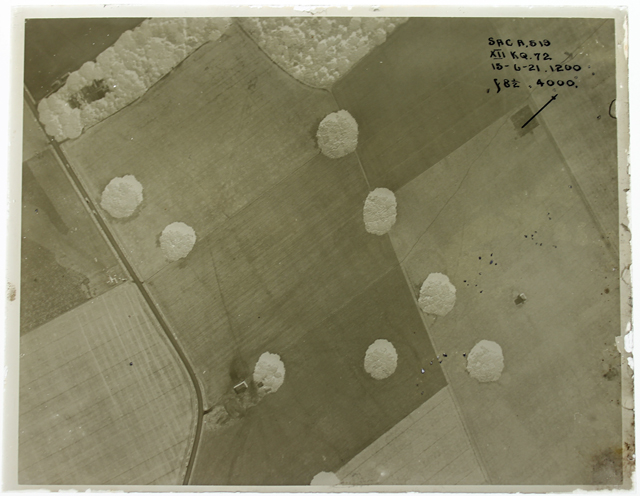
Figure 2
The glass negative on which Crawford first saw the traces of the Avenue, taken by an unknown RAF flier on 15th June 1921. This photo is of the reverse side, so everything appears the right way round. North to top right corner. With magnification, the Avenue can just be seen as two roughly parallel lines curving round between the last two trees towards the bottom right. Historic England Archive CCC8544/75. Photo: M Barber; ©Historic England.
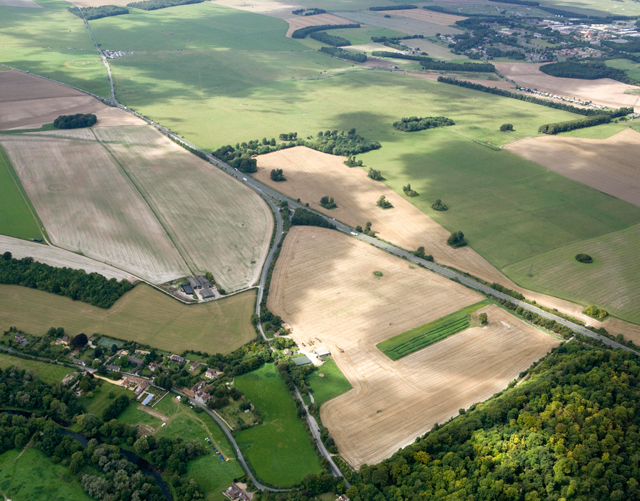
Figure 3
A view across the Stonehenge landscape encompassing the full course of the Avenue. North is to top right. Stonehenge can be seen in the distance top left; just above centre is King Barrow Ridge, the two copses north of the road being those containing the Old and New King Barrow groups. The Avenue runs through the gap between them before curving south-eastwards towards the River Avon, whch can be seen bottom left. Photo: Historic England Archive 26462/036, taken 27th August 2009 by Damian Grady; ©Historic England.
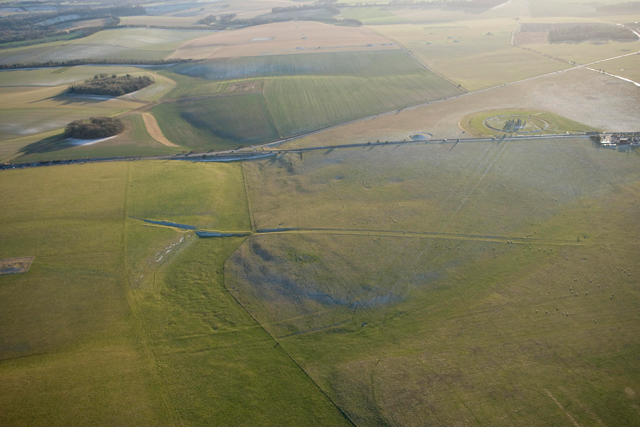
Figure 4
The branch of the Avenue running north-eastwards from Stonehenge, turning eastwards just below the centre of the photograph to cross Stonehenge Bottom. Traces of the track mistaken for the ‘northern branch’ can be seen around the point where the Avenue bends. Photo: Historic England Archive 26554/023, taken 30th January 2010 by Damian Grady, ©Historic England.
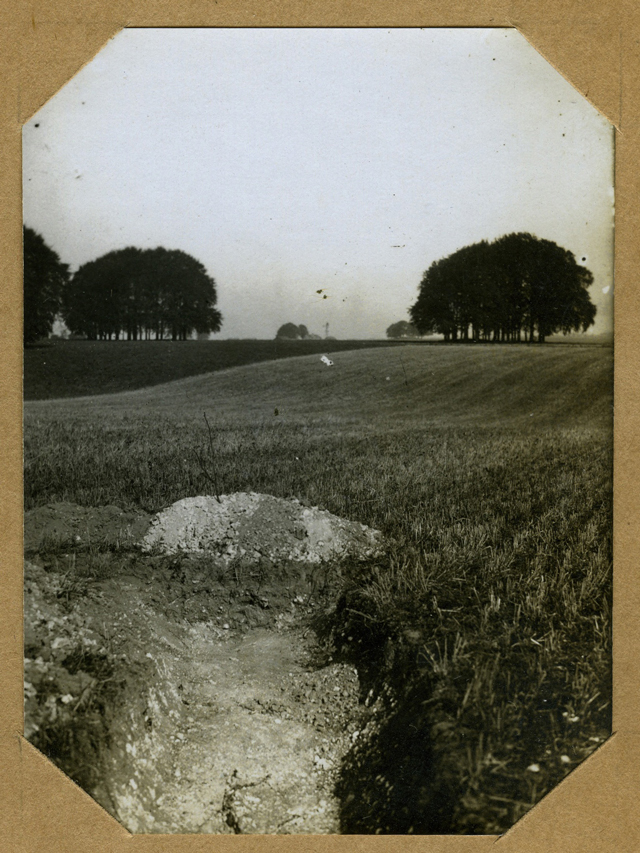
Figure 5
One of five contact prints in the Crawford Collection at the Institute of Archaeology, Oxford, showing the end of one of the excavation trenches with the Avenue ditch visible in section. These photographs were taken by Passmore. As far as I am aware, none of these photographs has been published previously. Image courtesy of the OGS Crawford Photographic Archive, Institute of Archaeology, Oxford.
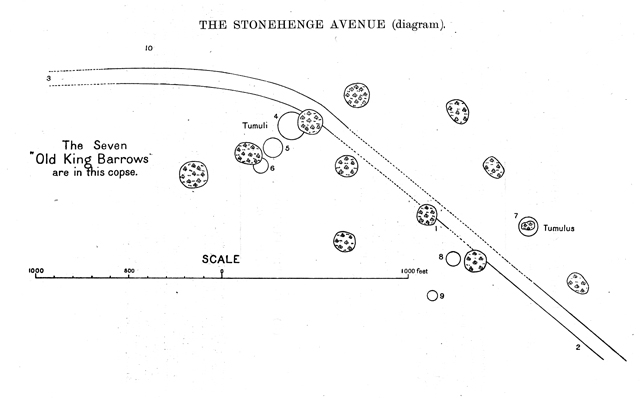
Figure 6
Part of the ‘new’ course of the Avenue, as published by Crawford (1924b). The numbers refer to the approximate location of the excavation trenches. Note that some of the circular ditched features visible on the RAF plates were also excavated in order to confirm that they did represent ditches surrounding plough-levelled round barrows. Crawford was assisted in this work by Colonel Hawley.