
1. INTRODUCTION
The reuse of building components is increasingly promoted as a key circular economy (CE) strategy in construction because it extends the use of materials with minimal reprocessing and can reduce embodied carbon, waste generation and demand for virgin resources (Castellani et al. 2015; Eberhardt et al. 2022). In practice, reuse remains challenging within conventional project frameworks, where decisions are influenced by fragmented responsibilities, programme pressures, compliance demands and established delivery routines (Tingley et al. 2017). Thus, the reuse challenge involves not only the availability of reclaimed components but also their integration into project decision-making and delivery processes.
Previous studies have identified a broad range of barriers and enabling factors, including economic, regulatory, technical and informational aspects (Margherita et al. 2021; Rakhshan et al. 2020). Other research has explored design-for-reuse strategies, digital tools and material-specific reuse solutions (Adams et al. 2017; Akanbi et al. 2018), while more recent studies increasingly view circular construction as an inter-organisational challenge that involves collaboration among multiple actors (Kooter et al. 2021; Rokio et al. 2024; Van Uden et al. 2025). However, they provide a less-detailed explanation of how these inter-organisational dynamics become organised around the specification of particular reclaimed components.
These studies provide important insights into the information, assessment and inter-organisational arrangements related to component reuse. However, these aspects are often studied separately, while material specification has received less ongoing focus as a key unit of analysis that links them around particular reclaimed components. This is significant because specification connects design intent with engineering assessment, procurement, compliance, and construction delivery. In the context of reuse, these activities are likely to be more uncertain, collaborative and iterative than in conventional projects. It evolves as material conditions become clear, different professionals interpret their implications, and project requirements are negotiated and revised. Studying material specification practices can therefore reveal how reclaimed components become assessable, acceptable and actionable within project delivery. The research question is:
How is material specification practice enacted in the reuse of building components in a construction project?
To answer this question, the paper draws on Schatzki’s practice theory and uses an in-depth qualitative case study of a large commercial refurbishment project in the UK. A practice-theoretical lens is valuable for understanding how practices are organised through practical understandings, rules, general understandings and teleoaffective structures and performed through interconnected doings and sayings (Schatzki 2002). Established material specification practice is therefore the focal object of analysis, examined in terms of how building component reuse prompts the reorganisation of its organising elements and the associated recomposition of the activities through which specification is performed.
The paper contributes to existing reuse research in two ways. First, it shifts focus from identifying barriers and enablers to examining how reuse is organised in practice within a project. Second, the study extends the identification of specification as an important interface between circular design intentions and construction delivery (Peretti & Druhmann 2019). Building on Jones’s (2019) focus on the specification decision, it demonstrates that material specification is not simply a technical or design activity but a key practice through which reuse is coordinated across project stages and professional boundaries. The empirical analysis compares specification decisions for structural steel, Portland stone and marble within the same project. It shows that the material specification was developed differently depending on when material conditions became known, how responsibilities were linked across professional practices, and whether project arrangements could meet the requirements of reclaimed components.
The paper is structured as follows. The next section describes the research context for the building component reuse in practice, alongside its organisational challenge and material specification as a focal site of implementation. Section 3 introduces the analytical framework. Section 4 explains the research design and methods. Sections 5 and 6 present the case study’s findings and discussion. Section 7 concludes by outlining the paper’s contributions and suggesting directions for future research.
2. LITERATURE REVIEW
2.1 BUILDING COMPONENT REUSE IN PRACTICE
Reusing building components requires project procedures that can accommodate uncertain material characteristics and availability, along with information, assessment and delivery plans that connect recovered components to intended applications. This need goes beyond simply determining whether a component is physically recovered, as reuse is also influenced by interacting technical, economic, regulatory, social and organisational factors (Rakhshan et al. 2020). The current literature below demonstrates how these factors affect project practice through adaptations to established procedures, phased information work and practical methods for assessing reclaimed components.
Conventional design and delivery procedures typically assume that products can be chosen based on predefined requirements and procured in consistent quantities and timescales. Reclaimed components challenge these assumptions because their availability can remain uncertain during the design process. Addressing this uncertainty may require greater flexibility in design and specifications, earlier assessment of available stock, and adjustments to programmes, procurement and contractual arrangements (Gorgolewski 2008). Consequently, component reuse influences not only product selection but also the development and modification of project requirements based on what is materially accessible.
Decisions regarding reuse also depend on information produced at different stages and on an intended application. Existing processes combine data collection about components with evaluation against criteria such as condition, technical performance, disassembly, logistics, risk and cost, followed by planning for subsequent use (Bellini et al. 2024). Research on timber reuse similarly demonstrates that reclamation, diagnosis and reuse involve alternative workflows with different information needs, costs and distributions of risk and benefit (Litleskare & Wuyts 2023). Thus, material information is not simply a fixed record of an existing component. Its usefulness depends on when it becomes available, the proposed use to which it is assessed and the resources dedicated to producing and maintaining it.
This informational work has been transformed into practical methods for recognising and assessing reusable components. Reclamation audits, inventories and reusability assessment procedures document material quantity, condition and characteristics, linking them to recovery potential and possible future uses (Devènes et al. 2024; Lambec et al. 2025). Demonstration programmes have expanded these methods into project contexts through pre-demolition audits, reclaimed-product specifications, and pilot applications involving clients, designers, contractors and technical specialists (Ghyoot et al. 2023). Danish demonstration projects have also gained practical experience in material reuse and design for disassembly, while demonstrating that broader adoption relies on ongoing development of knowledge, processes and supporting industry frameworks (Ottosen et al. 2021).
This literature shows that reuse depends on more than just the availability of recoverable components. It requires flexible procedures, application-specific assessments, and arrangements that allow material information to guide later project activities. Because these activities are distributed across design, reclamation, assessment and delivery, and are often undertaken by actors from different organisations, their implementation also raises questions about how expertise, responsibilities and decisions are connected across organisational and project-stage boundaries. The next section explores this inter-organisational dimension.
2.2 REUSE AS AN INTER-ORGANISATIONAL CHALLENGE
Building on studies of reuse implementation, a growing body of research has explicitly examined building reuse and CE construction as inter-organisational challenges, since construction projects distribute design, assessment, procurement, dismantling, certification and delivery responsibilities among actors who may enter the project at different stages and operate under different commercial and professional conditions. Circular construction can therefore be constrained by fragmented knowledge, responsibilities, incentives and institutional arrangements (Eikelenboom & van Marrewijk 2023; Kooter et al. 2021; Lindblad & Gustafsson 2026; Tingley et al. 2017).
Reuse can reshape both the project inter-organisation and its relationship with the wider construction sector. At the project front end, pursuing reclaimed components may redistribute actor roles, increase the need for knowledge sharing and generate new forms of value through the joint development of practices (Rokio et al. 2024). However, project-level CE initiatives remain embedded in established industry structures, which shape how circular ambitions are interpreted and implemented and whether they contribute to broader sectoral change (Kooter et al. 2021). These perspectives explain how reuse influences project organisation and interacts with broader institutional conditions, but they do not closely trace how requirements for individual reclaimed components are developed and revised through detailed project activities.
Research focusing on particular organisational actors and relationships further shows that reusing components requires changes to traditional project arrangements. From the perspective of Swedish property companies, Ericsson et al. (2024) find that typical project management methods, unclear responsibilities and limited skills hinder reuse efforts. They emphasise that early planning for reuse, organisational learning and adapted project management methods are important for enabling reuse. Alkki et al. (2025), studying business-to-business relationships in concrete-element reuse, reveal that actors’ experiences with circular solutions influenced their interactions and led to organisational and inter-organisational changes. These findings indicate that mere participation is not enough; actors must also develop competence, clarify responsibilities and modify working arrangements to effectively support reuse.
Practice-oriented studies better explain why such inter-organisational adjustments can remain challenging. Eikelenboom and van Marrewijk (2023) find that established practices of inter-organisational collaboration often reproduce conventional construction priorities and hinder the transition to circular construction. Van Uden et al. (2025), analysing practices associated with seven circular design strategies, similarly identify misalignments that limited the utilisation of secondary resources. These included conflicting understandings of quality, aesthetics and safety among project participants, as well as misalignment between municipal decision-making processes and the timing needed for circular design.
Together, these studies show that circular change relies on reorganising responsibilities, professional judgements, decision-making processes and established modes of collaboration across organisational boundaries. These perspectives provide important insights into broad organisational dynamics in CE construction. However, their primary units of analysis are property companies, business relationships, collaborative practices or broader sets of circular design strategies. They provide less-detailed explanations of how these inter-organisational dynamics connect around the evolving specification of individual reclaimed components.
2.3 MATERIAL SPECIFICATION AS A FOCAL SITE OF REUSE DECISION-MAKING
To examine how these inter-organisational dynamics influence whether and how reclaimed components are incorporated into a project, this study focuses on material specification practices. Jones (2019) provides an important methodological precedent by adopting the specification decision as the unit of analysis to examine the implementation of new material solutions in construction projects. This practice focus allows for examining material implementation in relation to the timing of project decisions, available resources and client performance objectives. Building on this approach, the present study views specification not as a single decision point but as a continuous project process through which design intentions and material evidence are translated into requirements relating to performance, quality, compliance, procurement and delivery.
This focus is particularly relevant to component reuse. Reclaimed components may introduce uncertainty regarding condition, dimensions, availability, provenance, performance, certification and compatibility with the proposed application (Rakhshan et al. 2020). Research on designing with reclaimed components has therefore identified the need for greater flexibility in design and specification, as well as adaptations in procurement, contractual arrangements and decision timing (Gorgolewski 2008). Information generated through surveys, assessments and reclamation activities must also be interpreted in relation to a proposed use and connected to subsequent design and delivery decisions (Bellini et al. 2024; Litleskare & Wuyts 2023).
Material specification provides a focused setting where technical and inter-organisational considerations come together around specific components. Although material specification is discussed within studies of design, assessment, procurement and compliance, it has received less sustained attention as a unit of analysis for examining how reclaimed components are evaluated, negotiated and incorporated into project requirements. This study investigates how reclaimed components are assessed, negotiated and translated into project requirements and delivery via material specifications. The following section presents practice theory as the framework for analysing how this existing project practice is reorganised.
3. ANALYTICAL FRAMEWORK
Practice theory provides a valuable perspective for understanding how complex work arrangements are organised and coordinated in daily life. Drawing on Schatzki (2002: 87), it is:
a temporally evolving, open-ended set of doings and sayings linked by practical understandings, rules, teleoaffective structures and general understandings.
Practice theory views social life as structured by practices, routine activities that shape how individuals perform tasks, interpret situations and work with others (Nicolini 2012; Schatzki 2002). From this perspective, social and organisational outcomes emerge from the continuous performance and coordination of practices rather than from fixed institutional arrangements. Practice-based approaches have therefore been adopted in organisation and management research to investigate how work is enacted through situated activities and interactions (Feldman & Orlikowski 2011; Gherardi 2012). These perspectives are especially valuable in contexts characterised by distributed expertise and the need for coordination among multiple actors.
According to Schatzki (2002), social organisation develops through bundles of practices and material arrangements. The present analysis highlights practices while recognising that they are inseparable from the material arrangements with which they are bundled. In the context of component reuse, the consequential material arrangements involved the reclaimed components themselves as well as their physical properties, condition, dimensions and recoverability, which emerged as the project progressed. These material conditions enabled, constrained and redirected the activities through which specifications were developed and revised.
Although practices and material arrangements are important in Schatzki’s account, the present analysis focuses primarily on the organisation of practices through four interconnected elements: practical understanding, general understanding, rules, and teleoaffective structure. More specifically:
Practical understandings refer to the embodied know-how that enables practitioners to perform activities and respond appropriately within specific contexts. In professional settings, this includes the tacit skills and experiential knowledge that guide how actors perform tasks and interpret situations.
General understandings are broader perspectives on what is suitable, valuable or desirable within a practice. These shared cultural and normative understandings influence how practitioners interpret the importance of their activities and the values linked with them.
Rules are explicit or implicit guidelines that direct how practices should be performed. These may include formal regulations, professional standards, contractual requirements or established procedures that define acceptable actions.
Teleoaffective structures relate to goals, projects and associated emotional orientations that organise practices. They influence the goals practitioners aim for and the emotional commitments that drive participation in specific activities.
For material specification, four elements clarify how material specifications are organised and why they change under conditions of reuse: (i) practical understandings influence how actors evaluate material conditions, technical feasibility and design implications; (ii) rules determine how reclaimed materials are assessed for certification and contractual and industry standards; (iii) general understandings shape perceptions of acceptable quality, value and suitability in design and delivery; (iv) teleoaffectuve structures highlight how commitments to CE goals, risk mitigation or project delivery shape actors’ attitudes towards reuse. This paper uses these elements to guide the analysis of how material specification practices are interpreted, organised and adapted within reuse contexts.
Schatzki (2002) emphasises that practice organisations are not static. Changes in understandings, rules and teleoaffective structures that organise a practice constitute its reorganisation, while changes in the doings and sayings composing the practice constitute its recomposition. Practical understandings may also evolve as participants encounter new situations and learn to perform activities differently. Reorganisation and recomposition are interconnected: changes in rules, understandings and teleoaffective structure may modify what participants do and say, while new activities and experiences can contribute to changes in how a practice is organised. This perspective is well-suited to analysing material specifications as an evolving practice rather than a discrete decision. As information about reclaimed components emerges and project participants interpret its implications, one or more of the practical understandings, general understandings, rules and teleoaffective structures organising the specification may be revised, along with the activities and interactions through which specifications are developed and implemented.
Thus, the analysis traces how specifications for specific reclaimed components were developed and revised as the project progressed. Unlike standard new products, reclaimed components might have uncertain availability, condition, dimensions, provenance and performance, some of which are only identified through surveys, assessments and dismantling. As this information became available, project participants needed to decide whether a component could satisfy design, technical, regulatory, procurement and delivery standards, and whether those standards themselves required adjustment. The practice perspective highlights both the reorganisation of the elements shaping these judgements and the recomposition of the activities through which they were made. Specification is therefore seen as an evolving process where material information, professional evaluations and project requirements are gradually connected, revised and translated into decisions about the intended reuse. Consequently, it explains how reuse manifests through the reorganisation of material specifications, rather than viewing reuse solely as a set of barriers or enabling conditions.
4. METHODS
4.1 RESEARCH DESIGN AND CASE SELECTION
This research is grounded in an exploratory, qualitative, single-case study to examining how circular material specification practices evolve for building component reuse in construction projects. Case studies are particularly effective for exploring complex organisational processes involving multiple actors and interactions in real-world contexts (Yin 2018). In construction projects, decisions about material specifications are influenced by continuous collaboration among organisations, including architects, engineers, contractors and clients. Moreover, the study is exploratory because the way material information, professional judgements and project requirements are connected and revised within specification practice remains poorly understood. A single-case study approach allows researchers to examine complex organisational processes within their real-life context and to trace how interactions between actors unfold over time (Eisenhardt 1989; Yin 2018).
Several of these activities had also occurred before the fieldwork began. Although an ethnographic approach could have provided richer direct observation of specification activities as they occurred, it would not have captured the full development of processes that had already evolved across organisational and temporal boundaries (Hammersley & Atkinson 2019). Retrospective interviews and selected project documents were therefore employed to reconstruct the development of the material specifications. The aim was not to achieve statistical generalisation or to suggest that identical outcomes would be replicated in other projects but to develop tentative explanatory patterns that can be tested through future comparative research (Flyvbjerg 2006).
This study examines an ongoing commercial refurbishment project in a UK city. The project’s client organisation is a major commercial property developer with a large portfolio of city-based office developments. Over several development cycles, the organisation had formalised its sustainability ambitions through internal briefs, performance targets and project review processes. Its portfolio-based operating model also enabled coordination between donor and recipient projects, creating the organisational conditions for reclaimed steel from one development to be incorporated into another. The case was therefore selected as an information-rich setting in which component reuse was pursued through established sustainability governance and cross-project material coordination. At the time of data collection, the project had entered the construction stage, with handover and use yet to occur (Figure 1).
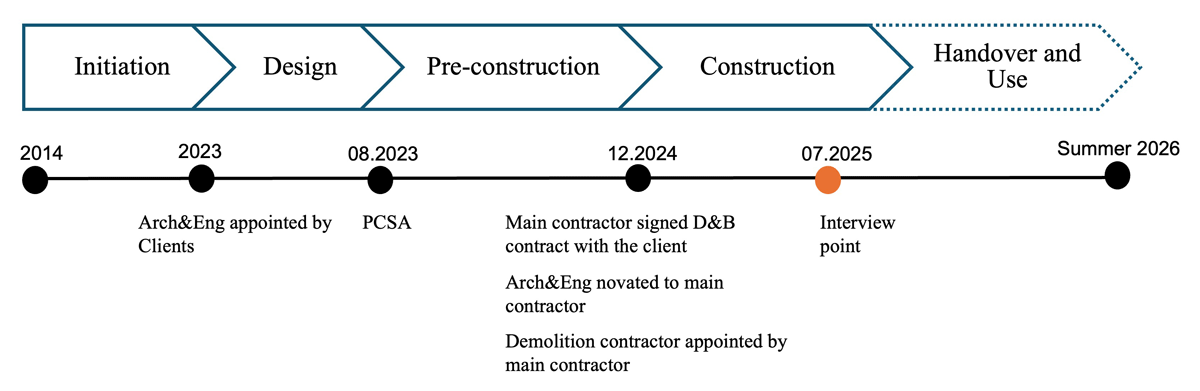
Figure 1
Project timeline and stage at data collection.
Additionally, the case was chosen because it involves detailed material specification vignettes related to the reuse of structural steel, Portland stone and marble from the same project. These vignettes were bounded around the sequence of activities and decisions through which requirements for a particular reclaimed component were developed, assessed and revised. Comparing them helps to distinguish project-wide influences from material-specific conditions, such as differences in material availability, technical assessment and reuse outcomes.
The project operated within a regulatory framework that encouraged CE practices. The local planning authority required major developments to submit a CE statement as part of the planning approval process but it did not specify material-specific requirements. These vignettes were developed later through design, assessment and delivery. CE integration was primarily driven by client ambitions but also influenced by planning policy expectations.
4.2 DATA COLLECTION
The primary data consisted of eight semi-structured interviews with participants directly involved in developing, assessing, coordinating or approving the three reuse options. Purposive sampling targeted key professional and organisational roles involved in the specification decision: the client sustainability lead, senior architect, two structural engineers, the main contractor project manager, the demolition specialist, the reclaimed-steel supplier and the sustainability consultant. Interviews were conducted online or in person, lasted 45 to 60 minutes and were recorded with participants’ consent and transcribed.
The interviews were conducted to retrospectively reconstruct how the three material options evolved and to examine the activities, requirements, judgements, interactions and concerns that shaped their specifications. Participants were informed that the study aimed to understand how component reuse decisions developed within the project and how established working methods changed in response. The interview guide (Appendix A in the supplemental data online) was shaped by the four elements of practice theory described above. Instead, interviews were supplemented by a review of project CE strategy and client brief, planning documents, material inventories, drawings, public project reports and photographs. These sources were used to identify formal ambitions and requirements, reconstruct the sequence of material decisions, clarify component availability and intended applications, and compare documentary evidence with participants’ retrospective accounts.
The analysis relied primarily on retrospective interviews with professional participants and selected project documents. To reduce reliance on individual memories, accounts from various professional roles were compared and checked against documentary evidence. However, the study did not include direct observation or interviews with operatives involved in dismantling, protection, storage and installation. Therefore, the evidence provides greater insight into how specifications were developed and revised than into how they were implemented through daily site activities.
4.3 DATA ANALYSIS
Data analysis followed an abductive approach, moving iteratively between the empirical material and concepts from practice theory (Timmermans & Tavory 2012). NVivo was used to organise and retrieve transcripts and documents.
First, the evidence was structured around the three key material vignettes, with a retrospective narrative developed for each. This narrative tracked stages such as identification, assessment, design development, specification, procurement and delivery, based on the available evidence. The initial coding closely reflected participants’ accounts, capturing activities, interactions, material conditions, information flows, responsibilities, requirements, feasibility and quality judgements, project goals, concerns, and adjustments in reuse outcomes.
Second, these empirical codes were compared with a practice-theoretical framework. The four organising elements were used as sensitising concepts to examine how specification practice was reorganised, while changes in activities, interactions and work sequences were analysed as part of its recomposition. This interpretation was iterative: emerging explanations were checked against the transcripts, documentary evidence and contrasting materials vignette, and the theoretical language was refined where the empirical material did not fit the initial interpretation.
Finally, the three vignettes were compared to identify recurring and contrasting patterns. Particular attention was paid to how material conditions, information availability, project timing and professional participation influenced whether reuse options were promoted, adjusted or restricted. Interpretations were checked across participants and against documentary evidence, including cases where accounts differed or where reuse ambitions were only partly realised.
5. FINDINGS
5.1 PRACTICAL UNDERSTANDINGS: DEVELOPING THE KNOW-HOW TO SPECIFY RECLAIMED COMPONENTS
Building component reuse required project participants to develop and connect forms of practical know-how that were not normally brought together during the specification process. For structural steel, the key change was from designing a structural frame and subsequently procuring standard sections to designing in relation to an existing stock of reclaimed steels. The structural engineers were involved in both the controlled dismantling of the donor building and in the design of the new project. They recorded the dimensions, grade, condition, existing holes and recoverability of individual members in a shared material inventory, which enabled the design team to assess how particular members could be incorporated into the new structural frame. Practical understanding, therefore, is developed through learning how to evaluate available components, respond to their constraints and adapt the design accordingly.
The inventory and design drawings allowed engineers to allocate available reclaimed steels to structural bays and assess where deeper or wider sections could be included. Architects and engineers consequently held earlier and more iterative coordination meetings than in their typical projects. As the architect explained,
Usually we would just say, ‘here’s the architectural design, please go off and do a structural design’, but instead we had to be much more and early communicative with them to go through each part of the building.
This shift towards designing around the available reclaimed steel changed the timing and composition of specification work: material investigation, structural assessment and architectural coordination occurred before the structural scheme was finalised, while contractors and fabricators later contributed knowledge of testing, connections, hole infilling and splicing.
Portland stone required different practical understanding because its reusability could not be established during early design. Occupation of the donor building restricted intrusive surveys, while hidden steelwork, cracking and the backing construction could not be confirmed from drawings or visual inspection. Reuse therefore depended on selective dismantling and continuing site-based assessment. Demolition specialists assessed whether elements could be removed intact, while architects evaluated condition, staining, dimensional variation and visual coherence as work progressed.
For marble vignette, architects initially specified predefined quantities and dimensions of intact panels based on early surveys. However, no sufficiently coordinated practical routine was established to ensure the panels’ preservation during removal, storage and transport. Practical work shifted from whole marble panels to decorative reuse and terrazzo. As the architect recalled,
As soon as they started taking the panels off, there was damage […] between the start and the end we ended up with considerably less marble than what we wanted.
Across the three material vignettes, practical understandings did more than provide technical input to specification. They shaped the activities undertaken, the timing and scope of specialist involvement and the forms of reuse that remained feasible.
5.2 GENERAL UNDERSTANDINGS: REDEFINING QUALITY, SUITABILITY AND REUSE
The three material vignettes also required participants to reconsider what reclaimed materials are and what qualifies as an acceptable reuse outcome. For the reclaimed steel vignette, professional groups understood the same material through different perspectives. The client regarded the donor steel as a portfolio resource opportunity. Architects saw irregular sections as a coordination challenge. Engineers treated them as technically uncertain components requiring verification, while the contractor associated them with certification, warranty and programme risk. These differences narrowed as inventories, testing and recertification translated the stock into familiar engineering categories and made it technically defined and warrantable. This did not make reclaimed steel equivalent to new steel: dents, scratches and dimensional variation still limited visible applications. Its acceptability therefore depended on separating structural performance from visual perfection expectations.
The general understanding of Portland stone also developed as more information about the material became available. Architects initially saw Portland stone as durable and straightforwardly reusable. Later investigations showed that appearance alone could not determine its suitability, as hidden steelwork or internal deterioration might undermine seemingly sound elements. Reusability was understood as provisional, depending on dismantling and inspection. At the same time, the team revised their view of acceptable material quality. As the architect explained:
You’re dealing with stuff that isn’t new. It’s not clean, it can be stained, it is weathered, and that’s something that we and the client have to accept.
Staining, weathering and variation were therefore regarded as expected features of reclaimed stone rather than simply as defects compared to new facade materials. When evaluated as part of the overall facade, this variation created a patchwork effect that the architect described as adding character. Reuse, therefore, required a broader perspective on facade quality, where coherence could coexist with visible material history.
Initially, reusing marble meant recovering intact panels and reinstalling them in designated locations. When damage made this impossible, the material was redefined from a set of components to a resource whose value could be maintained through transformation. The architect described the resulting revision as a development of the reuse intention rather than its complete abandonment. The eventual acceptance of decorative applications and terrazzo preserved the material’s value but diverged from the original goal of component reuse. The architect stated:
It’s not compromised, it’s just development […] understanding what’s there, understanding the material and the limitations of that material, and then understanding how we could best use that.
These findings show that reuse outcomes partly depended on how actors defined material identity and acceptable quality. Steel remained a component for reuse because irregular members could still fulfil structural functions after verification and adaptation. Portland stone remained a facade component despite changes to its backing and appearance. Marble shifted from component reuse towards material-level transformation. Therefore, general understandings shaped not only whether reuse was accepted but also which form of reuse was recognised as feasible.
5.3 RULES: ESTABLISHING THE CONDITIONS UNDER WHICH REUSE COULD PROCEED
Rules did not just support or obstruct reuse; they set different acceptability levels for various materials and assigned responsibility for proving those thresholds were met. At project level, the CE statement and client brief formalised an expectation to explore reuse without prescribing how individual components should be assessed. Material-specific rules became more important as each option developed.
For structural steel, certification, structural performance, traceability, warranty and insurability established definite conditions for entry into the structural system. As the main contractor explained:
For materials coming onto the site, we absolutely have to follow formal requirements. Whatever the material is, it must be certified, it must be insurable, and it must comply with the relevant standards […] before we agree to reuse anything, all the certification and compliance documents have to be in place.
The contractual structure also affected responsibility. The Pre-Construction Services Agreement (PCSA, which is used to appoint a design and build contractor to carry out services before entering into a formal building contract) allowed the contractor to contribute to buildability, procurement, and fabrication before the main contract, while the subsequent design and build arrangement shifted responsibility for technical design coordination to the contractor. These arrangements incorporated supplier capability, warranty, and procurement considerations into specifications before construction. Rules were therefore not relaxed for reclaimed steel; instead, additional work was undertaken to ensure the material aligned with existing regulatory and contractual requirements.
Portland stone was subject to a different regulatory environment. Because it was reused as facade cladding rather than as a primary structural element, it did not require a separate reuse certification process comparable to that for steel. Its suitability was evaluated based on the overall facade performance, safe installation and visual coherence. Cost and programme considerations were key project constraints. Careful dismantling extended the demolition process and delayed the point at which the final building could generate rental income. The client described the programme implications:
When we took the building down, it took longer, which means it takes longer for the building to complete, and it means we can’t then rent it […] we want to complete the building as quickly as we can so that we can get it rented and used.
For marble, the existing delivery arrangements did not establish sufficient continuity of responsibility for protecting panels during removal, storage, transfer, and return to the site. As the architect reflected:
Unless there’s someone on top of all of this, making sure that everything that’s to be reused is completely protected and all the contractors understand exactly what it’s going to be reused for, it will just be thrown in a box and thrown in a van.
The problem was the lack of a clear rule assigning responsibility for its protection among various contractors and handovers. Preserving whole panels would have required clearer instructions, additional protection, more time and a defined allocation of liability for damage. Because these arrangements were not established early enough, the original panel-based specification could not be sustained.
Therefore, rules shaped different material reuse pathways. For steel, formal verification enabled reuse at scale. For Portland stone, professional assessment and bounded commercial tolerance enabled continued reuse. For marble, unchanged delivery and liability conditions constrained component preservation and favoured material transformation.
5.4 TELEOAFFECTIVE STRUCTURES: ALIGNING CIRCULAR AMBITIONS, CONFIDENCE AND DELIVERY PRIORITIES
Although participants broadly supported CE objectives, they attached different priorities and emotions to the three reuse options. Reorganisation involved changes in how circular ambitions were prioritised relative to design quality, technical confidence, programme, cost and risk.
Steel reuse was initially a strong client objective. However, the shared aim of maximising reclaimed steel did not initially lead to a common view on its feasibility. Engineers worried about unknown grades and irregular sections, architects were concerned about coordination and loss of design control, and contractors linked reuse to programme delays and warranty issues. Confidence grew when the same engineering team documented the donor steel and created a verified inventory. Early workshops helped architects see irregular sections as manageable design challenges, while trusted suppliers reassured the contractor that testing and recertification could be undertaken within recognised processes. The affective orientation shifted from uncertainty to professional confidence and ownership.
Portland stone reuse remained desirable but became more explicitly conditional. Architects acknowledged the tension between their ambition to reuse as much as possible and the commercial realities of construction. One architect described these aspirations as ‘romantic ideas’ that had to be reconsidered as hidden conditions, cost and programme implications became clearer. The client also recognised that careful dismantling would delay completion and rental income. Continued commitment therefore depended on defining acceptable limits rather than pursuing maximum reuse regardless of consequences. The material’s contribution to the project narrative and identity also supported continued engagement despite uncertainty.
In the marble vignette, commitment to reuse survived the failure of the original design intention, but the desired end changed. Architects expressed disappointment as panel damage accumulated, while demolition and main contractors emphasised what was realistically achievable. As the demolition contractor explained:
There is always some negotiation and compromise. Everyone starts with the ambition to reuse as much as possible. But you have to be honest about what’s achievable.
Rather than abandoning the material, participants accepted alternative outcomes that preserved some material value. Teleoaffective alignment, therefore, occurred around continued reuse in principle but not around the original whole-panel scheme.
Throughout the vignettes, CE ambition was not a static goal that operated separately from other project concerns. Instead, it was consistently reordered in relation to confidence, professional responsibility, commercial priorities and perceptions of feasible action. This ordering shaped whether participants continued to invest effort in a reuse option and whether they accepted modifications to the intended outcome.
5.5 REORGANISATION, RECOMPOSITION AND MATERIAL REUSE OUTCOMES
The comparison shows that the four organising elements changed relative to each other. New practical understandings alone were insufficient unless rules allowed the material to follow recognised project procedures, general understandings supported its quality and value, and participants remained committed to resolving uncertainty. These changes were implemented through recomposed activities and interactions: earlier surveys, shared inventories, joint workshops, testing, selective dismantling, site-based assessment, negotiation of acceptable variation, and revision of material requirements.
The reuse outcome nevertheless varied. Steel specifications were reorganised around early material knowledge, formal verification and cross-project coordination, allowing reclaimed members to be incorporated at scale. Portland stone specifications remained provisional for a longer period and advanced through selective recovery, technical adaptation and acceptance of aesthetic variation within cost and programme limits. Marble specifications were less effectively linked to dismantling and handling practices; once whole-panel reuse became unfeasible, the material was redirected into alternative applications.
Material specification practice was therefore not reorganised through a single, transferable process. Reuse involved material-specific adjustments to knowledge, rules, meanings, priorities and activities. These adjustments determined whether the original reuse intention could be maintained, whether it had to be altered or whether component reuse was replaced by a lower-order material transformation.
Table 1 summarises the configuration of material specifications, practices and reuse outcomes across the three material vignettes.
Table 1
Configuration of material specification, practice and reuse outcome across the three material vignettes
| ANALYTICAL ELEMENT | STRUCTURAL STEEL | PORTLAND STONE | MARBLE |
|---|---|---|---|
| Practical understandings | Inventory-led design, testing and recertification | Selective dismantling and site-based assessment | Limited coordination of panel protection; shift to alternative uses |
| General understandings | Verified structural reliability, with aesthetic limitations | Weathering and variation accepted as part of material history | Reuse redefined from panel retention to material transformation |
| Rules | Certification, traceability, warranty and procurement requirements | Facade performance, installation, cost and programme limits | Programme, protection and liability constraints |
| Teleoaffective structures | Client ambition supported by increasing professional confidence | Reuse balanced against cost, programme and rental priorities | Commitment remained, but the whole-panel objective was revised |
| Recomposition | Earlier investigation, shared inventory, workshops and testing | Repeated assessment, technical adaptation and negotiated variation | Revised specification, decorative reuse and terrazzo production |
| Reuse outcome | Component identity and structural function retained | Conditional component reuse within the facade | Whole-panel reuse replaced by material transformation |
6. DISCUSSION
6.1 EMERGING MATERIAL INFORMATION REORGANISED SPECIFICATION PRACTICE
Research on reuse has emphasised audits, inventories, diagnosis and information transfer. Gorgolewski (2008) shows that designing with reclaimed components depends on knowing what stock is available, while Litleskare and Wuyts (2023) and Bellini et al. (2024) clarify the informational work needed to identify, assess and plan for reusable materials. Related studies indicate that reclaimed components require additional documentation, evaluation and regulatory interpretation before being used in projects (Condotta & Zatta 2021).
The steel vignette confirms this literature. A shared inventory translated the donor structure into identifiable members, allowing the frame to be developed around known sections. However, comparison with Portland stone and marble shows that material information was not always complete before specification decisions were made. Instead, it continued to emerge through dismantling, assessment, storage and handling, requiring decisions and requirements to be repeatedly revised. In both cases, the material became knowable as the project work advanced.
Thus, information was created and maintained through practice rather than simply collected and transferred. In other words, emerging information did not influence specification automatically, from a practice perspective. Its value depended on practical understanding for assessing feasibility, rules defining what counted as sufficient evidence, general understandings of acceptable quality, and teleoaffective judgements about whether further effort was justified. New information could therefore reorganise the elements shaping specifications and recompose the activities through which requirements are assessed and revised. The marble example is especially instructive: better documentation alone would not have preserved the panels if handling routines, responsibilities and programme allowances had remained the same. Information-centred approaches explain an important part of reuse but can understate how knowledge is shaped by activities that recover, protect and transform components. Specification was recursive: emerging information revised requirements, while requirements determined what additional evidence and care for materials were needed.
6.2 COORDINATION IS MATERIAL-SPECIFIC AND REQUIRES CONTINUITY
Inter-organisational research has advanced reuse studies beyond barrier lists by demonstrating how circular projects redefine actor roles, value creation and knowledge sharing (Kooter et al. 2021; Rokio et al. 2024). Ericsson et al. (2024) emphasise property companies as key decision-makers, while Alkki et al. (2025) illustrate how experience shapes interaction and adaptation. Practice-oriented studies further reveal that established collaboration can either facilitate or hinder circular change and that alignments and misalignments among practices influence outcomes (Eikelenboom & van Marrewijk 2023; Van Uden et al. 2025).
Comparison of the three material trajectories shows that cross-organisational interaction and a shared CE objective did not, by themselves, ensure effective coordination. Their effectiveness depended on whether material-specific information, requirements and responsibilities remained connected across successive activities and organisational handovers. For steel, the same engineering team connected donor assessment with recipient design, while inventories, workshops, testing and supplier input linked successive activities to a common component-level requirement. Portland stone involved less certainty, yet repeated exchanges allowed dismantling evidence to revise design and installation requirements. Marble involved multiple organisations and ongoing support for reuse, but responsibility for preserving panels throughout removal, storage and transport was not linked strongly enough to the architectural intention.
Coordination is therefore better understood as a material-specific accomplishment rather than as a stable project-wide attribute. It depends on whether activities performed in one practice remain consequential in another: whether demolition protects what design intends to reuse, whether engineering evidence enters procurement and whether responsibility follows the component across organisational and temporal boundaries. This qualification complements Rokio et al. (2024) and Kooter et al. (2021): changing roles and joint practice development matter, but their effectiveness rests on continuity and accountability. It also supports Eikelenboom and van Marrewijk’s (2023) critical observation that collaboration can reproduce established delivery priorities. A marble vignette illustrates how a visible CE ambition can coexist with conventional programme, handling and liability arrangements that disrupt the practical continuity required for component reuse.
6.3 PRACTICE REORGANISATION AND DIFFERENTIATED SPECIFICATION OUTCOMES
Previous studies have recognised early material information, inter-organisational collaboration and flexible design processes as important conditions for component reuse (Bellini et al. 2024; Gorgolewski 2008; Kooter et al. 2021; Litleskare & Wuyts 2023; Rokio et al. 2024). Although the three material vignettes shared the same client, formal CE expectations and broader delivery context, they produced different reuse outcomes. Other research emphasises the roles of property companies, professional experience and adaptation within organisational relationships (Alkki et al. 2025; Ericsson et al. 2024), while practice-oriented studies demonstrate how alignments and misalignments among established practices influence circular outcomes (Eikelenboom & van Marrewijk 2023; Van Uden et al. 2025). These studies establish important enabling conditions but provide less explanation of why they may produce different outcomes for materials developed within the same project. This research clarifies that project-wide conditions supported reuse, but their effects depended on whether material knowledge, professional responsibilities, formal requirements, understandings of quality and commitment to reuse were interconnected within the specification of each material.
Structural steel specification was reorganised early through relatively formalised procedures. Information about the available stock was linked to engineering assessment, certification, procurement and supplier involvement before the structural scheme was finalised. Portland stone followed a more provisional trajectory because its condition and recoverability were established through investigation and dismantling, requiring ongoing revision of technical solutions and acceptable visual differences. Marble was approached more reactively. Although an initial comprehensive specification had been developed, dismantling, storage and handling practices were not sufficiently aligned with that intention. Once the panels were damaged, the specification was revised to accommodate alternative material uses.
These differences influence the tendency to regard information, broader participation or design flexibility as generally enabling reuse. All three material vignettes involved information exchange, multiple professional actors and some adjustment of project requirements, yet these conditions did not have equivalent effects. What mattered was whether material knowledge, professional responsibilities, formal requirements, understandings of quality and commitment to the intended reuse outcome became mutually supportive. When these relationships were established early, as with steel, component reuse could influence the developing specification. When information developed gradually, as with Portland stone, the specification remained provisional but continued to support component reuse. When specification requirements were weakly linked to subsequent activities, as with marble, the intended outcome had to be reformulated.
Practice theory explains these differences through the relational reorganisation of practical understandings, rules, general understandings and teleoaffective structures. Their reorganisation was enacted through the recomposition of activities such as surveying, inventory development, testing, coordination, selective dismantling and specification revision. Building on Jones’s (2019) use of the specification decision as a focused unit of analysis, this study expands the focus to the practice through which such decisions were created, modified and applied across project stages. Material specification for reuse thus emerged as an evolving, recursive practice: emerging information about component condition and recoverability prompted revisions to material-specific requirements, while those requirements directed further assessment, dismantling, handling and design work. Its development varied depending on when material conditions were identified, how responsibilities were connected across practices and whether project rules and priorities accommodated the needs of each reclaimed component.
7. CONCLUSIONS
This paper has examined how material specification practice was enacted in the reuse of building components within a commercial refurbishment project. The comparison of structural steel, Portland stone and marble shows that the specification for the reuse of building components was neither a fixed document nor a single decision made at a single project stage. It evolved as the material conditions were understood, leading different professional actors to evaluate their implications and revise project requirements. The form this process took varied by material. Steel reuse was organised early around an identified donor building and formal verification requirements. Portland stone specification remained provisional as its condition and recoverability emerged during dismantling. Marble followed a more reactive course, as the original whole-panel intention was replaced by alternative uses after the panels were damaged. Therefore, material specifications were enacted differently depending on when relevant knowledge became available, how responsibilities were linked across project stages and whether project arrangements could accommodate the requirements of a particular reclaimed component.
Theoretically, the study contributes by treating CE material specification as an evolving unit of analysis for component reuse. Existing research has identified information, assessment, collaboration, regulation and design flexibility as important conditions for reuse. The analysis shows that these conditions do not operate independently or have uniform effects across materials. Their significance depends on how they become connected within specification practice. Information must be interpreted and translated into requirements; participation must be linked through ongoing responsibilities; and formal CE ambitions must be reconciled with understandings of material quality, risk and project delivery.
Schatzki’s practice theory helps explain these differences through the reorganisation of practical understandings, rules, general understandings and teleoaffective structures, together with the associated recomposition of doings and sayings. The three material vignettes demonstrate that similar project-level CE expectations can produce different reuse outcomes because the elements organising specification are configured differently around each material. The study extends attention from the presence of general barriers and enabling conditions to the situated organisation of the practice through which reclaimed components are evaluated and incorporated into project requirements.
In practice, the findings suggest that early identification of reusable components should be linked to subsequent decisions and responsibilities required to preserve their reuse potential. Material information needs to reach actors capable of translating it into design, compliance, procurement and delivery requirements. Responsibility should also remain sufficiently continuous across assessment, dismantling, storage, transport and installation, particularly for components whose condition is easily damaged during handling. A single reuse procedure is unlikely to be appropriate for all materials. Structural steel may require formal inventories, testing and certification, while stone and interior finishes might rely more on careful dismantling, protection measures, provisional requirements and accepted standards of variation. When an intended component reuse outcome is changed, the reason for the change and the resulting form of material use should be clearly documented.
It is exploratory research that focuses on a single project, limiting the applicability of its findings to other organisational, contractual and regulatory contexts. However, the three contrasting material vignettes provide a valuable within-case comparison. Since steel, Portland stone and marble were used within the same client organisation and overall project environment, their differing outcomes highlight how material-specific conditions and arrangements influenced specification practice. Additional comparative cases would be necessary to determine whether the patterns identified here are also present across different clients, procurement routes, building types and jurisdictions. Further limitations arise from the timing and sources of the research. The project was ongoing during data collection, so some final reuse outcomes and longer-term performance could not be verified.
Future research could combine cross-project comparison with longitudinal observation, following reclaimed components from initial identification through to installation and use. Including operatives, fabricators and logistics providers would offer a more comprehensive understanding of how specification requirements are enacted during delivery. Additionally, research might explore whether the changes identified here become embedded as routine organisational practices or if they remain reliant on unusual portfolio opportunities, dedicated individuals and specific material circumstances.
AUTHOR CONTRIBUTIONS
S.G.: Conceptualisation, methodology, formal analysis, and writing- original draft. K.J.: Conceptualisation, supervision, and writing- review and editing. J.X.: Conceptualisation and supervision- review and editing. J.G.: Conceptualisation and supervision- review.
DATA ACCESSIBILITY
Owing to the confidential nature of participant interviews and ethical considerations regarding the protection of professional identities, the data are not publicly available.
ETHICAL APPROVAL
This research adhered to ethical protocols and received ethics approval from the University Ethics Committee (ethical consent number 28179/001). It followed the UK General Data Protection Regulation (GDPR) (Data Protection Act 2018) and the Information Commissioner’s Code of Practice (2012).
SUPPLEMENTAL DATA
Supplemental data for this article can be accessed at: https://doi.org/10.5334/bc.838.s1