
1. INTRODUCTION: WHAT IS RECONSTRUCTION?
There are hundreds of studies on post-disaster reconstruction, but few of them have attempted to conceptualise it critically. This means that even though disasters are more frequent—and some are increasingly predictable—it is hard for decision-makers to anticipate what will happen afterwards. Although common patterns emerge during reconstruction, those responsible for change have few conceptual tools with which to predict challenges, anticipate possible outcomes and assess common variables (Lloyd-Jones 2006). In other words, they must ‘reinvent the wheel’ after every disaster (Edgington 2011). In part because of this, most countries lack ‘institutionalized task-specific structures for recovery prior to the event’ (GFDRR 2015: 66). Actions taken in the aftermath of disasters therefore fall into legal and administrative limbos after states of emergency and other ‘exceptional measures’ end. Temporary solutions tend to become permanent (Tanji et al. 2018) and cannot be governed through ‘regular’ regulations and laws (Rotimi et al. 2011). This conceptual and procedural uncertainty adds anxiety, communication problems and unpredictability to a process that is expectably stressful—but also surprisingly repetitive.
Think, for instance, of relocation. Disasters create (an often momentary) awareness of hazard exposure (Birkland 1997). Relocating survivors is thus frequently seen as a solution to reduce risk (Cernea & McDowell 2000; Oliver-Smith & de Sherbinin 2014). Yet, relocation often leads to loss of social networks, deteriorating mental health and other problems (Oliver-Smith 1991). Something similar happens with temporary solutions. Several factors can justify the use of temporary settlements (Lines et al. 2022), but they facilitate urban sprawl (Johnson 2007), disrupt social networks (Hooper 2021) and raise infrastructure costs in the long run (Johnson 2007). High-tech temporary shelters are sometimes abandoned (Félix et al. 2013), tend to become permanent, despite being substandard (Corsellis & Vitale 2005), and are as expensive as permanent solutions (Johnson 2002). Despite this knowledge, decision-makers repeatedly opt for relocation (McAdam & Ferris 2015) or high-tech temporary solutions (Davidson et al. 2008) without considering their long-term consequences. Reconstruction also requires hard decisions about social justice, cost, time, quality and safety. Under the pressure to act quickly and demonstrate action, decision-makers struggle to assess (let alone clearly communicate) these tensions. Consequently, unrealistic expectations, oversimplification, unachieved plans and poor decisions are all too common (Johnson 2002; Lloyd-Jones 2006).
In 2021, J. C. Gaillard, a professor at the University of Auckland, adopted the term ‘the invention of disaster’ to underscore that disasters are dynamic social constructs embedded in cultural and historic specificities (Gaillard 2021). Gaillard and other representatives of critical disaster studies mobilise fundamental notions of Critical Theory to produce new understandings of the contemporary complexity of risk creation. Discussion, deliberation and dialogue are often at the centre of this critical knowledge-practice. According to Rüdiger Bubner, a German philosopher, Critical Theory ‘makes itself explicit by discussing other theoretical positions’. It implies an ‘emancipatory reflection that accompanies dialogue and reveals de facto dependencies’ (Bubner 1972: 399). A critical approach often serves three functions: diagnostic (explaining systemic failure), normative (clarifying what ought to be) and practical (guiding action) (Bohman 2021). How can Critical Theory notions now be mobilised to conceptualise reconstruction in a way that allows decision-makers to both anticipate recurrent challenges and adapt solutions to the specific conditions of each place and time?
To answer this question, the present authors analysed 68 studies published between 1977 and 2026 that deal with the following terms: ‘post-disaster reconstruction’, ‘disaster relief’, ‘recovery’, ‘policy’ and ‘planning’. Contributions from political geography, sociology, anthropology, architecture, urban studies, engineering, design and political science (issues of mental and physical health, psychological reactions and economic recovery are therefore underrepresented in this sample) were included. Publications in English, Spanish, French, Italian, Turkish and Portuguese that propose definitions, models or typologies of reconstruction, and which are widely cited, were looked for. Policy and frameworks supported by international agencies (United Nations (UN), World Bank, Red Cross, international banks, etc.) as well as scholarly studies that link concepts to policy, recurring mechanisms and patterns across cases in the Global North and South, rather than single-case descriptions, were included. The aim was not exhaustiveness, but to identify recurring representations in epistemology, policy and practice. Principles of critical studies were then used to analyse these publications, identifying patterns that apply to different contexts in the Global South and North. The following section presents the principal framings found in this literature.
2. THE CONSTRUCTION OF DESTRUCTION
The victims of these disasters were plunged into confusion and uncertainty. […] Some sought help from the gods, and others felt there were no gods.
This is how J. Donald Hughes, an American historian, explains people’s reactions to the eruption of Vesuvius in 79 CE (Hughes 2012: 111). Ancient stories of reconstruction existed in Mesopotamia (Michalowski 2011) and Classical Greece (Garland 2017) and Ancient Rome (Hughes 2012). Often, they underscored the moral responsibility of rebuilding after divine punishment and God-guided destruction. Surely, links between heavenly forces and disasters never fully disappeared (Chester 2005). But secular analyses of reconstruction emerged (at least in printed form) centuries later.
One example is the Rebuilding of London Act 1666, enacted by the English Parliament after the Great Fire of London. It prescribes, among other provisions, details for new housing typologies clarifying that they:
shall be pursuant to such Rules and Orders of Building and with such materialls [sic] as are herein after particularly appointed […].1
About 27 years later, in 1693, south-east Sicily was struck by a major earthquake, leading to one of the first reconstruction plans of what is sometimes called ‘rational urbanism’ (Nixon 2023). The city of Catania was rebuilt following urban and architectural principles that prioritised modernisation of infrastructure, ‘ideal’ urban forms and land-use reforms. After the 1755 Lisbon earthquake, the Marquês de Pombal used reconstruction to advance a programme of urban ordering and administrative reform (Alexander 2004; Santos et al. 2019). Urban renewal, taken to its maximum potential in Baron Haussmann’s vision of Paris c.1853–70, was also adopted after the 1783 Calabria earthquakes, and in the Sicilian city of Messina following the 1908 Messina earthquake (Clemente & Salvati 2017).
In all these cases, what distinguished reconstruction from ‘construction’ was the recognition of a form of disruption—something Clemente & Salvati (2017) refer to as ‘interrupted landscapes’. In fact, the invention of reconstruction was (and still is) closely related to the conceptualisation of disasters (Barenstein & Leemann 2012; Bornstein et al. 2013). To understand this relation, it must be remembered that disasters have a strong connotation of disruption in Western science (Perry 2018). But this is not necessarily the case in other cultures or traditions. Some village communities in the Caribbean and indigenous groups in Latin America, for instance, do not see extreme weather events as exceptional moments of disruption, but as normal cycles of life and destruction. In the cosmology of indigenous Mapuche communities in Chile, water (Kai-Kai) and land (Txeg-Txeg) are in a constant fight. Flood-related disasters, for instance, are the natural consequence of the cyclic struggle between these two forces (Herrera & Lizarralde 2025). Similarly, housing reconstruction after hurricanes is for many traditional coastal communities in Cuba not a dramatic disruption of the regular order, but a regular practice of land occupation (Aragón-Duran et al. 2020). Contrary to the conception of most Western societies, houses are, for these Cubans, dynamic systems that are built, repaired and rebuilt several times over decades.
It is only when disruption is labelled as ‘disaster’ that some form of reconstruction is needed. In 1992, UN agencies attempted to define reconstruction as the:
actions taken to re-establish a community after a period of rehabilitation subsequent to a disaster. Actions would include construction of permanent housing, full restoration of all services, and complete resumption of the pre-disaster state.
But this first institutional definition became rather confusing. A ‘complete resumption of the pre-disaster state’ appears both illusory (change is inevitable) and undesirable (why rebuild in a way that created vulnerability in the first place?). Instead, critics started to see reconstruction as the way to correct what went wrong and caused the destruction (Kushma 2021). As explained in Section 3 below, reconstruction became an extension of the way disasters are conceptualised.
3. COMMON REPRESENTATIONS
Over the past 50 years, at least seven distinct representations of reconstruction have existed. They emerged in the aftermath of major disasters and within significant historical moments, reflecting also the disciplinary or professional positioning of scholars and institutions. These representations are, of course, abstractions. The positions and writings of the authors mentioned below evolved over time, making these distinctions sometimes blurry. But they make some objectives and mechanisms appear more legitimate than others.
3.1 RECONSTRUCTION AS URBAN RENEWAL
Wilkinson and colleagues define reconstruction as the ‘physical regeneration of the built environment’ (Wilkinson et al. 2021: 1). A common idea since the Rebuilding of London Act 1666 is that disasters are caused by inadequate construction practices, urban planning and regulations (UN-Habitat 2007; UN-OCHA et al. 2008). Reconstruction is therefore an ideal moment for modernisation, renovation and city planning (Lizarralde 2021). Recent interpretations of these principles are embedded in the notion of ‘Building Back Better—BBB’ (Malcolm Reading Consultants 2010), an approach that became particularly popular after the 2010 earthquake that partially destroyed Haiti’s capital, Port-au-Prince. BBB typically encompasses improving design, planning, construction and regulation practices to reduce risk exposure (UNDRR 2024) and increase buildings and infrastructure resistance (Lloyd-Jones 2006). Studying a long trajectory of approaches to reconstruction in Italy, Giacomo Parinello, a professor at Louisiana State University, concludes that ‘earthquakes have been a powerful force in urbanisation throughout the country’ (Parinello 2015: 222). Urban renewal after disasters, however, has received significant criticism. Eugene Haas and colleagues had already written one of the first books on the subject (Haas et al. 1977). Studying reconstruction patterns in Central and North America, they warned against a ‘basic error of the professional community’, assuming ‘implicitly that formal studies, plans, and designs are requirements for reconstruction’ (p. 268). They argued that ambitious planning is often counterproductive: desire for change competes with a desire for continuity, and aspiring plans are rarely effectively implemented. More recently, Cheek & Chmutina (2022) criticised BBB as a technical approach that advances neoliberal practices without addressing the political and social causes of risk.
3.2 RECONSTRUCTION AS BUILDING QUALITY
Learning from post-Second World War reconstruction in Europe, several scholars in the 1970s focused on the advantages of technological innovation and avant-garde design. The post-war period was a time of contagious optimism about the potential of construction innovation and architectural creativity to solve social problems. ‘Fine architecture can follow in the wake of tragedies,’ wrote Ian Davis, a British architect (Davis 1978: 89). Contrary to urban renewal, there is less of an emphasis here on city planning and more on architectural design. At the time, Italian architects and engineers took the lead in design-oriented reconstruction. In the 1970s the Italian journal Domus published several issues on technological innovations for post-disaster reconstruction. In 1983, an Italian team wrote a comprehensive analysis of innovative solutions for rapid deployment after disasters (Donato et al. 1983). A similar publication by Bologna & Terpolilli (2005) followed. Since 2002, the international network i-Rec has organised a biannual competition inviting students worldwide to design risk reduction and reconstruction solutions. A common objective in all this work is to demonstrate that recovery benefits from spatial quality and design can be used to find not only appropriate spatial solutions but also organisational structures and recovery pathways.
3.3 RECONSTRUCTION AS RELIEF
While several Italian architects had moved from ambitious post-disaster urban renewal to design solutions, Davis explored the complexity of post-disaster housing (Davis 1978, 1981). Analysing reconstruction strategies in many countries, Davis (1978: 91) concluded that the aim of emergency shelter is to ‘provide protection for a vulnerable family’. By the 1970s, major disasters in low-income communities in Peru (1974), Brazil (1978), Guatemala (1976) and other countries in the Global South had captured the attention of scholars and institutions worldwide (Guha-Sapir et al. 2004). The UN dealt with the complexities of reconstruction (land management, risk reduction, relocation, etc.) while underscoring the central role of aid (UNDRO 1982). The same year, but on the other side of the Atlantic, Enrico Quarantelli, an American sociologist, suggested that reconstruction implies four types of housing solutions: emergency sheltering, temporary sheltering, temporary housing and permanent housing (Quarantelli 1982). Like Davis, Quarantelli was interested in the complexities of reconstruction but focused on the needed support for housing recovery. Post-disaster action was not a moment for grandiose urban renewal or aesthetic explorations, but for attending to the needs of survivors. In 2001, the World Bank focused on how to provide assistance for successful reconstruction (Gilbert 2001). This emphasis on aid, however, was soon criticised by authors who claimed that it overlooked the political dimension of long-term development (Serna 2012).
3.4 RECONSTRUCTION AS DEVELOPMENT
In the 1980s, famines in Africa and earthquakes in the Global South (e.g. Mexico, 1985) alarmed scholars about the perils of underdevelopment. Cuny (1983) focused on the relationships between disasters and poverty. Cuny was interested in the role of aid and relief and highlighted people’s active involvement in building their own housing solutions. His objective was to connect post-disaster action with long-term social and economic development. A few years later, UN-Habitat (1989) framed reconstruction beyond sheltering (an emphasis that had characterised Davis’s and Quarantelli’s early work) and embracing the complexity of urban systems and patterns of poverty. Anderson & Woodrow (1991) noted that an:
awareness of the relationships between disaster response and development is fundamental to preparedness and mitigation.
(n.p.)
David Alexander, a British scholar, argued that any form of sustainable reconstruction would require planning in advance (Alexander 2004). Development would imply much more than short-term planning, design and construction. It would require mobilising people’s capacities over the long term. How to define capacities and development after disasters, however, also became a contentious issue (Bandopadhyay 2024; Escobar 2007).
3.5 RECONSTRUCTION AS EMPOWERMENT
Low-cost housing in the Global South, said John Turner, a British architect, should be considered not as a static object, but as a ‘verb’ (Turner 1977). Housing is a complex social process where construction is often made incrementally through bottom-up action. Inspired by Turner, several authors in the 1980s tried to explain what bottom-up forms of reconstruction could be. Andrew Maskrey observed that the key to success lies in community participation (Maskrey 1989). Like Maskrey, Anthony Oliver-Smith saw reconstruction as a complex social process where ordinary people should play a crucial role using their resources, knowledge and skills. People should not be offered ready-made solutions through top-down mechanisms but become involved in the whole recovery process (Oliver-Smith 1991).
In humanitarian and development practice, however, the idea of people’s participation was often reduced to self-help reconstruction: mechanisms where people contributed labour in exchange for construction materials and aid. Scholars found problems that these participatory instruments often resembled a form of manipulation and labour exploitation (Lizarralde 2014). Solutions were often of poor quality, residents had no impact on design, public infrastructure and facilities were often neglected, and projects often required detached homes and low urban densities, challenging urban sustainability. How can people’s capacities be recognised without reducing them to self-help labour?
In the 2000s, Amartya Sen and Martha Nussbaum noticed that people affected by disasters (Sen used the example of famines) very often lack the rights and freedoms to choose appropriate development paths. Development, they argued, is about freedom. They coined the term ‘capabilities’ to refer to people’s effective possibilities to choose among solutions to improve their own conditions in ways valued by themselves (Nussbaum 2007; Sen 1999, 2009). Freedom to choose, decide and pursue development paths that people value are the key elements of a justice-oriented process. Reconstruction can thus be seen as the process of increasing people’s capabilities (Lizarralde & Raynaud 2011). This implies offering households reachable alternatives to develop livelihoods, and conduct practices, rituals and activities they value (Comim 2001), which Lizarralde et al. (2009) framed as the development of hard and soft resources. The former includes housing, facilities and infrastructure, while the latter includes insurance, education, information, psychological aid, etc. Inspired by the notion of capabilities, Jennifer Duyne-Barenstein, a Swiss scholar, and other academics coined the term ‘owner-driven reconstruction’ to refer to a situation where disaster victims receive cash and technical support so they can lead their own individual reconstruction projects (Barenstein et al. 2010; Barenstein 2006; Lyons et al. 2010). Their empirical studies documented the benefits of this approach in India (Barenstein & Leemann 2012), Colombia (Lizarralde 2002) and Haiti (Lizarralde et al. 2018). The capability approach had some impact on disaster studies in the 2000s, but no other idea captured the enthusiasm of social scientists more than one developed by a group of UK scholars in the 1990s.
3.6 RECONSTRUCTION AS VULNERABILITY REDUCTION
In 1994, Ben Wisner, Piers Blaikie, Terry Cannon and Ian Davis conceptualised the creation of disasters. Since the 1980s, anthropologists, sociologists and other social scientists influenced by post-Marxist theory had argued that disasters are not caused by nature but by vulnerabilities (Blaikie et al. 1994). They found that several social injustices had played a part in the Armero disaster in Colombia (1985) and other major tragedies in the 1970s and 1980s. In Oliver-Smith’s (2006) memorable formulation, ‘there is no such thing as a natural disaster’. Surely, vulnerabilities lead to ‘unsafe conditions’, such as substandard construction. But they can ultimately be traced to deep-rooted injustices, such as poverty, exclusion, violence, marginalisation and colonialism (Cannon & Müller-Mahn 2010). The idea took hold in Latin America, where a group of researchers working in collaboration with American and British scholars developed a network called La Red. The network became a platform to advance vulnerability theory and push governments to address disaster risk creation. It emphasised the fundamentally social and political nature of disasters, and deplored that politicians often blame disasters on the ‘extreme’ and ‘unpredictable’ nature of hazards (Wisner 2001, 2016). Proponents condemned that reconstruction be seen as a ‘technical problem’ and not as a political one (Oliver-Smith 1996). The ultimate goal of reconstruction should not be to rebuild, but to redress the social and environmental injustices that create vulnerabilities (Chmutina et al. 2023). This implies reforming economic and political systems, and resisting extreme capitalism and neoliberal ideals (Cheek & Chmutina 2022).
Vulnerability theory is still the best tool to explain disasters, notably in the Global South. But it also faces its own problems. A Marxist reading of power relationships and economic systems is useful to explain vulnerabilities in slums in La Paz or Guatemala City. But it requires a stretch to explain why disasters happen in wealthy neighbourhoods of influential citizens in Los Angeles, Tokyo, Vancouver or Sydney. Another problem is that vulnerability theory helps explain why disasters happen, but not how to rebuild after them. If vulnerabilities are built over time through structural and historic factors, can they actually be redressed in the aftermath of disasters to respond to the destruction? A third problem is its connection with global warming. Defenders of vulnerability theory clearly distinguish hazards from social risk creation (Kelman 2017). Science shows, however, that human action exacerbates the intensity and frequency of hazards, and that climate change increases vulnerability factors (Lizarralde et al. 2021). Is it still useful to maintain a radical distinction between hazards and human action in the era of global warming? Another problem is that engineers and architects are sometimes uncomfortable with a representation of reconstruction that implies radical changes in economic and political systems. Their skills have limited use in a view of the world that largely depends on long-term political and geopolitical transformations over decades. Finally, vulnerability theory tends to focus on social injustices and oppression. But those affected by disasters also have capacities and resources. How to avoid seeing survivors mostly as victims of external forces and an excessive emphasis on what they lack and their suffering? It is perhaps because of these problems that resilience, another abstract concept of the 1990s, became popular worldwide.
3.7 RECONSTRUCTION AS ADAPTATION
In the 2000s, the Indian Ocean earthquake and tsunami and other major disasters in Pakistan, Mozambique, India, the United States and other places captured the attention of scholars, institutions and non-governmental organisations (NGOs). Several of them argued that disasters occur when there is insufficient adaptation of a system to a dynamic environment (Brown 2016). Inspired by ecosystems, they underscored the need for human systems to adapt to current and future shocks (Brand & Jax 2007). Proponents of this approach see reconstruction as the effort aimed at building resilience within systems and communities (Carpenter et al. 2001). A resilient reconstruction not only reduces risk but also reinforces systems’ capacity to recover in case of new shocks (Bosher 2008). Since adaptation is key, reconstruction must enhance people’s capacities to adapt (Schipper et al. 2014). The idea that reconstruction is a space for resilience enhancement is surely captivating: recovery and risk reduction can be achieved simultaneously by simply deploying people’s resources! But several authors have claimed that resilience is a buzzword that is difficult to adapt to real-life human systems (Alexander 2013). Others argue that it fails to capture the political dimension of risk creation and is used to manipulate survivors and advance neoliberal ideas (Evans & Reid 2014; Chandler & Reid 2016; Sage et al. 2015).
Several other conceptualisations of reconstruction also exist in different cultures. But it is safe to say that although many representations of reconstruction exist, most are variations that combine, at different doses, seven framings: urban renewal, building quality, relief, development, empowerment, vulnerability reduction and adaptation. This analysis also shows that common representations mobilise a limited number of mechanisms at different levels of intensity:
Policy: real-estate, economic, transportation, labour and environmental policy, and other institutional directives.
Planning: urban planning, zoning, building regulations, etc.
Projects: the design, management and construction of housing, public services, facilities and infrastructure.
Social organisation: the establishment of governance mechanisms and structures, organisational design, institutional and capacity-building, social activism, etc.
Critical Theory, a philosophical approach, can be particularly useful for translating these abstractions into reflexive concepts and practices.
4. CRITICAL THEORY AND CRITICAL DISASTER STUDIES
Critical Theory is not a monolithic body of work, manifesting instead in various ways across disciplines (Bohman 2021). However, its central lineage in contemporary thought is via the ‘Frankfurt School’, whose members (most influentially, Max Horkheimer, Theodor Adorno, Herbert Marcuse and Jürgen Habermas) developed a thorough critique of both 20th-century capitalism and the structures of knowledge associated with it. Brenner (2012) identifies four key strands in the Frankfurt tradition of Critical Theory.
First, it is theory, in the sense that it aims at generating simplifying abstractions rather than direct guidelines for action. In any complex social situation, there are practically infinite contingent facts but a much smaller number of patterns which allow that situation to be properly understood (Sayer 1992). It is the identification of these abstractions which is at the heart of Critical Theory.
Second, Critical Theory is reflexive, in the sense that it rejects totalising thought, and instead aims to understand how oppositional knowledge and politics emerge. Critical Theory thus rejects the:
systematicity characteristic of any thought nourished by the illusion of self-sufficiency, the myth of the identity of thought and being.
Third, it entails a critique of instrumental reason, and the attendant idea that theory should ‘inform’ practice (Habermas 1985). Instead it considers the distinction between theory and practice to be an ideological stance used by political and economic elites to preserve their privileges and the status quo (Albrecht & Lim 1986), and emphasises how theory emerges from social practice.
Finally, Critical Theory explores the disjuncture between the actual and the possible. It is oriented towards identifying emancipatory possibilities for individuals and social groups. It deplores that:
individuals (workers, social actors, etc.) unconsciously reproduce the social structures of capitalism which, however, alienate them.
It recognises that individuals and knowledge are dominated and instrumentalised to preserve capitalist mechanisms (Bronner 2017). Therefore, it aims at transformation in society and a constant challenge of power structures and proposes to resist domination and pursue the emancipation of knowledge and individuals from existing forces.
Critical Theory has already contributed to challenging widely accepted premises around disasters. It complements political ecology and decolonial approaches which argue that technocratic reason itself is a mode of domination (Gaillard 2019). Recent critical disaster studies recognise that disasters are interpretive fictions (socially constructed), political (related to power relationships) and take place over time (historical processes) (Remes et al. 2021). They recognise that multiple representations of disasters coexist (Gilbert 2005), influencing people’s actions and creating tensions (Bornstein et al. 2013). According to Oliver-Smith (2022: 27), critical disaster studies:
see neoliberalism as a distorted form of development that has produced colossal but highly concentrated wealth and power, enormous inequality and vast environmental destruction, achieved through the relatively unrestrained exploitation of human labor and the natural environment.
Critical approaches to disasters highlight the value of deliberation (Lizarralde et al. 2025) and tend to be suspicious of popularised ideas that depoliticise risk creation, such as resilience (Uekusa & Matthewman 2022) and adaptation (Evans & Reid 2014). They also condemn the instruments of hegemony of Western scholarship, welcoming alternative ideas and cosmologies (Gaillard 2019, 2023), as well as postcolonial approaches (Carrigan 2015). Critical disaster studies have contributed to revisiting conceptions of vulnerability, informed by feminist and decolonial approaches (Chmutina & Von Meding 2019). Here vulnerabilities can also be seen as spaces for strength and potential (von Meding & Harmon 2020). Common representations of disaster facilitate a form of commodification through disaster tourism and media spectacle (Gotham 2007). Finally, others have used critical approaches to condemn cronyism, manipulation, corruption and other political ills during reconstruction (Alexander 2010; Fois & Forino 2014; Forino 2015). In all this work, risk, disasters and reconstruction are not given facts, but socially constructed notions that fail to account for lived experiences on the ground (Lizarralde et al. 2020). This idea sounds, in principle, easy to accept, but as will be shown below, it faces a few problems.
5. THE PARADOXES OF A CRITICAL APPROACH
Gaillard has recently challenged the very objective of theorising social constructs about disasters (Gaillard 2021). He claims that a postcolonial approach is needed to fully understand disasters as social constructs. However, he recognises that this approach has offered ‘little but theories, concepts and methods supposed to be universal’ (p. 5). Gaillard finds a crucial paradox: critical studies see phenomena as social constructs, but also tend to generalise them in unifying concepts. For him, these efforts of theorisation, notably under Western hegemony, can mask ‘the unique and diverse experiences of millions of people across very different cultures’ (p. 5). Gaillard is right, but the legitimation of ‘diverse experiences’ across ‘different cultures’ can also be problematic. Take this example: since at least 1976, social scientists have tried to convince decision-makers that ‘disasters are not natural’ (O’Keefe et al. 1976). But how to reconcile this idea with the fact that some indigenous communities and non-Western populations do believe that disasters are caused by natural forces, or even supernatural ones? Should social scientists discard these views (perhaps labelling them as ‘legends’ or ‘stories’) or should they embrace them even when empirical ‘data’ seem to prove the opposite? How do beliefs (including Western interpretations of disaster) influence the way change and continuity are understood, managed, and sometimes exploited?
How could reconstruction be conceptualised through the lens of Critical Theory without falling into these traps? It is suggested here that this conceptualisation can be based on as many perspectives and voices as possible and should be built on patterns that reflect the ‘unique and diverse experiences of millions of people across different cultures’ (Gaillard 2021: 4). A theory of reconstruction must therefore:
be critical of power structures, institutions, and unsuccessful or unethical practices
avoid abstract imagination and wishful thinking, remaining rooted instead in lived experiences
help predict likely outcomes, drawing on patterns from empirical evidence and
lead to desirable outcomes, seeking suitable transformation in society.
6. CRITICAL PATTERNS
In times of global warming, new hazards emerge in some places, and some become more frequent. Although some rare disasters eradicate complete towns and communities, most do not. Contemporary cities are the result of small- and large-scale cycles of construction–destruction–reconstruction. Reconstruction is therefore a process between disasters (understood as historically built). But how is it different from ‘construction’? Reconstruction starts in the aftermath of a hazard but dissipates into a trajectory that people consider ‘normal’, that is … until a new cycle begins.
Every disaster is unique. But when it comes to disasters linked to earthquakes, floods, landslides, storms and other events that destroy buildings and infrastructure, scholars have found several patterns of reconstruction across countries (Lizarralde et al. 2016). One example is the sequence of events that characterise stakeholders’ efforts. In the early moments of the disaster, journalists are busy documenting the impacts on people and housing. Politicians rush to promise steadfast response, special legal measures and aid. Charities then start fundraising campaigns, documenting people’s losses and needs in efforts to reach potential donors. Artists and celebrities launch concerts and public events to attract philanthropists. Entrepreneurs and inventors seek to promote their own solutions, such as high-tech disaster barriers, temporary housing units, prefabricated schools and other creations. The common promise is that their ‘new’ solution will help rebuild quickly and cheaply. International agencies and consultants offer support to design reconstruction plans and conduct studies and academics are busy discussing reconstruction solutions in conferences and scientific panels. However, the public’s attention quickly wanes. The reporters’ cameras move to other ‘urgent’ events. Donors and NGOs focus on a new catastrophe or war. The attention of most politicians also dissipates. Artists and celebrities return to their normal businesses.
A few months later, ideal plans start encountering implementation challenges. Architects, engineers, urban planners, entrepreneurs and inventors find that their plans are actually hard to implement. Even if houses can be built relatively quickly, obtaining suitable land and building infrastructure are expensive, time-consuming, and politically and legally complex. Funding is rarely enough to build the ambitious plans that were designed when donors and politicians were paying attention. By now, political will is weak. Even the most committed decision-makers find that codes and regulations hinder rapid action, administrative and legal procedures are slow, and bureaucracy is heavy.
In the meanwhile, survivors have tried since the hazard to regain a sense of normality. Many have started to rebuild their homes and develop their own solutions to access services and recover livelihoods. They are not waiting for the grandiose projects to start. They are actively pursuing efforts to improve their living conditions. States of emergency and other temporary legal measures eventually end. Several solutions that were intended to be temporary become protracted. Efforts by disaster-response organisations diminish and those by ‘regular’ actors (those who influence the built environment in ‘normal’ times) become more relevant. Rebuilding becomes increasingly like … building.
Then come the first, the fifth and the 10th anniversaries of the disaster (Forrest 1993). During these commemorations, journalists return to the affected areas and politicians cut a few ribbons, while promising that more aid and efforts will be deployed. These commemorations often have a political connotation, and sometimes make it clear that survivors’ conditions are still precarious, and that insufficient improvement has been achieved (Fuentealba 2021). More houses and infrastructure are needed and there are still people living in substandard conditions. While rebuilding by themselves, many survivors have reproduced some of the unsafe conditions that triggered the disaster. Several projects and plans that were announced during the emergency phase have been abandoned. In the (often few) housing projects that have been completed, the solutions are ill-adapted to traditions, local climate and people’s ways of living. A new hazard then happens a few or several years later. A new cycle—which scholars argue should not exist (Bosher et al. 2021)—might start again.
Figure 1 represents this timeline of events, following the analysis of previous models by Bosher et al. (2021), Balamir (2022), Alexander et al. (2006) and Alexander (2018). Some minor variations obviously occur according to context: informal construction and economic activities, for instance, tend to be more frequent in the Global South than in the Global North. But the general picture is all too common. One reason, as now discussed, is that reconstruction is driven by three ‘pressure factors’: time, visibility and political agendas.
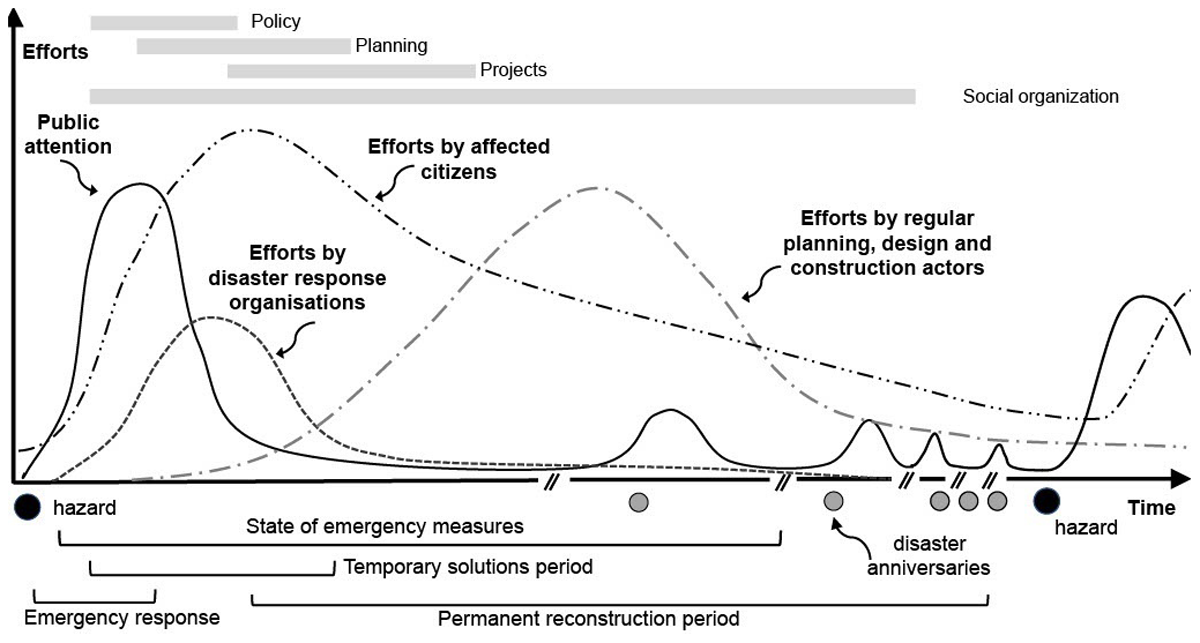
Figure 1
Common sequence of events during disaster processes, showing typical reconstruction phases, and variations in stakeholders’ efforts.
7. CRITICAL PRESSURES
The suffering of victims often puts pressure on aid workers, professionals, NGO representatives and technocrats to act quickly. Housing and infrastructure, therefore, must be rebuilt quickly, even if that implies lower construction standards. A common way to build quickly is to do so on large, empty areas of land. Finally, it is easier to build on city outskirts, where land is affordable, than in densely populated urban areas, where land is scarce, and heritage, infrastructure and public opposition complexify action. (The CASE (Complessi Antisismici Sostenibili ed Ecocompatibili) project (Angelucci 2009) in L’Aquila after the 2009 earthquake offers a contested example of this logic.) A common pattern, therefore, is urban sprawl (Johnson 2007; Johnson & Lizarralde 2012), dispossession (Lizarralde 2021), and urban expansion that diminishes the sustainability of infrastructure and services. Homes on the city outskirts are also far from services and jobs. Those who move to these new developments, therefore, suffer from several new problems: higher commuting times and costs, loss of employment, reduced access to services, and disruption of social networks. Relocation might reduce exposure to a certain hazard, but often creates new forms of vulnerability.
Stakeholders are also under pressure to show effective action. Many, therefore, focus on solutions that produce rapid visibility, such as temporary shelters (Fayazi 2018). A common consequence, however, is that other needs, such as restoring livelihoods and jobs, providing sustained psychological support, and facilitating access to water, sewage, schools and other services, receive less attention. Temporary measures can outlast the emergency phase and become ‘regular’ tools, influencing governance and feasible choices. Yet post-disaster temporariness is not systematically recognised as a structuring condition of recovery. It is often left outside the planning, monitoring, and evaluation of social and territorial effects, even though it can reconfigure routines, attachments and expectations long after emergency measures end.
Virtually all reconstruction efforts are also influenced by conflicting political goals (Alexander et al. 2006; Fayazi & Lizarralde 2018). Haas et al. (1977) warned that the city is filled with ‘hidden agendas’, some of which the disaster reveals and others that must be revealed in the reconstruction process. An objective of reconstruction is therefore to render ‘the invisible city visible’ (p. 269). In fact, disasters are ideal scenarios to advance undisclosed agendas (Olson 2000), neoliberal programmes (Barrios 2017) and branding exercises (Bonati et al. 2026). People are distracted, so less inclined to oppose new dispositions. States of emergency allow some rules and procedures to be bypassed. New resources are suddenly available. And the sense of ‘urgency’ allows decision-makers to legitimise methods and decisions that could be considered autocratic in normal times. It is therefore unsurprising that economic and religious elites take advantage of disasters to advance their own objectives. Reconstruction is therefore a favourable moment for corruption, nepotism, cronyism and other political ills.
The best argument about parallel agendas during disasters was made by Naomi Klein, who argues that disasters are ideal moments to advance neoliberal policy—what she calls ‘disaster capitalism’ (Klein 2007). Radical capitalists find opportunities in ‘blank slates’ to replace social institutions with new ones in collaboration with corporations and financial organisations. Not all post-disaster contexts are as extreme as those reported by Klein. But it is true that some form of political and ideological opportunism almost always takes place. Reconstruction is not a political-economic state of exception but rather a structural feature of capitalism which enables successive rounds of ‘accumulation by dispossession’ (Harvey 2012).
8. BETWEEN CHANGE AND CONTINUITY
Disasters produce inevitable change. They even affect people’s identities. Chileans often claim, for instance, that their country is the result of disasters. Some carry this identity profoundly: ‘Somos terremotizadas,’ explain Chilean women who suffered the 2014 earthquake in Iquique. This unusual expression would be the equivalent of ‘We are earthquake-tised’ (in the way someone can be trauma-tised). Disasters are tangible proof that something went wrong, and therefore changes are required. But survivors also cherish rituals, traditions, beliefs and ways of living that existed before the disaster. They often rely on cultural and social traditions, history, and vernacular construction typologies to find comfort and a sense of ‘going back to normality’ (Jigyasu 2000, 2010; Lizarralde 2021). That said, not all deep-rooted traditions are desirable, and some are impressively ‘resilient’, despite being unjust. Patriarchal systems, for instance, can prevent people from certain rights after disasters. Reconstruction is about defining what is ‘just’, ‘appropriate’ and ‘desirable’. But, given how difficult implementation is, it is also about achieving what is ‘possible’, ‘urgent’ and ‘viable’. Arguably, reconstruction is therefore a process by which societies incorporate inevitable change; identify what should and should not be changed; and act according to what can be changed and preserved.
This definition raises several questions: Who must make such decisions? How does one transform desired into viable change? How does on settle on what is possible, given that some needs and expectations cannot be met?
The writings of Herbert Simon, an American scholar, are a good place from which to start to answer these questions. For Simon, every person who attempts to change their current situation is in fact a designer. This agent identifies how reality is and attempts to define what reality ought to be—a process that is purely normative. But Simon finds that designers cannot achieve ‘optimal’ solutions (Simon 1996). They are constrained by what he calls ‘bounded rationality’. No decision-maker has the capacity to identify, collect, compute, and compare all possible inputs and outputs. There are too many variables, so a system’s optimisation is out of reach. Incapable of optimising the variables and outputs, designers therefore develop ‘satisficing’ solutions which are ‘good enough’. This requires a form of deliberative decision-making (Forester 1999) that is both pragmatic and ethical at once: it enacts a ‘realization-focused comparison’ (Sen 2009) to identify contextually achievable improvements in justice, in light of contextually specific trade-offs. Figure 2 summarises the different forms of agency and the multiple types of stakeholders who must participate in these forms of deliberation. This ethical decision-making requires that representatives of different levels of government (from national to local), international agencies, and local and external funding bodies constantly interact with civil society, stakeholders from the aid and development sectors, and the construction and building sectors.

Figure 2
Map of the stakeholders and different forms of agency required in reconstruction.
But optimal reconstruction is impossible and requires, instead, several trade-offs. Take the example of the costs and benefits of living close to water. Rebuilding housing far from the sea reduces residents’ risks of being affected by, say, tsunamis. But it also prevents households from making a living out of fishing. There are also tensions between safety and costs. Rebuilding houses in a way that they resist every possible hazard is, of course, absurd. Even if the technology existed, they would be too expensive and surely non-functional. Through constant deliberation and concertation, the stakeholders represented in Figure 2 must settle for solutions that resist only the hazards (and their ranges of intensity) that have a higher probability of occurring.
Figure 3 represents a common relationship between these two variables. To understand the ‘S’-shaped curve, imagine this situation: rebuilding earthquake-resistant houses in a flood-prone area increases the cost of construction, when compared with homes that are vulnerable to earthquakes. But it adds little to their overall safety if floods are more likely to happen than earthquakes. Cost increases, but the overall safety does not improve much—the lower part of the curve. Imagine (in the upper part of the curve) that decision-makers try to reinforce post-disaster homes in every possible way. This decision keeps adding construction costs (due to reinforced technology and redundant systems). But at a certain point the increases in safety start to be relatively modest because the likelihood of those extreme hazards happening tends to diminish. Yet there is a spectrum of solutions towards the middle of the curve, where significant increases in safety can be obtained with relatively modest increases in cost.
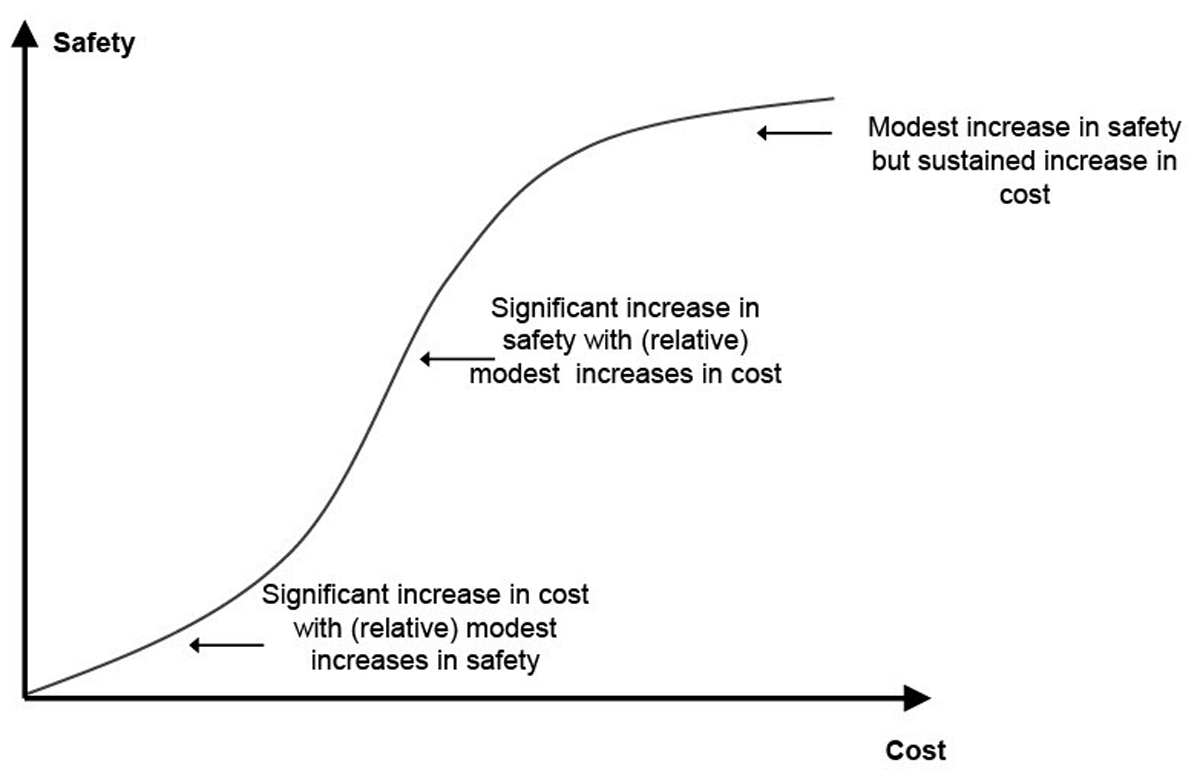
Figure 3
Relationships between safety and costs in reconstruction.
A similar relationship exists between other variables such as construction quality and time. Rebuilding low-quality housing can be done quickly. There is then a ‘sweet spot’ where better quality is obtained with relatively modest increases in time. But if stakeholders keep adding details and finishes to the buildings, they keep increasing construction times, with modest increases in quality. In fact, there might be a moment where adding more features starts reducing the overall quality of the solution (excessive carbon emissions, for instance). Figure 4 shows the relationships among four reconstruction variables: safety, cost, quality and time. The two curves intersect in a space where some trade-offs can be obtained, achieving some level of safety, affordability, quality and speed. Even though some ‘satisficing’ solutions can be obtained in that area, the overall result might be disappointing. This can be called an area of ‘easy reconstruction’: low-hanging fruit that perhaps does not add sufficient value.
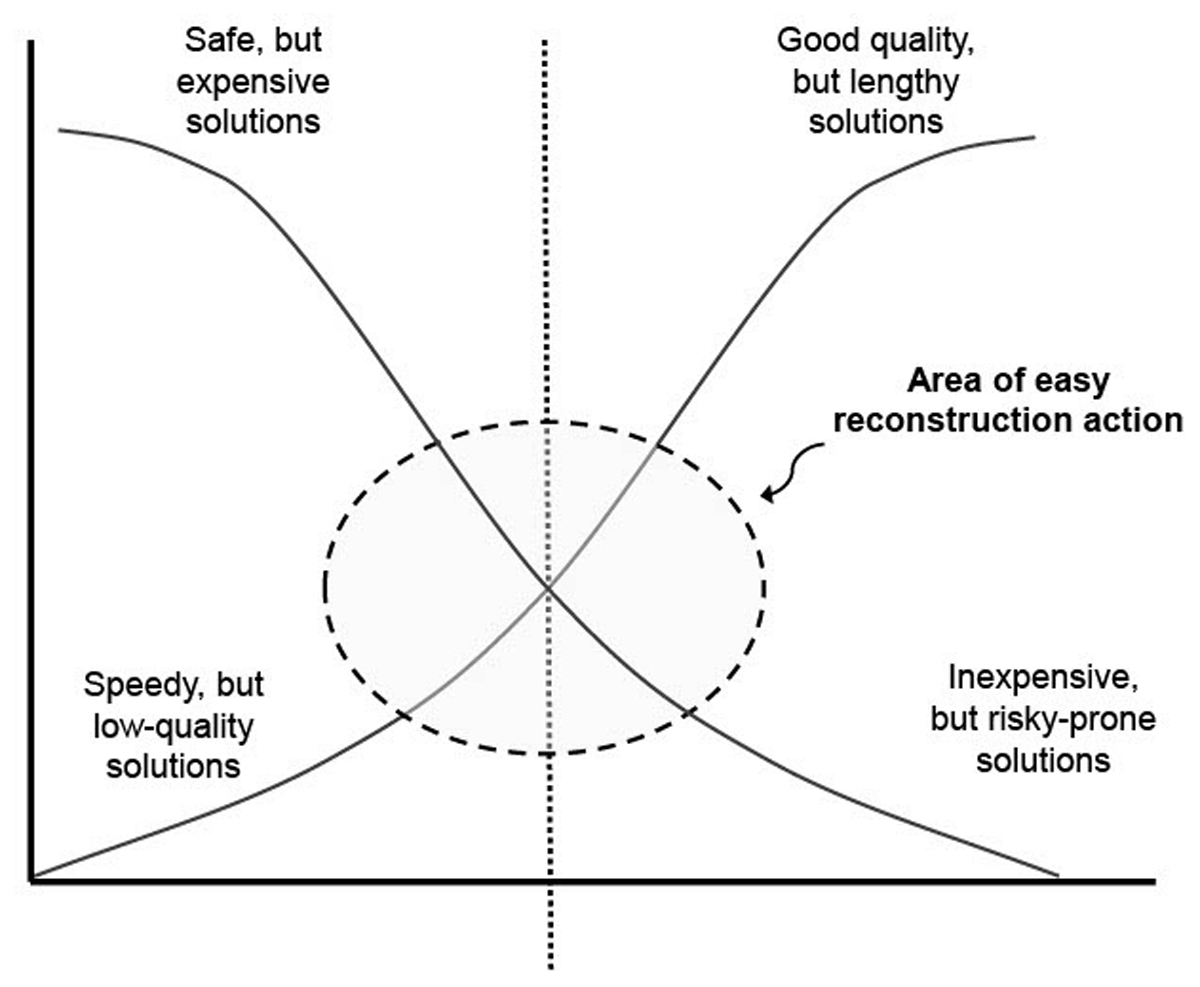
Figure 4
Relationships between the four variables to be considered in reconstruction: safety, cost, quality and time.
However, it is also possible to imagine a situation where stakeholders put extra effort into improving the relationships between these variables. In that case, they establish conditions that alter the slope of the ‘S’-curves. They promote innovation or procurement practices, for instance, in a way that better quality is obtained with little impact on construction times, or they promote regulations where more safety can be obtained with modest increases in construction costs. By promoting innovation, better regulation, better contractual conditions and stronger collaborative processes, stakeholders can raise the space of pertinent satisficing solutions. The result is that living conditions can be improved with relatively modest additional resources. In Figure 5, the area of pertinent trade-offs moves upward: more safety and better quality for modest increases in time and construction costs.

Figure 5
Possible relationships between variables, where efforts have been made to change the relationships between them.
Imagine that stakeholders offer several solutions that can be developed in this elevated area of possible trade-offs. Disaster-affected residents can therefore choose among alternatives that offer better conditions with modest increases in resources (Figure 6). It is precisely this case that exemplifies the type of definition that responds to the challenge proposed here.
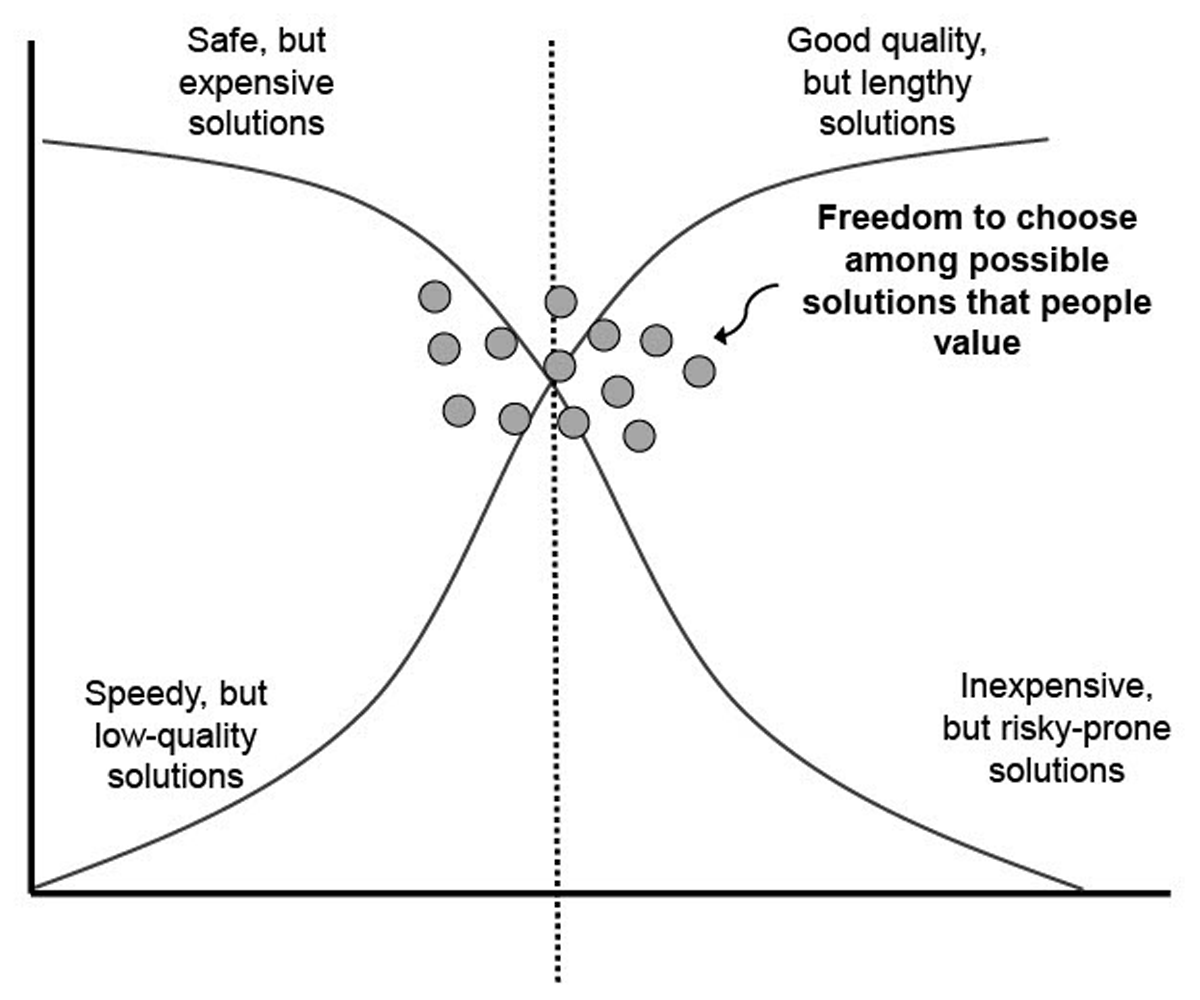
Figure 6
Reconstruction scenario where affected residents can choose between possible solutions that offer appropriate trade-offs between variables.
If these premises are accepted, then reconstruction must be a political space of collective discussion within society, which happens after a hazard and leads to the establishment of an environment that improves the living conditions of disaster-affected people, notably by offering them the possibility to choose, among multiple solutions, those they value the most. Following Forester (1999), this form of satisficing in reconstruction is not a failure of rationality but an expression of deliberative ethics: a collective process of reasoning and justice-seeking under bounded conditions. Reconstruction, therefore, requires the establishment of democratic and just spaces where citizens, institutions, experts and political representatives can discuss what should be changed and preserved. But it is also about making practical decisions about what can be changed and maintained, given the benefits, risks, advantages and disadvantages implied.
Figure 7 presents a model of critical reconstruction. It explains the process by which stakeholders can transform vulnerabilities and strengths into opportunities for social justice, mobilising the ideas of change, continuity, concertation, action and transformation (through policy, planning, projects and social organisation) to improve possibilities for improved quality in living environments.
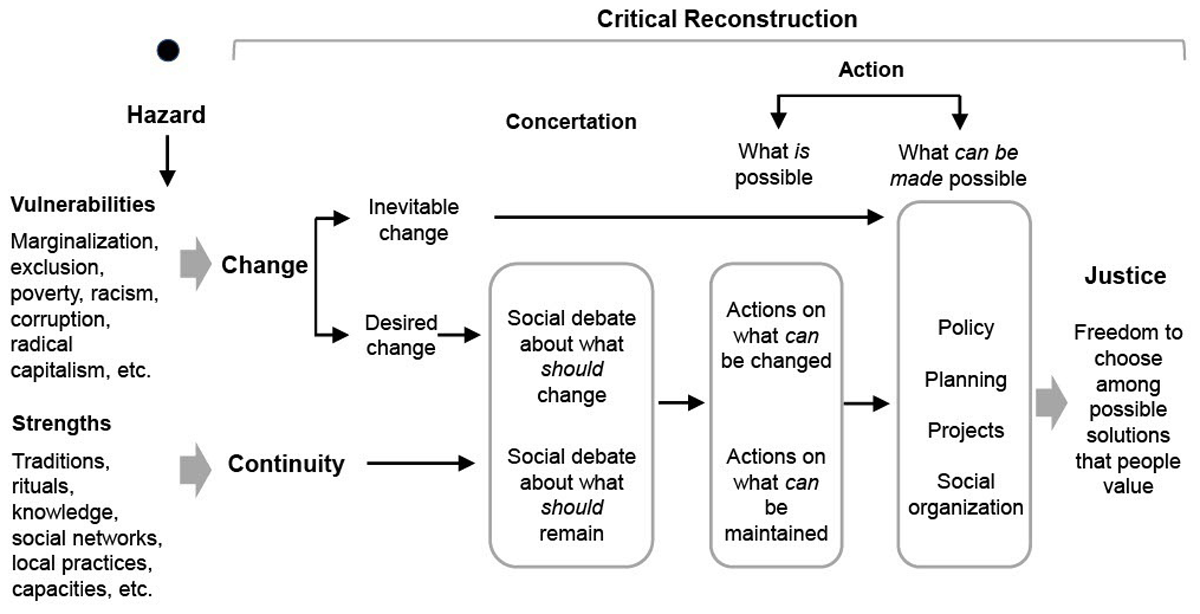
Figure 7
Model of critical reconstruction.
9. CONCLUSIONS
More work is still required to continue this conceptualisation effort. This paper conceptualised reconstruction in a way that captures five patterns found in 50 years of literature. First, as a political process, where debates about change and continuity are important. Second, as a normative endeavour, where moral debates about ‘what ought to be’ are key. Third, as a space of concertation around delicate balances between conflicting objectives: innovation versus tradition, short- versus long-term benefits, etc. This implies collective discussion about what affected residents and other stakeholders consider ‘good’, ‘just’ and ‘desirable’. But also about what is ‘necessary’, ‘urgent’, ‘viable’ and ‘possible’. It also means that there are no ‘optimal’ reconstruction solutions, only satisficing solutions that respond to delicate balances between complex variables in a context of deliberation and concertation. Fourth, as a process where legal, market, economic and administrative conditions can be changed so that it is possible to improve living conditions. Finally, as a process ultimately aimed at social justice, notably by offering people real options and trajectories they have reason to value.
Reconstruction is a time and a space with a clear beginning, but an undefined end. It slowly dissipates, transforming into a form of ‘regular’ practice. It should be devoted to collective and engaged debate about change and continuity, benefits and costs, opportunities, and risks. As such, it is not a technical problem, but a political one that requires difficult trade-offs, produces winners and losers, and affects people’s lives and territories in permanent ways. A critical view of reconstruction reframes it not as an episode of rebuilding but as a test of social justice.
Notes
ACKNOWLEDGEMENTS
The authors acknowledge the intellectual exchanges within the Disaster Resilience and Sustainable Reconstruction Research Alliance (Œuvre Durable) and their colleagues who provided feedback on earlier drafts of this manuscript.
DATA ACCESSIBILITY
This article is based on a qualitative synthesis of existing scholarly literature and previously published research. No new empirical datasets were generated or analysed for the purposes of this study. All sources used are cited in the reference list.
AUTHOR CONTRIBUTIONS
G.L.: theoretical framework development, conceptualisation, methodology, visualisation, writing, review and editing; D.W.: theoretical framework development, conceptualisation, writing, review and editing; F.Ö.: literature review, conceptual analysis, review and editing; M.C.: literature review, conceptual analysis, review and editing. All authors contributed to manuscript revisions and approved the final version.