
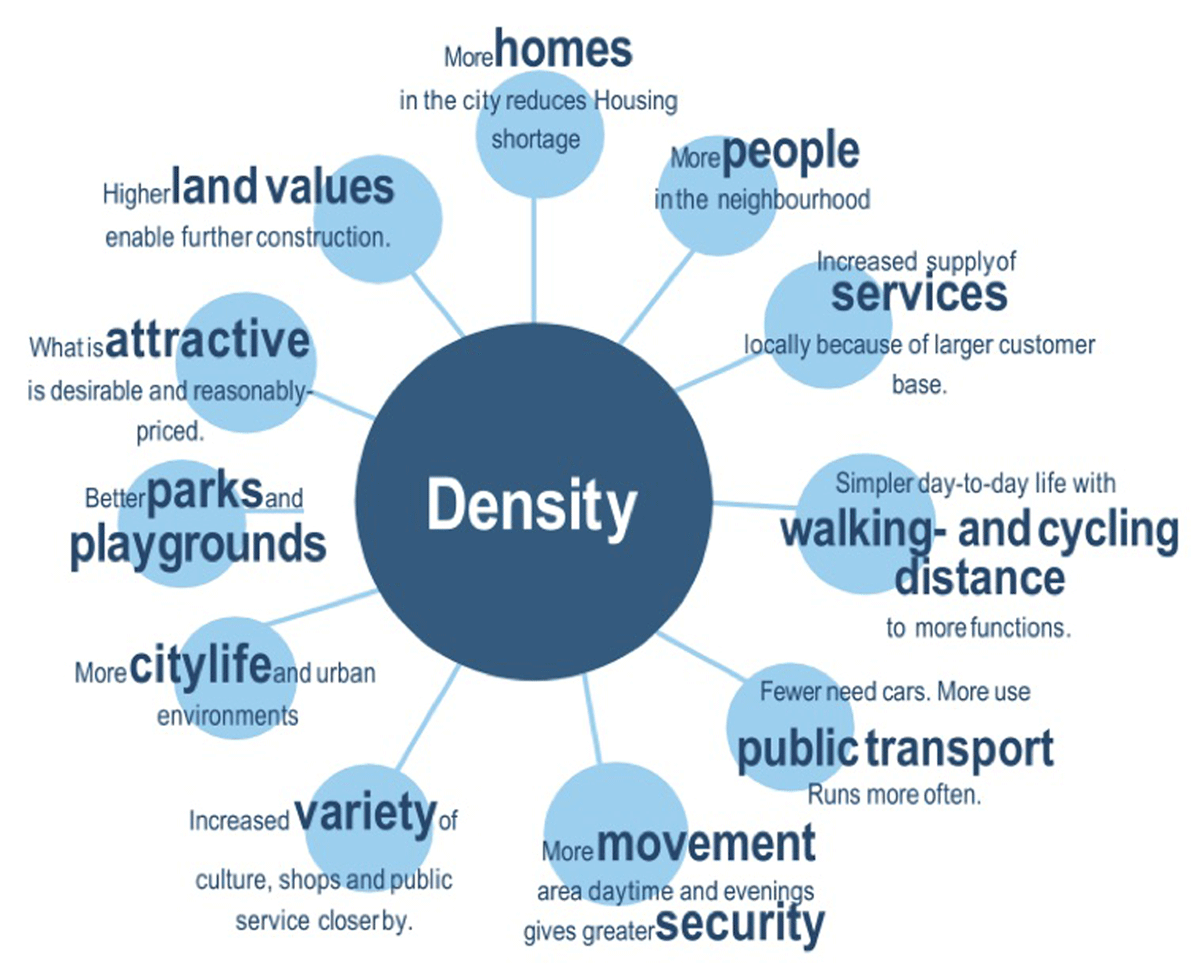
Figure 1
Positive effects of density.
Source: Bibri et al. (2020).
Table 1
Types of intensification.
| BUILT-FORM INTENSIFICATION COMPRISES: |
|---|
|
| ACTIVITY INTENSIFICATION INCLUDES: |
|
Table 2
Densification in the city centre.
| BUILT-FORM DENSIFICATION | ACTIVITY DENSIFICATION |
|---|---|
| Compact city structure | New purpose-built buildings |
| Redevelopment of buildings or developed sites at higher densities | Reuse of existing buildings for new activities |
| Subdivision or conversion of buildings | Increased number of people living in the centre |
| Extensions to existing structures | Growth in the number of people working in the centre |
| Development of previously undeveloped land | Attraction of temporary residents |
| Verticalisation of building form | Improved transport infrastructure for mobility |
| Pressure on green space provision | Enhanced movement and flows |
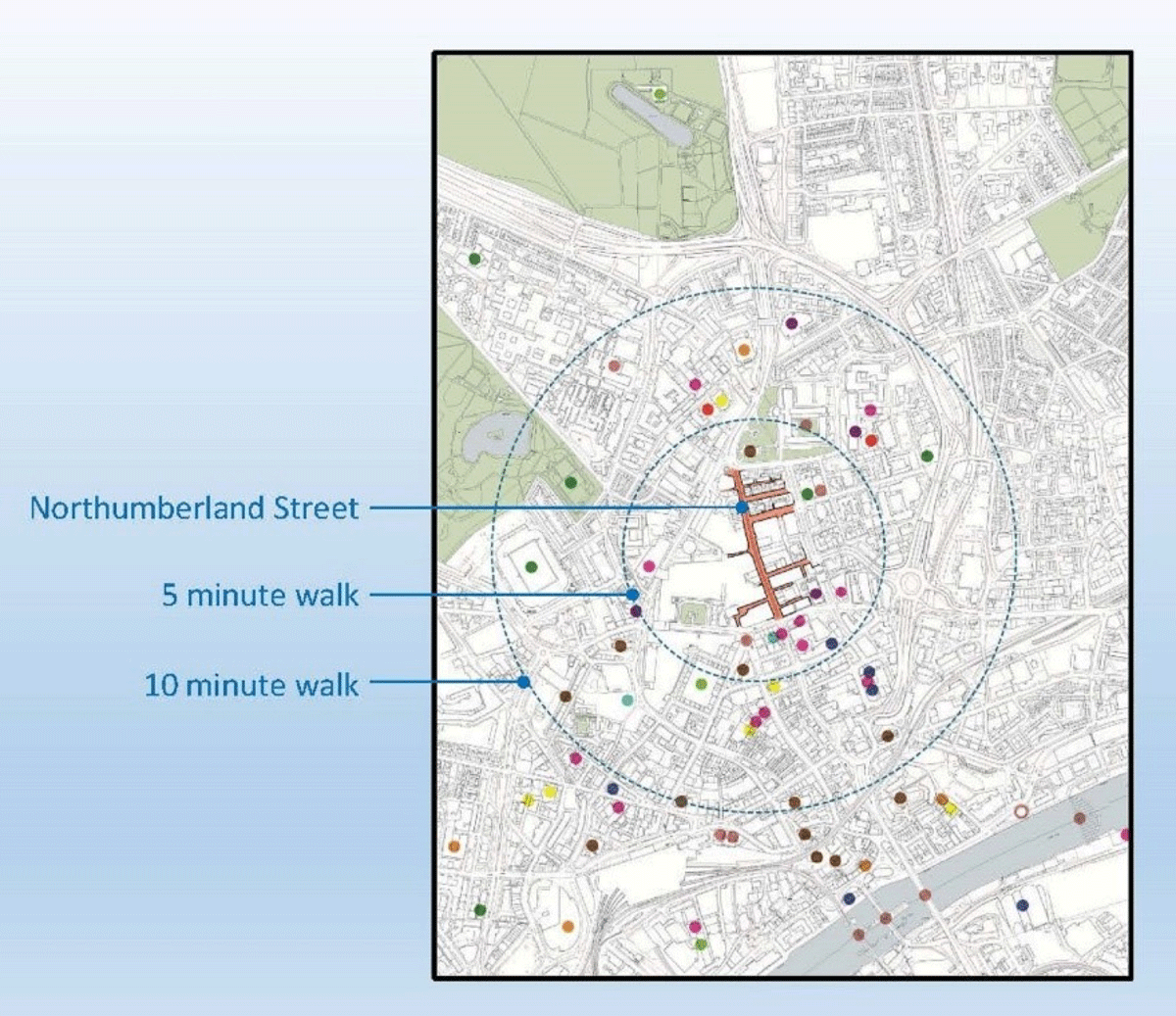
Figure 2
Newcastle upon Tyne, city centre.
Source: Newcastle City Council & Gateshead Council (2015).
Table 3
Key densification areas in Newcastle upon Tyne’s city centre.
| Stephenson Quarter | Predominantly a brownfield district, but includes significant cultural heritage. After decades of neglect, a private developer was appointed to manage the consolidation of the whole area, but financial difficulties led the city council to terminate the contract. In July 2020, the council entered into an agreement with another developer to complete the second and final phase (Whitfield 2020) |
| East Pilgrim Street | A total of 27 ha representing one of the most strategically important city centre opportunities (Lawless 2016). The area was sold to an international real estate investment and development company in 2016. Since then, most of the buildings have been emptied and some demolished. There have been reports of proposals for £200–£300 million of luxury leisure, shopping and living, but there does not seem to be definite agreement (Ford 2019) |
| Newcastle Helix: Science Central | A total of a 10 ha site of the former Newcastle Brewery. The £350 million regeneration scheme has received investment from the European Regional Development Fund and UK government. It is claimed that it will become one of the most important innovation hubs in Europe and the UK’s biggest urban development outside London (Newcastle City Council & Gateshead Metropolitan Borough Council: Newcastle Helix 2020). It has been partly constructed, but in 2018 it was rebranded to bid for more investment from around the world (Property Funds World 2018) |
| Forth Goods Yard | A brownfield area presented by the city council as an opportunity for developers to deliver a new gateway entrance into the south-west of the city centre. The framework document sets out an ambition to deliver a vibrant mixture of uses with a linked green infrastructure. Movement emphasises enhanced provision for cyclists and pedestrians (Lawless 2019). The location is not part of the metro network and there is a concern that it will increase traffic |
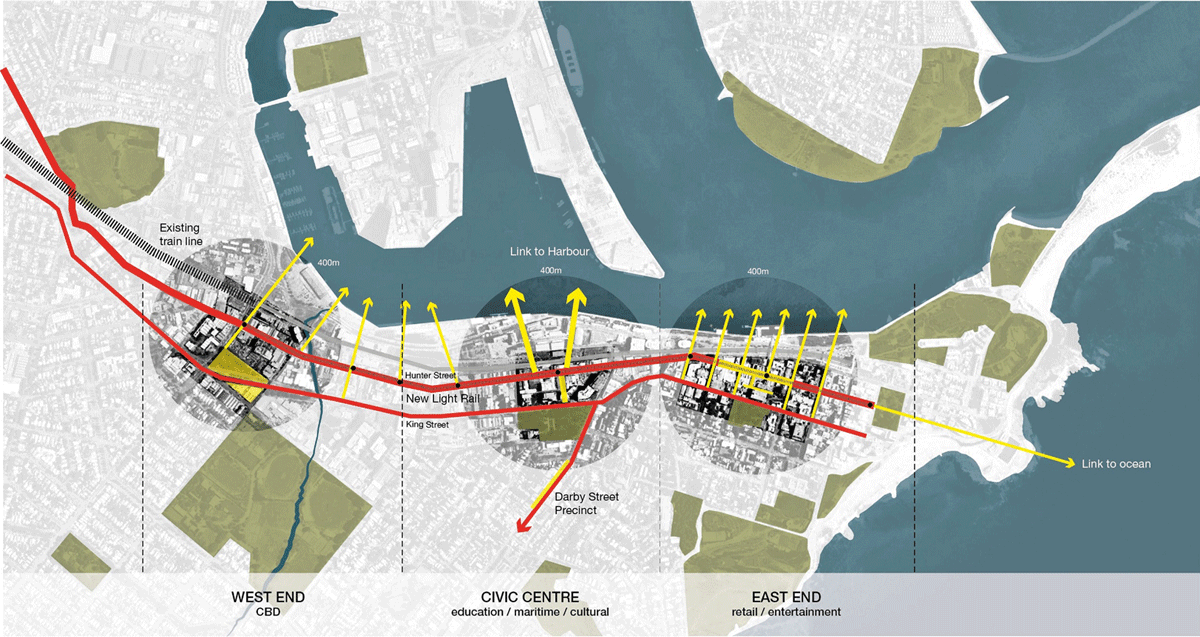
Figure 3
Newcastle, NSW, city centre.
Source: EJE Architecture.
Table 4
Convergence and divergence of densification in the two centres.
| CHARACTERISTICS | NEWCASTLE UPON TYNE | NEWCASTLE, NSW |
|---|---|---|
| Built-Form Densification | ||
| Compact city structure | Monocentric Infill | Polycentric Strategic relocation of the city centre to the west end |
| Redevelopment of buildings or developed sites at higher densities | Brownfield development in four large densification sites | – |
| Subdivision or conversion of buildings | Integral part of plans | – |
| Extensions to existing structures | As part of infill development | – |
| Development of previously undeveloped land | – | Major growth |
| Verticalisation of building form | Mainly low- to medium-rise | High-rise: increased height limits to incentivise development |
| Provision of green spaces | Small amount, but 15 a minutes’ walk to large green areas | Few and small green spaces |
| Activity densification | ||
| New buildings | Plan for retail development, but
mainly Student accommodation | Commercial, large-scale retailing, residential and new council office |
| Reuse of existing buildings | Conversion of retail and commercial into residential | – |
| Number of people living in the centre | Conversion of buildings into residential; significant increase of students | New residential buildings |
| Number of people working in the centre | Potential in four large densification sites | New commercial buildings |
| Temporary residents | Students, visitors and tourists all encouraged | |
| Transport infrastructure | Railway station in the centre and a metro light rail network | New transport interchange in the west end and new street-based light rail |
| Movement | Increasing traffic restrictions, enhancing pedestrian and cycle routes | No restrictions to traffic |
| Process | ||
| Community engagement | Pro-growth, neoliberal, market-led ethos dominates citizen and cultural agendas | |
Table A1
Symposia data sources.
| NEWCASTLE UPON TYNE | NEWCASTLE, NEW SOUTH WALES | |
|---|---|---|
| Symposium dates | 10–11 September 2018 | 5–6 March 2019 |
| Tier 1: Documentary sources | ||
| Primary source | Core Strategy and Urban Core Plan for Gateshead and Newcastle upon Tyne 2010–30 | Greater Newcastle Metropolitan Plan 2036 |
| Supplementary sources | Lawless (2016, 2019), Newcastle City Council (2020a, 2020b) | Commonwealth of Australia (2011), HDC (2009), City of Newcastle (2008), Urbis (2017) |
| Tier 2: Key delivery stakeholder presenters | ||
| Place Directorate, Newcastle City
Council Council Housing, Design and Technical Services, Gateshead Council Newcastle NE1 Ltd Newcastle Gateshead Initiative Shelter | Hunter and Central Coast Development
Corporation Smart Cities, Newcastle City Council EJE Architecture Renew Newcastle Cycle Space | |
| Tier 3: Discussion participants | ||
| Civic | BALTIC Centre for Contemporary
Art North East England Chamber of Commerce North Tyneside Council Stadt Neuburg, Germany Sunderland Business Improvement District | Newcastle City Council Lake Macquarie City Council New South Wales, Department of Education New South Wales, Department of Health |
| Community | Changing Newcastle and Newcastle Liberal
Democrats Green Party Merseyside Civic Society Newcastles of the World North East Times Place Changers Shelter | Hunter Research
Foundation Newcastle Museum Newcastle NOW |
| Academic | Durham University Northumbria University University of Newcastle | Newcastle High School University of Newcastle |
| Professional | Access and Inclusion
Consultant AECOM BeemCar Ltd Civic Engineers FaulknerBrowns Architects groundSTUDIOS Architecture GT3 Architects GVA Nicholson Nairn Architects Ryder Architecture Stanton Walker Vital Energy | APP Property and Infrastructure
consultants Core Project Group De Witt consulting Planners GHD Engineers Hansen Yuncken Contractors Morrissey Law Muller Partnership Surveyors and Property Managers O’Brien Winter Partners Rider-Levit Bucknall Quantity Surveyors Suters Architects |