
1. INTERSECTION OF CLIMATIC AND GOVERNANCE RISKS IN CITIES
Adapting urban areas to climate change is a core goal for global sustainability. This is partly because urban areas are hotspots of high risk in terms of population and infrastructures but also because they are potential seedbeds for scalable transformative adaptation strategies (Bulkeley 2022; IPCC 2023; Seto et al. 2021). Although much of the literature on responses to climate change seeks to animate the scalability of interventions driven by local communities, it does not focus deeply on the intersections between climatic and non-climatic governance risks. In the context of overcoming systemic constraints to adaptation, gaps exist in the consideration of previous long-term decisions and investments in infrastructures. For example, while housing structures can be designed with the aim of resolving socio-spatial inequalities, there is potential for maladaptation if such investments are unable to absorb future shocks and disregard local community networks. These are key for recovery from disasters (Singh et al. 2026). Environmental departments may respond accordingly through the design of flood adaptation strategies, but their plans are routinely neutralised by non-climatic risks like parallel, uncoordinated real estate development or transit planning handled by separate municipal silos (Vedeld et al. 2021).
Co-benefit frameworks that couple mitigation with adaptation efforts, though essential in breaching silos across sectors, can also overlook interlinkages between climatic and governance risks. Sectors like energy have been identified as strategic points for pursuing mitigation and adaptation efforts concurrently (Swilling & Hajer 2017). This is because there are direct and indirect energy components in every urban sector like water, sanitation, health, education, housing, transport and waste management. Though this could support governing adaptation beyond sectoral silos, it may not necessarily address climate risks in cities without a fundamental focus on non-climatic municipal issues, such land-use conflicts and alternative municipal financing outside government sources and international aid (Ibrahim & Kepe 2026; Sharifi 2020). Co-benefit frameworks that often lean heavily on technocratic or ecological solutions, such as installing solar-powered water pumps, could also present non-climatic governance risks if, for example, the local water authority is characterised by institutional shortcomings, local revenues for ongoing maintenance and innovative redesign that relies on local hardware supply chains (Sethi et al. 2020).
A literature exists on converging transnational with trans-local city networks to enable urban reform coalition. These mechanisms are designed to enable grassroots and local governments bypass internal rigidities and learn how to manage compound risks through alternative financing (Lorenz Fontolan et al. 2026). The emphasis is on intermediaries, catalysts and actors outside centralised forms of government, which can span boundaries to demonstrate alternative ways for transforming infrastructure for climate safety in cities, including urban informal spaces (Antaki et al. 2026; Barcena 2025; Sutherland 2025). However, adaptation efforts that thrive on the potential of aggregation through formal and informal coalition-building may be unable to resolve the lack of cohesion between top-down government strategies and bottom-up community-level efforts, as well as elite capture and vested interest groups that often dominate public participation processes.
2. ADAPTATION IN URBAN INFORMAL SETTLEMENTS AND GOVERNANCE RISKS
The usual framing of urban informal settlements is often negative and unhelpful. It describes illegality, messiness and being unfit for effective urban development controls that reduce environmental risks (e.g. wetland and floodplain preservation). A significant shift has begun to acknowledge the critical role of urban informal settlements in building climate-resilient urban futures, particularly in cities of the global south. Unincorporated businesses, community-based organisations and household actors in urban informal settlements possess invaluable local knowledge about climate hazards and effective coping strategies that create opportunities for governing adaptation risks better (Antaki et al. 2026; GCA 2022).
The relationship between urban informal settlements and adaptation governance risks could be analysed alongside framings of adaptation measures, their diffusion mechanisms and governance-related reversals of effective adaptation (Table 1). The upgrading of informal settlements as the conventional adaptation measure was conceptualised without acknowledging the attendant climate-related risks. Maladaptation often occurs as a result of narrowly framed structural engineering plans for infrastructures (e.g. roads, drainage and sewage systems) and presents adaptation governance risks. This narrow approach omits multisectoral improvements across a different range of infrastructure services that support households and businesses, instead questioning governments’ modes of engagement with actors affected by the upgrading, the underlying power dynamics and the possible alternatives to relocations or evictions. It fails to tackle systemic issues like tenure insecurity, social exclusion, and disparities in economic opportunities (Satterthwaite et al. 2020).
Table 1
Summary of adaptation measures in urban informal settlements and governance risks.
| ADAPTATION MEASURES (THE FOUNDATION) | DIFFUSION MECHANISMS (THE ACCELERATORS) | GOVERNANCE-RELATED REVERSALS (THE RISKS) | ILLUSTRATIONS |
|---|---|---|---|
| • Transformative slum upgrading: Deep, structural modifications over cosmetic fixes. • Community-based and community-led adaptation: Grassroots ownership of resilience targets. • Non-networked and decentralised infrastructure services: Off-grid, modular water, energy and waste systems. | • Co-production: Blending official municipality workflows with local community delivery. • Citizen-led data and mapping: Grassroots mapping to counter lack of official census records. • Locally led adaptation measures: Shifting decision-making power directly to local actors. • Equitable financing: Ensuring climate funds actually hit the ground at the settlement level. | Land-use friction: Intense local or political resistance to changing traditional zoning/land rights. | Eviction threats or rigid pushback when trying to secure land tenure or formalise borders in high-density informal zones. |
| Design flaws: Infrastructure built for current baselines instead of future climate extremes. | Drainage networks that overflow during heavy rainfall because they were built using historical averages instead of future flood models. | ||
| Strategic disconnect: Lack of cohesion between city-level planners and frontline community groups. | Top-down municipal zoning plans that fall apart because they conflict with the actual, lived spatial layout of the community. | ||
| Financial fragility: Systems built via short-term grants that lack funds for long-term maintenance. | Community water reservoirs or sanitation blocks built via NGO grants that fall into disrepair as a result of a lack of a long-term operational budget. |
[i] Source: Author.
Since urban informal settlements face both a disproportionate exposure to climate risks and frequent exclusion from formal decentralised planning, there has been a confluence of community-based adaptation (CBA) and community-led adaptation (CLA). The key contrast is centred on the best possible means of reconfiguring power dynamics. CBA often positions communities as participants or victims to be supported through externally initiated and defined projects. CLA places urban informal settlements at the centre of decision-making, with control over resources, priorities and outcomes (Archer et al. 2014).
Although large-scale, networked systems of infrastructure service delivery form the backbone of urban economies, they are often vulnerable to cascading failures and lack the local adaptability needed to address context-specific adaptation limits (Lawhon et al. 2023). For example, in low-lying coastal and inland slum regions where neighbourhood access barriers accrue from disparities in public and private land management rights, an approach combining decentralised technologies, nature-based solutions (NBSs) and community-led infrastructure reconfigurations has demonstrated potential to respond to the interlinked nature of climate risk, land tenure and service inequalities. It is sometimes impossible to fully adapt to threats using large-scale green or grey infrastructures, including wider scaling of NBSs, when potential land-use conflicts and displacement shape residents’ (lack of) receptivity and perceived benefits.
Alternatives are gaining traction, to overcome barriers to managing excessive precipitation (Kasper 2025) (e.g. local use of plastics for rainwater harvesting on corners, towers, rooftops or underground as place-specific infrastructure configurations). Co-production of knowledge involves collaboration between residents, academics and policy officials to understand and co-design potential solutions to urban challenges. This sometimes starts in citizen-led data and mapping initiatives for hyper-local specific information, which conventional data collection methods often treat peripheral in integrated climate risk assessments. Co-production of service delivery takes this partnership a step further by jointly designing, implementing and managing tangible improvements like water, sanitation and drainage infrastructure (Johnson et al. 2025). Though co-production is embedded in the lived experiences of actors and scalable innovations from urban informal settlements, cross-city partnerships with emancipatory opportunities for centring different actors in decision-making spheres remain limited.
Both non-networked and co-production of urban service delivery as prognostic framings have found common place in locally led adaptation (LLA) policy measures and communities of practice (Rahman et al. 2023). This is especially where polycentric governance models that comprise multiple actors as individuals or organisations with varying degrees of autonomy can be tested without the constraints of existing rules that favour hard-engineering solutions. LLA is also possible where reform ordinances and guidelines permit actors who bear the brunt of extreme events, like flooding, to scale up their technologies like increasing the recyclability of urban waste materials to create new clean energy products but also reduce emissions.
However, in cases where there is resurgence of authoritarian modes of city governance (Goodfellow & Jackman 2023), LLA could face barriers to lasting institutional legacies and reform pathways to cohesion between top-down government strategies and bottom-up community-level efforts. Local and subnational governments have the mandate but often lack the resources and support of central governments to integrate non-relocation considerations into their climate adaptation reforms, especially when urban planning departments are constituent elements of the large patronage networks for the state (Lewis 2014). Though this has diminished public trust in urban governance institutions and entrenched bypassing of competitive public procurements, large-scale infrastructure projects continue unabated to lead to loss of livelihoods, coupled with coercive or below-market rate resettlement and compensation packages.
Efforts have been and continue to be underway to simultaneously pursue inclusive adaptation reform and systemic equity along with gender, age, race, indigeneity, migratory status and other sources of discrimination. But the landscape of intersectional climate justice constitutes local actors who are struggling with sustaining solidarity even in contexts of long-term support from transnational counterparts (Castán Broto et al. 2023). This could be due to power imbalances within local movements or splintering agendas via intergenerational differences. Youth could be often at the forefront of highly visible online climate activism, but older generations in the global south frequently possess the political and financial power to influence large-scale change. The risk then is decentering voices and dialogue arenas where the focus is on deep systemic changes in different sector operations.
Sometimes local agency prioritises short-term relief efforts because of entrenched urban poverty in slums, but other times it could be avoiding the risks of channelling developments away to spaces preferred by political elites and affluent citizenry in planned settlements. Local governments may not have the influence to push beyond existing pathways owing to conflicts between local revenue targets and enforcing needed adaptation reforms (Werners et al. 2021). It is within this interplay of legitimation framings, reversals and diffusion mechanisms that the paper interrogates the normative and operational actions in managing flooding. The focus is on what changes in actor collaborations could be introduced to transform the governing of adaptation, not just for urban informal settlements but also for alternatives to existing pathways globally.
3. METHODS AND MATERIALS
Though there is exponential growth of literature on climate change in cities, Africa is often substantially underrepresented, contributing to topical, geographic and disciplinary biases in the work of the Intergovernmental Panel on Climate Change and other global assessments (Montfort et al. 2025). As a contribution, this systematic review included selection of evidence from scientific research. The systematic review of available scientific evidence followed the guidelines proposed by Berrang-Ford et al. (2021) in adaptation research. It undertook four steps, namely: a) setting the overarching research questions; b) designing search queries for the selection of literature; c) inclusion and exclusion criteria; and d) data categorisation, thematic extractions and analysis.
3.1 SYSTEMATIC REVIEW AND SEARCH STRATEGIES
The systematic review was underpinned by three overarching questions:
What is the characterisation of normative to operational actions taken in response to flooding in urban informal settlements in African cities?
Who are the salient actors at different scales, and by what means are they empowered to respond to flood-related risks?
What are the areas of risk convergence where climatic and non-climatic factors interact to influence action, and what changes in actor constellations could be introduced to transform the governing of adaptation?
The review conducted queries on titles and abstracts via online databases, mainly Scopus and OpenAlex. The search strings that guided the querying at both Scopus and OpenAlex was initially ‘Adaptation to flooding in urban informal settlements’, followed by ‘Adaptation to flooding in African cities’ and then finally ‘Adaptation to flooding in urban informal settlements in African cities’.
The reasons for coupling searches via OpenAlex with Scopus were to broaden the possibilities of including open-access publications that could permit detailed information beyond tittles and abstracts (Priem et al. 2022). Open-access publications were 60% of the total of 91 papers from OpenAlex, compared to 13% of 156 articles from Scopus, using the same search query as ‘adaptation to flooding in urban informal settlements’. It also permitted the inclusion of a wider coverage of papers from different publishers. Scopus provided mostly journal articles with very limited inclusion of editorials, books and book chapters.
Many of the studies generated were focused on cities in mainly East, West and Southern Africa, where urban informal settlements predominate, and not much from Central and Northern parts of Africa. The Mediterranean regions, particularly in North Africa, have different histories of urban development, characterised by historical archaeological sites that have for long influenced their physical expansion and natural growth compared to sub-Saharan Africa (Mahmoud et al. 2019). While informality and climate vulnerability are present in Northern Africa and the Mediterranean region, the challenges are often not salient for urban informal contexts (UN-HABITAT 2018). Scientific literature published in languages other than English was not considered and therefore the material selected may not be representative of studies in other international languages like French and Spanish.
3.2 INCLUSION AND EXCLUSION CRITERIA
The titles and abstracts of 247 scientific papers generated from both OpenAlex and Scopus were subjected to an inclusion and exclusion criteria that is shown in Figure 1. For the open-access publications, literature was included and excluded based on not only titles and abstracts but also in-depth review of texts on methodology and results. Criteria for selection were a) topical relation to adaptation to flooding in urban informal settlements; b) articulation of the actors involved and actions taken to respond to flood-related risks in the urban informal settlements of African cities; and c) contribution to reducing geographic and disciplinary biases in the systematic review selection.
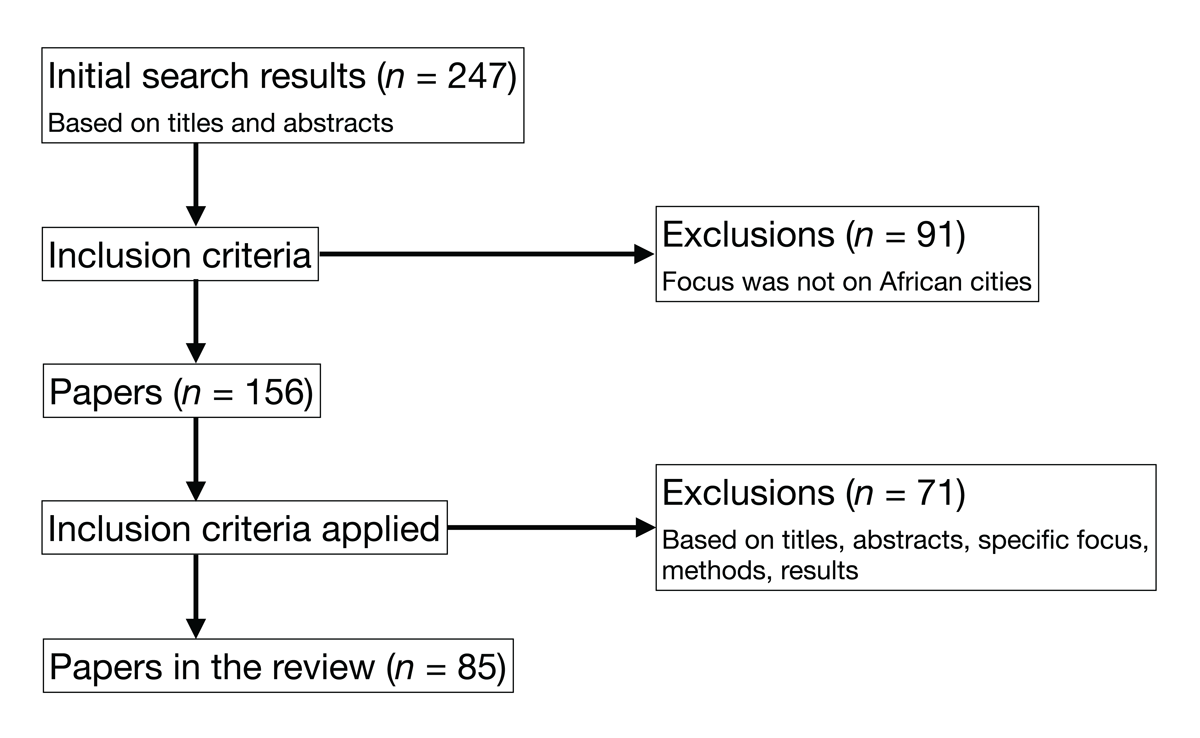
Figure 1
Process for screening evidence.
The third criterion enabled inclusion of papers on informal settlements in secondary cities and towns, for example the city of Tshwane in South Africa (Nyam et al. 2024) and Jijel, Algeria (Chabou et al. 2025). This was a necessary step for inclusion of evidence on the role of actors and actions, including scalable autonomous coping strategies and experiences by households outside the largest metropolitan areas in Africa. These include Cairo (Egypt), Accra (Ghana), Johannesburg (South Africa), Khartoum (Sudan), Kinshasa–Brazzaville (Democratic Republic of the Congo), Lagos (Nigeria) and Nairobi (Kenya) (UN-HABITAT 2016). Since African cities comprise different and mixed ecoregions, including coastal and inland cities and arid, semi-arid and mountainous cities (Awoyemi & Ibánez-Álamo 2023), there was deliberate effort to include papers with details arid regions, for example in Khartoum in Sudan (Elagib et al. 2021; Horn & Elagib 2018).
The criteria resulted in the selection of 85 scientific publications, 70 of which were journal articles (including synthesis articles). There were also two dissertations, five books, seven book chapters and one editorial. No conference papers, book reviews or commentaries appeared for inclusion. The timeline set for the inclusion of papers was publications from 2010 to 2025, and therefore some papers were excluded on this basis. Papers were included in the review that compared cities in Africa with the rest of the global south (e.g. Kibii et al. 2025; Sakijege et al. 2014). Other papers were excluded because of their larger focus on urban informal settlements in the global south but not specifically African cities (e.g. Haque et al. 2020; Wolff et al. 2021). Other exclusions were on papers focused on climate change in urban informal settlements in African cities, but without an in-depth response to flooding (e.g. Opoku-Boateng et al. 2024; Rodina et al. 2024; Wilson & Smith 2016).
3.3 DATA EXTRACTION AND ANALYSIS
The selected material from scientific publications was uploaded using Google Sheets for screening. Google Sheets enabled simultaneous work on streamlining the screening process using thematic particulars, the detection of duplicates and the inclusion and exclusion of papers (Shaffril et al. 2021; Tawfik et al. 2019). The thematic particulars used to structure, analyse and extract data from the Google Sheet were: document title, authors, year of publication, type of publication, specific name of publisher, type of flood event, African cities of focus, normative framing of response pathway, operational pathway description, risks associated with responses, risk categories (environmental, climate-related, governance, infrastructure, economic, social inequities), proposed/potential response pathways, risks associated with proposed/anticipated pathway, actors, actor categories, roles of each actor category, means of empowering actors to react or anticipate, scale (neighbourhood, city, city region, subnational and national), target sectors and DOI or URL of the publication. The thematic analysis of data, including retrieving the corresponding texts for producing maps and graphs for visualisation, was aligned with the themes and subthemes generated from the systematic review questions.
4. FLOOD-RELATED RISKS AND ACTIONS IN AFRICAN URBAN INFORMAL SETTLEMENTS
The characterisation of actions is multidimensional: value propositions underlying planning for or reactions to post-flood events; existing regulations and policies; institutional project planning tools; approaches to capacity strengthening for municipal departments in designing and overseeing standards; and knowledge integration from different sources to shape reactive and anticipatory actions (Comelli et al. 2024). The multidimensional forms of actions that were salient in the literature included inclusive, incremental and intersectional adaptation. Incremental actions are phased techno-managerial pathways, during pre- or post-flood events, including additive upgrades to damaged infrastructure, and standards for delivery of emergency aid, often devoid of pathways to address the systemic vulnerabilities that perpetuate cycles of urban poverty and inequalities (Fofana et al. 2022; Kemwita et al. 2023).
Incremental actions are sometimes dominated or complemented by structural engineering, despite the selective enforcement of environmental laws and planning regulations by both national and local governments. Conformity to physical planning standards (e.g. public–private partnerships for social housing projects) often targets the urban poor to relocate based on development zoning and controls (Okaka & Odhiambo 2019b). As shown in Table 1, inclusive actions are visions and sociotechnological processes that could be top-down or bottom-up in nature. These actions open opportunities for different social groups in local communities to be represented in structuring actions for neighbourhood to city level (Tasantab et al. 2022; Tavares et al. 2024). Inclusive characterisations that appeared in the literature also implied the integration of knowledge sources from societal and scientific methods, particularly exploring opportunities for merging indigenous with scientific knowledge on both predictions and actions (Kasei et al. 2019).
As a departure from single urban function approaches to inclusivity and equity, some literature aligned with intersectional approaches and intersectoral pathways. This literature integrated risks among subgroups into climate assessments and spoke of actor interlinkages and infrastructure improvements across sectors and geographical scales. It was mainly shaped by coping experience, and preparedness for future extremes (Maru et al. 2021; Othoo et al. 2021).
Intersectoral interlinkages bordered on integrating climate change adaptation, disaster risk reduction, health sector responses and water resource management. Intersectionality was further represented by promoting the compatibility of blue, green and grey infrastructures in flood risk management strategies. Interlinkages occurred across sector urban policies and standards, in for example generating multiple co-benefits from water, transport and sanitation infrastructures. A long-term sole focus on ‘grey pathways’ has demonstrated potential for alternatives to service delivery inequities in informal settlements, for example the use of savings groups to mobilise finance for community-led housing and irrigation systems. However, intersectional approaches simultaneously increase the costs of restoring green corridors with ecosystem-based pathways that respond to future projections of extreme events (Douglas 2018; Zehra et al. 2019).
Restoring natural water systems and creating connected blue corridors can improve water quality and irrigation systems without necessary following grey pathways. However, if not designed without due consideration of inequities beyond ranking urban residents according to socially ascribed identities and income groups to include terrain and spatial inequalities (Kabeer 2016), then large-scale green pathways can lead to potential trade-offs triggered by perceptions and appropriations of space. Thus, the limited receptivity is likely to occur amongst local actors of floodplain and wetland infrastructures for flood hazard reduction (Asibey et al. 2025).
As represented in Figure 2, the dominant characterisation of adaptation action pathways in cities of Africa includes incremental, intersectional and inclusive adaptation governance. These are often not approached in isolation but concurrently. Transformative actions (though not salient in the reviewed literature) are characterised by fundamental changes within and across urban systems as well as power structures amongst actors (IPCC 2022; Pasquini et al. 2024; Shackleton et al. 2015; Shi et al. 2016).
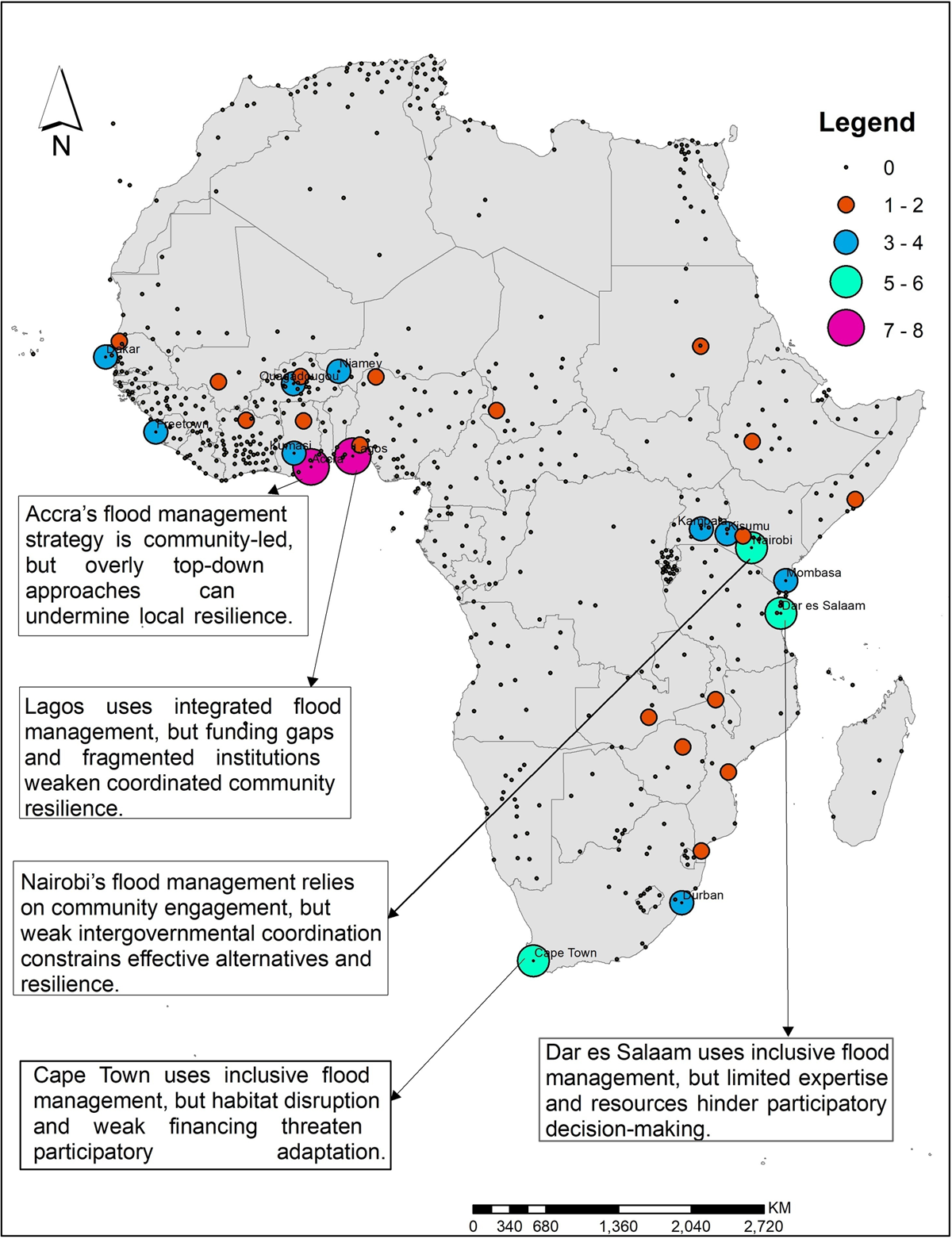
Figure 2
Convergence of flood risks and adaptation pathways in selected African cities.
Source: Author’s aggregation of the reviewed literature.
4.1 THE MULTISCALAR NATURE OF ACTIONS
The multiscalar nature (neighbourhood to city level) of implementing actions is contingent upon the singularity or multiplicity of flood events as shown in Figure 3. Operational actions often include economic resource allocation tools for budgeting and financing, technical standards and policy interventions by formal institutions, or socially galvanised actions by local community organisations and residents in the face of challenges around preparedness, recovery or relief and response measures. Inland floods are the most frequently reported type of event, affecting cities like Nairobi, Dar es Salaam and Kampala. This is often attributed to poor drainage systems and rapid growth of settlements horizontally outside the purview of development controls set by municipalities. Coastal floods significantly impact cities like Lagos, Mombasa and Dakar, with rising sea levels and storm surges exacerbating risks for informal coastal settlements (Mwalwimba et al. 2024; Okaka & Odhiambo 2019a; Schubert 2024).
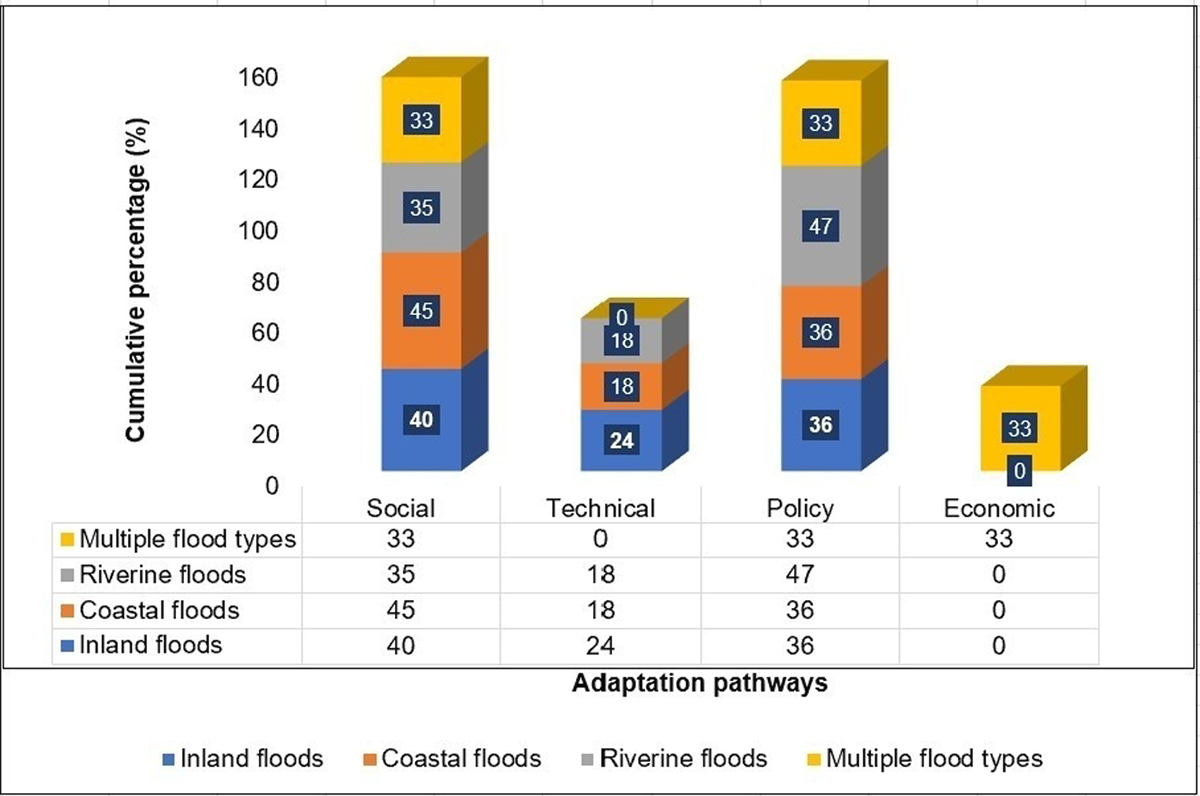
Figure 3
Types of flooding and operational actions in African cities.
The sequential and concurrent nature of flood events, combined with the fragile infrastructure in cities like in Durban, Freetown, Ouagadougou, Kumasi and Lagos, creates conditions for hinging operational actions on urban sanitation and public health, to avert a cascade of negative health consequences that are particularly acute in coastal and low-lying informal settlements. This is partly why Nyam et al. (2024) argue that timely health care access services are a significant precursor for people to form their participation in planning arrangements organised at neighbourhood to city level.
The simultaneous occurrence of riverine and flash floods is common cities like Addis Ababa, whose topography and ecosystem are characterised by streams and rivers, while land-use changes in the surrounding highlands and upper catchments have reduced the landscape’s ability to absorb water (Ayenew & Kebede 2023). This calls for simultaneous actions by self-organised informal networks and individuals, mainly alongside continuous refurbishment of housing units; alternative sewer and sanitation facilities; rainwater harvesting; elevating, grassing and de-silting roads and drainages; communal bridges for safe passage and accessing essential services; creation of local evacuation teams in collaboration with external partners; voluntary immobility; temporary and permanent relocation to safe havens; and most recently flood recovery or relief communications using mobile technologies (Asiedu 2020; Kisembo 2021).
Intra-city relocation is often preferred to migration to other towns within the country or internationally (Ekoh et al. 2023; Williams et al. 2018). Although measures by self-organised informal groups demonstrate evolving adaptation capacities at local community level with potential to address gaps in municipal financing and service delivery, they do not necessarily address systemic adaptation governance issues such as land use and urban growth that inscribe anticipatory tools into measures for protecting the asset portfolios of communities from future extreme events. Though inadequate anticipation for preparedness compounds flood vulnerability, action by both municipal and informal networks is often more galvanised in reaction to post-flood effects.
Grey pathways to infrastructure improvement are often the dominant consequence measure by municipal and national government authorities. These actions focus on drainage systems, housing structures and flood barriers. However, they often face sustainability challenges associated with financial maintenance costs, as many of the upgrades are based on imported rather local hardware supply chains. Early warning systems were highlighted in the literature, including promoting efforts to integrate scientific with indigenous ways that issue alerts based on rainfall or water body levels. Household emergency and evacuation planning, plus distribution of emergency kits and relief items (including food and medical supplies for preventing disease outbreaks) were mainly associated with literature on local civil society operations (Bhanye 2025).
4.2 RISK CONVERGENCE ALONG CLIMATIC AND NON-CLIMATIC INTERACTIONS
Discerning nodes of risk convergence, where climatic factors (e.g. floods) and non-climatic factors (e.g. urban inequalities and inadequate infrastructures) interact to influence action, is critical in creating preparedness measures and resources for harnessing the co-benefits of promoting sector synergies, while reducing the negative trade-offs. But, more often, the standard understanding of flood-related risk is a function of frequency, exposure and vulnerability, the at-risk places and subpopulations affected (Alegría et al. 2024; UNDRR 2025). Flood-related risks in urban informal settings are not solely attributable to climatic conditions; they are deeply rooted in a complex convergence of historical social inequities, different layers and networks of political engagement, and economic and environmental factors (Rözer et al. 2022). Moreover, the dominant risk frameworks like ‘compounding’ or ‘cascading’ often represent sequences of unfolding risks but without paying deeper attention to the multilayered and dynamic realities on the ground.
Across the literature (72 articles), the main nodes for understanding risk convergence included governance, infrastructure and social equity. Under governance risks, a lack of continued cohesion exists between top-down government strategies and bottom-up community-level efforts, after projects supported by aid interventions have ended. Governance risks also touch on elite capture and vested interest groups dominating public participation processes, while overcoming resistance to land-use changes and spatial controls by political elites happens concurrently. Many existing regulations favour large-scale centralised networked solutions, thus risking limited integration of non-networked solutions. Amongst other infrastructural risks is the issue of the financial unsustainability of infrastructure upgrades disconnected from local hardware supplies and African artisanship. Potential maladaptation results from poorly designed systems that are inadequate for future climate extremes.
There is also habitat disruption. Reconstruction projects can disrupt existing wetland ecosystems and other natural systems that provide essential hydrological services. Infrastructure overburdening due to intensified dust and rainfall storm events overwhelm modified systems (e.g. bridges). Social equity risks can stem from limited compatibility of indigenous with scientific knowledge on cultural and behavioural responses. This could be reinforced by hierarchical social structures and gender biases that limit the participation of marginalised groups in indigenous innovations and leadership. All these risks exist simultaneously, forming a constant state of precarity that is amplified by, rather than simply triggered by, a flood event.
4.3 REORIENTING ACTOR CONSTELLATIONS TO TRANSFORM THE GOVERNING OF ADAPTATION
Literature on multi-level governance, social movements and polycentric networks of actors animates the logics and relations amongst multi-actor constellations in cities globally (DiGaetano & Strom 2003; Petzold et al. 2023). Also, the most common interface of actors from the literature reviewed is individuals or households with municipal authorities, community-based organisations and national governments (79 articles). These categories of actor are often known in other literature beyond African cities, and so are the attendant means of empowerment. Means of empowerment included city-to-city learning and stakeholder engagement on community-level flood protection infrastructures; designing and promoting climate-proofing models for integrating flood risk management frameworks into upgrading grey and green urban infrastructures; science–policy–practice interfaces for co-production of adaptation reforms; and incorporating indigenous innovations and leadership into anticipatory science modelling for preparedness and response measures.
The governance of adaptation through networks of multi-actor constellations could be transformed. Wider change can happen from the ground up, rather than confining change in adaptation governance to standard-setting at global scale. Challenges of internal cohesion may arise in the face of converse interests and different pathways to delivering impacts at system level. But this does not negate the lesson that the search for a set of localisable universal standards on governing adaptation has not always matched up to the different contextual realities on the ground. The key lesson on risks accruing from adaptation in urban informal settlements is that it shows how different actors come together in moments of climate extremes (interwoven with un-anticipated economic hardships and public health emergencies) to find alternative pathways to governing adaptation.
As the probable exceedance of the 1.5°C limit of the Paris Agreement gains prominence in how to transform the governing of adaptation locally and globally (Theokritoff et al. 2025), it is important to rethink the hegemonic categorisation of urban informal settlements as vulnerable groups and under-serviced communities. This often obscures their ingenuities and agency to innovate and advance adaptation reforms using local technologies and natural resources. Municipal and government bodies often gain traction when climate policy reporting depicts the inclusion of varied categories of vulnerable groups as direct beneficiaries of municipal interventions, via national communications to the United Nations Convention Framework on Climate Change.1 But the same vulnerable groups are also agents of change and contributors to implementation of nationally determined contributions. They are active leaders in adaptation initiatives like urban forestry, scaling up the greening of value chains through unincorporated business, and as agents of solar electrification, small-scale irrigation and waste recycling for emission reduction (Buyana et al. 2020).
5. DISCUSSION
Overall, the literature demonstrates that climate adaptation pathways focus heavily on technological advancements, policy integration, and the structural redesign of urban infrastructure to match the escalating frequency and intensity of storm events. While technologically advanced and structurally resilient infrastructure is necessary, it poses substantial long-term economic and technical risks. The primary challenge lies in financial unsustainability, as municipalities and local authorities often lack the fiscal capacity to maintain highly sophisticated, upgraded systems over time. A heavy reliance on large-scale engineering interventions can replicate previous environmental failures, resulting in further habitat disruption and the destruction of natural systems that regulate regional hydrology.
By coupling path-breaking capacities with conditions for systemic transformation, current scholarship seeks to disrupt entrenched adaptation pathways (Teebken 2024). Deviating from the conventional, top-down integration of informal stakeholders into mainstream climate agendas, this perspective elevates localised agency that actively challenges orthodox urban management. Adopting this lens requires a dual understanding of urban informal settlements: they are simultaneously incubators for scalable climate initiatives and structurally marginalised communities vulnerable to non-climatic governance risks. To navigate this dichotomy, research must interrogate how informal actors strategically exploit multi-actor networks to contest conflicting municipal and state agendas. These localised interventions can trigger structural shifts, fostering emergent reform alliances that transcend existing institutional boundaries. Although this trajectory must contend with formidable political headwind – particularly state-led, authoritarian preferences for large-scale grey infrastructure – embedding reform processes in empirically tested, localised actions unlocks critical opportunities to pioneer alternative adaptation pathways.
6. CONCLUSIONS
The existing literature categorises current adaptation pathways into social, technological and policy-driven domains, predominantly featuring infrastructure improvements, local community engagement and critical urban infrastructure flood-risk mitigation measures. Beyond these standard actions, current practices also utilise early warning systems, ecosystem-based adaptation, zoning regulations and emergency evacuation protocols. However, these pathways carry distinct risks – classified into environmental, economic, climate-related and social inequality categories – for example the disruption of wetland ecosystems due to infrastructure reconstruction. To address these vulnerabilities, potential future pathways could pivot towards the systemic redesigning and reconstruction of urban infrastructure to withstand the heightened frequency of extreme storm events.
While these anticipated pathways offer robust structural defences, they introduce risks of financial unsustainability, potential maladaptation from inadequate future climate forecasting, and the reinforcement of hierarchical social structures or gender biases. Community-based organisations emerge as the primary actor category within these frameworks, tasked with driving inclusive, participatory and CLA planning, such as the spatial rearrangement of informal settlements to align with drainage upgrades. Empowering these local actors requires a concerted effort to design, fund and promote collaborative planning models that elevate marginalised voices and integrate local knowledge into formal urban governance.
Notes
ACKNOWLEDGEMENTS
The authors would like to thank the editors of this special issue and the reviewers whose valuable comments support the brevity in this paper.
DATA AVAILABILITY
All the sources of data obtained from the systematic review are referenced in this paper.
AUTHOR CONTRIBUTIONS
K.B.: conceived the paper, framing, methodology and drafting. H.S.: reviewed the methodological approach, undertook the systematic review of evidence and data management and developed the figures.