
Table 1
Frequently used terms to describe low or zero carbon approaches to buildings.
| Climate change | Greenhouse gas (GHG) emissions | Carbon |
|---|---|---|
| Climate friendly | CO2 neutral | Carbon neutral |
| Climate neutral | GHG neutral | |
| Climate positive | Zero GHG emissions | |
| Paris compatible | ||
| Below 2°C compatible |
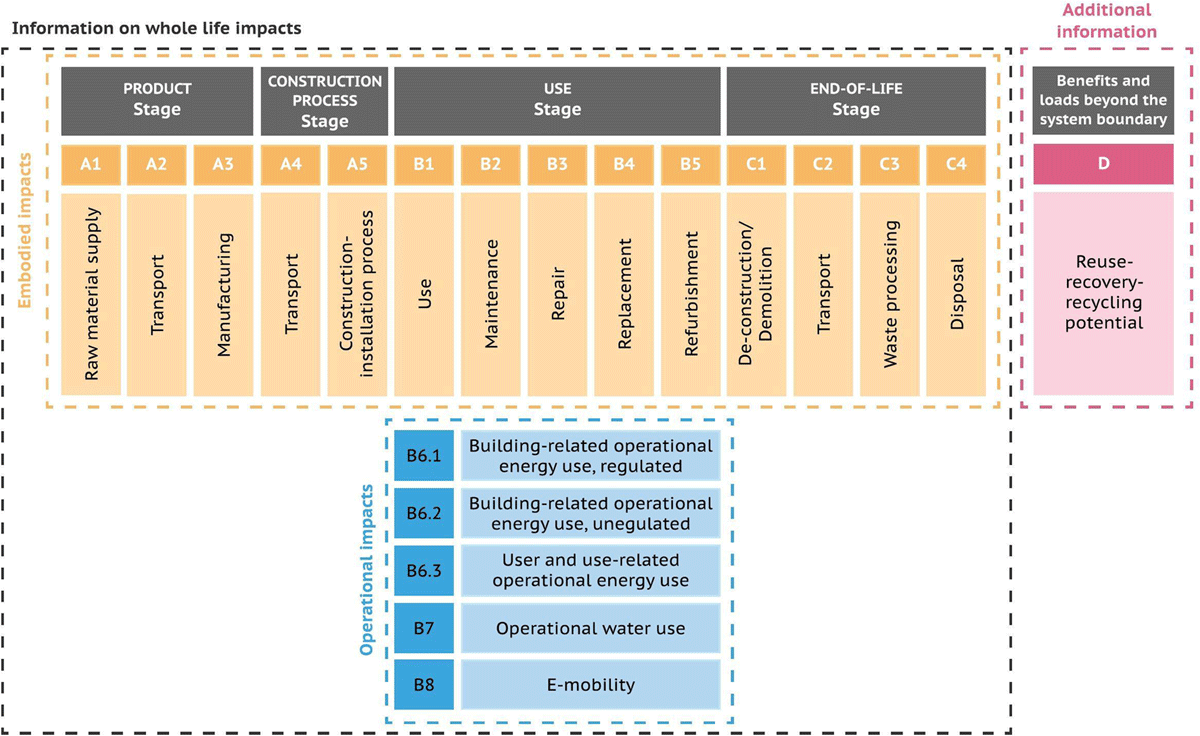
Figure 1
Life-cycle stages of a building, distinguishing the different boundaries (dotted) between the impacts arising from embodied and operational aspects.
Source: Modified from EN 15978 (CEN 2011) in combination with Lützkendorf (2019).

Figure 2
Greenhouse gas (GHG) emissions, GHG emission reductions and resulting net-zero GHG emissions.
Note: GHG emission reductions may be based on potentially avoided emissions beyond the system boundary, the purchase of CO2 emissions certificated or investments in negative-emission technologies (NET) (see section 3).
Source: Adapted from Musall (2013).
Table 2
System of terms, definitions and approaches for net-zero and zero-emission building during operation or full life-cycle.
| Type | Net-zero-emission approaches | Zero-emission approach | |||
|---|---|---|---|---|---|
| A | B | C | D | ||
| Name | Net-balanced approach | Economic compensation | Technical reduction | Absolute zero | |
| Description | Aa Attributes the potential benefits caused by exported energy produced on-site solely to the GHG emissions of the building | Ab Attributes the pro rata share of GHG emissions caused by on-site energy production to the exported energy The amount of exported energy and potential benefits caused by exported energy are reported as additional information | Purchase of CO2 certificates covering life-cycle GHG emissions caused by the building | Investment in technical-reduction measures to reduce life-cycle-based GHG emissions caused by the building | Use of construction materials and components with zero GHG emissions (including supply chain emissions), purchase of operational energy and water with zero GHG emissions (including supply chain emissions) |
| Feasibility | Net-zero GHG emissions are within reach by minimising the energy demand and maximising the generation of renewable energies and the inclusion of potentially avoided GHG emissions due to the export/sale of energy to third parties | Net-zero GHG emissions are within reach by minimising the energy demand and maximising the on-site production of energy with (building-integrated) renewable energies combined with an economic compensation (B) or a technical reduction (C) | Net-zero GHG emissions are within reach by purchasing CO2 certificates/emission allowances and thus economically compensate for the remaining GHG emissions caused by the buildinga | Net-zero GHG emissions are within reach by purchasing technical GHG emission reductions to level off the GHG emissions caused by the buildingb The GHG emission reductions are achieved by one of the following negative-emission technologies (NET)c or carbon dioxide removal (CDR):
| Absolute zero emissions are within reach if all production processes, including all supply chains, are based on renewable energies and free from emissions of any GHG, and if no building products emitting CO2 from carbonisation processes are used |
| Limitations | Dependent on the (continuously declining) carbon intensity of avoided electricity producing technology or mix Avoided emissions attributed to the building need to be accounted for by the purchaser of exported energy. This measure to reach a net-zero GHG building leads to increased GHG emissions elsewhere Double-counting of low-carbon energy production is likely to occur | Net-zero GHG-emission buildings are reachable only with financial compensation or technical reduction | Financial compensation does not sufficiently contribute to the global net-zero emission target The cheapest reduction potentials are likely located in emerging and developing economies. These countries may thus face high costs in future when it is their turn to reduce GHG emissions | Achievable if permanent carbon storage is technically and economically feasible | Very difficult to achieve due to the current dependence on certain materials (float glass, cement, etc.). A viable carbon capture and storage is needed to reduce emissions from the production of these materials |
[i] Notes: GHG = greenhouse gas.
a The GHG emissions to be compensated economically equal the GHG emissions caused in construction, use and end of life of the building under assessment. Ideally, a safety factor (e.g. 1.05 or 1.10) is included.
b The GHG emissions to be captured and fixed/stored long term equal the GHG emissions caused in construction, use and end of life of the building under assessment. Ideally, a safety factor (e.g. 1.05 or 1.10) is included.
c For NET, see, for example, Minx et al. (2018).
d Extraction of ambient CO2 through photosynthesis and long-term storage in biomass (living or dead; increase of natural sinks): achievable with afforestation, improved forest management; the storage of carbon in long-living buildings and wood products; the storage of carbon in the soil; and long-term underground storage of biogenic carbon.
Table 3
Proposal for specific terms in the context of (net-) zero greenhouse gas (GHG)-emission buildings.
| Name | Variations in scope | Explanation | |||
|---|---|---|---|---|---|
| Operational on-site GHG emissions | Operational including supply chain GHG emissions | Embodied GHG emissions | Life-cycle-based GHG emissions | ||
| Zero × GHG emissions building | ▄ | ▄ | ▄ | ▄ | Absolute zero (Option D) |
| Net zero × GHG emissions building by economic compensation | ▄ | ▄ | ▄ | ▄ | Combined with economic compensation (Option B) |
| Net zero × GHG emissions building by technical reduction | ▄ | ▄ | ▄ | ▄ | Combined with technical reduction (Option C) |
| Net zero × GHG emissions building by credits from emissions avoided elsewhere | ▄ | ▄ | ▄ | ▄ | Including potential benefits beyond the system boundary (Option Aa) |
[i] Note: ‘×’ = Different variations of scopes: ‘operational on-site’, ‘operational including supply chains’, ‘embodied’ or ‘life-cycle based’. The appropriate term can be applied in each circumstance.
Table 4
Key figures for the virtual building illustrating the (net-) zero greenhouse gas (GHG) emission approaches and variations.
| Unit | Value | ||
|---|---|---|---|
| Construction | kg CO2/m2a | 10 | |
| PV system | kg CO2/m2a | 2 | |
| Operation | On-site | kg CO2/m2a | 3 |
| Supply chain | kg CO2/m2a | 1 | |
| Exported PV electricity | Share | 30% | |
| Electricity mix | kg/kWh | 0.5 | |
| PV electricity | kg/kWh | 0.05 |
[i] Note: PV = photovoltaic.
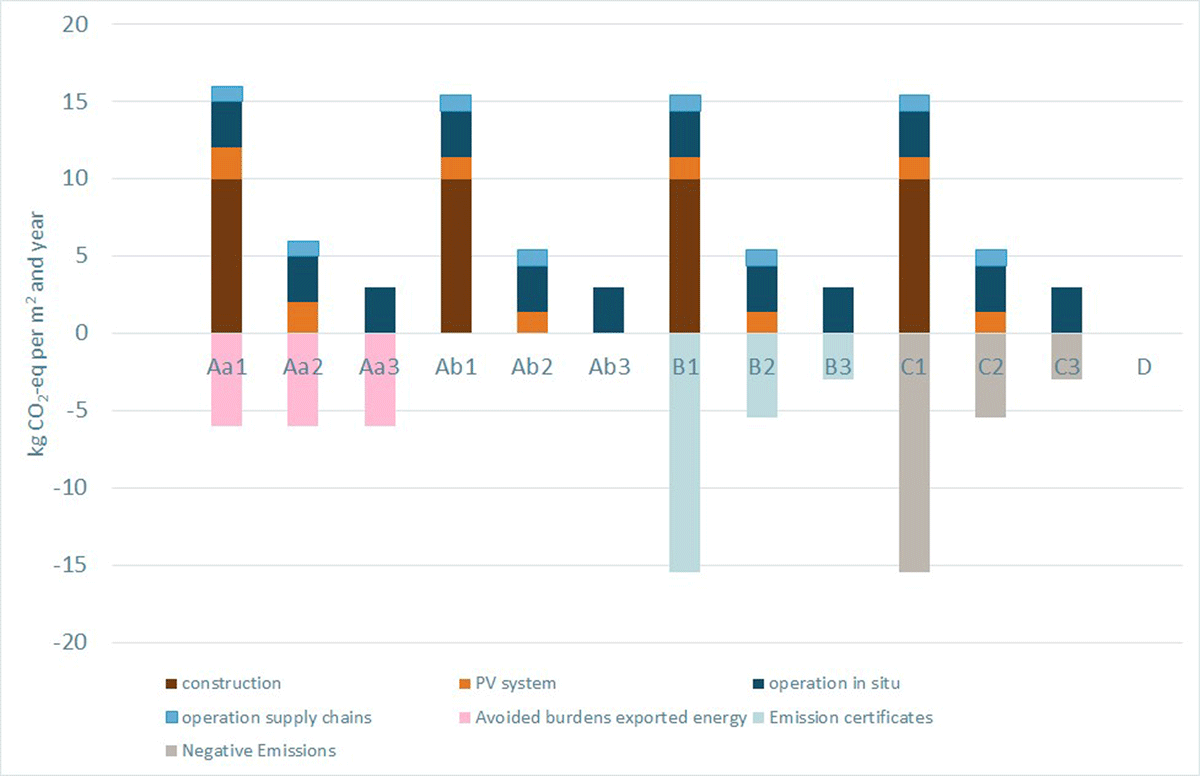
Figure 3
Greenhouse gas (GHG) emissions and GHG emission reductions of the fictive building according to the four approaches and three variations.
Note: A = net balance; B = economic compensation; C = technical reduction; D = absolute zero; a = potentially avoided emissions; b = allocation; 1 = life-cycle based; 2 = direct and indirect operational emissions; and 3 = direct (on-site) emissions.