
Abbreviations
| AHC | After housing costs |
| ENEX | Energy expenditure |
| EPC | Energy performance certificate |
| FoI | Freedom of information |
| IAAW | Inability to Afford Adequate Warmth |
| IMD | Index of Multiple Deprivation |
| GHG: LAD | Green Homes Grant Local Authority Delivery |
| GLA | Greater London Authority |
| LBSM | London Building Stock Model |
| LIHC | Low Income High Cost |
| LILEE | Low Income Low Energy Efficiency |
| PSR | Priority Services Register |
1. Introduction
Fuel poverty is a significant international challenge, widely understood as shaped by a broad range of factors, including increased energy prices, general inflation and poor energy efficiency standards in some homes. The problem is complex and has negative social impacts, exacerbating health and socio-economic inequalities (Butler 2022; Thomson et al. 2017b). Hence, establishing priorities for the use of limited resources is a major challenge for policymakers. With buildings having a long life-cycle, domestic energy retrofits are generally agreed to be an essential part of the response. Retrofits also have a vital role in reducing CO2 emissions by reducing heating and cooling demands while also addressing the performance gap by fostering changes in occupants’ behaviours. The barriers and drivers that domestic energy retrofit agendas involve, including the different types of retrofit (single step, staged or deep), the fuel poverty metrics, and the limitations of strict eligibility criteria for financing interventions, have been thoroughly examined (Ben & Steemers 2020; Evans et al. 2023; Wade & Visscher 2021). In terms of the feasibility of retrofitting, there are knowledge gaps and skills shortages, with a lack of qualified workers able to carry out the work and limited public resources to comprehensively address inequalities and deliver inclusive energy retrofits that specifically tackle households in fuel poverty (Clarke et al. 2016; Ince & Marvin 2019). Given the importance of local-scale governance and leadership in addressing these opportunities and challenges, the complex interrelationship between national and local policy remains relatively unexplored. There is also limited research on the health and socio-economic inequalities that fuel-poor households face when public retrofit interventions, (which focus primarily on emissions reduction) are designed.
These challenges are considered here for policymakers in the UK context, focusing on policy for tackling fuel poverty in London. The UK government seeks to improve the energy efficiency of at least 2.5 million homes by 2030 as part of the net-zero-carbon agenda. However, it is estimated that 3.53 million homes in England are currently in fuel poverty, with the number increasing annually, despite home retrofit programmes, advice, and awareness campaigns for eligible vulnerable households (Hinson & Bolton 2023). Important social inequalities, vulnerabilities and health problems affect a growing number of these households. Through a case study of London, we examine their implications. Our findings demonstrate how national metrics, local policy, assessment tools and home energy efficiency programmes have impacted fuel poverty since 2021. The paper has the following four objectives:
To provide an overview of the main drivers and social impacts of fuel poverty, with a focus on London, UK.
To identify the main challenges in embedding wider socio-economic characteristics and inequalities in metrics and assessment frameworks for fuel poverty and energy retrofitting across different scales of governance.
To evaluate national indicators and methodologies for assessing fuel poverty in England, considering health and socio-economic inequalities, and exploring their impacts on city-regional (London) level.
To examine how different interpretations of inequalities have influenced and shaped local policy and governance in the case of UK and Greater London Authority (GLA) policies and funding schemes.
The study contributes to the development of frameworks for assessing policy interventions for tackling fuel poverty and the debate assessing interrelationships between national and city-level policies and programmes. It provides directions for enhancing existing metrics and eligibility criteria for fuel poverty and domestic retrofit funding programmes. It also highlights the need for place-based, city-scale policy interventions and a broader, multifaceted understanding of fuel poverty for informing the design and delivery of domestic energy retrofit programmes.
The paper is structured as follows. Section 2 outlines the research design and methods. Section 3 reviews the background and literature on definitions and indicators of fuel poverty, socio-economic and health inequalities in London, local fuel poverty plans and funding programmes. Section 4 presents data on domestic energy retrofits in London, and Section 5 discusses the findings. Section 6 concludes, with recommendations and directions for further research.
2. Research methods
We carried out a detailed thematic literature review concerning international debates about the definitions and causes of fuel poverty, including the wider social impacts of this challenge for policymakers. Our review also assessed the (mostly post-2016) literature on UK policy, national statistics, and UK government reports, including a focus on city-level policies and programmes such as the London Fuel Poverty Action Plan (GLA 2018). This provided an understanding of the specific metrics, policies and commitments on fuel poverty and energy retrofits at national and local levels. It also enabled an evaluation of domestic energy retrofit programmes in terms of how they prioritise households in fuel poverty at city scale.
Empirical data on the GLA retrofit programme were collected through freedom of information (FoI) requests. The number of retrofitted homes already in fuel poverty as part of a specific funding programme was difficult to identify owing to the lack of publicly available comprehensive databases (Schiano-Phan et al. 2023). FoI requests were sent to all 33 boroughs in London and the GLA, to develop an evidence base of the number of domestic retrofit upgrades since the Mayoral Accountability Assembly in 2021.
A multistakeholder focus group workshop was carried out in July 2023. This workshop was attended by 20 participants, including academics, local authority officers (London boroughs), GLA representatives and practitioners working in architecture, construction, building energy performance, environmental design, governance and social sustainability. Participants engaged in critical discussions on publicly available data on fuel poverty and the effectiveness of the retrofit action in London, thus triangulating the results from the desk-based research and FoI requests. Caillaud and Flick (2017) suggest using focus groups as a valuable tool in mixed methods studies for triangulating the data generated and providing a better understanding of the ‘study insights’ in group discussions. Purposive sampling was conducted, focusing on gathering data from participants likely to provide the most relevant data to the research (Bryman 2012; Hammersley 2013). Publicly available GLA policy documents and the authors’ network of contacts were used to make this identification. Interaction with participants during the focus group by the research team was limited to avoid bias (Mills et al. 2006).
A limitation is that most London boroughs do not hold information about their private stock (Schiano-Phan et al. 2023). An important data source is the G15 consortium of housing associations, which holds most of the private social housing stock previously managed by the councils. However, the G15 did not respond to the research requests for information and data on energy retrofits of their housing portfolio by the end of the study’s first phase. This fragmentation of responsibilities was evident in the limited data gathered for private and social housing stock (Schiano-Phan et al. 2023).
3. Background and literature review
3.1 Definitions and indicators of fuel poverty
Fuel poverty1 is an international sustainability challenge, widely understood to refer to households not being able to meet energy-related needs (Bouzarovski 2018; Halkos & Aslanidis 2023). The range of causal factors shaping this form of poverty is widely recognised, including low incomes (Boardman 2012), general and energy price inflation, poor levels of energy efficiency in residential properties, and household characteristics (Bouzarovski 2018). Viewed in this broad context, the metrics used by policymakers in the UK to measure fuel poverty have historically had significant limitations, based exclusively upon either ‘subjective’ (self-reported) or ‘objective’ (expenditure-based) information (Galvin 2024).
The UK was one of the first countries to define fuel poverty through an Act of Parliament in 2000 and annual national statistics (Bouzarovski 2018). By contrast, other European countries, such as Germany, do not recognise fuel poverty as such. Instead, the German federal government aims for a holistic approach to assess and combat poverty overall, encompassing fuel poverty (Galvin 2024). It is especially important for tools used to assess the sustainability of the built environment to be sensitive to the complex inter-relationships between multiple environmental, social and economic factors (Greenwood 2012: 175). Reflecting such recognition at the European Union level, the Energy Poverty Advisory Hub (EPAH) recently revised national fuel poverty indicators across Europe, incorporating a blend of objective and subjective indicators (Gouveia et al. 2023). The EPAH review is linked to the ‘Covenant of Mayors for Climate and Energy Europe’, gathering data from 10,000 municipalities and examining the potential interdependencies between fuel poverty, energy expenditure and exacerbation of health conditions. The review acknowledges the complex range of issues influencing fuel poverty. Fuel poverty indicators are broadly categorised into four macro areas: climate; facilities/housing; mobility; and socio-economic and health aspects and include (Gouveia et al. 2023):
cooling and heating degree days
final energy consumption in households by energy and type of fuel
perception by population considering their dwelling as too dark
population who cannot afford regular use of public transport
causes of death
disposable annual household income
housing cost overburden rate
population reporting a chronic disease
final consumption expenditure of households
This last indicator ranges from basic household subsistence expenditure to health, building maintenance/repairs, energy consumption, equipment purchases and mobility expenses.
The EPAH review points out the importance of local differences, including varied socio-economic conditions, climate, and energy infrastructure, and rural and urban areas, as well as demographic considerations related to gender, age, and social status – highlighting the necessity for a multidimensional and holistic approach to fuel poverty assessments bridging the national and local indicators with a unified method of reporting that is continuously updated (Gouveia et al. 2023; Gouveia et al. 2019).
In the UK, in contrast with this recent EU approach, objective definitions of fuel poverty have traditionally focused on energy expenditure (ENEX) or total energy consumption, as space heating is currently the contributing factor in household energy use. Fuel poverty is assessed via various metrics after gathering data on thermal comfort, household needs, building characteristics and external weather and climate conditions. A further measure of fuel poverty is the Inability to Afford Adequate Warmth (IAAW) in the home. While intuitively appealing, IAAW’s measurement of this ‘inability’ is based on occupants’ self-assessment. IAAW is a highly subjective measure, with younger households more likely to report an inability to achieve adequate warmth (Deller et al. 2021). Another simple but more objective measure is the ‘10%’ indicator, by which a household is fuel-poor if the ENEX is more than 10% of the income, with income usually being defined as net of tax and separate from benefits (Deller et al. 2021). Therefore, a household is fuel-poor if FP Ratio = Required Fuel Cost / Income > 0.1.
The ‘10% indicator’, which assesses ENEX after housing costs (AHC), was the former official UK government metric used in fuel poverty and energy retrofit studies up to 2014 (Boardman 2012; Thomson et al. 2017a). Official analyses conducted in Wales and Scotland still apply this method (Mahoney et al. 2020), though common disadvantages are its narrow assessment, excessive dependence on fuel prices and failure to include a range of broader social inequalities applying to households in fuel poverty (Siksnelyte-Butkiene et al. 2021).
Another indicator is Low Income, High Cost (LIHC), which the UK government adopted as the official metric in 2015. According to LIHC, there are two thresholds – high energy costs and low income – for assessing households in fuel poverty. ENEX should be higher than the national median. Low income is 60% of median income (income remaining after deducting required fuel costs below the official poverty line). LIHC considers the fuel poverty gap, i.e. the reduction in energy costs that would take households out of fuel poverty (DESNZ 2023). It represents a needs assessment measuring income, housing costs, modelled energy bills and socio-demographic characteristics, including a range of ethnicity groups in full-time education, part-time work, retirement or unemployment (Burlinson et al. 2018). In 2021, the LIHC metric was replaced with Low Income, Low Energy Efficiency (LILEE), the current official indicator in England. According to LILEE, a household is considered fuel-poor if they live in a property with an EPC of band D or below and their income remaining after deducting required fuel costs falls below the official poverty line (DESNZ 2023; Semple et al. 2024). LILEE is the first indicator to consider home energy efficiency and LILEE annual data are slow to change compared to the 10% metric, which focuses on AHC.
In 2022, the average fuel poverty gap in the UK/England was 33% higher than in 2021 under the LILEE metric (DESNZ 2023). About 78.4% of all fuel-poor homes in England are rated band D, 16.6% band E and 5% F and G. Alongside the diversity of EPC ratings, fuel poverty also affects various dwelling types differently: 24.8% of households in fuel poverty live in converted flats, and 19.8% live in end-of-terrace houses. In comparison, a smaller proportion (7.6%) live in detached houses but with a relatively higher fuel poverty gap, that is, the reduction in annual energy costs to take a household out of fuel poverty (£702) (DESNZ 2023). In addition to the building typology, which affects energy efficiency (e.g. high window-to-wall ratio, high exposed wall area), the property’s age is another risk factor. In 2022, 40% of households in fuel poverty lived in older properties built before 1945 (DESNZ 2023). Privately rented households are more likely than those in social renting and owner-occupied categories to live in poor-quality homes. It is estimated that 14% of UK households (3.5 million) live in properties that do not meet the Decent Homes Standard and a Category 12 Hazard is present in 10% (2.3 million) (UK Government 2023).
The main criticism of LILEE is that it does not reflect fuel price rises since 2022, with some scholars reverting to the 10% indicator to quantify the actual number of UK households in fuel poverty in 2022 (Keung & Bradshaw 2023). There are also concerns about the accuracy of EPC assessments owing to human and measurement errors and the performance gap (Coyne & Denny 2021; Jenkins et al. 2024; Semple et al. 2024). Semple et al. (2024) estimate a 145% higher risk than LILEE data in London owing to the number of vulnerable homes who are automatically excluded because of an EPC A–C rating. Domestic energy efficiency policy has contributed to emissions reductions, but it is unclear whether this has improved fuel poverty outcomes (Bridgen & Robinson 2023: 398; Keung & Bradshaw 2023).
3.2 Socio-economic and health inequalities in London homes
Marmot et al. (2020) discuss the interplay between health inequalities, life expectancy and the health gap in placemaking. In addition, the recent COVID-19 pandemic and the Ukrainian conflict have drawn policymakers’ attention to the cost of fuel, rising energy prices, general inflation and climate change and how these affect the health and well-being of vulnerable and disadvantaged people (Butler 2022; Clair & Baker 2022; Guan et al. 2023; Halkos & Aslanidis 2023; IPCC 2023; Stojilovska et al. 2022). In terms of the local distribution of health and socio-economic inequalities, the Index of Multiple Deprivation (IMD 2024) is a publicly available, open-source tool for identifying the most deprived areas, which often present a linear correlation with high rates of fuel poverty.
Evidence of climate change and global warming are becoming more apparent globally. Increased extreme weather events, including heatwaves, drought and heavy rainfall, damage dwellings and pose risks to public health (IPCC 2023). However, a significant limitation in definitions and metrics of fuel poverty is that they do not include the risk of summer fuel poverty, the health implications from overheating and the need for cooling (Sanchez-Guevara et al. 2019).
The financial difficulties caused by the COVID-19 pandemic, when many were homebound, led to a greater political awareness of inequalities of vulnerable groups disadvantaged by the cost of living in London. One in nine London households cannot heat their homes and are in fuel poverty. A ‘recovery board’ was proposed with five aims, including to ‘narrow social, economic and health inequalities’ and reach net zero by 2030 (London Labour Party 2021: 21). Renewable energy and indoor air quality became priorities and retrofit was acknowledged as a solution.
A diverse range of people are at risk of fuel poverty, including families with young children, the elderly, the unemployed, young adults, and people with disabilities (Hinson & Bolton 2023). The proportion of households in fuel poverty and the average fuel poverty gap were two indicators used for England in 2022 by the UK government. According to the Department for Energy Security and Net Zero, the single-parent category had the highest proportion of fuel-poor households (26%) with a low average fuel poverty gap (£255). By comparison, couples under 60 years old without children had the highest average gap (£430) but the smallest proportion (7%) of fuel-poor households (DESNZ 2023). This example illustrates the complexity of addressing inequalities in assessments. While some groups (single parents) are largely impacted, others (couples under 60 without children) are unnoticed but with severe impact. This diverse socio-economic reality presents a fundamental challenge not addressed in government policy and action.
‘Health’ or ‘well-being’ is not generally mentioned in government reports on fuel poverty. However, tackling cold homes would save the NHS £540 million per year (Garrett et al. 2023). Respiratory and circulatory problems are two main health problems related to cold homes in the UK (Public Health England 2014), with 93% of excess winter deaths reported being from the elderly population (Braubach et al. 2011). Ageing occupants are susceptible to fuel poverty per the LILEE, LIHC and 10% metrics but are less likely when applying the IAWW indicator. Ageing groups perceive lower temperatures as usual or feel uncomfortable admitting they are in fuel poverty (Deller et al. 2021). Winter mortality in the UK is twice as high as in Nordic countries (Braubach et al. 2011). Children living in cold homes are one and a half to three times more likely to develop symptoms of asthma.
Furthermore, increased indoor temperatures significantly improve mental health, particularly for people who can become socially isolated due to financial difficulties and feel anxious about energy bills (Braubach et al. 2011). The World Health Organization suggests that exposure to dampness and mould in the home may lead to depression (Braubach et al. 2011). While the impacts of climate change on occupants’ thermal comfort in winter are well known, the effects of higher temperatures and the need for summer cooling are less discussed in the fuel poverty literature (Sanchez-Guevara et al. 2019).
3.3 Fuel poverty plans and funding programmes at national and local levels
Fuel poverty can be addressed in three ways: by improving a household’s income, by reducing energy costs and by improving energy efficiency. This section analyses existing UK policies, action plans and funding schemes, and how national policies (DESNZ 2023) cascade down to local policy and programmes in London.
UK-wide social funds support a household’s ability to pay bills through payments and discounts to eligible vulnerable occupants. Examples include the winter fuel payment, the warm homes discount, and cold weather payments. The UK government is investing £12 million in home energy efficiency programmes, including energy company obligations (ECO) and the Social Housing Decarbonisation Fund (DESNZ 2023). Depending on the programme, funding is delivered to eligible households through local authorities, installers, energy companies, registered bodies (e.g. social landlords, housing associations, charities, and management organisations).
The GLA receives funding from the aforementioned UK government scheme. Energy for Londoners is a GLA umbrella programme focusing on energy efficiency and local, clean energy in domestic and non-domestic buildings. Under this programme, the Fuel Poverty Action Plan, announced in 2018, aims to reduce the fuel poverty gap and help Londoners who cannot heat their homes to overcome the health effects of cold, damp and draughty living conditions. The London Fuel Poverty Plan adopted the LIHC indicator as the national metric; no updates have been made since 2018. The aim is to tackle fuel poverty by improving home energy efficiency and increasing the rate of domestic energy retrofits, also considering the target of being a net-zero-carbon city by 2030 (Schiano-Phan et al. 2023).
The London Building Stock Model (LBSM), developed by the UCL Energy Institute, is an online, open-source database of all energy and carbon data from domestic and non-domestic buildings in London (CREDS 2020; GLA 2020; Steadman et al. 2020; UCL 2020). The tool has two versions, one solely for the use of the GLA/boroughs and a publicly available one (Steadman et al. 2020). This digital twin maps the EPC rating of a property and is considered a tool for tackling fuel poverty, as stated in the London Fuel Poor Home Action Plan (GLA 2018). In the GLA version, the LBSM contains EPC data alongside datasets developed or acquired by the GLA, which include economic opportunity areas, conservation areas, district heating networks, energy efficiency funding programmes, census data, air quality data and low emission zones. The tool therefore allows poorly performing dwellings to be identified and enables the GLA and local boroughs to plan for energy improvements, reduce energy bills and cut carbon emissions (Steadman et al. 2020).
The GLA recommends ‘whole house’ (or deep) retrofit, particularly for dwellings with EPC ratings of F and G, following the Minimum Energy Efficiency Standard (MEES) of an EPC rating of C in the private rented sector by 2030 (GLA 2023b). However, owing to the prioritisation and targeting of energy efficiency improvements, there is no GLA framework for explicitly identifying households in fuel poverty. The question of how domestic retrofits tackle fuel poverty caused by low incomes and rising energy prices remains and moves up to the limitations of LILEE and issues of assessment frameworks not addressing social needs and broader inequalities.
The GLA and London boroughs can fund their own place-based energy efficiency measures and realise the co-benefits of low-carbon development (Sugar & Webb 2022). However, local practice depends on how national metrics and UK government funding programmes are designed. Examples of GLA schemes include the Green Homes Grant Local Authority Delivery scheme (GHG: LAD), the Sustainable Warmth (Local Authority Delivery and Home Grant Upgrade) and the Warmer Homes Programme. Funding usually covers insulation (cavity, solid wall, loft), air source heat pumps, boiler repairs, electric storage heaters, solar photovoltaic panels and heating controls (GLA 2023b). The Green Homes Grant Local Authority Delivery offers up to £10,000 to homeowners and £5,000 to landlords and housing associations, including social housing. The Warmer Homes Programme provides funding between £5,000 and £25,000 to eligible low-income homeowners and private tenants. As well as a low EPC rating, to be eligible for the GHG: LAD and Warmer Homes schemes, households must meet criteria related to total annual income or receipt of means-tested benefits (e.g. benefits entitlement checks, London affordable rent, and London living wage). However, in all the above schemes, eligible households should have an EPC rating of D or lower (E, F or G), which connects the schemes to LILEE, the national metric.
In London, vulnerable households, including those in fuel poverty but without a low enough EPC to be eligible for government/GLA funding, can obtain advice and support through the Priority Services Register (PSR) (GLA 2018). The Warm Homes Advice Service delivers additional support through visits and bespoke advice for funding applications and enrolment to PSR and other support services (GLA 2023a). In July 2023, the mayor announced the following updates to the 2023–2025 fuel poverty and place-based retrofit programmes in London (GLA 2023b):
£2,600,000 of Warmer Homes funding for London homes in the owner-occupied and privately rented sectors.
£370,000 on a fifth round of the Warmer Homes Advice Service.
The GLA had successfully bid for £12,006,000 from the Home Upgrade Grant 2 competition for use in London in 2023–24 and 2024–25. This funding would target low-income households in poorly performing homes by installing insulation and low-carbon heating upgrades.
Finally, £950,000 has been sought for a new Retrofit London delivery framework programme, awaiting formal approval (GLA 2023b).
4. Results
4.1 Analysis of FoI requests
4.1.1 The rate of domestic energy retrofits
The number of retrofitted homes, public and private stock, and the use of the LBSM were the subject of FoI requests sent on 9 June 2023 by email to all London boroughs and the GLA. Twenty-six of 33 authorities responded with relevant information, as shown in Figure 1. Nine did not have data on the number of retrofitted homes and seven did not respond. Based on the 26 responses, 17,250 homes in the public stock and 983 private homes implemented retrofits and accessed government grants, such as the Warmer Homes Programme. These are shown by borough in Figure 1. Some boroughs specified the type of grants and retrofits received, while others did not.
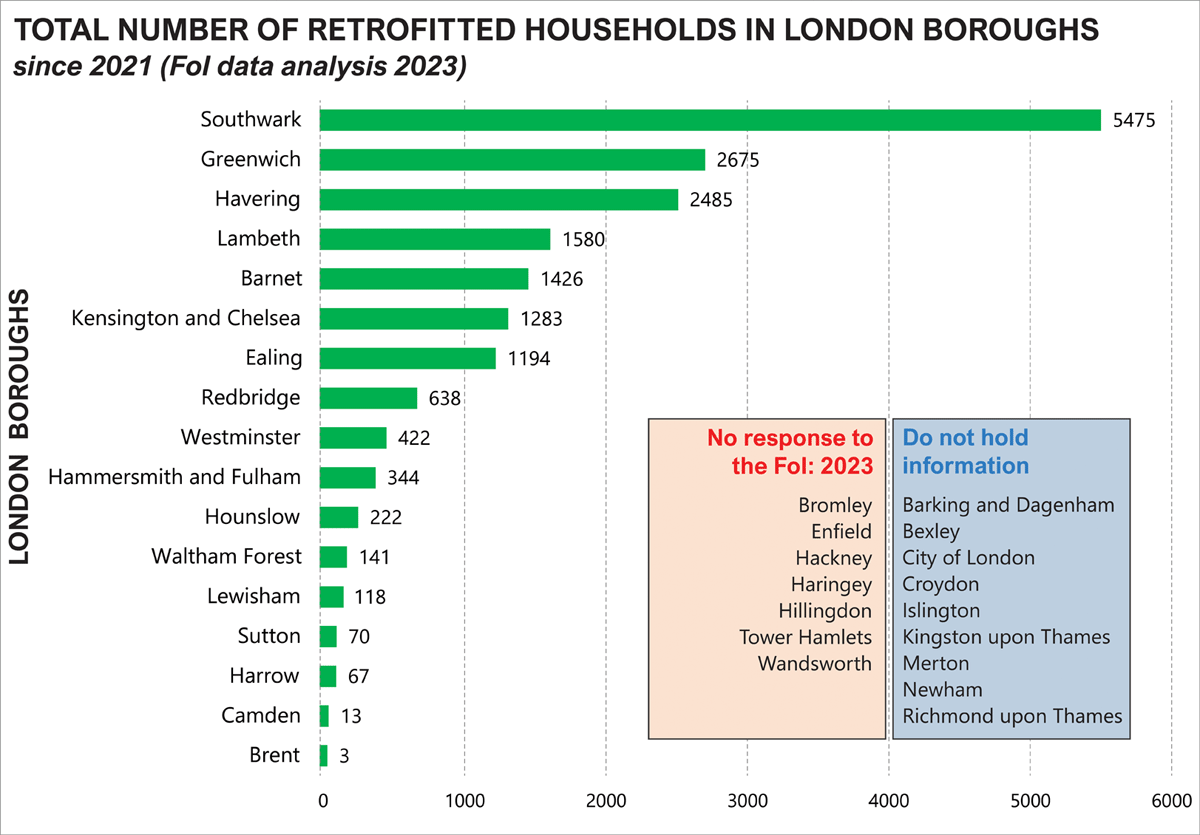
Figure 1
Total number of households retrofitted in London since 2021.
Source: FoI data analysis, 2023.
Only the boroughs of Havering, Lambeth and Sutton provided figures on deep or whole-house retrofit, with a total of 117 homes in public stock. From the boroughs specifying retrofit types for the public stock, the following figures emerged: 4,914 homes were retrofitted for boiler replacement; 1,099 undertook window and door upgrades; 1,190 homes installed loft insulation, roof insulation and cavity wall insulation; and 2,023 homes received energy savings measures. The uptake of various schemes such as ECO and the GHG: LAD was evident but it is not clear which of the above-mentioned retrofit measures were delivered from each scheme.
4.1.2 Domestic energy upgrades and the LBSM
The FoI requests inquired about using the GLA/borough version, which is more powerful, to determine whether it is implemented specifically to identify households in fuel poverty. Figure 2 shows the responses from 26 boroughs to the FoI requests:
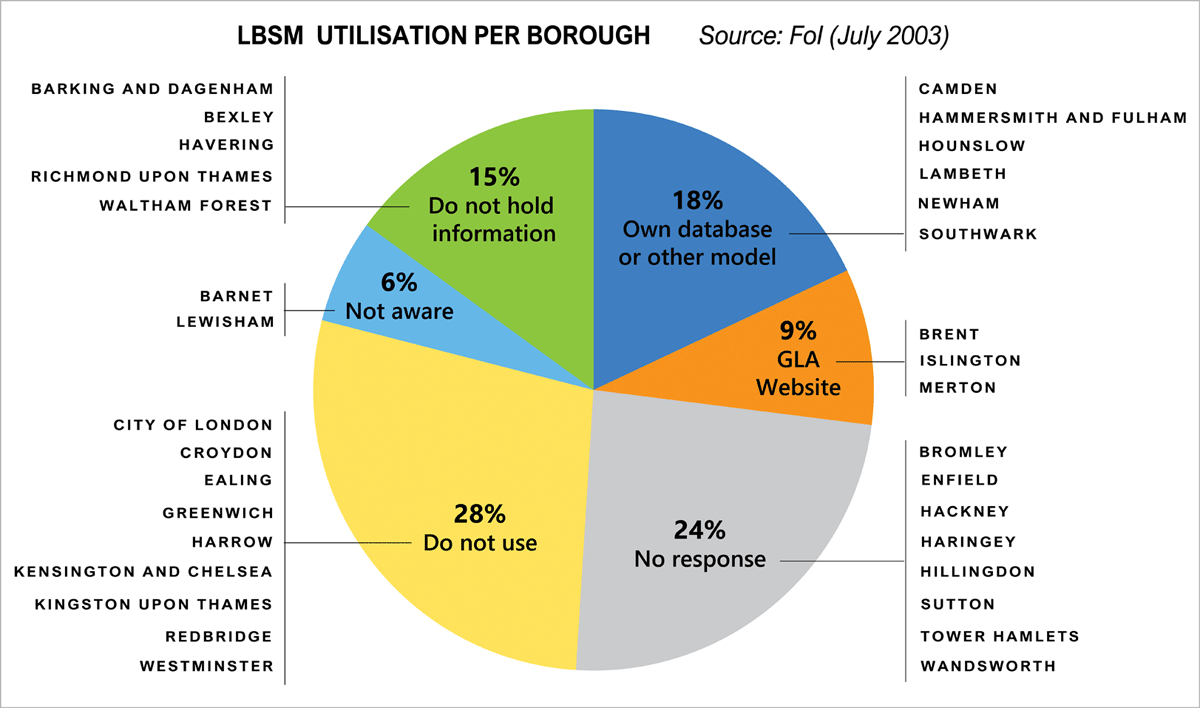
Figure 2
LBSM utilisation per borough.
Source: FoI data analysis, 2023.
three (9% of the 33 authorities) used the LBSM (Brent, Islington and Merton)
nine (28%) responded that they were not using the LBSM
five (15%) boroughs did not hold any information
two (6%) were not aware of the LBSM
six (18%) (Camden, Hammersmith and Fulham, Hounslow, Lambeth, Newham, and Southwark) used their in-house database or other models such as Pathway and Parity’s Portfolio to analyse the energy efficiency of their building stock instead of the LBSM.
These results suggest that the use of the LBSM alone cannot identify homes in fuel poverty. The LBSM is an effective database for showing energy efficiency improvements but it fails to incentivise the uptake of domestic retrofits. The FoI responses do not show whether retrofits were motivated primarily by the alleviation of fuel poverty or the net zero targets. This is because the LBSM only maps the EPC rating, requiring cross-referencing with socio-economic databases – beyond, for instance, the IMD – to identify homes in fuel poverty. There are also data accountability issues and inconsistencies with the reporting of EPC assessments. Hounslow is the only borough that stated its use of the LBSM to check the EPC ratings.
4.2 Focus group discussion
The focus group explored the different values, experiences and knowledge held by London policy and industry practitioners in housing, fuel poverty and energy retrofitting. First, focus group participants commented on the results of the FoI requests in relation to the rate of domestic energy retrofit programmes in London and the extent to which local policy prioritises households in fuel poverty at the city scale. Second, participants considered the interrelationship between national metrics, local retrofit plans and local policies for addressing fuel poverty. The majority agreed that one key reason for the slow uptake of retrofit projects is that the GLA and London boroughs do not lead independent place-based retrofit interventions. A participant from the London Assembly commented:
The role of local authorities is still limited and needs to progress to cooperative leadership and action in a way that addresses the unique context-specific health and socio-economic inequalities facing households in fuel poverty in each local area.
Participants also felt that the change from the LIHC to the LILEE indicator hinders accurate identification of households in or at risk of fuel poverty. A representative from GLA highlighted the disconnect between the net zero target and the eligibility criteria for public funding for domestic retrofits with the inequalities driven by fuel poverty, saying that:
The inability to afford energy bills has health, safety and thermal comfort implications which deep energy retrofits would potentially address.
However, to have a full picture of vulnerable households in fuel poverty, there is an apparent challenge to data availability and data management. An environment and climate change officer from a London borough commented that:
All boroughs need to have access to reliable and frequently updated datasets and sources, to account for household status, socio-economic data, and the dynamic profiles of occupancy and ownership profiles.
5. Discussion
There is a lack of clarity about which levels of government currently have responsibility for identifying and addressing fuel poverty. The primary goal of city-regional funding programmes is CO2 emission reductions, rather than tackling fuel poverty being at the forefront. The results of the FoI requests have shown inconsistencies in attainment and proactivity in both addressing fuel poverty and retrofit delivery. Polanski (2023) reveals that the reasons that some local authorities are slower than others in retrofit delivery are a lack of both local leadership and a local retrofit strategy that develops pathways to specialised retrofit work through vocational education and training provision, procurement for the Warmer Homes Scheme, public awareness, and demand beyond that stimulated by government funding.
5.1 National metrics and local policies for addressing fuel poverty
Higher energy prices and living costs increase the likelihood of vulnerable populations falling into fuel poverty. At the national level, the scope or definition of a fuel poverty metric (i.e. whether it accounts for housing costs, low income, energy efficiency or high energy costs) plays a critical role in identifying health and socio-economic inequalities across households (Burlinson et al. 2018).
An implication is that the choice of metric impacts how domestic retrofit programmes are designed and how successful their delivery is in removing households from fuel poverty. The LILEE does not consider the cost of energy, a challenge impacting vulnerable households in EPC A–C properties. This leads to results vastly different from previous indicators, such as the 10% metric, which would show a sharp increase in fuel poverty due to increased energy bills since 2021 (DESNZ 2023; Semple et al. 2024). It is inevitable that local policy will have to follow the use of national metrics, but as there is no clear divide or share of responsibilities it is easier for local authorities to just follow what is set at national level owing to the lack of leadership, innovation, and specialised retrofit skills and competencies (Polanski 2023).
Furthermore, with climate change, London and many urban areas in the UK and globally will experience higher average temperatures, intensifying the urban heat island effect (Sanchez-Guevara et al. 2019). The London Energy Assessment Guide suggests that major new developments in London should follow a cooling design hierarchy that seeks to avoid the need for active cooling systems by prioritising energy efficiency and natural ventilation strategies to reduce internal heat gains (GLA 2022b). However, no specific metric exists for fuel poverty overheating and the summer heat exposure risk in the context of overheating risk analysis (for either the present or future climates), and the relationship between summer fuel poverty and health inequalities has not yet been explored in the UK (Sanchez-Guevara et al. 2019). In contrast, the revised EPAH indicators at European level include cooling degree days into the fuel poverty metrics (Gouveia et al. 2023).
Enhanced national metrics (e.g. LILEE) and local policies (e.g. the London Fuel Poverty Action Plan) should identify vulnerable households at high urban heat risk. There are no periodic reviews of GLA policies, including the Fuel Poverty Action Plan, with binding targets and impact assessment of actions. Although the LIHC was amended in 2021 to use the LILEE metric (DESNZ 2023), the London Fuel Poverty Action Plan has not been updated since 2018 (it initially referred to the previous LIHC indicator, not LILEE). Hence, any opportunity to provide specialised advice to developers and occupants to address the risk of overheating in dwellings is missed.
An investigation into international examples is key to understanding what might work in the UK context and the shared responsibility between local and national policy levels. For example, the Irish one-stop-shop delivery is at local level and the successful national advice service to complement and enhance local delivery is found in France and Scotland (Energy Saving Trust 2023).
Climate adaptation and net zero policies also bring the challenge of retrofit upskilling and tackling inequalities in the supply chain, addressing the skills gap (Clarke et al. 2024; Clarke et al. 2016). A GLA representative during the focus group claimed that the GLA works on an exemplar basis but does not aim to reach a specific target of retrofitted households and acknowledges the lack of employers and workers with diverse skills and competencies. London needs around 56,000 new construction jobs in 2025 to stay on the path to net zero by 2030, but only 4,000 qualified workers in 2021 worked on retrofit projects in London (GLA 2022a; GLA 2021). However, employers are not prepared to take on many skilled workers owing to uncertainties in the demand for retrofit work, and vocational education training schemes for net zero have traditionally failed to address socio-economic inequalities embedded in the construction industry (Clarke et al. 2024). Such inequalities persist in employment, opportunities for women and migrants, occupational health and safety, and social benefits.
5.2 Domestic energy upgrades and public funding programmes
FoI requests reveal the low rate of energy retrofits in London. Polanski (2023) found that home energy improvements in London are 10 times slower than needed to meet the 2030 net zero target, with less than 1% of households being retrofitted yearly under the Warmer Homes Programme. Deep or whole-house retrofit is one of the primary energy efficiency targets of the London Fuel Poverty Action Plan, but the low delivery rate of deep retrofits and fabric improvements can also be associated with 60% of London homes being ‘hard to treat’ (GLA 2018). For fuel-poor households, moving out is usually a requirement for deep retrofits; hence, staged retrofit becomes the only option.
The FoI results demonstrate that the LBSM does not encourage individual local authorities to independently identify fuel-poor households. Although the tool can quickly identify the EPC rating of a property (CREDS 2020), the fuel poverty aspect needs triangulation with socio-economic data and cross-referencing to identify households in fuel poverty. For instance, Figure 3 shows that Newham had the highest percentage (17.8%) of fuel-poor homes in London in 2021. However, FoI results (Figure 1) suggest that the borough does not hold information on retrofit projects despite using a model other than the LBSM (DESNZ 2023).
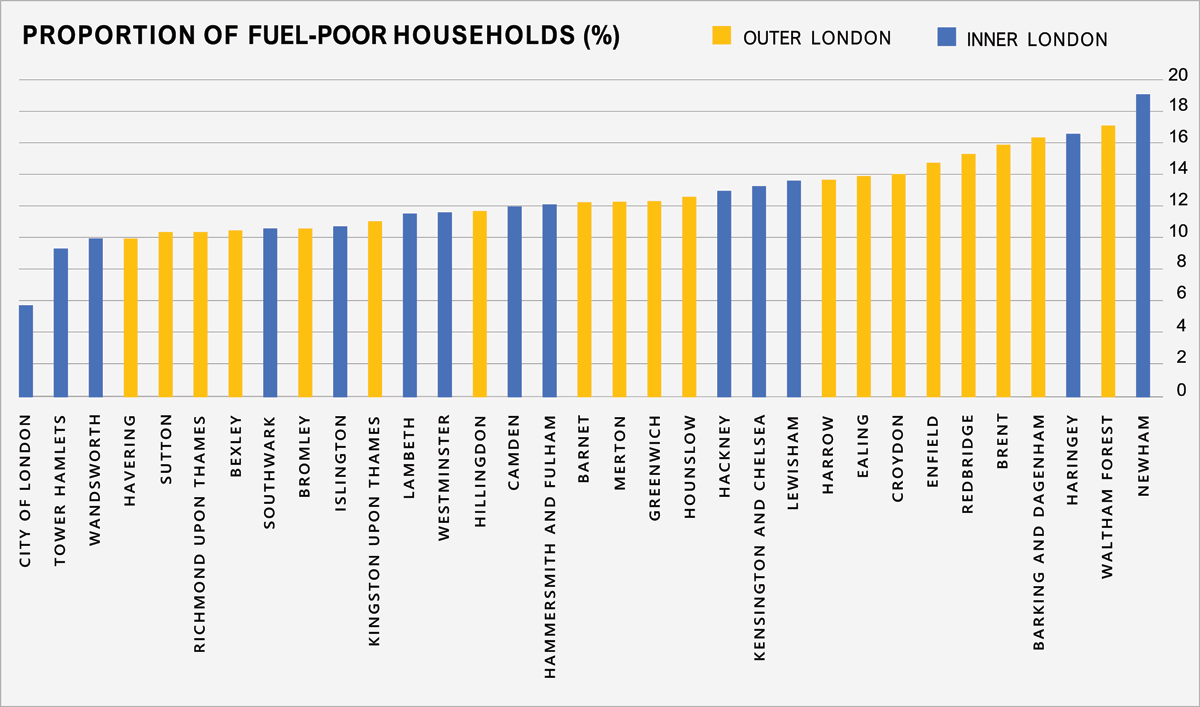
Figure 3
Proportion of fuel-poor households in London boroughs, based on the LILEE definition in 2021.
Source: DESNZ (2023).
If the LBSM could effectively identify fuel-poor homes, it could also assist in delivering retrofitted units or other measures to aid fuel-poor households. In addition, more empirical databases need to be publicly available to specifically retrofit upgrades of fuel-poor homes. A focus group participant from the London Assembly highlighted the importance of ‘having a single reference unit when reporting retrofit and fuel poverty databases’. Some councils have data regarding individual building fabric measures (insulation), while others use building typologies or household types. It is essential to have a single reference unit when reporting retrofit and fuel poverty databases so that any compilation or comparison of data does not lead to double-counting households or energy efficiency interventions.
The GLA (2018) and the GLA focus group participants highlighted insufficient national funding to implement energy efficiency improvements for all households in fuel poverty. The ECO scheme has not been utilised to its full potential, given the decreasing measures delivered through the four rounds of the scheme in London (DESNZ 2023). A further issue with the government funding programmes is the need to define eligibility criteria for households with high energy needs above the poverty threshold. Many households already in fuel poverty cannot access funding and may not even know they are in fuel poverty (GLA 2023b). Some boroughs have established carbon offset funds to meet the GLA’s 2030 net-zero-carbon targets, and a small number are using these funds to retrofit low-income households. However, boroughs need further guidance on using various carbon offset funds most effectively to deliver home energy improvements that will help tackle fuel poverty. In addition to grant funding, the Fuel Poverty Action Plan emphasises the need to unlock private capital to increase investment in energy efficiency, particularly for households in fuel poverty in London (GLA 2018).
6. Conclusions and recommendations
Fuel poverty is a growing socio-economic, health, environmental and policy issue affecting people’s health and well-being, particularly for vulnerable groups already facing difficulties. With a focus on the UK and the case of city-regional governance in London, this study has reviewed the interrelationships between fuel poverty indicators and assessment frameworks, policy targets, and UK government funding schemes for vulnerable households.
The evidence gathered reveals that only a few domestic energy retrofits were carried out in London between April 2021 and July 2023. After the COVID-19 pandemic and with the government’s commitment to the levelling-up agenda, a greater political awareness of fuel poverty emerged at the city-regional scale and the implementation of nationwide retrofit policies has fallen to individual local authorities. However, in the case of the GLA, this has not translated into binding targets, as the Fuel Poverty Action Plan has not been updated since 2018.
A key message reflected by the current low rate of domestic retrofits is that local policy frameworks, such as the Fuel Poverty Action Plan, need to be periodically reviewed. To foster robustness and accountability, frameworks should incorporate binding targets and a systematic approach for gathering, monitoring and evaluating data (including EPCs) and impacts. There is also a need for more local funding schemes targeted specifically to fuel-poor households. The difficulties of identifying households actually in fuel poverty add to this challenge, as fuel poverty is a dynamic issue that is not systematically linked to the physical property but to the household.
At the national level, according to the LILEE indicator, fuel poverty is decreasing. However, this measure does not consider rising energy prices. Financially vulnerable households or those with health conditions, single-parent or single-pensioner households might be at high risk of fuel poverty in EPC A-C properties. National UK policy is primarily focused on reducing heating demand during winter. Although there is an acknowledgement of summer fuel poverty and the need for cooling and adaption to the risk of overheating, this has yet to become an imperative for local governments.
In London, the LBSM was not used by most of the boroughs that answered our FoI requests. This tool provides data about the property’s energy efficiency but does not identify households in fuel poverty. Most boroughs that answered the FoI requests did not hold information on private-sector retrofits as they are under the responsibility of housing associations, which are not legally obliged to report. Home improvements are not always deep retrofits but individual interventions of limited impact.
Our key recommendations for tackling fuel poverty through domestic energy retrofits are:
Embedding a broader understanding of inequalities into fuel poverty assessment frameworks. The GLA should develop a new comprehensive tool that integrates LBSM results with additional databases, including geographical location, building typology, age, health, and socio-economic profile of end users at local levels, beyond the level of granularity of the IMD tool. This would help identify fuel-poor households and design more appropriate retrofit strategies.
The need for further empirical case study research. There is much need and potential for research exploring these complexities involved in the design and evaluation of retrofit programmes across a range of international contexts. In the UK, with our study having focused on London, there is a need for further research in other parts of England and the other devolved regions of the UK, to further understand the complexities of effective stakeholder management and the social value of fuel-poor energy retrofit homes from the perspective of UK government, local authorities, the supply side, private rented or social housing sector, housing associations, fuel poverty charities and individual households.
Local authorities as enablers of place-based retrofit interventions. Evaluating place-based approaches for inclusive energy retrofits would allow an understanding of the needs and profile of fuel-poor households and provide an opportunity for local authorities to enhance social value from local renewable energy and energy efficiency programmes that would contribute to reducing fuel poverty. This would involve deep analysis of inequalities, energy behaviours, more accurate EPC data, cost of retrofitting, funding scheme eligibility, and cross-referencing with various technological interventions (fabric improvements, low/zero carbon technologies, metering) at property and neighbourhood scale.
Notes
[1] The term fuel poverty usually refers to the issue of energy affordability, while energy poverty is broader and incorporates improved access to energy provision (Bouzarovski 2018; Halkos & Aslanidis 2023).
[2] Category 1 hazards relate to the most severe risk to the health and safety of occupiers, including death, permanent paralysis, permanent loss of consciousness, loss of a limb or severe fractures (Housing Act 2004).
Acknowledgements
The authors thank Agostino Anselmo, Raymund Laurel and Mathieu Naccarato for supporting the data collection for this research. The team would also like to thank Linda Clarke for her valuable comments and feedback on this paper and all the focus group participants who engaged in critical discussions.
Authors contributions
MCG: conceptualisation, methodology, investigation, visualisation, resources, project administration, writing – original draft. DG: investigation, visualisation, writing – original draft. RSP: conceptualisation, methodology, investigation, visualisation, resources, funding acquisition, project administration, writing – review and editing. FR: methodology, investigation, data curation, formal analysis, writing – review and editing.
Competing interests
The authors have no competing interests to declare.
Data availability
Publicly available documents on which the article is based are included in the reference list with links to PDFs. FoI responses and focus group notes are not shared publicly in the interests of data protection and confidentiality; however, they can be made available upon request.
Ethical consent
The study is covered under the University of Westminster Research Ethics Committee reference number: ETH2223-2251, April 2023. This includes data generated by the FoI requests and focus group discussions.
Funding
This research was funded by the 2022/23 University of Westminster Participatory and Policy Research Fund.