
Table 1
Descriptions of 10 development types of sustainable neighborhoods.
| Development type | Description | |
|---|---|---|
| 1 | Economic development | An attractive opportunity for the city’s and/or region’s business development, in one or several sectors (services, industry, tourism); financial viability is one of the claimed priorities |
| 2 | Natural space | A privileged and unique experience to be in contact with natural habitats and urban ecosystems. An operation to make the urban space greener |
| 3 | District with a lighter environmental footprint | Technology-based solutions to increase buildings’ efficiency in energy, water and materials consumption. The target is a less polluting district |
| 4 | Compact urban environment | A walkable, well-connected and well-designed urban space in order to reduce the dependence on motorised vehicles. Limiting urban sprawl by rehabilitating brownfield sites is encouraged |
| 5 | Community with a high quality of life | A project oriented towards livability and wellbeing thanks to a comfortable and safe built environment, adapted for socialisation purposes |
| 6 | Diverse urban area | The value of the community lies in its social and cultural diversity as well as in the opportunities offered by mixed-use buildings and diverse housing types |
| 7 | Self-sufficient community | A self-reliant and autonomous community that promotes a way of living free from the dependence on external hinterlands (supply security) |
| 8 | Equal society | A socially inclusive neighborhood with special attention paid to redressing injustice and inequalities in favor of vulnerable citizens (low income, children, elderly, disabled) |
| 9 | Participatory governance | A place where the community is the key actor of its development, open to deliberative consultations, collective decision-making and community-based management of facilities |
| 10 | Learning environment | A collective project characterised by a sense of responsibility towards futures generations. The transfer of knowledge and new sustainable practices are encouraged through education, formation, research and innovation |
[i] Source: Adapted from Holden et al. (2015).
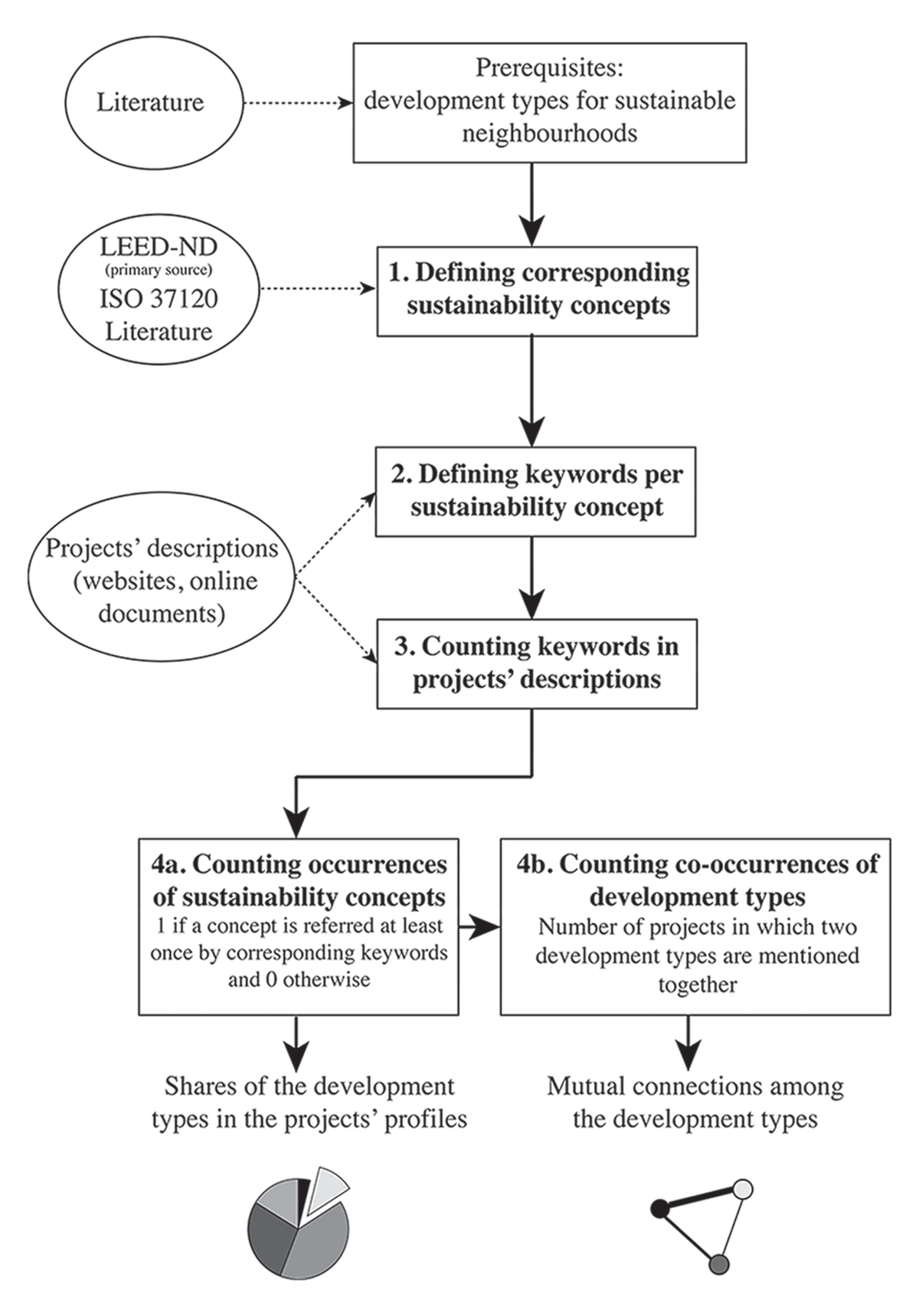
Figure 1
Approach developed to determine the share of development types in sustainable neighborhood profiles and to perform their co-occurrence analysis.
Table 2
Sustainability concepts attached to the 10 development types.
| Development type | Sustainability concepts from LEED-ND | Additional sustainability concepts found in the literature |
|---|---|---|
| Economic development | Local economy | |
| Sound financial investments (ISO 2014) | ||
| Creation of jobs (ISO 2014) | ||
| Natural space | Wildlife protection | |
| Natural habitat protection | ||
| Green spaces | ||
| District with lighter environmental footprint | Energy management | |
| Water management | ||
| Waste management | ||
| Air emissions management | ||
| Compact urban environment | Transit facilities | |
| Soft mobility | ||
| Car-dependency reduction | ||
| Densification | ||
| Community with high quality of life | Built environment quality | |
| Cultural and recreational services | ||
| Safety, health and security | ||
| Sense of place and belonging (Axelsson et al. 2013; Cloutier et al. 2018) | ||
| Diverse urban area | Socioeconomic diversity (based on age, income level) | |
| Mixed-use buildings | ||
| Housing and business diversity | ||
| Food production/security | ||
| Self-sufficient community | On-site water treatment (ISO 2014) | |
| Energy production/security (Lufkin, Rey, & Erkman 2016) | ||
| Other local supply (Bogunovich 2009) | ||
| Equal society | Affordability (housing, transport) | |
| Care for targeted population (children, elderly, disabled) | ||
| Intragenerational solidaritya (Feleki et al. 2018; Gibson 2006b) | ||
| Participatory governance | Open consultations | |
| Fostering residents’ engagement (ISO 2014) | ||
| Collective decision-making and ownerships of services (Gibson 2006b; Moroke et al. 2019) | ||
| Learning environment | Education and training facilities | |
| Research and innovation | ||
| Awareness programs (Gibson 2006b) |
[i] Notes: a Support was offered to people affected by unemployment, poverty, lack of access to education, training and leisure.
LEED-ND, Leadership in Energy and Environmental Design and Neighbourhood Development.
Table 3
Total number of concepts per development type and the resulting shares in the reference case.
| Development type | Total number of concepts | Share for the reference case (%) | |
|---|---|---|---|
| 1 | Economic development | 3 | 8.8% |
| 2 | Natural space | 3 | 8.8% |
| 3 | District with a lighter environmental footprint | 4 | 11.7% |
| 4 | Compact urban environment | 4 | 11.7% |
| 5 | Community with a high quality of life | 4 | 11.7% |
| 6 | Diverse urban area | 3 | 8.8% |
| 7 | Self-sufficient community | 4 | 11.7% |
| 8 | Equal society | 3 | 8.8% |
| 9 | Participatory governance | 3 | 8.8% |
| 10 | Learning environment | 3 | 8.8% |
| Total | 34 | 100% |
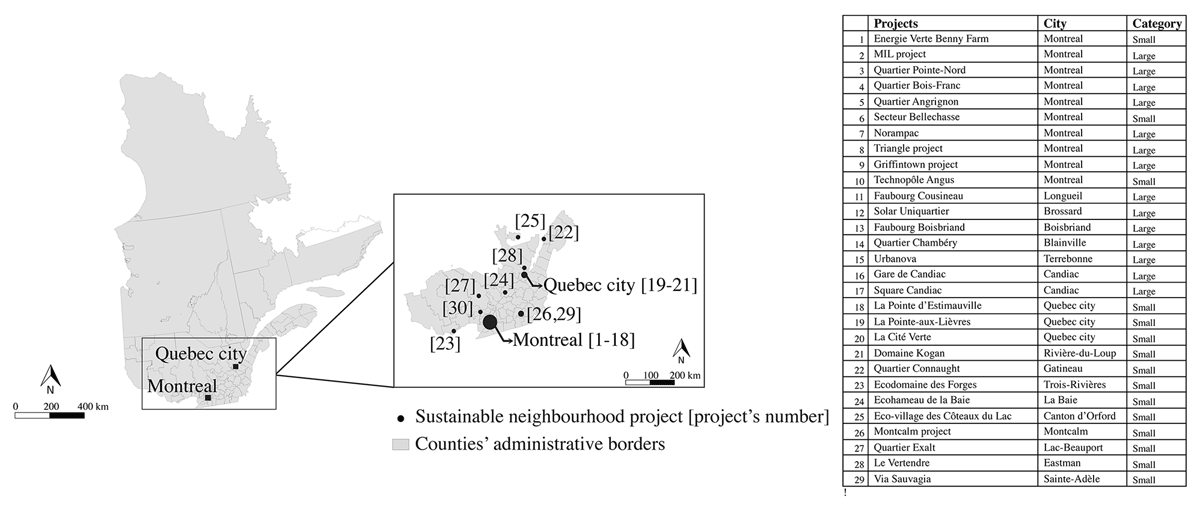
Figure 2
Spatial distribution of the selected initiatives in the province of Quebec.
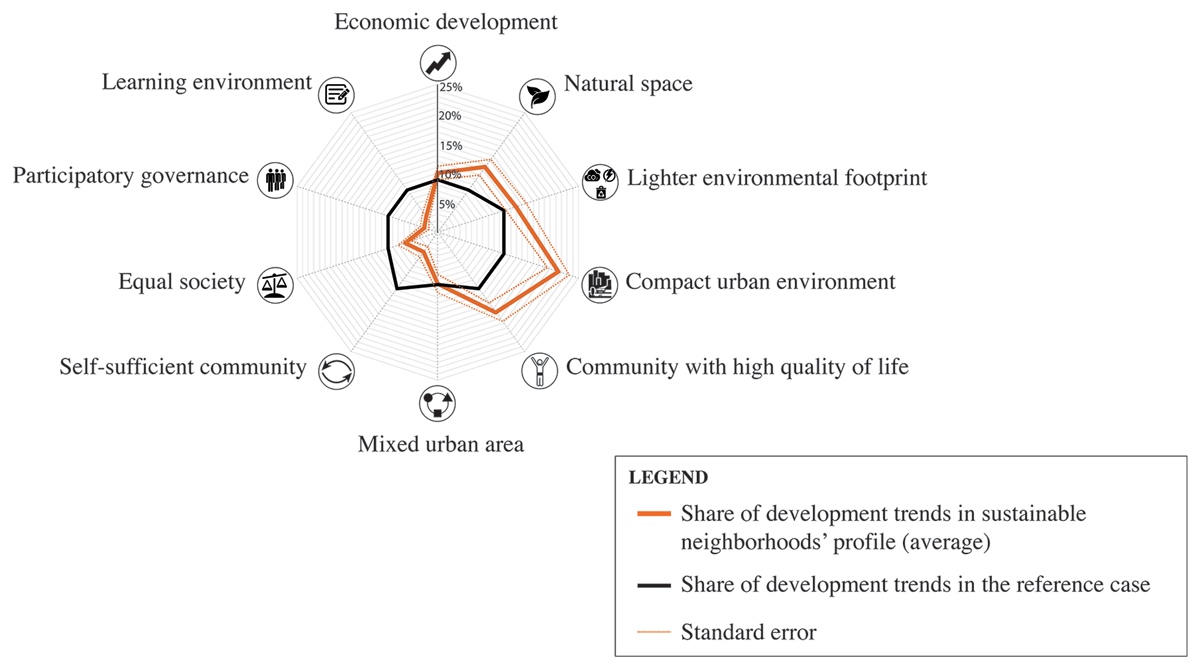
Figure 3
Average profile of sustainable initiatives in the province of Quebec according to the 10 development types, with standard errors. The profile of the reference case is provided for comparison.
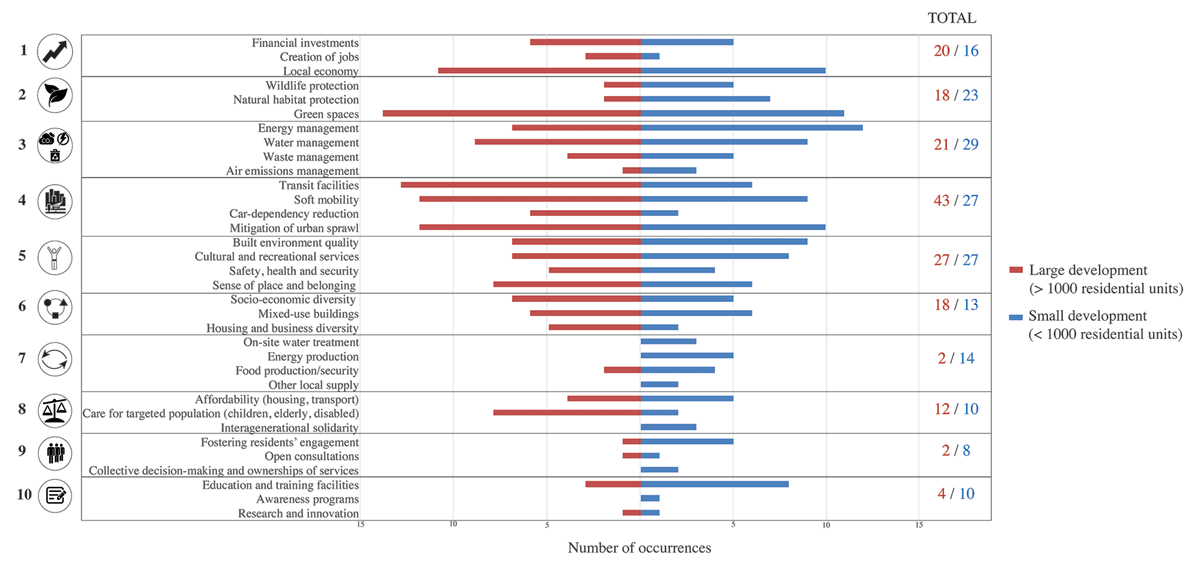
Figure 4
Number of occurrences of sustainability concepts in the case studies for large and small developments: 1, economic development; 2, natural space; 3, lighter environmental footprint; 4, compact urban environment; 5, community with a high quality of life; 6, diverse urban area; 7, self-sufficient community; 8, equal society; 9, participatory governance; and 10, learning environment.
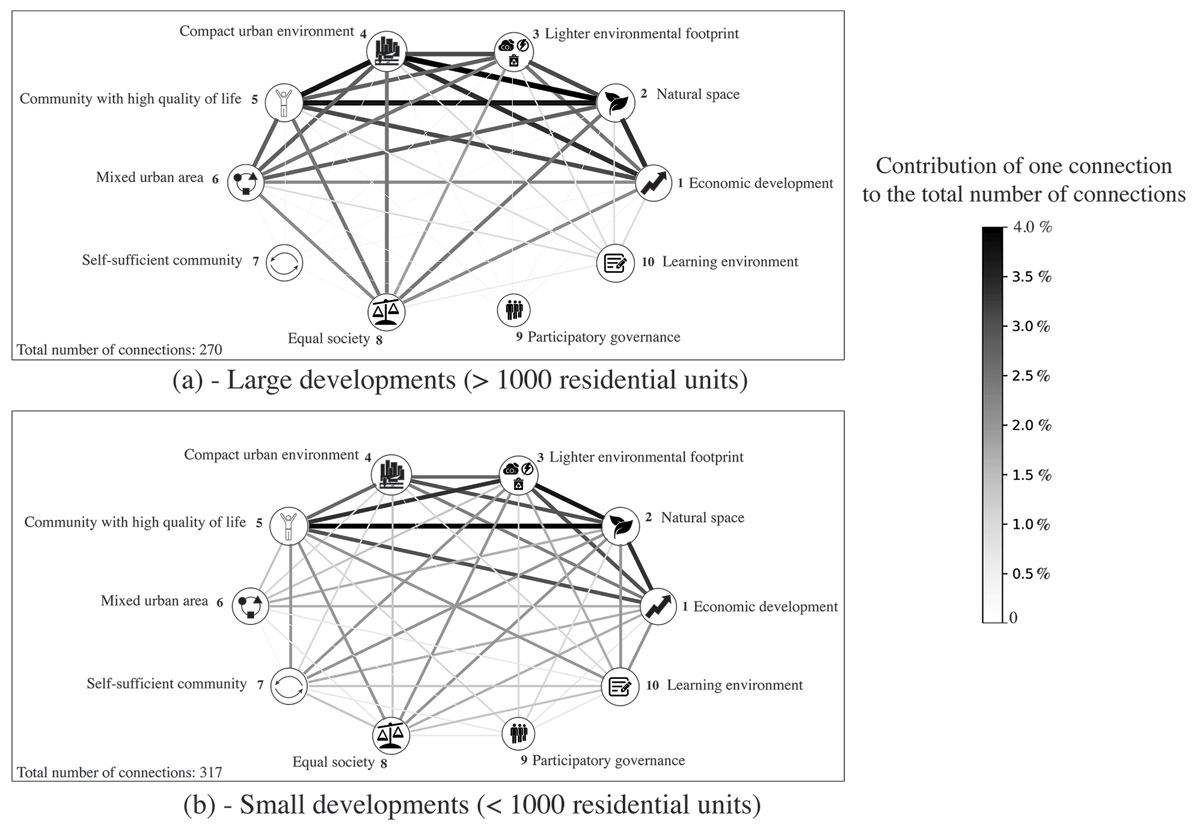
Figure 5
Co-occurrence of the development types for (a) large developments and (b) small developments in Quebec province. The co-occurrence is the number of projects in which two development types are mentioned together.
Table A1
Keywords for development types 1–5.
| Type 1 Economic development | Type 2 Natural space | Type 3 Smaller environmental footprint | Type 4 Compact urban environment | Type 5 Community with a high quality of life |
|---|---|---|---|---|
| Rentability | Biodiversity | Energy efficiency | Public transport | Comfort |
| Viability | Fauna | Clean energy | Bus | Esthetics |
| Investments | Flora | Wind energy | Metro | Modern |
| Shops | Ecological corridors | Solar energy | Active transportation | Socialisation |
| Commercial | Ecosystems | Biomass | Bikes | Common values |
| Tourism | Natural area | Geothermal energy | Narrow streets | Conviviality |
| Hotel | Natural habitat | Water savings | Roads reduction | Community areas |
| Luxury | Forest | Rainwater collection | Proximity of services | Public places |
| Jobs | Parc | Recycling | Densification | Recreation |
| Industries | Green space | Reuse | Brownfield rehabilitation | Culture |
| Greening | Carbon dioxide | Safety | ||
| Air emissions | Security | |||
| Climate change | Healthcare |
Table A2
Keywords for development types 6–10.
| Type 6 Diverse urban area | Type 7 Self-sufficient community | Type 8 Equal society | Type 9 Participatory governance | Type 10 Learning environment |
|---|---|---|---|---|
| Multigenerational | Self-sufficient | Affordability | Concertation | Education |
| Social mix | Independent | Social housing | Participation | Training |
| Mixed use | Self-production | Equity | Involvement | Scientific |
| Multifunctional | Autonomy | Childcare | Open deliberations | Experimental |
| Housing diversity | Community gardens | Elderly | Cooperation | Chair |
| Urban agriculture | Universal access | Self-governance | Awareness | |
| Local goods | Social support | Community management | ||
| Local materials | Solidarity | Activism |
Table A3
Selected case studies and their characteristics.
| Project | City | Type of development | Area (ha) | Residential units |
|---|---|---|---|---|
| Energie Verte Benny Farm | Montreal | Revitalisation | 7.3 | 797 |
| MIL project | Montreal | Revitalisation | 38 | 1300 |
| Quartier Pointe-Nord | Montreal | New development | 9.2 | 1600 |
| Quartier Bois-Franc | Montreal | Revitalisation | 260 | 8000 |
| Quartier Angrignon | Montreal | Revitalisation | Unknown | 3000 |
| Secteur Bellechasse | Montreal | Revitalisation | Unknown | 166 |
| Norampac | Montreal | Revitalisation | 4.2 | 1163 |
| Triangle project | Montreal | Revitalisation | 40 | 3200 |
| Griffintown project | Montreal | Revitalisation | 84 | 8200 |
| Secteur Ouest de Pierrefonds | Montreal | New development | 365 | 5500 |
| Technopôle Angus | Montreal | Revitalisation | 8.3 | 360 |
| Faubourg Cousineau | Longueil | New development | 63 | 3500 |
| Solar Uniquartier | Brossard | New development | Unknown | 4000 |
| Faubourg Boisbriand | Boisbriand | Revitalisation | 102 | 1700 |
| Quartier Chambéry | Blainville | New development | 250 | 3000 |
| Urbanova | Terrebonne | New development | 83 | 1200 |
| Gare de Candiac | Candiac | New development | 113 | 2300 |
| Square Candiac | Candiac | Revitalisation | 16 | 1400 |
| La Pointe d’Estimauville | Quebec City | Revitalisation | 8.4 | 782 |
| La Pointe-aux-Lièvres | Quebec City | Revitalisation | 12 | 910 |
| La Cité Verte | Quebec City | Revitalisation | 9.3 | 800 |
| Domaine Kogan | Rivière-du-Loup | Revitalisation | 2.8 | 220 |
| Quartier Connaught | Gatineau | Revitalisation | 40 | 800 |
| Ecodomaine des Forges | Trois-Rivières | New development | 29 | 41 |
| Ecohameau de la Baie | La Baie | New development | 15 | |
| Eco-village des Côteaux du Lac | Canton d’Orford | New development | 22 | 18 |
| Montcalm project | Montcalm | New development | 109 | n.d. |
| Quartier Exalt | Lac-Beauport | New development | 19 | 166 |
| Le Vertendre | Eastman | New development | 445 | 35 |
| Via Sauvagia | Sainte-Adèle | New development | Unknown | 247 |
Table A4
Projects’ descriptive documents.