
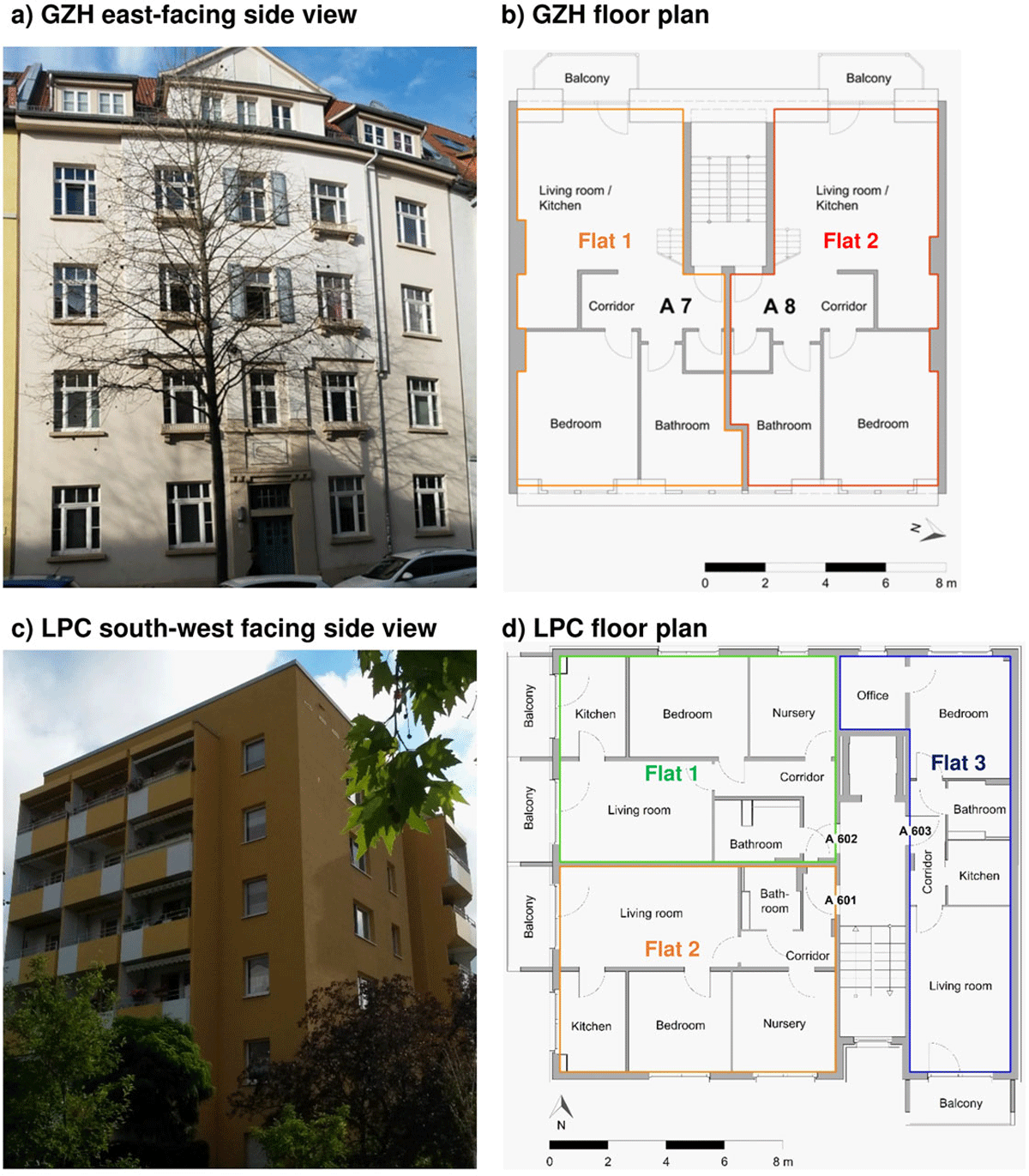
Figure 1
(a) East-facing street-side view of the Gründerzeithaus (GZH) building; (b) floor plan of the GZH; (c) the large-panel construction (LPC) building seen from the south-west; and (d) floor plan of the retrofitted LPC multifamily housing (MFH). The depicted top-floor plans are similar to the other floors in both buildings.
Table 1
Resident data conducted from the citizen survey for the districts of the investigated large-panel construction (LPC) (Dresden, Germany) and Gründerzeithaus (GZH) building (Erfurt, Germany), respectively.
| LPC district (%) | GZH district (%) | |
|---|---|---|
| (a) Employment | ||
| Pupil, student, trainee | 2% | 18% |
| Employed | 31% | 58% |
| Unemployed | 13% | 5% |
| Non-Working | 4% | 2% |
| Pensioner | 48% | 18% |
| (b) Net household income per month | ||
| <€1000 | 23% | 14% |
| €1000–1500€ | 27% | 21% |
| €1500–2000€ | 20% | 15% |
| €2000–3000€ | 19% | 26% |
| >€2000 | 11% | 25% |
| (c) Household lifestyle | ||
| Alone | 46% | 24% |
| Alone with a child | 6% | 4% |
| With partner, no child | 30% | 28% |
| With partner and child | 12% | 26% |
| Flat-sharing community | 3% | 15% |
| Other | 2% | 3% |
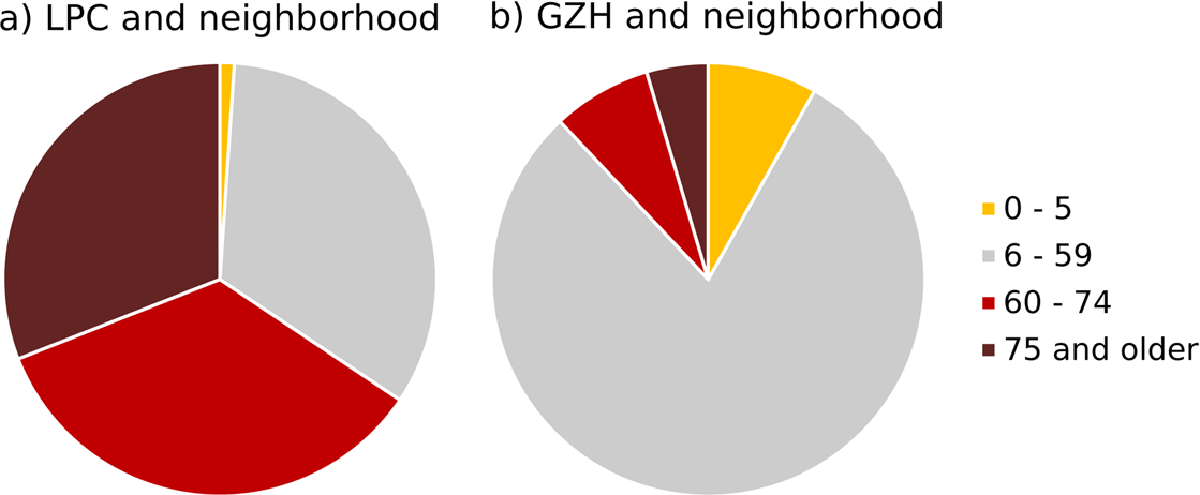
Figure 2
Resident age structure from block population data for the (a) LPC and (b) GZH buildings, including several surrounding buildings. Sources: Landeshauptstadt Dresden (2019) and Landeshauptstadt Erfurt (2020).
Table 2
Structural components of the GZH and LPC multifamily housings (MFHs).
| Component | GZH building | LPC building |
|---|---|---|
| Exterior walls | Levels 1 and 2: 51 cm brick walls, U = 1.0 W/m²K Levels 3 and 4: 38 cm brick walls, U = 1.2 W/m²K Attic: 25 cm brick wall with 6 cm calcium silicate boards for interior insulation, U = 0.6 W/m²K | Sandwich panel elements: 14 cm reinforced concrete/6 cm mineral wool/6 cm reinforced concrete, U = 0.6 W/m²K |
| Interior walls | Mainly 38 cm brick walls and some drywalls; in attic only drywalls | Reinforced concrete, mainly 15 cm and a few 7 cm thick |
| Basement ceiling | Wooden beam ceiling with 4 cm polystyrene insulation/2 cm dry screed/flooring, U = 0.48 W/m²K | 14 cm prestressed concrete/2.5 cm mineral wool/5 cm anhydrite screed/0.5 cm impact sound insulation/flooring, U = 1.2 W/m²K |
| Ceilings | Suspended wooden beam ceilings/1 cm mineral wool/2 cm dry screed/flooring, U = 0.5 W/m²K | 14 cm prestressed concrete/3 cm anhydrite screed/0.5 cm impact sound insulation/flooring, U = 3.7 W/m²K |
| Top-floor ceiling | – | 14 cm prestressed concrete/final layer of 6 cm mineral wool, U = 1.0 W/m²K |
| Roof | Saddle roof with 16 cm between-rafter mineral wool insulation and 2.5 cm plasterboard interior, U = 0.25 W/m²K | Cassette roof of reinforced concrete (cold roof) |
| Windows | Double insulation glazing, Uw = 1.8 W/m²K and g = 0.7a | Double glazing Uw = 2.8 W/m²K and g = 0.75a |
[i] Note: a Frame ratio of all windows was calculated by measuring the glazing and frame areas; the g-value stands for the energy transmittance of the glazing; and Uw is the thermal transmittance coefficient of the whole window, including the glazing and frame.
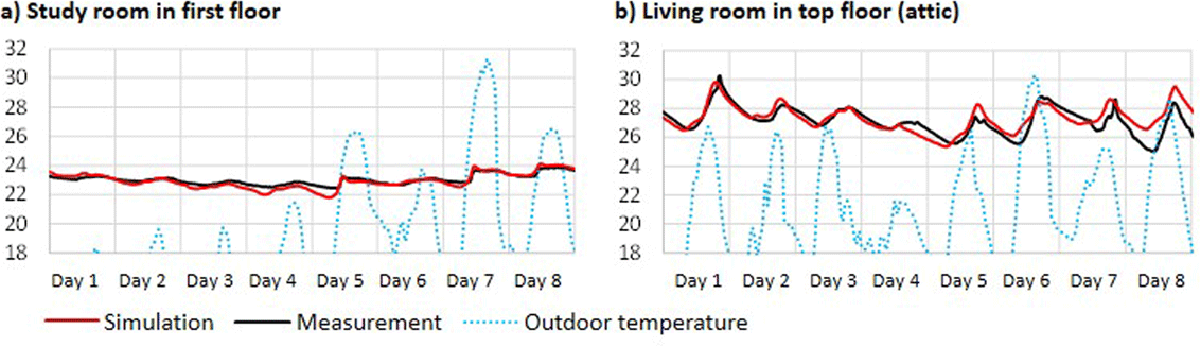
Figure 3
Comparison of the measured and simulated room temperature curve for the eight-day absence of the occupants for (a) a study room on the first floor and (b) a living room in the attic in the GZH building.
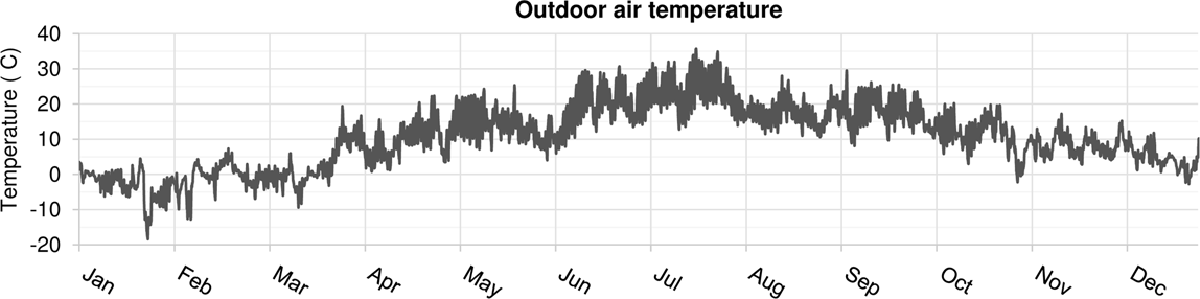
Figure 4
Outdoor air temperatures of the chosen weather data set TRY 2015 Summer for Dresden city.
Table 3
Characteristics of the test reference year TRY 2015 Summer for Dresden city.
| Parameter | Value |
|---|---|
| Annual average temperature | 10.5°C |
| Minimum temperature | –18.7°C |
| Maximum temperature | 35.7°C |
| Number of hot days (>30°C) | 16 |
| Number of tropical nights (>20°C) | 9 |
| Total direct radiation for the year | 564 kWh/m²a |
| Total diffuse radiation for the year | 562 kWh/m²a |
Table 4
Climate change (CC) mitigation measures for the GZH and LCP multifamily housings (MFHs) to reduce heating demand in wintertime.
| Component | GZH building | LPC building |
|---|---|---|
| Walls | External insulation with 2 cm vacuum insulation panels, U = 0.20 W/m²K | External insulation with 10 cm mineral wool insulation, U = 0.20 W/m²K |
| Roof or top-floor slab | No change, U = 0.25 W/m²K | 14 cm of cellulose injection insulation on top-floor slab, U = 0.22 W/m²K |
| Basement ceiling | No change, U = 0.48 W/m²K | 10 cm mineral wool beneath, U = 0.27 W/m²K |
| Windows | Triple insulation glazing Uw = 1.0 W/m²K and g = 0.5 (same window opening profile and frame ratio as the existing windows)a | |
| Ventilation system | Natural window ventilation | |
[i] Note: a Uw is the thermal transmittance coefficient of the whole window, including the glazing and frame.
Table 5
Simulated heating demand of the existing GZH and LPC buildings before and after retrofitting.
| Heating demand | Existing (kWh/m²a) | Retrofitted (kWh/m²a) |
|---|---|---|
| GZH | 72 | 39 |
| LPC | 97 | 38 |
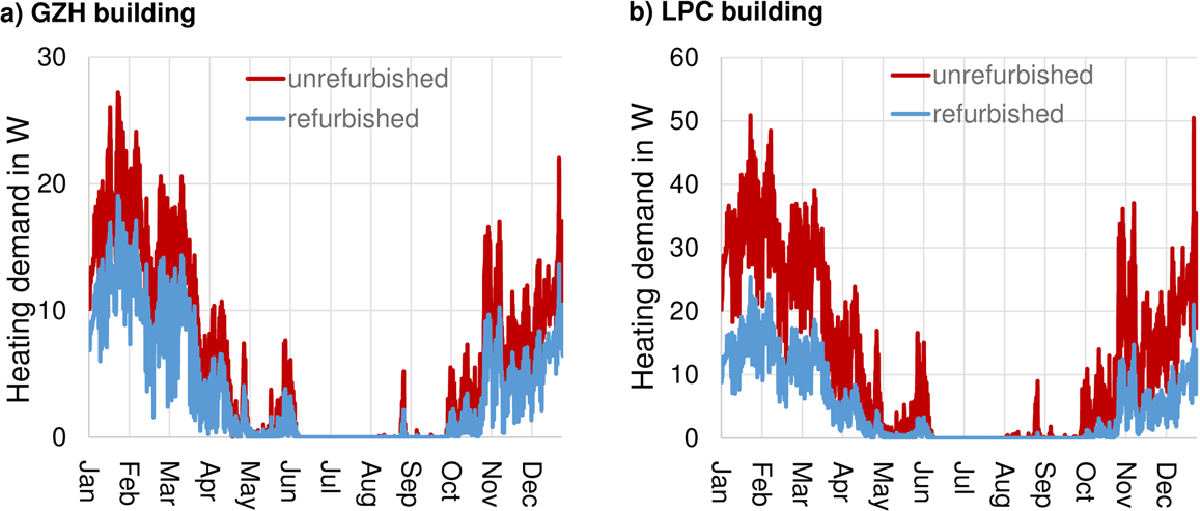
Figure 5
Simulated heating demand over the course of a year for (a) the GZH and (b) the LPC buildings in the existing (unrefurbished) and retrofitted (refurbished) states (enhanced insulation; refurbished).
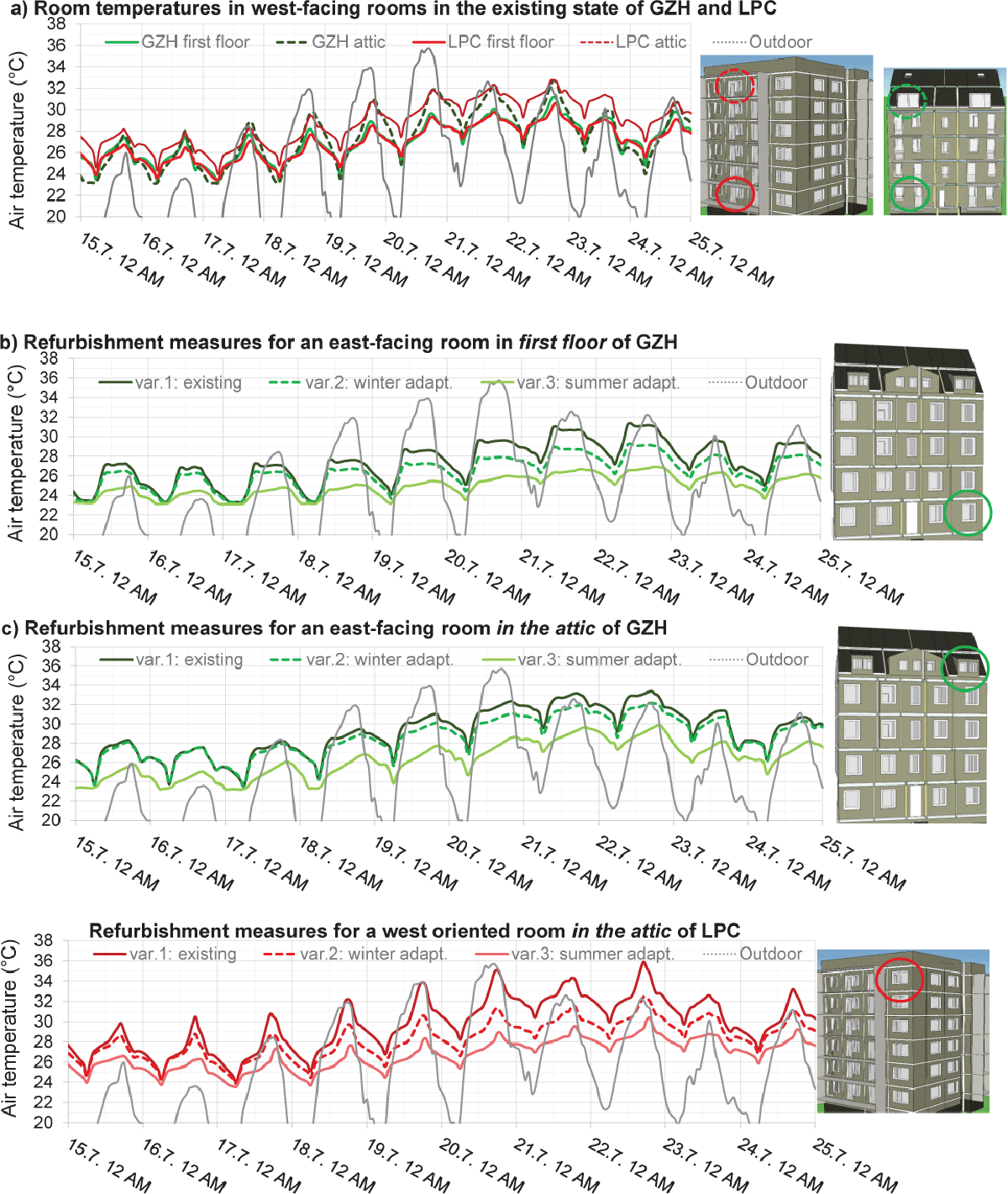
Figure 6
Simulated room temperature curves for 10 summer days in (a) the existing LPC and GZH buildings for west-facing living rooms shaded by balconies; (b) an east-facing bedroom of the GZH building; and (c) a west-facing bedroom of the LPC. The variants in (b) and (c) are: 1, existing state; 2, thermal retrofitting; and 3, including heat resilience measures. The investigated rooms are circled on the building views. The outdoor air temperature is indicated for comparison.
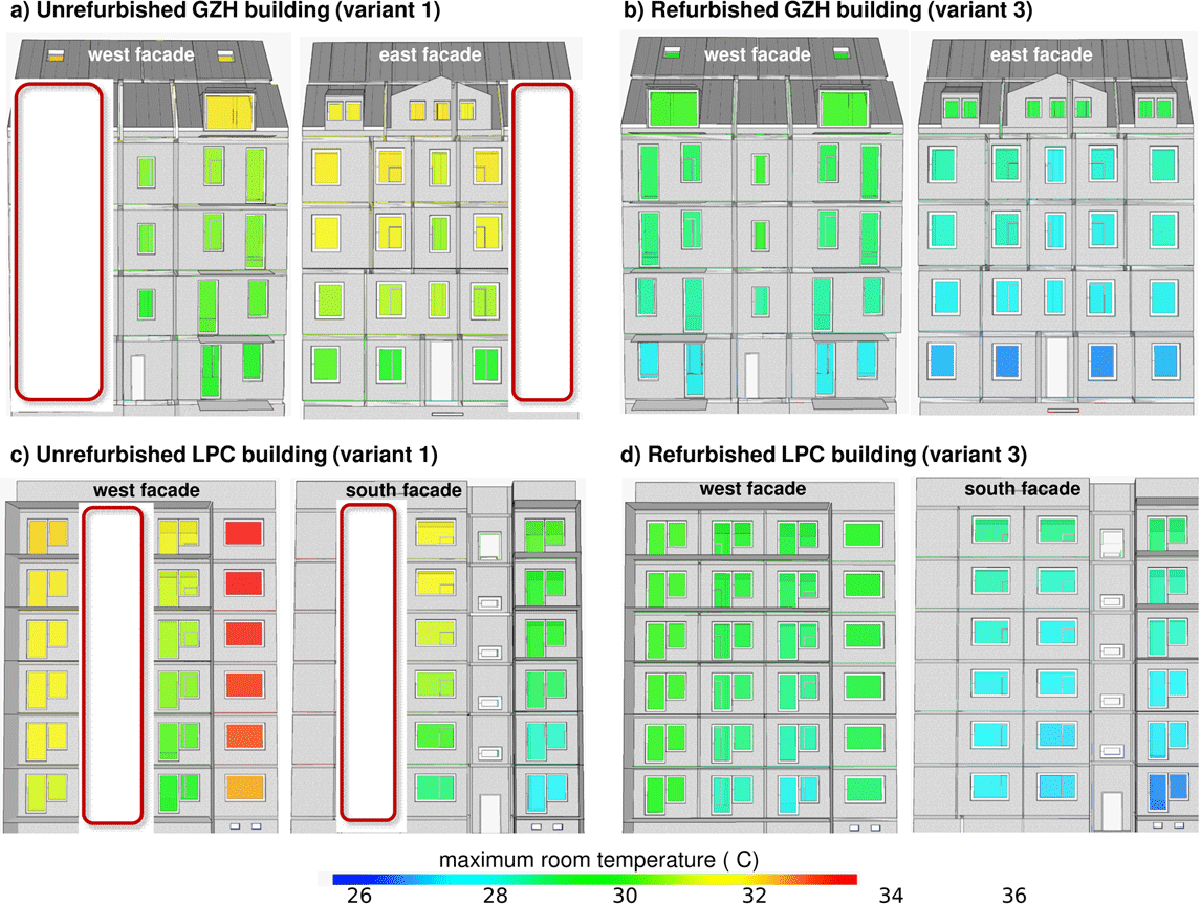
Figure 7
Distribution of maximum room temperatures simulated in the existing and refurbished (climate change (CC) mitigation and adaptation measures) GZH and LPC buildings for two facade orientations. For the framed rooms, the DH27 (overheating degree-hours above a maximum room temperature of 27°C) are also shown in Figure 8.
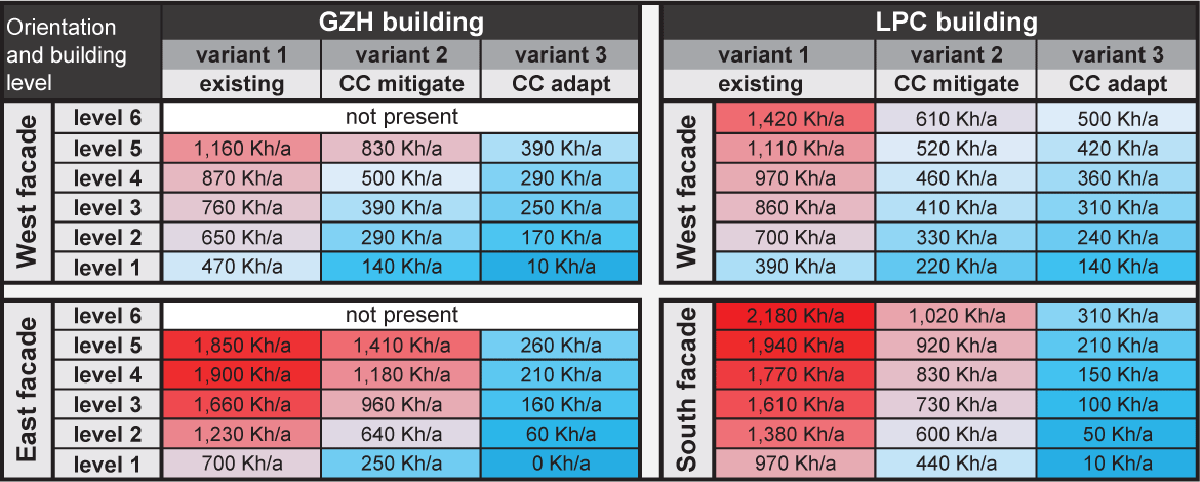
Figure 8
Simulated annual overtemperature degree-hours >27°C (DH27) for the variants: 1, existing state; 2, thermal retrofitting; and 3, including heat resilience measures depending on the orientation and building level for the GZH and LPC buildings.
Table 6
Climate change (CC) adaptation measures to reduce overheating in summer for GZH and LPC buildings.
| Component | GZH building | LPC building |
|---|---|---|
| Sun protection | External vertical awning on east facade and roof window | External roller shutter in west-, south- and east-facing windows without balconies |
| Sun protection control | Nearly closed (factor of reduction of solar radiation, Fc = 0.2) from 0700 to 1800 hours in summer | |
| Ventilation | Exhaust ventilation in the attic bathrooms | No change |
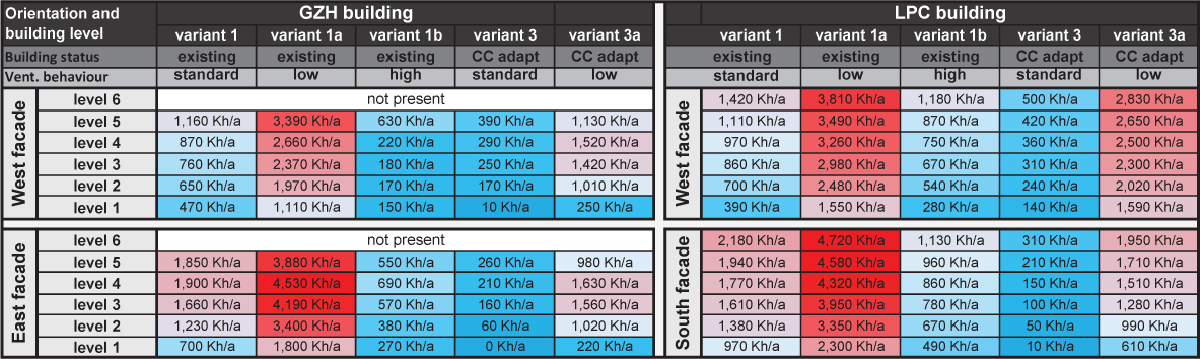
Figure 9
Simulated annual overtemperature degree-hours >27°C (DH27) for different window ventilation behaviour dependent on the building retrofitting: 1, existing state with standard ventilation; 1a, existing state with less ventilation; 1b, existing state with high ventilation; 3, a CC mitigated and adapted building with standard ventilation; and 3a: a CC mitigated and adapted building with less ventilation (depending on orientation and building level) for the GZH and LPC buildings.
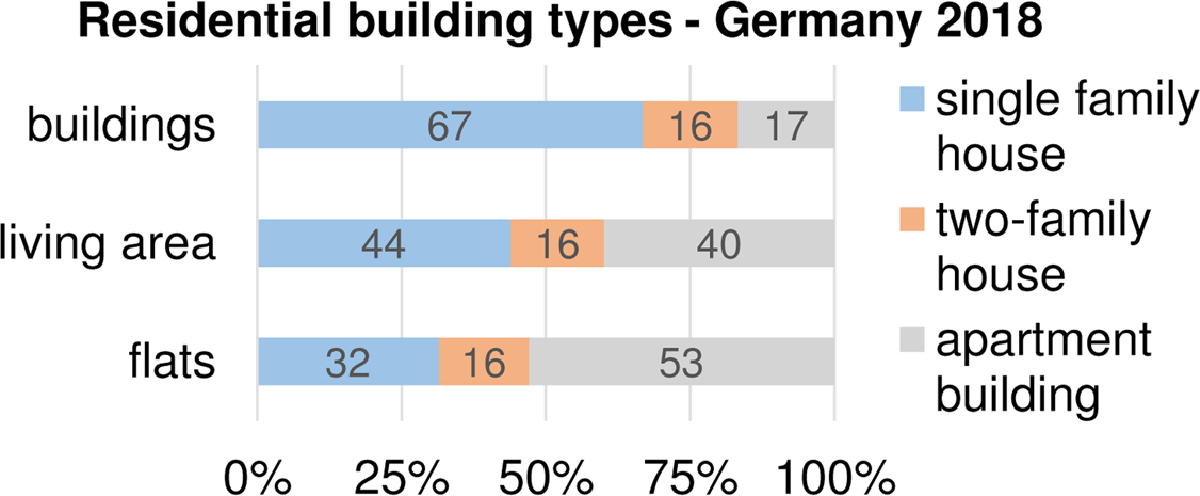
Figure A1
Ratios of the three standard types of residential building in Germany in terms of number of buildings, living area and number of dwellings. Source: Destatis (2018).
Table A1
Dresden’s stock of residential buildings classified by the number of dwellings and the year of construction: the italic figure indicates Gründerzeithaus (GZH) buildings, while the bold figure indicates large-panel construction (LPC) buildings.
| Construction year group | 1–2 | 3–12 | >12 |
|---|---|---|---|
| Until 1918 | 12% | 14% | 2% |
| 1919–45 | 17% | 10% | 0% |
| 1946–69 | 3% | 5% | 1% |
| 1970–90 | 3% | 4% | 2% |
| After 1990 | 21% | 5% | 2% |
[i] Source: Destatis (2018).