
Table 1
Institutional models and data availability.
| INSTITUTION | INSTITUTIONAL MODEL | LOCATION | IMPLEMENTATION PERIOD | MAIN AVAILABLE EVIDENCE |
|---|---|---|---|---|
| Clínica CEDES | Private institution | Riohacha, La Guajira | January 2022 onwards | Pre/post costs, exploratory cost‑effectiveness, clinical outcomes, AOI/WAOS/SI |
| ESE Hospital San José de Maicao | Public ESE under national government intervention | Maicao, La Guajira | 2024 onwards | Baseline economic data only for 2018–2023; post‑implementation longitudinal AOI/WAOS/SI from 2024 onwards |
| ESE Hospital La Divina Misericordia | Public ESE with private operational support | Magangué, Bolívar | 2024 onwards | Pre/post partial economic and clinical data, WAOS |
Table 2
Components of the multi‑component maternal safety and technological strengthening model.
| COMPONENT | DESCRIPTION | EXPECTED MECHANISM |
|---|---|---|
| Situational diagnosis | Assessment of institutional gaps in infrastructure, workforce, technology, monitoring, escalation, governance, and leadership alignment | Identification of correctable system failures |
| Safety standards | Adaptation of clinical pathways for obstetric emergencies and severe maternal morbidity | Earlier recognition and standardised response |
| Obstetric high‑dependency capacity | Intermediate care platform for high‑risk obstetric patients | Enhanced monitoring and prevention of deterioration |
| Workforce strengthening | Training in technical competencies, Non‑Technical Skills, team dynamics, and interprofessional communication | Improved preparedness and team response |
| Technological support | Equipment, monitoring capacity, oxygen support, laboratory readiness, and infrastructure | Better detection and treatment capability |
| Indicator monitoring | AOI, WAOS, SI, clinical outcomes, cost indicators, and dashboards | Continuous feedback and institutional learning |
| Economic evaluation | Cost description and exploratory cost‑effectiveness analysis | Assessment of resource implications and sustainability |
Table 3
Annual mean total cost per maternal event (range across years).
| INSTITUTION | PERIOD | YEARS | ANNUAL MEAN TOTAL COST PER MATERNAL EVENT* |
|---|---|---|---|
| CEDES | Pre‑implementation | 2018–2021 | COP $1.97–2.36 million |
| CEDES | Implementation | 2022–2023 | COP $2.65–2.84 milliona |
| Maicao | Pre‑implementation baseline | 2018–2023 | COP $1.24–2.55 million |
| Divina Misericordia | Pre‑implementation | 2018–2023 | COP $1.93–3.00 million |
| Divina Misericordia | Early implementation | 2024 | COP $2.88 millionb |
[i] *Costs were estimated by bottom‑up micro‑costing as directly billed costs within each ≤45‑day maternal episode plus allocated personnel, equipment, infrastructure, and operating costs. Values represent the range of annual mean costs per maternal event within each period.
[ii] a Higher early implementation costs at CEDES partly reflected increased maternal service volume and start‑up investments, including personnel, equipment, and HDU facility adaptation, and may therefore exceed steady‑state operating costs.
[iii] b The 2024 Divina Misericordia estimate reflects partial early implementation follow‑up and should not be interpreted as a steady‑state postimplementation cost.
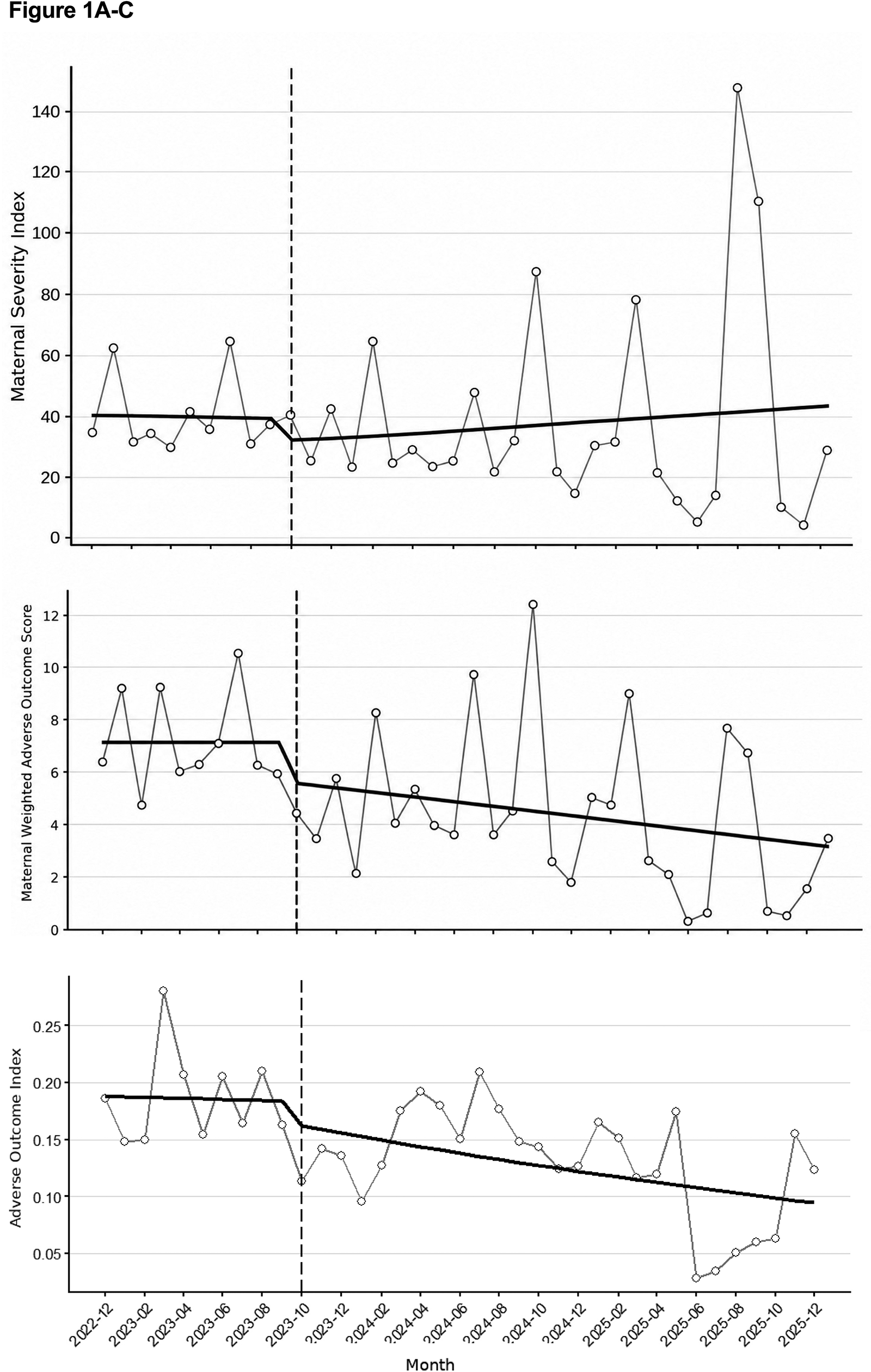
Figure 1A–C
Combined longitudinal indicator panel for Clínica CEDES during the post‑implementation monitoring period. Panel A shows the severity index (SI), Panel B the weighted adverse outcome score (WAOS), and Panel C the adverse outcome index (AOI). Open circles connected by grey lines indicate monthly observations, and solid black lines represent fitted temporal trends. Vertical dashed lines mark the monitoring reference point used in each panel; these correspond to the analysed post‑implementation indicator window rather than the formal start of the multi‑component institutional model, which began in January 2022. Descriptively, WAOS and AOI decreased over time, whereas SI showed intermittent peaks and an apparent upward pattern. Interrupted time series analyses did not identify statistically significant changes in pre‑intervention trend, immediate level change, or post‑implementation slope for any total indicator: WAOS trend β = −0.019 (SE 0.716; P = 0.979), level β = 1.355 (SE 4.608; P = 0.771), slope change β = −0.038 (SE 0.734; P = 0.959); AOI trend β = −0.003 (SE 0.035; P = 0.935), level β = −0.128 (SE 0.234; P = 0.586), slope change β = −0.021 (SE 0.036; P = 0.569); SI trend β = −0.0001 (SE 0.0551; P = 0.998), level β = 0.063 (SE 0.354; P = 0.859), slope change β = 0.031 (SE 0.056; P = 0.588).
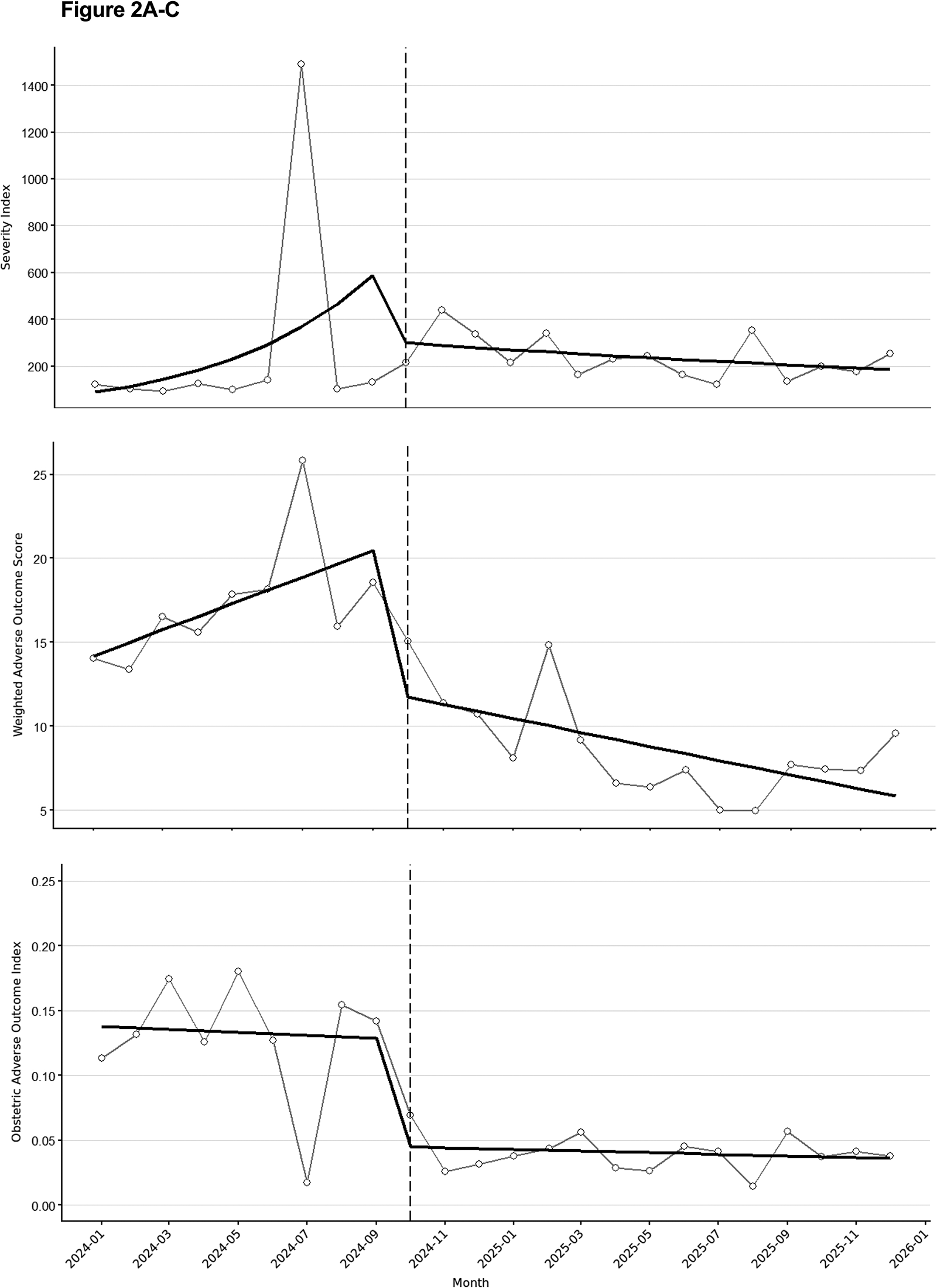
Figure 2A–C
Longitudinal obstetric quality indicators at ESE Hospital San José de Maicao. Panel A shows the severity index (SI), Panel B the weighted adverse outcome score (WAOS), and Panel C the adverse outcome index (AOI), following the same sequence used for Clínica CEDES. Open circles connected by grey lines indicate monthly observations, and solid black lines represent fitted trends before and after implementation. The vertical dashed line marks HDU implementation in October 2024. The results showed a favourable post‑implementation pattern: SI had a significantly increasing pre‑intervention trend (β = 0.234; SE 0.104; P = 0.036) followed by a significant negative slope change after implementation (β = −0.268; SE 0.115; P = 0.030), although the immediate level change was not statistically significant (β = −0.638; SE 0.662; P = 0.347); WAOS showed a significantly increasing pre‑intervention trend (β = 0.784; SE 0.359; P = 0.041), a significant immediate level reduction (β = −8.302; SE 2.283; P = 0.002), and a significant decrease in post‑implementation slope (β = −1.205; SE 0.396; P = 0.006); AOI showed a significant immediate post‑implementation level reduction (β = −1.130 on the logit scale; SE 0.337; P = 0.003), whereas the pre‑intervention trend (β = −0.010; SE 0.038; P = 0.799) and post‑implementation slope change (β = −0.006; SE 0.048; P = 0.901) were not statistically significant.
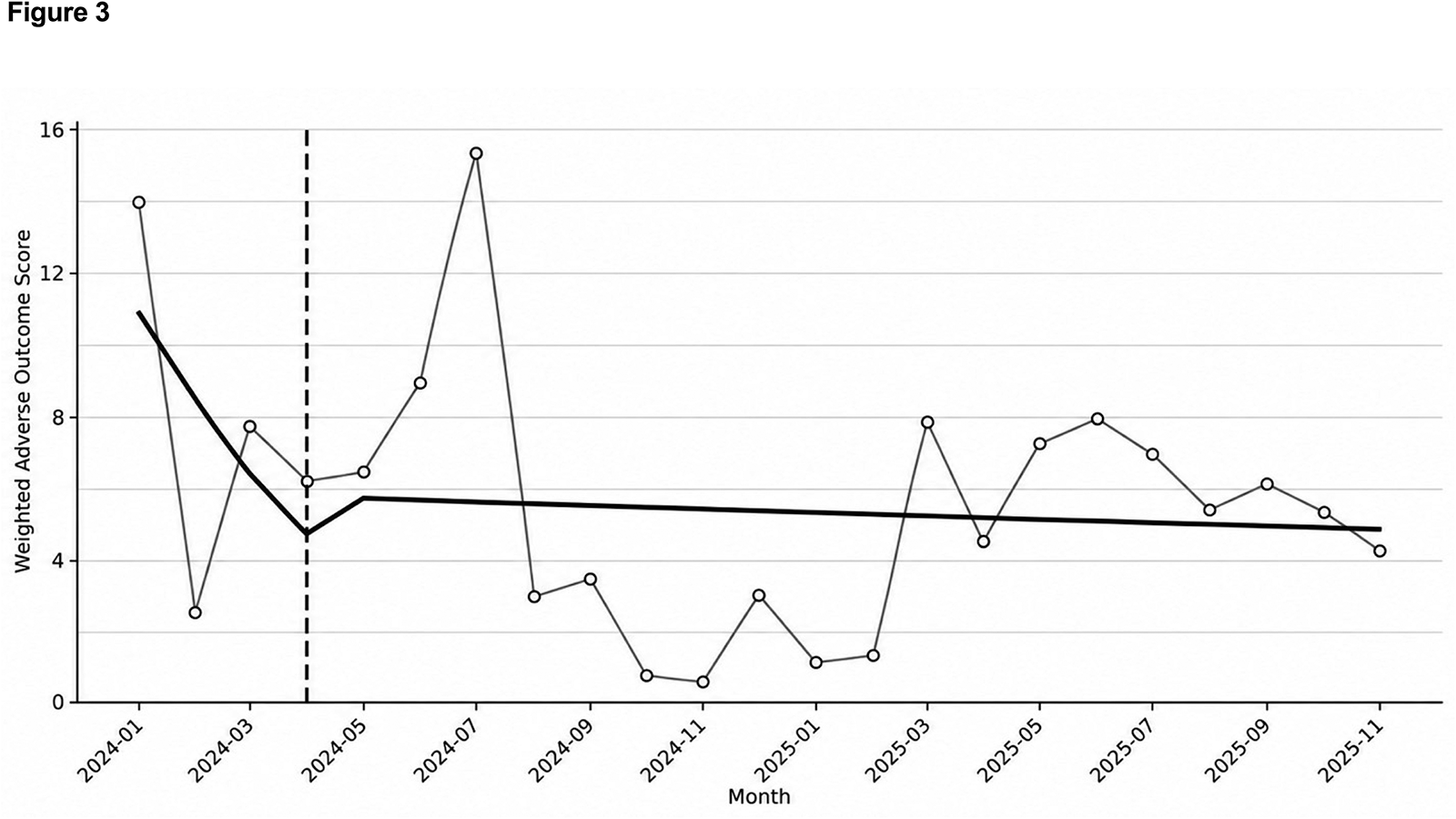
Figure 3
Weighted adverse outcome score at ESE Hospital La Divina Misericordia, Magangué. Monthly trends in the weighted adverse outcome score at ESE Hospital La Divina Misericordia, January 2024–November 2025. Open circles connected by grey lines indicate monthly observations, and the solid black line represents the fitted temporal trend. The vertical dashed line marks HDU implementation in April 2024. The quasi‑Poisson interrupted time series model did not identify statistically significant intervention‑related changes: pre‑intervention trend rate ratio 0.760 (95% CI 0.439–1.240; P = 0.306), immediate level‑change rate ratio 1.210 (95% CI 0.359–5.220; P = 0.776), and post‑implementation trend‑change rate ratio 1.300 (95% CI 0.795–2.260; P = 0.326).
Table 4
Integrated institutional interpretation.
| INSTITUTION | ECONOMIC PATTERN | CLINICAL PATTERN | QUALITY INDICATOR PATTERN | OVERALL INTERPRETATION |
|---|---|---|---|---|
| CEDES | Higher post‑implementation costs | Reduced morbidity and ICU‑related indicators | Descriptive decreases in AOI and WAOS; intermittent SI peaks; no statistically significant ITS changes | Improved conventional clinical indicators with higher implementation costs; longitudinal quality signals are descriptive and hypothesis‑generating rather than confirmatory |
| Maicao | Baseline 2018–2023 cost increase; no mature post‑implementation economic comparison | No mature conventional pre/post clinical effectiveness comparison; favourable longitudinal quality observations | Significant reductions in WAOS level and slope; significant immediate AOI reduction; favourable SI slope change | Strongest associative longitudinal quality‑improvement signal after implementation, although economic and conventional clinical post‑implementation comparisons remain immature |
| Divina Misericordia | Preliminary comparable costs; partial follow‑up | Mixed early clinical signals: shorter hospital stay and no recorded deaths, but increases in some morbidity measures | Descriptive WAOS decrease; no statistically significant ITS intervention effect | Mixed early clinical signals and a descriptive WAOS decrease; evidence remains preliminary and requires longer follow‑up before sustained effectiveness can be inferred |