
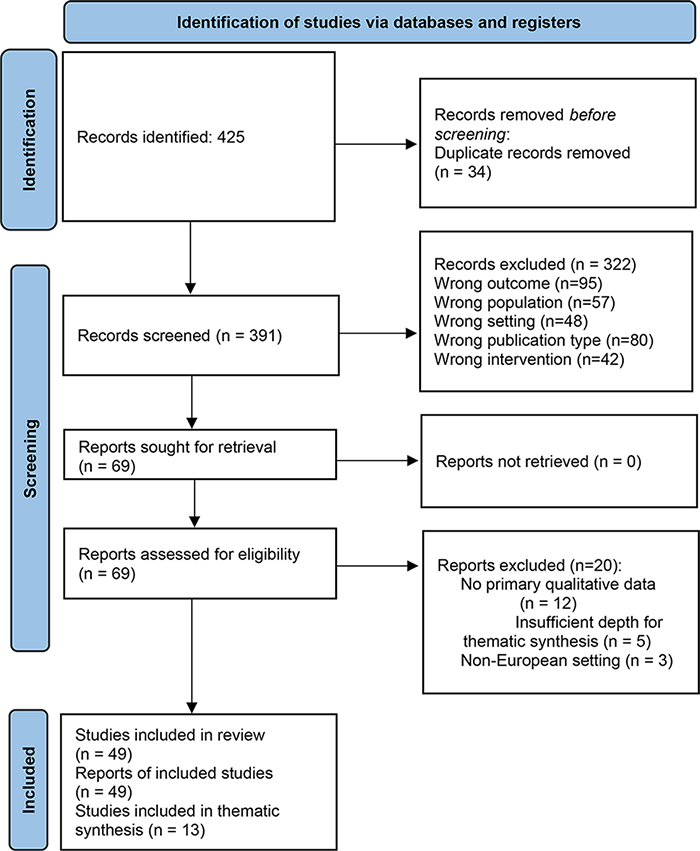
Figure 1
PRISMA flow diagram of study identification, screening, eligibility assessment, and inclusion.
Table 1
Characteristics of included empirical studies informing the thematic synthesis.
| AUTHOR | COUNTRY | SETTING | POPULATION | SCREENING FOCUS | STUDY DESIGN | MIGRATORY CONTEXT |
|---|---|---|---|---|---|---|
| Nkulu‑Kalengayi et al. [22] | Sweden | Reception and primary care services | Newly arrived migrants | Health screening (general) | Qualitative interviews | First arrival |
| Louka et al. [23] | Greece, Netherlands | Reception centers | Asylum seekers | Vaccination and infectious disease screening | Qualitative interviews | First arrival |
| Kang et al. [24] | United Kingdom | Primary care | Asylum seekers and refugees | Access to primary healthcare | Qualitative community‑based study | Long‑term settlement |
| Khanom et al. [25] | United Kingdom (Wales) | Primary care and community services | Asylum seekers and refugees | Access to healthcare services | Qualitative interviews (focus groups) | Long‑term settlement |
| Delilovic et al. [26] | Sweden | Health examination services (HE) | Asylum seekers | Health examinations including screening | Qualitative interviews (providers) | First arrivals |
| Gonçalves et al. [27] | Spain | Primary care | Migrant patients | Multi‑disease screening | Qualitative study (GPs) | Long‑term settlement |
| Seedat et al. [14] | United Kingdom | Community and primary care | Migrant communities | Infectious disease screening | Qualitative interviews | Long‑term settlement |
| Scott et al. [28] | United Kingdom | Primary care | Refugees and asylum seekers | Primary healthcare access | Qualitative study | Long‑term settlement |
| Carter et al. [29] | United Kingdom | Primary care | At‑risk migrant patients | Multi‑disease screening and catch‑up vaccination | Mixed‑methods | Long‑term settlement |
| Moffat et al. [30] | United Kingdom | Community health services | Refugees and asylum seekers | Health access facilitation | Qualitative evaluation | Long‑term settlement |
| Marrone et al. [31] | Italy | Reception centers and regional services | Refugees and asylum seekers | NTDs and infectious disease screening | Observational, prospective prevalence study | First arrival |
| Kortas et al. [32] | Germany | Reception center | Newly arrived asylum seekers | Infectious disease screening | Retrospective analysis | First arrival |
| Boye et al. [33] | Denmark | Community health services | Migrants | HIV testing | Qualitative study | Long‑term settlement |
[i] Quality appraisal of all included empirical studies was conducted using the MMAT is reported in full in Supplementary Table S1.
[ii] Migratory context reflects the setting and population addressed by each study. “First arrival” refers to studies conducted in reception or entry‑point settings; “Long‑term settlement” refers to studies conducted in primary care or community settings among migrants with established residence. Temporal thresholds for “newly arrived” varied across studies.
Table 2
Binary coding matrix of barriers, facilitators, and migratory‑context themes across empirical studies informing the thematic synthesis.
| AUTHOR | A | C | T | O | N | F | L |
|---|---|---|---|---|---|---|---|
| Nkulu‑Kalengayi et al. [22] | Y | Y | Y | N | N | Y | N |
| Louka et al. [23] | N | Y | Y | N | N | Y | N |
| Kang et al. [24] | Y | Y | Y | Y | N | N | Y |
| Khanom et al. [25] | Y | Y | Y | N | N | N | Y |
| Delilovic et al. [26] | Y | N | N | Y | N | Y | N |
| Gonçalves et al. [27] | N | Y | N | Y | N | N | Y |
| Seedat et al. [14] | N | Y | Y | N | Y | N | Y |
| Scott et al. [28] | Y | N | Y | Y | N | N | Y |
| Carter et al. [29] | Y | N | N | Y | Y | N | Y |
| Moffat et al. [30] | Y | N | Y | N | Y | N | Y |
| Marrone et al. [31] | Y | N | N | Y | N | Y | N |
| Kortas et al. [32] | Y | N | N | Y | N | Y | N |
| Boye et al. [33] | Y | N | N | N | N | N | Y |
| Total number (n/13)a | 10 | 6 | 7 | 7 | 3 | 5 | 8 |
[i] Coding matrix of empirical studies (Y = yes, N = no). Themes: A = Administrative / legal barriers, C = Communication, language, cultural mediation, T = Trust, stigma, perceived coercion, O = Organizational capacity / fragmented pathways, N = Role of NGOs / community actors, F = First‑arrival context explicitly addressed, L = Long‑term settlement context explicitly addressed.

Figure 2
Representative cascade model of barriers and facilitators influencing infectious disease screening, linkage to care, and retention in care among migrants across the migratory cycle. Barriers organized by thematic domain across three sequential care stages; impact severity and facilitating influence indicated by colored dots.