
Table 1
Inclusion and exclusion criteria.
| INCLUSION CRITERIA | EXCLUSION CRITERIA |
|---|---|
| Human studies investigating periodontal status among individuals diagnosed with tuberculosis | Animal and in vitro experimental studies |
| Epidemiological investigations, including clinical trials, case‑control, cross‑sectional and cohort studies | Case reports lacking detailed periodontal evaluation |
| Systematic reviews and meta‑analyses primarily focused on immunological pathways or clinical correlations unrelated to direct periodontitis–tuberculosis associations | Studies addressing confounding conditions not directly linked to tuberculosis or periodontitis |
| Studies published in English language | Non‑English language publications |
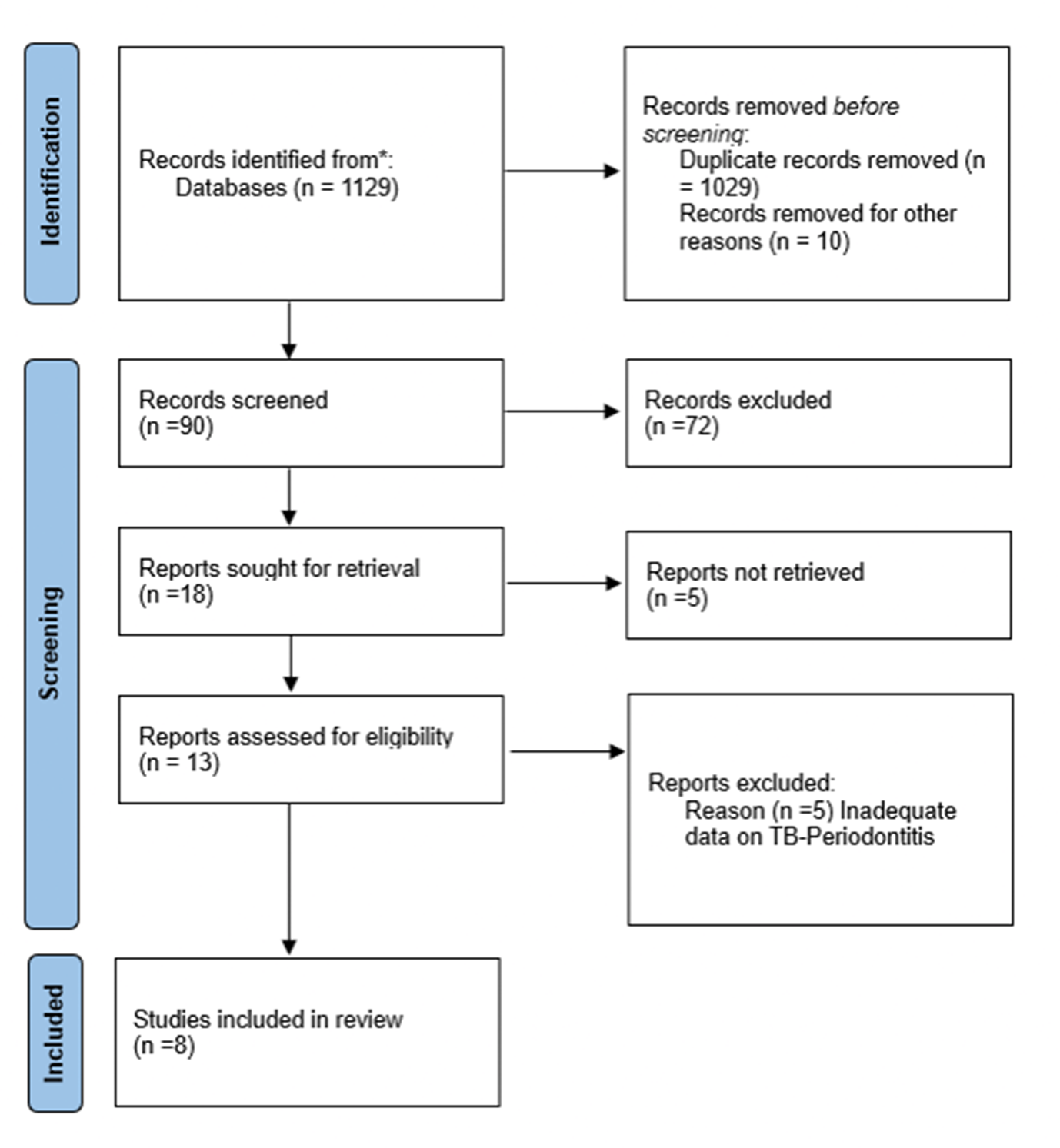
Figure 1
Flowchart illustrating the identification, screening, and inclusion of studies.
Table 2
Study characteristics.
| YEAR | AUTHOR | TYPE | FINDINGS | CONCLUSION |
|---|---|---|---|---|
| 2016 | Sharma et al. [9] | Case‑control | Significant positive correlation was found in PPD 3.08 ± 0.466 and 2.56 ± 0.493 in group I (TB) and group II (non‑TB), respectively, and BOP 0.763 ± 0.149 and 0.642 ± 0.222 in group I and group II, respectively, with P value ≤0.005. | Periodontal status might be linked with TB. |
| 2023 | Shahzad et al. [10] | Case‑control | Evaluation of periodontal parameters (PPD, gingival bleeding, and GI) showed that 56% of tuberculosis patients had a 6.23‑fold higher risk of periodontitis (95% CI: 4.2–9.1; P < 0.001). The mean value for PPD and Bitewing X‑ray finding was higher in cases (patients suffering from TB) group with a mean score of 3.2 ± 2.07, 1.0 ± 0.1 respectively, as compared to the control group with a mean score of 2.8 ± 1.03 and 1.0 ± 0.0, respectively. The difference between the groups for these parameters showed statistical significance with P < 0.001. | Periodontitis and TB have a significant association. |
| 2019 | Kumar et al. [11] | Cross‑sectional | Among 127 patients suffering from tuberculosis, majority reported with Generalised Periodontitis. The mean loss of attachment was 2.81 ± 1.36 within the range of 0.85–8.7. The mean pocket probing depth was 1.77 ± 0.56 with a range of 0.67–3.53. | Incidence of periodontal disease and oral lesions is higher in tuberculosis patients. |
| 2012 | Palakuru et al. [12] | Case‑control | The mean difference in attachment loss scores as measured by CPI was 0.48 (P = 0.09) and was statistically not significant. | Tuberculosis status did not significantly affect periodontal health; however, the detection of Mycobacterium tuberculosis in plaque and saliva may pose a potential clinical risk. |
| 2019 | Rastogi et al. [13] | Cross‑sectional | TB patients aged 51–60 showed the highest periodontitis prevalence (42%), with males (43%) more affected than females (P < 0.01). Based on PIRI (Periodontal index for risk of infectiousness) scores as shown in majority of the population was recorded under high‑risk category with highest risk observed in TB patients. | A significant proportion of the study population exhibited periodontitis, with PIRI assessments indicating a predominance of individuals in the high‑risk category. |
| 2024 | MohanaSundaram et al. [14] | Review | Case reports suggests a potential role of Mycobacterium tuberculosis in periodontitis, highlighting a concern amid the rising incidence of tuberculosis, particularly in individuals with HIV and immunocompromised patients. | Tubercle bacilli as a causative of periodontitis are an upcoming concern in oral health. |
| 2025 | Noor et al. [15] | Review | Periodontitis may exacerbate systemic conditions like tuberculosis by increasing levels of circulating inflammatory markers, such as C‑reactive protein, IL‑6, and TNF‑α. | The potential association between TB and periodontitis holds significant public health implications. |
| 2025 | Ojha et al. [16] | Cross‑sectional study | More than two‑thirds of the participants had fair plaque control (75.6%), moderate gingivitis (92.2%), and moderate form of periodontitis (73.3%). | Two‑thirds of the participants diagnosed primarily with pulmonary disease had periodontitis. |