
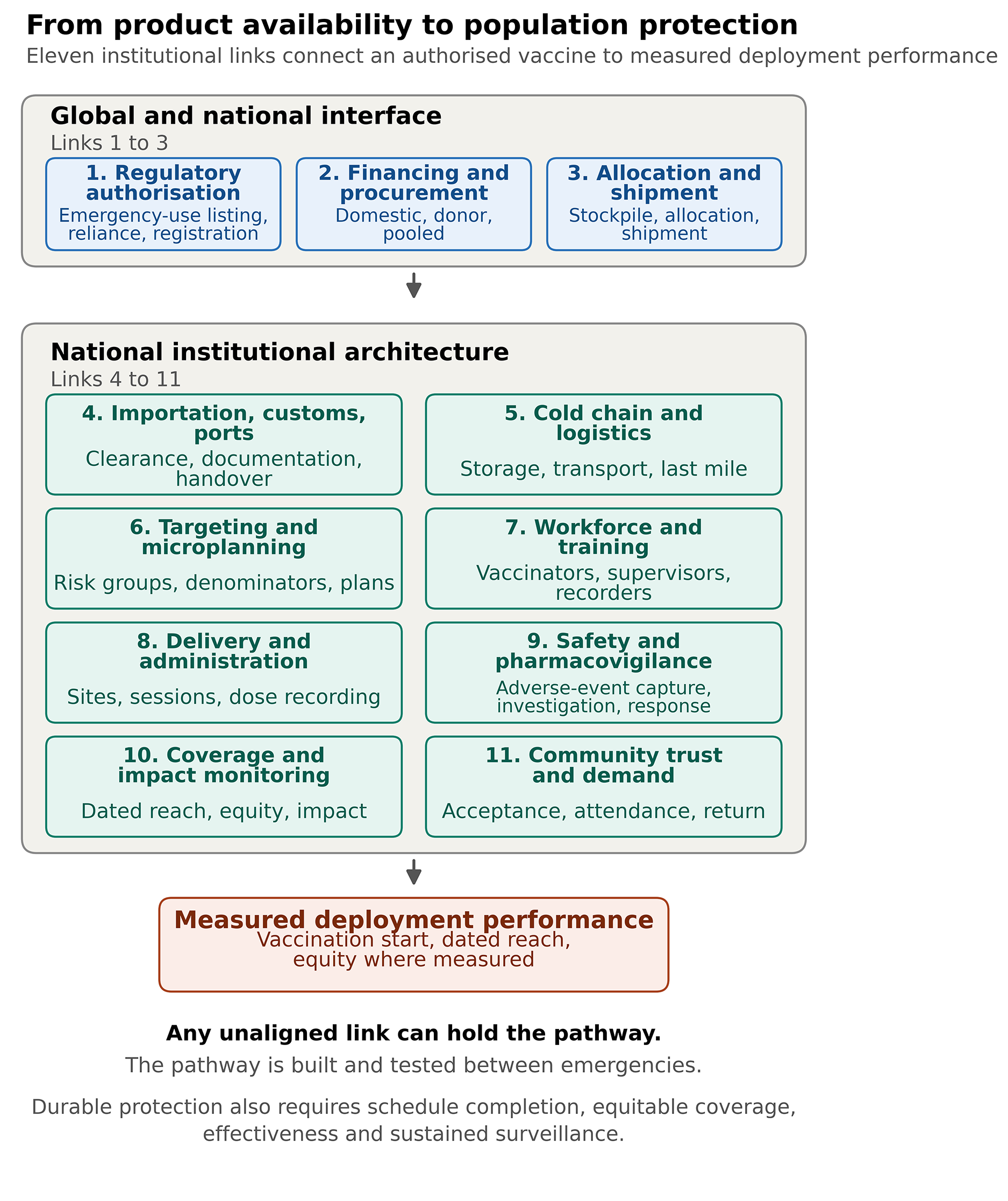
Figure 1
The 11‑function Deployment Readiness Chain, from an authorised vaccine product to measured deployment performance.
Functions 1 to 3 span the global and national interface; functions 4 to 11 operate nationally and subnationally. Any unaligned function can hold the pathway. The heuristic sequence derives from immunisation, emergency‑vaccination and country‑readiness practice. Durable protection also requires schedule completion, equity, effectiveness and surveillance.
Source: Authors’ own figure.
Table 1
Institutional functions and preparedness questions in the Deployment Readiness Chain.
| NO. | FUNCTION | ROLE IN THE PATHWAY | TRACING EVIDENCE | PATHWAY QUESTION |
|---|---|---|---|---|
| 1 | Regulatory authorisation | National approval, registration or reliance pathway | Authorisation, registration or reliance record | Could the product legally enter national use? |
| 2 | Financing and procurement | Budget or procurement mechanism that secures doses | Budgets, financing commitments and procurement records | Were financing and procurement connected to secured supply? |
| 3 | Allocation and shipment | Rules and logistics for assigning and shipping doses | Allocation decisions, stockpile releases and shipping records | When did secured doses move towards the country? |
| 4 | Importation, customs or domestic handover | Clearance, documentation and receipt into the national system | Import approval, customs clearance and receipt records | When did doses enter national custody? |
| 5 | Cold chain and logistics | Storage, transport and last‑mile distribution | Storage, transport and distribution records | Could doses reach delivery sites without interruption? |
| 6 | Targeting and microplanning | Risk groups, denominators, sites and session plans | Target denominators, site maps and session plans | Did a defined target become an operational plan? |
| 7 | Workforce mobilisation and training | Vaccinators, supervisors, recorders and logistics staff | Rosters, training and supervision records | Were trained teams available when and where needed? |
| 8 | Delivery and administration | Sites, sessions, dose administration and recording | Launch dates, session records and dose totals | When did vaccination start, and could delivery continue? |
| 9 | Safety monitoring and pharmacovigilance | Adverse‑event capture, investigation and response | Adverse‑event protocols, reports and investigation records | Could safety events be detected and managed? |
| 10 | Coverage and impact monitoring | Dated coverage, equity and impact assessment | Dated dose totals, denominators and stratified reports | What proportion was reached, by when and for whom? |
| 11 | Community trust and demand | Acceptance, attendance and return | Engagement plans and acceptance, attendance or rumour data | Did intended recipients accept and return for vaccination? |
[i] Note: The Joint External Evaluation and the State Party Self‑Assessment Annual Reporting tool provide broad International Health Regulations capacity evidence. VIRAT/VRAF, national deployment and vaccination plans and programme records add vaccine‑specific evidence. The functions are drawn from established Expanded Programme on Immunisation, emergency‑vaccination and World Health Organization country‑readiness practice. The Chain connects them through institutional responsibility, handoffs and dated performance.
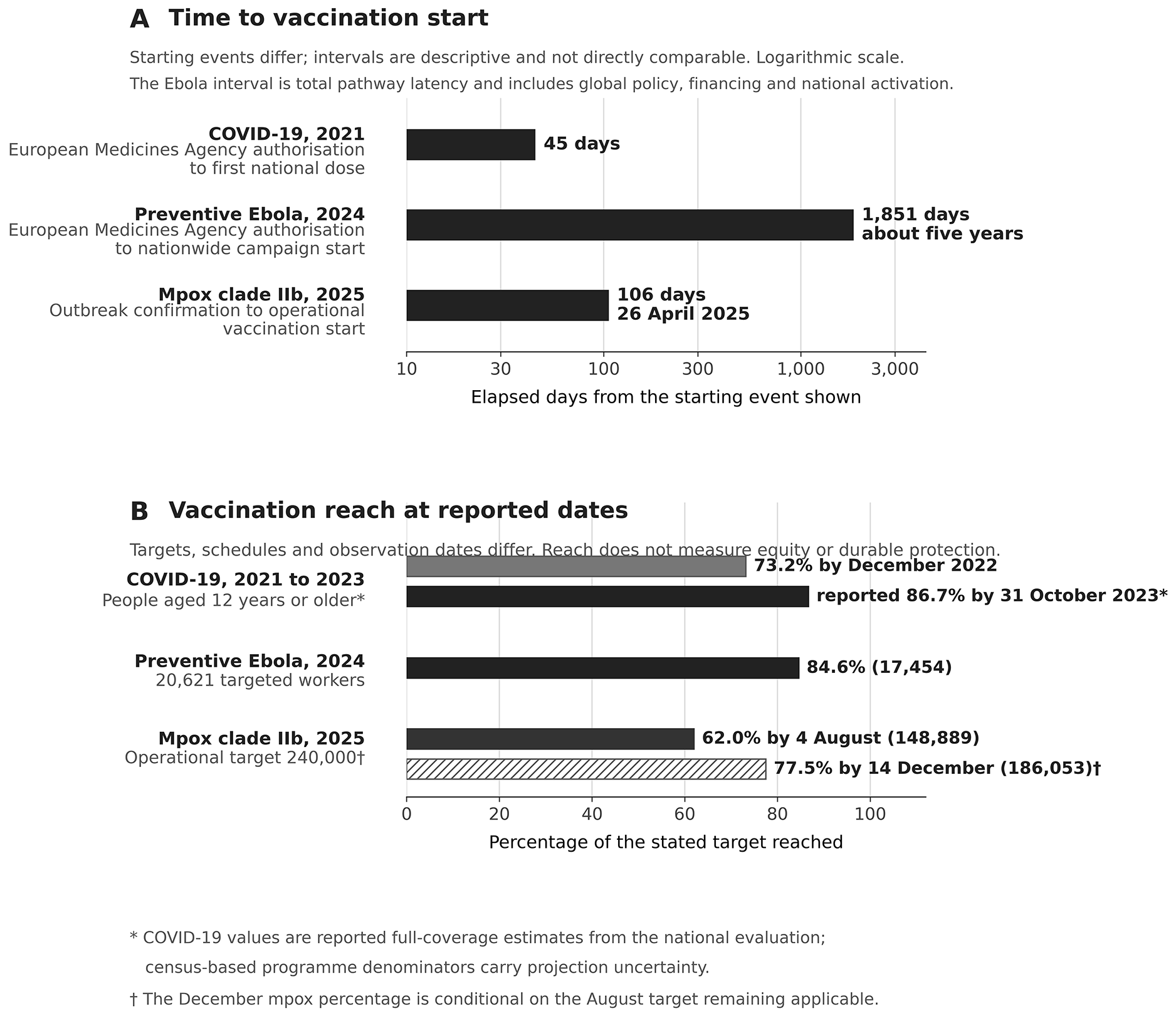
Figure 2
Time to vaccination start and reported vaccination reach for three deployment events in Sierra Leone, 2021–2025.
Panel A shows descriptive intervals on a logarithmic scale. Starting events differ and are not directly comparable. Ebola’s 1,851 days include global policy, financing and national activation. Panel B shows dated reach. COVID‑19 estimates carry denominator uncertainty. Ebola uses 20,621 targeted workers. Mpox uses an operational target of 240,000; its December percentage is conditional on that target remaining applicable. Reach does not measure equity or durable protection.
Source: Cited records and aggregate National Public Health Agency reports; Authors’ own figure.
Table 2
Link‑by‑link comparison of three vaccine deployment events. Principal bottleneck assignments were made by the author team, including authors with operational roles in the programmes, using the criteria stated in Methods section.
| FUNCTION | COVID‑19, 2021 | PREVENTIVE EBOLA, 2024 | MPOX CLADE IIB, 2025 |
|---|---|---|---|
| Functioning: World Health Organization emergency‑use reliance | Functioning by launch: Pharmacy Board product approval | Functioning: Pharmacy Board and national advisory approval |
| Functioning but externally dependent: COVAX Facility | Functioning: Gavi stockpile and partner financing | Functioning: global stockpile and partner financing |
| Principal constraint: global scarcity and phased allocation | Functioning by launch: stockpile allocation secured | Functioning with expansion: 61,300 initial doses, 283,500 later available |
| Functioning | Functioning | Functioning |
| Ebola‑acquired ultra‑low‑temperature equipment reused; facility gaps remained | Functioning for the Ervebo campaign | Functioning for the national campaign |
| Functioning with phased age and risk eligibility | Functioning: occupational targeting across 16 districts | Functioning: contacts, health workers, hotspot and other high‑risk groups |
| Surge teams expanded from 299 to 1385 across 16 campaigns | Functioning: national and district teams | Functioning: emergency workforce reused |
| First dose in 45 days; later delivery relied on 16 surge campaigns and periodic intensification | 17,454 of 20,621 reached in three weeks | Formal launch reported in March; operational start at 106 days on 26 April; 186,053 vaccinated by 14 December |
| Established during rollout; uneven reporting | Functioning campaign protocols | Functioning within the national response |
| 73.2% full coverage by December 2022; reported estimate 86.7% by 31 October 2023 | 84.6% of target reached | 186,053 people; 77.5% if the August target of 240,000 remained applicable |
| Active engagement; variable acceptance | Sustained engagement with occupational groups | Active outbreak drove mobilisation; community engagement expanded |
[i] Note: Categories are assigned only where the documentary record supports them. Starting events, endpoints and observation dates differ across cases.
Table 3
Institutional enabling conditions across the study period.
| ENABLING CONDITION AND RELEVANT CHAIN LINKS | DOCUMENTED POSITION, 2019–2021 | DOCUMENTED POSITION OR USE BY DECEMBER 2024 |
|---|---|---|
| Legal and institutional foundation (links 1 and 2, cross‑cutting) | Public Health Ordinance of 1960; emergency functions distributed across Ministry directorates [26, 27]. | Public Health Act in force; National Public Health Agency operating as the institutional home for public health emergency coordination [26, 27]. |
| Targeting workforce (links 6–8) | Field epidemiology and district capacity expanding after Ebola [30, 31]. | Field Epidemiology Training Programme cohorts and district teams supported national targeting and delivery [14]. |
| Cold chain and logistics (link 5) | Ebola‑acquired ultra‑low‑temperature equipment met national COVID‑19 needs, although facility‑level gaps remained [25]. | Ervebo stored and distributed to campaign teams across all 16 districts [14]. |
| Surveillance and microplanning (links 6 and 10) | Electronic surveillance expanded after Ebola; third‑edition Integrated Disease Surveillance and Response guidance reached 1464 facilities by 2021 [30, 37]. | The national electronic surveillance network and district teams supported targeting and microplanning [15, 37]. |
| Community engagement (link 11) | Trust rebuilding after the 2014–2016 epidemic informed COVID‑19 engagement [25, 30, 31]. | Engagement involved health workers, traditional and religious leaders, transport workers and security forces [8, 15]. |
| Partnership coordination (links 2 and 3, cross‑cutting) | Coordination operated through Ministry and emergency‑response structures [30, 31]. | The Ministry, the National Public Health Agency, Gavi, the World Health Organization, the United Nations Children’s Fund and the International Coordinating Group on Vaccine Provision coordinated the national campaign [8, 9, 27]. |
[i] Note: All abbreviations used in this table are written out in full at their first appearance in the text.