
Table 1
Respondent demographics (n = 120).
| TBS, N = 58 | FC, N = 62 | |||
|---|---|---|---|---|
| VARIABLE | (N, PERCENTAGE) | (N, PERCENTAGE) | P‑VALUE | |
| Region | 0.715 | |||
| Southwest | 30 (51.7) | 30 (48.4) | ||
| Far‑North | 28 (48.3) | 32 (51.6) | ||
| Age (median, IQR) | 51 (39, 60) years | 34 (30, 36) years | <0.001 | |
| Male sex | 42 (72.4) | 32 (51.6) | 0.019 | |
| Highest level of education completed | <0.001 | |||
| None | 14 (24.1) | 0 | ||
| Primary | 29 (50.0) | 0 | ||
| Secondary | 11 (19.0) | 12 (19.4) | ||
| University | 2 (3.4) | 49 (79.0) | ||
| Unknown/Other | 2 (3.4) | 1 (1.6) | ||
| Practice in multiple regions | 20 (34.5) | 0 | <0.001 | |
| Years caring for injured patients (median, IQR) | 20 (11, 28) years | 5 (3, 8) years | <0.001 | |
| Practice facility | <0.001 | |||
| District Hospital | 0 | 7 (11.3) | ||
| Regional Hospital | 0 | 43 (69.4) | ||
| Private Hospital | 0 | 3 (4.8) | ||
| Military Hospital | 0 | 2 (3.2) | ||
| Home | 57 (98.3) | 0 | ||
| Other/Missing | 1 (1.7) | 7 (11.3) | ||
[i] *TBS = Traditional bone setters, FC = Formal care providers, IQR = Interquartile range.
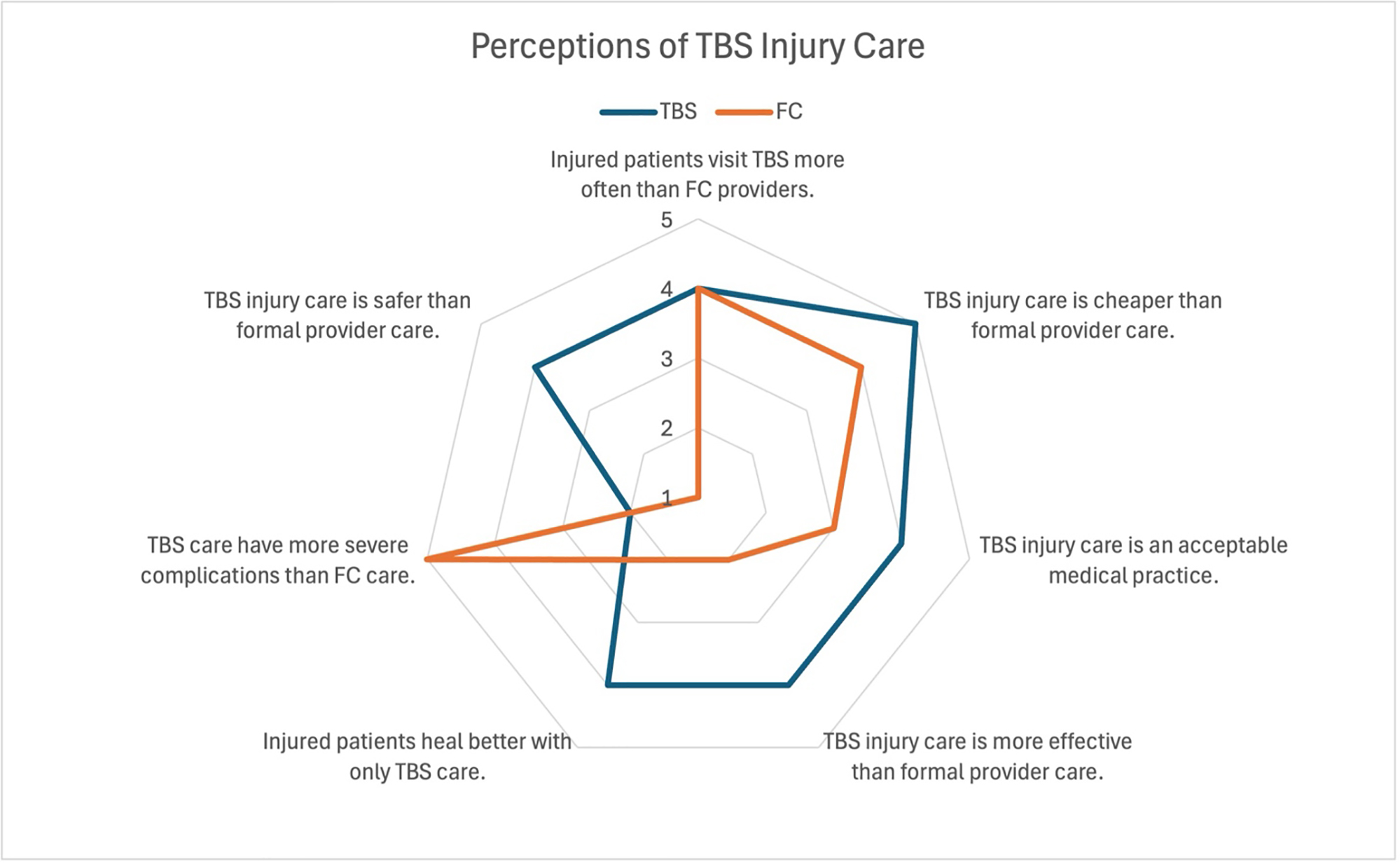
Figure 1
Perceptions of TBS injury care. Radar plot of median Likert scale responses.
Legend: 1 = Strongly Disagree, 2 = Disagree, 3 = Neutral, 4 = Agree, 5 = Strongly Agree.
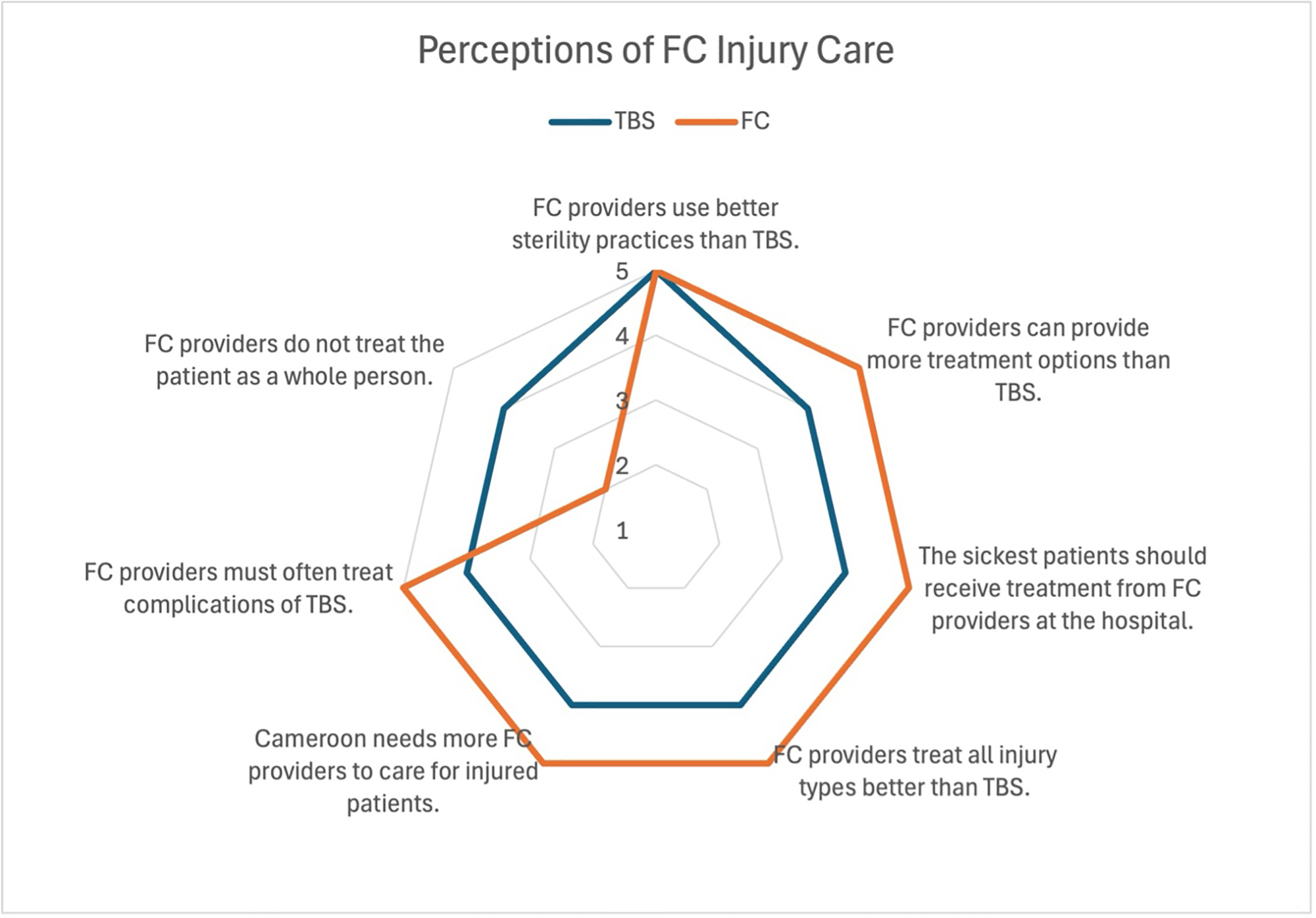
Figure 2
Perceptions of FC injury care. Radar plot of median Likert scale responses.
Legend: 1 = Strongly Disagree, 2 = Disagree, 3 = Neutral, 4 = Agree, 5 = Strongly Agree.
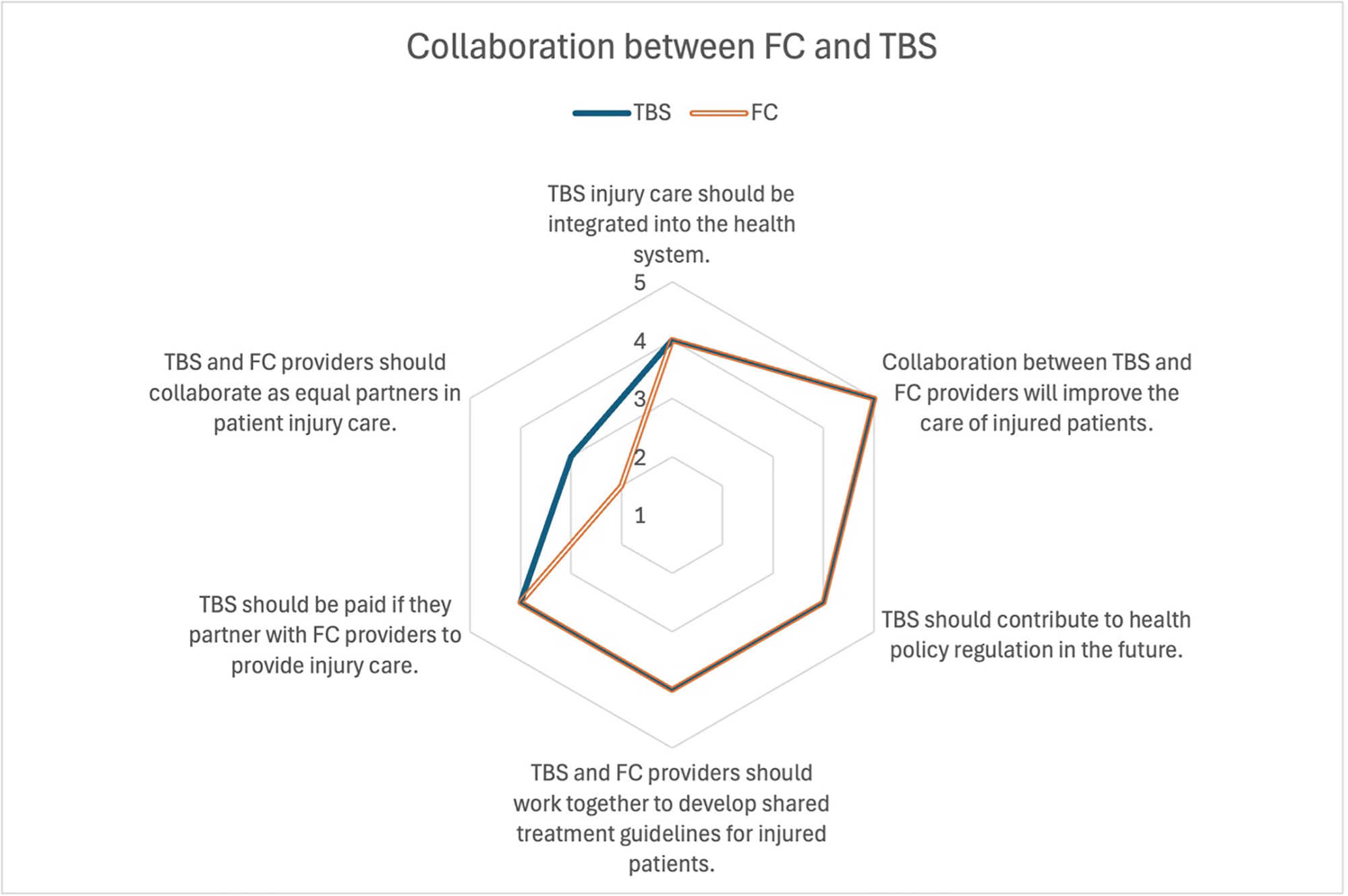
Figure 3
Collaboration between FC and TBS providers. Radar plot of median Likert scale responses.
Legend: 1 = Strongly Disagree, 2 = Disagree, 3 = Neutral, 4 = Agree, 5 = Strongly Agree.
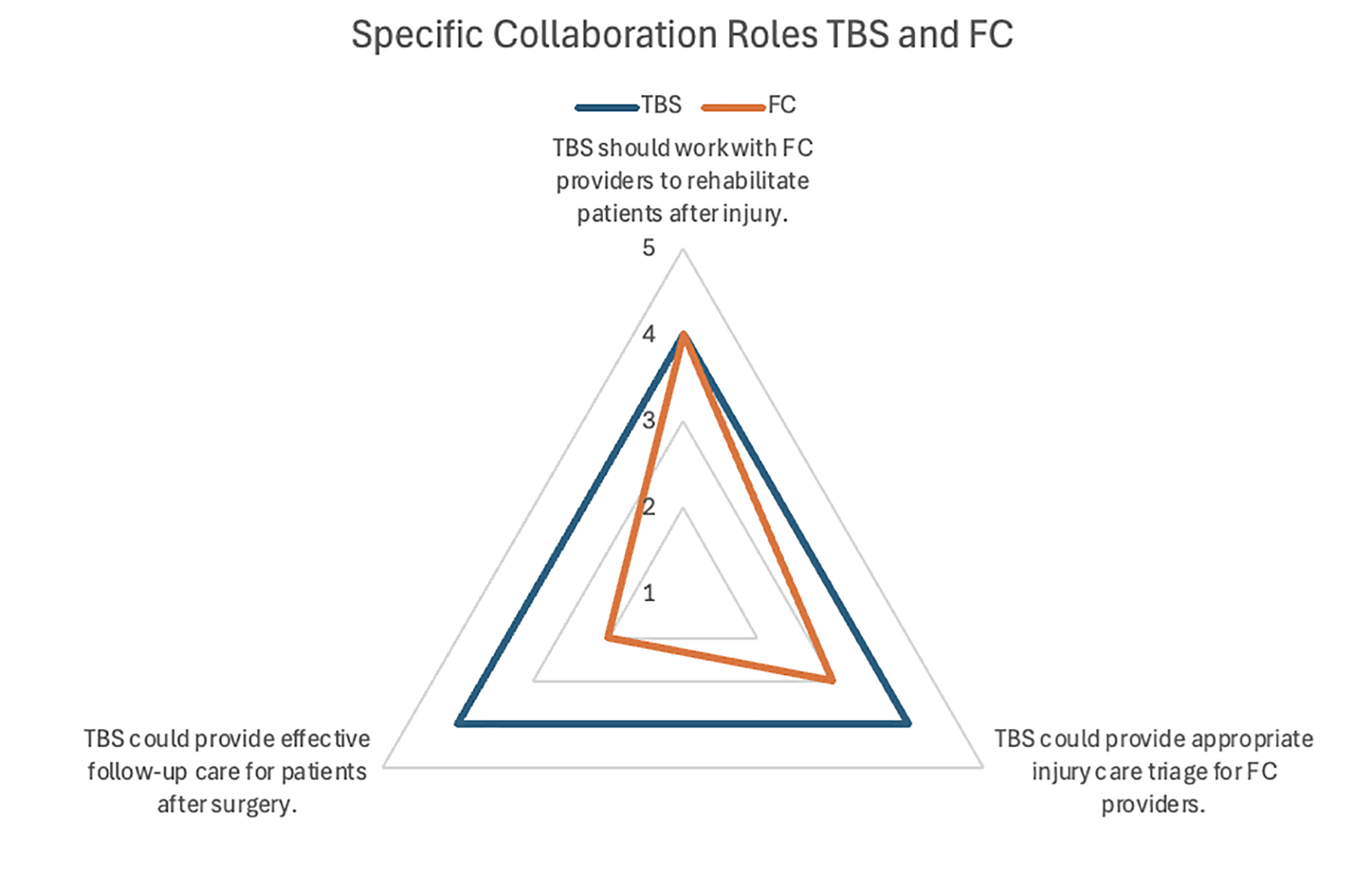
Figure 4
Specific collaborative roles between FC and TBS providers. Radar plot of median Likert scale responses.
Legend: 1 = Strongly Disagree, 2 = Disagree, 3 = Neutral, 4 = Agree, 5 = Strongly Agree.
Table 2
Descriptive statistics of survey responses (n = 120; TBS n = 58, FC n = 62).
| STATEMENT | MEDIAN | MEAN | IQR | P‑VALUE | |
|---|---|---|---|---|---|
| Perceptions of TBS Injury Care | |||||
| Injured patients visit TBS more often than FC providers | TBS | 4, Agree | 3.8, Agree | 3–5 | 0.19 |
| FC | 4, Agree | 3.4, Neutral | 2–5 | ||
| TBS injury care is cheaper than formal provider care | TBS | 5, Strongly Agree | 4.5, Strongly Agree | 4–5 | 0.001 |
| FC | 4, Agree | 3.8, Agree | 3–5 | ||
| TBS injury care is an acceptable medical practice | TBS | 4, Agree | 3.9, Agree | 3–5 | <0.001 |
| FC | 3, Neutral | 3, Neutral | 2–4 | ||
| TBS injury care is more effective than FC | TBS | 4, Agree | 4.1, Agree | 4–5 | <0.001 |
| FC | 2, Disagree | 2.1, Disagree | 1–3 | ||
| Injured patients heal better with only TBS care | TBS | 4, Agree | 4.2, Agree | 4–5 | <0.001 |
| FC | 2, Disagree | 2.2, Disagree | 1–2 | ||
| TBS care have more severe complications than FC care | TBS | 2, Disagree | 2.5, Neutral | 2–3 | <0.001 |
| FC | 5, Strongly Agree | 4.5, Strongly Agree | 4–5 | ||
| TBS injury care is safer than formal provider care | TBS | 4, Agree | 3.9, Agree | 4–5 | <0.001 |
| FC | 1, Strongly Disagree | 1.7, Disagree | 1–2 | ||
| Perceptions of FC Injury Care | |||||
| FC providers use better sterility practices than TBS | TBS | 5, Strongly Agree | 4.4, Agree | 4–5 | 0.001 |
| FC | 5, Strongly Agree | 5.0, Strongly Agree | 5–5 | ||
| FC providers can provide more treatment options than TBS | TBS | 4, Agree | 4.1, Agree | 4–5 | 0.001 |
| FC | 5, Strongly Agree | 4.7, Strongly Agree | 5–5 | ||
| The sickest patients should receive treatment from FC at the hospital | TBS | 4, Agree | 3.9, Agree | 4–5 | <0.001 |
| FC | 5, Strongly Agree | 4.7, Strongly Agree | 5–5 | ||
| FC providers treat all injury types better than TBS | TBS | 4, Agree | 3.9, Agree | 3–5 | 0.002 |
| FC | 5, Strongly Agree | 4.7, Strongly Agree | 5–5 | ||
| Cameroon needs more FC to care for injured patients | TBS | 4, Agree | 4.2, Agree | 4–5 | <0.001 |
| FC | 5, Strongly Agree | 4.9, Strongly Agree | 5–5 | ||
| FC providers must often treat complications of TBS | TBS | 4, Agree | 3.5, Neutral | 3–5 | <0.001 |
| FC | 5, Strongly Agree | 4.5, Strongly Agree | 4–5 | ||
| FC providers do not treat the patient as a whole person | TBS | 4, Agree | 3.2, Neutral | 2–4 | 0.002 |
| FC | 2, Disagree | 2.5, Neutral | 2–4 | ||
| Collaboration between FC and TBS Providers | |||||
| TBS injury care should be integrated into the health system | TBS | 4, Agree | 4.2, Agree | 4–5 | 0.07 |
| FC | 4, Agree | 3.8, Agree | 3–5 | ||
| TBS and FC collaboration will improve care of injured patients | TBS | 5, Strongly Agree | 4.7, Strongly Agree | 4–5 | 0.06 |
| FC | 5, Strongly Agree | 4.3, Agree | 4–5 | ||
| TBS should contribute to health policy regulation in the future | TBS | 4, Agree | 3.8, Agree | 3–4 | 0.58 |
| FC | 4, Agree | 3.5, Neutral | 2–5 | ||
| TBS and FC should work together to develop shared treatment guidelines for injured patients | TBS | 4, Agree | 3.6, Agree | 3–4 | 0.94 |
| FC | 4, Agree | 3.5, Neutral | 3–4 | ||
| TBS should be paid if they partner with FC to provide injury care | TBS | 4, Agree | 3.7, Agree | 3–5 | 0.91 |
| FC | 4, Agree | 3.9, Agree | 3–5 | ||
| TBS and FC should collaborate as equal partners in patient injury care | TBS | 3, Neutral | 2.8, Neutral | 2–4 | 0.006 |
| FC | 2, Disagree | 2.1, Disagree | 1–3 | ||
| TBS should work with FC to rehabilitate patients after injury | TBS | 4, Agree | 4.2, Agree | 4–5 | <0.001 |
| FC | 4, Agree | 3.5, Neutral | 3–4 | ||
| TBS could provide appropriate injury care triage for FC | TBS | 4, Agree | 4.2, Agree | 4–5 | <0.001 |
| FC | 2.5, Neutral | 2.8, Neutral | 2–4 | ||
| TBS could provide effective follow‑up care for patients after surgery | TBS | 4, Agree | 3.7, Agree | 4–4 | <0.001 |
| FC | 2, Disagree | 2.1, Disagree | 1–3 | ||
[i] *TBS = Traditional bone setters, FC = Formal care providers, IQR = Interquartile range.
[ii] **Numeric categorization of responses: Strongly Disagree = 1–1.5, Disagree = 1.6–2.4, Neutral = 2.5–3.5, Agree = 3.6–4.4, and Strongly Agree = 4.5–5.