Have a personal or library account? Click to login
Engaging Social Stakeholders in National Asbestos Research for Public Health: An Italian Experience Cover

Engaging Social Stakeholders in National Asbestos Research for Public Health: An Italian Experience

Open Access
|Jun 2025

Figures & Tables

aogh-91-1-4717-g1.png
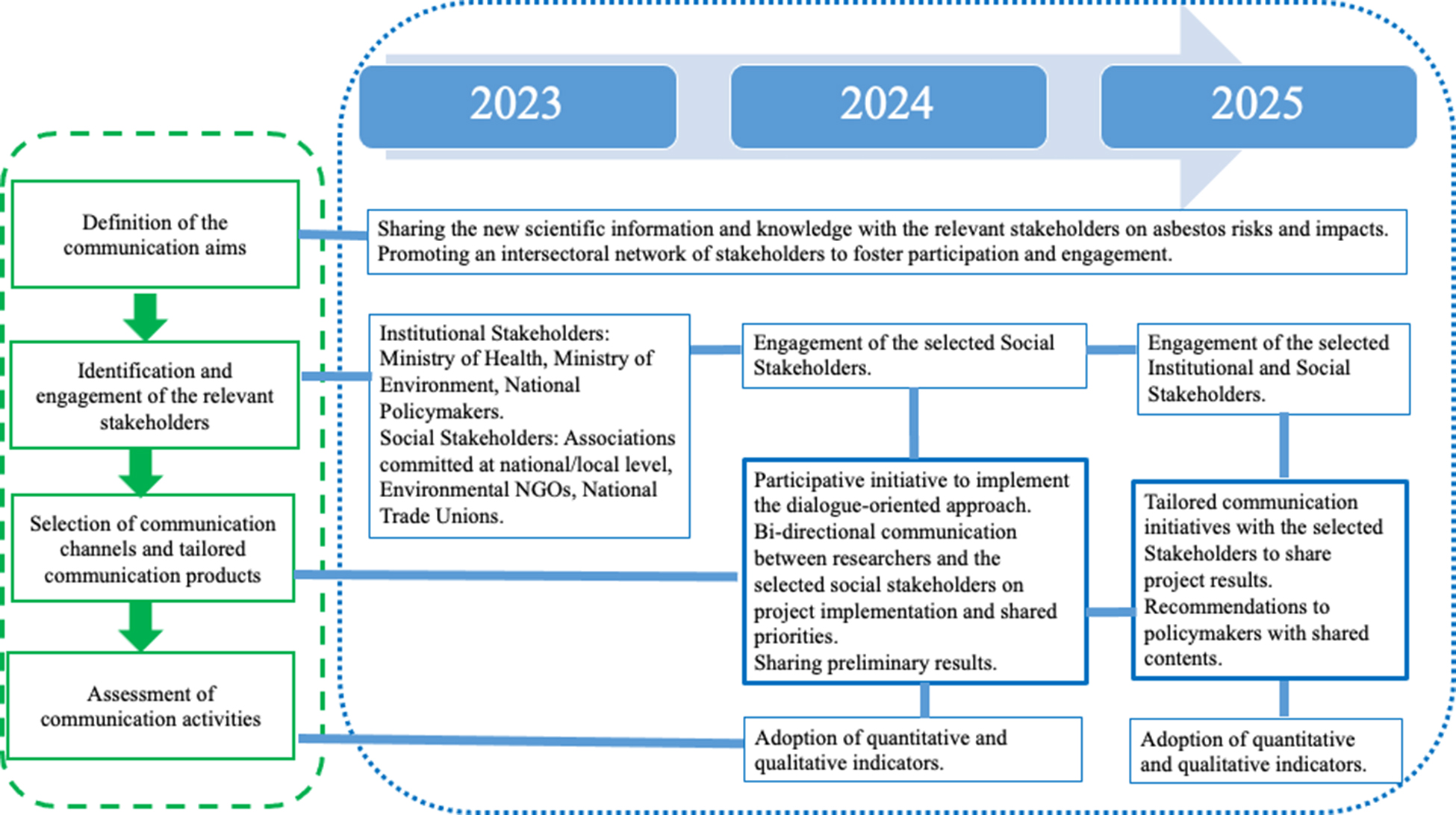
Figure 1

Implementation of the communication approach in the SEPRA project. The four methodological steps of the communication plan are depicted on the left panel (green dashed box). Its implementation in the SEPRA project is illustrated in the right panel (blue dotted box). The key actions are described in the blue rectangular boxes. The key actions involving bidirectional communication are described in the two blue boxes highlighted in bold. The project timeline is shown on the top of the figure. Blue lines depict the workflow of the implemented communication activities, undertaken coherently with the methodology and the timeline.

Table 1

Discussed research topics and social stakeholders’ inputs on project activities. The third column shows the requests made by social stakeholders on issues related to the discussed research topics, but outside the roles and responsibilities of involved Institutions. They will be disseminated by the SEPRA project to policymakers.

DISCUSSED RESEARCH TOPICSSOCIAL STAKEHOLDERS’ INPUTS TO IMPLEMENT PROJECT ACTIVITIESSOCIAL STAKEHOLDERS’ REQUESTS TO POLICYMAKERS
Sharing the dialogue‑oriented approach to foster proactive participation and the project’s implications in public health.
  • Strengthening their role in collaborating with researchers.

  • Improvement of tools commonly used for asbestos prevention actions.

  • Revision/definition of the asbestos‑contaminated sites of national concern for remediation.

  • Implement environmental remediation of asbestos‑contaminated areas, and removal of asbestos containing materials.

  • Improvement of social insurance and welfare for all occupational and non‑occupational victims of asbestos, with the recognition of all ARD cases.

  • Implementation of health surveillance plans at the national scale.

Updating the epidemiological surveillance of mortality from mesothelioma in Italy at the municipal level.
  • Strengthening the study of asbestos non‑occupational exposures at the municipal level.

  • Estimates of mortality from ARDs, different from mesothelioma.

  • Forecasting ARDs’ impact.

Updating the Italian national surveillance system of mesothelioma incidence cases.
  • Improving the territorial homogeneity in the recognition of mesothelioma cases and asbestos exposure contexts.

  • Estimates of ARD incidence cases different from mesothelioma.

Updating the questionnaire used for the detection of mesothelioma cases by the COR‑ReNaM.
  • Recognizing all ARD cases, in addition to mesothelioma.

  • Strengthening information exchanges between COR‑ReNaM technicians and social stakeholders for ARD case detection.

  • Interactions on updating questionnaire.

Estimating the impact of asbestos exposure on the development of ovarian cancer in Lombardy.
  • Estimating malignant cancer cases attributable to asbestos, in addition to mesothelioma, in areas highly impacted by asbestos of the national territory.

Applying the model for psychological support to former asbestos‑exposed workers and their families developed for the Casale Monferrato asbestos‑contaminated community.
  • Developing a national plan addressing the psychological support to patients and their families affected by mesotheliomas.

  • Training key health professionals and operators, including the general practitioners on asbestos health impact to share experience on ARDs with the affected patients.

Network of Institutions committed to the recognition of ARDs.
  • Improving cooperation between the national authority and its regional‑local offices, committed to the recognition of all ARDs.

DOI: https://doi.org/10.5334/aogh.4717 | Journal eISSN: 2214-9996
Language: English
Submitted on: Feb 17, 2025
Accepted on: May 19, 2025
Published on: Jun 5, 2025
Published by: Ubiquity Press
In partnership with: Paradigm Publishing Services
Publication frequency: 1 issue per year

© 2025 Daniela Marsili, Alessandra Binazzi, Alessandro Marinaccio, Carolina Mensi, Lucia Fazzo, SEPRA project Working Group for the study on communication and social stakeholders’ engagement, published by Ubiquity Press
This work is licensed under the Creative Commons Attribution 4.0 License.