
Table 1
Demographics and descriptive statistics on select data.
| DEMOGRAPHICS AND DESCRIPTIVE STATISTICS | |||||
|---|---|---|---|---|---|
| Age (years) | Median age | Average age | Min age | Max age | |
| 36 | 36 | 23 | 54 | ||
| Sex | Woman | Man | Other | ||
| N = 29; 66% | N = 15; 34% | 0 | |||
| GH experience prior to SS? | Yes | No | |||
| N = 22; 49% | N = 23; 51% | ||||
| Length of prior GH experience | 1–2 weeks | 3–12 weeks | 4–12+ months | ||
| N = 9; 43% | N = 9; 43% | N = 6; 29% | |||
| Type(s) of prior GH experience | Education | Clinical/healthcare | Community project | GH research | Other |
| N = 6; 29% | N = 12; 57% | N = 12; 57% | N = 6; 29% | N = 1; 5% | |
| Continuation in GH career? | Yes | No | In med school | ||
| N = 30; 70% | N = 6; 14% | N = 7; 16% | |||
Table 2
Perceptions of the SS program.
| RANGE: 1 (STRONGLY DISAGREE)–5 (STRONGLY AGREE) | |
|---|---|
| STATEMENT | MEAN (SD) |
| I enjoyed participating in the Slemenda Scholars program. | 4.9 (0.3) |
| I learned more about myself by participating in the Slemenda Scholars program. | 4.9 (0.3) |
| I learned more about global health by participating in the Slemenda Scholars program. | 5 (0.0) |
| I learned more about the field of medicine by participating in the Slemenda Scholars program. | 4.9 (0.3) |
| Participating in the Slemenda Scholars program changed the trajectory of my career. | 4.0 (1.0) |
[i] SD, standard deviation.
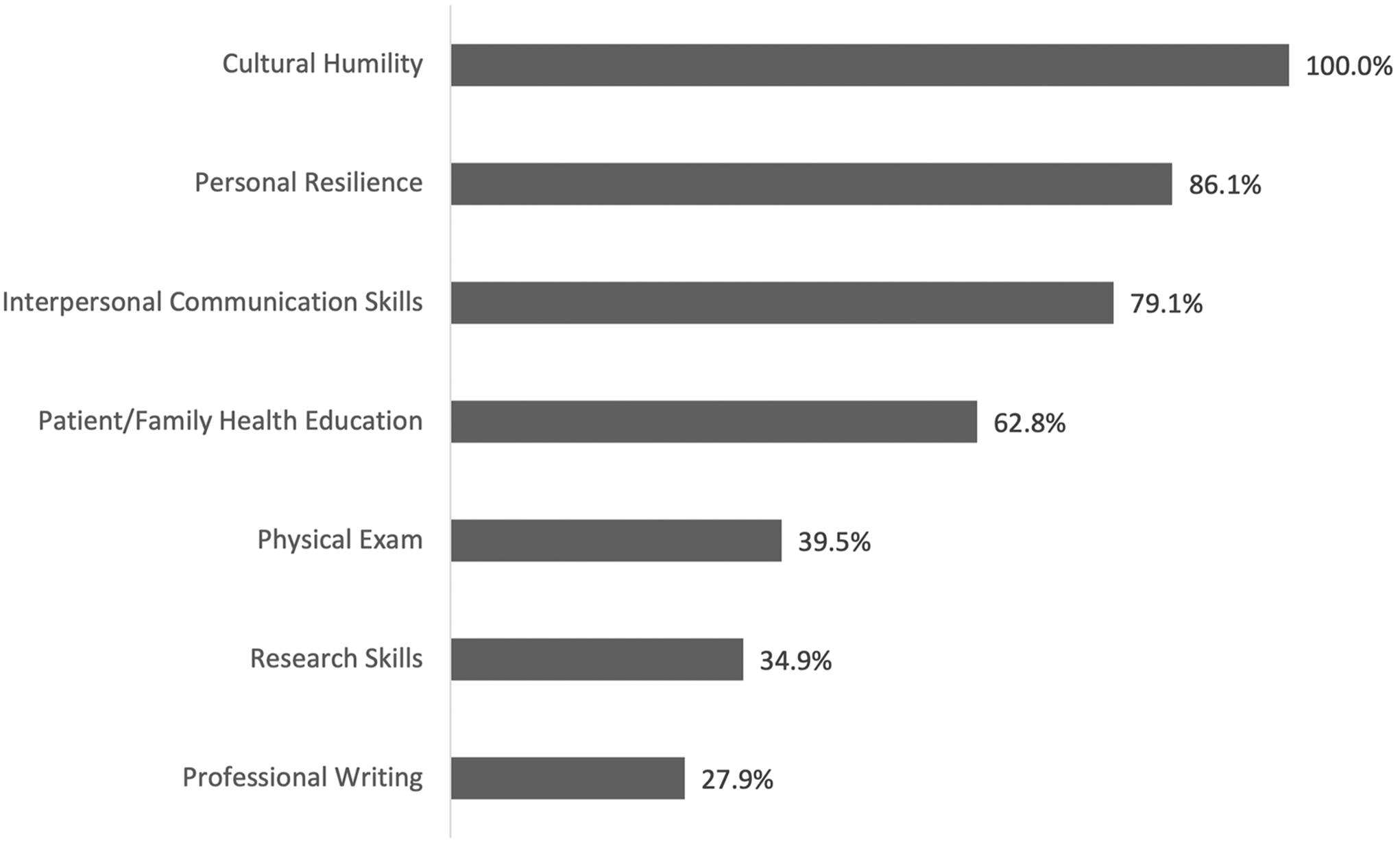
Figure 1
Self‑reported competencies.
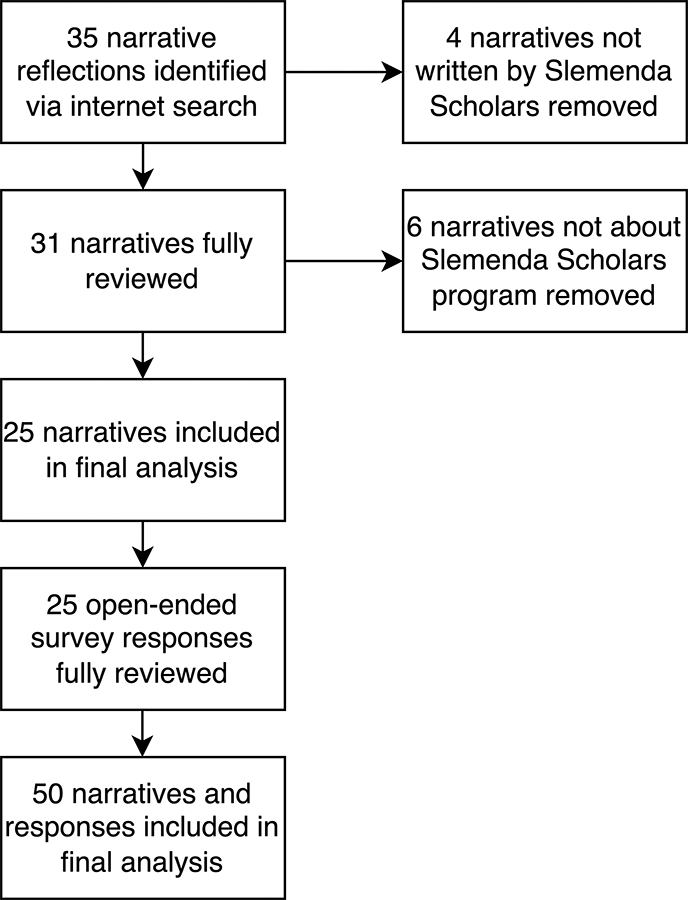
Figure 2
Workflow for identifying narratives about the Slemenda Scholars experience.
Table 3
Impactful experiences themes.
| IMPACTFUL EXPERIENCES | DEFINITIONS | COUNT IN PERSONAL NARRATIVES, N (%) N = 25 (100%) | COUNT IN SURVEY OPEN‑ENDED RESPONSES, N (%) N = 25 (100%) | TOTAL N = 50 (%) |
|---|---|---|---|---|
| Experiential learning | Informal education occurring in … | 21 (84) | 6 (24) | 27 (54) |
| Research | Scholarly projects or research endeavors | 14 (56) | 1 (4) | 15 (30) |
| Clinical experience | Wards or other clinical settings | 11 (44) | 4 (16) | 15 (30) |
| Community outreach | Volunteer work or site visits outside the hospital | 12 (48) | 2 (8) | 14 (28) |
| Cultural exploration | Kenya beyond the AMPATH or Slemenda program | 7 (28) | 0 (0) | 7 (14) |
| Didactic learning | Formal instruction on … | 16 (64) | 6 (24) | 22 (44) |
| AMPATH | Infrastructure and/or history of AMPATH and its programs | 14 (56) | 5 (20) | 19 (38) |
| Global health education | Global health or Kenyan healthcare system (fireside chats, public health talks, personal or clinical experiences) | 5 (20) | 4 (16) | 9 (18) |
| Professional development | 14 (56) | 7 (28) | 21 (42) | |
| Network‑building | Mentions work with professionals outside of medicine and/or with mentors in AMPATH | 14 (56) | 4 (16) | 18 (36) |
| Career exploration | Reflects on an experience that changed/affirmed their interest in a field of medicine | 3 (12) | 3 (12) | 6 (12) |
| Cross‑cultural interactions | Collaboration with Kenyans in a … | 17 (68) | 3 (12) | 20 (40) |
| Professional | Work setting | 13 (52) | 3 (12) | 16 (32) |
| Personal | Cultural or extraprofessional setting | 13 (52) | 3 (12) | 16 (32) |
Table 4
Transformative learning themes.
| TRANSFORMATIVE LEARNING | DEFINITIONS | COUNT IN PERSONAL NARRATIVES, N (%) N = 25 (100%) | COUNT IN SURVEY OPEN‑ENDED RESPONSES, N (%) N = 25 (%) (100%) | TOTAL N = 50 (%) |
|---|---|---|---|---|
| Expanding perspectives | Reflections on experiences in Kenya that strengthened or changed views regarding … | 21 (84) | 7 (28) | 28 (56) |
| Ethical global health | Importance or understanding of sustainable GH | 13 (52) | 4 (16) | 17 (34) |
| Impactful patient experiences | Patients | 12 (48) | 1 (4) | 13 (26) |
| Cultural humility | Kenyan people, culture, and medical system | 8 (32) | 4 (16) | 12 (24) |
| Health equity | Health disparities or inequities | 6 (24) | 1 (4) | 7 (14) |
| Motivation for service‑oriented career | Expresses future orientation with … | 18 (72) | 9 (26) | 27 (54) |
| Global health | Desire to continue working in GH | 12 (48) | 8 (32) | 20 (40) |
| Optimism | Hope for improvement of care and/or quality in GH work | 10 (40) | 0 (0) | 10 (20) |
| Underserved | Desire to work with underserved communities | 3 (12) | 1 (4) | 4 (8) |
| Interpersonal skills | Reflections on significant/effective interactions in … | 7 (28) | 5 (20) | 12 (24) |
| Relationship‑building | Social settings | 5 (20) | 4 (16) | 9 (18) |
| Collaboration | Professional partnerships | 4 (16) | 2 (8) | 6 (12) |
| Innovation | Observations on innovation in Kenyan healthcare, goals for reciprocally implementing Kenyan methods back at home, and ideas for the future of GH | 9 (36) | 0 (0) | 9 (18) |
| Adaptability | Resilience and creativity in a resource‑ or language‑limited setting | 4 (16) | 1 (4) | 5 (10) |
Table 5
Illustrative quotes from transformative learning themes.
| THEME | SUBTHEME | ILLUSTRATIVE QUOTE(S) |
|---|---|---|
| Expanding Perspectives | Ethical global health | “My view is biased – I have spent such a limited amount of time here and I see only the short‑term. The truth is that so much progress has been made, progress that can only be made when people commit to a community for a long period of time, and that is the macroscopic view that people saw and continue to see in these developing communities.” “If we don’t work to let our hearts break for the hurting, then our board meetings about sustainability and bilateral exchange will be less informed, less motivated, and less effective.” “We have discussed how it is easy to judge a care system based on its apparent ‘low‑hanging fruit’ problems, but it is more important to look past these snap judgements and potential ‘quick fixes’ to look into the depths of what is working and what isn’t.” |
| Impactful patient experiences | “They weren’t tears of sadness but of joy. Joy in a chance at life. Joy in new beginning. She was surely dead within the year if not for an antiretroviral treatment. This big system that has taken years to develop was changing lives like hers.” “From the child with xeroderma pigmentosum to the patients with pneumocystis pneumonia or hydatid cysts, it has not only been a learning experience being on the wards but also a reminder of why many of us chose to go into the medical profession.” “My time spent in the [HIV Resistance] clinic was a rollercoaster of emotions. I did not expect to find myself face‑to‑face with one of [ARVs] failures, especially in the form of a very young child.” | |
| Cultural humility | “I was forced to acknowledge my own privilege, question my own values, and scrutinize how the media chooses to portray systems and cultures foreign to our own. While the Kenyan system is one that is resource‑poor, it is not inferior in knowledge, it is not inferior in joy, it is not inferior in quality of life.” “My time spent in the [HIV Resistance] clinic was a rollercoaster of emotions. I did not expect to find myself face‑to‑face with one of [ARVs] failures, especially in the form of a very young child.” | |
| Health equity | “The trip taught me much about the importance of access to health care for everyone. Seeing patients with cancer so advanced that they could barely walk into the clinics underscores the importance of preventative care and not just acute care.” “Cases like this make it more apparent to me that there is an increasing need for universal access to safe and affordable surgical and anesthetic care to save lives and stimulate growth with communities around the world… a lack of affordable and accessible surgical care prevents people from flourishing and living to their potential.” | |
| Motivation for service‑oriented career | Global health | “To see how the health and quality of living can be improved from within the hospital to the communities within villages is powerful and a testament to why we should all be interested and strive to become involved in global health.” |
| Optimism | “Even though there is so much to be done, there is so much hope, and that is what draws people here, and what makes me want to come back.” | |
| Underserved | “The AMPATH mission is something I carry close to my heart – to improve the health of people in underserved communities by leading with care. In the future, I hope to encourage broader application of the AMPATH model and its principles to developing sustainable institutional partnerships.” | |
| Interpersonal skills | Relationship building | “Above all, it has become abundantly clear to me throughout my short time here that little can be accomplished alone, but what can be accomplished in consortium and partnership with open minds and open hearts seems to be nearly limitless.” “What was so special about this Chama visit was we got to see the community health volunteer run the group as she usually would, in Swahili and the local language. I felt even more welcomed into the group being able to experience how it usually runs and getting to focus more of my attention on the nonverbal ways the women interacted, visibly demonstrating trust and mutual respect.” |
| Collaboration | “[Those times where] I was privileged to connect and collaborate with my new Kenyan friends were the interactions where I learned the most this summer.” | |
| Innovation | “[My Kenyan co‑workers] valued this process because it took them beyond the routine and brought up the ‘why’ behind what they do. I think this is such a good idea for any group, board, school, hospital, nonprofit, etc. Periodically, a staff/team should question why they do the things they do to keep their values and past lessons in focus.” | |
| Adaptability | “For example, instead of using a human mannequin with ribs for teaching how to insert a chest tube, I was tasked with finding a suitable replacement that would also be affordable so that future ATLS classes could create them without much difficulty. However, it has been pretty hard trying to explain to the butcher what cut of goat meat or pork meat I wanted.” “While the [healthcare] system is one that is far from what I was accustomed to, despite the initial shock and instinctive comparison to medical care at home, I learned to quickly adjust to how the system works and flows.” |