
Table 1
Key frameworks and policies regarding adaptation to climate change.
| UNFCCC FRAMEWORK |
|---|
| • National Adaptation Plans |
| WHO FRAMEWORKS |
| • Health in National Adaptation Plans |
| • Quality Health National Adaptation Plans |
| • Framework for Public Health Adaptation to Climate Change |
| AFRICAN FRAMEWORK |
| • African Framework for Public Health Adaptation to Climate Change |
| KENYAN POLICIES |
| • Kenya National Adaptation Plan: 2015–2030 |
| • Kenya National Climate Change Response Strategy (KNCCRS) |
| • Climate Change Act 2016 |
Table 2
CIDP evaluation elements.
| Section 1: County description | Was climate change mentioned in the environmental sector? Was health mentioned in the context of climate change within the environmental sector? If so, how many specific climate-sensitive health conditions were noted? |
| Section 2: Links to other plans | Was Sustainable Development Goal 13 mentioned? Was Kenya Vision 2030 Medium Term Plan III Climate Change Goal mentioned? |
| Section 3: Review of previous CIDPs | Did the previous 5-year CIDP note adaptation for climate change in the health sector? |
| Section 4: Priorities and strategies—health sector | Was building adaptive capacity for climate change mentioned in the health sector? Is a climate change adaptive capacity program planned? If so, is it a full- or sub-program? If any key program outputs are noted, what are they? |
| Section 4: Priorities and strategies—environment sector | Was building adaptive capacity for climate change or mitigating climate change mentioned in the environment sector? To what extent is climate change prioritized? Is a climate change adaptive capacity program planned? If so, is it a full- or sub-program? If any key program outputs are noted, what are they? |
Table 3
County-level interventions specified by ACCAPAHS measured in Kenyan CIDPs and how they were measured.
| INTERVENTIONS | EVALUATION METRIC: DOES THE CIDP ADDRESS THE FOLLOWING? |
|---|---|
| 1. Undertake baseline risk and capacity assessments | The need to undertake these assessments |
| 2. Capacity building | Increasing the number of healthcare workers, increasing hospital beds, strengthening healthcare infrastructure |
| 3. Implement integrated environment and health surveillance | Action to increase data sharing/health surveillance |
| 4. Undertake awareness raising and social mobilization | Specific action to increase awareness of climate-sensitive diseases among the public (such as communicable, vector, etc.) |
| 5. Promote public-health oriented environmental management | Program or sub-program on health promotion |
| 6. Scale up existing public health interventions | Scale up existing public health actions focused on environmental factors WASH, communicable and vector-borne diseases |
| 7. Strengthen and operationalize the health components of disaster risk reduction | Disaster preparedness in the health sector development priorities or cross-sectoral collaborations |
| 8. Promote research on climate change impacts | Allocating funds for research in the health sector |
| 9. Strengthen partnerships and intersectoral collaboration | Cross-sectoral impacts relating to adaptation in the health sector |
Table 4
Summary of findings regarding the joint consideration of climate change and health in the first two sections of CIDPs.
| MEASURE | YES | NO |
|---|---|---|
| Climate change is mentioned in the county description | 45 (95.7%) | 2 (4.3%) |
| Health is mentioned in the climate change/environment county description | 23 (48.9%) | 24 (51.1%) |
| Linked to Sustainable Development Goal 13 | 43 (91.5%) | 4 (8.5%) |
| Linked to Kenya Vision 2030 Medium Term Plan III—Climate change goal | 16 (34.0%) | 31 (66.0%) |
Table 5
Summary of the priority given the climate change and health in two development priority sections of CIDPs.
| ENVIRONMENTAL HEALTH IN HEALTH SECTOR DEVELOPMENT PRIORITIES | |||||
|---|---|---|---|---|---|
| SUB-PROGRAM | MENTIONED | NOT MENTIONED | TOTAL N (%) | ||
| Climate change adaptive capacity or mitigation goal in the development priorities | Full program | 1 | 0 | 4 | 5 (10.6%) |
| Sub-program | 12 | 2 | 8 | 22 (46.8%) | |
| Mentioned | 5 | 1 | 3 | 9 (19.14%) | |
| Not mentioned | 3 | 0 | 8 | 11 (23.4%) | |
| Total N (%) | 21 (44.7%) | 3 (6.4%) | 23 (48.9%) | 47 (100%) | |
Table 6
CIDPS with health sector adaptation goals by mentioning specific climate-sensitive health outcomes in the background.
| PRIORITIES AND STRATEGIES FOR THE HEALTH SECTOR—ADAPTATION STRATEGIES AS KEY OUTCOMES | ||||
|---|---|---|---|---|
| NOT MENTIONED | MENTIONED | TOTAL | ||
| Climate sensitive health impacts in the background | Not mentioned | 28 | 2 | 31 (66%) |
| Mentioned | 12 | 4 | 16 (34%) | |
| Total | 40 (85.1%) | 7 (14.9%) | 47 (100%) | |
Table 7
Evaluation of ACCAPAHS action presence in the health sector development priorities for 24 Kenyan counties.
| ACCAPAHS ACTION | NUMBER (%) OF COUNTIES WITH THIS ACTION |
|---|---|
| Undertake baseline risk and capacity assessments | 0 (0) |
| Capacity building | 24 (100) |
| Implement integrated environment and health surveillance | 21 (87.5%) |
| Undertake awareness raising and social mobilization | 7 (29.2%) |
| Promote public-health-oriented environmental management | 14 (58%) |
| Scale up existing public health interventions | 24 (100) |
| Strengthen and operationalize the health components of disaster risk reduction | 5 (20.1%) |
| Promote research on climate change impacts | 6 (25%) |
| Strengthen partnerships and intersectoral collaboration | 12 (50) |
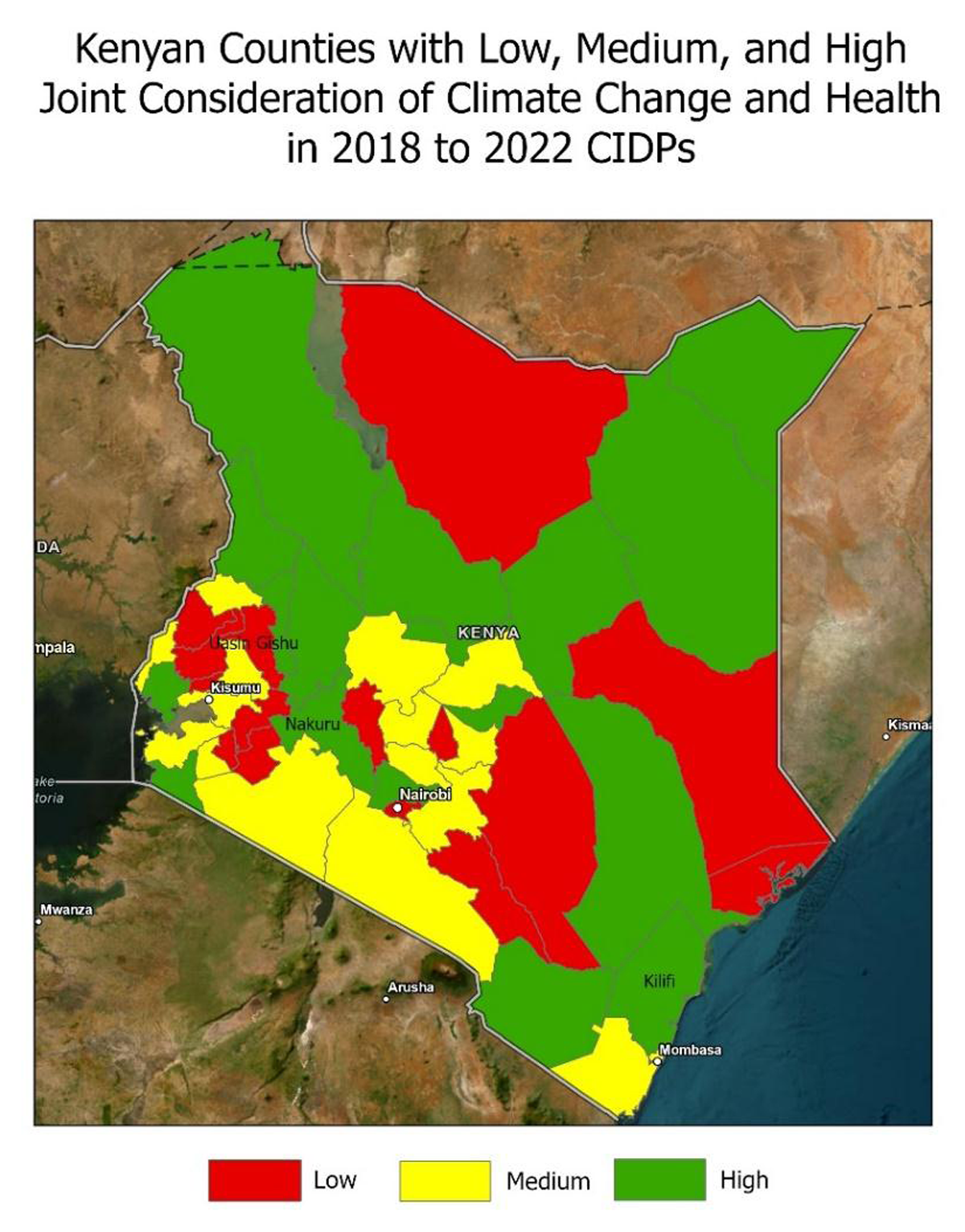
Figure 1
Map of Kenyan counties by degree of connection between climate change and health in 2018–2022 CIDP.