
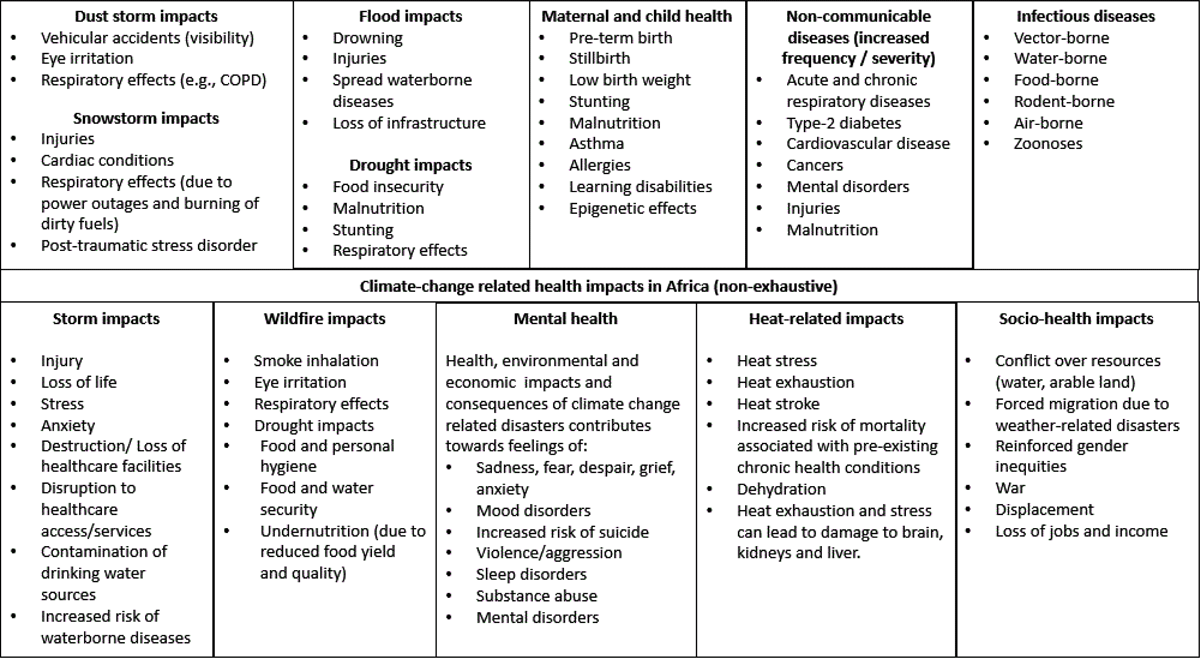
Figure 1
Conceptual framework applied in searching for and describing the impacts of climate change on health in Africa.
Table 1
General climate change risks and impacts by region in Africa. Evidence drawn from State of Climate Report (2021), State of Climate Report (2022), IPCC Africa Chapter (2021), AFDB report (2019), AFDB report (2022), and Godfrey and Tunhuma (2020).
| TEMPERATURE-RELATED IMPACTS | RAINFALL-RELATED IMPACTS | OTHER IMPACTS | |
|---|---|---|---|
| Northern Africa | Warming the fastest, at ±0.4 °C every decade between 1991 and 2022, compared to +0.2 °C per decade between 1961 and 1990. Increases up to ±8°C in the Sahel region. | Precipitation could decline by 40–60% during summer months with risk of drought and water shortages. Shorter growing season for crops. Areas south of 25°S are projected to experience increases in precipitation. | Salinization of groundwater due to water extraction and sea-level rise, especially in deltaic areas. |
| Eastern Africa | In equatorial and tropical latitudes, mean temperatures have increased by 1–3°C over the past 50 years leading to malaria-carrying mosquitoes that survive at higher altitudes. | Increasing frequency of drought events that undermine health and livelihoods of farmers, agro-pastoralists in the region. | Environmental degradation via deforestation, intensified agriculture in arid and semi-arid lands, rapid urbanization and industrialization compound climate change impacts in the region, e.g., pest infestations due to heat affecting crops and livelihoods. |
| Central Africa | Warming has been experienced, including an increase in warm extremes and a decrease in the occurrence of cold spells. Second highest temperature rise per decade at ±0.22°C per decade compared to the pre-1960’s average. | Unlikely that rainfall will change drastically in the region, however, there is some risk of flooding for low-lying and coastal areas. | Projected median increase of 2.5 heatwave events per warm season. Larger data gaps than the rest of the continent noted in all reports. |
| Western Africa | The proportion of extremely hot days (annual maximum 35°C) and tropical nights increased by 1–9 days and 4–13 nights every decade, respectively whereas cold nights decreased. | Drought is expected to increase, and agricultural yield is projected to decline by more than 15% by 2100. Decline in rain-fed agriculture could be as high as 50%. Water stress and water scarcity are concerns. | With 15 000 km of coastline, the region is at risk of sea-level rise and coastal degradation of fisheries and tourism ventures. Malaria transmission may become unsuitable in the region due to changes in vector habitats’ conditions. |
| Southern Africa | Temperatures are projected to increase by 4–6°C by 2100. Minimum and maximum temperatures and the number of heatwaves will increase. | At 2°C warming, the region is likely to see a 20% reduction in precipitation, with more consecutive dry days and a 5–10% reduction in the volume of the Zambesi River basin. | Changing patterns in the distribution of malaria, moving from the east to the central parts of the region. Mozambique is susceptible to tropical cyclones and the north-eastern parts of South Africa to flooding associated with these cyclones. |
| Small Island States | Most African island states are experiencing rising heat and lower rainfall leading to a higher risk of drought. | Sea-level rise threatens these states together with tropical cyclones and heavy rainfall. | Loss of land to the sea means reduction in resources and space for income-generating activities. |
Table 2
Strategies for addressing climate change and health challenges in Africa.
| STRATEGY | TIMING | DESCRIPTION | SUGGESTED ACTIONS |
|---|---|---|---|
| Integrated approaches to health in Africa should be pursued to deliver multiple health benefits for humans and ecosystems | Medium- to long-term | The intersections between climate change, air pollution and human health involve interactions of numerous systems and sectors. Such complexities require holistic and cross-sectoral approaches like One Health and Planetary Health to ensure long-term effectiveness of responses to health risks. |
|
| Africa should build substantially upon progress made in recent decades towards the Sustainable Development Goals by investing in solutions that collectively reduce the impacts of climate change and air pollution on health | Short- to medium-term | Critical areas for attention include poverty, inequality, restoration and protection of ecosystems and forests, increasing food security and agricultural productivity, adopting clean energy, and improving waste management. |
|
| Special attention is needed to address water stress and the impacts of extreme weather and climatic events in Africa | Short- to medium-term | Water stress, droughts and floods undermine water security and aggravate conflict and displacement, and the consecutive disasters affect the mental health of an ever-increasing segment of the population. Not only does this threaten lives and livelihoods but such impacts affect stresses negatively impact economies and ecosystems. Preparedness and enhancing adaptive capacity are needed to bolster Africa’s efforts to prevent adverse human health and well-being impacts. |
|
| Research, surveillance and upgraded data capture and processing is critical to provide the evidence required to inform data-driven decision-making and policy development | Short- and medium-term | Drivers of climate change and its health impacts are complex, multi-sectoral and prohibitively expensive as they operate under both short and long time periods. Given the need for context specific primary evidence and the complex multi-dimensionality of data needed to fully examine the related issues, significant investments are critically essential to build human capacity, enhance physical infrastructure (to collect, analyze, and interpret data) in order to conduct strategically designed studies, put together effective policies to protect human health, and enforce policy mandated actions in ways that are optimized for economic resiliency. |
|