
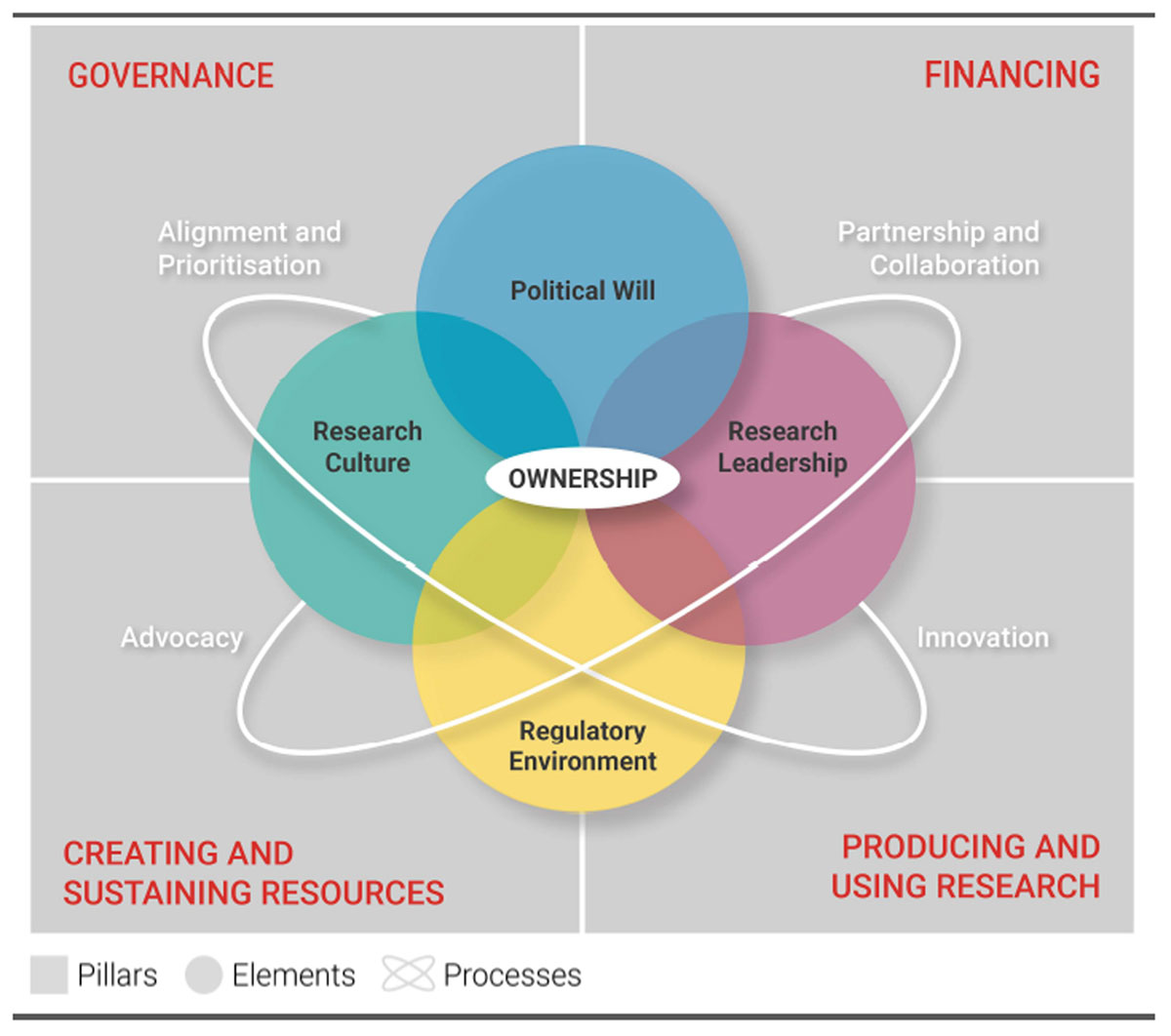
Figure 1
Empirically informed conceptual framework of national health research systems from a systems perspective. From: Jones CM, Ankotche A, Canner E, et al. Strengthening National Health Research Systems in Africa: Lessons and Insights from across the Continent. LSE Health; 2021. p. 22. Available at: https://doi.org/10.6084/m9.figshare.14039807.
Table 1
Critical elements of sustainable health research capacity strengthening in low- and middle-income countries (LMICs).
| 1 | Training diverse cadres in research methodology and writing scientific manuscript and grant proposals |
| 2 | Establishing and maintaining infrastructure and core capacities with research clinics, laboratory testing, biorepositories, data management, biostatistics, research ethics review, and research regulatory capacity |
| 3 | Research support centers, including grant and financial management |
| 4 | Equitable North–South and South–South partnerships, collaborations, and networking |
| 5 | Mentorship networks with local, regional, and international advisers for continuous development opportunities and support |
| 6 | Regular scientific meetings for scientists at all career stages to present research and network |
| 7 | Diversification of sources of research funding and increasing LMIC government and private sector funding |
| 8 | Country-led research agendas and demand for research to inform evidence-based policies |
| 9 | Community engagement with members of research populations, policy makers, and other stakeholders |
| 10 | Data- and milestone-driven monitoring and evaluation frameworks for research capacity |