
Table 1
Curriculum of the training for the doctors.
| Category | Items | Contents |
|---|---|---|
| Lectures | Course introduction | Course overview |
| Introduction to laparoscopy | History, indications and contraindications, advantages and limitations, future perspective | |
| Instruments | The tower, accessories, hand instruments, energy devices | |
| Port issues | Abdominal access techniques, precautions, review of the guidelines | |
| Complications | Complications specific to laparoscopic surgery | |
| Step-by-step operative procedure | Laparoscopic cholecystectomy | |
| Laparoscopic appendectomy | ||
| Laparoscopic salpingectomy | ||
| Others (according to the specialties of the trainees) | ||
| Simulation | Peg transfer | Transferring pegs into different posts |
| Cutting | Cutting the patterns printed on paper | |
| Peeling the candies | Peeling off the wrap of the candies | |
| Intracorporeal suture | Intracorporeal suture on the skin pad | |
| Knot tying | Intracorporeal knot tying | |
| Animal lab | Lecture | Review of the principles |
| Pig lab | Laparoscopic cholecystectomy | |
| Laparoscopic splenectomy | ||
| Laparoscopic oophorectomy | ||
| Laparoscopic uterine horn resection |
Table 2
Characteristics of the doctors who participated in the training programs.
| Simulation (N = 97) | Animal lab (N = 32) | |
|---|---|---|
| Age (years, median, IQR) | 33 (29~38) | 35 (32~41) |
| Sex (M:F) | 66:31 | 25:7 |
| Rank | ||
| Specialist | 20 (20.6%) | 12 (37.5%) |
| Resident | 25 (25.8%) | 16 (50.0%) |
| Medical officer | 28 (28.9%) | 4 (12.5%) |
| House officer | 24 (24.7%) | 0 |
| Specialties | ||
| General surgery | 23 (23.7%) | 18 (56.3%) |
| Gynaecology | 17 (17.5%) | 12 (37.5%) |
| Urology | 3 (3.1%) | 2 (6.2%) |
| Orthopedic surgery | 2 (2.1%) | 0 |
| Pre-specialization | 52 (53.6%) | 0 |
| Institution | 6 hospitals | 6 hospitals |
| Prior experience with minimally invasive surgery | ||
| None | 22 (22.7%) | Those who completed the simulation course |
| Literature | 10 (10.3%) | |
| Basic training including simulation | 6 (6.2%) | |
| Observation of the procedure | 23 (23.7%) | |
| Assisting the procedure | 22 (22.7%) | |
| Primary operator | 5 (5.2%) | |
| Not declared | 9 (9.3%) | |
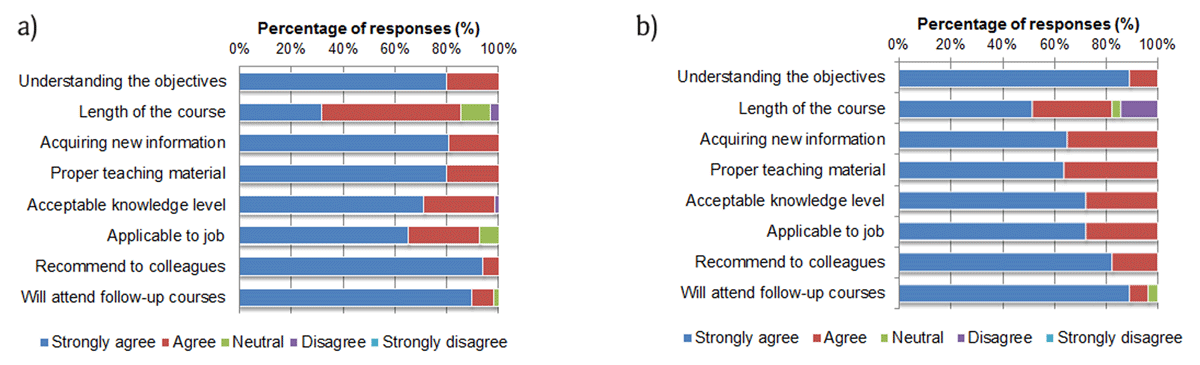
Figure 1
a) Overall level of satisfaction in simulation training. b) Overall level of satisfaction in animal lab.
Table 3
Characteristics of the procedures according to time period.
| Period 1 (Feb~Dec 2017) | Period 2 (Jan~Oct 2018) | Period 3 (Nov 2018~Sep 2019) | |
|---|---|---|---|
| Number of operations | 17 | 31 | 34 |
| Age (years, median, IQR) | 40 (31~48) | 36 (28~53) | 30.5 (27~41) |
| Sex (M:F) | 2:17 | 3:28 | 4:30 |
| Specialties | |||
| General surgery | 17 (100%) | 18 (58.1%) | 11 (32.4%) |
| Obstetrics & gynecology | 0 | 11 (35.5%) | 22 (64.7%) |
| Pediatric surgery | 0 | 1 (3.2%) | 1 (2.9%) |
| Urology | 0 | 1 (3.2%) | 0 |
| Primary operator | |||
| Local | 0 | 13 (41.9%) | 27 (79.4%) |
| Expatriate | 17 (100%) | 18 (58.1%) | 7 (20.6%) |
| Operation time (minutes, median, IQR) | 45 (30~60) | 60 (45~120) | 60 (40~150) |
| Open conversion | 0 | 0 | 0 |
| Complications | 1 (5.9%)a | 0 | 1 (2.9%)b |
| Postoperative hospital stay (days, median, IQR) | 1 (1~3) | 1 (1~2) | 1 (1~2) |
| >5 days | 2 (11.8%) | 0 | 2 (5.9%) |
[i] a Paralytic ileus; b Sickle cell crisis.
Table 4
Indications and laparoscopic procedures according to time period.
| Total (n = 82) | Period 1 (Feb~Dec 2017) | Period 2 (Jan~Oct 2018) | Period 3 (Nov 2018~Sep 2019) | ||
|---|---|---|---|---|---|
| Indications | |||||
| General surgery | Gallbladder stone related disease | 37 | 15 (88.2%) | 12 (66.7%) | 10 (90.9%) |
| Appendicitis | 6 | 2 (11.8%) | 3 (16.7%) | 1 (9.1%) | |
| Appendicitis with gallbladder stone | 3 | 0 | 3 (16.7%) | 0 | |
| Subtotal | 46 | 17 | 18 | 11 | |
| Obstetrics & gynecology | Infertility | 10 | 0 | 3 (27.3%) | 7 (31.8%) |
| Ovarian cyst | 9 | 0 | 4 (36.4%) | 5 (22.7%) | |
| Ectopic pregnancy | 5 | 0 | 2 (18.2%) | 3 (13.6%) | |
| Uterine myoma | 4 | 0 | 0 | 4 (18.2%) | |
| Chronic pelvic pain | 2 | 0 | 0 | 2 (9.1%) | |
| Endometriosis | 2 | 0 | 2 (18.2%) | 0 | |
| Tubo-ovarian abscess | 1 | 0 | 0 | 1 (4.5%) | |
| Subtotal | 33 | 0 | 11 | 22 | |
| Pediatric surgery | Undescended testis | 2 | 0 | 1 (100%) | 1 (100%) |
| Urology | Renal cyst | 1 | 0 | 1 (100%) | 0 |
| Procedures | |||||
| General surgery | Laparoscopic cholecystectomy | 37 | 15 (88.2%) | 12 (66.7%) | 10 (90.9%) |
| Laparoscopic appendectomy | 6 | 2 (11.8%) | 3 (16.7%) | 1 (9.1%) | |
| Laparoscopic appendectomy with cholecystectomy | 3 | 0 | 3 (16.7%) | 0 | |
| Subtotal | 46 | 17 | 18 | 11 | |
| Obstetrics & gynecology | Diagnostic laparoscopy | 12 | 0 | 5 (45.5%) | 7 (31.8%) |
| Laparoscopic salpingectomy/salpingo-oophorectomy/oophorectomy | 7 | 0 | 2 (18.2%) | 5 (22.7%) | |
| Laparoscopic cornual wedge resection | 1 | 0 | 1 (9.1%) | 0 | |
| Laparoscopic ovarian cystectomy | 7 | 0 | 3 (27.3%) | 4 (18.2%) | |
| Laparoscopic myomectomy | 3 | 0 | 0 | 3 (13.6%) | |
| Laparoscopy-assisted vaginal hysterectomy | 2 | 0 | 0 | 2 (9.1%) | |
| Total laparoscopic hysterectomy with bilateral salpingo-oophorectomy | 1 | 0 | 0 | 1 (4.5%) | |
| Subtotal | 33 | 0 | 11 | 22 | |
| Pediatric surgery | Laparoscopic exploration of undescended testis | 2 | 0 | 1 (100%) | 1 (100%) |
| Urology | Laparoscopic kidney cyst marsupialization | 1 | 0 | 1 (100%) | 0 |