
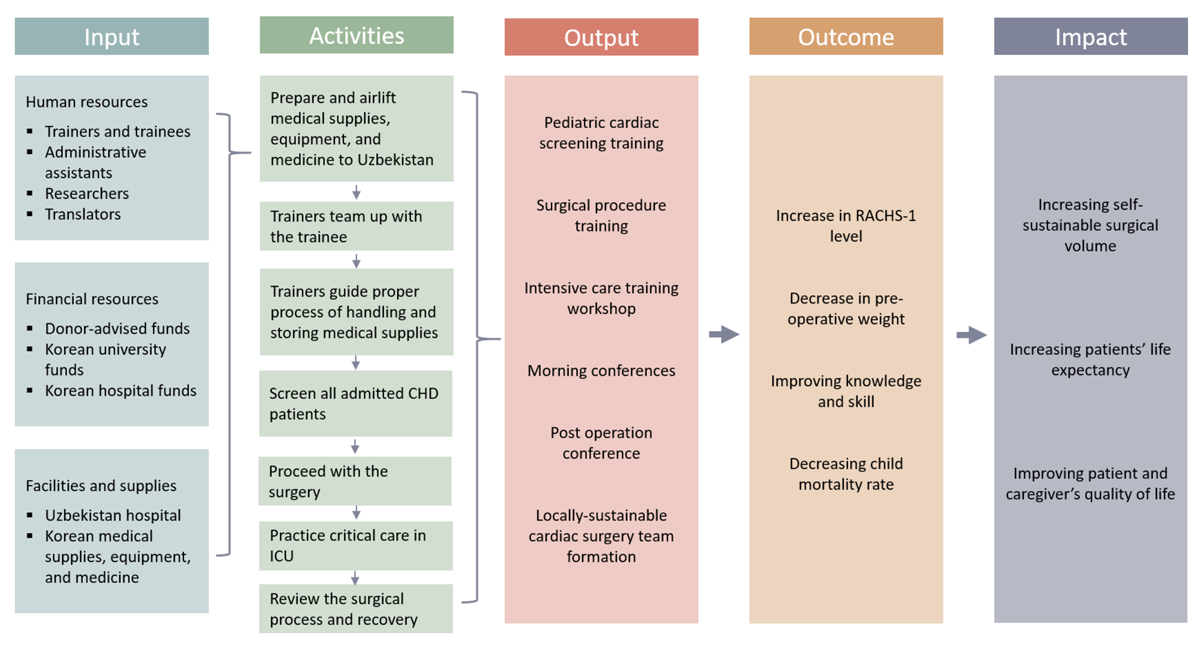
Figure 1
A project design matrix for the on-site cardiac surgical capacity-building program in Uzbekistan.
Table 1
Characteristics of interview participants (N = 31).
| Interview groups | Year of interview | Interview Participants | ||||||
|---|---|---|---|---|---|---|---|---|
| Cardiac Surgeon | Perfusionist | Pediatric Cardiologist | Anesthesiologist | ICU Nurse | Ward Nurse | Scrub Nurse | ||
| Uzbekistan medical staff (N = 10) | 2016 | 2 | 1 | – | – | – | 2 | – |
| 2017 | 2 | – | – | 1 | 1 | – | 1 | |
| 2020 | – | – | – | – | – | – | – | |
| Korean medical staff (N = 4) | 2016 | – | – | – | – | – | – | – |
| 2017 | 1 | – | 1 | – | 1 | – | – | |
| 2020 | – | – | – | – | 1 | – | – | |
| Caregivers (N = 17) | 2016 | 14 | ||||||
| 2017 | 3 | |||||||
| 2020 | – | |||||||
[i] Unit: Number of people; ICU: intensive care unit.
Table 2
Annual patient operation records during the training, 2010–2019.
| 2010 | 2011 | 2012 | 2013 | 2014 | 2015 | 2016 | 2017 | 2018 | 2019 | Total | |
|---|---|---|---|---|---|---|---|---|---|---|---|
| N | 10 | 11 | 11 | 13 | 12 | 11 | 10 | 10 | 10 | 9 | 107 |
| Gender, N | |||||||||||
| Female | 6 | 8 | 4 | 6 | 2 | 7 | 6 | 2 | 5 | 4 | 50 |
| Male | 4 | 3 | 7 | 7 | 10 | 4 | 4 | 8 | 5 | 5 | 57 |
| Age, months | |||||||||||
| Mean | 35.9 | 46.1 | 35.8 | 30.2 | 31.1 | 16.3 | 26.3 | 12.3 | 42.2 | 22.3 | 30.0 |
| (SD) | (30.2) | (38.3) | (40.5) | (22.0) | (37.1) | (31.7) | (27.4) | (11.1) | (41.0) | (25.3) | (32.1) |
| Weight, kg | |||||||||||
| Mean | 13.0 | 13.9 | 11.8 | 10.3 | 11.2 | 6.7 | 9.1 | 6.2 | 12.1 | 10.2 | 10.5 |
| (SD) | (8.5) | (5.1) | (7.4) | (4.3) | (5.7) | (5.6) | (4.8) | (3.2) | (8.2) | (6.3) | (6.3) |
| Risk Category, RACHS-1 | |||||||||||
| Mean | 1.9 | 2 | 2.4 | 2.2 | 2.4 | 2.7 | 2.5 | 2.6 | 3 | 2.8 | 2.4 |
| (SD) | (0.3) | (0.5) | (0.8) | (0.6) | (0.8) | (1.0) | (0.9) | (0.8) | (1.1) | (0.8) | (0.8) |
Table 3
Diagnosis Classification, 2010–2019.
| Diagnosis Classification | N (%) Total = 107 |
|---|---|
| Ventricular septal defect (VSD) | 20 (18.7) |
| Tetralogy of Fallot (TOF) | 17 (15.9) |
| Single Ventricle | 16 (15.0) |
| Total anomalous pulmonary venous return (TAPVR) | 14 (13.1) |
| Coarctation of the aorta (CoA) | 5 (4.7) |
| Transposition of the great arteries (TGA), VSD | 5 (4.7) |
| CoA-VSD | 3 (2.8) |
| Ebstein’s anomaly | 3 (2.8) |
| Atrial septal defect (ASD) | 2 (1.9) |
| Complete atrioventricular septal defect (AVSD) | 2 (1.9) |
| Interrupted aortic arch (IAA) | 2 (1.9) |
| Pulmonary atresia with an intact ventricular septum (PA-IVS) | 2 (1.9) |
| Pulmonary atresia with ventricular septal defect (PA-VSD) | 2 (1.9) |
| Complete AVSD with TOF | 1 (0.9) |
| Complete TGA with IVS | 1 (0.9) |
| Complete TGA with VSD | 1 (0.9) |
| Double outlet right ventricle (DORV) with PS (Fallot type) | 1 (0.9) |
| Intracardiac mass | 1 (0.9) |
| Partial anomalous pulmonary venous return (PAPVR) | 1 (0.9) |
| Posterior interventricular artery (PDA) | 1 (0.9) |
| Partial AVSD | 1 (0.9) |
| Pulmonary atresia with VSD | 1 (0.9) |
| Tricuspid Atresia (TA) | 1 (0.9) |
| TAPVR-ASD | 1 (0.9) |
| TOF-PA | 1 (0.9) |
| VSD-ASD | 1 (0.9) |
| VSD-PS | 1 (0.9) |
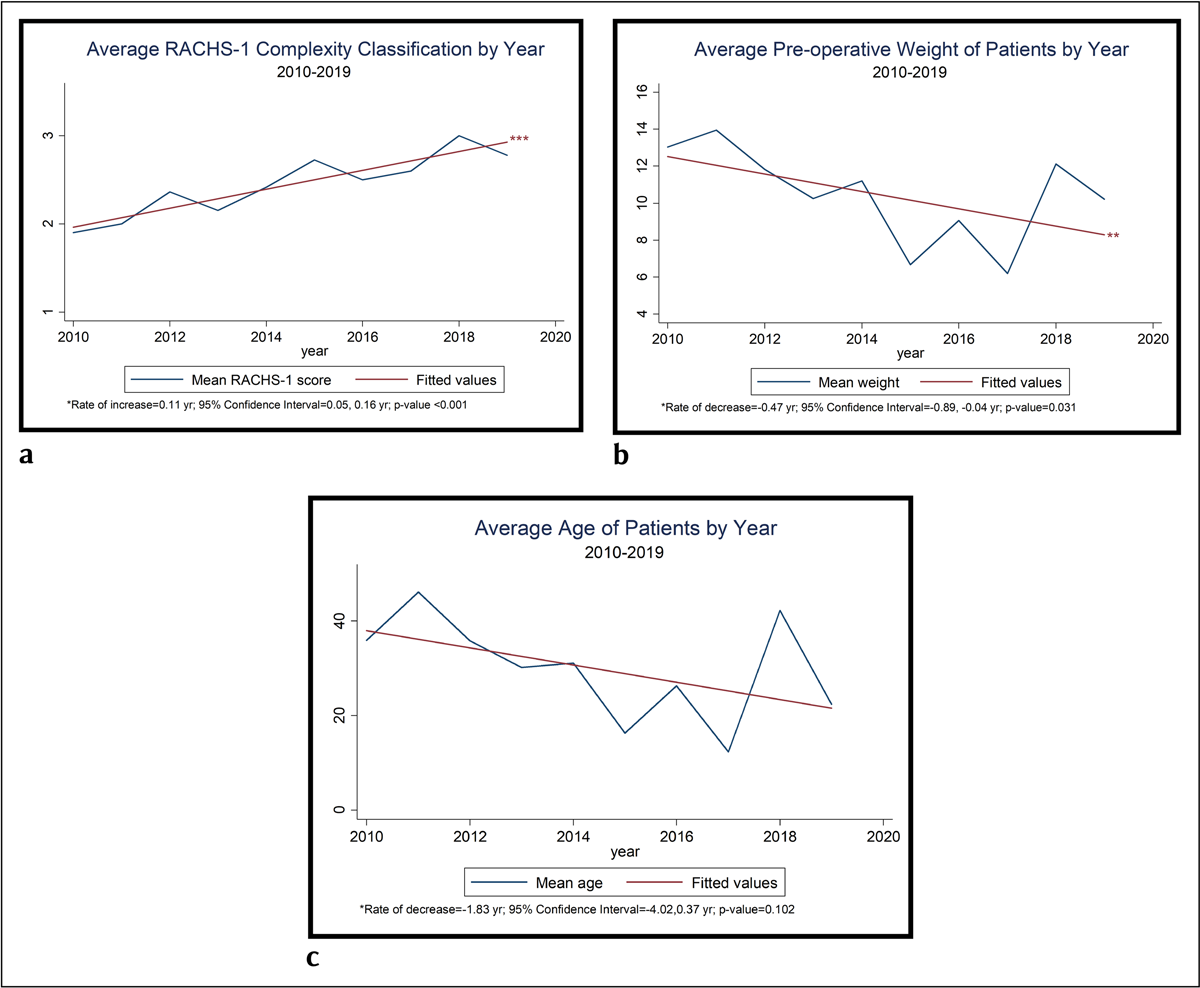
Figure 2
Surgery data and patient characteristics.