
Table 1
Classifications for major and minor programs in public health, global health, and related fields.
| Public Health |
|
|
| Global Health |
|
|
| Public Health Related | To be considered “public health related,” a major or minor had to be in a traditional discipline within public health (such as environmental health or epidemiology), focus on health and society or related areas (such as medical sociology or medical humanities), or otherwise include required courses on community or public health. Programs in areas such as behavioral health, health education, health promotion, health sciences, and health studies were excluded if they required only premedical science courses, were teacher credentialing programs, or were in other excluded program categories. | |
| Global Health Related | Majors and minors in subareas within global health were considered to be “global health related.” This included programs in biology of global health, global disease biology, global health affairs, global health and humanitarian assistance, global health technologies, international health and development, language and international health, medical anthropology, and medical geography in global health. | |
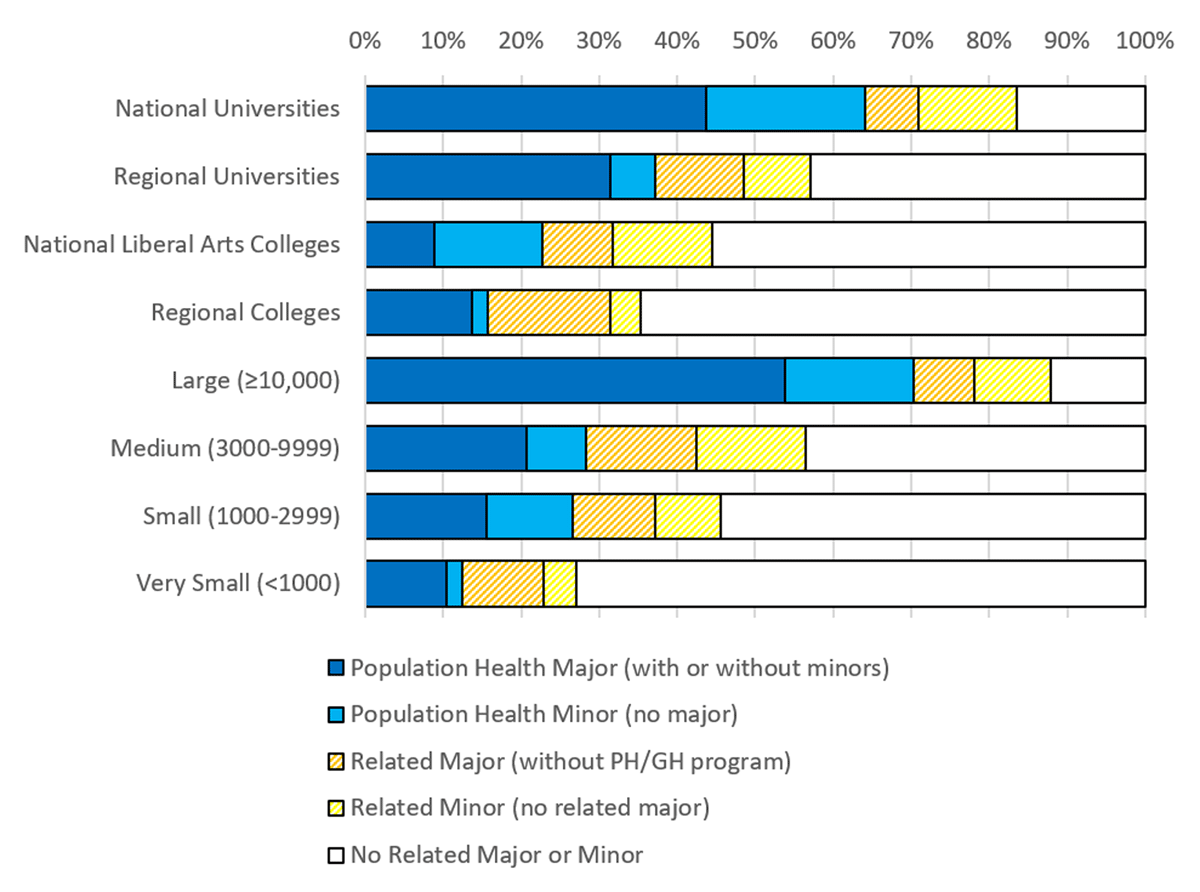
Figure 1
Distribution of schools offering majors and minors in public health and/or global health (blue) and in related fields (yellow), by institutional type and enrollment during the 2019–20 academic year.
Table 2A
Number of institutions in the United States that are among the “top 100” national universities, regional universities, liberal arts colleges, or regional colleges evaluated by US News and World Report during the 2019–20 academic year and offer majors and minors in public health, global health, and related fields.
| National Universities | Regional Universities | National Liberal Arts Colleges | Regional Colleges | Total | ||||||
|---|---|---|---|---|---|---|---|---|---|---|
| # | % | # | % | # | % | # | % | # | ||
| Total in USNWR rakings | 399 | – | 605 | – | 223 | – | 373 | – | 1600 | |
| Number in “top 100,” including ties | 103 | – | 105 | – | 101 | – | 102 | – | 411 | |
| Public Health (PH) | Major | 39 | 38 | 32 | 30 | 7 | 7 | 14 | 14 | 92 |
| Minor | 28 | 27 | 21 | 20 | 13 | 13 | 12 | 12 | 74 | |
| Major and/or Minor | 46 | 45 | 38 | 36 | 15 | 15 | 15 | 15 | 114 | |
| Global Health (GH) | Major | 10 | 10 | 1 | 1 | 2 | 2 | 0 | 0 | 13 |
| Minor | 30 | 29 | 2 | 2 | 8 | 8 | 0 | 0 | 40 | |
| Major and/or Minor | 33 | 32 | 3 | 3 | 8 | 8 | 0 | 0 | 44 | |
| Population Health (PH and/or GH) | Major | 45 | 44 | 33 | 31 | 9 | 9 | 14 | 14 | 101 |
| Minor | 50 | 49 | 22 | 21 | 21 | 21 | 12 | 12 | 105 | |
| Major and/or Minor | 66 | 64 | 39 | 37 | 23 | 23 | 16 | 16 | 144 | |
| Population Health and/or related field | Major | 62 | 60 | 46 | 44 | 20 | 20 | 32 | 31 | 160 |
| Minor | 72 | 70 | 46 | 44 | 39 | 39 | 26 | 25 | 183 | |
| Major and/or Minor | 86 | 83 | 60 | 57 | 45 | 45 | 36 | 35 | 227 | |
Table 2B
Institutional characteristics of colleges and universities offering majors and minors in public health and/or global health in the United States during the 2019–20 academic year. Rows within each category are ordered based on the percentage shown in the final column.
| Total | Major | Minor | Major and/or Minor | |||||
|---|---|---|---|---|---|---|---|---|
| # | # | % | # | % | # | % | ||
| Total | 411 | 101 | 25 | 105 | 26 | 144 | 35 | |
| Size classification by full-time equivalent enrollment (2018) | Large (≥10,000) | 91 | 49 | 54 | 46 | 51 | 64 | 70 |
| Medium (3000–9999) | 92 | 19 | 21 | 16 | 17 | 26 | 28 | |
| Small (1000–2999) | 180 | 28 | 16 | 39 | 22 | 48 | 27 | |
| Very small (<1000) | 48 | 5 | 10 | 4 | 8 | 6 | 13 | |
| Undergraduate students as a percentage of total enrollment (2018) | Majority graduate (<50%) | 17 | 5 | 29 | 8 | 47 | 10 | 59 |
| Majority undergraduate (50% to 74%) | 63 | 26 | 41 | 27 | 43 | 35 | 56 | |
| High undergraduate (75% to 89%) | 98 | 32 | 33 | 32 | 33 | 43 | 44 | |
| Very high undergraduate (≥90%) | 137 | 28 | 20 | 21 | 15 | 37 | 27 | |
| Exclusively undergraduate (100%) | 96 | 10 | 10 | 17 | 18 | 19 | 20 | |
| Undergraduate selectivity (2018) | More selective (80th to 100th percentile) | 246 | 66 | 27 | 74 | 30 | 100 | 41 |
| Selective (40th to 80th percentile) | 118 | 24 | 20 | 22 | 19 | 32 | 27 | |
| Inclusive | 43 | 10 | 23 | 8 | 19 | 11 | 26 | |
| Ownership | Public | 96 | 39 | 41 | 34 | 35 | 49 | 51 |
| Private | 315 | 62 | 20 | 71 | 23 | 95 | 30 | |
| Location | City: midsize | 49 | 21 | 43 | 19 | 39 | 27 | 55 |
| City: large | 87 | 24 | 28 | 30 | 34 | 37 | 43 | |
| City: small | 52 | 16 | 31 | 14 | 27 | 21 | 40 | |
| Town | 96 | 20 | 21 | 25 | 26 | 30 | 31 | |
| Suburb | 106 | 19 | 18 | 16 | 15 | 27 | 25 | |
| Rural | 21 | 1 | 5 | 1 | 5 | 2 | 10 | |
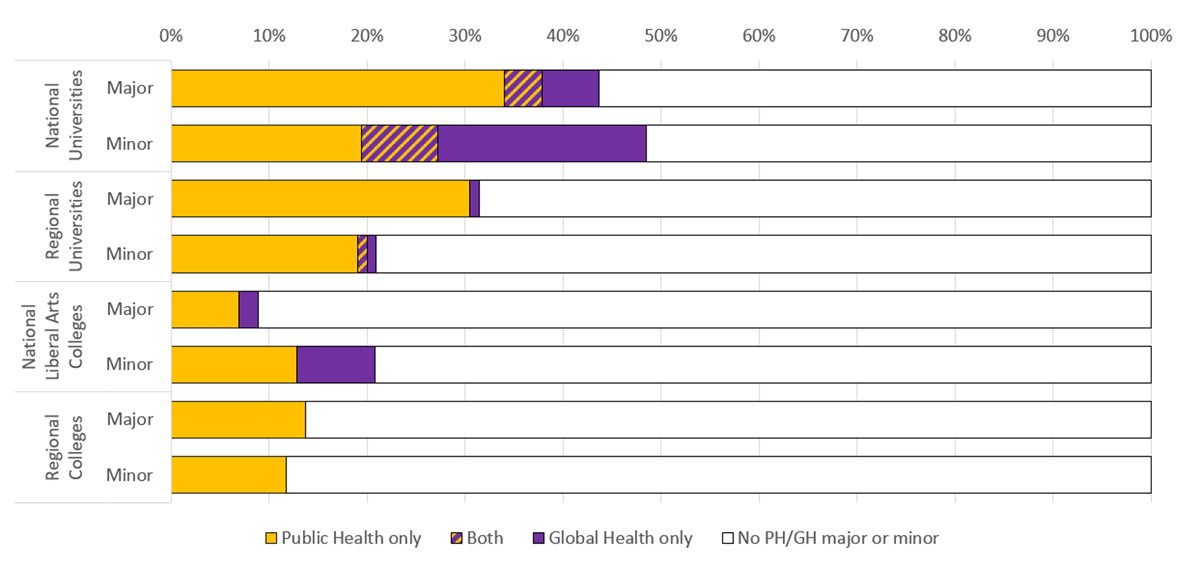
Figure 2
Distribution of schools offering majors and minors in public health (PH) (orange) and global heath (GH) (purple) offerings, by institutional type during the 2019–20 academic year.