
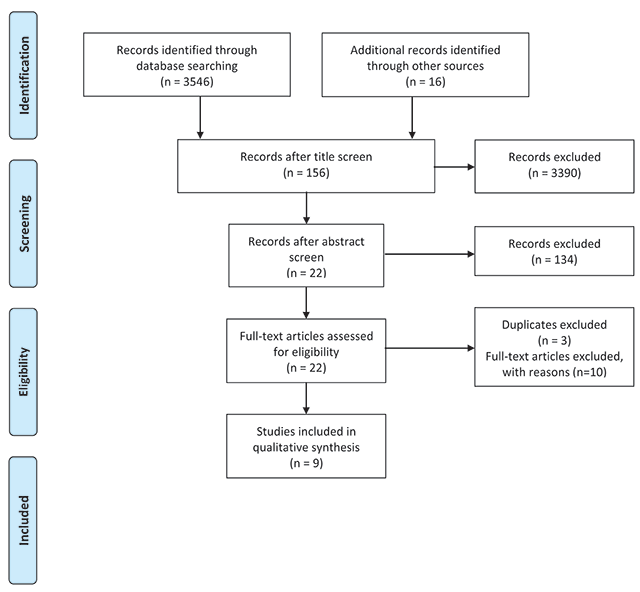
Figure 1
PRISMA Flow Diagram.
Table 1
Inclusion criteria.
|
Table 2
Exclusion criteria.
|
Table 3
Screening procedure.
| Search Engine | Search Results | After Title Screen | After Abstract Screen | After Full-text Screen |
|---|---|---|---|---|
| PubMed | 467 | 69 | 6 | 2 |
| Engineering Village | 962 | 35 | 4 | 2 |
| OVID Medline | 234 | 1 | 0 | 0 |
| Web of Science | 1883 | 51 | 12 | 5 |
Table 4
Results of analysis.
| Study | Country | Purpose | Methods | Population | Intervention | Outcome | Limitations |
|---|---|---|---|---|---|---|---|
| Oliveira et al., 2004 | Brazil | 1) Evaluate methods to reduce mercury pollution and assess environmental impacts and miners’ exposures due to improved amalgamation centres 2) Assess current levels of mercury and metals in Bento Gomes river basin | Follow-up evaluation of 11 improved amalgamation centres by sampling mercury levels in air, water circuits, and precipitated solid residues after amalgamation | No direct participants | Technology: Eleven improved amalgamation centres using closed vessel systems and depositing residues from amalgamation into concrete tanks or pits sealed with plastic sheets | Emissions to local waterways reduced but inadequate reduction of mercury emissions to air Use of retorts cannot reduce mercury emissions to an acceptable level. | Initial reductions in mercury emissions can be attributed to supervision and enforcement by the FEMA as well as declining gold prices. |
| Drace et al., 2011 | Mozambique | Assess the practices used at the Clean Tech Mine to eliminate mercury in mining processes | Survey of four ASGM sites in Mozambique, personal interviews, and site assessments of gaseous and surface soil mercury was performed. | No direct participants | Technology: Centrifugation and magnetic isolation of gold | Soil and air samples from Clean Tech mine indicate much lower mercury levels that those found at traditional ASGM sites Innovative mining practices using magnets are an inexpensive and sustainable way to eliminate mercury amalgamation practices in ASGM. These practices have strategic advantage in light of the European trade ban on mercury and United States Mercury Export Ban Act. | Limited analysis because there are no direct comparisons with other ASGM sites that have completely eliminated the use of mercury |
| Spiegel et al., 2013 | Mozambique | 1) Understand the feasibility of developing homemade retorts with local materials 2) Assess effectiveness of homemade retorts 3) Document challenges and barriers | Conducting three workshops using train-the-trainer strategies were used to introduce locally-made retorts and teach techniques to reduce mercury emissions | (At least 24 organizers from the miners’ association representing 3,764 miners in the area) | Technology: Homemade retorts; Education: Train-the-trainer three-part workshops | Portable mercury monitor noted decrease in mercury production using homemade retorts but free mercury supplies from private gold buyers are barriers to widespread adoption Recommended that government intervene to regulate gold sales and distribution | No direct numerical measurements made pre- and post-intervention to quantify the impact of retorts Long-term follow-up on success of intervention needed |
| Sousa and Veiga, 2009 | Brazil | Capacity building and training of miners at ASGM sites focusing on the goals of: 1) Legalization of mining sites 2) Adoption of techniques to increase gold recovery 3) Protection of water and forest resources 4) Reduction of mercury use 5) Improvement in water quality, sanitation, and overall health | An initial training of trainers program found 13 people to spend 3–5 months with miners to advise them on changes in their mining operations. Balanced scorecard methodology was used to assess mining sites prior to training and evaluate success 120 days after | 4,200 people at 141 mining sites | Education: Advice provided by trainers on ways to improve mining operations according to the five goals and twenty performance indicators selected | Overall conformity to indicators increased from 22.2% to 40% Reduction of mercury emissions by 10% of total mercury released in the region | Government bureaucracy and lack of resources create difficulties for miners to attain licenses to legalize mining operations. Lack of funding and resources serve as barriers in the adoption of new technologies to improve gold recovery. |
| Saldarriaga-Isaza et al., 2014 | Colombia | Assess the feasibility and benefits of co-management and exclusion as forms of associative entrepreneurship to help mining communities invest in sustainable environmentally-friendly technologies | Multi-period two hour game hosted 1) in a classroom (n = 35) and 2) in the mines (n = 50) Participants put into small groups each with a different equipment promoted to their group Group member then decided whether they would adopt the new equipment A survey at the end of each session gathered information about personal perceptions to gold recovery process as well as assessments of risk, trust, empathy, and self-control | 85 miners | Education: Adopting different institutional arrangements on associative entrepreneurship | Barriers to adoption of alternative gold mining equipment other than mercury amalgamation due to lack of funds Co-management resulted in more equal contributions and more optimal decisions and fair contribution. The leader plays a significant role in persuading other group members to make decisions for public good. Exclusion did not trigger this kind of collective action and miners made contributions that did not allow a sustained acquisition of the technology. | Base findings where total contributions exceeded the provision point was fluctuating and inconsistent leading to difficulties making comprehensive conclusions |
| Veiga et al., 2015 | Ecuador | Reduce mercury use in ASGM practices and increase gold recovery | Miners brought to a processing plant in Portovelo Ecuador by car to demonstrate mercury-free processing techniques A classroom series was delivered by the project team - topics included explosives handling, underground ventilation, caling and falling rocks, and operational safety | 211 miners from Ecuador, Colombia, and Peru | Educational workshops on methods of gravity concentration, flotation, and cyanidation to reduce mercury use | Mercury use in regions reduced by 50% in 2013 compared to levels in 2010 Thirty-nine small plants installed in Antioquia following training that used some of the practices taught Mercury levels entering processing plants reduced by 43% and mercury losses reduced 63% from comparison levels in 2010 A new training centre for artisanal miners is being built supported by the Government of Ecuador in recognition of the importance of education and training | Poor access to the mines and illegal nature of mining activities made it difficult for the research team to access trainees. Implementation of cleaner technology requires a large sum of funds |
| Garcia et al., 2014 | Colombia | To reduce atmospheric mercury levels by focusing on improvements to the use of “entables”, retorts, and gold shops. | Use of a mercury balance to estimate mercury lost in 20 “entables” in Remedios and Segovia Absorption spectrometers were used to assess levels of atmospheric mercury. Mercury levels in urine were collected via absorption spectrometer, clinical assessments, and five neuropsychological exams conducted Introduction of new equipment and awareness campaign conducted | Health assessments performed on 50 males directly involved in mining from Segovia (mean age: 40.3) in 2010 and on 37 residents of Segovia not directly involved in mining activities in 2013 | Technology: Introduction of retorts and mercury condensers, Education: Lectures for miners and owners of “entables”, awareness campaigns for mining communities, Monitoring and assessment: Atmospheric mercury and health assessments conducted | Mercury levels reduced by 63% from comparison levels in 2010 Levels of mercury in urine reduced from over 100% > 100ug Hg/g to 43% < 5 ug Hg/g, 35% > 20 ug Hg/g and 16% > 50 ug Hg/g. 39 new mercury-free processing plants generated | Bureaucratic processes and lack of understanding about project objectives and methods from stakeholders. |
| Metcalf and Veiga, 2011 | Zimbabwe | To raise awareness about the detriments of mercury exposure using street theatre | Street theater using the Nakai drama performed by semi-professional travelling troupe and traditional dancers. Zimbabwe Panner’s Association hosted workshops demonstrating mercury vapour collecting retorts and gold recovery sluice carpets. | 9,000 people informed about dangers of mercury exposure through the drama and 700 miners trained on safer gold recovery processes | Education: Travelling theatre | Street theater can be an effective tool for raising awareness about the hazards of mercury exposure. | Police repression on the project and corruption by nation and local elites served as barriers to proper analysis of success Actors of Nakai also did not live in mining communities themselves which contributed to lower impact. Many miners also did not stay after the performance to take part in the training workshop |
| Shandro et al., 2008 | Mozambique | Evaluation of 9-day pilot training program in 2005 to raise awareness of impacts of mercury amalgamation and introduction to alternative practices | Visit conducted in 2007 to observe changes in ASGM practices | Not available | Technology: Centralized amalgamation centre, retorts, education, monitoring, and assessment | Use of centralized amalgamation center but improper use of retorts noted and discharge of contaminated sand Mining practices with cyanidation not yet introduced High prevalence of poverty-related diseases such as HIV and malaria noted in mining towns | Local authorities and mining associations not equipped with resources to work with researchers and miners Unsustainable due to lack of trust of trainers, lack of involvement of miners in decision-making and planning, and lack of strong awareness campaign in mining communities Short interventions neglect socioeconomic and cultural considerations |