
Introduction
Within the Carpathian Mountains, the Danube Gorge and the Mehedinți Mountains shelter numerous Habitat directive species and rare species (Halada et al., 2024). Generally, the Romanian Carpathians are a hot spot of endemic and relict plant species (e.g., Hurdu et al., 2012, 2016; Kliment et al., 2016; Breman et al., 2020), a fact also true for the fauna (e.g., Pop et al., 2010; Teodor et al., 2018; Novák et al., 2019; Dénes et al., 2025). Additionally, the Carpathians, particularly the Southern Carpathians, have been identified in recent years as a glacial refugium (e.g., Šrámková-Fuxová et al., 2017; Lachowska-Cierlik et al., 2020; Zając et al., 2020; Kirschner et al., 2023; Triest et al., 2024). One of the most interesting relict plant species in the Southern Carpathians is Daphne blagayana Freyer (Meusel, 1968). It is considered a relict of European laurel forests (Meusel, 1968, 1969), with a small distribution range, occurring almost exclusively in southeastern Europe (Brus, 2001). Besides a few records in the Romanian Carpathians, it is found in scattered locations across the Balkan Peninsula, reaching the eastern Alps in the west (Meusel, 1968), where it is present in northeastern Italy (Martini & Poldini, 1990). Daphne blagayana is distributed mainly in the Balkan Peninsula (Derganc, 1902), as it is considered a Balkan species (Hein & Lippert, 2001), or an Illyrian plant, which at its north-western distribution range limit descends at lower altitudes in mountains than further south, alongside other species considered glacial relicts (Derganc, 1908). In Slovenia and Croatia, this Illyrian plant is considered a tertiary relict that survived the ice age in a large part of Slovenia (Horvat, 1929). Other authors considered it an Illyrian Carpathian species (Badea & Cretzoiu, 1941). Although the earliest records of D. blagayana in Romania were attributed to another congener species, its presence has been certified since the late 1800s in some locations in the Southern Carpathians (see Derganc, 1904). In 1941, its presence was known in Romania in one location in the Apuseni Mountains, and a few more in the Southern Carpathians, to which was added a new record, situated close to a previous one, but only a few individuals were observed at the edge of a Fagus sylvatica L. - Abies alba Mill. forest (see Badea & Cretzoiu, 1941). Afterwards, no information appeared in the country, as the same distribution records were presented in subsequent reviews (e.g., Lupșa, 1975–1976). The situation is also generally consistent with the information available in electronic databases (Daphne blagayana Freyer in GBIF Secretariat, 2023). Three closely related haplotypes are present in Romania, more than in other parts of the species distribution range (Fišer Pečnikar et al., 2017). However, there is little data on the distribution of this species in Romania, and the data are old (e.g., Badea & Cretzoiu, 1941; Meusel, 1968; Lupșa, 1975–1976). Thus, information on the distribution of this relict is of great importance, as even in areas where it is widespread, it has a patchy distribution (Fišer Pečnikar et al., 2017). Even in Slovenia, where it was described and has been protected for more than 100 years, it remains poorly known, even with respect to its distribution (Omejc & Brus, 2005). Thus, we present a new distribution record of D. blagayana in the Romanian Carpathians in a region where its presence was not previously known (e.g., Meusel, 1968; Lupșa, 1975–1976; Daphne blagayana Freyer in GBIF Secretariat, 2023).
Material and methods
The study area is located in southwestern Romania, within the Danube Gorge, in the Iron Gates Natural Park (IGNP). It is a region with a rich biodiversity and biogeographic peculiarities (e.g., Pașcovschi, 1956; Covaciu-Marcov et al., 2009; Schneider-Binder, 2016; Petruș-Vancea et al., 2024; Teodor et al., 2025). The study region (the Almăj Mountains) is a low mountainous area (Mândruț, 2006) with a warmer climate than most of Romania (Stoenescu et al., 1966; Mândruț, 2006). The mountain’s maximum altitude is only 1224 m (Mândruț, 2006), reached at about 20 km north from the study site. The study was made in the Mraconia River basin, in eastern IGNP. Mraconia is a left side tributary of the Danube in the gorge, with a relatively large hydrographic basin (Tetelea, 2014). It has a narrow valley, with a sinuous course and steep slopes covered with beech and oak forests. Some tributaries in the upper region are narrow and shaded (Teodor et al., 2025).
The fieldwork was conducted in February, March, and November 2025. Thus, at the beginning of 2025, we have made more transects in the basin of the Mraconia Valley by walking along different forest roads and other paths in the region. Initially, the species was observed accidentally during a field investigation focused on other species groups (especially insects). Daphne blagayana was directly identified on the field, using the literature (e.g., Martini & Poldini, 1990; Brus, 2001; Ciocârlan, 2009), based on its clear features. We didn’t collect the plants for herbarium; we only photographed them and their habitats. Additionally, we collected some information on other plants in the area, including the neighboring forests, but because it was the beginning of spring, only a few plants were visible. A second location was observed in November 2025, again by chance, while making transects for other species groups.
Results
Daphne blagayana (Figure 1) was identified on the Teiului Valley (“linden valley”), a tributary of the Mraconia River, on a steep slope in the basin’s upper region (Figure 2). The Balkan Daphne was observed in two locations. At the first site, the species is present in two small, interconnected glades and in the neighboring forest, with the entire site situated at the upper part of a steep slope. In February-March 2025, we observed hundreds of flowering shoots, especially in sun-exposed areas. The species was well represented throughout the entire site, on a south / south-western-oriented slope, with a 30°–35° inclination. This site is dominated by Rubus plicatus Weihe & Nees, which exhibited only leafless branches because our study was conducted in early spring. In the glades, D. blagayana was well exposed to sunlight, similar to the neighboring, rare, young Quercus petraea (Matt.) Liebl. forest (Figure 3). This is likely a secondary forest, a natural recovery resulting from the exploitation of an old forest (occurring at least 35–40 years ago). Besides Quercus petraea, Quercus robur L., Corylus avellana L., and Fraxinus excelsior L. were present. Among herbaceous plants, Festuca sp. L., Genista sp. L., Carex sp. L., Potentilla sp. L., and numerous Erythronium dens-canis L. individuals were observed.
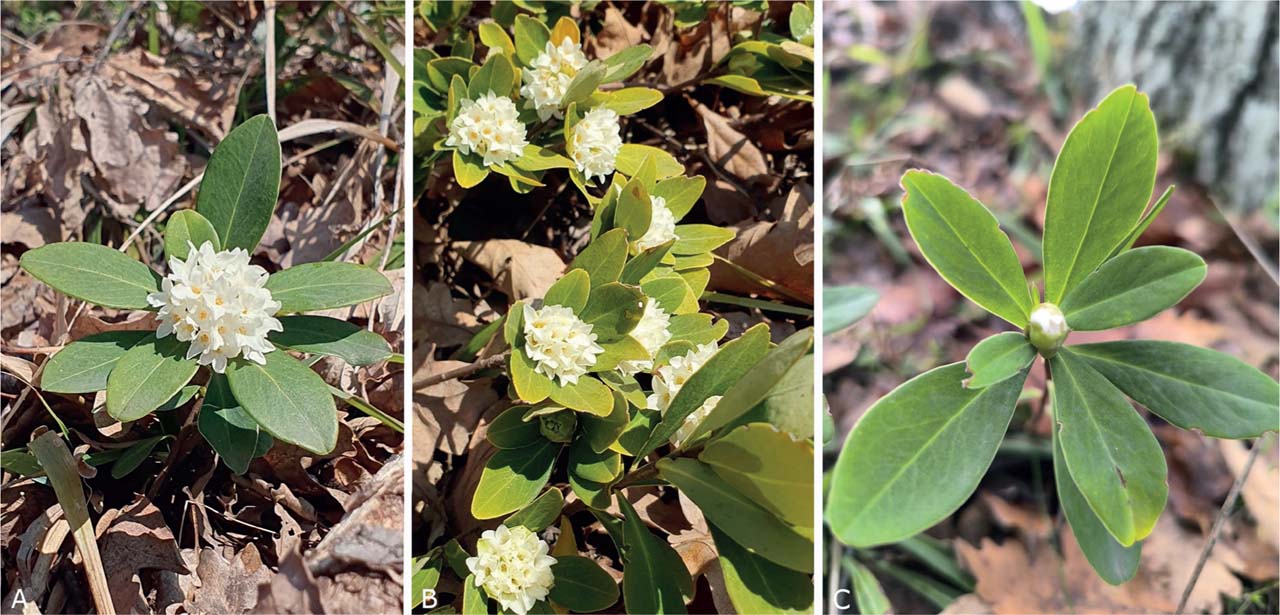
Figure 1:
Daphne blagayana in the Teiului Valley, Iron Gates Natural Park, Romania, in the spring (A and B) and autumn (C) of the year 2025.
Slika 1: Daphne blagayana v dolini Teiului, Narodni park Železna vrata, Romunija, spomladi (A in B) in jeseni (C) leta 2025.
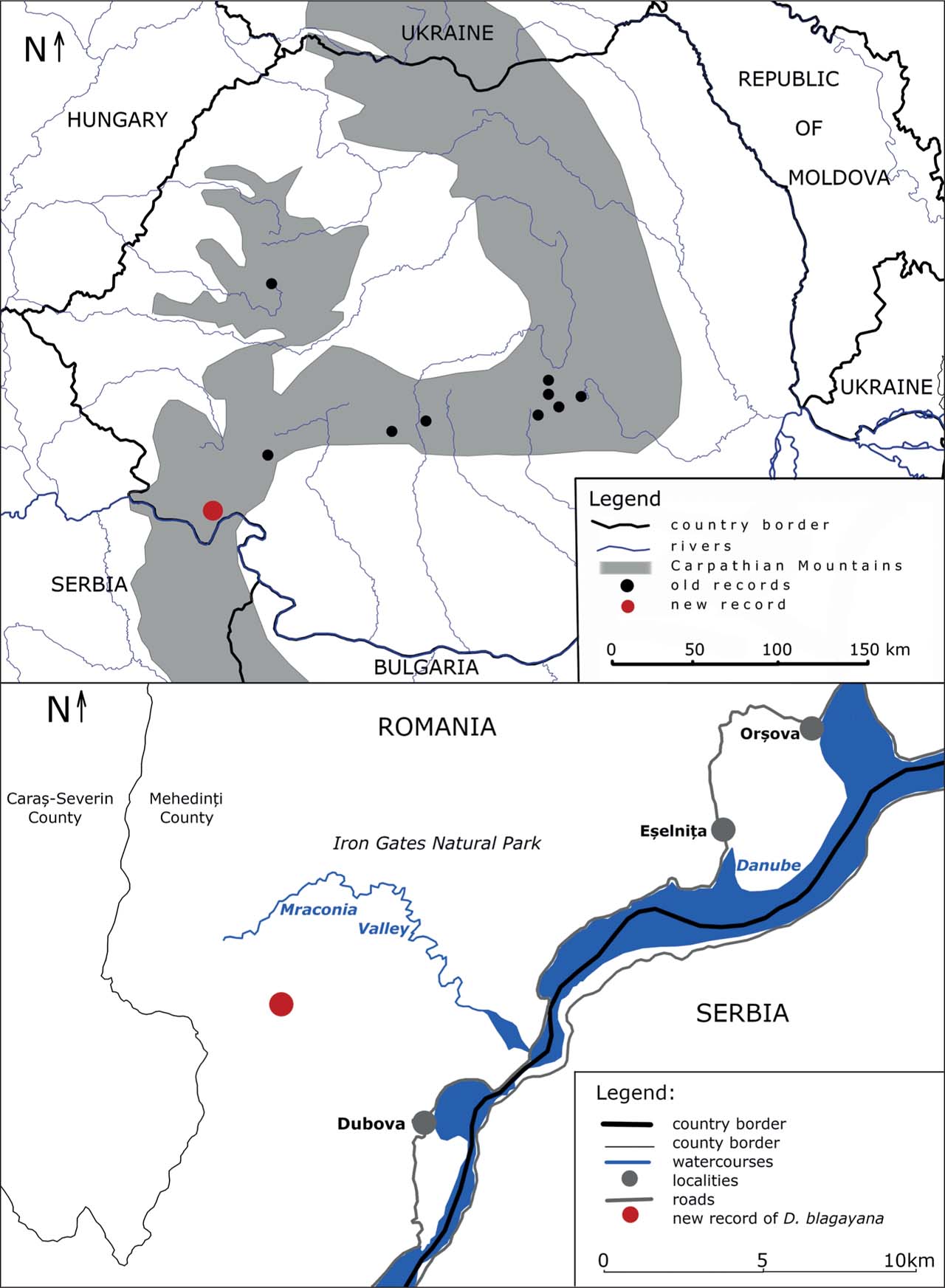
Figure 2:
Distribution of Daphne blagayana in Romania with old records (according to Lupșa 1975–1976) and the new records’ area (above). Details of the area where the Balkan Daphne was recorded in the Iron Gates Natural Park, Romania (below).
Slika 2: Razširjenost vrste Daphne blagayana v Romuniji s starimi (po Lupșa 1975–1976) in novimi podatki (zgoraj). Podrobnejši prikaz območja v Naravnem parku Železna vrata v Romuniji, kjer je bila najden Daphne blagayana (spodaj).
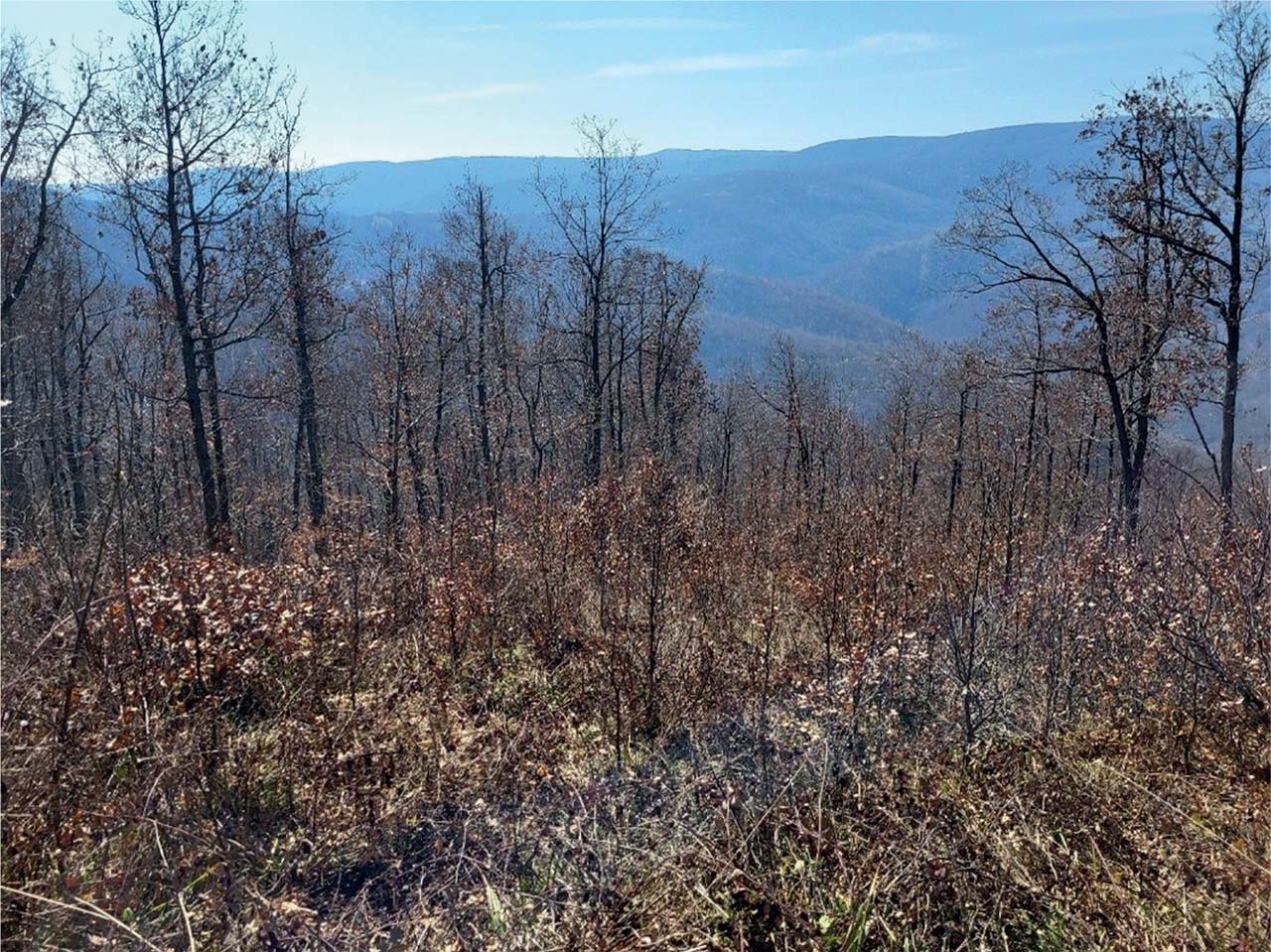
Figure 3:
The Q. petraea forest where D. blagayana was recorded in the Teiului Valley, Iron Gates Natural Park, Romania.
Slika 3: Gozd gradna (Q. petraea), kjer so zabeležili vrsto D. blagayana v dolini Teiului Valley, Narodni park Železna vrsta, Romunija.
The medium density of the Balkan Daphne was 50–55 flowering shoots/m2 on this populated slope. The plants were healthy and turgescent, with a height of 10–20 cm above the 10–15 cm thick layer of leaf litter. The population was well-shaped, but apparently isolated. The location is difficult to access because the region has only a few abandoned forest roads, most of which are overgrown with vegetation. On one side, the site is surrounded by a young Q. petraea forest interspersed with F. sylvatica individuals; this relatively compact, shaded forest is not populated by D. blagayana, and the boundary between the Balkan Daphne population and the forest is obvious. On the other side, there is a slightly more open Q. petraea forest, with more sunlight (Figure 3). On this side, there is a gradual transition in the density of D. blagayana flowering shoots: they become rarer as tree density increases. The population likely expanded from the glades into the Q. petraea regeneration. On 20th February 2025, the plants were blooming, despite snow patches on the ground. Numerous flowering shoots remained on 9th March, when we revisited this site (Figure 1). At this site, the lowest altitude, where flowering shoots were recorded, was at 647±3 m (44°38′52″ N / 22°12′14″ E), while the upper limit was at 667±3 m altitude (44°38′52″ N / 22°12′17″ E). The second site with D. blagayana was observed in November 2025. Here, we observed hundreds of flowering shoots (Figure 1C) in late autumn. They were situated on a different slope, at 500–700 m distance (44°38′27″ N / 22°12′29″ E) from the previous site. The habitat is similar, as the species also occupies open areas surrounded by Q. petraea and F. sylvatica forests. The slope had a 20°– 30° inclination, the altitude ranged from 650 to 700 meters, and the plants were present in areas where the forest was more open. As in the previous habitat, both old and young trees were present.
Discussion
The record of D. blagayana in the Mraconia River basin is not just a first record for the Danube Gorge area, but for the entire Banat Mountains, as this represents the most south-western distribution record in Romania, compared with the literature (e.g., Badea & Cretzoiu, 1941; Meusel, 1968; Lupșa, 1975–1976; Daphne blagayana Freyer in GBIF Secretariat, 2023). It also appears to be the lowest location in Romania, as previous records ranged from 900 m to 1.890 m in altitude (Lupșa, 1975–1976). However, online databases record it at lower altitudes inside a large urban area (Ștefănești Argeș town, near Pitești city, at about 310 m altitude) (Daphne blagayana Freyer in GBIF Secretariat, 2023), indicating a location where the species may have been introduced to gardens, as in other cases (e.g., Strgar, 1975; Brus, 2001). Although at its northern distribution range limit, D. blagayana occurs at lower altitudes (e.g., Martini & Poldini, 1990; Dakskobler et al., 2011), in Romania, it was previously observed only at higher altitudes (Lupșa, 1975–1976). In the north-western parts of its distribution range, few individuals were present at altitudes of 630–670 m in the undergrowth of different F. sylvatica forests (Dakskobler et al., 2011). In Slovenia, it descends to 440–460 m, altitudes where there are both native and introduced populations (Omejc & Brus, 2005). In Italy, D. blagayana was recorded in two locations between 580 and 930 m altitude (Martini & Poldini, 1990). At its north-western distribution limit, it occurs at 1000 m on steep peaks with little winter snow, but because the area was glaciated, its survival and relict status are difficult to accept (Hein & Lippert, 2001). In this case, the presence of the Balkan Daphne likely results from a northward expansion into areas with suitable conditions in the Alps after the last glacial maximum (Hein & Lippert, 2001). In Bulgaria, it is considered a rare, typically mountain species (Yurukov & Zhelev, 2001), connected with Pinus nigra forests, whose assemblages have a relict origin (Tzonev et al., 2018). It appears that in Bulgaria, D. blagayana attains the highest altitude within its range (Fišer Pečnikar et al., 2017). Thus, the location within IGNP has not only biogeographic but also ecological significance, as it represents the species’ lowest-altitude record in Romania. The new distribution record is located at approximately 60–70 km south-west of the closest previously known location (the upper basin of the Motru River) (Meusel, 1968; Lupșa, 1975–1976; Daphne blagayana Freyer in GBIF Secretariat, 2023) and at approximately 4 km from the Danube. Thus, the new record represents a partial connection with populations south of the Danube, that belong to haplotypes different from those in Romania (Fišer Pečnikar et al., 2017). Only subsequent genetic studies will be able to establish if this geographically intermediate population is also genetically intermediate.
Daphne blagayana likely survived in the Mraconia basin during the Quaternary glaciations, just like other species in the Southern Carpathians (e.g., Schmitt & Varga, 2012; Šrámková-Fuxová et al., 2017; Lachowska-Cierlik et al., 2020; Zając et al., 2020; Kirschner et al., 2023; Triest et al., 2024). The Balkan Daphne was not discovered for a long period in the region (Badea & Cretzoiu, 1941; Meusel, 1968; Lupșa, 1975–1976; Daphne blagayana Freyer in GBIF Secretariat, 2023), probably due to its difficult access. However, previously numerous studies were made upon plants in IGNP (e.g. Csűrös et al., 1968; Boșcaiu & Resmeriță, 1969; Pop et al., 1969; Coldea et al., 1970; Dihoru et al., 1973; Schneider-Binder, 2014), as the region is considered well studied from this perspective (Drăgulescu, 2014), although most studies focused on the areas close to the Danube. Even if the region with D. blagayana in the Mraconia Valley was not targeted by such studies, human access there is evidenced by past deforestation, the consequences of which are still visible in the forests of the upper valley. At the same time, this dwarf plant, with only 30 cm in height (Martini & Poldini, 1990; Brus, 2001), is probably difficult to observe. It waited a long time, but its biogeographic significance is now obvious. Thus, D. blagayana probably survived in the Mraconia Valley during the glacial periods and subsequently expanded along the Southern Carpathians, as at its northwestern range limit in the Alps (Martini & Poldini, 1990; Hein & Lippert, 2001). In this case, the haplotype became even more relevant, as it is possible that this population belongs to a different one that survived in isolation during the glaciations. It was recently suggested that a mountain insect species (Liparus glabrirostris Küster, 1849) could survive during the glaciations in the Mraconia Valley (Teodor et al., 2025). In IGNP, there are likely additional D. blagayana populations hidden on remote, difficult-to-access slopes, as evidenced by our November record of another population on a different slope. This confirms the importance of new studies in the region; as for example, in IGNP, Vaccinium myrtillus L. was recently identified at low elevations (Petruș-Vancea et al., 2024).
The presence of D. blagayana at low altitude, although unusually related to its distribution in Romania (e.g., Lupșa, 1975–1976), is integrated in a wider biogeographic context of the Danube Gorge, where some mountain species (plants, insects, and vertebrates) descend at very low altitudes (e.g., Pașcovschi, 1956; Csűrös et al., 1968; Covaciu-Marcov et al., 2009, 2025; Teodor et al., 2019; Petruș-Vancea et al., 2024). In the Danube Gorge, the Mraconia Valley is notable in this respect, as recently identified relict mountain species with biogeographic peculiarities were found at low altitudes (Dumbravă & Cupșa, 2025; Teodor et al., 2025). This fact was also confirmed for plants, as certain species were identified in this valley at their lowest altitudes in the Carpathians (Schneider-Binder, 2016). Recently, in the Mraconia basin, a mountain insect species (L. glabrirostris) was first identified in the IGNP at low altitude (Teodor et al., 2025). Afterward, hoverfly species (Diptera Syrphidae) with similar requirements were identified in the hydrographic basin (Dumbravă & Cupșa, 2025). The presence of D. blagayana is even more relevant than that of the insect (Teodor et al., 2025), which was previously reported in the Banat Mountains, whereas the Balkan Daphne is the first record in the region. However, for the insect as well, it was suggested that Mraconia Valley represents a connection between populations from the Southern Carpathians and those from the Balkan Peninsula (Teodor et al., 2025), a fact that may also apply to D. blagayana. Thus, the factors that acted upon the insect also acted upon D. blagayana, as past conditions allowed the survival of more relict species in this region, confirming that the same conditions from the past acted in the same direction for both plants and animals (Petruș-Vancea et al., 2024). Thus, even if the Danube Gorge is one of the warmest regions in Romania (e.g. Stoenescu et al., 1966; Mândruț, 2006), with numerous southern, Mediterranean species, at their northern distribution limit (e.g. Pașcovschi, 1956; Coldea et al., 1970; Fuhn, 1975; Tăușan & Teodorescu, 2017; Dumbravă & Ruicănescu, 2023), Mraconia Valley confirms that the region shelters mountain species at low altitudes (e.g. Pașcovschi, 1956; Schneider-Binder, 2016; Petruș-Vancea et al., 2024; Dumbravă & Cupșa, 2025; Teodor et al., 2025), as the Southern Carpathians have acted as a glacial refugium (e.g. Schmitt & Varga, 2012; Šrámková-Fuxová et al., 2017; Lachowska-Cierlik et al., 2020; Zając et al., 2020; Kirschner et al., 2023; Triest et al., 2024). The Danube Gorge area is considered a possible corridor and a potential cryptic refugium for plant species such as Primula vulgaris Huds. (see Triest et al., 2024). Additionally, in other plant species, recent data have demonstrated the existence of glacial refuges in the Romanian Carpathians (e.g., Šrámková-Fuxová et al., 2017; Kirschner et al., 2023). This fact also holds for less mobile animals, such as snails (Zając et al., 2020; Korábek et al., 2023), as well as for more mobile vertebrates (e.g., Horreo et al., 2018). Additionally, lowland populations of a butterfly species were considered potential survivors of glacial periods in the Carpathian valleys (Sitar et al., 2025).
The habitats in the Mraconia basin align with the species’ requirements, as D. blagayana has previously been recorded in sunny habitats between forests and open areas (Meusel, 1968). Although F. sylvatica is well represented in the Danube Gorge (Rozylowicz, 2008; Manolache et al., 2022), as it occurs even at low altitudes near the Danube (see Pașcovschi, 1956), in the Mraconia Valley, D. blagayana is found in Q. petraea forests. However, F. sylvatica occurs at lower elevations than the Balkan Daphne, in wet, cold, and shady valleys, whereas on the steeper, drier slopes, it is replaced by Q. petraea, despite the higher altitude. Daphne blagayana was often mentioned alongside conifers (e.g., A. alba, Pinus nigra J.F. Arnold) (Badea & Cretzoiu, 1941; Bergmeier, 1988). It is considered linked with P. nigra (Fukarek, 1957), although this connection could be only a result of the substrate preference (Fukarek, 1969). Naturally, in IGNP, there are no coniferous trees with the exception of P. nigra, which is extremely rare, as in the region, there are only deciduous forests (Rozylowicz, 2008; Manolache et al., 2022), even if many mountain species descend to lower altitudes here (e.g., Pașcovschi, 1956; Schneider-Binder, 2016; Petruș-Vancea et al., 2024; Dumbravă & Cupșa, 2025; Teodor et al., 2025). In Serbia and Montenegro, it occurs in F. sylvatica forests, although it is considered characteristic of oak and pine forests (Novakovic-Vukovic et al., 2022). It is present in F. sylvatica forests in Bulgaria (Tzonev et al., 2006). Daphne blagayana prefers open, light forests; thus, it is decreasing with forest successions (Omejc & Brus, 2005), whereas in IGNP, the steep, rocky slopes did not allow the establishment of a mature forest with old trees. At the same time, past deforestation may have benefited the species by leaving open areas. Although the flowering period takes place in April-May, both in Romania (Badea & Cretzoiu, 1941) and generally (Brus, 2001), in the IGNP, the Balkan Daphne was blooming in February-March, probably because of the lower altitude compared to other locations in Romania (Lupșa, 1975–1976) and of the warmer climate (Stoenescu et al., 1966; Mândruț, 2006). Because of such conditions, in the Danube Gorge, also other mountain species present at lower altitudes began reproducing earlier (Teodor et al., 2025) or were active in winter (Covaciu-Marcov et al., 2022). In the IGNP, D. blagayana bloomed again in November, just like in the Alps (Hein & Lippert, 2001).
Although, in certain locations it has been suggested that the species was introduced by irresponsible plant enthusiasts (Accetto, 2010), this possibility is ruled out in our case, as the population’s surface area is extensive and the number of flowering shoots is very high. At the same time, in the Mraconia basin (and in neighboring areas), there are many similar steep slopes that are very difficult to access and could shelter other Balkan Daphne populations. Nevertheless, their limited accessibility keeps them undiscovered, a pattern previously observed for this species across much of its range, including its northwestern limit (Dakskobler et al., 2011). The large surface area of IGNP and the difficulty of accessing certain areas were considered responsible for incomplete distribution of data in other groups as well (Covaciu-Marcov et al., 2025; Dumbravă & Cupșa, 2025). Probably, the rarity of the species led to it not being reconfirmed even in some areas of the Balkan Peninsula, south of Romania (Sočo et al., 2002).
Although D. blagayana is considered protected in all countries within its distribution range by some authors (Fišer Pečnikar et al., 2017), it is not mentioned in the environmental legislation in Romania (O.U.G. 57, 2007). This is an unexpected fact, considering its small range (Brus, 2001), scattered distribution, and relict status (Meusel, 1968, 1969). However, this situation is recurring in Romania for other rare and endemic species that are not mentioned in environmental legislation, even though they have biogeographical importance (Covaciu-Marcov & Ferenți, 2019). The absence of D. blagayana from the Romanian environmental legislation (O.U.G. 57, 2007) is even more confusing, as more than 100 years have passed since it was proposed for protection as a nature monument, a rare and important species (Borza, 1924). Fortunately, in IGNP, D. blagayana occurs in a large, protected area with rich biodiversity (e.g., Rozylowicz et al., 2019), which could help ensure its survival despite lacking a conservation status, through habitat protection. The habitat’s relative isolation can also contribute to this direction. Thus, the primary threat to the species in IGNP are future forest interventions, as the difficult access deters tourists who could collect the flowers. Nevertheless, in another region of Romania (Vâlcea County), D. blagayana is collected by tourists along with other plants (Ploaie & Turnock, 2001), a practice also observed in other regions, thus it has become rare and endangered (Paulin, 1902; Brus, 2001). Unlike in Romania, in other regions the species has been protected for more than 100 years (see Omejc & Brus, 2005). In conservation actions for D. blagayana, evolutionarily significant units should be used, as Romania is already rich in haplotypes (Fišer Pečnikar et al., 2017), and the population from IGNP could represent a distinct evolutionarily significant unit. Ultimately, the identification of D. blagayana confirms that the apparently low number of protected and rare species in the Romanian Carpathians, compared with the Western Carpathians, is attributable to the difficulty of the studies due to the larger country surface area relative to the countries of the Western Carpathians (Halada et al., 2024).
Acknowledgments
Our study was made with the support of the IGNP Administration, to which we are grateful.