
Introduction
The Orchidaceae remains one of the largest families in terms of the number of genera and species and these species have long attracted great interest from botanists around the world.
Thus, in southwestern Australia, in a sensitive area, Phillips et al. (2010) sought to highlight the ecological causes of the diversification or rarity of orchids in a natural habitat. In contrast, Djordjević et al. (2020) assessed and quantified the ecological niche of orchids in the forest ecosystem in Serbia. Other authors have worked on the taxonomic update and endemism status of orchids. These include Lussu et al. (2020) in Sardinia, Italy, based on a synthesis of surveys and botanical studies that highlights the importance of endemism in the islands of the Mediterranean basin, as well as an update of the taxonomic list of orchids, showing the potential of islands for understanding the ecology and evolution of plants. Youssef et al. (2015), in the Kurdistan region, which is part of the Iranian-Anatolian hotspot, and Delforge (2000, 2002, 2005), have worked on the identification and design of an inventory guide for certain orchids in Europe and North Africa, as have El Mokni et al. (2012) and Véla et al. (2012, 2015) in Tunisia.
In Algeria, the sixth volume of the North African flora (see Maire, 1959), describes 57 species, while Quézel & Santa (1962–1963) in the Algerian flora, present 47 species. From 1999 to 2020, researchers focused on the botanical description of the orchid’s species and their distribution in different types of habitats. In the Numidia (northeastern Algeria), the Algerian central-eastern Tell and in the region of Tlemcen, the researchers contributed to update the presence of orchids, their nomenclature and synonymy as well as their ecology (see Derradji, 1999; De Bélair, 2000; De Bélair & Boussouak, 2002; De Bélair et al., 2005; Rebbas & Véla, 2008; De Bélair, 2010; Rebbas & Véla, 2013; Bougaham et al., 2015 ; Hamel et al., 2017; Babali et al., 2018; Madoui & Véla, 2020). Despite all these studies, not enough is known about the orchid flora of Algeria, as several regions have not yet been surveyed due to the vastness of the Algerian territory or have rarely been prospected, such as the national park of Chréa.
The national park of Chréa represents a mountainous reserve type charged with the natural flora preservation with a notable taxonomic and functional diversity within the Blidean Atlas. It represents almost 26% of the national floristic richness (Halimi, 1980; DGF, 2000). Despite this importance, the orchids of the Metidja region have not been studied systematically and no work has been published. This work aims to establish a detailed inventory of all orchid species in Chréa and to study the floristic niche of each population comprehensively. An initial cartographic approach to the population and dispersal status of orchids will also be discussed.
Material and methods
Study area
The national park of Chréa was created in September 1925, on the initiative of the Natural History Society of North Africa. Originally, it covered only 1351 ha including the dense cedar forests of Djebel Gureouane, Djebel Ferroukha and the forest of Beni Salah (DGF, 2000). In 1983, the surface of the park was extended to 26587 ha with forest formations occupying 20.3% of the total surface and scrubland which accounts for more than 63% of the surface of the park (Halimi, 1980; Marre, 1992).
Located 50 km southwest of Algiers, the park which is within the Tell Atlas, extends along the central heights of the Blidean Atlas. It dominates about the north of Metidja plains, towards the south Medea plateau, towards the west the massif of Dahra and surroundings in the east the massif of Djurdjura. It includes from east to west the mountains of Hammam Melouane, the ridges of Chréa and Djebel Temesguida (Halimi, 1980). This park is confined to the department of Blida and Medea and overlaps the limits of Ain Defla province. The Blidean Atlas is a mountainous region of the alpine fold with the highest point reaching 1629 m (Koudiat Abdel Kader). It is divided into compartments and well-limited siltation basins (Marre, 1992).
According to Halimi (1980), the park is a rocky barrier with a very rough topography and a dense hydrographic network including a series of wadis oriented south-north. The geology of the Blidean Atlas is very homogeneous, composed only of deposits of schist that are more or less clay-like and rarely fossiliferous (Halimi, 1980; Marre, 1992).
The climate is of Mediterranean type, characterized in this region by a long period of dryness and by relatively warm and rainy winters with determined by frost (Halimi, 1980). The Blidean Atlas suffers from both the severe winter and the dryness of summer, which occurs just when vegetation most needs water (Emberger, 1930; Seltzer, 1946; Daget, 1977; Pons & Quézel, 1998; Le Houerou, 2007; Colmet-Daâge et al., 2018). The intermediate seasons (spring and autumn) are the most favorable for the plant structuring of natural habitats in the Mediterranean region (Daget, 1977; Pons & Quézel, 1998). The intermediate seasons (spring and autumn) are the most favorable to vegetation.
Our surveys focused on three sectors according to the recommendations of the national park of Chréa’s forestry engineers who assert that “these are the sectors that constitute the largest areas of ecological interest and natural diversity”. In each sector, study sites were selected according to their accessibility; a total of 10 sites were the subject of floristic survey (Figure 1, Table 1).
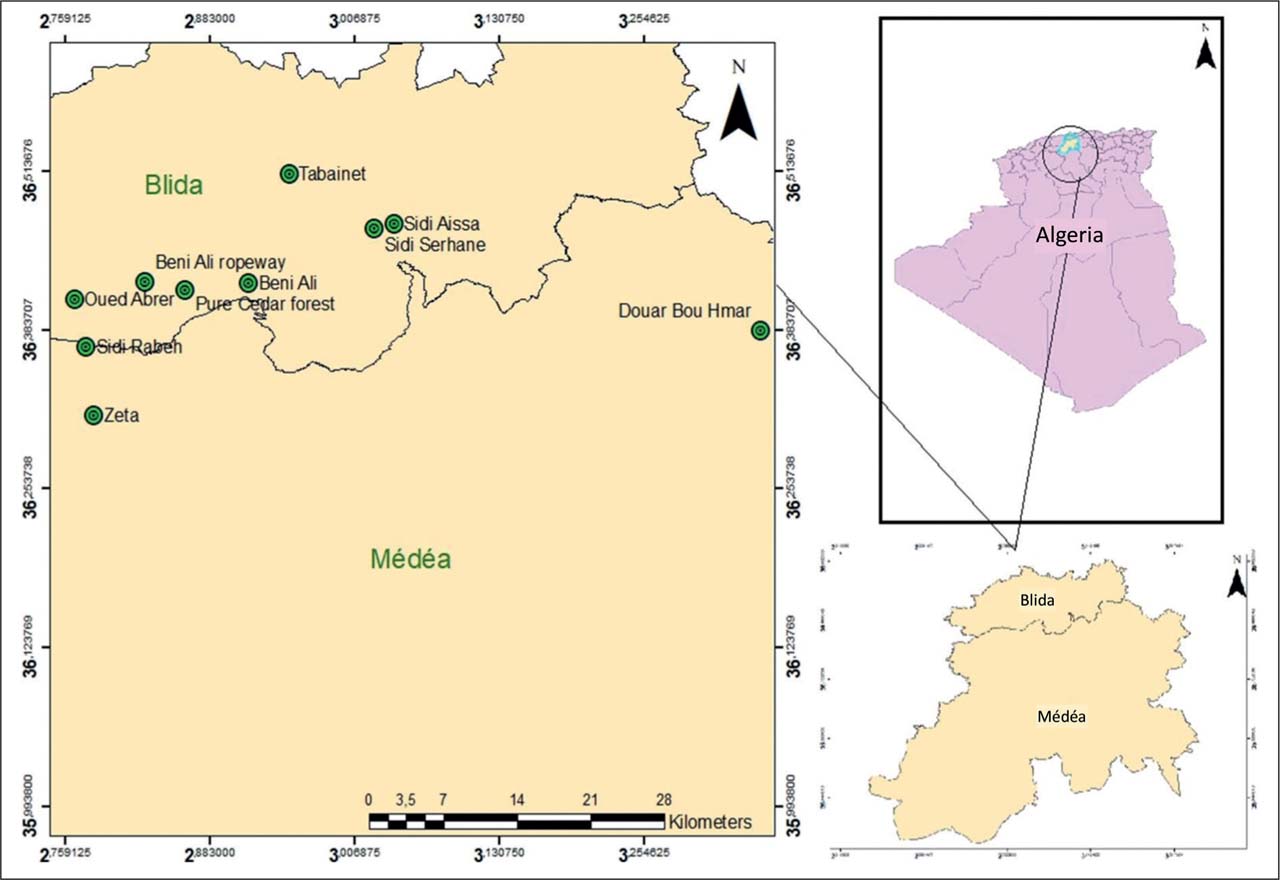
Figure 1:
Location maps of the study area with sectors and localities.
Slika 1: Zemljevid lokacij preučevanih sektorjev in krajev.
Table 1:
Exposition, soil type and geographic coordinates of the studied sectors and localities.
Tabela 1: Ekspozicija, vrsta tal in geografske koordinate preučevanih sektorjev in krajev.
| Sector | Locality | Exposition | Type of soil and rock (Halimi, 1980; DGF, 2000) | Latitude | Longitude | Altitude (m a. s. l.) |
|---|---|---|---|---|---|---|
| El Hamdania Sector 36°21′49.05″ N, 2°45′05.51″ E | Zeta | South | Schistose stone | 36°18′48.48″ N | 2°47′04.93″ E | 447 |
| Sidi Rabeh | Northwest | Schistose stone, rich in organic matter, with dry soil | 36°22′12.68″ N | 2°46′40.55″ E | 503 | |
| Chréa Sector 36°25′11.72″N, 2°51′15.64″ E | Pure Cedar forest | North | Schistose stone, rich in organic matter, with dry soil | 36°24′59.38″ N | 2°51′44.40″ E | 1519 |
| Beni Ali ropeway | Northwest | Schist outcropping in some areas | 36°25′22.82″ N | 2°49′42.50″ E | 924 | |
| Beni Ali | North | Schistose, non-calcareous soils, dry on severe slopes, with low organic matter content | 36°25′18.70″ N | 2°55′01.16″ E | 815 | |
| Oued Abrer | North | Schistose, non-calcareous soils | 36°24′32.19″ N | 2°46′04.46″ E | 768 | |
| Hammam Melouane Sector 36°28′30.79″ N, 3°03′02.90″ E | Sidi Aissa | Northwest | Non-calcareous soil with low organic matter at pH=6.8 | 36°28′13.61″ N | 3°02′27.90″ E | 550 |
| Douar Bou Hmar | Southeast | Grey schist | 36°22′58.63″ N | 3°21′15.75″ E | 350 | |
| Tabainet | East | Grey schist | 36°30′40.29″ N | 2°57′05.33″ E | 169 | |
| Sidi Serhane | South | Grey schist | 36°28′00.63″ N | 3°01′27.63″ E | 262 |
El Hamdania sector: Located in the west of Medea province, it is characterized by important natural resources (gorges of the Chiffa, waterfalls, the high-altitude lake of Tamesguida). Two localities in this sector were surveyed (Sidi Rabeh and Zeta), characterized by the presence of arborescent maquis dominated by Quercus ilex L.
Chréa sector: This sector is located in the center of the park area and includes a centenary cedar grove, a rich and varied arboretum, places for summer and winter sports activities. Four localities were selected here (pure cedar forest, Beni Ali ropeway, Beni Ali and Oued Aberer), where a very important tree flora has been recorded, in particular Cedrus atlantica (Endl.) Manetti ex-Carrière, Cupressus sempervirens L., Pinus halepensis Mill., Prunus avium (L.) L., Quercus ilex L. and Q. suber L.
Hammam Melouane sector: It is a mountainous area, located in the east of the region of Chréa. It is characterized by its thermal resources, an important rural vocation, and relaxation places in nature. Four localities were prospected here (Sidi Aissa, Douar Bou Hmar, Tabainet and Sidi Serhane). The vegetation in these localities is diverse and includes forests of Quercus ilex and Pinus halepensis, as well as low maquis shrublands, grasslands, and horticultural crops.
Study method and sampling
Our work aims to compile a systematic inventory of orchids present in Chréa National Park. As part of this study, several surveys were conducted between April 2022 and June 2023. We placed particular emphasis on random sampling based on the presence/absence of the different taxa studied in the Orchidaceae family. As part of each survey (25m2), we compiled a systematic inventory of all the flora associated with orchids (Frontier & Pichod-Viale, 1998), assigning each species a Braun-Blanquet abundance-dominance value (Braun-Blanquet, 1932). We thus established a matrix of 27 floristic surveys covering all species co-occurring with the identified orchid. The identification of orchids and main co-occurring species was based on the Algerian flora of Quézel & Santa (1962–1963) and the North African flora of Maire (1959), but also, especially for orchids, based on Martin et al. (2020), Kreutz et al. (2013, 2015), Rebbas & Véla (2013), and Rebbas et al. (2023). The nomenclature was updated according to Euro+Med PlantBase (2024), International Plant Name Index (IPNI, 2024), and African Plant Database (APD, 2025). The Plants of the World Online (POWO, 2024) and Euro+Med PlantBase (2024) indicate the general distribution of the taxa, allowing the determination of the categories of endemism, which was also checked in Le Floc’h et al. (2010) and Dobignard & Chatelain (2010). Taxa were classified in alphabetical order and their synonyms in the Algerian or North African flora were indicated.
The size (height) of individuals of orchids observed was measured in situ. The mapping of the sites and study localities, as well as the dispersal maps of the orchid species studied, were established by the ARC-GIS 10.8 software.
Statistical analysis
One of the methods applied to the processing of ecological plant data is certainly correspondence analysis (CA), which is indeed the most appropriate method for discriminating between plant groups (Legendre & Legendre, 1984; Dervin, 1988). This method is the most suitable for our fieldwork, given that Braun Blanquet’s abundance-dominance cover estimates are semi-quantitative.
In a first step, a CFA was used to highlight the significant interactions between the main factors. This includes finding the best simultaneous representation of two clusters comprising the “plant species” rows and the “survey” columns of a data table and testing the link between these two clusters (Legendre & Legendre, 1984). In our case, this involves a census of matrix species, where we note a Braun-Blanquet abundance-dominance coefficient for each plant species. The term ‘matching’ in CFA comes from the fact that we are trying to match characteristics. Correspondence factor analysis describes the dependence or correspondence between sets of character data. Thus, CFA is mainly descriptive (Dervin, 1988), allowing us to describe the floristic environment that accompanies each orchid species in a multidimensional analysis and to establish the reason for the grouping of these species or their isolated occurrence.
Results
Inventory
In the ten localities distributed across the three sectors of the Chréa national park (the Sector of Chréa, the sector of El Hamadania and the sector of Hammam Melouane), 19 species of orchids were identified (Figure 2A–J), including 2 subendemics (Orchis laeta, an Algerian-Tunisian endemic, and Ophrys atlantica Munby, a taxon with distribution area limited to Spain, Morocco, Algeria, and Tunisia, Table 2), and 131 co-occurring species. The most represented genus of orchids in the study area is Ophrys (7 species), followed by Orchis (3 species), then Anacamptis, Himantoglossum and Neotinea (2 species each). In the field, 378 individuals of orchids were recorded.
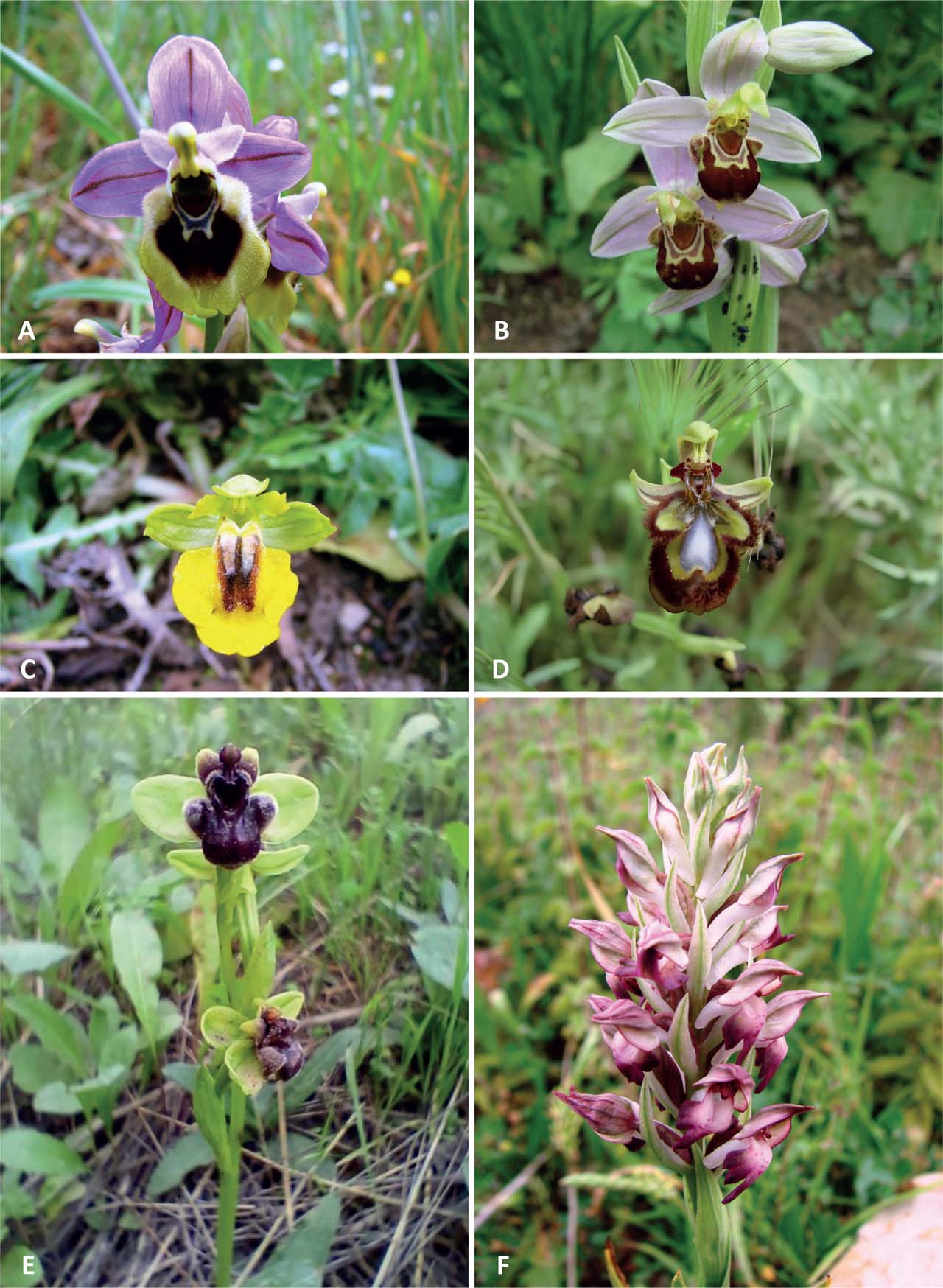
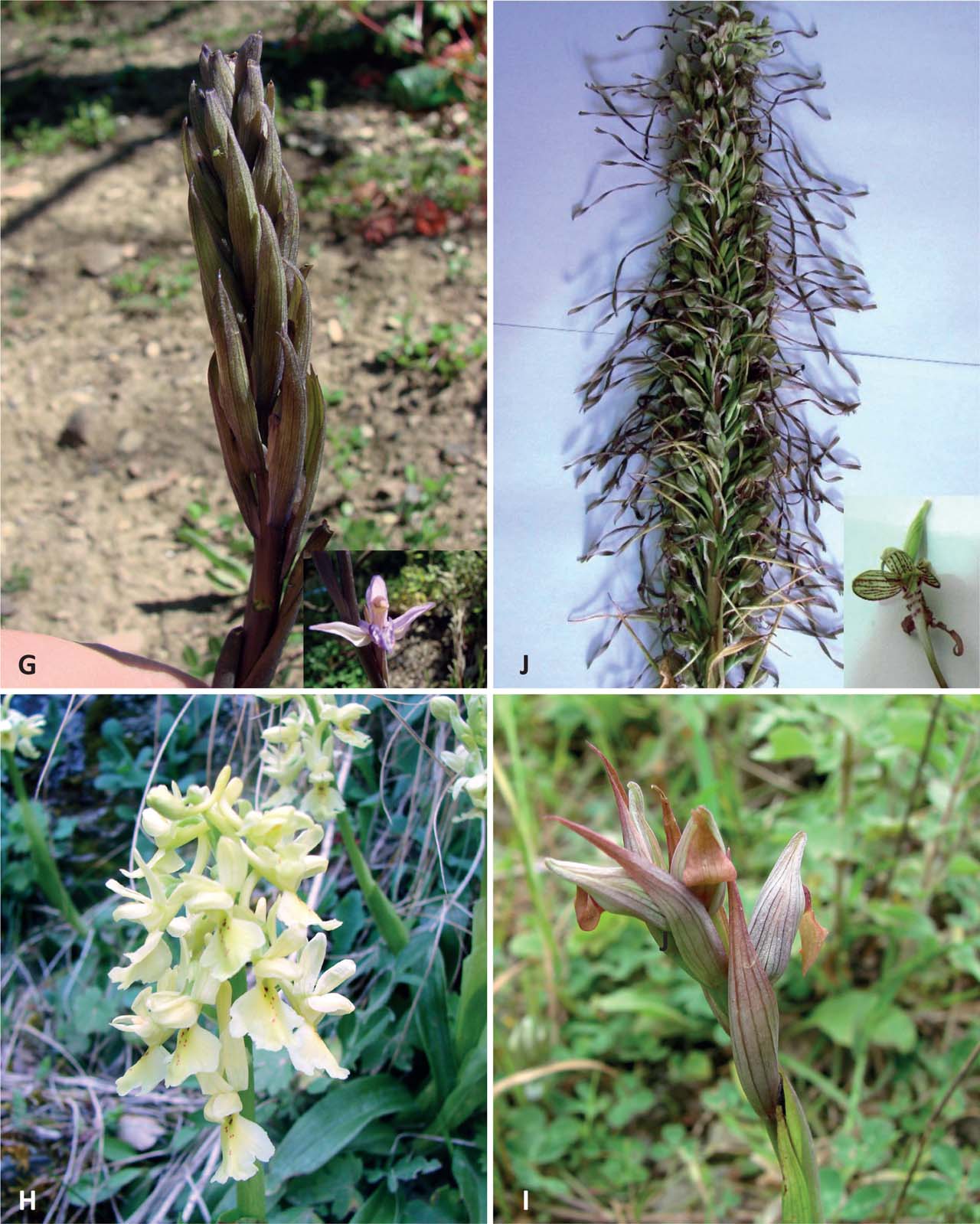
Figure 2:
Some of the orchid species observed at the study sites. A: Ophrys tenthredinifera, B: Ophrys apifera, C: Ophrys lutea, D: Ophrys speculum, E: Ophrys bombyliflora, F: Anacamptis coriophora, G: Limodorum abortivum, H: Orchis laeta, I: Serapias parviflora, J: Himantoglossum hircinum.
Slika 2: Nekatere vrste orhidej, ki smo jih opazili na raziskovanih območjih. A: Ophrys tenthredinifera, B: Ophrys apifera, C: Ophrys lutea, D: Ophrys speculum, E: Ophrys bombyliflora, F: Anacamptis coriophora, G: Limodorum abortivum, H: Orchis laeta, I: Serapias parviflora, J: Himantoglossum hircinum.
Table 2:
Orchid species recorded in Chréa park and specific synonymy.
Tabela 2: Vrste orhidej s sinonimi, ki smo jih zabeležili v parku.
| Taxon | Synonymy according to Maire (1959), Quézel & Santa (1962–1963), Dobignard & Chatelain (2010) | Nomenclature adopted by the African Plant Database (APD, 2025) |
|---|---|---|
| Anacamptis coriophora (L.) R. M. Bateman, Pridgeon & M. W. Chase | A. coriophora subsp. fragrans (Pollini) R. M. Bateman, Pridgeon & M. W. Chase Anteriorchis coriophora (L.) Klein & Strack Orchis coriophora L. subsp. fragrans (Pollini) K. Richt O. fragrans Pollini | A. coriophora (L.) R. M. Bateman, Pridgeon & M. W. Chase |
| Anacamptis papilionacea (L.) R. M. Bateman, Pridgeon & M. W. Chase | Orchis papilionacea L. sensu lato | A. papilionacea (L.) R. M. Bateman, Pridgeon & M. W. Chase |
| Cephalanthera longifolia (L.) Fritsch | / | C. longifolia(L.) Fritsch |
| Himantoglossum hircinum (L.) Spreng. | Aceras hircina (L.) Lindl. Loroglossum hircinum (L.) Rich. Orchis hircina (L.) Crantz Satyrium hircinum L. | H. hircinum (L.) Spreng. |
| Himantoglossum robertianum (Loisel.) P. Delforge | H. longibracteatum (Biv.) Schlechter Barlia robertiana (Loisel.) Greuter Orchis robertiana Loisel. | H. robertianum (Loisel.) P. Delforge |
| Limodorum abortivum (L.) Sw. | L. abortivum subsp. eu-abortivum (L.) Maire & Weiller Orchis abortiva L. | L. abortivum (L.) Sw. |
| Neotinea maculata (Desf.) Stearn | N. intacta (Link) Rchb. f. Aceras intactum (Link) Rchb. f. Orchis intacta Link Satyrium maculatum Desf. | Orchis intacta Link |
| Neotinea tridentata (Scop.) R. M. Bateman, Pridgeon & M. W. Chase | Orchis tridentata Scop. | N. tridentata (Scop.) R. M. Bateman, Pridgeon & M. W. Chase |
| Ophrys apifera Huds. | / | O. apifera Huds. |
| Ophrys atlantica Munby | O. fusca subsp. atlantica (Munby) Coss. | O. atlantica Munby |
| Ophrys bombyliflora Link | O. tabanifera Willd O. distoma Biv. O. pulla Dix. O. hiulca Sébast. & Mauri O. canaliculata Viv. O. labrofossa Brot. | O. bombyliflora Link |
| Ophrys fusca Link | / | O. fusca Link |
| Ophrys lutea Cav. | / | O. lutea Cav. |
| Ophrys speculum Link | O. ciliata Bivona O. vernixia Brot. | O. speculum Link |
| Ophrys tenthredinifera Willd. | / | O. tenthredinifera Willd. |
| Orchis anthropophora (L.) All. | Aceras anthropophorum (L.) W. T. Aïton Ophrys anthropophora L. | O. anthropophora (L.) All. |
| Orchis laeta Steinh. | O. provincialis var. laeta (Steinh.) Maire & Weiller Androrchis laeta (Steinh.) D.Tyteca & E.Klein | Androrchis pauciflora subsp. laeta (Steinh.) Véla, Rebbas & R. Martin |
| Orchis mascula (L.) L. | O. morio var. mascula L. Androrchis mascula (L.) D.Tyteca & E. Klein | Androrchis mascula (L.) D.Tyteca & E. Klein |
| Serapias parviflora Parl. | S. parviflora subsp. occultata (J.Gay ex Cavalier) Maire & Weiller | Serapias parviflora Parl. |
Ophrys lutea Cav. is the most abundant in the study area (113 individuals), followed by Anacamptis coriophora (L.) R.M.Bateman, Pridgeon & M.W.Chase and Ophrys bombyliflora Link (71 and 50 individuals respectively). On the other hand, Himantoglossum hircinum (L.) Spreng. and H. robertianum (Loisel.) P.Delforge are the least abundant with only 3 individuals for each of them (Figure 3). The study area offers suitable conditions for orchids to thrive and is also an ecological optimum for some of these species, with their populations reaching fairly high densities compared with others orchids (Figure 4).
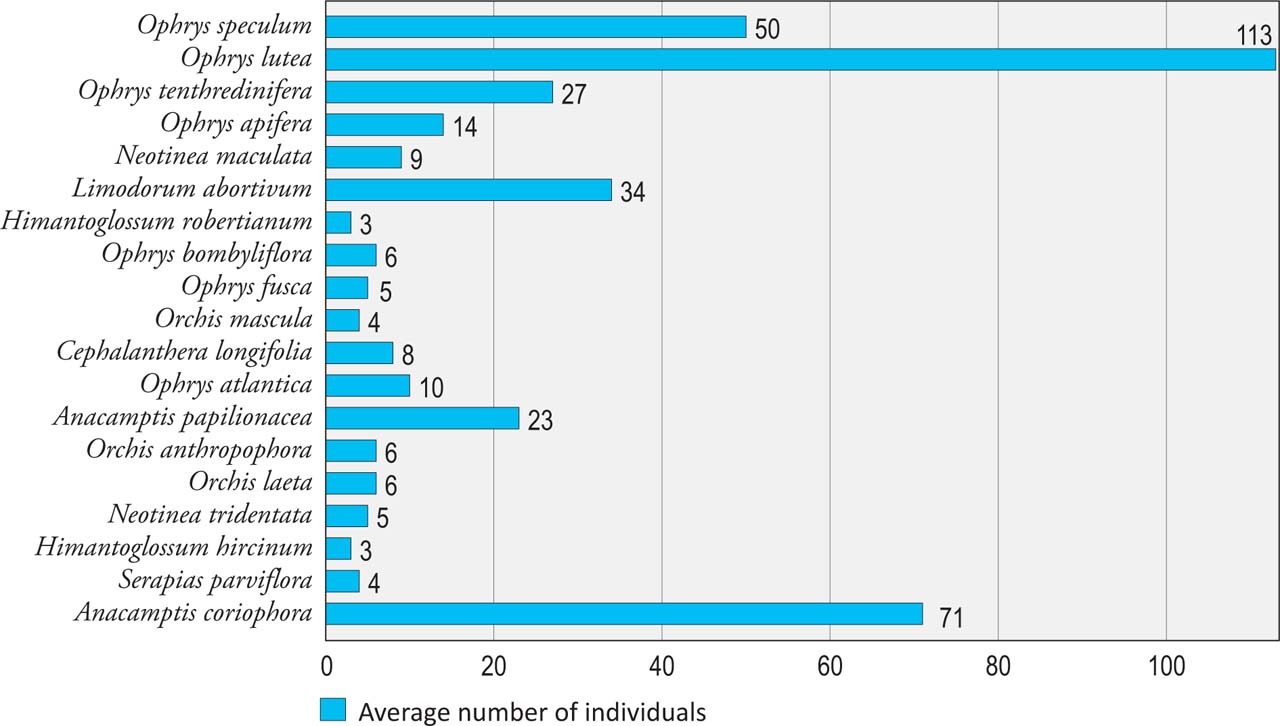
Figure 3:
Number of individuals of each orchid species recorded in the study area.
Slika 3: Število osebkov posameznih vrst orhidej, ki smo jih zabeležili na preučevanem območju.
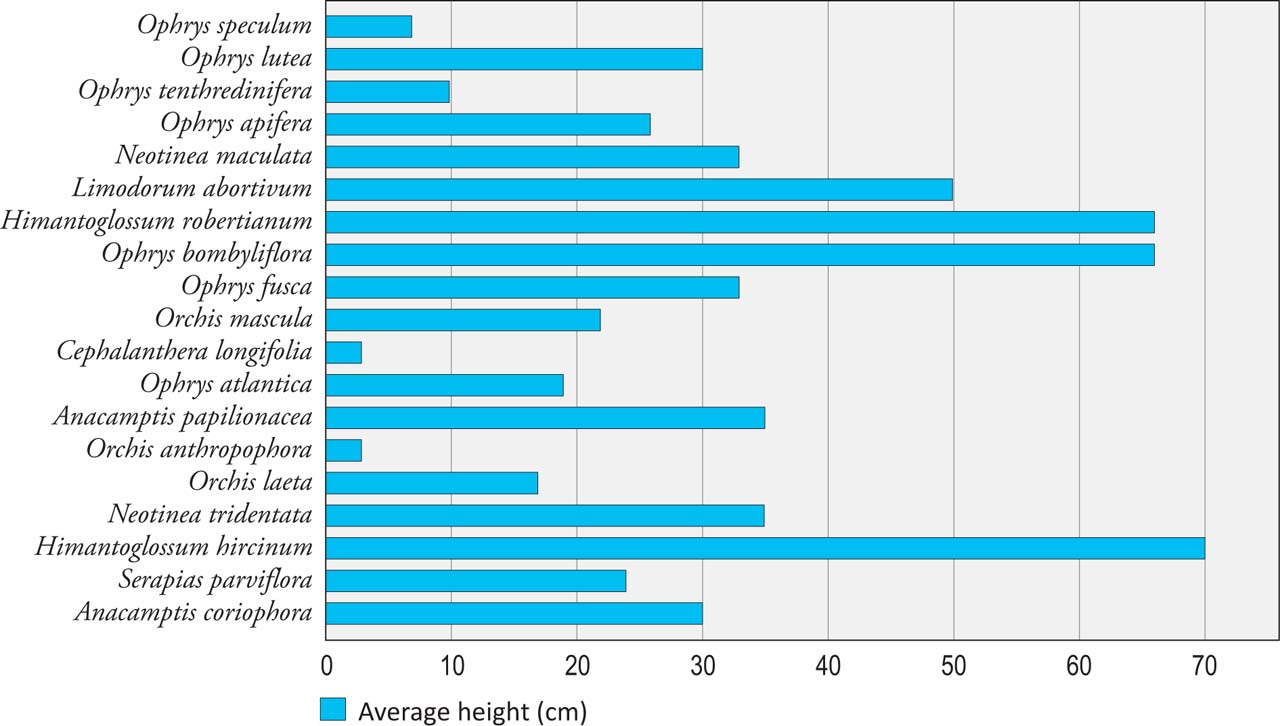
Figure 4:
The average height (cm) of the orchid species inventoried in the study sites.
Slika 4: Povprečna višina orhidej, ki smo jih popisali na preučevanih območjih.
Floristic composition of co-occurring species
The factorial analysis highlights a clear distribution of orchids according to the companion species in each study site. Graph with second and third axis gives ecologcally most sound result, therefore we decided to present this graph.
The analysis divides the orchids in 2 groups which are distributed on the factorial axis 2 from right to left according to a gradient of plant density and the third settles at the limit of the factorial axis 3 (Figure 5). This distribution follows the plant physiognomic formation of each locality studied. Figure 6 supports the distribution of localities according to the plant density of the survey itself where the orchid species is reported; this one divides the localities into 3 sectors according to the altitude and the exposition of the survey. The analysis of the plant procession of each orchid locality highlights the floristic niche of these species and their sociability with each other.
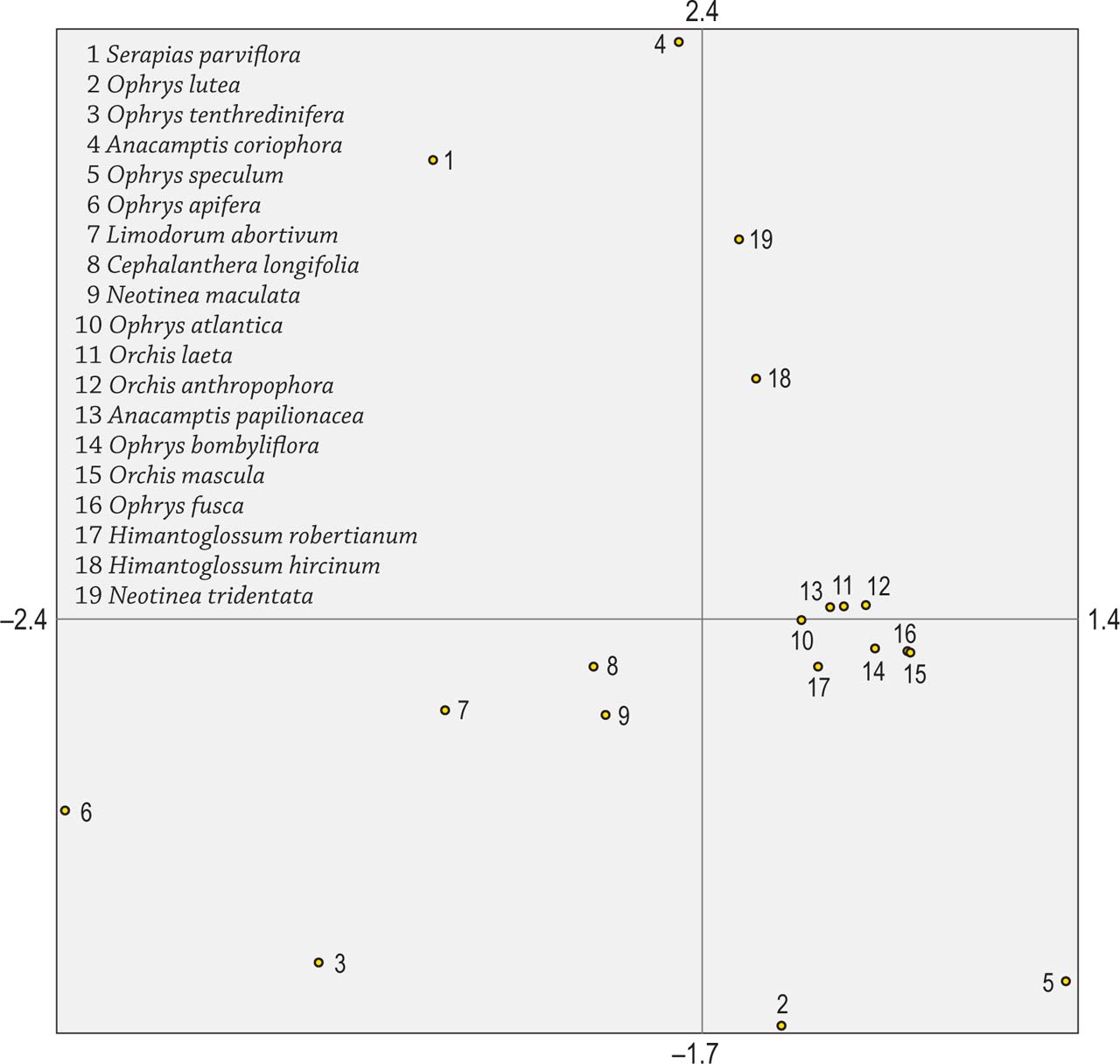
Figure 5:
AFC factor analysis (axes 2–3) highlighting the distribution of 19 species of orchids inventoried across 27 floristic readings. Some orchids have a clustered distribution, others show overlapping presence, while others are solitary.
Slika 5: AFC faktorska analiza (osi 2–3) z razporeditvijo 19 vrst orhidej, ki smo jih zabeležili v 27 florističnih popisih. Nekatere orhideje imajo gručasto razporeditev, druge se prekrivajo, tretje pa so samostojne.
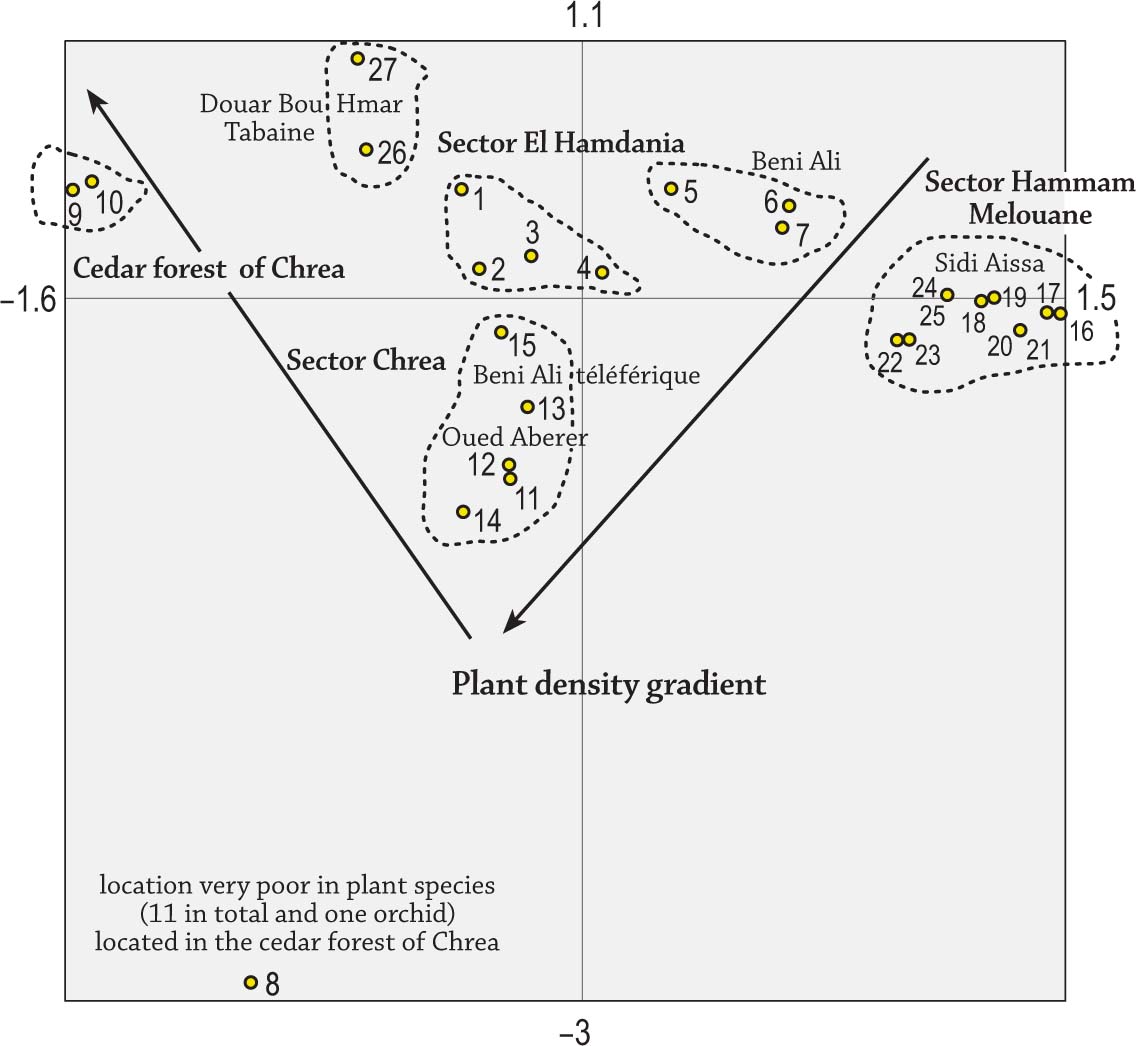
Figure 6:
Distribution of study sites on the factorial plane (2,3) (CFA).
Slika 6: Razporeditev preučevanih območij na faktorski ravnini (2,3) (CFA).
In the mountainous localities we observe a specific installation for some populations of orchids such as: Ophrys atlantica Munby and Neotinea maculata (Desf.) Stearn where the orchid is surrounded by a companion flora. on the other hand, in open localities with low plant density, such as: rocky lawns and clearings of cork oaks, we see a clustering of different species of orchids associated with a specific flora constituting a population of orchids very characteristic of the nature of the habitat where they are found. Giving example to the population of: Anacamptis papilionacea (L.) R.M.Bateman, Pridgeon & M.W. Chase, Ophrys bombyliflora Link, Orchis anthropophora (L.) All., and O. mascula (L.) L.
Figure 7 illustrates the floristic niche of the orchids recorded during our field survey. The factor analysis thus identifies five distinct groups of orchids (G1, G2, G3, G4 and G5). Each group is characterised by a set of orchid species accompanied by a floristic composition characteristic of the biotic environment. However, the factorial plot of the analysis brings together all the companion species common to all the habitats studied during our work.
Flora Group number. 1: Himantoglossum robertianum, Cephalanthera longifolia, Ophrys tenthredinifera, Ophrys lutea, Ophrys speculum, Malope malacoides, Asplenium obovatum, Pallenis maritima, Chamaerops humilis, Nigella damascena, Squilla maritima and Anagallis arvensis.
Flora Group number. 2: Neotinea maculata, Myosotis discolor, Crataegus azarolus, Ranunculus spicatus, Hyacinthoides hispanica, Smyrnium perfoliatum and Leucanthemum glabrum.
Flora Group number. 3: Orchis anthropophora, Anacamptis papilionacea, Ophrys bombyliflora, Orchis mascula, Orchis laeta, Ophrys fusca, Anacamptis coriophora, Serapias parviflora, Himantoglossum hircinum, Neotinea tridentata, Asplenium trichomanes, Asphodelus ramosus, Bromus scoparius, Allium triquetrum, Orobanche purpurea, Stachys marrubiifolia, Dactylis glomerata, Bellis annua, Pinus halepensis, Valeriana tuberosa, Papaver rhoeas and Gladiolus byzantinus.
Flora Group number. 4: Ophrys apifera, Orchis laeta, Limodorum abortivum, Plantago major, Geranium molle, Quercus suber, Erica arborea and Genista tricuspidata.
Flora Group number. 5: Ophrys atlantica, Hypochoeris radicata, Eryngium tricuspidatum, Astragalus armatus, Polygala nicaeensis, Hypericum perfoliatum, Cedrus atlantica, Ranunculus macrophyllus, Sedum caeruleum, Funaria hygrometrica, Paronychia argentea and Viola munbyana.
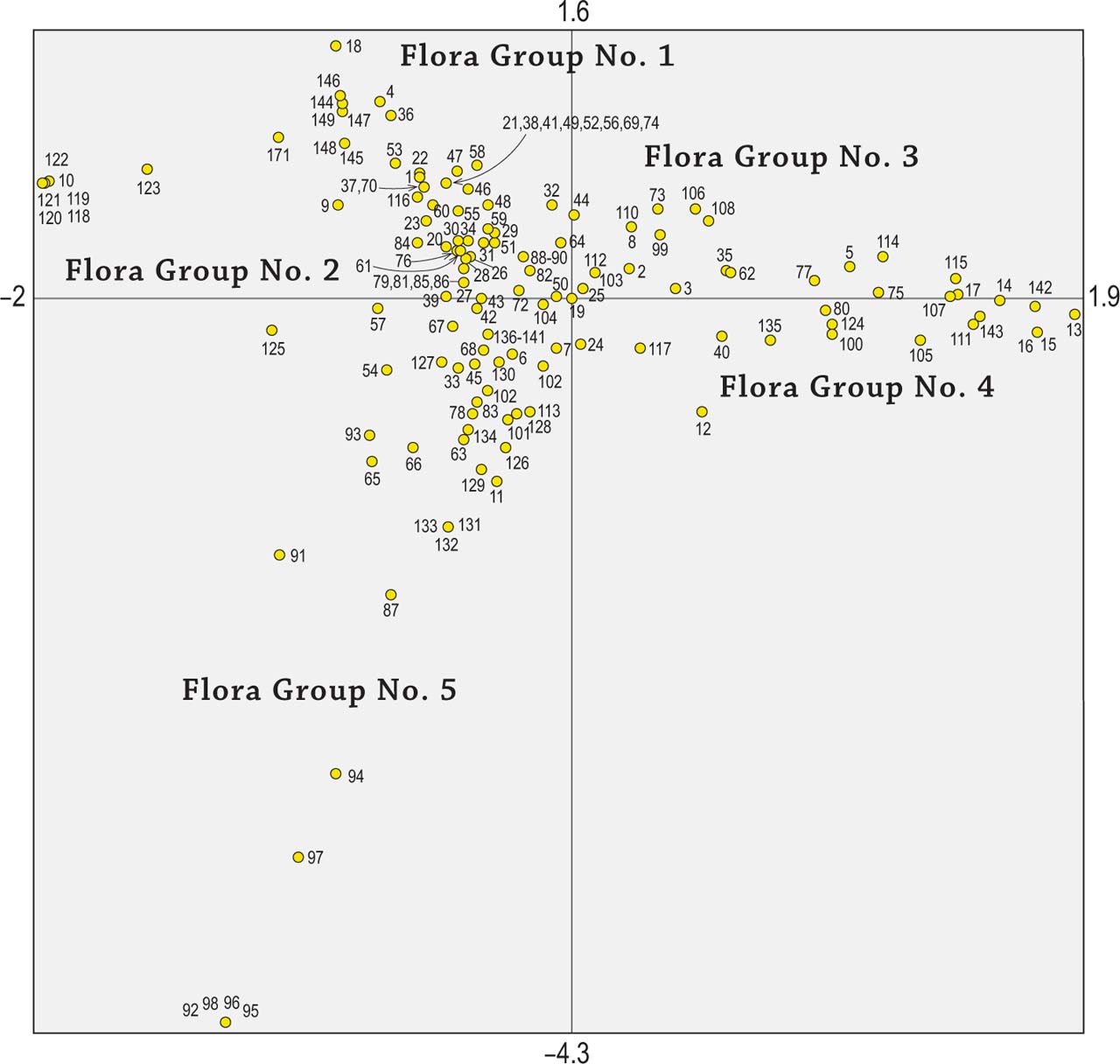
Figure 7:
AFC axis 2–3. Highlighting the grouping of each of the 19 orchid species with the 131 co-occurring plant species, revealing the most characteristic species of the habitat.
Slika 7: Osi 2–3 v analizi AFC. 19 vrst orhidej s 131 vrstami drugih rastlin, s katerimi uspevajo skupaj in ki nakazujejo najbolj značilne vrste habitata.
Orchid dispersal in the study area
The distribution maps, combined with graphs showing the diversity of orchids at each study site and the abundance of each species (Figure 8A, B, C, D, E, F), highlight the genera with a wide distribution and those with a limited distribution within the study area. Thus, the genus Ophrys exhibits a fairly broad ecological profile, occupying all the habitat types studied during our fieldwork. The genus Orchis exhibits habitat specificity, being restricted to cedar forests at an altitude ranging from 550 to 815 metres across just two sites. The genus Himantoglossum is present at only four sites, and the two species characteristic of this genus do not overlap in their distribution, as is the case for the genera Neotinea and Anacamptis. These maps and graphs enable a clearer distinction to be made between orchids with a broad ecological profile, i.e. those that colonise various habitats studied (mixed forest of Quercus ilex and Pinus halepensis, Quercus suber scrub, cedar forest), such as Ophrys, Serapias, Himantoglossum and Neotinea, and orchids with a specialised ecological profile, such as the Orchis species that grow only in mixed forests, or Limodorum and Cephalanthera.
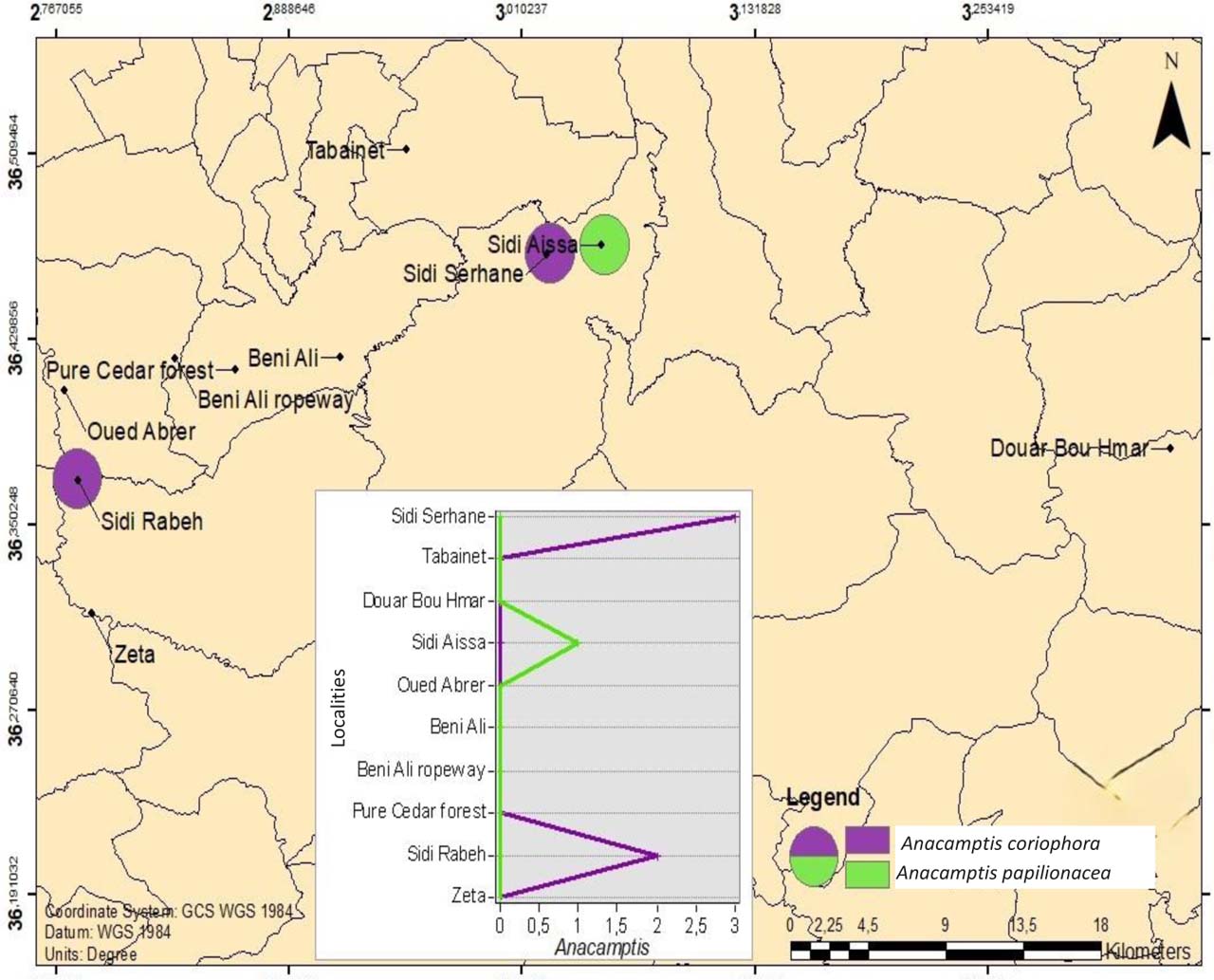
Figure 8A:
Dispersal map and abundance graph for species of the genus Anacamptis in the study area (Chréa Park, northern Algeria).
Slika 8A: Zemljevid razširjenosti in graf številčnosti vrst iz rodu Anacamptis na območju raziskave (park Chréa, severna Alžirija).
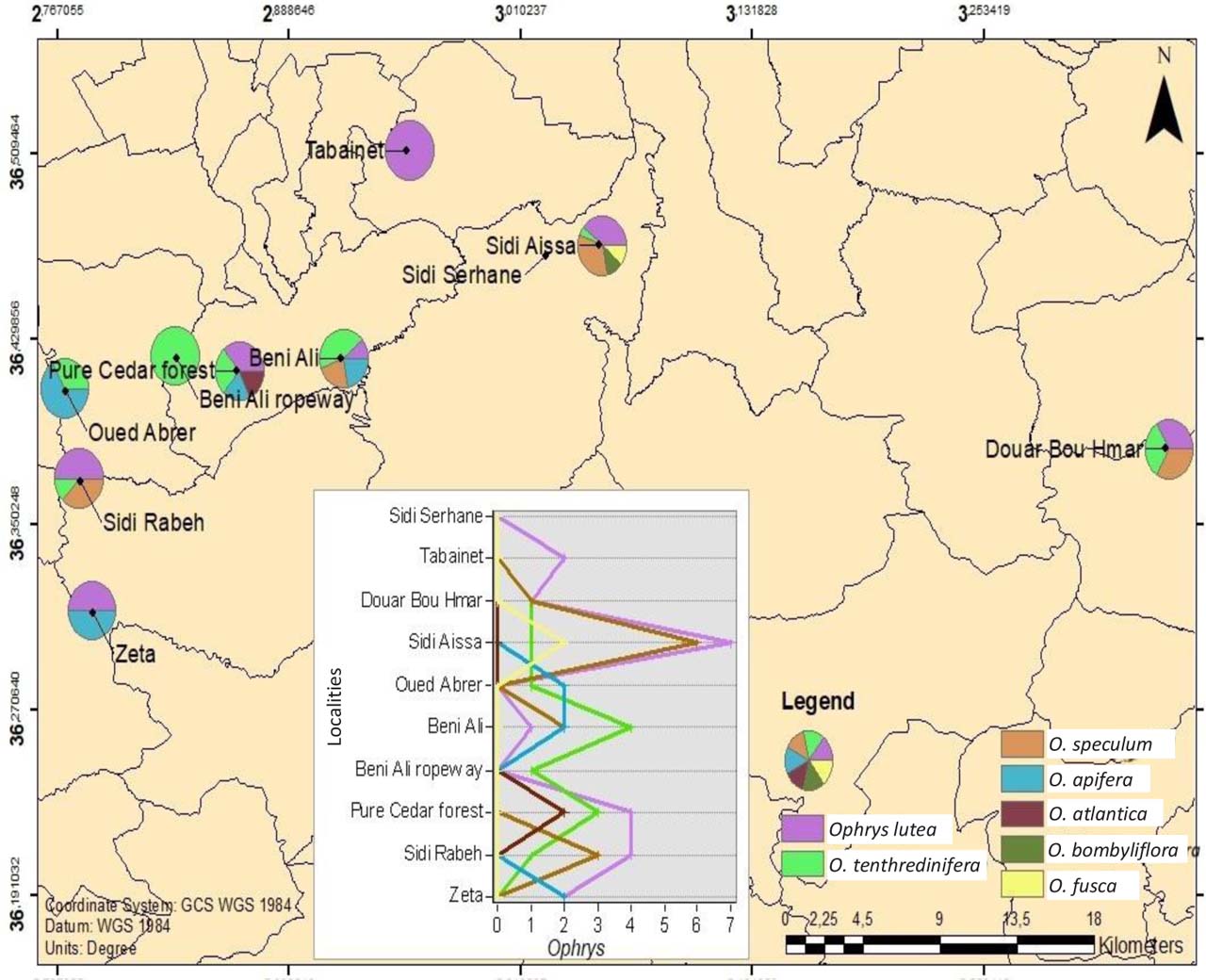
Figure 8B:
Dispersal map and abundance graph for species of the genus Ophrys in the study area (Chréa Park, northern Algeria).
Slika 8B: Zemljevid razširjenosti in graf številčnosti vrst iz rodu Ophrys na območju raziskave (park Chréa, severna Alžirija).
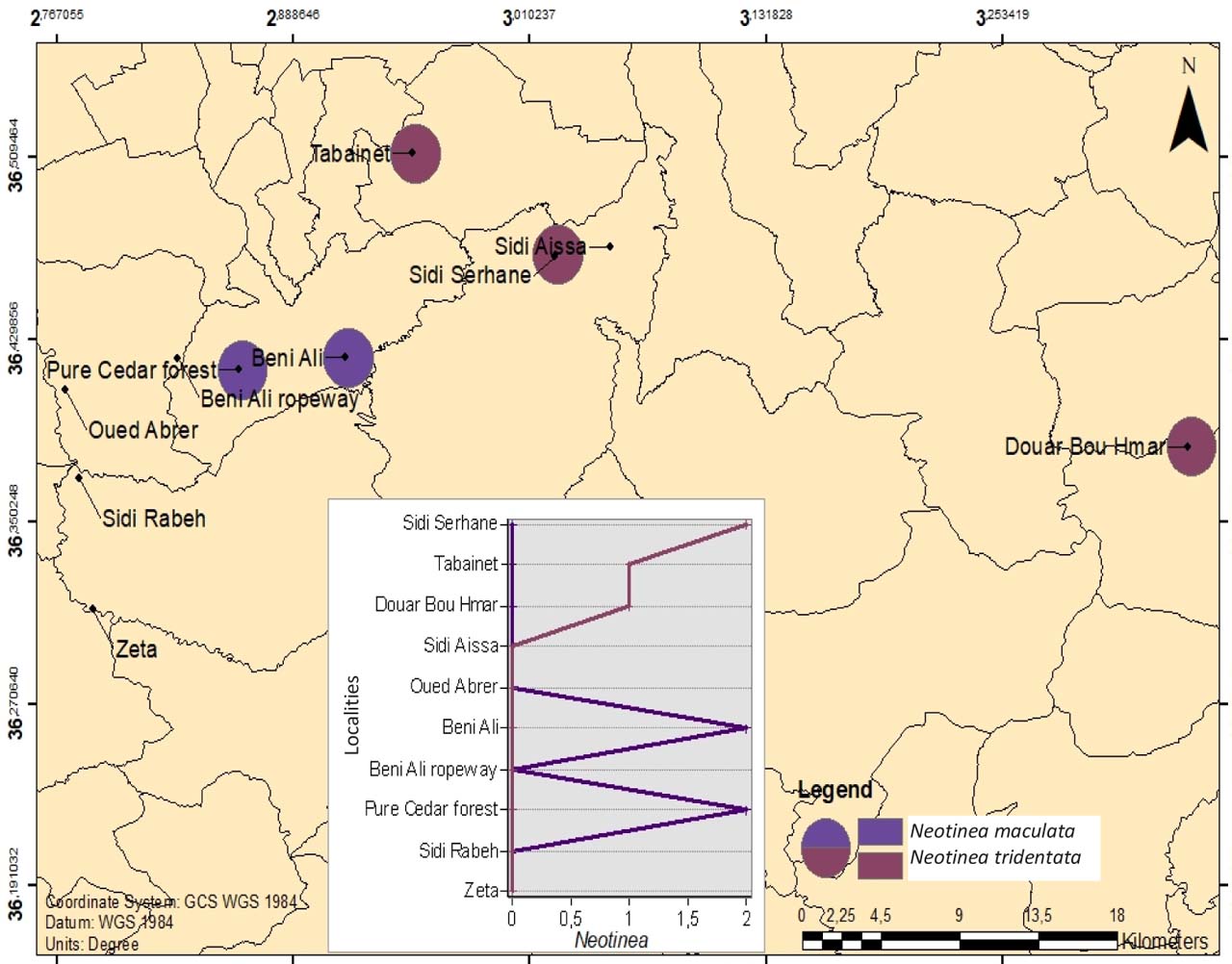
Figure 8C:
Dispersal map and abundance graph for species of the genus Neotinea in the study area (Chréa Park, northern Algeria).
Slika 8C: Zemljevid razširjenosti in graf številčnosti vrst iz rodu Neotinea na območju raziskave (park Chréa, severna Alžirija).
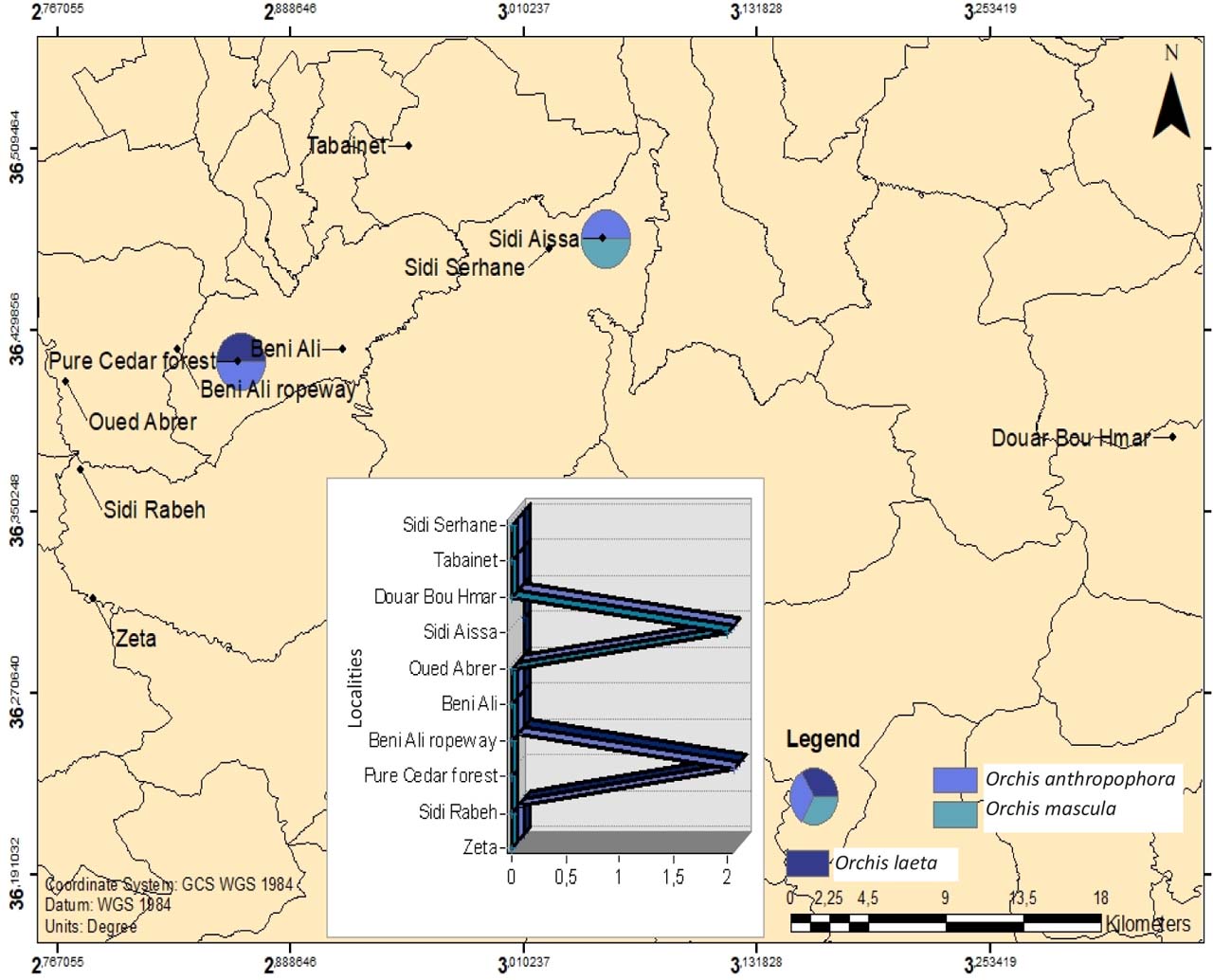
Figure 8D:
Dispersal map and abundance graph for species of the genus Orchis in the study area (Chréa Park, northern Algeria).
Slika 8D: Zemljevid razširjenosti in graf številčnosti vrst iz rodu Orchis na območju raziskave (park Chréa, severna Alžirija).
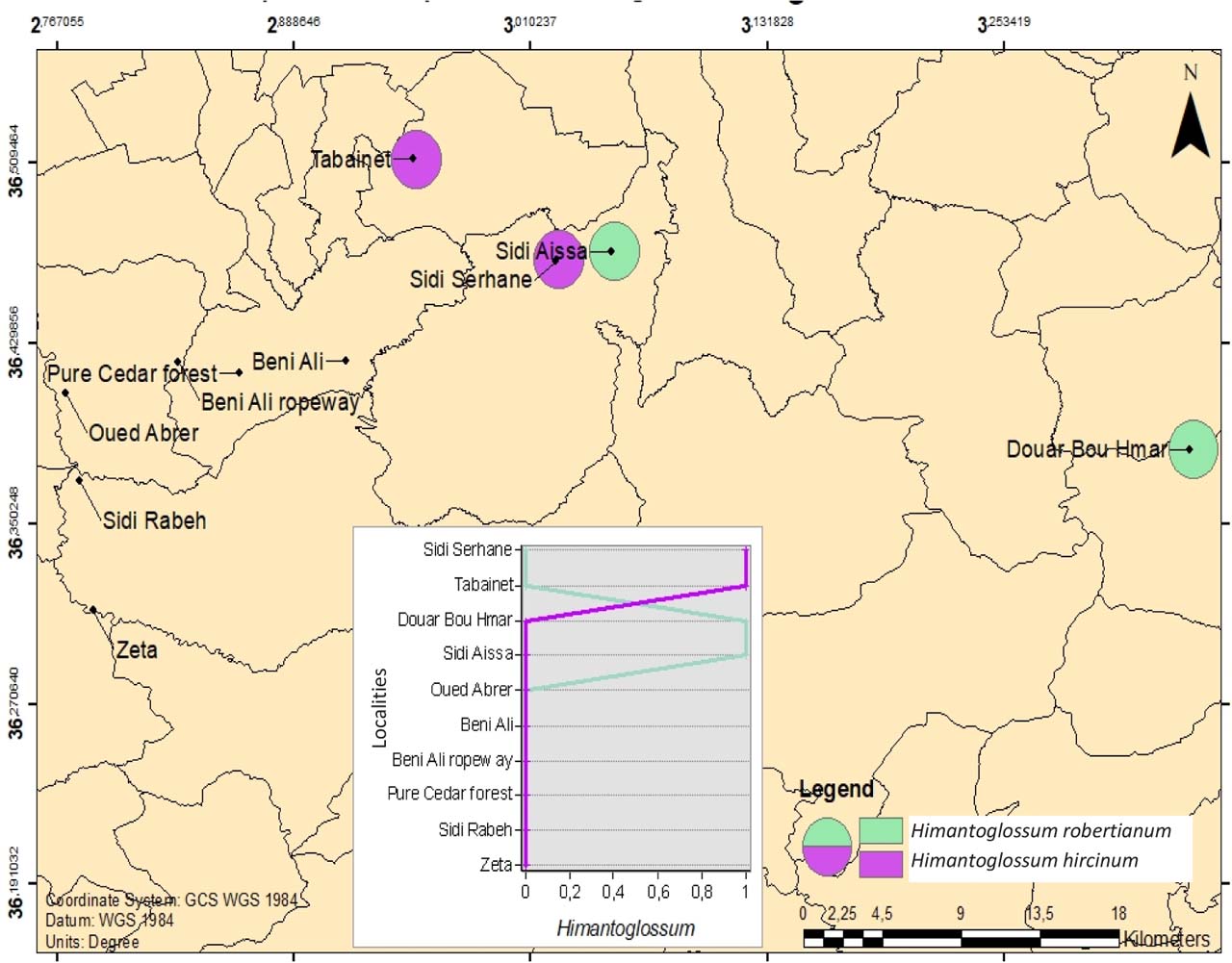
Figure 8E:
Dispersal map and abundance graph for species of the genus Himantoglossum in the study area (Chréa Park, northern Algeria).
Slika 8E: Zemljevid razširjenosti in graf številčnosti vrst iz rodu Himantoglossum na območju raziskave (park Chréa, severna Alžirija).
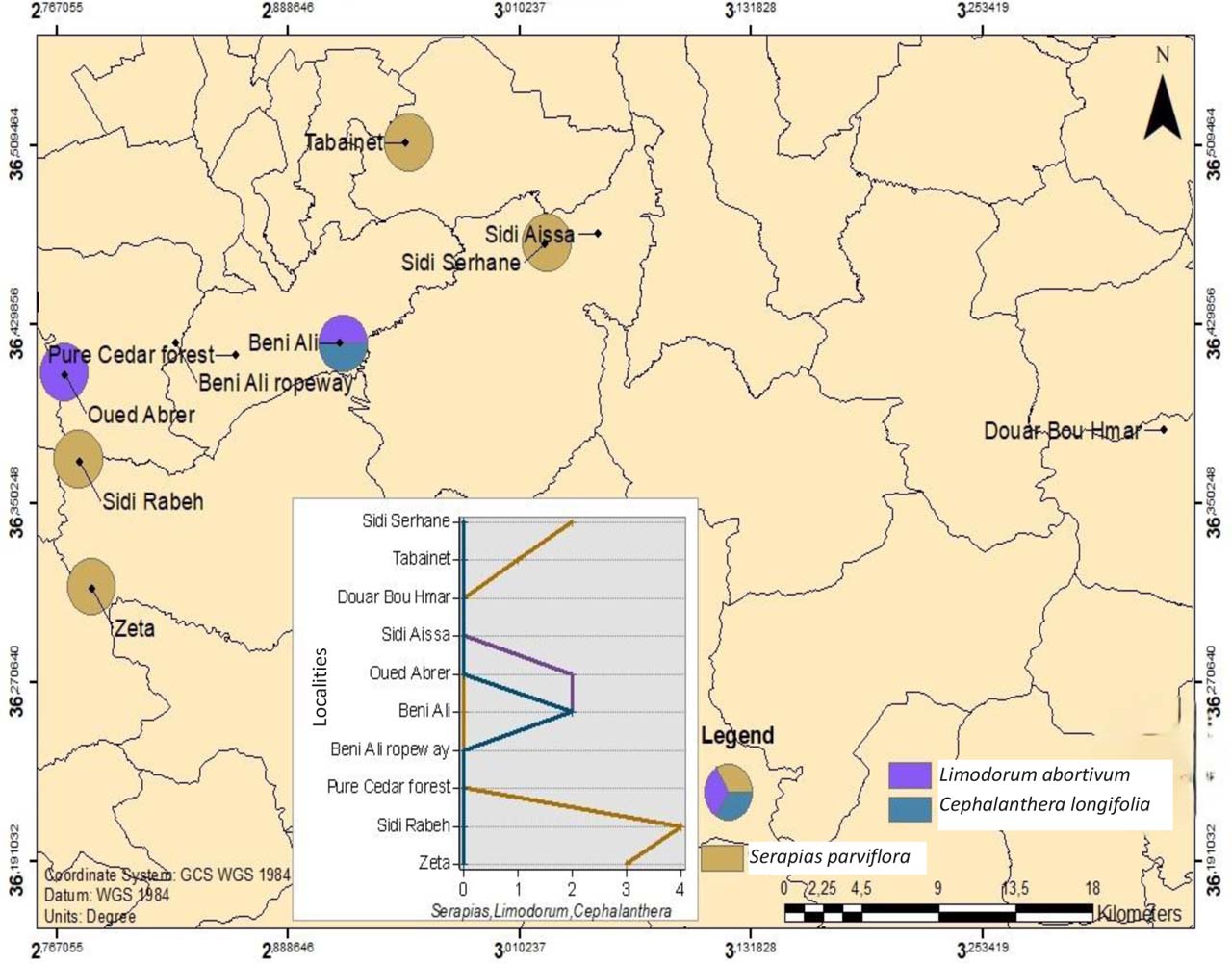
Figure 8F:
Dispersal map and abundance graph for species of the genera Cephalanthera, Limodorum and Serapias in the study area (Chréa Park, northern Algeria).
Slika 8F: Zemljevid razširjenosti in graf številčnosti vrst iz rodov Cephalanthera, Limodorum in Serapias na območju raziskave (park Chréa, severna Alžirija).
Discussion
All species identified in this study have already been described in the literature and reported in Algeria in different regions, including Djurdjura national park (Rebbas et al., 2023), while for Chréa national park orchid data were almost absent. To the best of our knowledge, no recent work has been done, and no publication has been made, similarly, no recent data have been reported on iNaturalist in this area, nor have any collections been made by de Bélair (GdB herbarium, https://gdebelair.com/) in this area. Our findings show that the study area is characterized by a significant specific diversity, which could have been much greater if we had access to certain locations (not possible due to dangerous and unsafe terrain), which limited our ability to establish a more exhaustive list of orchids in the study area.
The study area is also characterized by variability in orchid abundance depending on the species and the state of their populations. This abundance varies between a high population density and a simple individual presence reflecting the rare status of the species under consideration. The low number of individuals of orchid species could be attributed to the strong anthropic pressure and the successive fires in the region during the summer season.
Anthropogenic actions such as wild dumps, high tourist numbers and fires caused by summer visitors (campfires and land clearing by farmers), cause a change in soil structure and destroy the seed bank of these plant species. The only refuge of the inhabitants of the region of Blida, well known for its hot summers, remains the pine forests, the cork oak forest and the cedar forest of Chréa.
Results indicated that differences in orchid species richness and composition were related to habitat type, elevation and exposition. Our results corroborate with Djordjević & Tsiftsis (2019) and Djordjević et al., (2020), who confirm these findings by studying the soil composition with its texture for the 28 orchid species inventoried, as well as the specialization of the forest orchid related to the altitude parameter (between low and medium). Phillips et al. (2010) noted that the habitat fragmentation (installation of paths, roundabouts, roads, for farming and urbanization), affects the rarity of orchids, this fact is due to the lack and even sometimes to the absence of their pollinators. Such was also found in our survey, at the Hammam Melouane site, where the density of orchid populations was very low, characterized by one to two individuals. From the other hand, Štípková et al. (2021) remarked that the orchids listed in their study are distributed in three groups depending on the orography of the region and the biological type of these species (rhizomatous, intermediate and tuberous). This has been noted in our survey, revealing the distribution of orchids in five groups related to specific flora and altitude. Beghami et al. (2015), who carried out their survey in a mountainous area of the Aurès (northeastern Algeria), based on multidimensional analyses of ecological and typological parameters, highlighted the distribution of a number of orchids, signaling their alarming vulnerability to the anthropization of their habitats, thereby raising the question of their protection immediacy. This was confirmed by Linder (2004) and Van der Niet (2017), who worked in the Cap region (South Africa), on the occurrence of Satyrium liltvedianum van der Niet, with its conservation status and ecology.
Conclusion
In this work, we tried to contribute to the determination of sites characterized by a taxonomic diversity of orchids in Algeria. The Tell Atlas, is one of the domains with high endemism and high diversity of rare species (Quézel & Santa, 1962). The national park of Chréa is included in this domain and despite the fact that it presents a great disturbance (fire, tourism and urbanization), many locations have revealed a great diversity and a noticeable orchidological abundance. Statistical analysis of ecological data collected in the field shows that the grouping of orchids depends on the plant density of the habitat, which also results in fairly small orchid populations in terms of size and number. On the other hand, the solitary species are present in quite a large number and a large size.
However, this inventory remains incomplete given the vastness of the park and requires further investigations especially for the hybrids not exploited here. In addition, it is necessary to support the national and international policies of conservation and to cooperate for a better floral knowledge of the territories. The status of conservation of some orchid species of patrimonial interest (two were recorded here) would benefit from being assessed according to the criteria of IUCN (2012), one of them, Ophrys atlantica, was recently included in the IUCN red list of threatened species in the “least concerned” category (Véla et al., 2018). Executive Decree no. 12/03 of January 4 (D.E., 2012), indicates the protection of 22 orchid species in Algeria by prohibiting all of the following actions: the destruction, cutting, mutilation, uprooting, gathering of plants of these species or their fruiting bodies, or any other form taken by these species during their biological cycle, their transport, use, offering for sale, or purchase, as well as the possession of specimens taken from their natural environment. However, this regulation must be accompanied by a genuine political will to preserve the entire orchidological wealth of the country by implementing and enforcing this decree.
Acknowledment
Our thanks go to Pr. M. Boumendjel from Badji Mokhtar University, Annaba, for the time he devoted to this document in order to correct it, Dr. A. Benabdallah for her help in revising the English of the earlier draft of this article, and the technical team of the Chréa national park.