
Introduction
Amaranthus L. (Amaranthaceae Juss. s. str.) is a genus comprising 75–95 species, of which approximately half are native to the Americas (Hernández-Ledesma et al., 2015; POWO, 2026). Several species spread out of their native distribution areas, sometimes becoming invasive and negatively impacting agricultural systems and natural vegetation (Costea et al., 2001; Iamonico, 2015; Das, 2016).
Amaranthus is taxonomically complex due to its high phenotypic variability and possible hybridization (Costea et al., 2001a; Bayón, 2015; Iamonico, 2015, 2017), which has resulted in the nomenclatural difficulties and misapplication of some names; many of these taxonomic and nomenclatural confusions and problems were discussed and clarified in our earlier publications (see, e.g., Iamonico, 2014a, 2014b, 2016a, 020a; Iamonico & Palmer, 2020).
As part and continuation of the ongoing studies of the Italian representatives of Amaranthaceae (see e.g., Iamonico & Sánchez Del Pino, 2016; Sánchez Del Pino & Iamonico, 2016; Marcenò et al., 2022; Iamonico, 2023; Iamonico & Freitag, 2023), we here present a note concerning Amaranthus cacciatoi (Aellen ex Cacciato) Iamonico, which was discovered for the first time out of its locus classicus.
Material and methods
The present research is based on field surveys in Veneto and Trentino-Alto Adige regions (north-eastern Italy), examination of specimens preserved at FI, G, PAD, RO, and ROV (herbarium codes follow Thiers (2026) [continuously updated]) and in the personal herbarium of Carlo Argenti (not listed in Index Herbariorum), and analysis of relevant literature.
Results and discussion
Amaranthus cacciatoi was originally described from Rome by Cacciato (1966) as a variety of A. bouchonii Thell. Iamonico (2012), by using a morphometric approach on 200 specimens of A. bouchonii s. str., A. bouchonii var. cacciatoi, and A. powellii S.Watson, showed that Cacciato’s variety deserves a rank higher than variety; thus, he proposed the subspecies level [Amaranthus powelli subsp. cacciatoi (Aellen ex Cacciato) Iamonico]. One year later (Iamonico 2013), after various useful discussions with T. Raus, the taxon was elevated to the species rank, based on the different origin of A. powellii (native to the Americas, most probably southwestern North America), A. bouchonii (known to have evolved in Western Europe), and A. cacciatoi (known so far only from central Italy). Anyway, A. cacciatoi morphologically differs from the other two supposedly closely related taxa by the following characters: synflorescence lax and not erect, with many lateral branches and bract/tepal length ratio 1.8–2.2 (vs. synflorescence stiff and erect, unbranched or with very few widely spaced branches and bract/tepal length ratio 2.3–3.7 in A. powellii); terminal florescence usually 2–9 cm long, flowers actinomorphic or slightly zygomorphic (tepals equal or subequal, with parallel margins; Figure 1A), and fruit with circumscissile dehiscence [vs. terminal florescence usually up to 20 cm, flowers zygomorphic (tepals very unequal and their margins parallel or not), and fruit indehiscent in A. bouchonii] (Iamonico, 2012, 2015).
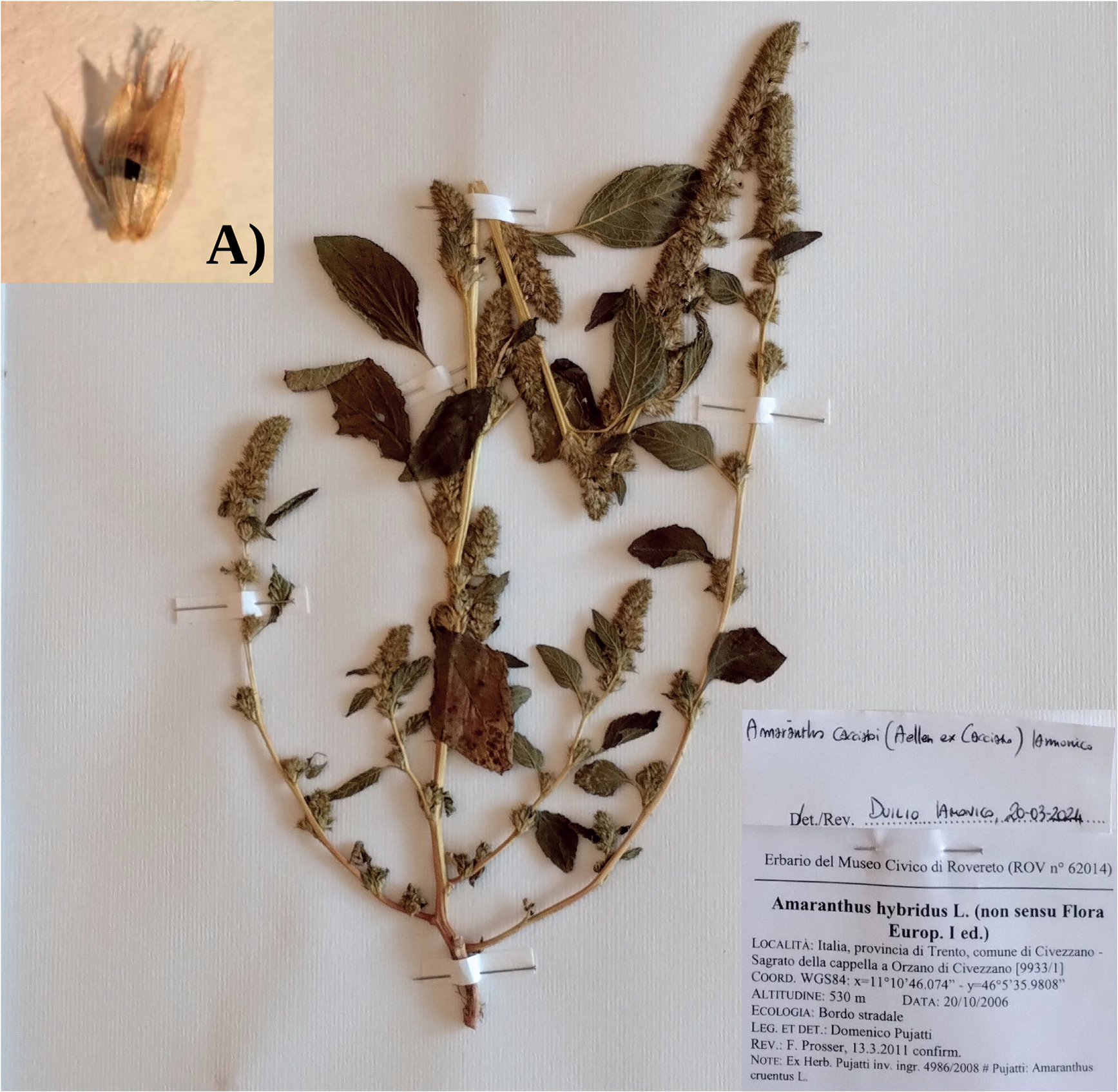
Figure 1:
Specimen of Amaranthus cacciatoi collected in Veneto; A) detail of the perianth (ROV62014). Photographs by D. Iamonico.
Slika 1: Primerek vrste Amaranthus cacciatoi, nabran v Venetu; A) detajl cvetnega odevala (ROV62014). Fotografiji D. Iamonico.
At the current state of knowledge, Amaranthus cacciatoi occurs in Italy only (Iamonico, 2015+; POWO, 2026), where it was so far recorded in Rome only (Latium region, central Italy; Iamonico, 2015). Field surveys in Veneto and Trentino-Alto Adige regions (north-eastern Italy) allowed us to find three populations identifiable as A. cacciatoi. These discoveries represent the first records out of Rome (locus classicus of the species).
Amaranthus cacciatoi (Aellen ex Cacciato) Iamonico, Willdenowia 43(2): 239−240 (2013) ≡ Amaranthus bouchonii Thell. var. cacciatoi Aellen ex Cacciato, Ann. Bot. (Rome) 28: 618 (1966) ≡ Amaranthus powellii S.Watson subsp. cacciatoi (Aellen ex Cacciato) Iamonico, Nordic J. Bot. 30(1): 13 (2012).
Holotype. Italy. Lazio, Roma, in ruderatis, communis in ipse Urbe, 12 August 1965, Cacciato 98 (G!, see Figure 26 in Iamonico, 2015: 60).
Chorology. Central (Latium region) and northern (Trentino-Alto Adige and Veneto regions) Italy. Amaranthus cacciatoi is considered native to Italy according to Iamonico (2015, 2015+), whereas the Portal of Flora of Italy (PFI, 2025) reports it as alien (naturalized in the Lazio region). In our opinion, further investigations are needed to establish the origin status of this taxon. By following the concept in PFI (2025), we considered A. cacciatoi as a casual alien species in both Trentino-Alto Adige and Veneto regions.
Habitat. Roadsides, uncultivated land (Rome city, Latium region) at 20‒60 m a.s.l. Concerning the new populations found in the north of Italy, that from Veneto (Belluno Province, at 575 m a.s.l.; Figure 1) is dense and composed of about one hundred individuals growing in a corn field (during the resting phase) with other weeds, e.g. Amaranthus blitum L. s. str., Lipandra polysperma (L.) S. Fuentes, Uotila & Borsch, Amarathus hybridus L., and Abutilon theophrasti Medik.
Phenology. Flowering from May to September (in Latium) and from March to October in northern Italy (Trentino-Alto Adige and Veneto regions).
Specimens examined. ITALY. Lazio: Roma, Piazza R. Malatesta, 4 November 1960, Cacciato s.n. (RO!); Roma, Centocelle, 29 August 1961, Cacciato s.n. (RO!); Roma, 20 August 1962, Cacciato s.n. (RO!). Roma, Cinecittà, 14 June 1963, Cacciato s.n. (RO!); Roma, ruderati a Torpignattara, 14 August 1964, Cacciato 5026.5 (FI!); Roma, in ruderatis, communis in ipse Urbe, 12 August 1965, Cacciato 98 (G!); Roma, prati a Cinecittà, 10 August 1965, Cacciato s.n. (RO!); Roma, 28 August 1966, Cacciato 13 (G!); Roma, 4 October 1968, Cacciato s.n. (RO!); Roma, lungo via di Portonaccio, 20 August 1968, Cacciato s.n. (RO!); Roma, 14 July 1970, Cacciato s.n. (RO!); Roma, via Appia Nuova, all’altezza di via delle Capannelle, incolti al margine della strada, 15 September 2008, Iamonico s.n. (RO!). Trentino-Alto Adige: provincia di Trento, comune di Divezzano, Sagrato della cappella Orzano di Divezzano bordo stradale, 530 m, 20 October 2006, leg. Et det. Pujatti 9933/1, rev. Prosser (sub Amaranthus hybridus), rev. Iamonico, 20 March 2024 (ROV62014); provincia di Trento, comune di Tassullo, Val di Non, tra Tassullo e la forra di S. Giustina, meleto, 500 m, 18 October 2012, leg. Prosser, Bertolli et Andreatta 9632/3, det. Prosser (sub Amaranthus hybridus), rev. D. Iamonico, 20 March 2024 (ROV60075). Veneto: Belluno, Frontal di Lentiai (Borgo Valbelluna), 575 m, 30 October 2023, leg. C. Argenti, rev. D. Iamonico (PAD, RO, Herbarium Argenti).
Aknowledgements
Thanks are due to the Directors and Curators of all quoted official herbaria for their support during my visits and loan of specimens/photographs.
Notes
[1] Funding
Project funded under the National Recovery and Resilience Plan (NRRP), Mission 4 Component 2 Investment 1.4 - Call for tender No. 3138 of 16 December 2021, rectified by Decree n.3175 of 18 December 2021 of Italian Ministry of University and Research funded by the European Union – NextGenerationEU. Project code CN_00000033, Concession Decree No. 1034 of 17 June 2022 adopted by the Italian Ministry of University and Research, CUP B83C22002950007, Project title “National Biodiversity Future Center – NBFC”.