
Introduction
The genus Galanthus L. (snowdrops) (Amaryllidaceae) currently comprises 26 species of scapose, bulbous perennials native to Europe and Asia Minor (Davis, 1999, 2001; Davis et al., 2025; Zubov et al., 2025). Until recently, G. elwesii Hook.f. and G. graecus Orph. ex Boiss. were considered to be conspecific, in agreement with Davis (1999, 2001). However, based on molecular data (Rønsted et al., 2013), re-evaluation of herbarium specimens and the latest fieldwork, it has been shown that snowdrops occurring in southeastern Europe, and formerly known as G. graecus, represent a distinct species compared to G. elwesii from Turkey (Davis et al., 2025). These species are morphologically very similar to one another because they both have two abaxial, green marks (apical and basal) on the inner perianth segments (except for G. elwesii var. monostictus P.D. Sell, which has a single apical mark), and their leaves have the same range of glaucous coloration. Nevertheless, G. elwesii from Turkey is usually a large plant with broad leaves that are always distinctly supervolute in vernation (i.e., one leaf folded around the other in bud). Conversely, “G. elwesii from Europe” (=G. graecus) is usually a smaller plant with narrow or medium broad leaves that are variable (applanate or supervolute) in vernation (Rønsted et al., 2013). Another species likely to be confused with G. elwesii and G. graecus is G. gracilis Čelak., which differs from the former two species in having leaves that are always strictly applanate in vernation (i.e., leaves held flat against each other in bud) (Davis, 1999, 2001).
Given that Galanthus elwesii is considered to be native to Turkey (Rønsted et al., 2013), the distribution of G. graecus can be defined as Bulgaria, North Macedonia, northeastern Greece, the eastern Aegean Islands (Khios, Lesvos, Samos and Thassos), southern Ukraine, Romania, Moldavia, and eastern Serbia (e.g., Bornmüller, 1928; Stjepanović-Veseličić, 1975; Davis, 1999, 2001, 2011; Jovanović et al., 2016). Due to different approaches and difficulties in classifying these species, the actual patterns of their distribution have remained uncertain. In addition, G. elwesii is introduced and naturalized in many European countries, such as the Netherlands, the United Kingdom (Davis, 2011) and Montenegro (Bubanja & Vuksanović, 2025). In Serbia (including Kosovo and Metohija regions), there are three native species of Galanthus: G. nivalis L., G. graecus, and G. subalpinus A.P. Davis & I. McEnery (Jovanović et al., 2016; Hashani et al., 2019; Millaku et al., 2025; Davis et al., 2025). Galanthus elwesii is commonly found as a garden plant in the country (Jovanović et al., 2014), but is also confirmed to occur subspontaneously in the wild. The distribution of G. graecus in Serbia has been reported in literature under the name “G. elwesii” (Stojanović et al., 2015; Jovanović et al., 2016; Bogosavljević & Zlatković, 2018), which can be supplemented by new field data for Mt. Šljivovički Vis, the vicinity of Telovac (V. Dimitrov, pers. comm.) and Neškovo Brdo, near Dimitrovgrad (B. Dimitrov, pers. comm.). However, considering that G. elwesii and G. graecus are recently separated taxa that are difficult to distinguish from one another, the exact distribution of G. elwesii in Serbia is unknown. In this paper, the distribution and ecology of G. elwesii as a naturalized species in Serbia is presented for the first time, and notes on the species’ morphology and taxonomy compared to the native and closely related G. graecus are given.
Material and methods
The present study is based on field survey, herbarium revisions, literature review and personal communications. Herbarium revisions were conducted at the Herbarium of the Institute of Botany and Botanical Garden “Jevremovac”, University of Belgrade (BEOU), the Herbarium of the Department of Biology and Ecology, Faculty of Natural Sciences and Mathematics, University of Novi Sad (BUNS), and the General Herbarium of the Natural History Museum in Belgrade (BEO) (herbarium acronyms according to Thiers, 2025 [continuously updated]). The analyzed plant material was identified using the taxonomic keys provided by Davis (1999, 2001), Jovanović et al. (2016) and Davis et al. (2025).
The distribution of naturalized Galanthus elwesii in Serbia is mapped using geolocated data and SimpleMappr (Shorthouse, 2010). In addition, chorological and ecological data on the investigated species are minutely presented and arranged by floristic regions. The floristic regionalization of the territory of Serbia used in this study follows Stevanović (1992) and Tomović et al. (2022). Flowering time and morphological characteristics of taxonomic value, such as leaf color and width, vernation, and variability of abaxial green marks on the inner perianth segments, were observed in each investigated population.
Results and Discussion
Taxonomy
In addition to the native species of the genus Galanthus in Serbia, G. elwesii var. elwesii was recorded as an introduced and naturalized taxon. Three native species of the genus in Serbia (G. nivalis, G. subalpinus, and G. graecus) are identified according to Davis et al. (2025). Conversely, G. elwesii is considered to be difficult to distinguish from the native and morphologically similar G. graecus. For this reason, we propose an identification key based on recent fieldwork, morphological observations and critical revision of relevant literature (Adamović, 1901, 1911; Stern, 1956; Artjushenko, 1970, 1974; Delipavlov, 1971; Stjepanović-Veseličić, 1975; Davis, 1999, 2001; Rønsted et al., 2013; Jovanović et al., 2016, 2018; Jovanović, 2019). As shown in the key, the main morphological characters for delimiting G. elwesii and G. graecus are vernation, the width and position of leaves at maturity, and the morphology of the apex of inner perianth segments. Similar patterns of morphological variation have been observed for G. elwesii in Turkey (Rønsted et al., 2013), and G. graecus in Greece (Kamari, 1981, 1982; Davis, 1999; Lafranchis & Sfikas, 2009; Rønsted et al., 2013), Ukraine (Rønsted et al., 2013) and Bulgaria (Delipavlov, 1971).
Key to the identification of Galanthus graecus and G. elwesii:
Leaves applanate (mostly in seedlings and juvenile plants) or subrevolute to supervolute in vernation (in mature plants); leaf blades usually 0.7–1.5 cm wide, slightly twisted to twisted at maturity; inner perianth segments frequently reflexed (flared) at the apex; native to SE Europe and the Balkans........................................ G. graecus (Figure 1a)
– Leaves supervolute in vernation; leaf blades usually 1.5–3.5 cm wide, straight or infrequently slightly twisted at maturity; inner perianth segments ± flat (not flared) at the apex; native to Turkey (in Asia....................G. elwesii (Figure 1b)
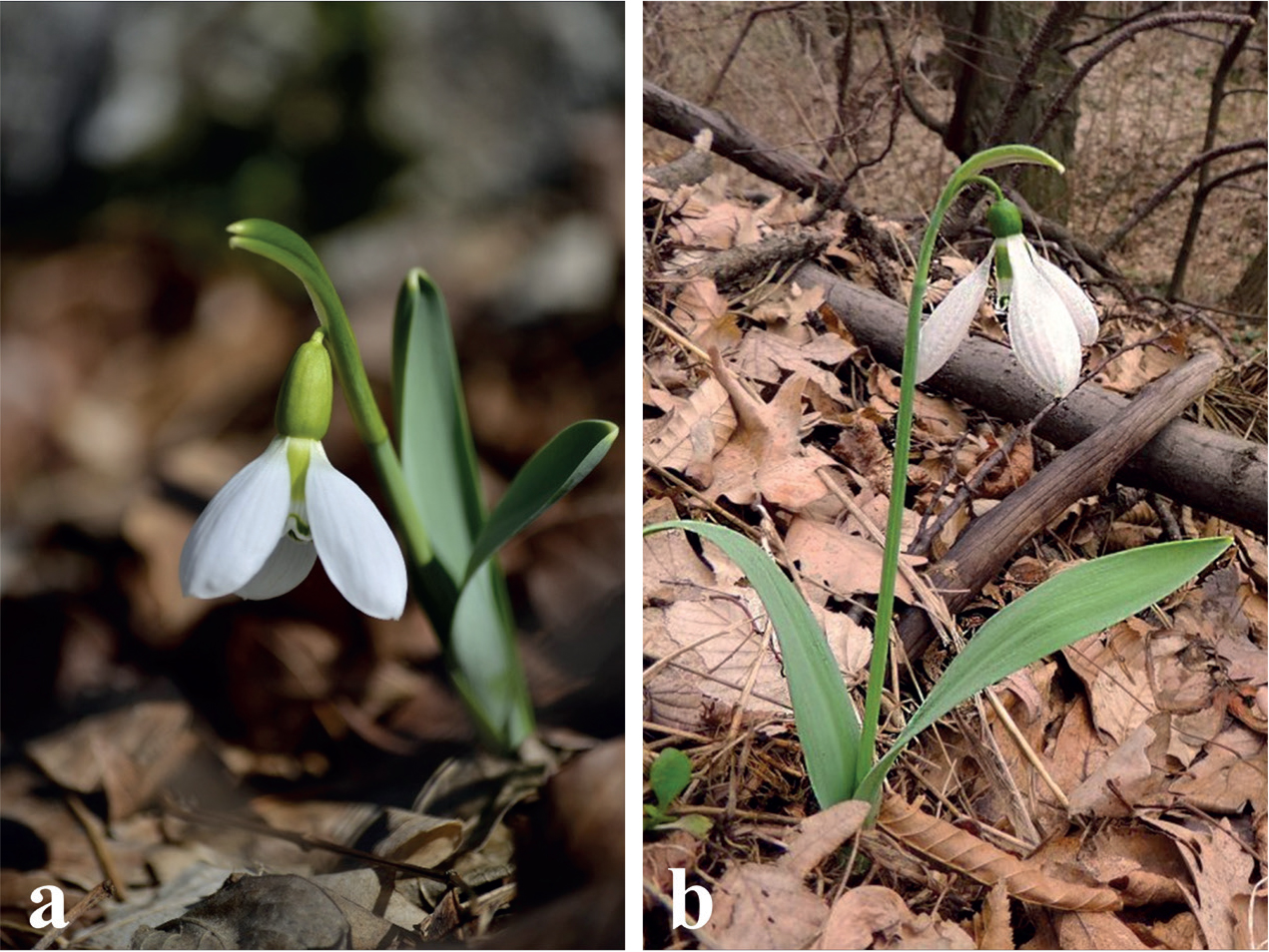
Figure 1:
Two morphologically similar species of Galanthus L. in Serbia: a) native Galanthus graecus Orph. ex Boiss. (Crni Vrh, the vicinity of Pirot), b) naturalized G. elwesii Hook.f. (Brestovačka Spa, near Bor). Photographs: F. Jovanović (a), P. Petrović (b).
Slika 1: Dve morfološko podobni vrsti rodu Galanthus L. v Srbiji: a) domorodna Galanthus graecus Orph. ex Boiss. (Crni Vrh, bližina Pirota), b) naturalizirana G. elwesii Hook.f. (Brestovačka Spa, v bližini Bora). Fotografiji: F. Jovanović (a), P. Petrović (b).
Chorology and ecology
The distribution of naturalized Galanthus elwesii in Serbia is shown in Figure 3 and listed with chorological and ecological data. At the present time, the species is known from 16 localities (including ruderal sites) distributed across eight floristic regions (Bačka, Šumadija, Pomoravlje, C Serbia, NE Serbia, E Serbia, SE Serbia, and S Serbia). Conversely, G. graecus is a narrowly distributed species in Serbia, mostly found in the eastern part of the country (Jovanović et al., 2016). Comparing the obtained results to the literature, it can be argued that the record of G. graecus for Brestovac surroundings (Petković et al., 1982) represented naturalized G. elwesii, given that only the latter species is found in the area. In Serbia, G. elwesii var. elwesii is the most commonly cultivated snowdrop taxon (Jovanović et al., 2014), being robust, decorative, free-flowering and easy to grow (Davis, 2001). Galanthus elwesii var. monostictus may also occur in cultivation, but has not been found naturalized in Serbia. There are no records of when G. elwesii was first introduced to the country, but the earliest cultivation in the Balkans may date back to the Ottoman period (XV–XIX century).
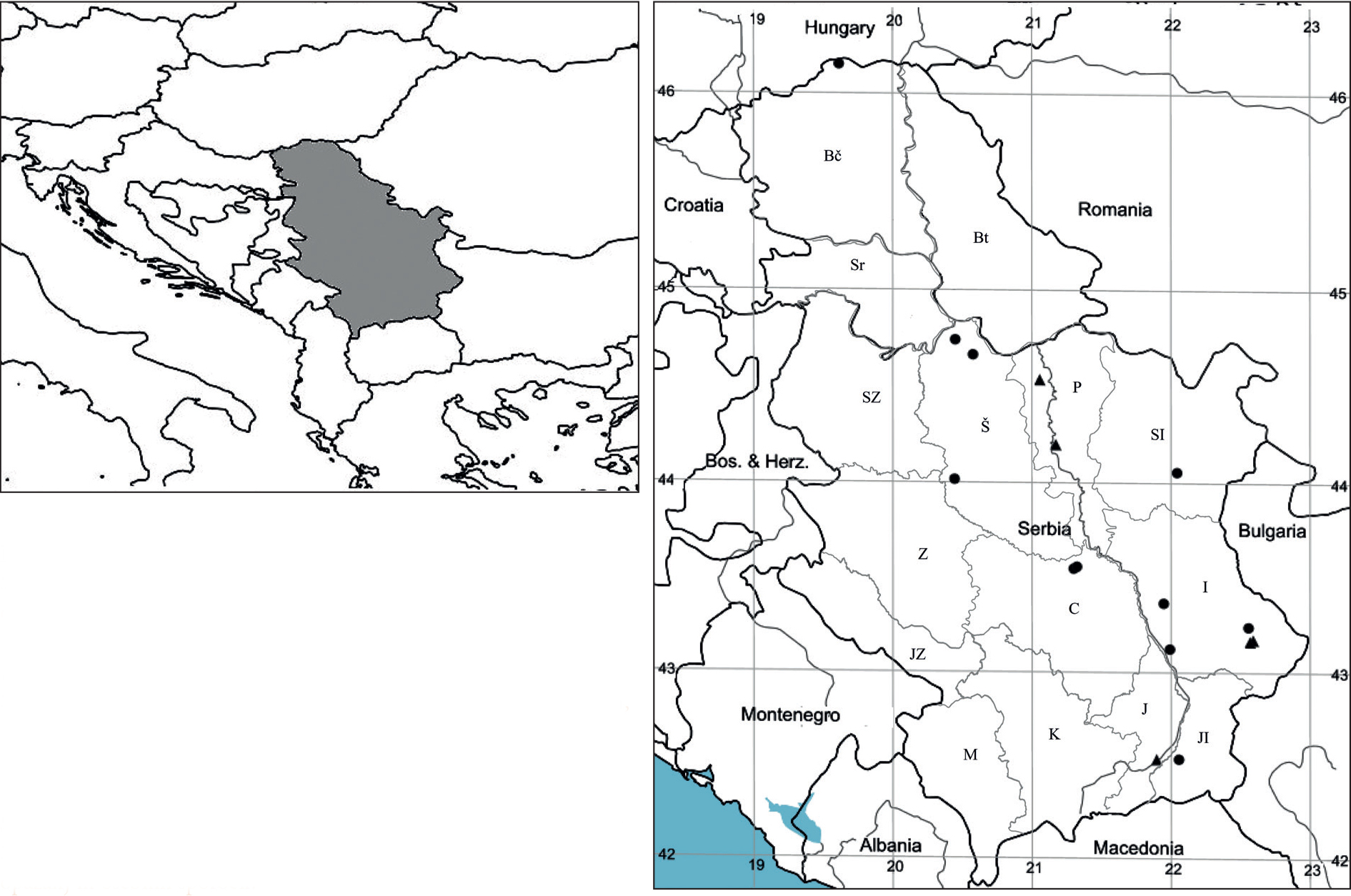
Figure 3:
Distribution of naturalized Galanthus elwesii Hook.f. in Serbia (southeastern Europe) based on herbarium collections, field observations and personal communications.
Black circles – natural sites, black triangles – ruderal sites. Floristic regions: Bč – Bačka, Bt – Banat, Sr – Srem, SZ – Northwestern Serbia, Z – Western Serbia, JZ – Southwestern Serbia, Š – Šumadija, P – Pomoravlje, C – Central Serbia, SI – Northeastern Serbia, I – Eastern Serbia, JI – Southeastern Serbia, J – Southern Serbia, K – Kosovo, M – Metohija.
Slika 3: Razširjenost naturalizirane vrste Galanthus elwesii Hook.f. v Srbiji (jugovzhodna Evropa) na osnovi herbarijskih zbirk, terenskih opažanj in osebnih sporočil.
Črni krožci – naravna rastišča, črni trikotniki – ruderalna rastišča. Floristične regije: Bč – Bačka, Bt – Banat, Sr – Srem, SZ – severozahodna Srbija, Z – zahodna Srbija, JZ – jugozahodna Srbija, Š – Šumadija, P – Pomoravlje, C – srednja Srbija, SI – severovzhodna Srbija, I – vzhodna Srbija, JI – jugovzhodna Srbija, J – južna Srbija, K – Kosovo, M – Metohija.
Chorological and ecological data on Galanthus elwesii in Serbia arranged by floristic regions:
BAČKA: Subotica: Subotica Sands (Daščanska Šuma), ca. 46.146944, 19.613611, forest clearing, sand, ca. 130 m (F. Jovanović, field obs.).
ŠUMADIJA: Beograd: Miljakovačka Šuma (Rakovica municipality hall), ca. 44.742522, 20.449945, deciduous forest (primarily Quercus spp.), marls, clays and siltstones, 148 m (leg./det. F. Jovanović, 07.02.2026, 18086, BEOU!); Grocka: Vrčin, ca. 44.665556, 20.577500, meadow, loess, 151 m (M. Vujić, pers. comm.); Gornji Milanovac: Brusnica (St. Nicholas church), ca. 44.015889, 20.444306, forest, sandstone, 415 m (F. Jovanović, field obs.).
POMORAVLJE: Smederevo: Osipaonica, ca. 44.534722, 21.056306, near a railway station (R. Marinković, pers. comm.); Svilajnac: Crkvenačko Blato, ca. 44.197222, 21.171111, abandoned quarry near a cemetery (Figure 2a) (leg. M. Niketić & G. Tomović, 30.01.2021, s.n., BEO!, det. F. Jovanović, 08.08.2025).
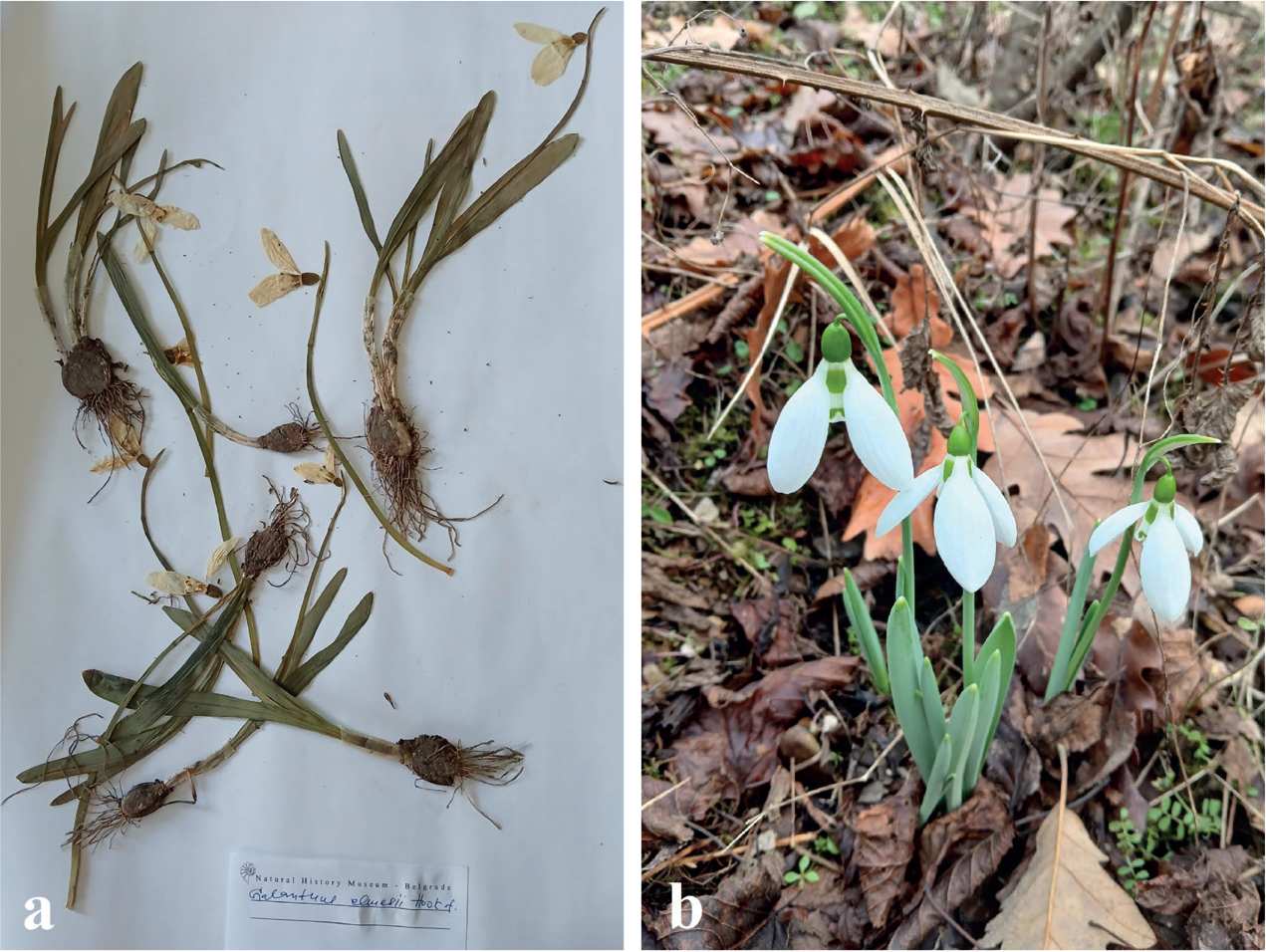
Figure 2:
Specimens of naturalized Galanthus elwesii Hook.f. in Serbia: a) collected at Crkvenačko Blato, near Svilajnac (leg. M. Niketić & G. Tomović, s.n., BEO!, det. F. Jovanović); b) observed in Mudrakovac, near Kruševac. Photographs: F. Jovanović (a, b).
Slika 2: Primerki naturalizirane vrste Galanthus elwesii Hook.f. in Serbia: a) nabrano pri Crkvenačkem Blatu v bližini mesta Svilajnac (leg. M. Niketić & G. Tomović, s.n., BEO!, det. F. Jovanović); b) opaženo pri naselju Mudrakovac v bližini Kruševca. Fotografiji: F. Jovanović (a, b).
C SERBIA: Kruševac: Gari, ca. 43.548874, 21.299349, streamside in a mixed deciduous forest (e.g., Quercus cerris L., Acer campestre L.), clays, sands and gravels, 235 m (leg. F. Jovanović & G. Češljar, det. F. Jovanović, 04. 02. 2026, 18088, BEOU!); Mudrakovac, ca. 43.559270, 21.323139, scrub (e.g., A. tataricum L., Prunus spinosa L.), clays, sands and gravels, 242 m (Figure 2b) (leg. F. Jovanović & G. Češljar, det. F. Jovanović, 04.02.2026, 18087, BEOU!).
NE SERBIA: Bor: Brestovačka Spa, ca. 44.056667, 22.043889, forest (Fagus sylvatica L.), ca. 400 m (Figure 1b) (P. Petrović, photo).
E SERBIA: Niš: Popova Glava, ca. 43.367500, 21.947222, meadow, limestone, ca. 350 m (F. Jovanović, field obs.); Mt. Babička Gora, ca. 43.125000, 21.991389, bushes near a mixed deciduous forest (e.g., Robinia pseudoacacia L., Quercus cerris), ca. 400 m (S. Stevčić, pers. comm.); Pirot: Provalija, ca. 43.171944, 22.590833, plantation (Pinus nigra J.F. Arnold), sand and gravel, 435 m (F. Jovanović, field. obs.); Sarlah, ca. 43.163056, 22.568056, orchard near the road, limestone, 450 m (ibid.); Oreovica, ca. 43.242056, 22.557000, mixed deciduous forest (primarily Quercus spp.), ca. 500 m (B. Đorđević, pers. comm.).
SE SERBIA: Vranjska Banja, ca. 42.536444, 22.055556 (leg. M. Velinov, det. Z. Krivošej, 171, BEOU!, subnom. G. graecus, rev. F. Jovanović, 31.03.2025).
S SERBIA: Vranje: Francuska Street, ca. 42.532778, 21.895389, wet ruderal sites (Stojanović et al., 2015; leg./det. ?, 31.03.2000, s.n., BEOU!, subnom. G. graecus, rev. S. Đurović, 14.02.2020).
In Serbia, Galanthus elwesii is found in a variety of habitats, including mixed deciduous forests (e.g., Fagus sylvatica, Acer campestre, Quercus spp.), plantations (Pinus nigra), orchards, scrub, forest clearings and meadows, on various substrates (limestone, loess, sand, etc.), at altitudes from ca. 80 m to 850 m, but most commonly above 400 m. Similar findings have been reported for Montenegro, the city of Berane and its surroundings (Donja Ržanica), where this species occurs subspontaneously in meadows, riversides and forest margins, at altitudes from 663 m to 804 m (Bubanja & Vuksanović, 2025). Conversely, in its natural range, G. elwesii is mainly a mountainous plant, occurring at altitudes above 800 m and up to 1600 m. It does not grow in areas that have been intensively affected by human activities, such as pastures and clear-cut forests (Davis, 2001). In addition, G. graecus in Serbia is mostly found in montane beech forests, at altitudes above 750 m and up to 1350 m (Jovanović et al., 2016).
Phenological observations revealed that Galanthus elwesii var. elwesii in Serbia flowers from mid-January to the beginning of March. In its natural range, this taxon flowers from February to May (Davis, 2001). The number of specimens per locality (ranging from several individuals to around one thousand individuals), their grouping habit and morphological similarity, along with the absence of fruits (capsules) with viable seeds, indicate clonal propagation of G. elwesii in Serbia. It is usually represented by large plants that have broad leaves and relatively large flowers similar to those found in cultivation (Davis, 1999, 2001). These observations support the hypothesis that G. elwesii in Serbia originated from cultivation and subsequently became naturalized.
Conclusion
In Serbia, Galanthus elwesii Hook.f is an introduced and naturalized snowdrop species, presently found at 16 localities distributed across eight floristic regions. Galanthus elwesii is morphologically similar to G. graecus Orph. ex Boiss., native in the country, but it can be distinguished from the latter by its leaves that are (consistently) supervolute in vernation, usually broader (i.e., more than 1.5 cm wide) and straight (not twisted) at maturity, and the inner perianth segments are more or less straight (not flared) at the apex. It occurs in a variety of habitats, such as mixed deciduous forests (e.g., Fagus sylvatica L., Acer campestre L., Quercus spp.), scrub, forest clearings and meadows, on various substrates (limestone, loess, sand, etc.), at altitudes from ca. 80 m to 850 m but particularly above 400 m. Further research should be conducted before the ecological impacts of this non-native species in Serbia can be evaluated and its potential interactions with native flora assessed.