
Introduction
Mountain ecosystems constitute climatic and geographic islands that reflect ecological conditions different from those of their surroundings, constituting shelter for certain types of vegetation (Quézel, 1996; Blanca et al., 2019). Due to these conditions, the existence of unique ecosystems that are not found in neighbouring areas and even at great distances is possible (Blanca & Algarra, 2011). These types of vegetation in refuge spaces (Blanca et al., 2002) constitute models to understand the adaptations to special ecological conditions and to study changes in flora composition or vegetation structure due to changes in the ecological conditions. Mountain Mediterranean areas offer small refuge spaces where ecological conditions resemble those that disappeared along the climatic history. The flora and vegetation living in these spaces provide basic information about the ecological characteristics of the ecosystem they inhabit (Blanca et al., 2001).
The mountains of southeastern Iberian Peninsula, and Sierra Nevada in particular, were of great importance as a cold climatic refuge for flora and vegetation during the successive climatic changes that occurred from the late Tertiary to the present Quaternary (Fernández et al., 2007; Manzano et al., 2017). It is especially a climatic refuge for several paleoendemics with boreal, temperate, or arctic-alpine affinities (Molina-Venegas et al., 2017) due to its latitude, E-W orientation and, above all, because it is the highest (3481 m) and most extensive mountain range in the south of the Iberian Peninsula. As a crossroad of migratory routes supplying floristic contingents of diverse origins (Blanca et al., 2019), it also acts as a “museum” for these relict, rare and endemic species (Peñas et al., 2019) that today constitute relevant biogeographical disjunctions.
Sierra Nevada (Andalusia, Spain), with a total of 2350 taxa in a territory of about 2000 km2 (Lorite, 2016, 2020), represents 33% of the Iberian flora and 20% of the European flora (Aedo et al., 2017). 95 species out of the total are endemic (Peñas et al., 2019), 138 species are threatened into different categories: 17 ‘critically endangered’ (CR), 18 ‘endangered’ (EN) and 103 ‘vulnerable’ (VU) (Salazar & Valle, 2019) and 31 protected (Decree 23/2012). It is considered an important hotspot of plant diversity in the western Mediterranean region (Médail & Quézel, 1999; Blanca et al., 2002; Lorite, 2016).
The northern face of Sierra Nevada represents an exceptional enclave because it is home to flora and vegetation in an acceptable state of conservation which is very scarce in the south of the Iberian Peninsula and Western Europe (Losa-Quintana et al., 1986). It is necessary to study the plant communities (Lorite et al., 2003; Rivas-Martínez, 2007; Rivas-Martínez, 2007, 2011) and its high floristic richness (Blanca et al., 1999, 2000, 2011; Lorite, 2016, 2020; Pavón-Núñez et al., 2020a) through basic studies to be able to carry out conservation and management tasks. The importance of knowing in depth the vegetation of Sierra Nevada lies also in the fact that it is included in the European Union’s Natura 2000 Network as a Special Area of Conservation (SAC) and because it contains habitats and species of Community Interest. 37 habitats of Directive 92/43 EEC are present in Sierra Nevada of which 22 HCI (Habitat of Community Interest) contain 95% of its threatened flora taking part in a wide diversity of plant communities (Salazar & Valle, 2019). Although the flora and vegetation of Sierra Nevada has been extensively studied, certain refuge enclaves on its northern face merit further study, above all because of the possible existence of deciduous forests (beyond those traditionally identified) and their associated dynamic and catenal vegetation. On the northern face of the Sierra Nevada, certain areas have been identified that form refuge areas for important types of vegetation that are no longer present today in the southeast of the Iberian Peninsula (Blanca et al., 2019). The upper basins of the rivers Alhama de Lugros, Genil, Dúrcal and Dílar, located in the north-west of Sierra Nevada, are very important forest areas surrounded by peaks exceding 3,000 metres in elevation, with ravines in moist siliceous soils and temporary flooding in the sub-humid supramediterranean thermotype (Losa-Quintana et al., 1986). The western basins of the Dúrcal and Dílar rivers maintain, even today, the most important relict and more southern Eurosiberian populations of Betula pendula subsp. fontqueri (Rothm.) G. Moreno & Peinado in the whole mountain range and in the southern Iberian Peninsula (Martínez-Labarga et al., 1990; Girela et al., 2001). The upper Northwestern basin of the Genil River is noted for its relict forests of the oak Quercus pyrenaica Willd. in its mesophytic faciation with Acer opalus Mill. subsp. granatense (Boiss.) Font Quer & Rothm. and Sorbus aria (L.) Crantz, as well as old Castanea sativa Mill. plantations (Losa Quintana et al., 1986). Among these places, the upper basin of the Alhama de Lugros River (Dehesa del Camarate) on the center-northern slope of Sierra Nevada contains well-preserved winter-deciduous forests. At the bottoms of ravines and shady supra-mediterranean slopes with humid ombrotype and temporohygrophilous soils between 1500 and 2000 m, mixed winter-deciduous forests of multispecific composition are found with Prunus avium L., Fraxinus excelsior L. and its hybrid (F. excelsior x F. angustifolia), Acer opalus subsp. granatense, Sorbus aria, Taxus baccata L., Malus sylvestris (L.) Mill. and Pyrus cordata Desv. This type of forest has not been described and catalogued yet and so deserves its phytosociological study. In sunnier areas and somewhat drier but equally deep soils, marcescent forests of Quercus pyrenaica oaks appear, which, depending on the gradients of humidity, can be monospecific or accompanied by other mesophilic species such as Acer opalus subsp. granatense or Sorbus aria (Molero & Marfil, 2017).
These northern slopes of Sierra Nevada could be considered suitable sites for studying the existence of climatic refuges, threatened flora and plant communities, which are key elements to be preserved. To contribute to a more detailed study of the mixed winter-deciduous forest and its associated vegetation, the first objective was to identify the diversity of vascular plants and to obtain a floristic catalogue, highlighting endemic, threatened, rare, chorologically interesting or legally protected taxa. The second objective was to characterise and identify the diversity of plant associations and communities, focusing on deciduous forests and their associated vegetation, identifying those included in the Habitats Directive 92/43/EEC.
Materials and methods
Study area
The study area (Figure 1) corresponds to the northern face of Sierra Nevada, upper basin of the Alhama river in the province of Granada, in the south of the Iberian Peninsula (Andalusia, Spain). The area is included in the municipality of Lugros and to a lesser extent (the highest part) in the municipalities of Jerez del Marquesado and Güejar-Sierra. It is included in the Sierra Nevada National Park and in the Special Area of Conservation (SAC) with Site code ES6140009. It occupies a total of 20.79 km2 state-owned land of which about 150 ha correspond to the Reserve Zone (21.4%). Altitudes reach between 1350 and 3088 m in the highest peak) above sea level. The lithology comprises a continuum of rocks derived from quartzite and micaschist (Martín et al., 2008; IGME, 2019), and the soils correspond to eutric and dystric cambisols (Balsera, 1989; FAO, 2009; Martín-Peinado et al., 2019).
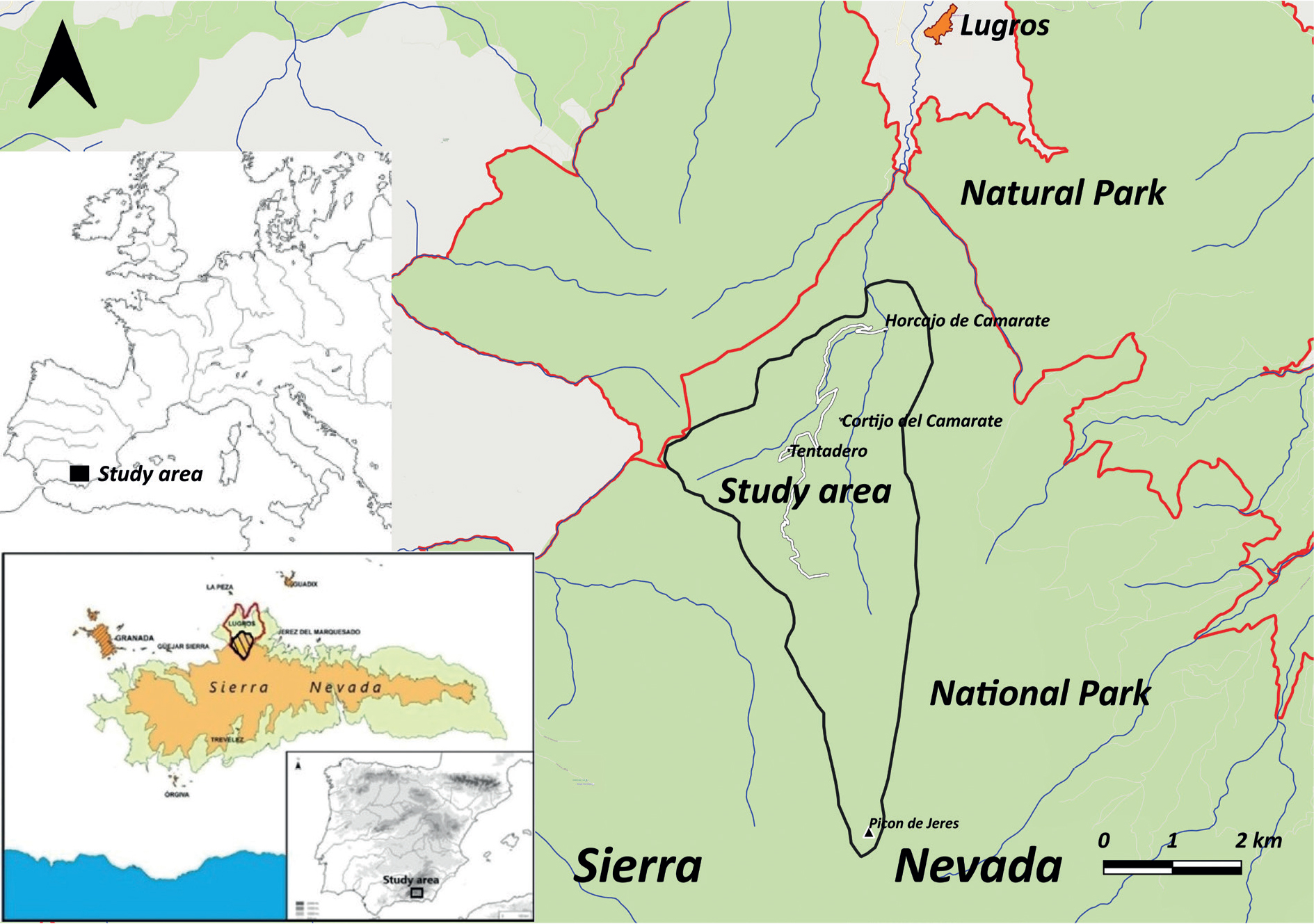
Figure 1:
Geographical location of the study area (Sierra Nevada, Granada, Spain) in the National Park of Sierra Nevada. Source: own elaboration using the coverage available in DERA (2019).
Slika 1: Geografska lega območja raziskave (Sierra Nevada, Granada, Španija) v narodnem parku Sierra Nevada. Vir: lastna izdelava na podlagi podatkov, ki so na voljo v DERA (2019).
Based on the available data collected at the two meteorological stations present in the study area, bioclimatic parameters and indexes were calculated (Table 1). In addition, the Submediterraneity Index (Rivas-Martínez et al., 2011b) was determined for the two stations mentioned above (Table 2). The Embarcadero station at 1517 m obtained a sub-Mediterranean index (Isbm) of 0 (all Ios values were negative) which is interpreted as a water deficit extending throughout the summer season, i.e. zero sub-Mediterraneanity, and therefore a genuine Mediterranean climate with intense summer drought. For the Piedra de los Soldados station at 2155 m, all Ios reached negative values except in September (Ios4 = +0.71), which was decisive in the Isbm value of + 0.71. This resulted in very weak sub-Mediterraneanity, insufficient as a water supply to compensate for the central months of summer.
Table 1:
Bioclimatic data of the study site (upper basin of the Alhama de Lugros river). T: Annual Average Temperature; Tp: Annual Positive Temperature; Ts: Summer temperature; P: Annual precipitation; Pp: Annual Positive Precipitation; Itc: Compensated Thermicity Index; Ic: Continentality Index; Io: Ombrothermic Index; Io6 (June); Io7 (July); Io8 (August): Monthly Ombrothermic Index (Marfil et al. 2016).
Tabela 1: Bioklimatski podatki območja študije (zgornji bazen reke Alhama de Lugros). T: letna povprečna temperatura; Tp: letna pozitivna temperatura; Ts: poletna temperatura; P: letne padavine; Pp: letne pozitivne padavine; Itc: kompenzirani indeks toplotne energije; Ic: indeks kontinentalnosti; Io: ombrotermični indeks; Io6 (junij); Io7 (julij); Io8 (avgust): mesečni ombrotermični indeks (Marfil et al. 2016).
| Study site (meteoro logical station) | Lat. Long. | Alt. (m) | Years | T | Tp | Ts | P | Pp | Itc | Ic | Io | Io6 | Io7 | Io8 | Isobioclimates |
|---|---|---|---|---|---|---|---|---|---|---|---|---|---|---|---|
| Embarcadero | 37º 11'N | 1517 | 2008–2019 | 12.1 | 1448.3 | 657.3 | 544.8 | 540.2 | 219.7 | 20.7 | 3.4 | 0.7 | 0.3 | 0.3 | Lower Supramediterranean- |
| 3º 15'W | Lower Subhumid | ||||||||||||||
| Piedra de los | 37º 9'N | 2155 | 2008–2019 | 7.9 | 899.7 | 509.9 | 509.2 | 444.6 | 82 | 20 | 4.6 | 1.2 | 0.3 | 0.4 | Lower Oromediterranean- |
| Soldados | 3º 15'W | Lower Subhumid. |
Table 2:
Submediterraneity Index (Isbm). Isbm = sum of the submediterraneity values of the summer monthly ombrothermic indexes Ios1, Ios2, Ios3 and Ios4 provided they are positive and not including negatives (Rivas-Martínez et al., 2017).
Tabela 2: Indeks submediteranskosti (Isbm). Isbm = vsota vrednosti submediteranskosti poletnih mesečnih ombrotermičnih indeksov Ios1, Ios2, Ios3 in Ios4, če so pozitivni in ne vključujejo negativnih vrednosti (Rivas-Martínez et al., 2017).
| Study site (meteoro logicalstation) | Lat. Long. | Alt. (m) | Years | Ios1 | Ios2 | Ios3 | Ios4 | Isbm | Type of submediterraneity |
|---|---|---|---|---|---|---|---|---|---|
| Embarcadero | 37º 11'N | 1517 | 2008–2019 | −40.03 | −58.84 | −57.44 | −24.42 | 0 | Genuine Mediterranean |
| 3º 15'W | |||||||||
| Piedra de los | 37º 9'N | 2155 | 2008–2019 | −23.64 | −47.94 | −43.74 | 0.71 | 0.71 | Extremely Weak Submediterranean (Isbm 1–30) |
| Soldados | 3º 15'W |
Bioclimatic diagrams have also been represented from the data of the two meteorological stations (Figure 2a, Figure 2b), showing a dry period coinciding with the summer months, generally from mid-late May to the end-middle of September, more accentuated at medium altitudes (1517 m) than at higher altitudes (2155 m).
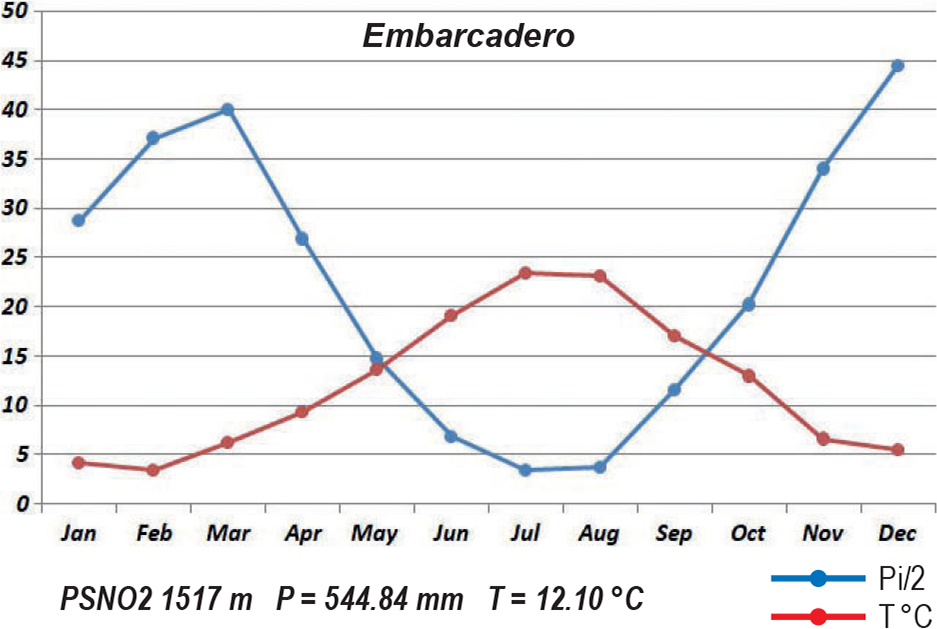
Figure 2a:
Climatic diagram of the study site (meteorological station: “Embarcadero” PSN02, 1517 m).
Slika 2a: Klimatski diagram območja raziskave (meteorološka postaja: “Embarcadero”PSN02, 1517 m).
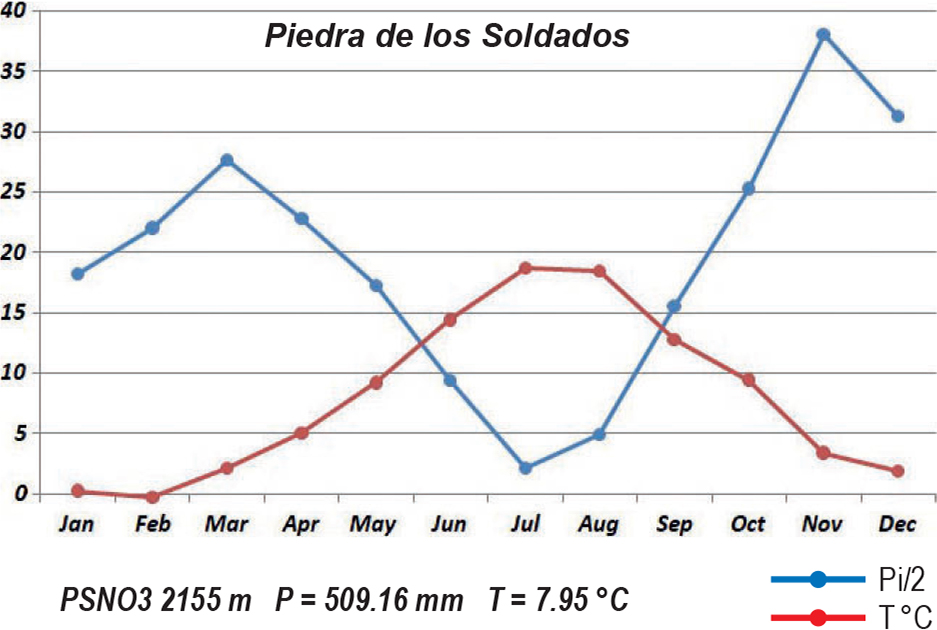
Figure 2b:
Climatic diagram of the study site (meteorological station: “Piedra de los Soldados” PSN03, 2155 m).
Slika 2b: Klimatski diagram območja raziskave (meteorološka postaja: “Piedra de los Soldados” PSN03, 2155 m).
The bioclimatic indexes, based on the bioclimatic classification of Rivas-Martínez (1996–2009) and Rivas-Martínez et al. (2017) were calculated for the two meteorological stations present at the study site:
Embarcadero station (1517 m): the site was classified as belonging to the lower supramediterranean thermotype (Mean annual temperature, T=12.38 ºC; Compensated thermal index, Itc=219) and the lower subhumid ombrotype (Average annual rainfall, P=540.15 mm; Annual ombrothermic index, Io=4.89).
Piedra de los Soldados station (2155 m): the site was classified as belonging to the lower oromediterranean thermotype (Mean annual temperature, T=7.94 ºC; Compensated thermal index, Itc=82.04) and the lower subhumid ombrotype (Average annual rainfall, P=477.01 mm; Annual ombrothermic index; Io=4.60).
Biogeographically, the area is classified into the Hol-arctic Kingdom, Mediterranean Region, Western Mediterranean Subregion, Iberian-Moroccan-Atlantic Super-province, Baetic Province, Nevadensian Sector and Nevadensian Subsector (Galán de Mera et al., 2003; Marfil et al., 2016).
Methodology
Botanical surveys (transects) of flora and vegetation have been carried out in this territory from August 2018 to July 2023, and are depicted in Figure 3.
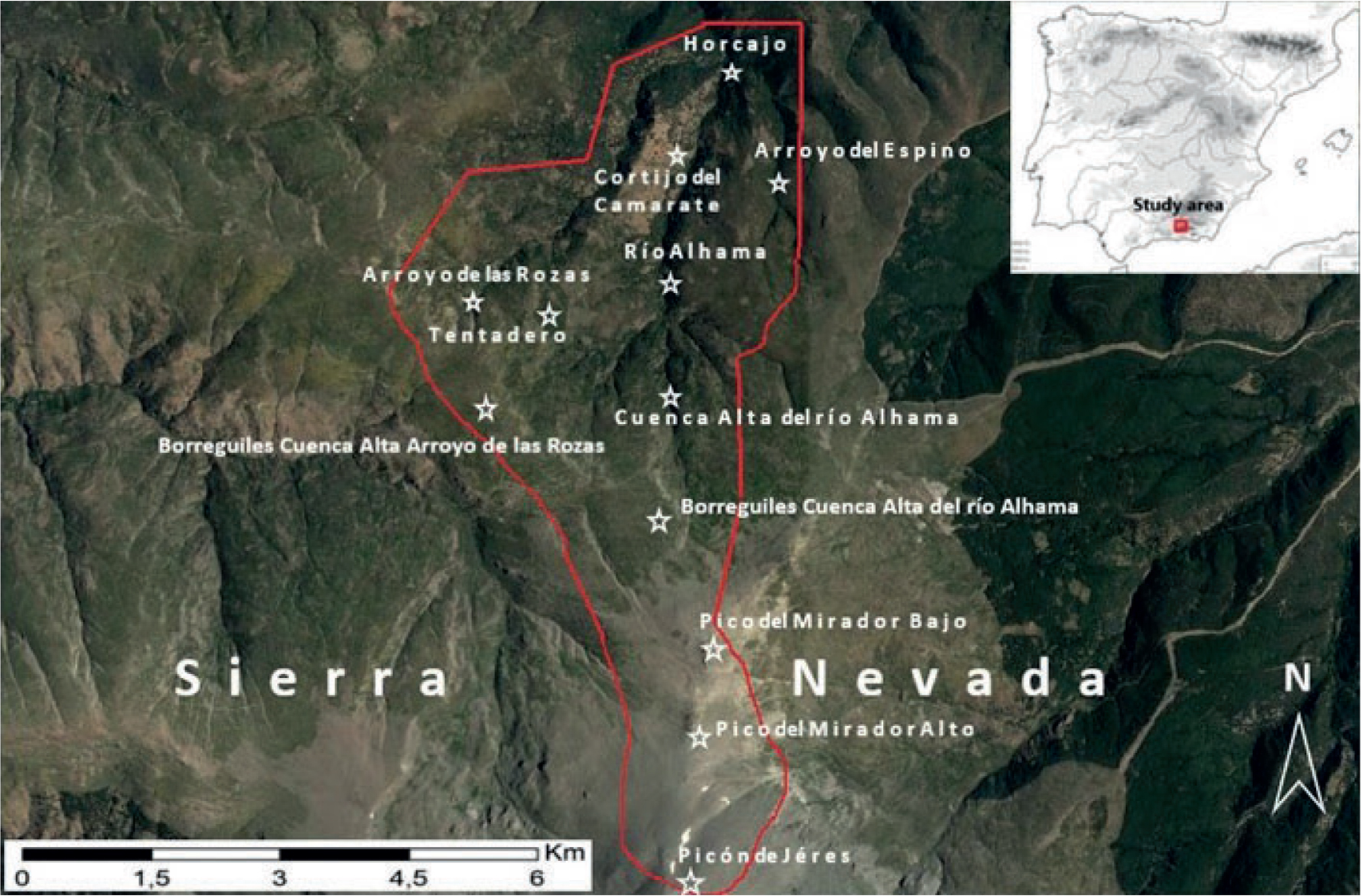
Figure 3:
Study area indicating surveyed localities (spelled in white):1. Horcajo (30S477803/4116010), 2. Cortijo del Camarate (30S477176/4114766), 3. Arroyo del Espino (30S 478422/4115337), 4. Río Alhama (30S477299/4113777), 5. Arroyo de las Rozas (30S 476774/4115046), 6. Tentadero (30S476384/4114341), 7. Cuenca Alta del río Alhama (30S477527/4113543), 8. Borreguiles Cuenca Alta Arroyo de las Rozas (30S475619/4113874), 9. Borreguiles Cuenca Alta del río Alhama (30S477216/4110557), 10. Pico del Mirador Bajo (30S477729/4110335), 11. Pico del Mirador Alto (30S477565/4112170), 12. Picón de Jeres (30S477520/4108619). Source: Own elaboration using the coverage available in Google Earth.
Slika 3: Lokacija območja študije z označenimi raziskanimi območji (belo): 1. Horcajo (30S477803/4116010), 2. Cortijo del Camarate (30S477176/4114766), 3. Arroyo del Espino (30S 478422/4115337), 4. Río Alhama (30S477299/4113777), 5. Arroyo de las Rozas (30S 476774/4115046), 6. Tentadero (30S476384/4114341), 7. Cuenca Alta del río Alhama (30S477527/4113543), 8. Borreguiles Cuenca Alta Arroyo de las Rozas (30S475619/4113874), 9. Borreguiles Cuenca Alta del río Alhama (30S477216/4110557), 10. Pico del Mirador Bajo (30S477729/4110335), 11. Pico del Mirador Alto (30S477565/4112170), 12. Picón de Jeres (30S477520/4108619). Vir: Lastna izdelava na podlagi podatkov, ki so na voljo v Google Earth.
Floristic study
The collection of plant specimens was done between August 2018 and July 2023 in the three main parts of the study area (Figure 2: low area -Horcajo de Camarate and Zona de Reserva Baja-, middle area -Arroyo de las Rozas and Tentadero- and high area -Zona de Reserva Alta and northern slope of Pico Mirador Bajo/Mirador Alto and Picón de Jeres). The samplings were carried out in two periods: spring-summer, and autumn, coinciding with the phenological development of flora and vegetation, and following altitudinal transects from 1350 m to 3088 m. All the possible ecosystems and micro-ecosystems (e.g. peat bogs) and altitudinal belts were visited. The works “Flora Vascular de Andalucía Oriental” (Blanca et al., 2011) and “Flora iberica” (Castroviejo et al., 1986–2021) have been used for the identification of vascular flora. Because of their importance, some bryophytes were also collected both in deciduous forests and in plant communities where they could be characteristic taxa (e–. hydrophytic vegetation). Identification has been made following Flora Briofitica Iberica (Guerra et al., 2006–2018) by the University of Murcia personnel (Dr. J. Guerra).
Taxa from GBIF.org recorded in the study area were also included. In order to determine the degree of threat for the catalogued flora, we have consulted the Spanish and Andalusian red books (Blanca et al., 1999, 2000; Bañares et al., 2004, 2010), the Spanish red list (Moreno, 2008) and the Andalusian red list (Cabezudo et al., 2005). The legal protection status of the catalogued species was included according to the Andalusian legislation (D 23/2012). For legally protected species we indicated: scientific name, family, protection status (according to Andalusian catalogue and list of wild species under special protection)(D 23/2012); PEC: Plant species of European Community interest in need of strict protection), threat degree in Red Lists of Spain -RLS- and/or Andalusia -RLA-; (Blanca et al., 1999, 2000; Bañares et al., 2004; Bañares et al., 2010; Moreno, 2008), ecology (Blanca et al., 2011), phytosociological class in the study site (Rivas-Martínez et al., 2011a), local endemism (Blanca et al., 2011) and for invasive alien species, Royal Decree 630/2013 and Sanz-Elorza et al. (2004) have been followed. Voucher specimens are deposited in the MGC Herbarium (University of Málaga) (Thiers, continuously updated).
For those taxa of greatest relevance, the percentages of threatened, protected and endemic flora were calculated based on the catalogue of flora collected, inventoried and initially cited in the databases GBIF (2023).
Vegetation study
For the description of the vegetation units, we applied the phytosociological methodology of Braun-Blanquet (1979), complemented by Gehú & Rivas-Martínez (1981) and Schuhwerk (1990). The most interesting forest vegetation for this study, such as winter-deciduous and marcescent forests, as well as their dynamic stages and catenal contact vegetation, have been inventoried. Phytosociological relevés (75) have been carried out between August 2018 and July 2023 in ecologically homogeneous plots, geo-referenced, distributed throughout the study area. Plot size was estimated by the minimum area calculation procedure (Braun-Blanquet, 1979; Rivas-Martínez, 2007, 2011a). The recorded ecological parameters for each phytosociological relevés included: slope (º), plot size (m2), lithological composition, altitude (m a.s.l.), vegetation height (m or cm) and vegetation cover (%). All the relevés have been georeferenced in UTM coordinates using satellite data measured on the ground in the inventoried plot using a handheld GPS receiver. The phytosociological synthetic tables methodology has been applied to differentiate between the new associations proposed and other similar ones published previously. This methodology has not been used for subassociations but a complete description and differential species are given. The new syntaxonomical proposals follow the International Code of Phytosociological Nomenclature (Theurillat et al., 2021).
The syntaxonomical scheme shows the associations identified during this work as well as those of other authors that appear in the bibliography obtained for the studied area (Martínez-Parras et al., 1985; Losa-Quintana et al., 1986; Martínez-Parras et al., 1987; Lorite, 2001; Salazar et al. 2001a; Lorite et al., 2003; Rivas-Martínez et al., 2011). The phytosociological database SIVIM (Iberian and Macaronesian Vegetation Information System) was also consulted for the elaboration of the syntaxonomic scheme.
The proposal of Rivas-Martínez et al. (2011) was followed to identify the vegetation series, the characteristic species of the syntaxa and the most precise geo-ecological nomenclature. We follow Pérez-Latorre et al. (2004, 2008) to describe the zone-potential vegetation, using the data from the phytosociological tables and inventories. Soil types follow the FAO classification (2009) and were obtained from De Pedraza (1996). The development of the altitudinal catenas (geosigmetum) follows Rivas-Martínez (2007).
To identify the habitat types included in the Habitats Directive (Council Directive 92/43/EEC), Annex I was consulted, as well as the Atlas and Manual of Habitats of Spain (Rivas-Martínez et al., 2003) and the Andalusian habitat guide (REDIAM, 2020).
Results and discussion
Flora
A total of 629 herbarium sheets were collected. The catalogue of vascular flora resulting from our study (Supplementary material) comprises a total of 440 taxa (species and subspecies), 370 from our floristic recording, 58 from our vegetation records and 12 initially from GBIF, belonging to 248 genera in 78 families. This represents almost 19% of the total number of species catalogued in Sierra Nevada (Lorite, 2016, 2020) and nearly 12% when compared to the flora of Eastern Andalusia (Cueto et al., 2014). In the catalogue, 20 taxa (4.5%) are endemic to Sierra Nevada and represent 23.8% of the known 84 endemic species for the whole of Sierra Nevada (Lorite, 2016, 2020). The distribution of species accor ding to large taxonomic groups is as follows: pteridophytes 2.35%, gymnosperms 0.85% and angiosperms 96.8%. In the study area, the predominant floristic element was the Mediterranean (60 taxa; 13.6%), followed by the Iberian-North African (49; 11.13%), European (40; 9.1%), Nevadensian (36; 8.18%), Eurasian (34; 7.72), Holartic (31; 7.05%), Iberian (30; 6.81%), Paleotemperate (25; 5.68%) and Eurosiberian element (17; 3.86%).
Legally protected and threatened Species
The total number of threatened species according to the Red List of Andalusia (Cabezudo et al., 2005) in the study area is 25, of which 17 species are protected by andalusian legislation (Decree 23/2012 and Law 8/2003). The following threat categories are represented: 1 (EX); 1 (CR); 2(EN) and 21 (VU) (Table 3). In Sierra Nevada, with 2348 catalogued species (Lorite et al. 2016, 2020), 123 (5.24%) species of vascular plants are threatened (Cabezudo et al. 2005) of which 61 (2.6%) are legally protected (Decree 23/2012 and Law 8/2003). In the study area, with a total of 440 species and subspecies that make up the floristic catalogue, 25 are threatened (5.68 %) and 17 are protected (3.86%).
The protected/threatened flora is shown in Table 3.
Table 3:
Protected/threatened flora, Phytosociological affinity and Habitats of Community Interest. (*) Priority habitat. Threat category IUCN (2001): EX = Extinct, CR = Critically Endangered, EN = Endangered, VU = Vulnerable.
| Taxa | Phytosociological affinity |
|---|---|
| Aconitum burnatii Gáyer (Ranunculaceae) | Cirsion flavispinae |
| Agrostis canina L. subsp. granatensis Romero García, Blanca & C. Morales. (Gramineae) | Festucion frigidae |
| Androsace vitaliana (L.) Lapeyr. subsp. nevadensis (Chiarugi) Luceño (Primulaceae) | Nevadension purpureae |
| Andryala agardhii DC. (Compositae) | Andryalion agardhii |
| Aquilegia vulgaris L. subsp. nevadensis (Boiss. & Reut.) T. E. Díaz (Ranunculaceae) | Cirsion flavispinae |
| Armeria filicaulis (Boiss.) Boiss. subsp. nevadensis Nieto Fel., Roselló & Fuertes (Plumbaginaceae) | – |
| Botrychium lunaria (L.) Swartz (Botrychiaceae) | Nardetalia strictae |
| Carex camposii Boiss. & Reut. (Cyperaceae) | Magnocaricion elatae |
| Dryopteris filix–mas (L.) Schott (Aspidiaceae) | Querco-Fagetea |
| Festuca clementei Boiss. (Gramineae) | Nevadension purpureae |
| Festuca elegans Boiss. (Gramineae) | Festucion merinoi |
| Gentiana alpina Vill. (Gentianaceae) | Caricetea-Curvulae |
| Gentiana sierrae Briq. (Gentianaceae) | Plantaginion nivalis |
| Leontodon boryi Boiss. ex DC. (Compositae) | Nevadension purpureae |
| Ophioglossum vulgatum L. (Ophioglossaceae) | Molinion caeruleae |
| Phleum brachystachyum (Salisb.) Gamisans, Romero García & C. Morales subsp. abbreviatum (Boiss.) Gamisans, Romero García & C. Morales (Gramineae) | Plantaginion nivalis |
| Pinguicula nevadensis (H. Lindb.) Casper. (Lentibulariaceae) | Festucion frigidae |
| Prangos trifida (Mill.) Herrnst. & Heyn (Umbelliferae) | – |
| Primula elatior (L.) L. subsp. lofthousei (Hesl.–Harr.) W. W. Sm. & Fletcher. (Primulaceae) | Nardetalia strictae |
| Prunus avium L. (Rosaceae) | Fagetalia sylvaticae |
| Prunus ramburii Boiss. (Rosaceae) | Lonicero arboreae-Berberidion hispanicae |
| Rhamnus cathartica L. (Rhamnaceae) | Prunetalia spinosae |
| Ribes uva–crispa L. subsp. austro-europaeum (Bornm.) Bech. (Grossulariaceae) | Berberidion vulgaris |
| Salix caprea L. (Salicaceae) | Betulo-Populetalia tremulae |
| Sarcocapnos speciosa Boiss.(Papaveraceae) | Sarcocapnion pulcherrimae |
| Scorzoneroides microcephala (Boiss.) Holub. (Compositae) | Festucion frigidae |
| Sorbus aria (L.) Crantz (Rosaceae) | Quercetalia pubescentis |
| Sorbus aucuparia L. (Rosaceae) | Betulo-Populetalia tremulae |
| Taxus baccata L. (Taxaceae) | Querco-Fagetea |
Tabela 3:
Zašcitena/ogrožena flora, fitosociološka pripadnost in habitati v interesu skupnosti. (*) Prednostni habitat. Kategorija ogroženosti IUCN (2001): EX = izumrl, CR = kriticno ogrožen, EN = ogrožen, VU = ranljiv.
| HIC | Threat category (Red List of Andalusia) | Protection Level (Andalusian Legislation) | Endemicity | MGC |
|---|---|---|---|---|
| 6430 | VU | Special protection regime | Local endemic | 95095 |
| 6230 | VU | Special protection regime | Local endemic | 93771 |
| – | VU | – | Local endemic | 93821 |
| 4090 | VU | – | Local endemic | 93835 |
| – | VU | – | – | 91684 |
| – | VU | – | – | 93789 |
| 6230 | VU | – | – | 93750; 95087 |
| – | NT | Special protection regime | Local endemic | 93869 |
| – | VU | – | – | 90745 |
| 6160 | VU | Special protection regime | Local endemic | 93834; 93841 |
| – | – | Special protection regime | – | |
| 6230 | VU | – | – | 93752 |
| 6230 | VU | Special protection regime | Subendemic | 93777 |
| – | NT | Special protection regime | Local endemic | 92465 |
| 6410 | CR | – | – | 89223 |
| 6230 | VU | – | Local endemic | 93774;95106 |
| 6230 | VU | Vulnerable | Local endemic | 93757 |
| – | VU | – | – | 93862 |
| 6420 | VU | Special protection regime | Local endemic | 93772 |
| 9180 | VU | Special protection regime | – | 90322 |
| VU | – | Subendemic | 90740 | |
| – | EN | Vulnerable | Subendemic | 93861 |
| – | VU | – | – | 90327; 92468; 95379 |
| 9180 | EN | Special protection regime | – | 91733 |
| 8220 | VU | Endangered | Local endemic | 90730 |
| 6230 | VU | Special protection regime | Local endemic | 93766 |
| 9180 | NT | Special protection regime | – | 91735; 92321; 93739; 93740; 93742; 95089 |
| 9180 | EX | Special protection regime | – | 92305 |
| 9580 | VU | Special protection regime | – | 90753; 93744 |
Alien taxa
Only one taxon in the study area, Datura stramonium L. (Solanaceae) can be considered exotic/invasive, which represents 0.2% of the floristic catalogue. It is considered a methaphyte, epecophyte-hemiagryophyte (Sanz-Elorza et al. 2004). It occurs in ruderal and road vegetation.
Species of chorological and biogeographical interest
Hereafter, we briefly highlight other species of interest due to their rarity and/or scarcity or for their biogeographic value, which are present in the study area and/or have been highlighted in previous works (Pavón-Núñez et al., 2020a, 2020b). This group of species is scarcely present in Sierra Nevada and is always associated with the refuge ecosystems inventoried in this work, such as the edges of streams with rising water, deciduous and prostrate gymnosperm undergrowth, mixed deciduous forests, sheltered rocky areas, ditches and wet sheepfolds, thorny-deciduous edges of wet soils and Sphagnum peat bogs. Furthermore, according to their distribution, most of them correspond to disjunctions with their centre of origin in territories located in the Euro-Siberian region and are very uncommon in the south of the Iberian Peninsula (Guerra et al., 2004; Blanca et al., 2011; Pavón-Núñez et al., 2020a).
Information provided for each taxon is as follows: family, ecology, thermotype, phytosociological affinity (Rivas-Martínez et al., 2002; Blanca et al., 2011) and herbarium sheet collected. They also reveal those taxa that are first herbarium citations for Sierra Nevada, Andalusia, and southern Iberian Peninsula.
Epilobium lanceolatum Sebast. & Mauri. (Onagraceae). Moist grasslands and stony mountain slopes. Supra-oromediterranean (Androsacetalia alpinae). MGC 91717.
New for Sierra Nevada and Granada with GBIF her-barium sheet (Pavón-Núñez et al., 2020a).
Fraxinus excelsior L. (Oleaceae). Riparian forests and deciduous rainforests. Meso-supramediterranean (Fagetalia). MGC90704. Second record for Sierra Nevada with herbarium specimen (GBIF, MA 751674) (Pavón-Núñez et al., 2020a).
Geranium divaricatum Ehrh. (Geraniaceae). Ruderal and mountain roadside vegetation. Supra-oromediterranean (Berberidion vulgaris). MGC 90732. Second record for Sierra Nevada as the first record with herbarium specimen (GBIF, MA 01-00614256) comes from Aedo et al. (1998).
Geranium sylvaticum L. (Geraniaceae). Deciduous thorny scrub, cushion and creeping vegetation of high mountains. Supra-oromediterranean (Trifolion medii/Triseto-Polygonion bistortae). MGC 93795. New for Sierra Nevada with herbarium sheet (GBIF)(Pavón-Núñez et al., 2020a).
Moehringia trinervia (L.) Clairv. (Caryophyllaceae). Herbaceous vegetation in mesophilic and humid forest clearings. Thermo-supramediterranean (Fagetalia sylvaticae). MGC 91702. Second record for the south of the Iberian Peninsula with herbarium specimen (GBIF, MGC 72188-1) (Pavón-Núñez et al., 2020a).
Ophioglossum vulgatum L. (Ophioglossaceae). Hygrophilous mountain grasslands. Meso-supramediterranean (Molinion caeruleae). MGC 89223. Second record for Sierra Nevada as herbarium specimen (GBIF, ABH 13660) (Pavón-Núñez et al., 2020a).
Pyrus cordata Desv. (Rosaceae). Cultivated and naturalised within its natural range in mountain areas. Mesosupramediterranean (Frangulo alni-Pyrion cordatae). MGC 95312. New for Andalusia, it had been excluded from the Andalusian catalogue (Cueto et al., 2025).
Quercus x trabutii Hy (Fagaceae). Deciduous forests on acid soils. Meso-supramediterranean (Ilici-Fagion). MGC 90706. New to the south of the Iberian Peninsula (Pavón-Núñez et al., 2020b)
Ranunculus omiophyllus Ten. (Ranunculaceae). Helophytic vegetation along water courses. Supra-oromediterranean (Ranunculion omiophyllo-hederacei). MGC 92482. New to the southern Iberian Peninsula with a herbarium specimen (GBIF).
Ribes uva-crispa L. subsp. austroeuropaeum (Bornm.) Bech. (Grossulariaceae). Deciduous thorny scrub, climatophilous deciduous forests. Supra-oromediterranean (Berberidion vulgaris). MGC 90327.
Rosa dumalis Bechst. (Rosaceae). Deciduous thorny scrub, undergrowth, hedgerows and forest edges. Supra-oromediterranean (Berberidion vulgaris). MGC 89226 A very rare Euro-Siberian taxon in the south of the Iberian Peninsula (Blanca et al., 2011).
Rosa villosa L. (Rosaceae). Deciduous thorny scrub, undergrowth, hedgerows and forest edges. Supra-oromediterranean (Berberidion vulgaris). MGC 91728. New for Sierra Nevada with herbarium sheet (GBIF).
Rubus canescens DC. (Rosaceae). Deciduous thorny scrub, climatophilous deciduous forests. Supra-oro-mediterranean (Prunetalia spinosae). MGC 93860. New for Sierra Nevada and the province of Granada as a herbarium specimen (GBIF).
Sorbus aucuparia L. (Rosaceae). Edges of deciduous forests on siliceous substrate. Supra-oromediterranean (Betulo pendulae-Populetalia tremulae). MGC 92305. It has been cited previously but without a herbarium sheet. First citation for Sierra Nevada with an herbarium specimen (GBIF) (Pavón-Núñez et al., 2020a).
Sphagnum subnitens Russow &Warnst. (Bryaceae). Peat-bogs. Supra-oromediterranean (Erico tetralicis-Sphagnetalia papillosi). MGC5192. Very uncommon in the south of the Iberian Peninsula (Guerra et al., 2004).
Sphagnum auriculatum Schimp. (Bryaceae). Peatsbogs. Supra-oromediterranean (Oxycocco-Sphagnetea). MGC 2097. Very uncommon in the south of the Iberian Peninsula (Guerra et al., 2004).
Vegetation
Of a total of almost 200 plant communities present in the Sierra Nevada natural area (Molero & Marfil, 2017; Muñoz & Molero, 2019) 35 syntaxa are present in the study area. They consitute 17.5% of phytocoenological richness. In the study area, 18 Habitats of Community Interest (HCIs) are present out of 37 catalogued for the whole Sie rra Nevada (Salazar & Valle, 2019), representing 48.6% of the areas HCI richness. These records highlight the value of this territory of just over 20 km2 in the Sierra Nevada National Park. Of these 35 syntaxa, 25 are associations, seven sub-associations, two communities and one var iant. We describe five new syntaxa: two new associations, two new subassociations and one new community. In this work, nine syntaxa have been identified for the first time for the studied territory, of which seven are associations, one is a sub-association and another is a variant. Prior to this publication, 21 syntaxa had already been identified in the area by other authors (Quézel, 1953; Arnáiz, 1979; Martínez-Parras & Mole-ro, 1982; Martínez-Parras et al., 1987; Rivas-Martínez, 1987, 2002; Lorite, 2001; Salazar et al., 2001; Lorite et al., 2003). In relation to the first objective of the work, we have described a new type of deciduous forest with Eurosiberian floristic-chorological relationships, placed in the Querco-Fagetea class. It is floristically and ecologically differentiated from the marcescent forests of Quercus pyrenaica, which was, until now, the only climatophilic deciduous forests considered to exist in the entire Sierra Nevada in its Nevadense sector (Martínez-Parras & Molero, 1982; Martínez-Parras et al., 1985; Molero & Marfil, 2017). The other new association constitutes a complete disjunction for the southern Iberian Peninsula of the hydrophytic communities with Ranunculus omiophyllus (Braun-Blanquet & Tüxen, 1952; Rivas-Martínez et al., 2002). Regarding the two new sub-associations, they constitute southward radiations of deciduous shrub and thorny vegetation characterised by species of a more northern optimum (Blanca et al., 2011; Castroviejo, 2021) and also constitutes the border and upper catenal contact of the new deciduous forest association. Regarding the new communities, the ash groves with Fraxinus excelsior and its hybrid with Fraxinus angustifolia subsp. angustifolia could be the southernmost localities on the European continent together with those located in Sierra Tejeda (Cabezudo et al., 2011). The ash hybrids were taxonomically differen tiated from the parent species by the dark brown colour of the dormant buds, the large size of the leaflets, and the fact that they had more teeth than secondary veins. The second community is a majadal with Poa bulbosa, a type of grazed grassland, whose existence was unknown in the siliceous Sierra Nevada (Pérez-Raya, 1987).
New records on plant associations and communities
Five plant associations and communities have been identified for the first time in the study area:
Montio fontanae-Ranunculetum omiophylli Pavón-Núñez, Pérez-Latorre & Hidalgo-Triana ass. nova (Table 4).
(Tabela 4):
Montio fontanae-Ranunculetum omiophylli ass. nova.
| N. relevé | 1 | 2 | 3 | 4 | 5 | 6 | 7 | 8 |
|---|---|---|---|---|---|---|---|---|
| Slope face | N | W | – | NE | – | – | N | – |
| Area (m2) | 1 | 1 | 1 | 2 | 1 | 4 | 1 | 2 |
| Lithology | Mica Cuar | Mica Cuar | Mica Cuar | Mica Cuar | Mica Cuar | Mica Cuar | Mica Cuar | Mica Cuar |
| Altitude (1=10 m asl) | 225 | 157 | 201 | 178 | 202 | 216 | 210 | 214 |
| N. species | 11 | 6 | 6 | 8 | 4 | 7 | 5 | 10 |
| Characteristics and differentials of association | ||||||||
| Ranunculus omiophyllus | 2 | 3 | 3 | 3 | 3 | 3 | . | 3 |
| Montia fontana subsp. fontana | 1 | 3 | 2 | 2 | 1 | 4 | 3 | 1 |
| Saxifraga stellaris subsp. robusta | + | . | . | . | . | . | . | . |
| Philonotis seriata | . | . | . | . | . | x | . | . |
| Characteristics of Myosotidion stoloniferae | ||||||||
| Philonotis fontana | . | . | . | . | . | . | x | . |
| Callitriche stagnalis | . | . | . | . | 3 | . | . | . |
| Brachythecium rivulare | . | . | . | . | . | . | . | x |
| Companions | ||||||||
| Agrostis stolonifera | . | . | . | 1 | . | 1 | + | 1 |
| Hypericum tetrapterum | + | . | . | + | . | . | 1 | + |
| Veronica anagallis–aquatica | . | + | 1 | 1 | . | . | . | . |
| Apium nodiflorum | . | . | . | + | . | . | . | . |
| Epilobium lanceolatum | . | . | . | . | . | . | 1 | + |
| Fontinalis antipyretica | . | . | . | . | . | + | . | + |
| Reophilic moss | 2 | . | . | . | . | . | . | + |
| Carex camposii | . | . | . | 1 | . | . | . | . |
| Carex nevadensis | 5 | . | . | . | . | . | . | . |
| Festuca nevadensis | + | . | . | . | . | . | . | . |
| Isolepis setacea | . | + | . | . | . | . | . | . |
| Juncus acutiflorus | . | . | . | . | . | . | . | + |
| Juncus alpino-articulatus subsp. alpino-articulatus | + | . | . | . | . | . | . | . |
| Juncus bufonius | . | + | . | . | . | . | . | . |
| Juncus tenageia | . | . | . | . | . | + | . | . |
| Scorzoneroides microcephala | + | . | . | . | . | . | . | . |
| Mentha aquatica | . | . | + | . | . | . | . | . |
| Mentha suaveolens | . | + | . | . | . | . | . | . |
| Rock moss | . | . | . | . | . | + | . | . |
| Myosotis decumbens subsp. teresiana | . | . | . | . | . | + | . | . |
| Poa supina | . | . | . | . | + | . | . | . |
| Phleum brachystachyum subsp. abbreviatum | + | . | . | . | . | . | . | . |
| Rumex pulcher | . | . | + | . | . | . | . | . |
| Sagina saginoides subsp. nevadensis | . | . | . | . | . | . | . | + |
| Trifolium repens | . | . | + | . | . | . | . | . |
| Viola palustris | + | . | . | . | . | . | . | . |
| Ranunculus repens | . | . | . | + | . | . | . | . |
[ii] 1. Granada. Lugros. Dehesa del Camarate. Borreguil de la Fuente de las Ortigas. 30S477240/4112467.
[iii] 2. Granada. Lugros. Dehesa del Camarate. Arroyo del Espino. Surgencia de agua. 30S478649/4115574.
[v] 4. Granada. Lugros. Dehesa del Camarate. Arroyo de las Rozas, abedular bajo el tentadero.30S476306/4114334.
[vi] 5. Granada. Lugros. Dehesa del Camarate. Cuenca alta del arroyo de las Rozas. 30S475619/4113874.
[vii] 6. Granada. Lugros. Dehesa del Camarate. Borreguiles de la Cuenca Alta del río Alhama de Lugros. 30S477565/4112170.
Holotypus ass.: Table 4, relevé 8. Granada, Dehesa del Camarate, Cuenca Alta del río Alhama de Lugros. Date: 27.07.2023. UTM: 30S477823/4112404.
Characteristic species: Ranunculus omiophyllus and Montia fontana subsp. fontana.
Diagnosis: association dominated by Ranunculus omiophyllus, which grows in small shallow pools connected to permanent streams with cold, oligotrophic water and with spring and summer phenology. It is a southern vicariant (reaching Sierra Nevada) of the Myosotido stoloniferae-Ranunculetum omiophylli Rivas-Martínez, Fernández-González, Pizarro, Sánchez-Mata & Sardinero in Rivas-Martínez et al. 2002, association described by Rivas-Martínez et al. (2002) for the Carpetano-Ibérico-Leonesa and Luso-Extremadurensean subprovinces in the centre of the Iberian Peninsula.
It has its optimum in the supra- and oromediterranean thermotypes of the Nevadensian sector although relict because of its scarcity. Another association with similar ecology (little ponds and streams) was included in Ranunculetum hederacei (R. Tüxen & Diemont 1936) Libbert 1940 by Lorite et al. (2003), but it differs from the new association by the presence of Ranunculus hederaceus and the absence of R. omiophyllus. Association of great environmental importance, as it develops in streams and irrigation channels, very characteristic and threatened ecosystems in Sierra Nevada (Salazar & Valle, 2019).
The different floristic composition (Table 5) of both associations is statistically reflected at the alliance level; in Montio fontanae-Ranunculetum omiophylli ass. nova, the characteristic species belong to the Cardamino-Montion typical of cold water streams poor in bases in Eurosiberian environments (Rivas-Martinez et al., 2011). On the contrary, in Myosotido stoloniferae-Ranunculetum omiophylli Rivas-Martínez, Fernández-González, Pizarro, Sánchez-Mata & Sardinero 2002, it belongs to Myosotidion stoloniferae of cold oligotrophic waters in Oroiberian Carpetan-Leonese and Western Orocantabric territories (Rivas-Martinez et al., 2011).
Table 5:
Synthetic table of Montio fontanae-Ranunculetum omiophylli ass. nova and Myosotido stoloniferae-Ranunculetum omiophylli Rivas-Martínez, Fernández-González, Pizarro, Sánchez-Mata & Sardinero 2002.
Tabela 5: Sintetska tabela Montio fontanae-Ranunculetum omiophylli ass. nova in Myosotido stoloniferae-Ranunculetum omiophylli Rivas-Martínez, Fernández-González, Pizarro, Sánchez-Mata & Sardinero 2002.
| Group nº | 1 | 2 |
|---|---|---|
| Nº relevés | 8 | 4 |
| Characteristics of Ranunculion omiophyllo-hederacei | ||
| Ranunculus omiophyllus | V | 4 |
| Characteristics of Cardamino-Montion | ||
| Montia fontana subsp. fontana | V | . |
| Saxifraga stellaris subsp. robusta | I | . |
| Philonotis seriata | I | . |
| Characteristics of Myosotidion stoloniferae | ||
| Myosotis stolonifera | . | 4 |
| Characteristics of Montio-Cardaminetalia | ||
| Montia fontana subsp. amporitana | . | 3 |
| Stellaria alsine | . | 1 |
| Philonotis fontana | I | . |
| Callitriche stagnalis | I | 2 |
| Brachythecium rivulare | I | . |
| Companions | ||
| Agrostis stolonifera | III | 1 |
| Hypericum elodes | . | 1 |
| Hypericum tetrapterum | III | . |
| Veronica anagallis-aquatica | III | . |
| Apium nodiflorum | I | 1 |
| Epilobium lanceolatum | III | . |
| Fontinalis antipyretica | I | . |
| Reophilic moss | III | . |
| Carex camposii | I | . |
| Carex nevadensis | I | . |
| Festuca nevadensis | I | . |
| Holcus reuteri | . | 1 |
| Isolepis setacea | I | . |
| Juncus acutiflorus | I | . |
| Juncus alpino-articulatus subsp. alpino-articulatus | I | . |
| Juncus bufonius | I | 1 |
| Juncus tenageia | I | . |
| Scorzoneroides microcephala | I | . |
| Mentha aquatica | I | . |
| Mentha suaveolens | I | . |
| Potamogeton polygonifolius | . | 2 |
| Rock moss | I | . |
| Myosotis decumbens subsp. teresiana | I | . |
| Poa supina | I | . |
| Phleum brachystachyum subsp. abbreviatum | I | . |
| Rumex pulcher | I | . |
| Sagina saginoides subsp. nevadensis | I | . |
| Trifolium repens | I | . |
| Viola palustris | I | . |
| Ranunculus repens | I | . |
| Glyceria declinata | . | 4 |
[iii] 2. Myosotido stoloniferae-Ranunculetum omiophyllii Rivas-Martínez, Fernández-González, Pizarro, Sánchez-Mata & Sardinero 2002
Community of Poa bulbosa (Table 6)
Table 6:
Community of Poa bulbosa.
Tabela 6: Združba z vrsto Poa bulbosa.
| Relevé | 1 | 2 |
|---|---|---|
| Slope face | E | - |
| Slope (º) | 15 | 0 |
| Area (m2) | 100 | 50 |
| Lithology | Micaesq | Micaesq |
| Altitude (m) | 1830 | 1830 |
| Vegetation height (cm) | 0,5 | 5 |
| Cover (%) | 80 | 80 |
| Characteristics of Poetalia bulbosae | ||
| Poa bulbosa | 4 | 2 |
| Herniaria hirsuta | . | 1 |
| Taraxacum obovatum | + | . |
| Companions | . | . |
| Anthemis pedunculata | 1 | . |
| Alyssum granatense | + | 1 |
| Alyssum minutum | . | + |
| Arabis verna | 4 | 4 |
| Anagallis arvensis | + | . |
| Erodium cicutarium | 1 | . |
| Gagea reverchonii | 1 | . |
| Herniaria hirsuta | . | 1 |
| Pilosella argyrocoma | . | + |
| Pilosella pseudopilosella | + | . |
| Plantago holosteum | . | + |
| Hyoseris radiata | 1 | . |
| Leontodon longirrostris | 1 | . |
| Rumex angiocarpus | 3 | 3 |
| Spergularia segetalis | 1 | . |
| Thlaspi arvense | + | . |
Diagnosis: grassland of hemicryptophytes, therophytes and geophytes dominated by Poa bulbosa growing on deep siliceous soils derived from micaschists and quartzites, subjected to grazing. They are preferably located in the supramediterranean thermotype with at least a sub-humid ombrotype. Synsuccessionally, they evolve from a nutrient-rich and green grass pasture from the beginning of autumn and winter to a dry pasture of therophytes and preferably nitrophilous Compositae especies from late spring to early summer (Rivas-Martínez et al., 2011). This type of grazed grassland on siliceous soils was unknown in Sierra Nevada, although a basophilous community was described by Pérez-Raya (1987).
Lonicero arboreae-Crataegetum granatensis Bolós 1954 corr. Rivas-Martínez, T. E. Díaz, Fernández-González, Izco, Loidi, Lousa & Penas 2002 nom. invers. propos in Cabezudo et al., (2016).
ribetosum austroeuropaei Pavón-Núñez, Pérez-Latorre & Hidalgo-Triana subass. nova (Table 7).
(Tabela 7):
Lonicero arboreae-Crataegetum granatensis Bolós 1954 ribetosum austroeuropaei Pavón-Núñez, Pérez-Latorre & Hidalgo-Triana subass. nova.
| Relevé | 1 | 2 | 3 | 4 |
|---|---|---|---|---|
| Slope face | NW | N | NW | NE |
| Slope (º) | 20 | 30 | 5 | 35 |
| Area (m2) | 50 | 100 | 100 | 100 |
| Lithology | MicaesqCuar | MicaesqCuar | MicaesqCuar | MicaesqCuar |
| Altitude (m) | 2020 | 2000 | 1870 | 1879 |
| Vegetation height (cm) | 4 | 6 | 2 | 5 |
| Cover (%) | 80 | 100 | 100 | 100 |
| Characteristics and differentials of association | ||||
| Lonicera arborea | 1 | 2 | 1 | 3 |
| Crataegus granatensis | + | 1 | 2 | . |
| Berberis hispanica | 2 | 2 | + | 2 |
| Cotoneaster granatensis | . | . | . | + |
| Characterstics and differentials of subassociation | ||||
| Ribes uva–crispa | 2 | 1 | 1 | 2 |
| Rosa villosa | 2 | 4 | . | 2 |
| Rosa dumalis | 1 | + | 2 | . |
| Rosa sicula | . | . | + | . |
| Geranium divaricatum | . | . | + | . |
| Characterstics of Prunetalia spinosae | ||||
| Rosa corymbifera | . | . | . | + |
| Rubus canescens | . | . | . | + |
| Companions of Querco-Fagetea | ||||
| Acer opalus subsp. granatense | . | . | . | + |
| Poa nemoralis | . | + | . | . |
| Companions | ||||
| Urtica dioica | 1 | 1 | . | 2 |
| Sorbus aria | + | 1 | + | . |
| Geum heterocarpum | 1 | + | . | . |
| Alliaria petiolata | . | + | . | + |
| Cirsium acaule subsp. gregarium | + | + | . | |
| Primula elatior subsp. lofthousei | . | 1 | . | . |
| Acinos alpinus | + | . | . | . |
| Alchemilla filicaulis | . | + | . | . |
| Aquilegia nevadensis | . | + | . | . |
| Artemisia absinthium | . | . | . | + |
| Cerastium fontanum subsp. vulgare | . | + | . | . |
| Cuscuta triumvirati | . | . | + | . |
| Cystopteris fragilis | . | . | . | + |
| Cytisus galianoi | . | . | + | . |
| Digitalis purpurea subsp. purpurea | + | . | . | . |
| Genista versicolor | . | . | + | . |
| Geranium lucidum | . | + | . | . |
| Helianthemum apenninum subsp. suffruticosum | . | . | + | . |
| Heracleum sphondylium subsp. granatense | . | + | . | . |
| Lapsana communis | + | . | . | . |
| Marrubium supinum | . | . | + | . |
| Pilosella argyrocoma | . | . | + | . |
| Prunella vulgaris | . | + | . | . |
| Senecio jacobaea | . | + | . | . |
| Vicia benghalensis | . | . | + | . |
Holotypus subass.: Table 7, relevé 3. Granada, Dehesa del Camarate, El Tentadero. Date: 16.06.2022. UTM: 30S476359/4114282.
Characteristic and differential species: Ribes uva-crispa subsp. austro-europaeum, Rosa villosa, Rosa dumalis, Rosa sicula and Geranium divaricatum.
Diagnosis: microphanaerophytic (2–5 m), chionophilous deciduous thorny shrubland, typical of the upper supramediterranean and lower oromediterranean thermotypes of the Nevadensian sector, developing on deep temporo-hygrophilous soils derived from micaschists and quartzites. The association is characterized by Lonicera arborea and Crataegus granatense, which generate the greatest biomass. The sub-association ribetosum austroeuropaei is endemic and micro-topographic, occurring in localised areas on the northern slopes of Sierra Nevada and is characterised by the frequent presence of characteristic and differentiating taxa of Berberidion vulgaris Br.-Bl. 1950 such as Ribes uva-crispa subsp. austro-europaeum, Rosa villosa, Rosa dumalis, Rosa sicula or Geranium divaricatum. It would be a phytocenological singularity due to its rarity and its relict situation that would connect these southern deciduous thorny shrublands of Lonicero arboreae-Berberidion hispanicae O. Bolòs 1954 with those existing in the Eurosiberian mountains of the central and northern Iberian Peninsula (Berberidion vulgaris) (Rivas-Martínez et al., 2011). As the characteristic species are also located in other northern, upper parts of several basins of Sierra Nevada (rivers Genil, Monachil, Maitena, see GBIF), the presence of this new subassociation is possible there. It constitutes the seral preforest mantle of the higher altitude forest of the association Poo nemoralis-Prunetum avium ass. nova.
Genisto versicoloris-Juniperetum nanae Quézel 1953 corr. Rivas-Martínez, Fernández-González & Loidi 1999 rosetosum villosae Pavón-Núñez, Pérez-Latorre & Hidalgo-Triana subass. nova (Table 8).
(Tabela 8):
Genisto versicoloris-Juniperetum nanae Quezel 1953 corr. Rivas-Martínez, Fernández-González & Loidi 1999 rosetosum villosae Pavón-Núñez, Pérez-Latorre & Hidalgo-Triana subass. nova.
| Relevé | 1 | 2 | 3 | 4 | 5 | 6 |
|---|---|---|---|---|---|---|
| Slope face | N | NW | N | S | W | W |
| Slope (º) | 25 | 15 | 25 | 20 | 30 | 15 |
| Area (m2) | 100 | 100 | 75 | 100 | 100 | 100 |
| Lithology | MicaCuar | MicaCuar | MicaCuar | MicaCuar | MicaCuar | MicaCuar |
| Altitude (m) | 2244 | 2190 | 2208 | 2641 | 2526 | 2257 |
| Vegetation height (cm) | 150 | 120 | 100 | 50 | 30 | 70 |
| Cover (%) | 90 | 100 | 100 | 90 | 70 | 90 |
| Characteristics of association and upper syntaxonomical units | ||||||
| Juniperus communis subsp. hemisphaerica | 4 | 2 | 2 | 3 | 3 | 5 |
| Juniperus sabina | 3 | 3 | 1 | . | . | . |
| Cytisus galianoi | + | 1 | . | . | . | 1 |
| Genista versicolor | . | . | . | . | . | 4 |
| Avenella flexuosa subsp. iberica | . | . | . | . | 1 | . |
| Characteristics and differentials of subassociation | ||||||
| Rosa villosa | + | 2 | 2 | . | . | . |
| Aquilegia vulgaris subsp. nevadensis | + | + | + | . | . | . |
| Primula elatior subsp. lofthousei | + | + | 1 | . | . | . |
| Geranium sylvaticum | . | 1 | 1 | . | . | . |
| Rosa dumalis | 1 | . | . | . | . | . |
| Characteristics of Rhamno-Prunetea | . | |||||
| Berberis hispanica | 2 | 3 | 4 | . | . | . |
| Lonicera arborea | . | + | + | . | . | . |
| Companions | ||||||
| Festuca indigesta | . | . | . | 3 | 1 | 2 |
| Aconitum vulparia subsp. neapolitanum | + | . | + | . | . | . |
| Agrostis stolonifera | . | + | . | . | . | + |
| Astragalus nevadensis subsp. nevadensis | . | . | . | 1 | + | . |
| Eryngium bourgatii | + | . | + | . | . | . |
| Geum heterocarpum | . | + | + | . | . | . |
| Senecio pyrenaicus subsp. granatensis | 1 | . | 1 | . | . | |
| Thymus serpylloides subsp. serpylloides | . | . | . | 1 | . | 1 |
| Vicia pyrenaica | . | + | 1 | . | . | . |
| Aconitum burnatii | . | 1 | . | . | . | . |
| Armeria filicaulis subsp. nevadensis | . | . | . | . | 1 | . |
| Arenaria tetraquetra subsp. amabilis | . | . | . | + | . | . |
| Cerastium alpinum var. nevadense | . | . | . | + | . | |
| Cirsium acaule | + | . | . | . | . | . |
| Dactylis glomerata subsp. hispanica | . | + | . | . | . | . |
| Dianthus brachyanthus | . | . | . | . | + | . |
| Festuca elegans | . | + | . | . | . | . |
| Hypericum tetrapterum | . | . | + | . | . | . |
| Lathyrus pratensis | + | . | . | . | . | . |
| Vaccinium uliginosum var. nana | + | . | . | . | . | . |
| Viola crassiuscula | 1 | . | . | . |
[ii] 1. Granada. Lugros. Dehesa del Camarate. Cuenca Alta del río Alhama. Sabinar próximo a la Fuente de las Ortigas. 30S476925/4111918.
[iii] 2. Granada. Lugros. Dehesa del Camarate. Cuenca Alta del río Alhama. Matorral borde de borreguil. 30S477695/4112133.
Holotypus subass.: Table 8, relevé 2. Granada, Dehesa del Camarate, Cuenca Alta del río Alhama, scrubland bordering hygromorphic grassland. Date: 2.07.2023. UTM: 30S477695/4112133
Characteristic and differential species: Rosa villosa, Rosa dumalis, Geranium sylvaticum, Aquilegia vulgaris subsp. nevadensis and Primula elatior subsp. lofthousei.
Diagnosis: the typical subassociation (juniperetosum hemisphaericae) is an oromediterranean sub-humid siliceous xerophytic shrubland, dominated by Juniperus sabina and Juniperus hemisphaerica in the Nevadensian sector, well adapted to the summer dryness, intense winter cold, snow and strong winds, at the altitude where it grows (Losa-Quintana et al., 1986). The rosetosum villosae subass. nova would represent a mesophilic subassociation of the high mountain juniper shrubland, frequently in ecotone with hygromorphic grasslands “borreguiles”, on humid siliceous substrates of oro-mediterranean microclimatic zones. It may also be considered as the preforest mantle of a hypothetic relict but exinct forest of Betula pendula subsp. fontqueri (Salici capreae-Betuletum fontqueri Molero & Rivas-Martínez in Rivas-Martínez et al., 2002), nowadays represented by isolated individuals in this ecosystem (Ruiz-Girela et al., 2001). The presence of rare, relict or endemic taxa of eurosiberian optimum within the creeping juniper shrub, such as Geranium sylvaticum, Primula elatior subsp. lofthousei or Pedicularis comosa subsp. comosa together with thorny shrub species such as Rosa villosa and Rosa dumalis (Berberidion vulgaris Br.-Bl. 1950) clearly differentiates this ecosystem from the typical, which thrives in more extreme environmental conditions and includes xerophytic species such as Festuca indigesta and Thymus serpylloides. As some of the characteristic species are also located in other northern basins of Sierra Nevada (Genil, Monachil, see GBIF), the presence of this new subassociation is possible there.
Poo nemoralis-Prunetum avium Pavón-Núñez, Pérez-Latorre & Hidalgo-Triana ass. nova (Table 9). (Berberido hispanicae-Aceretum granatensis sensu Molero & Marfil 2017 nomen nudum, art. 2)
(Tabela 9):
Poo nemoralis-Prunetum avium Pavón-Núñez, Pérez-Latorre & Hidalgo-Triana ass. nova.
| Relevé | 1 | 2 | 3 | 4 | 5 | 6 | 7 | 8 | 9 | 10 |
|---|---|---|---|---|---|---|---|---|---|---|
| Slope face | N | NW | N | NW | N | NW | NE | NE | W | N |
| Slope (º) | 20 | 15 | 35 | 40 | 30 | 35 | 30 | 45 | 35 | 45 |
| Area (m2) | 100 | 100 | 400 | 400 | 400 | 400 | 200 | 200 | 200 | 150 |
| Lithology | Micasc Cuar | Micasc Cuar | Micasc Cuar | Micasc Cuar | Micasc Cuar | Micasc Cuar Micasc | Cuar | Micasc Cuar | Micasc Cuar | Micasc Cuar |
| Altitude (m) | 1895 | 1750 | 1475 | 1465 | 1860 | 1840 | 1860 | 1805 | 1595 | 1984 |
| Vegetation height (cm) | 800 | 1500 | 600 | 800 | 1200 | 1500 | 1500 | 1500 | 1000 | 1200 |
| Cover (%) | 100 | 100 | 70 | 90 | 80 | 100 | 90 | 100 | 100 | 100 |
| Characteristics and differentials of association | ||||||||||
| Prunus avium | 4 | 1 | 2 | 4 | 4 | 2 | . | 4 | 5 | . |
| Poa nemoralis | + | 1 | . | 1 | . | + | . | + | . | + |
| Fraxinus excelsior | . | . | 1 | 1 | . | . | . | . | . | . |
| Moehringia trinervia | . | + | . | + | . | . | . | . | . | . |
| Epilobium montanum | . | + | . | . | . | . | . | . | . | . |
| Characteristics of Quercetalia roboris | ||||||||||
| Quercus pyrenaica | . | . | + | + | . | . | . | . | . | . |
| Quercus x trabutii | . | . | . | . | + | . | + | . | . | . |
| Characteristics of Quercetalia pubescentis | ||||||||||
| Sorbus aria | 2 | 3 | + | . | 1 | . | 3 | 2 | . | 3 |
| Acer granatense | . | 3 | 3 | + | + | 4 | 1 | . | . | 3 |
| Characteristics of Betulo pendulae-Populetalia tremulae | ||||||||||
| Salix caprea | . | . | . | . | . | 1 | . | 1 | . | . |
| Sorbus aucuparia | . | . | . | + | + | . | . | . | . | . |
| Betula fontqueri | + | . | . | . | . | . | . | . | . | . |
| Companions of Querco-Fagetea | ||||||||||
| Berberis hispanica | 3 | 2 | + | + | 2 | 1 | 2 | . | + | 3 |
| Helleborus foetidus | . | 1 | + | + | + | 2 | . | 1 | + | 1 |
| Taxus baccata | 1 | 1 | . | + | . | . | . | . | . | . |
| Polygonatum odoratum | . | . | . | + | . | . | . | . | . | . |
| Companions of Prunetalia spinosae | ||||||||||
| Crataegus granatensis | + | . | + | 1 | + | 1 | . | + | 1 | 2 |
| Lonicera arborea | 2 | . | + | + | + | . | 1 | . | + | 3 |
| Rhamnus cathartica | . | 1 | 1 | 3 | . | . | . | . | + | . |
| Rosa corymbifera | . | + | 1 | + | . | . | 1 | . | . | . |
| Rubus canescens | . | . | . | . | . | . | . | + | + | . |
| Rosa dumalis | . | . | . | . | + | . | + | 1 | . | . |
| Rubus ulmifolius | . | . | + | + | . | . | . | . | 1 | + |
| Cotoneaster granatense | . | . | + | + | . | . | . | . | . | . |
| Rosa villosa | . | . | . | . | . | . | . | . | . | 2 |
| Rosa sicula | 2 | . | . | . | . | . | . | . | . | . |
| Pyrus cordata | . | . | . | . | . | 1 | . | . | . | . |
| Malus sylvestris | . | . | . | 1 | . | . | . | . | . | . |
| Lonicera periclymenum subsp. hispanica | . | . | . | . | . | . | . | . | + | . |
| Geranium divaricatum | . | . | . | . | . | . | + | . | . | . |
| Ribes uva-crispa | + | . | . | . | . | . | . | . | . | . |
| Companions | ||||||||||
| Alliaria petiolata | 1 | 2 | . | . | 1 | + | 1 | 3 | . | 1 |
| Lapsana communis | + | 1 | . | + | + | + | . | + | . | . |
| Cystopteris fragilis | . | + | . | . | + | + | + | + | . | . |
| Urtica dioica | + | 2 | . | . | . | . | . | 2 | . | 1 |
| Silene latifolia | . | . | . | . | . | + | + | + | . | + |
| Galium aparine | . | . | . | . | 1 | 2 | 1 | . | . | . |
| Paeonia coriacea | . | . | . | 2 | . | . | + | + | . | . |
| Bunium macuca | . | . | . | . | 1 | + | + | . | . | |
| Geum urbanum | . | . | . | + | . | 1 | . | + | . | . |
| Vicia benghalensis | . | . | . | . | . | + | + | + | . | . |
| Cynosurus echinatus | . | . | . | . | 3 | . | 3 | . | . | . |
| Bromus sterilis | . | . | . | . | . | 2 | 1 | . | . | . |
| Adenocarpus decorticans | . | . | 1 | + | . | . | . | . | . | . |
| Digitalis purpurea subsp. purpurea | . | + | . | . | . | . | . | 1 | . | . |
| Festuca patula | . | . | . | . | . | . | + | 1 | . | . |
| Myrrhoides nodosa | . | . | . | . | . | + | . | 1 | . | . |
| Cotta triumfetti | . | . | + | + | . | . | . | . | . | . |
| Doronicum plantagineum | . | . | . | . | . | + | . | + | . | . |
| Elymus hispanicus | . | + | . | + | . | . | . | . | . | . |
| Silene vulgaris | . | . | . | + | + | . | . | . | . | |
| Aquilegia vulgaris subsp. nevadensis | . | + | . | . | . | . | . | . | . | + |
| Carex camposii | . | + | . | . | . | . | . | . | . | + |
| Cytisus reverchonii | . | . | + | . | . | . | . | + | . | . |
| Vicia cracca | . | . | + | + | . | . | . | . | . | . |
| Homalotheciom meridionale | . | . | . | . | x | x | . | x | . | . |
| Dactylis hispanica subsp. hispanica | + | . | . | . | . | . | . | . | . | + |
| Lewinskya rupestris | . | . | . | . | x | . | . | x | . | . |
| Syntrichia ruralis | . | . | . | . | x | . | . | x | . | . |
| Arum cylindraceum | . | . | . | . | . | . | . | + | . | . |
| Calepina irregularis | . | . | . | . | + | . | . | . | . | . |
| Campanula rapunculus | . | . | . | . | . | . | . | + | . | . |
| Clematis flammula | . | . | . | + | . | . | . | . | . | . |
| Clinopodium vulgare | . | . | . | + | . | . | . | . | . | . |
| Delphinium pentagynum | . | . | . | + | . | . | . | . | . | . |
| Festuca capillifolia | . | . | . | . | . | . | . | . | 1 | . |
| Geum heterocarpum | + | . | . | . | . | . | . | . | . | . |
| Geranium lucidum | . | . | . | . | . | + | . | . | . | . |
| Hypericum perforatum | . | . | . | + | . | . | . | . | . | . |
| Lonicera etrusca | . | . | . | . | . | . | . | . | + | . |
| Marrubium supinum | . | . | . | . | . | . | + | . | . | . |
| Potentilla hirta | . | . | . | . | . | . | . | . | . | + |
| Pteridium aquilinum | . | . | . | + | . | . | . | . | . | . |
| Pyrus cordata | . | . | . | . | . | 1 | . | . | . | . |
| Ranunculus monspeliacus | . | . | . | . | . | + | . | . | . | . |
| Salix atrocinerea | . | . | . | . | . | . | . | . | + | . |
| Saxifraga carpetana | . | . | . | . | + | . | . | . | . | . |
| Scrophularia lyrata | . | . | . | . | . | . | . | 1 | . | . |
| Trifolium ochroleucon | . | . | . | . | . | + | . | . | . | . |
| Trifolium pratense | . | . | . | . | . | + | . | . | . | . |
| Verbascum nevadense | . | . | . | . | . | . | . | + | . | . |
| Orthotrichum lyelii | . | . | . | . | . | x | . | . | . | . |
| Pterigynandrum filiforme | . | . | . | . | . | x | . | . | . | . |
| Orthotrichum affine | . | . | . | . | . | x | . | . | . | . |
Holotypus ass.: Table 9, relevé 4. Granada, Dehesa del Camarate, Horcajo de Camarate. Date: 17.07.2019. UTM: 30S477724/4115971.
Characteristic species: Prunus avium, Fraxinus excelsior, Moehringia trinervia, Epilobium montanum and Poa nemoralis.
Diagnosis: deciduous, mixed climatophilic and temporihygrophilic forests growing in shady ravines and canyon bottoms with deep eutrophic soils close to neutral pH derived from micaschists and quartzites, with an optimum in the supramediterranean subhumid thermotype of the Nevadense sector. The tree layer is dominated by Prunus avium and/or sometimes by Sorbus aria and Acer opalus subsp. granatense, with noteworthy presence of Taxus baccata, Fraxinus excelsior and Quercus x trabutti (Ilici-Fagion Br.-Bl. 1967). It is a sub-Mediterranean relict association, with a notable presence of taxa characteristic for Quercetalia pubescentis Klika 1933, where it was initially included. In protected and well-preserved areas, in addition to the dominant species (Prunus avium), several relict and rare species characteristic for Fagetalia sylvaticae, such as Fraxinus excelsior, Moehringia trinervia or Epilobium montanum are present, together with some differential nemoral plants, such as Poa nemoralis or Polygonatum odoratum. The rare presence of some Prunetalia spinosae species is remarkable, e.g. Rhamnus cathartica or Rosa dumalis. Homalothecium meridionale is a noteworthy bryophyte epiphyte on the base of trunks. This forest could be interpreted as an impoverished, relict, southern irradiation of the Betulo-Populetalia tremulae, which would occasionally reach, from the Eurosiberian Region, the microclimatic zones of the northern slope of Sierra Nevada. An ecological similar situation shows the Geo urbani-Coryletum avellanae ulmetosum glabrae Pavón-Núñez & Pérez-Latorre 2010 subassociation, endemic to the Alcaracensian subsector, Subbaetic sector, Baetic province. The adjacent catenal marcescent forests of Quercus pyrenaica (Adenocarpo-Quercetum pyrenaicae aceretosum granatensis) develop in a lower altitudinal position or in zonal climatic soils compared to Poo nemoralis-Prunetum avium ass. nova. The name Berberido hispanicae-Aceretum granatensis was proposed by Molero & Marfil (2017), without a table of inventories, for Acer opalus subsp. granatensis woodlands occupying similar habitats in Sierra Nevada.
The synthetic table (Table 10) shows comparison between the new association (Poo nemoralis-Prunetum avium) and the two similar plant communities previously described in the literature (Adenocarpo decorticanti-Quercetum pyrenaicae and Aceri granatensis-Fraxinetum angustifoliae). In the new association elements characterisic for the Fagetalia order dominate, which is unique, as mentioned in the previous paragraph, and clearly separates it from the Adenocarpo decorticanti-Quercetum pyrenaicae association, where the majority of species are characeristic for Quercetalia pubescentis or Quercetalia roboris. With regard to Aceri granatensis-Fraxinetum angustifoliae, the differences are notable, characterised by a dominant number of Populetalia albae species. In summary, the table reflects three distinct phytosociological orders, which differentiate each of the three associations.
Table 10:
Synthetic table of Poo nemoralis-Prunetum avium ass. nova, Adenocarpo decorticanti-Quercetum pyrenaicae Martínez-Parras & Molero-Mesa 1982 aceretosum granatensis Martínez-Parras & Molero-Mesa 1982 and Aceri granatensis-Fraxinetum angustifoliae Molero & Pérez Raya in J. M. Losa, Molero, Casares & Pérez Raya 1986.
Tabela 10: Sintetska tabela Poo nemoralis-Prunetum avium ass. nova, Adenocarpo decorticanti-Quercetum pyrenaicae Martínez-Parras & Molero-Mesa 1982 aceretosum granatensis Martínez-Parras & Molero-Mesa 1982 in Aceri granatensis-Fraxinetum angustifoliae Molero & Pérez Raya in J. M. Losa, Molero, Casares & Pérez Raya 1986.
| Group nº | 1 | 2 | 3 |
|---|---|---|---|
| Nº relevés | 10 | 5 | 5 |
| Characteristics of Fagetalia | |||
| Prunus avium | IV | II | . |
| Fraxinus excelsior | I | . | . |
| Moehringia trinervia | I | . | . |
| Epilobium montanum | I | . | . |
| Characteristics of Quercetalia roboris | |||
| Quercus pyrenaica | I | V | III |
| Quercus x trabutii | I | . | . |
| Characteristics of Quercetalia pubescentis | |||
| Sorbus aria | IV | III | . |
| Acer granatensis | IV | V | III |
| Acer monspessulanum | . | . | III |
| Sorbus torminalis | . | II | I |
| Quercus faginea | . | . | I |
| Characteristics of Betulo pendulae-Populetalia tremulae | |||
| Salix caprea | I | I | I |
| Sorbus aucuparia | I | . | . |
| Betula fontqueri | I | . | . |
| Characteristics of Querco-Fagetea | |||
| Poa nemoralis | III | . | . |
| Helleborus foetidus | IV | I | . |
| Taxus baccata | II | . | . |
| Hedera helix | . | . | III |
| Tamus communis | . | . | IV |
| Luzula forsteri | . | I | . |
| Polygonatum odoratum | I | I | . |
| Characteristics of Populetalia albae | |||
| Fraxinus angustifolia | . | . | V |
| Salix atrocinerea | . | . | IV |
| Malus sylvestris | I | . | I |
| Arum cylindraceum | I | . | . |
| Characteristics of Salicetalia purpurea | |||
| Salix alba | . | . | I |
| Salix fragilis | . | . | I |
| Characteristics of Salici purpureae-Populetea nigrae | |||
| Brachypodium sylvaticum | . | . | V |
| Characteristics of Rhamno-Prunetea | |||
| Berberis hispanica | V | II | . |
| Crataegus granatensis | IV | . | . |
| Crataegus laciniata | . | . | III |
| Crataegus monogyna | . | IV | II |
| Lonicera arborea | IV | IV | II |
| Rhamnus cathartica | II | . | . |
| Rosa corymbifera | II | . | . |
| Rubus canescens | II | . | . |
| Rosa dumalis | II | . | . |
| Rubus ulmifolius | II | . | V |
| Cotoneaster granatense | I | . | . |
| Rosa villosa | I | . | . |
| Rosa sicula | I | . | . |
| Pyrus cordata | I | . | . |
| Lonicera periclymenum subsp. hispanica | I | . | . |
| Geranium divaricatum | I | . | . |
| Ribes uva-crispa | I | . | . |
| Companions | |||
| Alliaria petiolata | IV | I | . |
| Lapsana communis | III | III | . |
| Cystopteris fragilis | III | I | . |
| Urtica dioica | II | . | . |
| Silene latifolia | II | . | . |
| Bryonia cretica subsp. dioica | . | . | III |
| Delphinium nevadense | . | . | III |
| Galium aparine | II | . | . |
| Paeonia coriacea | II | II | . |
| Bunium macuca | II | . | . |
| Geum urbanum | II | . | . |
| Ruscus aculeatus | . | . | III |
| Vicia benghalensis | II | . | . |
| Cynosurus echinatus | II | . | . |
| Bromus sterilis | II | . | . |
| Adenocarpus decorticans | I | IV | I |
| Digitalis purpurea subsp. purpurea | I | I | . |
| Festuca patula | I | . | . |
| Myrrhoides nodosa | I | V | III |
| Euphorbia characias | I | . | III |
| Campanula rapunculus | I | V | III |
| Cotta triumfetti | I | . | . |
| Doronicum plantagineum | I | IV | . |
| Elymus hispanicus | I | . | . |
| Silene vulgaris | I | . | . |
| Aquilegia vulgaris subsp. nevadensis | I | . | . |
| Carex camposii | I | . | . |
| Cytisus reverchonii | I | . | . |
| Vicia cracca | I | IV | . |
| Homalotheciom meridionale | II | . | . |
| Dactylis hispanica subsp. hispanica | I | . | . |
| Smyrnium perfoliatum | . | I | II |
| Lewinskya rupestris | I | . | . |
| Syntrichia ruralis | I | . | . |
| Origanum virens | . | . | I |
| Calepina irregularis | I | . | . |
| Clematis flammula | I | . | . |
| Clinopodium vulgare | I | IV | I |
| Delphinium pentagynum | I | . | . |
| Festuca capillifolia | I | . | . |
| Geum heterocarpum | I | . | . |
| Geranium lucidum | I | . | . |
| Hypericum perforatum | I | . | . |
| Lonicera etrusca | I | . | . |
| Marrubium supinum | I | . | . |
| Potentilla hirta | I | . | . |
| Pteridium aquilinum | I | . | . |
| Ranunculus monspeliacus | I | . | . |
| Saxifraga carpetana | I | . | . |
| Scrophularia lyrata | I | . | . |
| Trifolium ochroleucon | I | III | . |
| Trifolium pratense | I | . | . |
| Verbascum nevadense | I | . | . |
| Orthotrichum lyelii | I | . | . |
| Pterigynandrum filiforme | I | . | . |
| Orthotrichum affine | I | . | . |
[iii] 2. Adenocarpo decorticanti-Quercetum pyrenaicae Martínez-Parras & Molero 1982 aceretosum granatensis Martínez-Parras & Molero-Mesa 1982
Community of Fraxinus excelsior (Table 11)
Table 11:
Community of Fraxinus excelsior
Tabela 11: Združba z vrsto Fraxinus excelsior.
| Relevé | 1 |
|---|---|
| Slope face | W |
| Slope (º) | 5 |
| Area (m2) | 200 |
| Lithology | Micaesqcuar |
| Altitude (m) | 1436 |
| Vegetation height (m) | 25 |
| Cover (%) | 100 |
| Characteristics of Fagetalia | |
| Fraxinus excelsior | 5 |
| Fraxinus excelsior x angustifolia | 1 |
| Prunus avium | + |
| Moehringia trinervia | + |
| Athyrium filix–foemina | + |
| Characteristics of Querco-Fagetea | |
| Helleborus foetidus | + |
| Characteristics of Populetea alba | |
| Salix atrocinerea | + |
| Characteristics of Prunetalia spinosae | |
| Rubus ulmifolius | 3 |
| Rhamnus cathartica | + |
| Berberis hispanica | + |
| Rubus canescens | + |
| Characteristics of upper syntaxonomical units | |
| Alliaria petiolata | 2 |
| Urtica dioica | 2 |
| Sambucus ebulus | 1 |
| Anthriscus sylvestris | + |
| Galium aparine | + |
| Lapsana communis | + |
| Arctium minus | + |
| Companions | |
| Angelica major | + |
| Geranium lucidum | 3 |
| Peucedanum hispanicum | + |
| Sonchus oleraceus | + |
| Saxifraga granulata | + |
| Torilis arvensis | + |
Diagnosis: woody mesophilic and edaphohygrophilous winter deciduous community, dominated mainly by ash trees (Fraxinus excelsior, Fraxinus angustifolia and their hybrid F. excelsior x angustifolia), occasionally accompanied by wild cherry trees (Prunus avium) or willows (Salix atrocinerea). Rubus ulmifolius is abundant in the thorny fringe, Rubus canescens and Rhamnus cathartica may be present, as well as Berberis hispanica. The herbaceous layer contains very rare and scarce nemoral species in Sierra Nevada. Characteristic species of Fagetalia such as Moehringia trinervia are concentrated in small, well-preserved areas and, where ferns such as Athyrium filix-foemina are also frequent. This habitat is always found in the vicinity of permanent watercourses in very localised areas of protected and shady valley bottoms, on fluvisols, soils close to neutral pH in the supramediterranean subhumid thermotype of the Nevadense sector. This community could be derived by altitude and more mesic conditions from the Aceri granatensis-Fraxinetum angustifoliae Molero & Pérez-Raya in J. M. Losa, Molero, Casares & Pérez-Raya 1986.
Syntaxonomical scheme
The syntaxonomical scheme presents the complete catalogue of vegetation types of the studied area and the novelties that are underlined (associations, subassociations, communities, and, where suitable, variants). A short description of the syntaxa with physiognomic and ecological data, and synchorology is provided. Associations that were identified for the first time in this work in the studied area are marked with in bold and underlined. The code for habitats of community interest listed in the Annex I of Directive 92/43/EEC is indicated in bold in brackets following the syntaxon name.
I. Amphibious vegetation of freshwaters, springs and fens
Ia. Vegetation of lakes, springs, fens and bogs
MONTIO-CARDAMINETEA Br.-Bl. & Tüxen ex Br.-Bl. 1948
Montio-Cardaminetalia Pawłowski in Pawłowski, Soko-łowski & Wallisch 1928
Ranunculion omiophyllo-hederacei Rivas-Martínez, Fernández-González, Pizarro, Sánchez-Mata & Sardinero 2002
1. Montio fontanae-Ranunculetum omiophylli Pavón-Núñez, Pérez-Latorre & Hidalgo-Triana ass. nova (3110_0) [Hidrophytic vegetation of cold oligotrofic water]
Myosotidion stoloniferae Rivas-Martínez, T.E. Díaz, F. Prieto, Loidi & Penas 1984
2. Community of Cratoneuron commutatum and Anagallis tenella [Oligotrophic cormophytic bryophytic community of waterlogged or water-splashed rock-covered areas.]
PHRAGMITO-MAGNOCARICETEA Klika in Klika & Novák 1941
Nasturtio-Glycerietalia Pignatti 1954
Glycerio-Sparganion Br.-Bl. & Sissingh in Boer 1942
Glycerienion fluitantis (Géhu & Géhu-Franck 1987) Molina 1996
3. Glycerio declinatae-Eleocharidetum palustris Rivas-Martínez & Costa in Rivas-Martínez, Costa, Castroviejo & Valdés 1980 [Vegetation consisting of small helophytes in oligotrophic waters.]
Nasturtion officinalis Géhu & Géhu-Franck 1987
4. Glycerio declinatae-Apietum nodiflori Molina 1996 [Association of crassiphilous helophytes of oligotrophic fresh waters with little source]
Magnocaricetalia Pignatti 1954
Caricion broterianae (Rivas-Martínez, Fernández-González & Sánchez-Mata 1986) Molina 1996
5. Caricetum camposii-cuprinae Salazar, Lo-rite, Cano & F. Valle in Salazar, Lorite, A. García, J. Torres, Cano & F. Valle 2001 [Association dominated by caespitose hemicryptophytes of considerable size occupying the centre of streams and rivers]
SCHEUCHZERIO PALUSTRIS-CARICETEA NIGRAE Tüxen 1937
Caricetalia nigrae Koch 1926
Caricion nigrae Koch 1926
6. Ranunculo alismoidis-Caricetum intricatae Martínez-Parras, Peinado & Alcaraz 1987 [Hygro-turbated grassland with permanent hydro-morphic soils and standing waters]
– caricetosum intricatae
II. Chasmophyte, epiphyte and scree vegetation
IIa. Chasmophyte vegetation of rock crevices
ASPLENIETEA TRICHOMANIS (Br.-Bl. in Meier & Br.-Bl. 1934) Oberdorfer 1977
Androsacetalia vandellii Br.-Bl. in Meier & Br.-Bl. 1934
Saxifragion nevadensis Rivas-Goday & Rivas-Martínez 1971
7. Sarcocapnetum speciosae J. Lorite 2001 [Out-cropping siliceous rock crevice communities]
III. Synanthropic, fringe and megaphorbic vegetation
IIIa. Synanthropic vegetation
ARTEMISIETEA VULGARIS Lohmeyer, Preising & Tüxen ex von Rochow 1951
– Onopordenea acanthii Rivas-Martínez, Báscones, T.E. Díaz, Fernández-González & Loidi 2002
Carthametalia lanati Brullo in Brullo & Marcenò 1985
Urtico piluliferae-Silybion mariani Sissingh ex Br.-Bl. & O. Bolòs 1958
8. Community of Silybum marianum and Carduus tenuiflorus sensu Aguiar 2000 [Thistle and tall grasses communities]
IIIb. Fringe and megaphorbic vegetation
GALIO-URTICETEA Passarge ex Kopecký 1969
Galio aparines-Alliarietalia petiolatae Görs & Müller 1969
Galio-Alliarion petiolatae Oberdorfer & Lohmeyer in Oberdorfer, Görs, Korneck, Lohmeyer, Müller, Philippi & Seibert 1967
9. Myrrhoidi nodosae-Alliarietum petiolatae Rivas-Martínez & Mayor ex Fuente 1986 (6430) [Megaphorbs in shady, humid and nitrogenous forest edge environments]
– nepetosum granatensis Salazar, Lorite, A. García, Torres, Cano & F. Valle 2001
Balloto-Conion maculati Brullo in Brullo & Marcenó 1985
10. Heracleo granatensis-Urticetum dioi cae Ríos & Alcaraz in Ríos 1996 [Scionitrophilous megaphorbic riparian community with deep soils]
Calystegietalia sepium Tüxen ex Mucina 1993
Filipendulion ulmariae Segal 1966
11. Aquilegio nevadensis-Ranunculetum granatensis Martínez-Parras, Peinado & Alcaraz 1987 (6430) [Megaphorbs in shady, humid and nitrogenous forest edge environments]
12. Ranunculo granatensis-Cochlearietum megalospermae Salazar, Lorite, Cano & F. Valle 2001 [Megaphorbic dense grassland, growing on siliceous rocks and oligotrophic waters with strong currents]
MULGEDIO-ACONITETEA Hadač & Klika in Klika 1948
Adenostyletalia Br.-Bl. 1930
Cirsion flavispinae Quézel 1953
13. Aconito nevadensis-Senecietum elodis Quézel 1953 [Summer phenological megaphorbic communities in cool, organic-rich soils surrounding streams]
TRIFOLIO-GERANIETEA Müller 1962
Origanetalia vulgaris Müller 1962
Origanion virentis Rivas-Martínez & O. Bolòs in Rivas-Martínez, T. E. Díaz, F. Prieto, Loidi & Penas 1984
14. Elymo hispanici-Brachypodietum sylvatici Gómez-Mercado & F. Valle 1991 [Hemicryptophytic scyophyllous grassland of deciduous forests]
VI. Supratimberline climactical zonal vegetation on cryophilous geliturbated soils
VIa. West-mediterranean orophilous siliceous vegetation
FESTUCETEA INDIGESTAE Rivas Goday & Rivas-Martínez 1971
Festucetalia indigestae Rivas Goday & Rivas-Martínez in Rivas-Martínez 1964
Nevadension purpureae Quézel 1953
15. Erigeronto frigidi-Festucetum clementei Quézel 1953 (6160) [Mediterranean orophyllous grasslands]
16. Sideritido glacialis-Arenarietum pungentis Quézel 1953 (6160) [Mediterranean orophyllous cushion scrublands]
VII. Grassland and meadow vegetation
VIIb. Perennial xerophytic grassland
FESTUCO-BROMETEA Br.-Bl. & Tüxen ex Br.-Bl. 1949
Agrostietalia castellanae Rivas Goday in Rivas-Martínez, Costa, Castroviejo & E. Valdés 1980
Agrostion castellanae Rivas-Goday 1958 corr. Rivas-Goday & Rivas-Martínez 1963
17. Euphrasio willkommii-Festucetum amplae Martínez-Parras, Peinado & Alcaraz 1987 (6510_1) [Siliceous perennial grasslands]
POETEA BULBOSAE Rivas-Goday & Rivas-Martínez in Rivas-Martínez 1978
Poetalia bulbosae Rivas-Goday & Rivas-Martínez in Rivas-Goday & Ladero 1970
Periballio-Trifolion subterranei Rivas-Goday 1964
18. Community of Poa bulbosa (6220_2) [Mediterranean siliceous grazed grasslands of perennial and annual species]
VIIc. Meadow and chionophilous grassland vegetation
MOLINIO-ARRHENATHERETEA Tüxen 1937
Holoschoenetalia vulgaris Br.-Bl. ex Tchou 1948
Molinio-Holoschoenion vulgaris Br.-Bl. ex Tchou 1948
19. Cirsio micranthi-Scirpetum holoschoeni Lorite, Salazar, Cano & F. Valle in Salazar & al. 2001 [Brushy pastures]
NARDETEA STRICTAE Rivas Goday in Rivas Goday & Rivas-Martínez 1963
Campanulo herminii-Nardenalia Rivas-Martínez, Fernández-González & Sánchez-Mata 1986
Plantaginion nivalis Quézel 1953
20. Nardo strictae-Festucetum ibericae Quézel 1953 (6230_1) [High mountain siliceous meadows with moist soils all year round]
21. Ranunculo acetosellifolii-Vaccinietum uliginosi Quézel 1953 (6230_1) [Microland on stony soils with permanent summer humidity]
22. Armerio splendentis-Agrostietum neva-den sis Quézel 1953 (6230_1)
– agrostietosum nevadensis
– plantaginetosum nivalis Martínez-Parras, Peinado & Alcaraz 1987 [High mountain siliceous grasslands with temporarily wet soils in summer]
VIII. Heathland, dwarf scrub and scrub vegetation
VIIIa. Heathland and dwarf scrub vegetation
CISTO-LAVANDULETEA Br.-Bl. in Br.-Bl., Molinier & Wagner 1940
Lavanduletalia stoechadis Br.-Bl. in Br.-Bl., Molinier & Wagner 1940
Cistion laurifolii Rivas-Goday in Rivas-Goday, Borja, Monasterio, Galiano & Rivas-Martínez 1956
23. Halimio viscosi-Cistetum laurifolii Martí nez-Parras & Molero-Mesa 1982 (4030_2) [Semi-continental siliceous Cistus laurifolius shrublands]
VIIIb. Seral and mantle shrublands
CYTISETEA SCOPARIO-STRIATI Rivas-Martínez 1975
Cytisetalia scopario-striati Rivas-Martínez 1975
Adenocarpion decorticantis (Rivas-Martínez & F. Valle ex F. Valle 1985) Rivas-Martínez, Fernández-González & Loidi 1999
24. Cytiso scoparii-Adenocarpetum decorticantis Valle 1981 [Large sized broom on deep siliceous soils]
RHAMNO-PRUNETEA Rivas-Goday & Borja ex Tüxen 1962
Prunetalia spinosae Tüxen 1952
Pruno-Rubion ulmifolii O. Bolòs 1954
25. Rubo ulmifolii-Rosetum corymbiferae Rivas-Martínez & Arnáiz in Arnáiz 1979
– rosetosum corymbiferae
var. with Adenocarpus decorticans [Prickly scrubby with brooms]
Lonicero arboreae-Berberidion hispanicae O. Bolòs 1954
26. Lonicero arboreae-Rhamnetum catharticae Martínez-Parras & Molero 1983 [Serial high thorny scrub of mixed deciduous forests]
27. Lonicero arboreae-Crataegetum granatensis Bolós 1954 nom. inv. propos in Cabezudo, B., Casimiro Soriguer-Solanas, C., García-Sánchez, J., & Pérez-Latorre, A. V. (2016) (5110_1) [Hawthorn and wet fringes]
– loniceretosum arboreae
– ribetosum austroeuropaei Pavón-Núñez, Pérez-Latorre & Hidalgo-Triana subass. nova [Deciduous prickly scrubby on wet and shady soils]
IX. Forest, woodland, potential natural vegetation
IXa. Marshy, chionophilous, pioneer and climactic riparian shrublands and woodlands
SALICI PURPUREAE-POPULETEA NIGRAE (Rivas-Martínez & Cantó ex Rivas-Martínez, Báscones, T.E. Díaz, Fernández-González & Loidi 1991) Rivas-Martínez, Fernández-González, Loidi, Lousa & Penas 2001
Populetalia albae Br.-Bl. ex Tchou 1948
Osmundo-Alnion (Br.-Bl., P. Silva & Rozeira 1956)
Dierschke & Rivas-Martínez in Rivas-Martínez 1975
28. Carici camposii-Salicetum atrocinereae Salazar, Lorite, Cano & F. Valle in Salazar, Lo-rite, A. García, J. Torres, Cano & F. Valle 2001 (92A0_2) [Supramediterranean willows riparian forests]
– salicetosum atrocinereae
– salicetosum capreae Salazar, Lorite, Cano & F. Valle in Salazar, Lorite, A. García, J. Torres, Cano & F. Valle 2001
29. Carici camposii-Alnetum glutinosae (Salazar, Lorite, Cano & Valle in Salazar, Lorite, García-Fuentes, Torres, Cano & Valle 2001) Pérez-Latorre, Pavón-Núñez & Hidalgo-Triana 2011 [Supramediterranean alder riparian forests] (identified by the authors as an observation near the border of the studied area)
IXb. Eurosiberian and mediterranean climactic zonal and potential natural vegetation
JUNIPERO SABINAE-PINETEA SYLVESTRIS Rivas-Martínez 1965 nom. invers. propos. Mucina et al. 2016
Juniperetalia hemisphaericae Rivas-Martínez & J.A. Molina in Rivas-Martínez, Fernández-González & Loidi 1999
Genisto versicoloris-Juniperion hemisphaericae Rivas-Martínez & J.A. Molina in Rivas-Martínez, Fernández-González & Loidi 1999
30. Genisto versicoloris-Juniperetum nanae Quezel 1953 corr. Rivas-Martínez, Fernández-González & Loidi 1999 (5120) [High mountain juniper prostrate forest]
– juniperetosum nanae
– rosetosum villosae Pavón-Núñez, Pérez-L atorre & Hidalgo-Triana subass. nova [Mesophilic faciation of the high mountain juniper prostrateforest]
31. Genisto versicoloris-Cytisetum nevadensis Rivas-Martínez & Molero 2011(5120) [High mountain cushion siliceous shrublands]
QUERCETEA ILICIS Br.-Bl. ex A. & O. Bolòs 1950
Quercetalia ilicis Br.-Bl. ex Molinier 1934
Quercion broteroi Br.-Bl., P. Silva & Rozeira 1956 em. Rivas-Martínez 1975 corr. Ladero 1974
32. Adenocarpo decorticantis-Quercetum rotundifoliae Rivas-Martínez 1987 (9340) [Continental holm oak forests]
– quercetosum rotundifoliae
QUERCO-FAGETEA Br.-Bl. & Vlieger in Vlieger 1937
Quercetalia roboris Tüxen 1931
Quercion robori-pyrenaicae (Br.-Bl., P. Silva, Rozeira & Fontes 1950) Rivas-Martínez 1975
Quercenion pyrenaicae Rivas-Martínez 1975
33. Adenocarpo decorticantis-Quercetum pyrenaicae Martínez-Parras & Molero-Mesa 1982 (9230) [Quercus pyrenaica oak forests]
– quercetosum pyrenaicae
– aceretosum granatensis Martínez-Parras & Molero-Mesa 1982 [Mesophilic mixed oak forest] Quercetalia pubescentis Klika 1933
Aceri granatensis-Quercion fagineae (Rivas-Goday, Rigual & Rivas-Martínez in Rivas-Goday, Borja, Esteve, Galiano, Rigual & Rivas-Martínez 1960) Rivas-Martínez 1987
34. Poo nemoralis-Prunetum avium Pavón-Núñez, Pérez-Latorre & Hidalgo-Triana ass. nova (9180) [Deciduous, mixed climatophilic and temporo-hygrophilic forests]
Fagetalia sylvaticae Pawłowski in Pawłowski, Soko-łowski & Wallisch 1928
35. Community of Fraxinus excelsior (91B0) [Deciduous, riparian ash and hybrids mixed mesophilic forests]
Betulo pendulae-Populetalia tremulae Rivas-Martínez, Fernández-González, Loidi, Lousã & Penas 2001
Betulion fontqueri-celtibericae Rivas-Martínez & M. Costa in Rivas-Martínez et al. 2002
36. Salici capreae-Betuletum fontqueri Mole-ro & Rivas-Martínez in Rivas-Martínez & al. 2002 (92B0_2) [Andalusian high mountain birch trees forests]
Zone-potential vegetation
The Table 12 summarises the potential of the climatophyllic vegetation zones and relates their ecological characteristics across the different cenotopes of the study area.
Table 12.
Climatophyllic vegetation and its relationship with zone-potential and ecological aspects in the different cenotopes of the study area.
Tabela 12. Klimatofilna vegetacija in njen odnos do potenciala območja in ekoloških vidikov v različnih cenotopih proučevanega območja.
| Lithology/cenotope | Edaphology | Thermotype | Ombrotype | Zonopotentiality |
|---|---|---|---|---|
| Slopes with high insolation | Luvisol / Cambisol | Meso-supramediterranean | Dry - Subhumid | Holm oak forest (Quercus rotundifolia) |
| Slopes with low insolation and deep soils | Luvisol | Supramediterranean | Subhumid | Pyrenean oak pure forest (Quercus pyrenaica) |
| Slopes with low insolation and deep soils | Luvisol | Supramediterranean | Subhumid-humid | Pyrenean oak mixed forest (Quercus pyrenaica, Acer granatense) |
| Shady ravines | Luvisol | Upper supra-lower oromediterranean | Subhumid-humid | Mixed deciduous forests (Prunus avium, Poa nemoralis) |
| Mountain streams | Fluvisol | Upper supra-lower oromediterranean | Subhumid-humid | Birch forest (Betula fontqueri, Salix caprea) |
| Riverbanks | Fluvisol | Supramediterranean | Subhumid | Willow forests (Salix atrocinerea) |
| Riverbanks | Luvisol | Supramediterranean | Subhumid | Mixed ash forests (Fraxinus excelsior, Fraxinus angustifolia) |
| High mountain areas with stony soils | Cambisol | Oromediterranean | Subhumid | Dwarf Juniperus scrub (Juniperus nana, Juniperus sabina) |
| Windy and blizzard areas | Cambisol | Upper oro-lower cryoromediterranean | Subhumid | Silicicolous geliturbate graminoid communities (Festuca clementei, Festuca indigesta) |
| Hygrophilous grassland | Gleysol | Oro-cryoromediterranean | Humid | Hygrophilous grassland communities (Agrostis nevadensis) |
| Hygrophilous grassland | Gleysol | Oro-cryoromediterranean | Humid | Hygrophilous boggy communities (Nardus stricta, Festuca iberica) |
| Hygrophilous grassland | Histosol | Oro-cryoromediterranean | Humid | Hygrophilous peaty communities (Carex nigra, Pinguicula nevadensis, Sphagnum subnitens) |
| Ponds and ditches | Argisol | Supra-oromediterranean | Subumid | Floating and helophytic vegetation (Ranunculus omiophyllus) |
| Siliceous rock walls | Litosol | Meso-supramediterranean | Subumid | Rock walls and overhangs (Sarcocapnos speciosa) |
Altitudinal catenal distribution of vegetation in the study area
Figure 4 illustrates the altitudinal and slope-orientation-dependent (geosigmetum) distribution of the forests and climax vegetation in the study area.
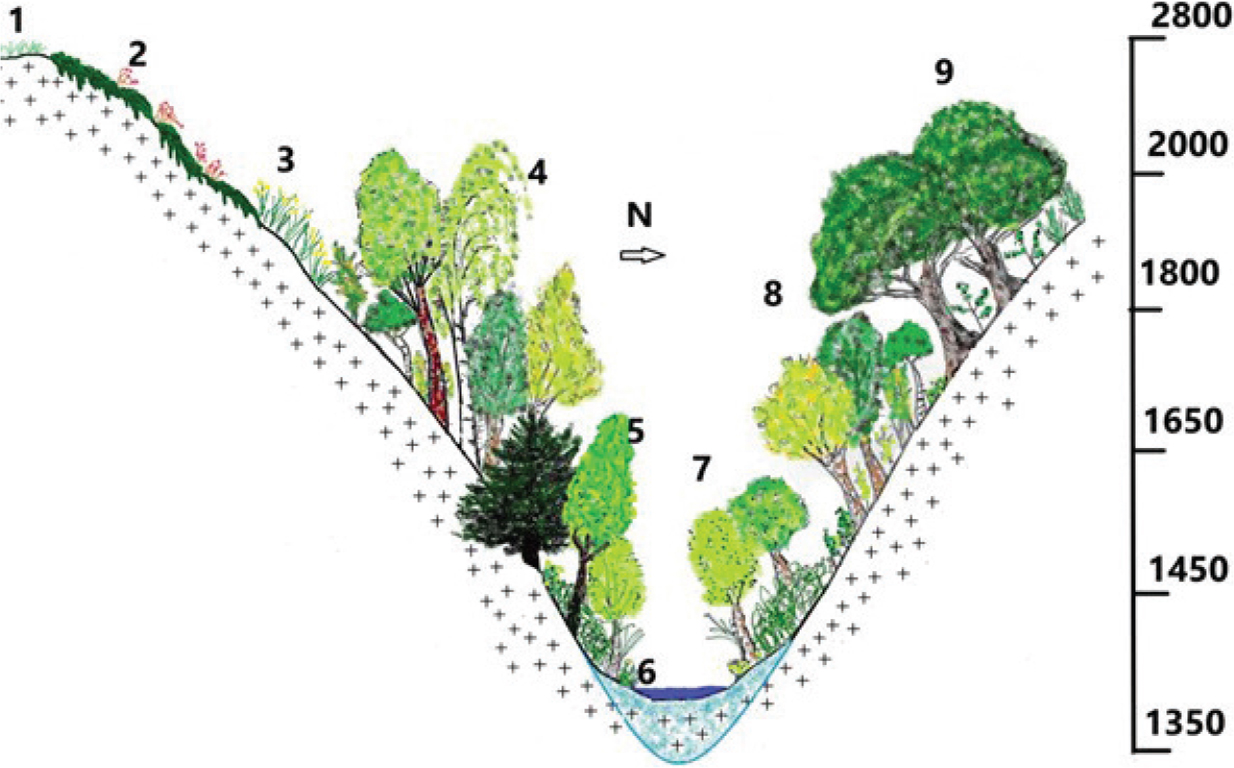
Figure 4:
Geosigmetum of vegetation in the study area:
1– Siliceous geliturbate graminoid communities (Erigeronto frigidi-Festucetum clementei); 2 – Juniper prostrate woodlands (Genisto versicoloris-Juniperetum nanae); 3 – Siliceous broom (Genisto versicoloris-Cytisetum nevadensis); 4 – Mixed deciduous climatophyllic forests (Poo nemoralis-Prunetum avium ass. nova); 5 – Mixed ash forests (Community of Fraxinus excelsior); 6 – Floating and helophytic vegetation (Montio fontanae-Ranunculetum omiophylli ass. nova); 7 – Willow forests (Carici camposii-Salicetum atrocinereae); 8 – Pyrenaic oak mixed forest (Adenocarpo decorticantis-Quercetum pyrenaicae aceretosum granatensis); 9 – Pyrenaic oak pure forest (Adenocarpo decorticantis-Quercetum pyrenaicae quercetosum pyrenaicae).
Slika 4: Geosigmetum vegetacije na območju raziskave: 1 – travišča na geliturbatni silikatni podlagi (Erigeronto frigidi-Festucetum clementei); 2 – brinovi gozdovi (Genisto versicoloris-Juniperetum nanae); 3 – sestoji reličnika na silikatu (Genisto versicoloris-Cytisetum nevadensis); 4 – mešani listopadni klimatofilni gozdovi (Poo nemoralis-Prunetum avium ass. nova); 5 – mešani jesenovi gozdovi (združba z vrsto Fraxinus excelsior); 6 – plavajoča in helofitska vegetacija (Montio fontanae-Ranunculetum omiophylli ass. nova); 7 – vrbovi gozdovi (Carici camposii-Salicetum atrocinereae); 8 – mešani gozd pirenejskega hrasta (Adenocarpo decorticantis-Quercetum pyrenaicae aceretosum granatensis); 9 – čisti gozd pirenejskega hrasta (Adenocarpo decorticantis-Quercetum pyrenaicae quercetosum pyrenaicae).
Conclusion
The study area on the northern slope of Sierra Nevada is an exceptional enclave for its relict flora and vegetation in an acceptable state of conservation, very scarce in the south of the Iberian Peninsula and western Europe (Losa-Quintana et al., 1986). Recent studies updating knowledge of its current plant communities (Lorite et al., 2003; Rivas-Martínez, 2007; Rivas-Martínez, 2011) and high floristic richness (Blanca et al., 2011; Lorite, 2016; Pavón-Núñez et al., 2020a) are a fundamental basis for carrying out conservation and management tasks.
We highlight the relevance of the phytocenological diversity of mixed deciduous forests with a high concentration of Eurosiberian species (Poo nemoralis-Prunetum avium ass. nova) from the only deciduous forest association documented for this biogeographic sector (Nevadensian Sector) until the present study, as the marcescent forests of Quercus pyrenaica. We also described a new hydrophytic association (Montio fontanae-Ranunculetum omiophylli ass. nova), two new Eurosiberian shrubland sub-associations (Genisto versicoloris-Juniperetum nanae rosetosum villosae subass. nova and Lonicero arboreae-Crataegetum granatensis ribetosum austroeuropaei subass. nova) and a new community of Fraxinus excelsior. We also highlight the floristic catalogue, including some taxa of very high ecological, chorological or paleobotanical value such as Geranium sylvaticum, Arum cylindraceum, Geranium divaricatum, Pedicularis comosa, Ranunculus omiophyllus and some very rare fern species in Sierra Nevada and the south of the Iberian Peninsula, including Ophioglossum vulgatum and Botrychium lunaria.
Notes
[42] Author contributions
Conceptualisation, M.P.N., N.H.T. and A.V.P.L.; methodology, M.P.N., N.H.T. and A.V.P.L.; formal analysis, M.P.N. and N.H.T.; investigation, M.P.N., N.H.T. and A.V. P.L.; fragmentation analysis, M. P.N.; writing original draft preparation, M.P.N. and A.V.P.L.; writing review and editing, M.P.N., N.H.T. and A.V.P.L.; supervision, N.H.T. and A.V.P.L.; project administration, A.V.P.L. and N.H.T.; funding acquisition, A.V.P.L. All authors have read and agreed to the published version of the manuscript.
Acknowledgments
We are grateful for the invaluable collaboration of the staff of the Sierra Nevada National Park, Blanca Ramos, Javier Sánchez-Gutiérrez, Javier Henares, Jose Enrique Granados and the environmental agents who accompanied us on site. We also thank Dr. Juan Guerra (University of Murcia) for his help with bryophytes identification. Funding – The field trips were partially co-financed by the Minis try of Science and Innovation (Spain) with funds from the European Regional Development Fund (ERDF), corresponding to the Pluri-regional Operational Programme for Spain 2014–2020 (POPE 2014–2020) and the ENVIRONMENT, BIODIVERSITY AND CLIMATE CHANGE LABORATORY (EnBiC2-Lab) University of Malaga reference: LIFEWATCH-2019-UMA-01.
Appendices
Appendix
Floristic list of the study area
The following symbols were used:
♦ Endemic of the natural area of Nevada following Blanca et al. (2011)
● Threatened. Data from Cabezudo et al. (2005).
▴ Species from relevés and which do not have an MGC herbarium sheet.
▪ Alien plant. Data from Spanish Legislation Royal Decree 630/2013 and Sanz-Elorza et al. 2004.
▵ Species found in databases and not confirmed by our collections.
Table 13:
List of taxa with their status ofendemicity, degree of threat, protection, exotic nature, source of relevés or databases.
Tabela 13: Seznam taksonov z njihovim statusom endemicnosti, stopnjo ogroženosti, zašcito, eksoticnostjo, virom podatkovnih baz.
| Family | Endemic | reatened | Protected | Exotic | From relevés | From data-bases | |
|---|---|---|---|---|---|---|---|
| BRYOPHYTA | |||||||
| Aulacomnium palustre Schwaegrichen | Bryaceae | ||||||
| Brachythecium rivulare Schimp. | Bryaceae | ||||||
| Bryum caespiticium Hedw. | Bryaceae | ||||||
| Fontinalis antipyretica Hedw. | Bryaceae | ||||||
| Homalotheciom meridionale (M.Fleisch. & Warnst.) Hedenäs | Bryaceae | ||||||
| Lewinskya rupestris (Schleich. ex Schwägr.) F. Lara, Garilleti & Goffinet | Bryaceae | ||||||
| Orthotrichum affine Brid. | Bryaceae | ||||||
| Orthotrichum lyelii (Hook. & Taylor) Plášek, Sawicki & Ochyra | Bryaceae | ||||||
| Pellia epiphylla (L.) Corda | Bryaceae | ||||||
| Philonotis caespitosa Jur. | Bryaceae | ||||||
| Philonotis fontana (Hedw.) Brid. | Bryaceae | ||||||
| Philonotis seriataffi Mitten | Bryaceae | ||||||
| Polytrichum juniperinumffi Hedw. | Bryaceae | ||||||
| Pterigynandrum ffiliforme Hedwig | Bryaceae | ||||||
| Sphagnum auriculatum Schimp. | Bryaceae | ||||||
| Sphagnum subnitens Russow & Warnst. | Bryaceae | ||||||
| Syntrichia ruralis (Hedw.) F.Weber & D.Mohr | Bryaceae | ||||||
| PTERIDOPHYTES | |||||||
| ▴ Dryopteris affinis (Lowe) Fraser–Jenkins subsp. affinis | Aspidiaceae | X | |||||
| Dryopteris affinis (Lowe) Fraser–Jenkins subsp. borreri (Newman) Fraser–Jenkins | Aspidiaceae | ||||||
| ● Dryopteris ffilix–mas (L.) Schott | Aspidiaceae | X | |||||
| ▵ Asplenium trichomanes L. subsp. quadrivalens D. E. Meyer | Aspleniaceae | X | |||||
| Athyrium filix-foemina (L.) Roth | Athyriaceae | ||||||
| Cystopteris dickieanaR. Sim | Athyriaceae | ||||||
| Cystopteris fragilis (L.) Bernh. subsp. fragilis | Athyriaceae | ||||||
| Cystopteris viridula (Desv.) Desv. | Athyriaceae | ||||||
| ● Botrychium lunaria (L.) Swartz | Botrychiaceae | X | |||||
| Pteridium aquilinum (L.) Kuhn subsp. aquilinum | Hypolepidaceae | ||||||
| ● Ophioglossum vulgatum L. | Ophioglossaceae | X | |||||
| GYMNOSPERMS | |||||||
| ▴ Juniperus communis L. subsp. alpina (Suter) Čelak. | Cupressaceae | X | |||||
| Juniperus communis L. subsp. hemisphaerica (K. Presl) N | Cupressaceae | ||||||
| Juniperus sabina L. | Cupressaceae | ||||||
| ● Taxus baccata L. | Taxaceae | X | X | ||||
| ANGIOSPERMS | |||||||
| Acer opalusMill. subsp. granatense (Boiss.) Font Quer & Rothm. | Aceraceae | ||||||
| ▴ Angelica majorLag. | Apiaceae | X | |||||
| Anthriscus sylvestris (L.) Hoffm. | Apiaceae | ||||||
| ▴ Apium nodiflorum (L.) Lag. | Apiaceae | X | |||||
| ▴ Bunium macucaBoiss. subsp. macuca | Apiaceae | X | |||||
| Carum verticillatum (L.) W. D. J. Koch | Apiaceae | ||||||
| Chaerophyllum hirsutum L. | Apiaceae | ||||||
| Conopodium pyrenaeum (Loisel.) Miegev. | Apiaceae | ||||||
| Eryngium bourgatiiGouan | Apiaceae | ||||||
| ▴ Eryngium campestre L. | Apiaceae | X | |||||
| Eryngium glacialeBoiss. | Apiaceae | ||||||
| Heracleum sphondylium L. subsp. granatense (Boiss.) Briq. | Apiaceae | ||||||
| ▵ Hydrocotyle verticillataThunb. | Apiaceae | X | |||||
| Ligusticum lucidumMill. subsp. lucidum | Apiaceae | ||||||
| ▴ Myrrhoides nodosa (L.) Cannon | Apiaceae | X | |||||
| ▵ Oenanthe crocata L. | Apiaceae | X | |||||
| Peucedanum hispanicum (Boiss.) Endl. | Apiaceae | ||||||
| ● Prangos trifida (Mill.) Herrnst. & Heyn | Apiaceae | X | |||||
| Tordylium maximum L. | Apiaceae | ||||||
| ▴ Torilis arvensis (Huds.) Link | Apiaceae | ||||||
| Arum cylindraceumGasp. | Araceae | ||||||
| Hedera helix L. subsp. helix | Araliaceae | ||||||
| Aristolochia paucinervisPomel | Aristolochiaceae | ||||||
| Asphodelus macrocarpusParl. subsp. rubescensDíaz Lifante & Valdés | Asphodelaceae | ||||||
| ● Andryala agardhii DC. | Asteraceae | X | |||||
| Andryala integrifolia L. | Asteraceae | ||||||
| ▵ Anthemis cotula L. | Asteraceae | X | |||||
| ▴ Anthemis pedunculataDesf. | Asteraceae | X | |||||
| Anthriscus sylvestris (L.) Hoffm. | Asteraceae | ||||||
| Artemisia absinthium L. | Asteraceae | ||||||
| ▴ Artemisia campestris L. subsp. glutinosa (Besser) Batt. | Asteraceae | X | |||||
| Arctium minus (Hill) Bernh | Asteraceae | ||||||
| Carduus platypussubsp. granatensis (Willk.) Nyman. | Asteraceae | ||||||
| Carduus tenuiflorusCurtis. | Asteraceae | ||||||
| ▴Carthamus lanatus L. | Asteraceae | X | |||||
| Carlina corymbosasubsp. hispanica (Lam.) O. Bolòs & Vigo | Asteraceae | ||||||
| Centaurea calcitrapa L. | Asteraceae | ||||||
| Centaurea ornataWilld. | Asteraceae | ||||||
| Centaurea solstitialis L. subsp. solstitialis | Asteraceae | ||||||
| Cirsium acaulon (L.) Scop. subsp.gregarium (Boiss.ex DC) Talavera | Asteraceae | ||||||
| Cirsium echinatum (Desf.) DC. | Asteraceae | ||||||
| Cirsium odontolepis Boiss. ex DC. | Asteraceae | ||||||
| Cirsium pyrenaicum (Jacq.) All. | Asteraceae | ||||||
| Cota triumfettii (L.) J. Gay | Asteraceae | ||||||
| Crepis oporinoidesBoiss. | Asteraceae | ||||||
| Doronicum plantagineum L. | Asteraceae | ||||||
| Erigeron acer L. | Asteraceae | ||||||
| Erigeron major (Boiss.) Vierh. | Asteraceae | ||||||
| Filago pyramidata L. | Asteraceae | ||||||
| ▴ Hyoseris radiata L. | Asteraceae | X | |||||
| ▵ Inula montana L. | Asteraceae | X | |||||
| Jurinea humilis (Desf.) DC. | Asteraceae | ||||||
| Lactuca tenerrima Pourr. | Asteraceae | ||||||
| Lapsana communis L. subsp. communis | Asteraceae | ||||||
| Leontodon boryi DC. | Asteraceae | X | |||||
| Leontodon longirrostris (Finch & P. D. Sell) Talavera | Asteraceae | ||||||
| Leucanthemopsis pectinata (L.) G. López & Ch. E. Jarvis | Asteraceae | ||||||
| Mantisalca salmantica (L.) Briq. & Cavill. | Asteraceae | ||||||
| Onopordum acanthiumsubsp. acanthium L. | Asteraceae | ||||||
| Pilosella argyrocoma (Fr.) F. W. Schultz & Sch. Bip. | Asteraceae | ||||||
| Pilosella castellana (Boiss. & Reut.) F. W. Schultz & Sch. Bip. | Asteraceae | ||||||
| ▴ Pilosella pseudopilosella (Ten.) Soják | Asteraceae | X | |||||
| Rhagadiolus edulisGaertn. | Asteraceae | ||||||
| Santolina rosmarinifolia L. subsp. canescens (Lag.) Ny | Asteraceae | ||||||
| ♦● Scorzoneroides microcephala (Boiss.) Holub | Asteraceae | X | X | X | |||
| ♦ Scorzoneroides nevadensis (Lange) Greuter | Asteraceae | X | |||||
| Senecio duriaeiJ. Gay | Asteraceae | ||||||
| Senecio jacobaea L. | Asteraceae | ||||||
| Senecio pyrenaicus L. subsp. granatensis (Boiss.) Rivas Mart. | Asteraceae | ||||||
| Silybum marianum (L.) Gaertn. | Asteraceae | ||||||
| Solidago virgaurea L. | Asteraceae | ||||||
| ▴ Sonchus oleraceus L. | Asteraceae | X | |||||
| Tanacetum parthenium (L.) Sch. Bip. | Asteraceae | ||||||
| Taraxacum laevigatum (Willd.) DC. | Asteraceae | ||||||
| Taraxacum obovatum (Willd.) DC. | Asteraceae | ||||||
| Berberis hispanicaBoiss. & Reut. | Berbericaceae | ||||||
| Alnus glutinosa (L.) Gaertn. | Betulaceae | ||||||
| ● Betula pendulaRoth subsp. fontqueri (Rothm.) G. Moreno & Peinado | Betulaceae | X | X | ||||
| ▵ Anchusa undulata L. subsp. granatensis (Boiss.) Braun–Blanq. & Maire | Boraginaceae | X | |||||
| Myosotis arvensisHill subsp. arvensis | Boraginaceae | ||||||
| Myosotis decumbensHost subsp. teresiana (Sennen) Grau | Boraginaceae | ||||||
| Myosotis strictaRoemer & Schultes | Boraginaceae | ||||||
| Alyssum granatenseBoiss. & Reut. | Brassicaceae | ||||||
| ▴ Alyssum minutumDC. | Brassicaceae | X | |||||
| Alliaria petiolata (M. Bieb.) Cavara & Grande | Brassicaceae | ||||||
| ▴ Arabis verna (L.) R. Br. | Brassicaceae | X | |||||
| Biscutella valentinasubsp. valentina (Loefl. ex L.) Heywood | Brassicaceae | ||||||
| Calepina irregularis (Asso) Thell. | Brassicaceae | ||||||
| Capsella bursa–pastoris (L.) Medik. | Brassicaceae | ||||||
| Cardamine flexuosaWith. | Brassicaceae | ||||||
| Cardamine hirsuta L. | Brassicaceae | ||||||
| Coincya monensis (L.) Greuter & Burdet subsp. cheiranthos (Vill.) Aedo, Leadlay & Muñoz Garm. | Brassicaceae | ||||||
| Draba lutescensCoss. | Brassicaceae | ||||||
| Erophila verna (L.) Chevall. | Brassicaceae | ||||||
| Hormathophylla spinosa (L.) P. Küpfer | Brassicaceae | ||||||
| Lepidium petrophilumCoss. | Brassicaceae | ||||||
| Lepidium villarsiiGren. & Godr. subsp. villarsii | Brassicaceae | ||||||
| Raphanus raphanistrum L. subsp. raphanistrum | Brassicaceae | ||||||
| Sisymbrella aspera (L.) Spach. subsp. aspera | Brassicaceae | ||||||
| Sisymbrium crassifoliumCav. | Brassicaceae | ||||||
| Sisymbrium orientale L. | Brassicaceae | ||||||
| Thlaspi arvense L. | Brassicaceae | ||||||
| Thlaspi perfoliatum L. | Brassicaceae | ||||||
| Callitriche stagnalisScop. | Callitrichaceae | ||||||
| Campanula herminii Hoffmanns. & Link | Campanulaceae | ||||||
| Campanula lusitanica L. | Campanulaceae | ||||||
| Campanula rapunculus L. | Campanulaceae | ||||||
| Jasione montana L. subsp. montana | Campanulaceae | ||||||
| Lonicera arboreaBoiss. | Caprifoliaceae | ||||||
| Lonicera etrusca G. Santi | Caprifoliaceae | ||||||
| Lonicera periclymenum L. subsp. hispanica (Boiss. & Reut.) Nyman | Caprifoliaceae | ||||||
| Sambucus ebulus L. | Caprifoliaceae | ||||||
| Sambucus nigra L. | Caprifoliaceae | ||||||
| Agrostemma githago L. | Caryophyllaceae | ||||||
| Arenaria armerinaBory subsp.armerina var. frigida (Boiss.) Cuatrec. | Caryophyllaceae | ||||||
| Arenaria grandiflora L. subsp. grandiflora | Caryophyllaceae | ||||||
| Arenaria pungensLag. subsp. pungens | Caryophyllaceae | ||||||
| Arenaria tetraquetra L. subsp. amabilis (Bory) H. Lindb. fil. | Caryophyllaceae | ||||||
| ▴ Cerastium alpinum var. nevadensePau | Caryophyllaceae | X | |||||
| Cerastium brachypetalumsubsp. brachypetalumN.H.F. Desp. ex Pers. | Caryophyllaceae | ||||||
| Cerastium fontanumBaumg. subsp. vulgare (Hartm.) Greuter & Burdet | Caryophyllaceae | ||||||
| Cerastium gibraltaricumBoiss. var. viridulum (Pau) Font Quer | Caryophyllaceae | ||||||
| Cerastium pumilumCurtis | Caryophyllaceae | ||||||
| Cerastium ramosissimumBoiss. | Caryophyllaceae | ||||||
| Dianthus brachyanthusBoiss. | Caryophyllaceae | ||||||
| Minuartia dichotoma L. | Caryophyllaceae | ||||||
| Moehringia pentandraJ. Gay | Caryophyllaceae | ||||||
| Moehringia trinervia (L.) Clairv. | Caryophyllaceae | ||||||
| Paronychia argenteaLam. | Caryophyllaceae | ||||||
| Petrorhagia dubia (Raf.) G. López & Romo | Caryophyllaceae | ||||||
| Petrorhagia nanteuilii (Burnat) P. W. Ball & Heywood | Caryophyllaceae | ||||||
| Sagina apetalaArd. | Caryophyllaceae | ||||||
| Sagina procumbens L. | Caryophyllaceae | ||||||
| Sagina saginoides (L.) H. Karst. subsp. nevadensis (Boiss. & Reut.) Greuter & Burdet | Caryophyllaceae | ||||||
| Silene boryi Boiss. | Caryophyllaceae | ||||||
| Silene latifoliaPoir. | Caryophyllaceae | ||||||
| Silene nutans L. subsp. nutans | Caryophyllaceae | ||||||
| Silene rupestris L. | Caryophyllaceae | ||||||
| Silene vulgaris (Moench) Garcke subsp. vulgaris | Caryophyllaceae | ||||||
| Spergula morisoniiBoreau | Caryophyllaceae | ||||||
| Spergularia capillacea (Kindb.) Willk. | Caryophyllaceae | ||||||
| Spergularia rubra (L.) J. Presl & C. Presl | Caryophyllaceae | ||||||
| Spergularia segetalis (L.) G. Don fil. | Caryophyllaceae | ||||||
| Stellaria alsineGrimm | Caryophyllaceae | ||||||
| Stellaria media (L.) Vill. | Caryophyllaceae | ||||||
| ▵ Celtis australis L. | Celtidaceae | X | |||||
| Cistus laurifolius L. | Cistaceae | ||||||
| Halimium umbellatum (L.) Spach subsp. viscosum (Willk.) O. Bolos & Vigo | Cistaceae | ||||||
| Helianthemum apenninum (L.) Mill. subsp. suffruticosum (Boiss.) G. López | Cistaceae | ||||||
| Hypericum perforatum L. | Clusiaceae | ||||||
| Hypericum tetrapterumFr. | Clusiaceae | ||||||
| ▴ Hypericum undulatumWilld. | Clusiaceae | X | |||||
| Colchicum triphyllumG. Kunze | Colchicaceae | ||||||
| Merendera montana (Loefl. ex L.) Lange | Colchicaceae | ||||||
| Cuscuta triumvirati Lange | Convolvulaceae | ||||||
| Sedum acre L. | Crassulaceae | ||||||
| Sedum album L. | Crassulaceae | ||||||
| Sedum forsterianum Sm. | Crassulaceae | ||||||
| Sedum villosumsubsp. villosum L. | Crassulaceae | ||||||
| Sedum rubens L. | Crassulaceae | ||||||
| ♦ Sempervivum minutum (Willk.) Pau | Crassulaceae | X | |||||
| ● Sempervivum tectorum L. | Crassulaceae | X | |||||
| ▴ Umbilicus rupestris (Salisb.) Dandy | Crassulaceae | X | |||||
| Bryonia dioicaJacq. | Curcubitaceae | ||||||
| ♦ Carex camposiiBoiss. & Reut. | Cyperaceae | X | X | ||||
| ▵ Carex divulsaStokes subsp. divulsa | Cyperaceae | X | |||||
| ▴ Carex leporina L. | Cyperaceae | X | |||||
| Carex muricata L. subsp.pairae (F. W. Schultz) Čelak | Cyperaceae | ||||||
| ♦ Carex nevadensisBoiss. & Reut. | Cyperaceae | X | |||||
| Carex nigra (L.) Reichard | Cyperaceae | ||||||
| Isolepis setacea (L.) R. Br. | Cyperaceae | ||||||
| Scabiosa turolensisPau | Dipsacaceae | ||||||
| ♦ Vaccinium uliginosum L. var. nanaBoiss. | Ericaceae | X | |||||
| Euphorbia flavicomaDC. subsp. flavicoma | Euphorbiaceae | ||||||
| Adenocarpus decorticansBoiss. | Fabaceae | ||||||
| Astragalus nevadensisBoiss. subsp. nevadensis | Fabaceae | ||||||
| ♦ Cytisus galianoiTalavera & Gibbs | Fabaceae | X | |||||
| Cytisus scoparius (L.) Link subsp. reverchonii (Degen & Hervier) Rivas Goday & Rivas Mart. | Fabaceae | ||||||
| Erinacea anthyllisLink subsp. anthyllis | Fabaceae | ||||||
| Genista umbellata (L’Hér.) Dum. Cours. subsp. equisetiformis (Spach) Rivas Goday & Rivas Mart. | Fabaceae | ||||||
| ♦ Genista versicolorBoiss. | Fabaceae | X | |||||
| Lathyrus pratensis L. | Fabaceae | ||||||
| ▴ Lotus corniculatus L. subsp. carpetanus (Lacaita) Rivas Mart. | Fabaceae | X | |||||
| ♦ Lotus corniculatussubsp. glacialis (Boiss.) Valdés | Fabaceae | X | |||||
| Lotus pedunculatus Cav. | Fabaceae | ||||||
| Pisum sativum L. | Fabaceae | ||||||
| ▴ Trifolium angustifolium L. | Fabaceae | X | |||||
| Trifolium campestreSchreb. | Fabaceae | ||||||
| Trifolium fragiferum L. | Fabaceae | ||||||
| ▴Trifolium ochroleuconHuds. | Fabaceae | X | |||||
| Trifolium pratense L. subsp.pratense | Fabaceae | ||||||
| Trifolium repens L. | Fabaceae | ||||||
| Trifolium repenssubsp. nevadense (Boiss.) D. E. Coombe | Fabaceae | ||||||
| Vicia dasycarpaTen. | Fabaceae | ||||||
| ▴Vicia benghalensis L. | Fabaceae | X | |||||
| ▴Vicia craccasubsp. incana (Gouan) Rouy | Fabaceae | X | |||||
| Vicia onobrychioides L. | Fabaceae | ||||||
| Vicia tenuifoliaRoth | Fabaceae | ||||||
| Quercus pyrenaica Willd. | Fagaceae | ||||||
| Quercus rotundifoliaLam. | Fagaceae | ||||||
| Quercus x trabutii Hy | Fagaceae | ||||||
| ● Gentiana alpinaVill. | Gentianaceae | X | |||||
| ● Gentiana boryiBoiss. | Gentianaceae | X | X | ||||
| ♦● Gentiana pneumonanthe L. subsp. depressa (Boiss.) Malag. | Gentianaceae | X | X | ||||
| ♦● Gentiana sierraeBriq. | Gentianaceae | X | X | X | |||
| Geranium lucidum L. | Geraniaceae | ||||||
| Geranium rotundifolium L. | Geraniaceae | ||||||
| Geranium robertianum L. | Geraniaceae | ||||||
| Geranium divaricatumEhrh. | Geraniaceae | ||||||
| Geranium sylvaticum L. subsp. sylvaticum | Geraniaceae | ||||||
| Erodium cheilanthifoliumBoiss. | Geraniaceae | ||||||
| Erodium cicutarium (L.) L’Her. | Geraniaceae | ||||||
| ● Ribes uva–crispa L. subsp. austro–europaeum (Bornm.) Bech. | Grossulariaceae | X | |||||
| Muscari comosum (L.) Mill. | Hyacithaceae | ||||||
| Crocus nevadensisAmo | Iridaceae | ||||||
| ▵ Crocus serotinusSalisb. subsp. salzmannii (J. Gay) Mathew | Iridaceae | X | |||||
| Gagea lacaitae A. Terracc. | Iridaceae | ||||||
| Gagea reverchoniiDegen | Iridaceae | ||||||
| Juncus alpino-articulatus Chaix subsp. alpino-articulatus | Juncaceae | ||||||
| Juncus articulatus L. subsp. articulatus | Juncaceae | ||||||
| Juncus bufonius L. | Juncaceae | ||||||
| Juncus capitatusWeigel | Juncaceae | ||||||
| ▴ Juncus inflexus L. subsp. inflexus | Juncaceae | X | |||||
| Juncus tenageia L. fil. | Juncaceae | ||||||
| Luzula campestris (L.) DC. | Juncaceae | ||||||
| Juglans regia L. | Junglandaceae | ||||||
| Acinos alpinus (L.) Moench | Lamiaceae | ||||||
| Clinopodium vulgare L. | Lamiaceae | ||||||
| Lamium amplexicaule L. | Lamiaceae | ||||||
| ▴ Marrubium supinum L. | Lamiaceae | X | |||||
| ▴ Mentha aquatica L. | Lamiaceae | X | |||||
| Mentha longifolia (L.) Huds. | Lamiaceae | ||||||
| ▴ Mentha pulegium L. | Lamiaceae | X | |||||
| ▵ Mentha suaveolensEhrh. | Lamiaceae | X | |||||
| Nepeta granatensisBoiss. | Lamiaceae | ||||||
| Prunella vulgaris L. | Lamiaceae | ||||||
| Sideritis glacialisBoiss. | Lamiaceae | ||||||
| ♦▴Teucrium aureumSchreb. subsp. angustifolium (Willk.) Valdés Berm. & Sánchez Crespo | Lamiaceae | X | |||||
| Teucrium similatumT. Navarro & Rosúa | Lamiaceae | ||||||
| Thymus mastichina (L.) L. subsp. mastichina | Lamiaceae | ||||||
| Thymus serpylloidesBory subsp. gadorensis (Pau) Jalas | Lamiaceae | ||||||
| ♦▴Thymus serpylloides Bory subsp. serpylloides | Lamiaceae | X | X | ||||
| ▴Thymus zygis L. subsp. gracilis (Boiss.) R. Morales | Lamiaceae | X | |||||
| ♦● Pinguicula nevadensis (H. Lindb.) Casper | Lentibulariaceae | X | X | X | |||
| Malva neglectaWallr. | Malvaceae | ||||||
| Fraxinus angustifoliaVahl. | Oleaceae | ||||||
| Fraxinus excelsior L. | Oleaceae | ||||||
| Fraxinus excelsior× angustifolia | Oleaceae | ||||||
| Epilobium alsinifolium Vill. | Onagraceae | ||||||
| Epilobium atlanticumLitard. & Maire | Onagraceae | ||||||
| Epilobium collinumC. C. Gmel. | Onagraceae | ||||||
| Epilobium lanceolatumSebast. & Mauri | Onagraceae | ||||||
| Epilobium montanum L. | Onagraceae | ||||||
| Epilobium palustre L. | Onagraceae | ||||||
| Epilobium parviflorum Schreb. | Onagraceae | ||||||
| Dactylorhiza elata (Poir.) Soó | Orchidaceae | ||||||
| Dactylorhiza maculata (L.) Soó | Orchidaceae | ||||||
| ▵ Orobanche clausonisPomel | Orobanchaceae | X | |||||
| Orobanche gracilisSm. subsp. gracilis | Orobanchaceae | ||||||
| ▵ Orobanche haenseleriReut. | Orobanchaceae | X | |||||
| Orobanche minorSm. | Orobanchaceae | ||||||
| Paeonia coriacea Boiss. | Paeoniaceae | ||||||
| ▴ Papaver argemone L. | Papaveraceae | X | |||||
| Papaver pinnatifidumMoris | Papaveraceae | ||||||
| ● Sarcocapnos speciosaBoiss. | Papaveraceae | X | X | ||||
| Plantago holosteumScop. | Plantaginaceae | ||||||
| Plantago major L. subsp.intermedia (Gilib.) Lange | Plantaginaceae | ||||||
| ♦ Plantago nivalisBoiss. | Plantaginaceae | X | |||||
| ♦● Armeria filicaulis (Boiss.) Boiss. subsp. nevadensisNieto Fel., Roselló & Fuertes | Plumbaginaceae | X | X | ||||
| Armeria villosa Girard. subsp. bernisii Nieto Fel. | Plumbaginaceae | ||||||
| Aegilops geniculataRoth | Poaceae | ||||||
| Aegilops ventricosaTausch | Poaceae | ||||||
| Agrostis castellana Boiss. & Reut. | Poaceae | ||||||
| ♦ Agrostis nevadensisBoiss. | Poaceae | X | |||||
| Agrostis stolonifera L. | Poaceae | ||||||
| Anthoxanthum odoratum L. | Poaceae | ||||||
| ▴ Anthriscus caucalis M. Bieb. | Poaceae | X | |||||
| ▴ Avena sterilis L. subsp. ludoviciana (Durieu) Gillet & Magne | Poaceae | X | |||||
| Avenella flexuosa (L.) Drejer subsp. iberica (Rivas Mart.) Valdés & H. Scholz | Poaceae | ||||||
| ▴ Brachypodium sylvaticum (Huds.) P. Beauv. subsp. sylvaticum | Poaceae | X | |||||
| Bromus intermediusGuss. | Poaceae | ||||||
| Bromus sterilisL | Poaceae | ||||||
| Cynosurus echinatus L. | Poaceae | ||||||
| ▴ Dactylis glomerata L. subsp.hispanica (Roth) Nyman | Poaceae | X | |||||
| Elymus hispanicus (Boiss.) Talavera | Poaceae | ||||||
| Festuca amplaHack. | Poaceae | ||||||
| Festuca baetica (Hack.) K. Richt. | Poaceae | ||||||
| Festuca capillifolia L. Dufour | Poaceae | ||||||
| ♦● Festuca clementeiBoiss. | Poaceae | X | X | X | |||
| Festuca elegansBoiss. | Poaceae | ||||||
| Festuca iberica (Hack.) K. Richt. | Poaceae | ||||||
| Festuca indigestaBoiss. | Poaceae | ||||||
| ▴ Festuca nevadensis (Hack.) K. Richt. | Poaceae | X | |||||
| Festuca patulaDesf. | Poaceae | ||||||
| Festuca scariosa (Lag.) Asch. & Graebn. | Poaceae | ||||||
| Glyceria declinataBréb. | Poaceae | ||||||
| Helictotrichon sedenense (DC.) Holub subsp. sedenense | Poaceae | ||||||
| Holcus lanatus L. | Poaceae | ||||||
| ▴ Hordeum murinum L. subsp.leporinum (Link) Arcang. | Poaceae | X | |||||
| Hordeum murinum L. subsp. murinum | Poaceae | ||||||
| ♦ Koeleria dasyphylla Willk. subsp. nevadensis (Hack.) Quintanar & A. T. Romero García | Poaceae | X | |||||
| Nardus stricta L. | Poaceae | ||||||
| Phalaris coerulescens Desf. | Poaceae | ||||||
| ♦● Phleum brachystachyum (Salisb.) Gamisans, Romero García & C. Morales subsp. abbreviatum (Boiss.) Gamisans, Romero García & C. Morales | Poaceae | X | X | ||||
| Phleum bertolonii DC. | Poaceae | ||||||
| Poa annua L. | Poaceae | ||||||
| Poa bulbosa L. | Poaceae | ||||||
| ▴ Poa ligulata Boiss. | Poaceae | X | |||||
| ♦ Poa minor Gaudin subsp. nevadensisNannf. | Poaceae | ||||||
| Poa nemoralis L. | Poaceae | ||||||
| Poa pratensis L. subsp. pratensis | Poaceae | ||||||
| ▴ Poa supinaSchrad. | Poaceae | X | |||||
| Poa trivialis L. | Poaceae | ||||||
| ♦●▴ Trisetum glaciale (Bory) Boiss. | Poaceae | X | X | X | |||
| ▴ Vulpia bromoides (L.) S. F. Gray | Poaceae | X | |||||
| Vulpia myuros (L.) C. C. Gmel. | Poaceae | ||||||
| Polygonum rurivagumBoreau | Polygonaceae | ||||||
| Rumex acetosa L. subsp. acetosa | Polygonaceae | ||||||
| Rumex acetosella L. subsp. angiocarpus (Murb.) Murb. | Polygonaceae | ||||||
| ▴ Rumex angiocarpus Murb. | Polygonaceae | X | |||||
| Rumex bucephalophorus L. subsp. gallicus (Steinh.) Rech. fil. | Polygonaceae | ||||||
| Rumex induratusBoiss. & Reut. | Polygonaceae | ||||||
| ▴ Rumex pulcher L. subsp. woodsii (De Not.) Arcang. | Polygonaceae | X | |||||
| Rumex scutatus L. | Polygonaceae | ||||||
| Montia fontana L. subsp. fontana | Portulacaceae | ||||||
| ▴ Anagallis arvensis L. | Primulaceae | X | |||||
| ♦● Androsace vitaliana (L.) Lapeyr. subsp. nevadensis (Chiarugi) Luceño | Primulaceae | X | X | ||||
| ♦● Primula elatior (L.) L. subsp. lofthousei (Hesl.–Harr.) W.W. Sm. & Fletcher | Primulaceae | X | X | X | |||
| Polygonatum odoratum (Mill.) Druce | Ruscaceae | ||||||
| ● Aconitum burnatii Gáyer | Ranunculaceae | X | X | ||||
| Aconitum vulparia Rchb. subsp. neapolitanum (Ten.) Muñoz Garm. | Ranunculaceae | ||||||
| ● Aquilegia vulgaris L. subsp. nevadensis (Boiss. & Reut.) T. E. Diaz | Ranunculaceae | X | |||||
| ▴ Clematis flammula L. | Ranunculaceae | X | |||||
| Clematis vitalba L. | Ranunculaceae | ||||||
| Delphinium emarginatum K. Presl subsp. nevadense (G. Kunze) C. Blanche & Molero | Ranunculaceae | ||||||
| ▴ Delphinium pentagynum Lam. | Ranunculaceae | X | |||||
| Helleborus foetidus L. | Ranunculaceae | ||||||
| Parnassia palustris L. | Ranunculaceae | ||||||
| Ranunculus granatensis Boiss. | Ranunculaceae | ||||||
| Ranunculus monspeliacus L. | Ranunculaceae | ||||||
| Ranunculus muricatus L. | Ranunculaceae | ||||||
| Ranunculus ollissiponensis Pers. subsp. ollissiponensis | Ranunculaceae | ||||||
| Ranunculus omiophyllus Ten. | Ranunculaceae | ||||||
| Ranunculus parviflorus L. | Ranunculaceae | ||||||
| Ranunculus repens L. | Ranunculaceae | ||||||
| Reseda lutea L. subsp. lutea | Resedaceae | ||||||
| ▴ Sesamoides purpurascens (L.) G.López subsp. prostrata (Boiss.) Martín–Bravo | Resedaceae | X | |||||
| ● Rhamnus cathartica L. | Rhamnaceae | X | X | ||||
| ▴ Alchemilla filicaulis Buser | Rosaceae | X | |||||
| Alchemilla straminea Buser | Rosaceae | ||||||
| Cotoneaster granatensis Boiss. | Rosaceae | ||||||
| Crataegus granatensis Boiss. | Rosaceae | ||||||
| Crataegus monogyna Jacq. | Rosaceae | ||||||
| Geum heterocarpum Boiss. | Rosaceae | ||||||
| Geum urbanum L. | Rosaceae | ||||||
| Malus sylvestris (L.) Mill. | Rosaceae | ||||||
| Potentilla cinerea Vill. | Rosaceae | ||||||
| Potentilla hirta L. | Rosaceae | ||||||
| ♦ Potentilla nevadensis Boiss. | Rosaceae | X | |||||
| ● Prunus avium L. | Rosaceae | X | X | ||||
| ♦● Prunus ramburii Boiss. | Rosaceae | X | X | ||||
| Pyrus cordata Desv. | Rosaceae | ||||||
| Rosa corymbifera Borkh. | Rosaceae | ||||||
| Rosa dumalis Bechst. | Rosaceae | ||||||
| Rosa pouzinii Tratt. | Rosaceae | ||||||
| Rosa sicula Tratt. | Rosaceae | ||||||
| Rosa villosa L. (Rosa mollis Sm.) | Rosaceae | ||||||
| Rubus caesius L. | Rosaceae | ||||||
| Rubus canescens DC. | Rosaceae | ||||||
| Rubus ulmifolius Schott. | Rosaceae | ||||||
| ▴ Sanguisorba minor Scop. subsp. balearica (Nyman) Muñoz Garm. & C. Navarro | Rosaceae | X | |||||
| ● Sorbus aria (L.) Crantz | Rosaceae | X | |||||
| ● Sorbus aucuparia L. | Rosaceae | X | X | ||||
| Galium aparine L. subsp. aparine | Rubiaceae | ||||||
| Galium nevadense Boiss. & Reut. | Rubiaceae | ||||||
| Galium pyrenaicum Gouan | Rubiaceae | ||||||
| ▴ Rubia peregrina L. | Rubiaceae | X | |||||
| Populus tremula L. | Salicaceae | ||||||
| Salix atrocinerea Brot. | Salicaceae | ||||||
| ● Salix caprea L. | Salicaceae | X | X | ||||
| Saxifraga carpetana Boiss & Reut. subsp.carpetana | Saxifragaceae | ||||||
| Saxifraga granulata L. | Saxifragaceae | ||||||
| ▴ Saxifraga stellaris L. subsp. robusta (Engl.) Gremli | Saxifragaceae | X | |||||
| Antirrhinum hispanicum Chav. | Scrophulariaceae | ||||||
| ▵ Digitalis obscura L. subsp. obscura | Scrophulariaceae | X | |||||
| Digitalis purpurea L. subsp. purpurea | Scrophulariaceae | ||||||
| Euphrasia willkommii Freyn | Scrophulariaceae | ||||||
| Linaria aeruginea (Gouan) Cav. subsp. aeruginea | Scrophulariaceae | ||||||
| ♦ Linaria aeruginea (Gouan) Cav. subsp. nevadensis (Boiss.) Malag. | Scrophulariaceae | X | |||||
| ♦ Pedicularis comosa L. subsp.nevadensis (Pau) À. M. Romo | Scrophulariaceae | X | |||||
| Scrophularia lyrata Willd. | Scrophulariaceae | ||||||
| ♦ Verbascum nevadense Boiss. | Scrophulariaceae | X | |||||
| ▪ Datura stramonium L. | Solanaceae | X | |||||
| Cuscuta triumvirati Lange | Solanaceae | ||||||
| ▴ Daphne gnidium L. | Thymelaeaceae | X | |||||
| Urtica dioica L. | Urticaceae | ||||||
| Valeriana tuberosa L. | Valerianaceae | ||||||
| Valerianella locusta (L.) Laterr. subsp. locusta | Valerianaceae | ||||||
| Linaria verticillata Boiss. subsp. verticillata | Veronicaceae | ||||||
| Veronica anagallis–aquatica L. subsp. anagallis–aquatica | Veronicaceae | ||||||
| Veronica beccabunga L. subsp.beccabunga | Veronicaceae | ||||||
| Veronica hederifolia L. | Veronicaceae | ||||||
| ♦ Veronica nevadensis (Pau) Pau var. nevadensis | Veronicaceae | X | |||||
| Veronica sibthorpioides Debeaux, Degen & Hervier | Veronicaceae | ||||||
| Veronica verna L. | Veronicaceae | ||||||
| ♦▵ Viola crassiuscula Bory | Violaceae | X | X | ||||
| Viola kitaibeliana Schult. | Violaceae | ||||||
| Viola palustris L. subsp. palustris | Violaceae | ||||||
| ▴ Viola riviniana Rchb. | Violaceae | X |