
Introduction
Anthropogenic grasslands are the result of the replacement of original forest and open woodland vegetation as consequence of human logging. These man-made ecosystems include pastures, i.e. grassland for livestock, and meadows, where grass is regularly mowed. The predominance of low-intensity land use is responsible for the establishment of semi-natural grasslands distinguishing from intensive grasslands which gain place when high-intensity land use significantly alters site conditions or the vegetation composition (Dengler et al., 2014; Dengler et al., 2020). Improvement techniques comprise artificial fertilization, a higher number of mowings or stocking rates, drainage, sown productive forage grasses. In Central Europe, pastures developed from the Neolithic up to the Iron Age, whereas there is evidence of the presence of hay meadows in the Middle Ages but they have exested on a large-scale only since the 18th century (Hejcman et al., 2013). Since then, meadows have developed as an essential part of the cultural landscape of Europe through their permanent extensive management (Pott, 1995; Pärtel et al., 2005; Poschlod et al., 2009). Nowadays, agriculture intensification and the abandonment of a traditional use of the land constitute a fatal mix responsible for the biodiversity decline of mesic permanent pastures (E2.1a in the EUNIS classification) and hay meadows (E2.2 and E2.3) that are classified as vulnerable habitat throughout Europe (Janssen et al., 2016).
Since the 1990s in northeastern Italy, it has been argued that mown meadows, especially those in the mountains, were destined to disappear due to ongoing socio-economic changes and, consequently, their abandonment and reversion to scrub stage (Poldini & Oriolo, 1995a). Follow-up studies on the decline of agriculture or high intensity management techniques in the mountain belt confirmed this prediction (e.g. Tasser & Tappeiner, 2002; Tasser et al., 2007; Sitzia & Trentanovi, 2011; Bonari et al., 2025), in so far as lowland and mountain hay meadows are in a poor state of preservation (Angelini et al., 2021). In the continuing debate regarding desired updates to the Habitats Directive (92/43/EEC), the inclusion of the mesic permanent pastures from the plain to the sub-montane areas of northern Italy (Cynosurion cristati) as a new habitat subtype within the type 6510 “Lowland hay meadows (Alopecurus pratensis, Sanguisorba officinalis)” has been suggested (Bonari et al., 2023).
Only few data on mesic grasslands of the Asiago Plateau are available, some deal with the fodder evaluation of the pastures (Gerola & Gerola, 1955; Da Ronch et al., 2005a), some other contributed to the phytosociological typification of Arrhenatherum elatius meadows along the Venetian Pre-Alps (Buffa et al., 1995). Marchiori & Sburlino (1989) provided only descriptive phytosociological information.
This paper aims describing and classifying, from a phytosociological point of view, mesic mown meadows and pastures that occur in the Asiago Plateau as part of South-Eastern Prealps in Italy.
Materials and methods
Study area
The Asiago Plateau extends for over 600 km2 in the southeastern Italian Prealps and ranges from about 300 m to over 2,300 m a.s.l. According to the SOIUSA classification of the Alps (Marazzi, 2006), the mountain area belongs to the Venetian Prealps and is included in the Vicenza Prealps subsection. The area is separated from the Lagorai Chain by the Valsugana to the North, it borders the Grappa Massif to the East and the Tonezza Plateau to the West (Figure 1). The stratigraphic sequence consists of carbonate rocks: outcrops of Main Dolomite, Calcari Grigi Group, Rosso Ammonitico Veronese and Maiolica are widespread in the survey areas (Barbieri & Grandesso, 2007). The Asiago Plateau can be subdivided into four main geomorphological sub-units (Pellegrini & Sauro, 1994): mown meadows are in the southern tectonic escarpment and especially in the central basin, whereas pastures spread in the lower belt of the northern plateau. As regards mown meadows, Aremonio-Fagion is the reference alliance: potential natural forest vegetation includes mixed common ash-beech (cf. Hacquetio-Fagetum) and hop hornbeam-woods (Quercion pubescenti-petraeae) in the tectonic escarpment, whereas Dentario-Fagetum can be considered the potential vegetation in the central basin. Low altitude pastures develop where high mountain Fagus-woods or Abies-Fagus mixed forests are, while at high altitudes natural disappearence of Fagus is being supplanted by increasing conifers (Picea, Larix) (cf. Homogyno sylvestris-Piceetum).
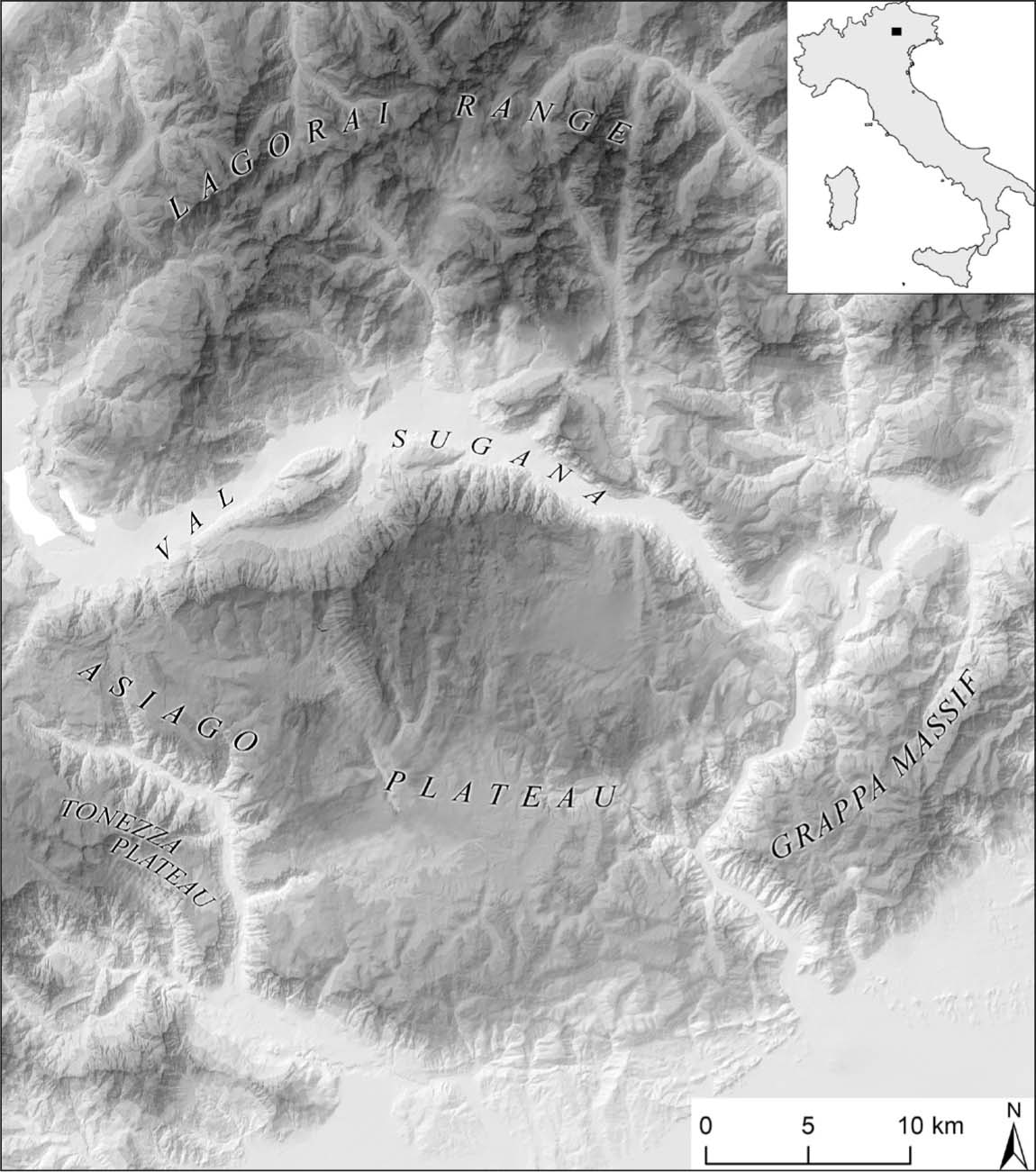
Figure 1:
The Asiago Plateau within the southeastern Prealpine Chain context.
Slika 1: Planota Asiago v predelu jugovzhodnega Predalpskega gorovja.
According to the Worldwide Bioclimatic Classification System (Rivas-Martínez et al., 2011), the central basin of the Asiago Plateau belongs to the temperate-oceanic bioclimate, upper supra-temperate thermotype, lower hyperhumid ombrotype.
Data analysis
The vegetation of hay meadows and cattle summer grazing areas in the Asiago Plateau was studied according to the phytosociological method (Braun-Blanquet, 1964). This analysis included 114 original relevés, supplemented by 12 previously published relevés dealing with mown Arrhenatherum elatius meadows (Buffa et al., 1995). Thus, the whole data set formed a matrix of 126 relevés by 345 taxa. Location, date and geographical coordinates of original relevés and source of the published ones are listed in Appendix 1. Appendix 3 provides a relevé we did not include in the matrix because we recorded only a single stand of the coenosis which it represents (Rumicetum alpini). In multivariate analyses some taxa were considered as aggregates, namely: Achillea millefolium, Alchemilla vulgaris, Anthoxanthum odoratum (A. odoratum + A. alpinum), Centaurea nigrescens, Leucanthemum vulgare, Festuca rubra (F. rubra + F. nigrescens), Lotus corniculatus (L. corniculatus + L. alpinus). It is likely that misidentifications led to attribute to Luzula alpina specimens belonging to L. exspectata which was not distinguished (see Bačič et al., 2019). Cover values meet the Braun-Blanquet scale but with Barkman et al.’s modification (1964) regarding 2a and 2b scores. The species scores were converted in the corresponding percentage values according to Lepš & Hadincová (1992) and Gigante et al. (2012) as concerns 2a and 2b scores; the same data transformation type was chosen for the subset of mat-grass sward matrix (38 relevés by 198 taxa) that included also 11 published relevés occurring in the study area (Giovagnoli & Tasinazzo, 2014). In both cases data were subjected to hierarchical agglomerative Q-mode clustering according to the unweighted pair-group method (UPGMA) on a percentage difference (Bray-Curtis) dissimilarity matrix with log-transformed values to satisfy the condition of computing in an euclidean space (Borcard et al., 2018). The synthetic tables we obtained as regards mat-grass swards, Anthryscus sylvestris-rich meadows and mountain to high-mountain Festuca rubra agg. pastures were put in comparisons with selected synthetic tables from prealpine, alpine or central European territories to reach a correct phytosociological interpretation or delimitation of found plant communities (Appendix 2). In these cases, chord distance matrices (Nardus swards: 21 by 540; A. sylvestris meadows: 6 by 204; F. rubra pastures: 24 by 471) underwent UPGMA clustering method, after we had aggregated some related taxa. Statistical analyses were carried out using R (R Core Team, 2025). Similarity matrices and cluster analysis were performed using the vegan R package (Oksanen et al., 2022). With few exceptions (Campanula witasekiana Vierh., Carduus defloratus subsp. tridentinus (Evers) Ladurner, Phyteuma zahlbruckneri Vest, Rhinanthus freynii (Sterneck) A.Kern. ex Fiori, R. alectorolophus (Scop.) Pollich), taxonomic nomenclature follows the online flora Euro+Med (2025). Syntaxonomic nomenclature of higher syntaxa follows the EuroVegChecklist, EVC (Mucina et al., 2016; FloraVeg.EU 2025).
Results and discussion
The cluster analysis supported the identification of nine groups corresponding to as much plant communities which are addressed below according to the resulting order from left to right (Figure 2).
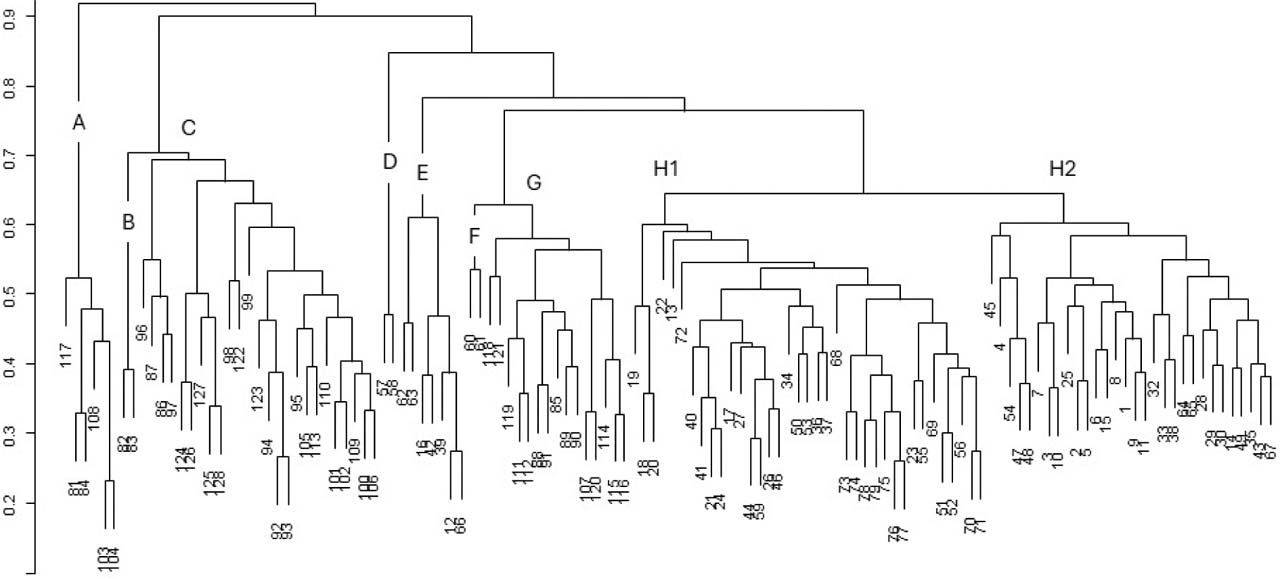
Figure 2:
Classification of the hay meadows and pastures from the Asiago Plateau (log-transformed data, Bray-Curtis/UPGMA). A: Alchemillo-Poetum; B: Festuca stricta/sulcata-Nardus community; C: Homogyno-Nardetum; D: Holcetum lanati; E: Ranunculo-Alopecuretum anthriscetosum; F: Centaureo-Trisetetum; G: Festuca rubra-Cynosurus cristatus community; H1: Arrhenatherum elatior-dominating form of Centaureo-Arrhenatheretum; H2: Centaureo-Arrhenatheretum avenuletosum pubescentis.
Slika 2: Klasifikacija senožeti in pašnikov s planote Asiago (log-transformirani podatki, Bray-Curtis/UPGMA). A: Alchemillo-Poetum; B: združba Festuca stricta/sulcata-Nardus; C: Homogyno-Nardetum; D: Holcetum lanati; E: Ranunculo-Alopecuretum anthriscetosum; F: Centaureo-Trisetetum; G: združba Festuca rubra-Cynosurus cristatus; H1: oblika s prevladujočo vrsto Arrhenatherum elatior asociacije Centaureo-Arrhenatheretum; H2: Centaureo-Arrhenatheretum avenuletosum pubescentis.
Alchemillo hybridae-Poetum supinae Aichinger 1933 corr. Oberd. 1971
Local diagnostic species. Ochlopoa supina, Veronica serpyllifolia, Barbarea bracteosa, Ochlopoa annua.
Floristic composition. The association is characterised by the large dominance of Ochlopoa supina which encompasses most of stand biomass (Table 1). It looks like a dwarf-grass pasture where most of more frequent species are creeping hemicryptophytes (Trifolium repens, Veronica serpyllifolia, Ranunculus repens) contributing to its compact appearance. Since only few species tolerate the conditions, the species number per relevé is low (13; sd: 2.4).
Syntaxonomy. The association was first described by Aichinger (1933) with Ochlopoa supina, Alchemilla hybrida and Veronica serpyllifollia as character species. Apart from the correction of Alchemilla hybrida with A. vulgaris coll., the diagnostic species remained quite similar in the following contributions from various European countries (Oberdorfer, 1993; Poldini & Oriolo, 1995a; Hájková et al., 2010), underlying a certain stability of the association. This is also the case of the Asiago Plateau stands which are enriched with Barbarea bracteosa, a Mediterranean orophyte locally occurring in vegetation typologies affected by intensive grazing nearby cattle barns. The assignment to the alliance level has been differently interpreted: Oberdorfer (1993) attributed the association to Polygono-Coronopodion (as Polygonion avicularis), which yet includes therophyte-rich vegetation, Ellmauer & Mucina (1993) assigned it to Poion supinae, whereas Czech authors (Chytrý, 2010) classified it in Cynosurion giving the absence of subalpine and alpine species in Czech stands. Despite the low presence and frequency of character species, our original stands are anyway referred to Poion supinae because of ecological features and in accordance with the other available sources from Alpic provenances (Ellmauer & Mucina, 1993; Poldini & Oriolo, 1995a; https://www.e-veg.net/app/13089). Species of Poo alpinae-Trisetetalia order are well-represented.
Synecology. Heavy trampling and soil compaction cause severe, selective pressure that drives the occurrence of resistant species and the development of the zoogenic coenosis. This creates small-size turfs nearby livestock shelters, especially cattle, and their watering sites, along paths to barns, in the high mountain belt at an altitude of 1,600–1,800 m a.s.l., where flat sites promote positive water balances and organic nutrient inputs thanks to livestock excrement.
Synchorology. It spreads in all main temperate European mountain ranges (www.e-veg.net/app/13089). As regard Italy, the only published relevés come from Friuli region (Poldini & Oriolo, 1995a). The occurrence of largely prevalent number of Salicetea herbaceae species and the absence of those tolerant of heavily trampled soils, except Ochlopoa supina, as well as Molinio-Arrhenathereta ones suggest that relevés from Dolomites in Pignatti & Pignatti (2016) may be referred to other associations, as discussed by the authors themselves (cf. Poo-Cerastietum).
EU reference habitat. None.
Conservation Status, Pressures, and Threats. Because of its origin, conservation problems as well as pressures and threats are not relevant factors.
Table 1:
Alchemillo-Poetum supinae from the Asiago Plateau.
Tabela 1: Alchemillo-Poetum supinae na planoti Asiago.
| relevé number | 117 | 81 | 84 | 108 | 103 | 104 | ||
|---|---|---|---|---|---|---|---|---|
| elevation (m) | 1602 | 1700 | 1640 | 1620 | 1735 | 1744 | ||
| aspect | - | - | - | - | - | SE | ||
| species number | 16 | 9 | 14 | 14 | 12 | 13 | ||
| pr | fr% | |||||||
| diff sp Alchemillo-Poetum supinae | ||||||||
| Ochlopoa supina (O) | 4 | 4 | 5 | 5 | 5 | 5 | 6 | 100 |
| Veronica serpyllifolia/serpyllifolia (C) | + | + | + | + | 1 | + | 6 | 100 |
| Barbarea bracteosa | + | + | r | + | + | 5 | 83 | |
| Ochlopoa annua | 2a | + | + | 3 | 50 | |||
| char sp Poion supinae | ||||||||
| Blitum bonus-henricus | + | 1 | 17 | |||||
| char sp Poo alpinae-Trisetetalia | ||||||||
| Alchemilla vulgaris agg. | + | + | 1 | 2b | 2a | 2a | 6 | 100 |
| Poa alpina | 1 | + | + | 3 | 50 | |||
| Crocus vernus/albiflorus | 1 | + | 2 | 33 | ||||
| char sp Molinio-Arrhenatheretea | ||||||||
| Trifolium repens | 1 | 2b | 2a | + | 1 | + | 6 | 100 |
| Taraxacum Sect. Taraxacum | + | 1 | + | 1 | + | 5 | 83 | |
| Ranunculus acris/acris | + | 1 | + | + | 4 | 67 | ||
| Ranunculus repens | + | + | 1 | 2a | 4 | 67 | ||
| Deschampsia cespitosa | + | + | + | 3 | 50 | |||
| Carum carvi | + | 1 | 17 | |||||
| Carex hirta | 1 | 1 | 17 | |||||
| Cerastium fontanum/vulgare | + | 1 | 17 | |||||
| Poa trivialis/trivialis | 2b | 1 | 17 | |||||
| other | ||||||||
| Plantago major/major | + | + | + | r | 2a | 2a | 6 | 100 |
| Capsella bursa-pastoris | 2a | + | + | 3 | 50 | |||
| Elytrigia repens/repens | 2a | 1 | 2 | 33 | ||||
| Rumex obtusifolius | + | r | 2 | 33 | ||||
| Cirsium arvense | + | 1 | 17 | |||||
| Gagea fragifera | + | 1 | 17 | |||||
| Glyceria notata | 2a | 1 | 17 | |||||
| Jacobaea alpina | + | 1 | 17 | |||||
| Lamium album | + | 1 | 17 | |||||
| Urtica dioica | + | 1 | 17 | |||||
| Veronica chamaedrys/chamaedrys | + | 1 | 17 | |||||
Mat-grass swards
Original mat-grass stands were first compared with already published natural, subalpine Nardus-rich grasslands coming from the same study area (Giovagnoli & Tasinazzo, 2014). According to the classification, original relevés do not merge with the published ones which remain well separated and form the cluster representing Sieversio-Nardetum (Figure 3). Based on this result as well as on ecological considerations, new data were classified into two communities we combined in Table 2: Festuca stricta-Nardus community (two relevés: 82, 83) and Homogyno-Nardetum (25 relevés).
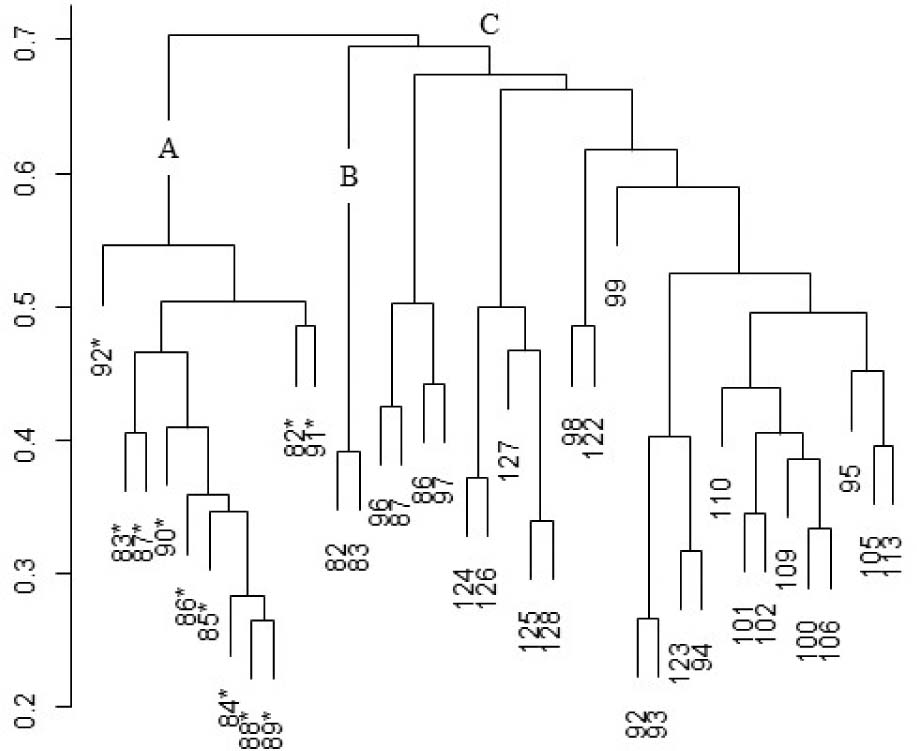
Figure 3:
Classification of Nardus swards from the Asiago Plateau (log-transformed data, Bray-Curtis/UPGMA). A: Sieversio-Nardetum (*: releve number from Table 10 in Giovagnoli & Tasinazzo, 2014); B: Festuca stricta/sulcata-Nardus community; C: Homogyno-Nardetum.
Slika 3: Klasifikacija travišč z vrsto Nardus stricta s planote Asiago Plateau (log-transformirani podatki, Bray-Curtis/UPGMA). A: Sieversio-Nardetum (*: številka popisa v Tabeli 10 v Giovagnoli & Tasinazzo, 2014); B: združba Festuca stricta/sulcata-Nardus; C: Homogyno-Nardetum.
Table 2:
Festuca stricta/sulcata-Nardus community (Com1) and Homogyno-Nardetum (Ass2; Nardo-Agrostion tenuis) from the Asiago Plateau.
Tabela 2: Festuca stricta/sulcata-Nardus (Com1) in Homogyno-Nardetum (Ass2; Nardo-Agrostion tenuis) s planote Asiago.
| relevé number | 82 | 83 | 96 | 87 | 86 | 97 | 124 | 126 | 127 | 125 | 128 | 98 | 122 | 99 | 92 | 93 | 123 | 94 | 110 | 101 | 102 | 109 | 100 | 106 | 95 | 105 | 113 | pr. | fr. % |
|---|---|---|---|---|---|---|---|---|---|---|---|---|---|---|---|---|---|---|---|---|---|---|---|---|---|---|---|---|---|
| elevation (m) | 1470 | 1510 | 1705 | 1750 | 1770 | 1755 | 1800 | 1855 | 1890 | 1850 | 1985 | 1590 | 1600 | 1390 | 1688 | 1720 | 1705 | 1700 | 1595 | 1354 | 1360 | 1632 | 1358 | 1693 | 1830 | 1665 | 1752 | ||
| aspect | SSE | SSE | SW | SE | NNE | W | SW | SSW | S | SW | SSW | SE | SW | W | NE | WSW | ESE | E | E | SSE | SW | ENE | NNE | SW | SW | nard | W | ||
| species number | 39 | 42 | 36 | 39 | 52 | 40 | 67 | 55 | 51 | 52 | 50 | 54 | 48 | 55 | 45 | 40 | 41 | 44 | 29 | 41 | 27 | 39 | 38 | 37 | 31 | 34 | 29 | ||
| pr. com1 | fr. % Ass2 | ||||||||||||||||||||||||||||
| local diff sp Festuca stricta/sulcata-Nardus community | |||||||||||||||||||||||||||||
| Bromopsis erecta/erecta | 2a | + | 2 | ||||||||||||||||||||||||||
| Festuca stricta/sulcata | 2a | 2b | 2 | ||||||||||||||||||||||||||
| Thymus pulegioides | + | + | 2 | ||||||||||||||||||||||||||
| local diff sp Homogyno-Nardetum | |||||||||||||||||||||||||||||
| Ranunculus acris/acris | + | + | + | + | 1 | 1 | + | + | + | 1 | + | + | 1 | + | + | + | 64 | ||||||||||||
| Dactylorhiza fuchsii | + | 1 | + | 1 | + | + | + | + | + | r | + | r | + | 52 | |||||||||||||||
| Pseudorchis albida/albida | + | + | 1 | + | 1 | 1 | + | + | + | 1 | + | + | 48 | ||||||||||||||||
| Dactylorhiza viridis | + | + | + | + | + | + | + | + | + | + | + | 44 | |||||||||||||||||
| Carlina acaulis/acaulis | + | + | + | + | + | + | + | + | + | + | r | 44 | |||||||||||||||||
| Ranunculus polyanthemos/nemorosus | + | + | + | + | + | 1 | + | + | 1 | + | 40 | ||||||||||||||||||
| char and diff sp Nardetalia | |||||||||||||||||||||||||||||
| Nardus stricta | 1 | 2a | + | + | + | + | 1 | 2b | 1 | 2a | 2b | + | 1 | 2b | 2a | 1 | + | 4 | 4 | 4 | 2b | 1 | 1 | 4 | 1 | 4 | 2 | 96 | |
| Hypericum maculatum/maculatum | + | 1 | 1 | + | 2a | + | + | 1 | + | + | + | 1 | 1 | + | 1 | 2a | + | 2b | 2a | + | 2a | 2b | + | + | + | 2 | 92 | ||
| Potentilla aurea/aurea | + | 2b | + | 1 | 1 | + | + | + | + | 2a | 1 | 1 | 1 | 1 | 1 | 1 | 2a | 2a | 2a | 2b | 1 | 2a | 2a | 1 | 88 | ||||
| Carex pallescens | 2a | 2a | + | 1 | + | 1 | 2a | 1 | 2a | 1 | 1 | + | 1 | + | 56 | ||||||||||||||
| Arnica montana/montana | + | 1 | + | + | 1 | + | + | + | + | + | + | + | 1 | 52 | |||||||||||||||
| Galium pumilum/pumilum | + | + | 1 | + | + | 1 | + | + | + | + | + | 1 | r | 2 | 44 | ||||||||||||||
| Homogyne alpina | + | + | + | + | 1 | 1 | + | 1 | 1 | 36 | |||||||||||||||||||
| Pilosella lactucella/lactucella | + | + | + | + | 1 | 12 | |||||||||||||||||||||||
| Botrychium lunaria | + | + | + | 12 | |||||||||||||||||||||||||
| char sp Nardetea strictae | |||||||||||||||||||||||||||||
| Potentilla erecta | + | 1 | + | 1 | 2a | 2a | 2a | 2a | 1 | + | 2a | 2a | 2a | 2a | 1 | 2a | 1 | 2a | 2b | 1 | 2b | 2a | 2a | 1 | 2 | 88 | |||
| Carex pilulifera/pilulifera | + | + | + | + | 2a | 1 | 2a | 2a | 2a | 1 | + | 2a | 1 | 2a | 2a | 2a | 2b | 1 | 2a | 2b | 2 | 72 | |||||||
| Stellaria graminea | r | + | + | + | + | + | 2b | 2b | + | + | 1 | + | r | 1 | 48 | ||||||||||||||
| Luzula campestris | 2a | 2a | + | + | + | + | + | 1 | 1 | 1 | 1 | + | 2 | 40 | |||||||||||||||
| Luzula multiflora/multiflora | + | 1 | + | r | 1 | 1 | + | + | + | 36 | |||||||||||||||||||
| Pilosella officinarum/officinarum | + | + | + | + | + | + | + | 28 | |||||||||||||||||||||
| Antennaria dioica | + | + | 1 | 1 | + | + | 24 | ||||||||||||||||||||||
| Danthonia decumbens/decumbens | + | 1 | 2a | 1 | + | 1 | 24 | ||||||||||||||||||||||
| char sp Festuco-Brometea | |||||||||||||||||||||||||||||
| Carex caryophyllea | + | + | + | + | + | + | + | 1 | + | + | + | + | + | + | + | + | + | 2 | 60 | ||||||||||
| Cirsium acaulon/acaulon | + | + | + | + | 2a | + | + | + | + | + | 1 | 36 | |||||||||||||||||
| Plantago media | + | + | + | + | r | 1 | r | + | + | + | 1 | 36 | |||||||||||||||||
| Dactylorhiza sambucina | 2a | + | 1 | + | r | + | 2 | 16 | |||||||||||||||||||||
| Briza media | 1 | 2a | + | 1 | r | 2 | 12 | ||||||||||||||||||||||
| Euphorbia cyparissias | + | 1 | + | + | + | 2 | 12 | ||||||||||||||||||||||
| Avenula pubescens/pubescens | 2a | + | + | + | 2 | 8 | |||||||||||||||||||||||
| Carex flacca/flacca | + | + | 8 | ||||||||||||||||||||||||||
| Helictochloa praeusta/praeusta | + | + | 8 | ||||||||||||||||||||||||||
| Rhinanthus freynii | + | 2a | 8 | ||||||||||||||||||||||||||
| Koeleria pyramidata/pyramidata | 1 | + | 1 | 2 | 4 | ||||||||||||||||||||||||
| Galium verum/verum | + | + | 1 | 4 | |||||||||||||||||||||||||
| Hippocrepis comosa | + | + | 1 | 4 | |||||||||||||||||||||||||
| Ranunculus bulbosus/bulbosus | + | 4 | |||||||||||||||||||||||||||
| Brachypodium rupestre | + | 1 | |||||||||||||||||||||||||||
| Pimpinella saxifraga | r | 1 | |||||||||||||||||||||||||||
| char sp Juncetea trifidi | |||||||||||||||||||||||||||||
| Anthoxanthum odoratum agg. (A. alpinum p.max.p.) | + | + | + | 2b | 2b | 1 | 1 | 2a | 2b | 2b | + | 1 | 2b | + | + | 1 | + | 2a | 1 | 1 | 2a | 2a | 2a | + | 2a | 2b | 1 | 100 | |
| Luzula alpina agg. | + | + | 1 | + | 1 | + | + | 1 | 1 | 1 | + | + | 1 | + | + | + | + | 1 | + | 1 | + | 1 | 1 | 84 | |||||
| Geum montanum | 1 | 1 | 1 | 1 | + | + | + | + | 2a | 1 | 2a | + | + | 2a | 1 | 2b | 1 | 2b | + | 2a | 80 | ||||||||
| Gentiana acaulis | 1 | 1 | + | + | + | 1 | + | + | r | + | + | 1 | 40 | ||||||||||||||||
| Scorzoneroides helvetica | + | r | 1 | + | + | 2a | 1 | 28 | |||||||||||||||||||||
| Centaurea nervosa | + | + | + | 1 | + | 20 | |||||||||||||||||||||||
| Hypochaeris uniflora | 2a | + | 2a | 2a | 16 | ||||||||||||||||||||||||
| Pilosella hoppeana | + | 1 | 8 | ||||||||||||||||||||||||||
| Phyteuma hemisphaericum | + | 4 | |||||||||||||||||||||||||||
| Helictochloa versicolor/versicolor | 1 | 4 | |||||||||||||||||||||||||||
| char sp Elyno-Seslerietea | |||||||||||||||||||||||||||||
| Potentilla crantzii | + | 2b | 1 | + | 1 | + | + | + | + | + | + | 1 | + | + | + | + | + | + | 1 | 68 | |||||||||
| Poa alpina | 1 | 2a | 1 | r | + | + | + | + | + | + | + | r | + | 52 | |||||||||||||||
| Ranunculus carinthiacus | + | + | + | + | + | + | + | + | + | + | + | + | + | 52 | |||||||||||||||
| Galium anisophyllon | 2a | 1 | 1 | 1 | 1 | 1 | 1 | + | + | + | + | + | 48 | ||||||||||||||||
| Carex sempervirens/sempervirens | + | 1 | 2b | 1 | 1 | 2b | 1 | 1 | 2a | 2a | 2a | 44 | |||||||||||||||||
| Stachys alopecuros | + | 2a | 2a | 2b | 2a | 1 | + | + | + | 1 | 2 | 32 | |||||||||||||||||
| Gymnadenia rhellicani | + | + | + | + | + | + | + | 28 | |||||||||||||||||||||
| Anthyllis vulneraria/alpestris | 1 | 1 | + | + | + | + | 24 | ||||||||||||||||||||||
| Leucanthemum heterophyllum | + | + | + | + | + | 20 | |||||||||||||||||||||||
| Thesium alpinum | + | + | + | r | + | 20 | |||||||||||||||||||||||
| Festuca norica | + | + | 1 | 1 | 16 | ||||||||||||||||||||||||
| Pedicularis elongata s.l. | + | + | + | + | 16 | ||||||||||||||||||||||||
| Scorzonera aristata | + | + | + | + | 16 | ||||||||||||||||||||||||
| Biscutella laevigata/laevigata | + | + | + | 12 | |||||||||||||||||||||||||
| Polygala alpestris/alpestris | + | + | + | 12 | |||||||||||||||||||||||||
| Myosotis alpestris/alpestris | + | + | + | 12 | |||||||||||||||||||||||||
| Gentiana verna/verna | + | + | + | 12 | |||||||||||||||||||||||||
| Horminum pyrenaicum | 2a | 1 | + | 12 | |||||||||||||||||||||||||
| Arabis ciliata | + | + | + | + | 2 | 8 | |||||||||||||||||||||||
| Clinopodium alpinum/alpinum | + | + | 8 | ||||||||||||||||||||||||||
| Crepis froelichiana/froelichiana | + | + | 8 | ||||||||||||||||||||||||||
| Jacobaea abrotanifolia | + | + | 8 | ||||||||||||||||||||||||||
| Ranunculus venetus | + | + | 8 | ||||||||||||||||||||||||||
| Bartsia alpina | + | 4 | |||||||||||||||||||||||||||
| Bellidiastrum michelii | r | 4 | |||||||||||||||||||||||||||
| Bupleurum ranunculoides/ranunculoides | + | 4 | |||||||||||||||||||||||||||
| Festuca laevigata/laevigata | + | 4 | |||||||||||||||||||||||||||
| Knautia longifolia | 1 | 4 | |||||||||||||||||||||||||||
| Pulsatilla alpina/austroalpina | + | 4 | |||||||||||||||||||||||||||
| Selaginella selaginoides | + | 4 | |||||||||||||||||||||||||||
| char sp Molinio-Arrhenatheretea | |||||||||||||||||||||||||||||
| Festuca rubra agg. (F. nigrescens p.m.p.) | 2a | 1 | 4 | 1 | + | 1 | 2b | 2a | 2b | 2a | 2a | 1 | 1 | 2a | 2b | 1 | 1 | 1 | 1 | 2a | + | + | 2a | 2a | + | + | 1 | 2 | 100 |
| Crocus vernus/albiflorus | + | 1 | 1 | 2a | 2a | 1 | 2a | 1 | 1 | 1 | + | + | 2b | + | 2a | 1 | 1 | + | + | 1 | 1 | 1 | 1 | + | + | + | 2 | 96 | |
| Lotus corniculatus | + | + | + | + | 1 | + | + | + | + | + | + | + | 1 | + | + | + | + | + | r | + | + | + | + | 2 | 84 | ||||
| Trifolium pratense | + | + | + | + | 1 | 1 | 2a | 1 | + | + | 1 | 2a | + | + | + | 1 | + | + | + | + | + | 2 | 76 | ||||||
| Phleum rhaeticum | + | 2a | 2a | + | 2b | + | + | + | 1 | + | 1 | + | 1 | 1 | 1 | + | 2a | 1 | + | + | 2 | 72 | |||||||
| Bistorta officinalis | + | + | + | + | 2a | 1 | + | 2b | 2b | 2a | 2a | 2a | 1 | 1 | 2b | + | + | 1 | + | 2a | 2 | 72 | |||||||
| Veronica chamaedrys/chamaedrys | + | 1 | + | + | + | + | + | + | + | 2a | + | + | + | + | 1 | 1 | 1 | 1 | + | 2 | 68 | ||||||||
| Poa pratensis/pratensis | + | + | + | + | + | + | + | + | 2 | 24 | |||||||||||||||||||
| Trifolium repens | + | + | 1 | 1 | + | 1 | 2a | 1 | 1 | 1 | + | + | + | 1 | + | 1 | 56 | ||||||||||||
| Centaurea nigrescens/transalpina | + | ||||||||||||||||||||||||||||
| Agrostis capillaris/capillaris | 1 | 1 | 1 | 2b | 1 | + | 1 | 1 | 1 | 2b | 1 | 1 | 1 | 1 | 1 | 2a | 1 | 1 | 2a | 2a | 2a | 1 | 84 | ||||||
| Cerastium fontanum/vulgare | + | + | r | 1 | + | 1 | + | + | + | + | 40 | ||||||||||||||||||
| Gymnadenia conopsea | + | 1 | + | + | + | 1 | r | + | + | r | 40 | ||||||||||||||||||
| Trollius europaeus/europaeus | r | + | + | + | + | + | + | + | 32 | ||||||||||||||||||||
| Deschampsia cespitosa | + | + | r | r | + | + | + | 28 | |||||||||||||||||||||
| Carum carvi | + | + | + | + | + | 2a | 24 | ||||||||||||||||||||||
| Galium mollugo agg. | r | r | + | + | + | r | 24 | ||||||||||||||||||||||
| Ajuga reptans | + | + | + | + | + | 20 | |||||||||||||||||||||||
| Euphrasia rostkoviana/rostkoviana | + | + | + | + | 16 | ||||||||||||||||||||||||
| Prunella vulgaris | + | + | + | + | 16 | ||||||||||||||||||||||||
| Rumex acetosa/acetosa | + | + | + | r | 16 | ||||||||||||||||||||||||
| Dactylis glomerata | + | 1 | 8 | ||||||||||||||||||||||||||
| Poa trivialis/trivialis | + | + | 8 | ||||||||||||||||||||||||||
| Rhinanthus minor | + | + | 8 | ||||||||||||||||||||||||||
| Colchicum autumnale | r | 4 | |||||||||||||||||||||||||||
| Cynosurus cristatus | 4 | 4 | |||||||||||||||||||||||||||
| Leucanthemum vulgare agg. | + | 4 | |||||||||||||||||||||||||||
| Plantago lanceolata | 1 | 4 | |||||||||||||||||||||||||||
| Ochlopoa supina | + | 4 | |||||||||||||||||||||||||||
| Tephroseris longifolia/gaudinii | r | 4 | |||||||||||||||||||||||||||
| Veronica serpyllifolia/serpyllifolia | + | 4 | |||||||||||||||||||||||||||
| other species | |||||||||||||||||||||||||||||
| Alchemilla vulgaris agg. | + | + | + | + | 1 | 1 | + | + | + | 1 | 2a | + | 1 | + | + | + | + | 2a | r | + | 2 | 72 | |||||||
| Carex ornithopoda | 2a | 1 | + | 2a | 1 | + | 1 | 2a | 1 | + | + | 1 | + | 1 | + | + | + | 1 | 2 | 64 | |||||||||
| Achillea millefolium | + | 1 | + | + | + | + | + | 1 | 1 | + | + | + | + | 1 | 1 | + | + | 2 | 60 | ||||||||||
| Avenella flexuosa/flexuosa | + | 1 | 2a | 2b | 1 | + | 2a | 2a | 1 | + | + | 1 | 48 | ||||||||||||||||
| Pedicularis verticillata | r | 2a | + | + | r | + | 1 | + | + | + | 40 | ||||||||||||||||||
| Aposeris foetida | r | 1 | 2a | r | + | 1 | 2a | r | + | 36 | |||||||||||||||||||
| Cruciata laevipes | + | + | + | + | + | + | + | + | + | 1 | 32 | ||||||||||||||||||
| Pimpinella alpina | + | 1 | + | + | + | + | + | 1 | + | 1 | 32 | ||||||||||||||||||
| Carduus defloratus/tridentinus | 1 | 1 | + | + | + | + | + | + | 32 | ||||||||||||||||||||
| Carex montana | + | + | 2a | + | 1 | + | + | + | 1 | 28 | |||||||||||||||||||
| Thymus praecox/polytrichus | 1 | r | + | + | + | + | 1 | 28 | |||||||||||||||||||||
| Calluna vulgaris | + | 1 | 1 | 1 | + | + | 1 | 28 | |||||||||||||||||||||
| Cerastium arvense s.l. | + | + | r | + | + | + | + | 28 | |||||||||||||||||||||
| Cruciata glabra | 1 | 1 | + | 2a | 2a | + | 1 | 2a | 2 | 24 | |||||||||||||||||||
| Campanula scheuchzeri/scheuchzeri | + | + | + | + | + | 20 | |||||||||||||||||||||||
| Galium x centroniae | + | + | + | + | + | 20 | |||||||||||||||||||||||
| Luzula sylvatica/sieberi | + | + | + | + | + | 20 | |||||||||||||||||||||||
| Veronica officinalis | + | + | + | + | + | 1 | 16 | ||||||||||||||||||||||
| Cirsium eriophorum | + | r | + | + | + | 1 | 16 | ||||||||||||||||||||||
| Vaccinium myrtillus | + | r | + | 1 | 16 | ||||||||||||||||||||||||
| Polygala chamaebuxus | + | 1 | + | + | 16 | ||||||||||||||||||||||||
| Daphne mezereum | + | + | 1 | + | 16 | ||||||||||||||||||||||||
| Soldanella alpina/alpina | + | + | 1 | 12 | |||||||||||||||||||||||||
| Juniperus communis/nana (pl+B2) | + | + | + | 12 | |||||||||||||||||||||||||
| Phyteuma zahlbruckneri | + | + | 1 | 12 | |||||||||||||||||||||||||
| Erica carnea | r | + | + | 12 | |||||||||||||||||||||||||
| Maianthemum bifolium | + | 1 | + | 12 | |||||||||||||||||||||||||
| Platanthera bifolia | + | + | + | 12 | |||||||||||||||||||||||||
| Tanacetum corymbosum/corymbosum | + | + | + | 12 | |||||||||||||||||||||||||
| Pulmonaria australis | + | r | + | 12 | |||||||||||||||||||||||||
| Geum rivale | + | + | 8 | ||||||||||||||||||||||||||
| Knautia drymeja | 1 | 1 | 2 | 8 | |||||||||||||||||||||||||
| Laserpitium krapfii/gaudinii | r | + | 8 | ||||||||||||||||||||||||||
| Sesleria caerulea/caerulea | r | + | 8 | ||||||||||||||||||||||||||
| Tofieldia calyculata | + | + | 8 | ||||||||||||||||||||||||||
| Viola biflora | + | + | 8 | ||||||||||||||||||||||||||
| Galium baldense | + | + | 8 | ||||||||||||||||||||||||||
| Chaerophyllum villarsii | + | + | 8 | ||||||||||||||||||||||||||
| Ranunculus platanifolius | + | r | 8 | ||||||||||||||||||||||||||
| Senecio cacaliaster | r | + | 8 | ||||||||||||||||||||||||||
| Primula veris/veris | r | + | 8 | ||||||||||||||||||||||||||
| Vaccinium vitis-idaea | + | + | 8 | ||||||||||||||||||||||||||
| Parnassia palustris | + | 4 | |||||||||||||||||||||||||||
| Leontodon hispidus/hispidus | + | 4 | |||||||||||||||||||||||||||
| Daphne cneorum/cneorum | + | 4 | |||||||||||||||||||||||||||
| Elytrigia repens/repens | + | 4 | |||||||||||||||||||||||||||
| Hieracium bifidum s.l. | + | 4 | |||||||||||||||||||||||||||
| Neottia ovata | + | 4 | |||||||||||||||||||||||||||
| Pinguicula leptoceras | + | 4 | |||||||||||||||||||||||||||
| Pinguicula vulgaris/vulgaris | + | 4 | |||||||||||||||||||||||||||
| Plantago major/major | r | 4 | |||||||||||||||||||||||||||
| Rumex acetosella/acetosella | 1 | 4 | |||||||||||||||||||||||||||
| Taraxacum sect. Taraxacum | + | 4 | |||||||||||||||||||||||||||
| Bistorta vivipara | + | 4 | |||||||||||||||||||||||||||
| Cyanus triumfettii/triumfettii | r | 4 | |||||||||||||||||||||||||||
| Valeriana stolonifera/angustifolia | + | 4 | |||||||||||||||||||||||||||
| Silene nutans | + | 4 | |||||||||||||||||||||||||||
| Ranunculus breyninus | + | 4 | |||||||||||||||||||||||||||
| Rumex arifolius | + | 4 | |||||||||||||||||||||||||||
| Veratrum lobelianum | + | 4 | |||||||||||||||||||||||||||
| Myosotis sylvatica | + | 1 | |||||||||||||||||||||||||||
Festuca stricta/sulcata-Nardus community
Local diagnostic species (in comparison with the other mat-grass swards). Bromopsis erecta subsp. erecta, Festuca stricta subsp. sulcata, Thymus pulegioides.
Floristic composition. Comparison of original and already published relevés of Nardetum strictae s. lat. from the study area highlights that relevés 82 and 83 are differentiated by a high proportion of thermophilous, dry grassland species of base-rich soils (Festuco-Brometea): Festuca stricta/sulcata, Bromopsis erecta, Briza media are some of the species with the highest cover values and frequencies (Table 2; Table 3). They blend with montane mat-grass pasture species (Nardus stricta, Festuca nigrescens, Hypericum maculatum, partly Luzula campestris) and mesic meadow ones (Phlaeum rhaeticum, Crocus vernus/albiflorus). Subalpine calcicolous pasture species are very sporadic, whereas species of subalpine Nardus communities are almost completely absent. The mean number of species per relevé is 40.5 (sd: 2.1).
Syntaxonomy. Due to the local rarity of the vegetation type, we were unable to find further sites to collect more relevés and attain a reliable syntaxonomical reference. A balanced occurrence of diagnostic species of Nardetea strictae and Festuco-Brometea characterises the two stands, as well as in Polygalo-Nardetum in Friuli (Poldini & Oriolo, 1997) and Arnico-Brometum in western Slovenia (Dakskobler, 2024). The two associations prevalently develop in the lower montane belt (from 700 to 1,250, mean 930, and from 640 to 1,130, mean 890, m a.s.l., respectively) and some relevés of Arnico-Brometum coming from the M. Matajur have a slightly stronger similarity with some relevés of Polygalo-Nardetum from the Italian side of the same mountain (Dakskobler, 2024). Comparison with the mat-grass swards from the south-eastern Alps confirms the close similarity between Polygalo-Nardetum and Arnico-Brometum (Figure 4; see also Dakskobler, 2024), despite the former is classified into Nardetea and the latter into Festuco-Brometea. The first association appears to differ from the second in the negative due to the absence of a large group of species including Dactylorhiza sambucina, Luzula campestris, Carlina acaulis, Leucanthemum ircutianum, Ranunculus polyanthemos s.l., Pilosella hoppeana, Carex pilulifera, Silene nutans, Serratula tinctoria, and others with lower frequencies, rather than for an original combination of diagnostic species. Stands from the study area are grouped with these two associations which share many frequent and diagnostic species of Polygalo-Nardetum or Violion caninae that are absent in our relevés: Polygala vulgaris, Genista tinctoria, Festuca filiformis, Viola canina, Hypochaeris maculata. On the contrary, mean higher elevation (1,490 m a.s.l.) characterising the stands from Asiago Plateau results in the occurrence of species that are more common in the subalpine belt, such as Phleum rhaeticum, Carex ornithopoda, Stachys alopecurus, Arabis ciliata and other. The community from the Asiago Plateau share with Arnico-Brometum the presence of Dactylorhiza sambucina, Luzula campestris and Carex pilulifera. The cluster also includes Danthonio-Nardetum, an association described from the Dolomites area by Pignatti & Pignatti (2014) who estimate it should be sought elsewhere in the Prealps, but Poldini & Oriolo (1997) regard it as a synonym for Polygalo-Nardetum. Danthonio-Nardetum develops in the montane belt, from (600) 1,200 to 1,500 m a.sl. (mean 1,264) and it is classified into Nardo-Agrostion alliance, whereas Polygalo-Nardetum belongs to Violion caninae. With the occurrence of the only one characteristic species Galium pumilum, and the presence of ingressive species Thymus pulegioides and Pimpinella saxifraga from Festuco-Brometea, the Violion caninae alliance is underrepresented in our two stands. On the other hand, the Nardo-Agrostion, which also encompasses the swards of Homogyno-Nardetum, is poorly represented too (Potentilla aurea). Based on the above conflicting considerations and the small number of available relevés, we prefer to classify the two relevés in the Festuca stricta/sulcata-Nardus community which is not assigned to any class.
Synecology. These secondary pastures develop at a mean altitude of 1,490 (sd: 28) m a.s.l. in the upper montane belt, in sites of potential beech forests (Figure 5). Despite the rock carbonatic origin, soils show well engaged acidification processes probably because of high rainfall and suboceanic climate; slopes are facing South.
Synchorology. Further data are needed.
EU reference habitat. 6230*.
Conservation Status, Pressures, and Threats. The conservation is affected by the small area occupied which is surrounded by intensive cattle and horse grazing.
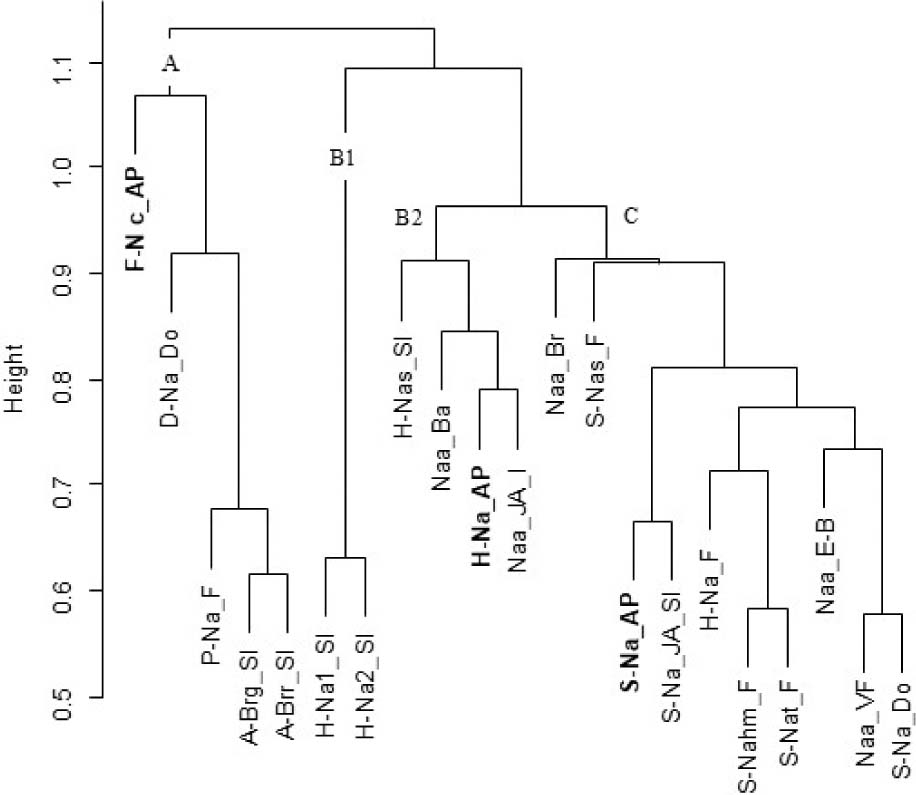
Figure 4:
Classification of the synthetic tables of mat-grass swards from the Asiago Plateau (in bold) and south-eastern Alps (chord distance/UPGMA). For abbreviations see Appendix 2.
Slika 4: Klasifikacija sintetskih tabel travišč z volkom s planote Asiago (krepko) in jugovzhodnih Alp (razdalja tetive /UPGMA). Za okrajšave glej Appendix 2.
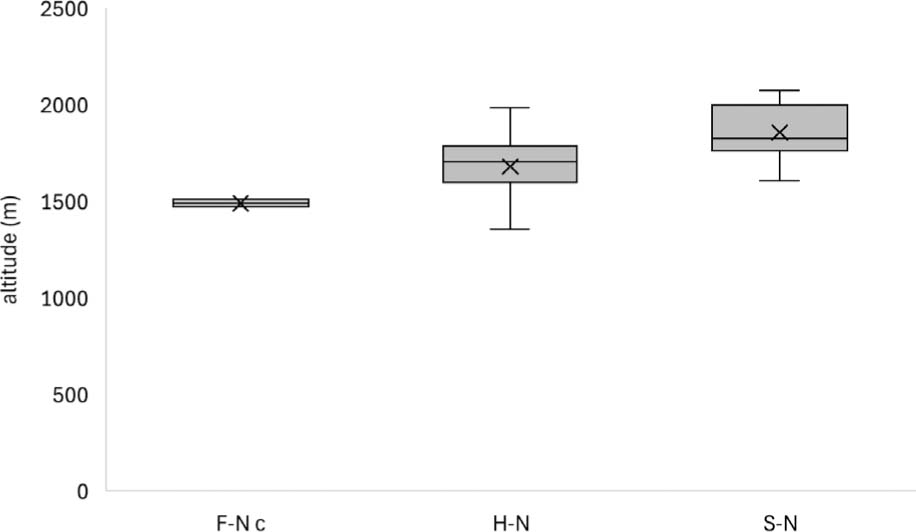
Figure 5:
Box-plot of altitudinal occurrence of different Nardus swards in the Asiago Plateau. F-N c: Festuca stricta/sulcata-Nardus community (this study); H-N: Homogyno-Nardetum (this study); S-N: Sieversio-Nardetum (Giovagnoli & Tasinazzo, 2014).
Slika 5: Škatla z ročaji nadmorskih višin, kjer se pojavljajo različna travišča z vrsto Nardus na planoti Asaiago. F-N c: združba Festuca stricta/sulcata-Nardus (ta raziskava); H-N: Homogyno-Nardetum (ta raziskava); S-N: Sieversio-Nardetum (Giovagnoli & Tasinazzo, 2014).
Table 3:
Synoptic table of Nardus swards from the Asiago Plateau.
Tabela 3: Sinoptična tabela travišč z vrsto Nardus s planote Asiago.
| association | Festuca-Nardus comm. | Homogyno-Nardetum | Sieversio-Nardetum |
|---|---|---|---|
| number of relevés | 2 | 25 | 11 |
| diagnostic species Festuca stricta/sulcata-Nardus comm. | |||
| Bromopsis erecta/erecta | 2 | ||
| Festuca stricta/sulcata | 2 | ||
| Thymus pulegioides (dAll1) | 2 | ||
| diagnostic species Homogyno-Nardetum | |||
| Ranunculus acris/acris | 64 | ||
| Dactylorhiza fuchsii | 52 | ||
| Pseudorchis albida/albida (dAll2) | 48 | ||
| Dactylorhiza viridis (Cl1) | 44 | 9 | |
| Carlina acaulis/acaulis | 44 | ||
| Ranunculus polyanthemos/nemorosus | 40 | ||
| diagnostic species Sieversio-Nardetum | |||
| Bistorta vivipara | 4 | 82 | |
| Galium baldense | 8 | 64 | |
| Jacobaea abrotanifolia | 8 | 64 | |
| Parnassia palustris | 4 | 55 | |
| Luzula spicata/conglomerata (Cl2) | 55 | ||
| Selaginella selaginoides | 4 | 45 | |
| Trifolium badium | 45 | ||
| diff sp Violion caninae (All.1) | |||
| Galium pumilum/pumilum | 2 | 44 | |
| Pimpinella saxifraga | 1 | ||
| diff sp Nardo-Agrostion (All2) | |||
| Potentilla aurea/aurea | 1 | 88 | 100 |
| Poa alpina | 52 | 82 | |
| Achillea millefolium | 2 | 60 | |
| Homogyne alpina | 36 | 73 | |
| Ajuga pyramidalis | 18 | ||
| Botrychium lunaria | 12 | ||
| char and diff sp Nardetalia | |||
| Nardus stricta | 2 | 96 | 100 |
| Hypericum maculatum/maculatum | 2 | 92 | |
| Pilosella lactucella/lactucella | 1 | 12 | 64 |
| Arnica montana/montana | 52 | 55 | |
| Carex pallescens | 56 | 18 | |
| char sp Nardetea strictae (Cl1) | |||
| Potentilla erecta | 2 | 88 | 45 |
| Carex pilulifera/pilulifera | 2 | 72 | 18 |
| Luzula campestris | 2 | 40 | |
| Stellaria graminea | 1 | 48 | 9 |
| Antennaria dioica | 24 | 64 | |
| Luzula multiflora/multiflora | 36 | ||
| Pilosella officinarum/officinarum | 28 | ||
| Danthonia decumbens/decumbens | 24 | ||
| char sp Juncetea trifidi (Cl2) and subordinate unities | |||
| Luzula alpina agg. | 1 | 84 | 100 |
| Geum montanum | 80 | 100 | |
| Anthoxanthum odoratum agg. (A. alpinum p.max.p.) | 1 | 100 | 91 |
| Scorzoneroides helvetica | 28 | 36 | |
| Gentiana acaulis | 1 | 40 | 27 |
| Phyteuma hemisphaericum | 4 | 27 | |
| Hypochaeris uniflora | 16 | 18 | |
| Euphrasia minima | 18 | ||
| Pulsatilla vernalis | 18 | ||
| Veronica bellidioides | 18 | ||
| Agrostis rupestris/rupestris | 9 | ||
| Campanula barbata | 9 | ||
| Juncus jacquinii | 9 | ||
| Juncus trifidus | 9 | ||
| Ligusticum mutellinoides | 9 | ||
| Centaurea nervosa | 20 | ||
| Pilosella hoppeana | 8 | ||
| Helictochloa versicolor/versicolor | 4 | ||
| char sp Festuco-Brometea | |||
| Carex caryophyllea | 2 | 60 | 18 |
| Dactylorhiza sambucina | 2 | 16 | |
| Briza media | 2 | 12 | |
| Euphorbia cyparissias | 2 | 12 | |
| Avenula pubescens/pubescens | 2 | 8 | |
| Koeleria pyramidata/pyramidata | 2 | 4 | |
| Cirsium acaulon/acaulon | 1 | 36 | |
| Plantago media | 1 | 36 | |
| Galium verum/verum | 1 | 4 | |
| Hippocrepis comosa | 1 | 4 | |
| Brachypodium rupestre | 1 | ||
| Carex flacca/flacca | 8 | ||
| Helictochloa praeusta/praeusta | 8 | ||
| Rhinanthus freynii | 8 | ||
| Ranunculus bulbosus/bulbosus | 4 | ||
| char sp Molinio-Arrhenatheretea | |||
| Crocus vernus/albiflorus | 2 | 96 | 73 |
| Agrostis capillaris/capillaris | 84 | 55 | |
| Lotus corniculatus | 2 | 84 | 36 |
| Trifolium pratense | 2 | 76 | 55 |
| Phleum rhaeticum | 2 | 72 | 27 |
| Bistorta officinalis | 2 | 72 | |
| Veronica chamaedrys/chamaedrys | 2 | 68 | 27 |
| Trifolium repens | 1 | 56 | |
| Cerastium fontanum/vulgare | 40 | 82 | |
| Gymnadenia conopsea | 40 | ||
| Trollius europaeus/europaeus | 32 | 18 | |
| Deschampsia cespitosa | 28 | 27 | |
| Poa pratensis/pratensis | 2 | 24 | |
| Carum carvi | 24 | ||
| Galium mollugo agg. | 24 | ||
| Ajuga reptans | 20 | ||
| Euphrasia rostkoviana/rostkoviana | 16 | ||
| Prunella vulgaris | 16 | ||
| Rumex acetosa/acetosa | 16 | ||
| Dactylis glomerata | 8 | ||
| Poa trivialis/trivialis | 8 | ||
| Rhinanthus minor | 8 | ||
| Colchicum autumnale | 4 | ||
| Cynosurus cristatus | 4 | ||
| Leucanthemum vulgare agg. | 4 | ||
| Plantago lanceolata | 4 | ||
| Ochlopoa supina | 4 | ||
| Tephroseris longifolia/gaudinii | 4 | ||
| Veronica serpyllifolia/serpyllifolia | 4 | ||
| Scorzoneroides autumnalis/autumnalis | 9 | ||
| Centaurea nigrescens/transalpina | 1 | ||
| char sp Elyno-Seslerietea | |||
| Potentilla crantzii | 1 | 68 | 55 |
| Ranunculus carinthiacus | 52 | 18 | |
| Galium anisophyllon | 48 | 9 | |
| Carex sempervirens/sempervirens | 44 | 73 | |
| Stachys alopecuros | 2 | 32 | |
| Gymnadenia rhellicani | 28 | 27 | |
| Anthyllis vulneraria/alpestris | 24 | ||
| Leucanthemum heterophyllum | 20 | ||
| Thesium alpinum | 20 | ||
| Festuca norica | 16 | 18 | |
| Pedicularis elongata s.l. | 16 | ||
| Scorzonera aristata | 16 | ||
| Biscutella laevigata/laevigata | 12 | 36 | |
| Polygala alpestris/alpestris | 12 | 36 | |
| Myosotis alpestris/alpestris | 12 | 9 | |
| Gentiana verna/verna | 12 | ||
| Horminum pyrenaicum | 12 | ||
| Arabis ciliata | 2 | 8 | |
| Clinopodium alpinum/alpinum | 8 | ||
| Crepis froelichiana/froelichiana | 8 | ||
| Ranunculus venetus | 8 | ||
| Bartsia alpina | 4 | 27 | |
| Bellidiastrum michelii | 4 | ||
| Bupleurum ranunculoides/ranunculoides | 4 | ||
| Festuca laevigata/laevigata | 4 | ||
| Knautia longifolia | 4 | ||
| Pulsatilla alpina/austroalpina | 4 | ||
| Dianthus superbus/alpestris | 9 | ||
| Trifolium thalii | 9 | ||
| other species | |||
| Festuca rubra agg. (F. nigrescens p.m.p.) | 2 | 100 | 91 |
| Alchemilla vulgaris agg. | 2 | 72 | 55 |
| Carex ornithopoda | 2 | 64 | 45 |
| Campanula scheuchzeri/scheuchzeri | 20 | 82 | |
| Pedicularis verticillata | 40 | 45 | |
| Avenella flexuosa/flexuosa | 48 | 27 | |
| Luzula sylvatica/sieberi | 20 | 55 | |
| Thymus praecox/polytrichus | 28 | 45 | |
| Carduus defloratus/tridentinus | 32 | 27 | |
| Carex montana | 1 | 28 | 27 |
| Calluna vulgaris | 28 | 27 | |
| Soldanella alpina/alpina | 12 | 36 | |
| Leontodon hispidus/hispidus | 4 | 36 | |
| Carex atrata/atrata | 36 | ||
| Aposeris foetida | 36 | ||
| Vaccinium vitis-idaea | 8 | 27 | |
| Veronica officinalis | 1 | 16 | 18 |
| Vaccinium myrtillus | 16 | 18 | |
| Cruciata laevipes | 1 | 32 | |
| Pimpinella alpina | 1 | 32 | |
| Cerastium arvense s.l. | 28 | ||
| Gnaphalium sylvaticum | 27 | ||
| Pinus mugo/mugo (pl) | 27 | ||
| Salix breviserrata | 27 | ||
| Salix retusa | 27 | ||
| Cruciata glabra | 2 | 24 | |
| Juniperus communis/nana (pl+B2) | 12 | 9 | |
| Phyteuma zahlbruckneri | 12 | 9 | |
| Galium xcentroniae | 20 | ||
| Cirsium spinosissimum | 18 | ||
| Vaccinium uliginosum | 18 | ||
| Cirsium eriophorum | 1 | 16 | |
| Polygala chamaebuxus | 16 | ||
| Daphne mezereum | 16 | ||
| Erica carnea | 12 | ||
| Maianthemum bifolium | 12 | ||
| Platanthera bifolia | 12 | ||
| Tanacetum corymbosum/corymbosum | 12 | ||
| Pulmonaria australis | 12 | ||
| Galium boreale | 9 | ||
| Carex brunnescens | 9 | ||
| Geum rivale | 8 | ||
| Laserpitium krapfii/gaudinii | 8 | ||
| Sesleria caerulea/caerulea | 8 | ||
| Tofieldia calyculata | 8 | ||
| Viola biflora | 8 | ||
| Chaerophyllum villarsii | 8 | ||
| Ranunculus platanifolius | 8 | ||
| Senecio cacaliaster | 8 | ||
| Primula veris/veris | 8 | ||
| Daphne cneorum/cneorum | 4 | ||
| Elytrigia repens/repens | 4 | ||
| Hieracium bifidum s.l. | 4 | ||
| Neottia ovata | 4 | ||
| Pinguicula leptoceras | 4 | ||
| Pinguicula vulgaris/vulgaris | 4 | ||
| Plantago major/major | 4 | ||
| Rumex acetosella/acetosella | 4 | ||
| Taraxacum Sect. Taraxacum | 4 | ||
| Cyanus triumfettii/triumfettii | 4 | ||
| Valeriana stolonifera/angustifolia | 4 | ||
| Silene nutans | 4 | ||
| Ranunculus breyninus | 4 | ||
| Rumex arifolius | 4 | ||
| Veratrum lobelianum | 4 | ||
| Knautia drymeja | 2 | ||
| Myosotis sylvatica | 1 | ||
Homogyno alpinae-Nardetum Mráz 1956
Local diagnostic species. Pseudorchis albida subsp. albida, Dactylorhiza viridis and Ranunculus polyanthemos subsp. nemorosus; Ranunculus acris, Dactylorhiza fuchsii and Carlina acaulis subsp. acaulis in comparison with the other mat-grass swards.
Floristic composition. Nardus stricta may reach high cover values giving the typical aspect of mat-grass sward to the pasture, but it can be also subordinate to other graminoids – such as Anthoxanthum odoratum agg. (A. alpinum p.max.p.), Carex pilulifera, Agrostis capillaris, Festuca rubra agg. (F. nigrescens p.max.p.) – and forbs (Hypericum maculatum, Potentilla erecta, Potentilla aurea) which share the dominance (Table 2). The latter case results in stands that are richer in species - up to 67 in semi-intensive ones around Cima Mandriolo - than those dominated by Nardus which are very poor: a mean number of 45.9 (sd: 8.5) species against 31.4 (sd: 5.5). The coexistence of acidophilous and calciphilous species is responsible for the higher floristic diversity of some stands.
Syntaxonomy. Species with a prevalent submontane-montane distribution, such as Carex caryophyllea, Ranunculus acris, Achillea millefolium, Hypericum maculatum, Carex pilulifera and Bistorta officinalis, mix with subalpine elements (Potentilla aurea, Luzula alpina, Geum montanum, Potentilla crantzii, Poa alpina) highlighting the hinge role of these swards with respect to lower and upper altitude lying Nardus communities. This is a feature which allows us to refer these mat-grass pastures to Homogyno-Nardetum (Ellmauer, 1993; Poldini & Oriolo, 1997) and to include them in Nardo-Agrostion tenuis (Kraulec, 1985; 1990). The high incidence of Molinio-Arrhenatheretea species, with the important role of Poo-Trisetetalia (Crocus vernus, Agrostis capillaris, Bistorta officinalis), and Elyno-Seslerietea species also goes along these lines. Ranunculus acris, Botrychium lunaria (weak) and partially Achillea millefolium are differential species of the association shared with the neighbouring Friuli (Poldini & Oriolo, 1997). The differential species of Homogyno-Nardetum in Austria (Ellmauer, 1993), i.e. Campanula scheuchzeri, Poa alpina, Phleum rhaeticum – with the exclusion of Crepis aurea which is absent in the study area – are on the other hand locally in common with subalpine Sieversio-Nardetum. Cluster with relevés from 124 to 128 (Figure 3, Table 2) from the upper part of the Altopiano Plateau around Cima Mandriolo between 1,800 and 2,000 m a.s.l. are semi-intensive and distinguished by the occurrence of Scorzonera aristata, Centaurea nervosa, Knautia longifolia, Leucanthemum heterophyllum, Thesium alpinum, Pulmonaria australis, and Pilosella hoppeana. Similar ecology features and some shared floristic similarity could lead to refer our relevés to Knautio-Trifolietum from the Dolomites, since its character species are among the previously quoted (Pignatti & Pignatti, 2016), at least as regards to Knautia longifolia and Trifolium pratense/nivale (Pignatti & Pignatti, 2014). This controversial subspecies, also occuring in our relevés around Cima Mandriolo, is not exclusive of these stands, but also grows in stands of Sieversio-Nardetum (Giovagnoli & Tasinazzo, 2014). A cluster analysis that was performed ad hoc but is not reported here excluded the possibility of referring these stands to Knautio-Trifolietum, therefore they are treated as representative of Homogyno-Nardetum. Likewise, the cluster comprising relevés 86, 87, 96 and 97 (Figure 3, Table 2) with sporadic presence of Nardus can be regarded as a transitional form towards more natural upper pastures due to the exclusive occurrence of Festuca norica and Gentiana verna or the high cover value of Stachys alopecurus (Elyno-Seslerietea). The attribution of the association to Nardetalia and Nardetea is assured by the presence of Nardus stricta, Hypericum maculatum, Potentilla erecta, Carex pilulifera and other less frequent species.
In the context of the southeastern Alps, stands of Homogyno-Nardetum from the study area show higher similarity with stands from the Italian Julian Alps which were attributed to Nardetum alpigenum (Lausi et al., 1981; Figure 4). Poldini & Oriolo (1997) already highlighted that the attribution of many relevés of mat-grass prairies to Nardetum alpigenum assumed by some Italian authors was questionable. Both synthetic tables (Table 3, Figure 4) group in cluster B2 with other Nardus-rich communities from the neighbouring M. Baldo but also from the Slovenian Julian Alps and the Karawanks. Synthetic tables of Homogyno-Nardetum from North-Eastern Slovenia group in cluster B1, whereas the synthetic tables of Sieversio-Nardetum and ‘Nardetum alpigenum’ that develop beyond tree line assemble in cluster C. The synthetic table of Sieversio-Nardetum from the study area bears more resemblance to that from the Slovenian Julian Alps. The synthetic table of Homogyno-Nardetum from Friuli Venezia-Giulia is also in cluster C. If we consider synthetic tables in B1 and B2 as representative of Homogyno-Nardetum, including also that from Friuli, the species Ranunculus acris, Trifolium repens, Luzula sylvatica s.l., Veronica chamaedrys, and Polygala alpestris appear to distinguish this association from Sieversio-Nardetum (cluster C) and from coenoses with higher number of thermophilous species (cluster A). In comparison with Sieversio-Nardetum, to a lesser extent also Hypericum maculatum, Achillea millefolium, Veronica chamaedrys, Galium pumilum, Carex montana, Luzula campestris, and Plantago lanceolata contribute to differentiate Homogymo-Nardetum. In the subalpine-alpine belt Sieversio-Nardetum shows a group of species that clearly separate it from Homogyno-Nardetum: Geum montanum, Carex sempervirens, Scorzoneroides helvetica, Phyteuma hemisphaericum, and Helictochloa versicolor appear as the principal diagnostic species of the association.
Synecology. These swards occur at a mean altitude of 1,680 (sd: 169) m a.s.l., a slightly higher elevation than Festuca stricta/sulcata-Nardus community. The potential natural vegetation is beech or beech-fir forests at lower altitudes with the increasing presence of spruce at higher altitudes. The sites are predominantly facing South. The Vaccinio-Piceetea characteristic species Homogyne alpina and Luzula sylvatica/sieberi, and Maianthemum bifolium, all with low frequency, are reminiscences of acidophilous forests. In mat-swards of Festuca stricta/sulcata-Nardus community from the montane belt they are substituted by Knautia drymeia (Carpino-Fagetea).
Synchorology. The occurrence of the association was first described from the Slovakian Western Carpathians (Mráz, 1956), then it was extended to the Alps (Ellmauer, 1993). Poldini & Oriolo (1997) reported it for the first time in Italian territories, hypothesizing its presence also in other south-eastern prealpine areas through the analysis of relevés included in previous contributions that Italian authors attributed to Nardetum alpigenum s.l. The issue is waiting for a revision.
EU reference habitat. 6150.
Conservation Status, Pressures, and Threats. The association alternates with stands of Festuca-Cynosurus community, whose mat-grass swards can be regarded as an evolutionary stage toward afforestation (Pedrotti, 1963; Marchiori & Ros, 1980). Intensification of cattle grazing can affect the eutrophication and related degradation of the habitat (Galvánek & Janák, 2008). On the contrary, the most species-rich stands at higher elevation (Cima Mandriolo) are affected by the land abandonment and subsequent invasion of dwarf juniper scrub (Juniperus communis/nana).
Holcetum lanati Issler 1934
Local diagnostic species. Carex nigra, Equisetum palustre, Juncus inflexus, Scirpus sylvaticus, Carex panicea, Taraxacum sect. Palustria.
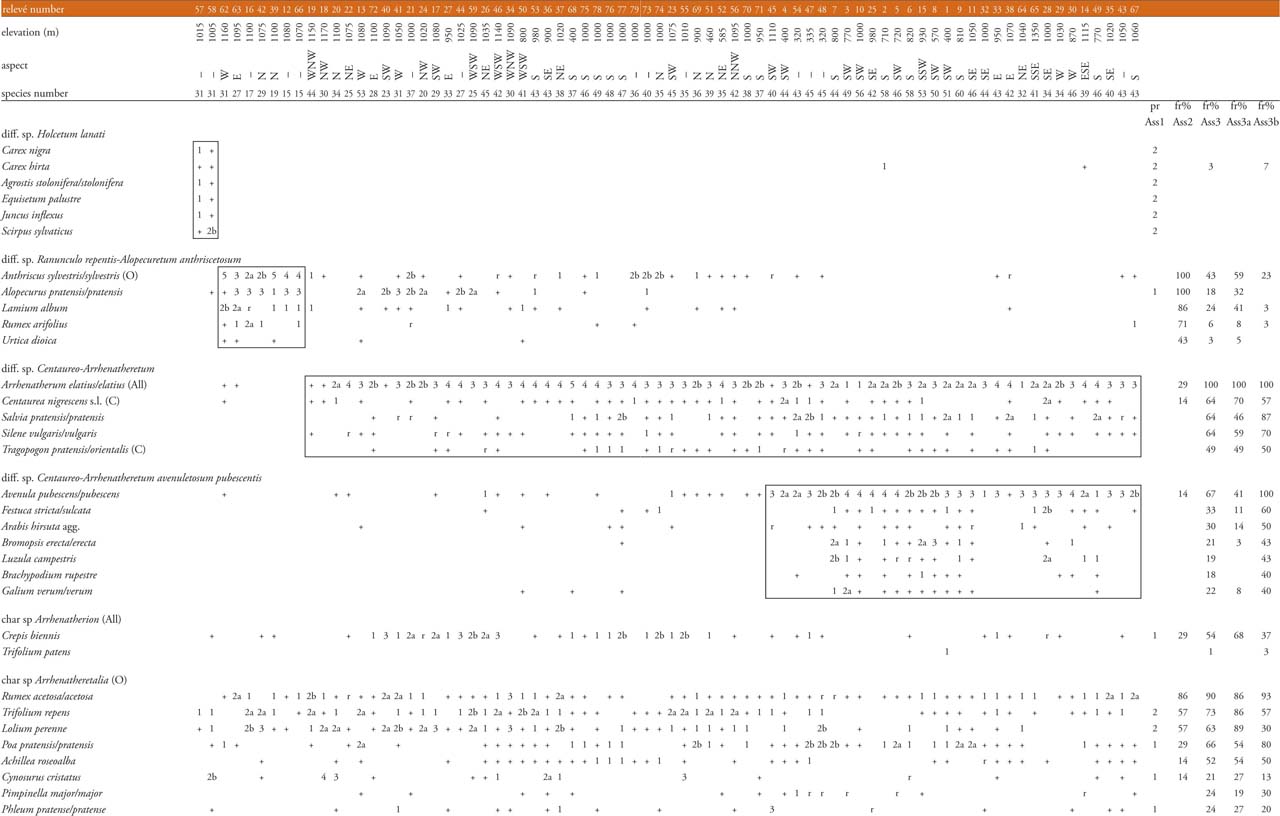
Floristic composition. Holcus lanatus is present as a dominant species heavily marking the structure of this hay meadow (Figure 6). Hygrophilous species distinguish this type from Arrhenatherum-dominated sympatric mesic meadow, where Holcus lanatus can be found too, but with lower cover and frequency (Table 4). Grasses and graminoids encompass more than half of the species occurring in stands. The mean number of species per relevé is 31(sd: 0).
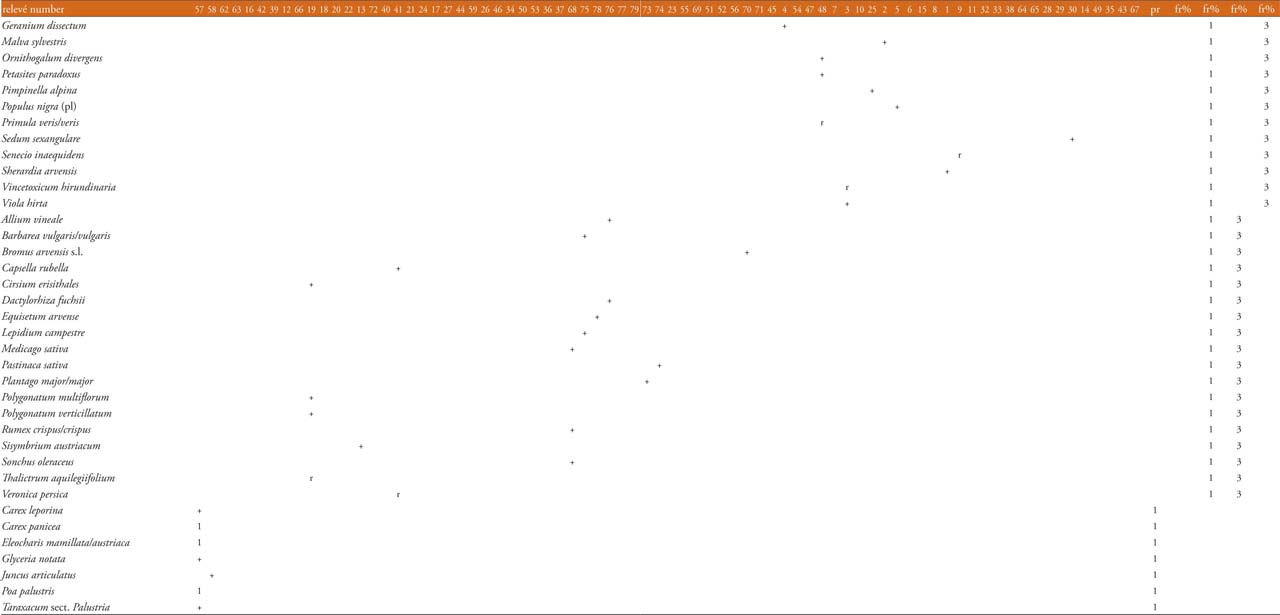
Syntaxonomy. Holcus lanatus is recognised as a species with a wide ecological valence (e.g Kovář, 1981; Stančić, 2008), making it problematic to associate its abundant occurrence to a well-defined association (e.g. Čarni, 2001). The switch from the sometimes adopted ‘Holcus lanatus community’ to the described Holcetum lanati association is related to the occurrence of hygrophilous species belonging to wet grasslands or fens along with the typical contingent of hay meadow mesic elements. With Carex nigra, C. panicea, Juncus articulatus, Taraxacum sect. Palustria (Scheuchzerio palustris-Caricetea fuscae), Eleocharis mamillata/austriaca, Poa palustris, Glyceria notata (Phragmito-Magnocaricetea) and Equisetum palustre, Scirpus sylvaticus, Cardamine pratensis agg. (Molinietalia) the number of hygrophilous species is such that it appears plausible to refer relevés 57 and 58 (Table 4) to the association level (Holcetum lanati). The framing of the coenosis in the upper syntaxonomical level was differently interpreted by various authors, some including it in Calthion (Kovář, 1981; Blažková, 1992), others in Deschampsion cespitosae (Hájková et al., 2010; Klimantová, 2017; www.e-veg.net/app/13360, as Alopecuro pratensis-Holcetum lanati) and some other in Arrhenatherion elatioris (Stančić, 2008). This is not a simple issue; however, the last solution fits better as regards our stands. The Italian vegetation prodrome (Biondi et al., 2014) excludes from the national borders Deschampsion cespitosae, an alliance spreading in floodplains of (sub)continental Central and Eastern Europe (Mucina et al., 2016). In any case, the prevalent occurrence of Arrhenatheretalia species (Trifolium dubium, Cerastium holosteoides, Lolium perenne etc.) against Molinietalia and ecological features relating to the moisture of soil argue in favour of the attribution of our stands to Arrhenatherion. It was already noticed that the reference alliance can change according to climate: under oceanic conditions, such as in the study area, the Holcus lanatus grasslands are close to Arrhenatherion vegetation (Černý, 2010). The occurrence of Carex hirta and the low species number might relate to the Carex hirta-variant Černý (2010) writes about, identifying it with the Holcetum lanati cirsietosum cani.
Synecology. Stands develop in slight slope sites which are moistened by water sources emerging to the surface. This results in dampen soil becoming mesic later in the season with the decreasing of surface water supply in coincidence with the lowering of the ground water. Despite its euryoecious features, Holcus lanatus benefits from fertile soils which are first saturated with water and then dry-up (Kovář, 1981). The association localy borders with a Filipendula ulmaria tall-herb stands and the Centaureo-Arrhenatheretum mesic meadows, depending on the greater extent of water saturation or deeper water table respectively.
Synchorology. The association probably spreads throughout temperate Europe, from France through Central Europe to the Balkan Peninsula (www.e-veg.net/app/13360), with an occurrence that can still be considered understimated (Černý, 2010). This is the first report from Italy.
EU reference habitat. 6510
Conservation Status, Pressures, and Threats. The conservation status must be considered unfavorable due to the small areas covered by the community. Post-mowing grazing, and possible changes in the hydrological balance due to water regulating measures are among the main pressures and threats.
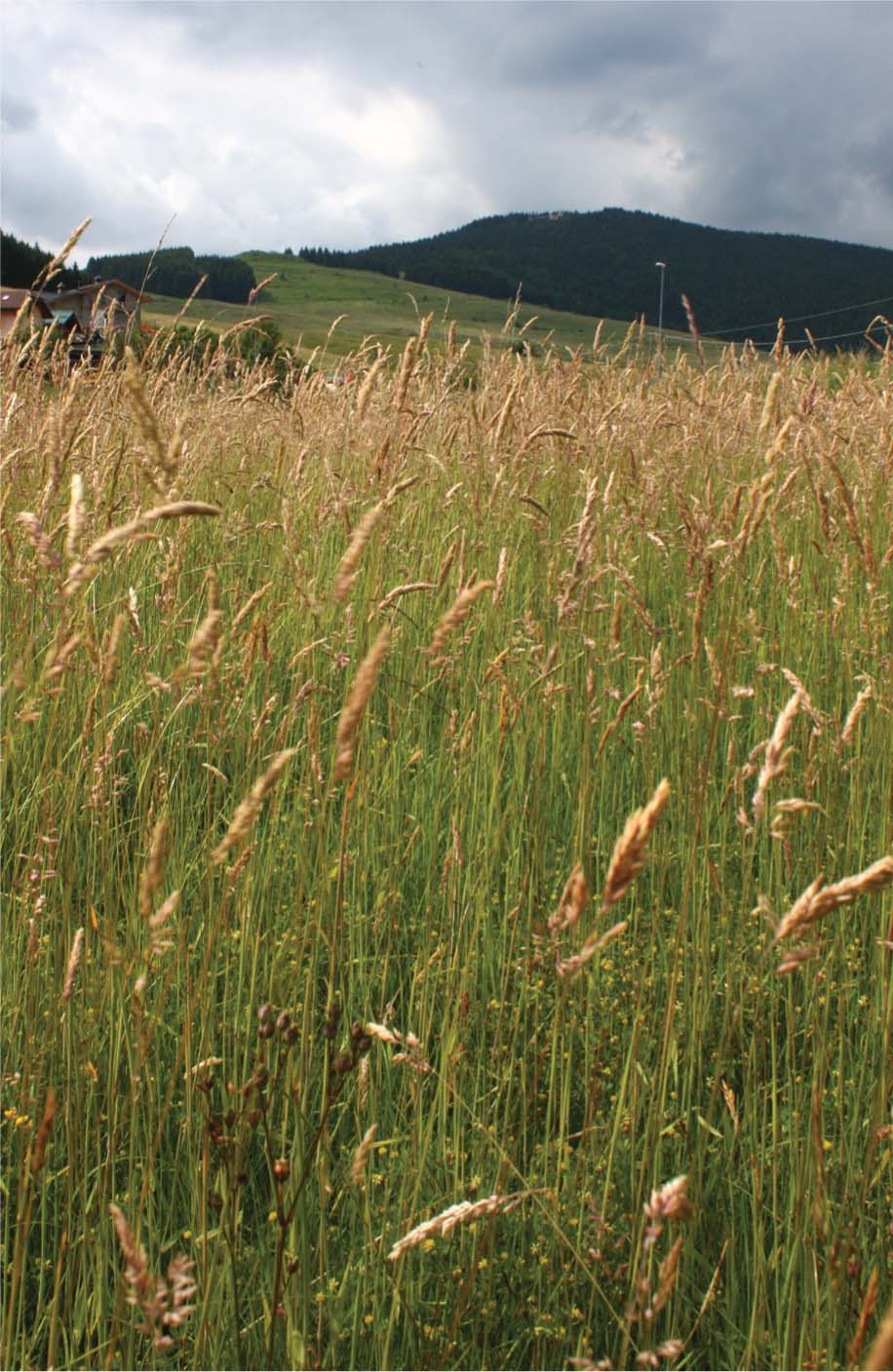
Figure 6:
Stand of Holcetum lanati (rel. 58, C. Vescovi-C. Valle (Asiago), Asiago Plateau)).
Slika 6: Sestoj asociacije Holcetum lanati (popis 58, C. Vescovi-C. Valle (Asiago), plato Asiago)).
Table 4:
Arrhenatherion associations from Asiago Plateau. Ass1: Holcetum lanati; Ass2: Ranunculo repentis-Alopecuretum anthriscetosum; Ass3: Centaureo-Arrhenatheretum; Ass3a: Arrhenatherum elatior-dominating form of Centaureo-Arrhenatheretum (rel from 19 to 71); Ass3b: Centaureo-Arrhenatheretum avenuletosum pubescentis (rel from 45 to 67).
Tabela 4: Asociacije zveze Arrhenatherion s planote Asiago. Ass1: Holcetum lanati; Ass2: Ranunculo repentis-Alopecuretum anthriscetosum; Ass3: Centaureo-Arrhenatheretum; Ass3a: oblika s prevladujočo vrsto Arrhenatherum elatior asociacije Centaureo-Arrhenatheretum (popisi od 19 do 71); Ass3b: Centaureo-Arrhenatheretum avenuletosum pubescentis (popisi od 45 do 67).



Ranunculo repentis-Alopecuretum pratensis Ellmauer in Ellmauer et Mucina 1993 anthriscetosum Ellmauer 1995
Local diagnostic species. Anthriscus sylvestris (dom.), Alopecurus pratensis (sudom.), Lamium album, Rumex arifolius, Urtica dioica.
Floristic composition. In this hay meadow Anthriscus sylvestris, in particular, and Alopecurus pratensis physiognomically distinguish the stands, due to their constantly high coverage values and height (Table 4). In the lower layers other species occur with high frequency: Ranunculus acris, Heracleum sphondylium/sphondylium (at the time of first mowing), Rumex acetosa/acetosa, R. arifolius, Poa trivialis s.l., Lamium album, Taraxacum sect. Taraxacum.
Syntaxonomy. The classification (Figure 2) separates the stands with abundant Anthriscus sylvestris and Alopecurus pratensis from the traditional hay meadows of Centaureo-Arrhenatheretum which then cannot be referred to. To discover their appropriate syntaxonomic position a synoptic table was arranged including comparable Antriscus sylvestris or Alopecurus pratensis rich communities from Central Europe (Table 5). An Anthriscus sylvestris-dominating coenose was first reported by Passarge (1975) from Central Germany as a fringe community thriving along ditches and roads in an area of mesic mown meadows where some type of earthmoving occurred (Symphyto officinalis-Anthriscetum). A little later Hadač (1978) described Anthriscetum sylvestris along road ditches from Moravia, today considered as a synonym of Symphyto-Anthriscetum (Láníková, 2009) that belongs to Aegopodion. According to Figure 7, also the roadside relevés in Lower Saxony that Brandes (1988) attributed to Arrhenatherion, but in contact with Aegopodion communities, can be likely referred to this last association. The synthetic table representing relevés from the study area joins the synthetic table of hay meadows of Ranunculo repentis-Alopecuretum pratensis anthriscetosum from Austria (Ellmauer, 1995), which belongs to Arrhenatherion elatioris, and that of Poo trivialis-Alopecuretum pratensis (Hájková et al., 2010) with a lesser degree of similarity. Slovak and Czech authors (Uhliarová & al., 2007; Kučera, 2010) speculate that Ranunculo-Alopecuretum is interpretable as Poo-Alopecuretum, a coenose framed inside Deschampsion cespitosae. The latter appears confined to regularly flooded sites (see also Stančić, 2008), resulting in the presence of several moisture-demanding species, such as Carex acuta, C. vulpina, Cerastium dubium, Inula britannica, Phalaris arundinacea, Sanguisorba officinalis ecc. These species lack in our stands that develop in an ecologic context devoid of flooding influences and related to Arrhenatherion alliance (Arrhenatherum elatius, Crepis biennis). Regardless of the different approach adopted by the authors mentioned above for the classification of this type of meadows, i.e. different associations or synonyms, this argues in favour of the attribution of the relevés from the Asiago Plateau to Ranunculo-Alopecuretum anthriscetosum.
Synecology. The association locally grows where abundant spreading of cow slurry on Arhenatherum elatius montane meadows takes place. Grasslands are mainly used for hay production, but also periodical horse grazing was observed. Gently sloping or flat fields originating moist soils rich in organic matter are preferred sites. The excessive spreading of slurry affects the floristic composition allowing the high nitrate demanding species such as Anthriscus sylvestris and Alopecurus pratensis to achieve dense populations and to be predominant. Consequently, there is a clear lowering of the mean number of species per relevé (21.7, sd 6.7) with respect to the Arrhenatherum-rich form of the other meadow association growing in the study area (Centaureo-Arrhenatheretum: 36.9, sd 7.9).
Synchorology. The association is documented from Central and Eastern Europe: Austria (Ellmauer & Mucina, 1993), Slovenia (Čarni, 2001; Šilc & Čarni, 2012), Bulgaria (Velev et al., 2011), Hungary (Lengyel et al., 2016). Ellmauer (1993) included in the association also the Arrhenatherum elatioris subass. Alopecurus pratensis from Tüxen (1937), extending its occurrence to Germany. The subass. anthriscetosum is documented from Austria (Ellmauer, 1995). As regards Italy, the association is only reported, without vegetation data, from South Tyrol (Luth et al., 2011) and from Trentino province in a publication with application purposes (Scotton et al., 2012). A single relevé assigned to Pastinaco-Arrhenatheretum from Trentino province (Pignatti & Pignatti, 2016) should be included in Ranunculo-Alopecuretum anthriscetosum (our, unpublished numeric analysis).
EU reference habitat. None.
Conservation Status, Pressures, and Threats. The coenosis is expanding due to eutrophication of hay meadows by the practice of liquid cattle waste spreading followed by intensive grazing in late season.
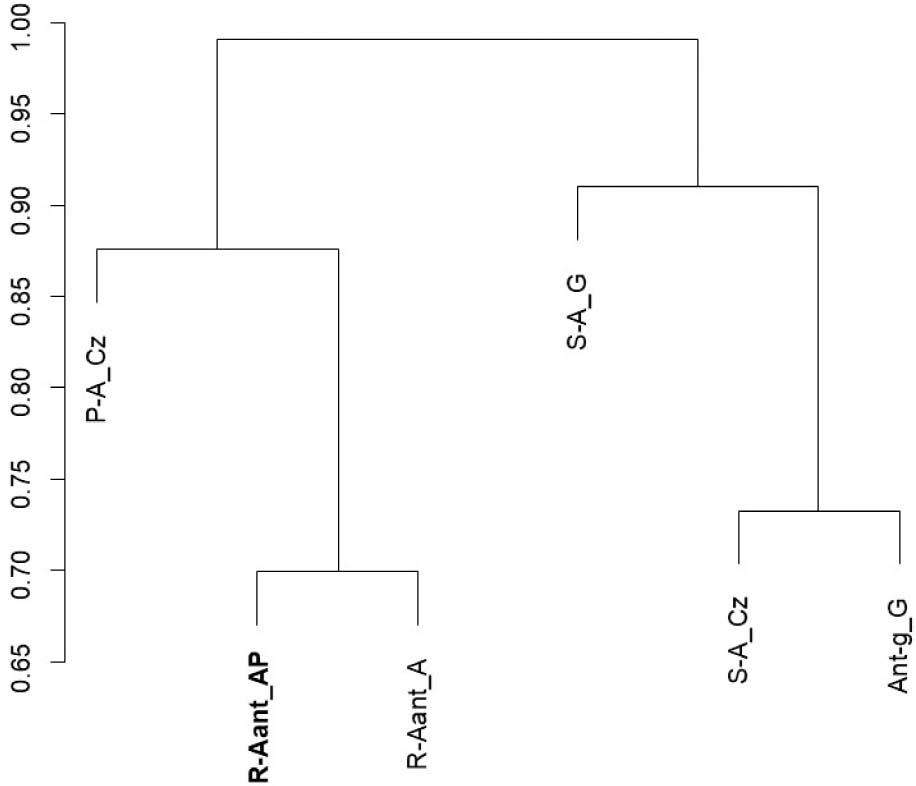
Figure 7:
Classification of the synthetic tables of Anthriscus sylvestris-dominating meadows from the Asiago Plateau (in bold) and some European related association (chord distance/UPGMA). For abbreviations see Appendix 2.
Slika 7: Klasifikacija sintetskih tabel travišč s prevladujočo vrsto Anthriscus sylvestris s planote Asiago (krepko) in nekaterih sorodnih asociacij iz Evrope (razdalja tetive/UPGMA). Za okrajšave glej Appendix 2.
Table 5:
Simplified synoptic table of Antriscus sylvestris- or Alopecurus pratensis-rich communities from the Central Europe and the Asiago Plateau. Only Molinio-Arrhenatheretea species or companion ones occurring in at least II frequency class in one synthetic table are included. In brackets, letters indicate which association or subassociation species are characteristic of, according to the original statements of the authors. For abbreviations see Appendix 2.
Tabela 5: Poenostavljena sinoptična tabela združb, bogatih z vrstama Antriscus sylvestris ali Alopecurus pratensis iz Srednje Evrope in planote Asiago. Prikazane so samo vrste razreda Molinio-Arrhenatheretea in spremljevalke, ki se pojavljajo s frekvenčnim razredom II. Črke v oklepajih nakazujejo, za katero asociacijo ali subasociacijo je vrsta značilna v skladu z izvornimi uvrstitvami avtorjev. Za okrajšave glej Appendix 2.
| a | b | c | d | e | f | |
|---|---|---|---|---|---|---|
| coenosis | P-A_Cz | R-Aant_AP | R-Aant_A | S-A_G | S-A_Cz | Ant-g_G |
| diagnostic sp ass or subass | ||||||
| Alopecurus pratensis (a-b-c) | 100 | 100 | 100 | 38 | 15 | 29 |
| Anthriscus sylvestris (b-c-e) | 27 | 100 | 100 | 100 | 100 | 100 |
| Lamium album (b-e) | 86 | 15 | 41 | 71 | ||
| Rorippa x anceps (a) | 10 | |||||
| Cerastium dubium (a) | 18 | |||||
| Rumex arifolius (b) | 71 | |||||
| Urtica dioica (b) | 37 | 43 | 92 | 86 | 71 | |
| Ranunculus repens (c) | 93 | 43 | 55 | 15 | 20 | 43 |
| Cardamine pratensis (c) | 42 | 14 | 45 | |||
| Lolium perenne (c) | 57 | 9 | 15 | |||
| Rumex obtusifolius (c) | 30 | 43 | 45 | 15 | 24 | |
| Glechoma hederacea (c) | 62 | 45 | 8 | 22 | 57 | |
| char sp Molinio-Arrhenatheretea | ||||||
| Poa trivialis/trivialis | 90 | 86 | 91 | 23 | 38 | 14 |
| Poa pratensis s.l. | 75 | 29 | 64 | 62 | 16 | 100 |
| Rumex acetosa | 72 | 86 | 100 | 46 | 9 | |
| Schedonorus pratensis | 65 | 14 | 64 | 8 | 7 | |
| Silene flos-cuculi | 52 | 14 | 9 | |||
| Ranunculus acris | 50 | 100 | 100 | 23 | ||
| Cerastium fontanum/vulgare | 38 | 29 | 64 | 23 | 14 | |
| Dactylis glomerata | 32 | 57 | 100 | 69 | 50 | 86 |
| Trifolium repens | 8 | 57 | 55 | |||
| Phleum pratense | 8 | 38 | 9 | 14 | ||
| Pimpinella major | 10 | 45 | 85 | |||
| Trisetum flavescens | 5 | 57 | 82 | |||
| Veronica serpyllifolia | 5 | 29 | 18 | |||
| Bellis perennis | 27 | |||||
| Trifolium pratense | 12 | 29 | 82 | 8 | ||
| Plantago lanceolata | 17 | 73 | 23 | 29 | ||
| Galium mollugo agg. | 38 | 43 | 82 | 14 | 57 | |
| Taraxacum Sect. Taraxacum | 83 | 86 | 100 | 54 | 49 | 86 |
| Vicia cracca | 22 | 29 | 18 | 54 | 9 | 29 |
| Veronica chamaedrys agg. | 27 | 14 | 64 | 54 | 19 | |
| Leucanthemum vulgare agg. | 3 | 27 | ||||
| Leontodon hispidus | 2 | 36 | ||||
| Colchicum autumnale | 10 | 43 | ||||
| Heracleum sphondylium | 25 | 86 | 91 | 100 | 42 | 57 |
| Vicia sepium | 57 | 55 | 5 | 14 | ||
| Stellaria graminea | 8 | 23 | ||||
| Holcus lanatus | 35 | 36 | 92 | |||
| Potentilla reptans | 30 | 14 | ||||
| Geranium pratense | 42 | 21 | ||||
| Lysimachia nummularia | 73 | 18 | ||||
| Symphytum officinale | 72 | 36 | 100 | 7 | ||
| Sanguisorba officinalis | 63 | 9 | ||||
| Deschampsia cespitosa/cespitosa | 43 | 9 | 54 | 4 | ||
| Agrostis stolonifera | 28 | |||||
| Trifolium hybridum/hybridum | 30 | |||||
| Arrhenatherum elatius/elatius | 15 | 29 | 64 | 38 | 26 | 100 |
| Cirsium oleraceum | 18 | 18 | 69 | 3 | ||
| Crepis biennis | 29 | 36 | ||||
| Tragopogon pratensis s.l. | 45 | |||||
| other | ||||||
| Achillea millefolium agg. | 30 | 43 | 91 | 69 | 16 | 43 |
| Alchemilla vulgaris agg. | 22 | 43 | 27 | 4 | ||
| Lathyrus pratensis | 50 | 36 | 54 | |||
| Phalaroides arundinacea | 50 | 15 | 4 | |||
| Elytrigia repens/repens | 45 | 14 | 9 | 38 | 57 | |
| Ranunculus auricomus agg. | 40 | |||||
| Rumex crispus | 38 | 9 | 8 | 4 | ||
| Galium aparine | 14 | 8 | 41 | 100 | ||
| Artemisia vulgaris | 54 | 46 | 57 | |||
| Cirsium arvense | 25 | 9 | 54 | 33 | 29 | |
| Veronica arvensis | 8 | 14 | 91 | |||
| Aegopodium podagraria | 20 | 27 | 8 | 42 | 14 | |
| Bromus hordeaceus s.l. | 57 | 45 | 8 | |||
| Filipendula ulmaria | 18 | 18 | 62 | |||
| Equisetum arvense | 15 | 18 | 57 | |||
| Galeopsis tetrahit+pubescens | 14 | 31 | 13 | 29 | ||
| Anthoxanthum odoratum | 12 | 43 | 27 | |||
| Knautia drymeja | 43 | 18 | ||||
| Myosotis sylvatica | 57 | |||||
| Achillea ptarmica | 54 | |||||
| Tanacetum vulgare | 8 | 3 | 43 | |||
| Centaurea jacea agg. | 15 | 27 | 8 | |||
| Persicaria amphibia | 8 | 38 | ||||
| Silene dioica | 29 | 1 | 14 | |||
| Geranium phaeum | 43 | |||||
| Alliaria petiolata | 9 | 29 | ||||
| Arctium tomentosum | 24 | 14 | ||||
| Rubus caesius | 23 | 14 | ||||
| Silene latifolia | 23 | 14 | ||||
| Ballota nigra | 33 | |||||
| Carduus crispus | 3 | 29 | ||||
| Geum urbanum | 31 | |||||
| Lotus pedunculatus | 31 | |||||
| Cruciata laevipes | 29 | |||||
| Solidago canadensis | 23 | |||||
| Sonchus asper | 23 | |||||
| Carex vulpina | 22 | |||||
| Carex acuta | 20 | |||||
| Ficaria verna s.l. | 20 | |||||
Centaureo transalpinae-Trisetetum flavescentis (Marschall 1947) Poldini et Oriolo 1995
Local diagnostic species. Noccaea caerulescens, Scorzonera rosea.
Floristic composition. The low number of relevés does not allow for a comprehensive evaluation (Table 6). The highest layer does not exceed half a metre. Various mid-high grasses (Dactylis glomerata, Avenula pubescens, Phleum spp.), with the significant exclusion of Arrhenatherum elatius, develop alongside tall herbs such as Ranunculus acris, Trollius europaeus. The ground level layer appears rich (Trifolium repens, Crocus vernus/albiflorus, Viola tricolor/alpestris, Cerastium fontanum/vulgare).
Syntaxonomy. Surveyed hay meadows with the relevés 60 and 61 (Table 6) are well separated from cluster including grasslands of Centaureo-Arrhenatheretum; on the contrary, they join the cluster representing the Festuca-Cynosurus community but at higher level than the remaining relevés (Figure 2). Strictly characteristic species of Arrhenatherion, i.e. Arrhenatherum elatius and Crepis biennis, are absent, and species of Poo-Trisetetalia prevail over Arrhenatheretalia. The occurrence of Noccaea caerulescens is of particular significance because all authors agree on considering it as characteristic species of Triseto-Polygonion (Marschall, 1947; Pedrotti, 1963; Hundt, 1985; Oberdorfer, 1993). In the study area it is quite rare and occurs only in this type of hay meadow. The two relevés (Table 6, 60 and 61) can be considered as representative of Trisetetum flavescentis s.l. Independence of golden oat grasslands from southern Alps was recognised by Marschall (1947) based on the occurrence of southern species, particularly Centaurea transalpina. Poldini & Oriolo (1995a) upgraded this type of grasslands to Centaureo-Trisetetum which Marschall (1947) had framed at subassociation level: Trisetetum flavescentis insubricum or Trisetetum flavescentis leponticum. Stands from the Asiago Plateau and from neighbouring eastern areas share the presence of Scorzonera rosea which is considered as local differential species of the association in Friuli Venezia-Giulia, with some extension into Veneto (Poldini & Oriolo, 1995a). We therefore regard the two original relevés as representatives of Centaureo-Trisetetum, excluding the possible reference to Trisetetum flavescentis which in Pignatti & Pignatti’s opinion (2014) extends in the Dolomites range. Along the southeastern Slovenian Alps, the presence of Trisetum flavescens grassland belonging to Astrantio-Trisetetum was ascertained (Petras Sackl et al., 2012). The physiognomy of these meadows is determined by dominant Trisetum flavescens, Astrantia major and Arrhenatherum elatius, the latter two species are only very rarely or not at all recorded in the stands of Centaureo-Trisetetum. In the same way, high-frequency occuring species in Astrantio-Trisetetum (Trifolium alpestre, Cirsium oleraceum, Bellis perennis, Centaurea jacea/jacea, Salvia pratensis ecc.) are absent from Centaureo-Trisetetum. The large group of Festuco-Brometea dry grassland species which characterises the Astrantio-Trisetetum largely decreases in Centaureo-Trisetetum where very frequent species such as Bromopsis erecta, Anthyllis vulneraria and Pimpinella saxifraga lack at all. On the contrary, the diagnostic species of Centaureo-Trisetetum (Scorzonera rosea, Knautia longifolia, Noccaea caerulescens) are very rarely or not at all recorded in the stands of Astrantio-Trisetetum.
Synecology. Golden oat meadows replace Arrhenatherum elatius grasslands in high-mountain belt around 1,450–1,500 m a.s.l. They thrive on medium-rich nutrient soils which are mown once or twice a year and grazed later in the season. The soils are slightly acidic indicated by the occurrence of Luzula campestris, Pilosella lactucella, Festuca filiformis, Potentilla aurea etc. show. Where the grazing prevails over haymaking, that has been discontinued, the Festuca-Cynosurus community or Nardus-rich stages develop.
Synchorology. According to Poldini & Oriolo (1995a), Centaureo-Trisetetum occurs throughout the south-eastern Alps; on the Asiago Plateau, it was found only on Monte Lambara.
EU reference habitat. 6520.
Conservation Status, Pressures, and Threats. High-mountain and subalpine hay meadows are in drastic decline all over the southern Alps due to their abandonment or conversion to pastures (e.g. Tasser & Tappeiner, 2002; Sitzia & Trentanovi, 2011; Pignatti & Pignatti, 2014). The intensive management due to grazing transforms the Trisetum flavescens meadows into Festuco-Cynosuretum (Büker, 1942) or into stages of Festuca rubra agg.-Agrostis capillaris, which were reported also from the Asiago Plateau (Pedrotti, 1963) and shall be considered as the pasture type which we provisionally identified as Festuca-Cynosurus community. The very few remaining local mountain hayfields are at risk of disappearing because of the immediate threat of colonization by Acer pseudoplatanus or conversion into pasture, that is in accordance with the same fate experienced by the whole surrounding study area.
Table 6:
Centaureo-Trisetetum from the Asiago Plateau.
Tabela 6: Centaureo-Trisetetum s planote Asiago.
| relevé number | 60 | 61 | |
|---|---|---|---|
| elevation (m) | 1440 | 1445 | |
| aspect | SE | S | |
| species number | 33 | 51 | |
| diff sp Centaureo-Trisetetum | pr | ||
| Scorzonera rosea | 1 | 1 | |
| Noccaea caerulescens (All) | + | 1 | |
| char sp Triseto-Polygonion (All) | |||
| Tephroseris longifolia/gaudinii | + | 1 | |
| char sp Poo alpinae-Trisetetalia | |||
| Poa alpina | 1 | + | 2 |
| Crocus vernus/albiflorus | + | + | 2 |
| Silene dioica | 1 | + | 2 |
| Bistorta officinalis | + | 1 | 2 |
| Viola tricolor/alpestris | + | + | 2 |
| Phleum rhaeticum | 2b | 1 | |
| Trollius europaeus/europaeus | 2a | 1 | |
| Galium pumilum/pumilum | 1 | 1 | |
| Hypericum maculatum/maculatum | 1 | 1 | |
| Centaurea nigrescens/transalpina | + | 1 | |
| Potentilla aurea/aurea | + | 1 | |
| char sp Arrhenatheretalia | |||
| Rumex acetosa/acetosa | + | + | 2 |
| Phleum pratense/pratense | 2b | 1 | |
| Lolium perenne | 1 | 1 | |
| Cynosurus cristatus | 1 | 1 | |
| Trifolium repens | + | 1 | |
| char sp Molinio-Arrhenatheretea | |||
| Dactylis glomerata | 2b | 1 | 2 |
| Trifolium pratense | 3 | 1 | 2 |
| Cerastium fontanum/vulgare | 1 | 1 | 2 |
| Colchicum autumnale | + | + | 2 |
| Festuca rubra/rubra | 2b | + | 2 |
| Leucanthemum ircutianum | 2a | 1 | 2 |
| Lotus corniculatus | + | + | 2 |
| Carum carvi | 2a | 1 | 2 |
| Poa trivialis/trivialis | 1 | + | 2 |
| Ranunculus acris/acris | 2b | 2a | 2 |
| Alchemilla vulgaris agg. | 1 | 1 | 2 |
| Veronica chamaedrys/chamaedrys | + | + | 2 |
| Trisetum flavescens/flavescens | 2a | 1 | |
| Avenula pubescens/pubescens | 4 | 1 | |
| Schedonorus pratensis/pratensis | + | 1 | |
| char sp Festuco-Brometea | |||
| Briza media | + | 1 | |
| Carex caryophyllea | + | 1 | |
| Cirsium acaulon/acaulon | + | 1 | |
| Dactylorhiza sambucina | + | 1 | |
| other | |||
| Achillea millefolium | 1 | 1 | 2 |
| Anthoxanthum odoratum | 2b | 1 | 2 |
| Knautia drymeja | + | 2a | 2 |
| Myosotis sylvatica | 2a | 2a | 2 |
| Phyteuma zahlbruckneri | + | + | 2 |
| Plantago lanceolata | + | + | 2 |
| Plantago media | + | + | 2 |
| Taraxacum sect. Taraxacum | 2b | + | 2 |
| Bromus hordeaceus s.l. | + | 1 | |
| Centaurea nervosa | 1 | 1 | |
| Cirsium eriophorum | + | 1 | |
| Cruciata glabra | + | 1 | |
| Cruciata laevipes | + | 1 | |
| Deschampsia cespitosa | r | 1 | |
| Festuca filiformis | + | 1 | |
| Luzula campestris | 1 | 1 | |
| Orchis mascula/speciosa | + | 1 | |
| Pilosella lactucella/lactucella | + | 1 | |
| Potentilla erecta | + | 1 | |
| Ranunculus bulbosus/bulbosus | + | 1 | |
Festuca rubra-Cynosurus cristatus community
Local diagnostic species. Carum carvi, Cynosurus cristatus, Rhinanthus minor, Koeleria pyramidata.
Floristic composition. Festuca rubra agg., Cynosurus cristatus and Agrostis capillaris constitute the bulk of the biomass in the upper layer; Festuca rubra agg. is mostly represented by the co-occurrence of F. rubra s.str., which is prevailing, and F. nigrescens (Table 7). The development of Agrostis capillaris is slightly delayed with respect to the other grasses, so that it determines the late-season aspect of the pasture; for the same reason, it was not always easy to assign its cover value at the time of the survey. The forbs Achillea millefolium, Carum carvi, Ranunculus acris and Stellaria graminea frequently contribute to the constitution of this layer. In the ground-level stratum Alchemilla vulgaris agg., Trifolium repens and T. pratense stand out for their cover and frequency. Cattle avoidance of prickly species accounts for occurrence of Cirsium and Carduus spp. Species diversity is high considering that the mean species number per relevé is 46.1 (sd 7.5).
Syntaxonomy. In the past, many Italian authors involved in studying north-eastern Italian vegetation ascribed prealpine pastures with dominating Festuca rubra agg. and Cynosurus cristatus, occurring on base-rich soils in the mountain belt, to Festuco commutatae-Cynosuretum cristati (Gerdol & Piccoli, 1980; Ziliotto & Vettorazzo, 1985; Buffa et al., 1989; Prosser, 1997; Da Ronch et al., 2005a; Da Ronch et al., 2005b; Da Ronch & Ziliotto, 2008). The interpretation resulted from applying the German scheme (Oberdorfer, 1957 and later editions), overlooking the occurrence of species with southern distribution – such as Carduus defloratus subsp. tridentinus, Tephroseris longifolia subsp. gaudinii, Centaurea nigrescens s.l., Primula intricata, Ranunculus venetus – and their role in determining a possible southern coenosis replacing the Festuco-Cynosuretum of the Northern Prealps. By contrast, this hypothesis was proposed for pastures developing in high mountain belt (Gerdol & Piccoli, 1980; Prosser, 1997) where the presence of species such as Poa alpina and Phleum rhaeticum suggested to assign relevès to Poion alpinae but made it challenging to identify the association. Poldini & Oriolo (1995a) partly remedied this with the typification of Crepido-Poetum within Poion alpinae in southern alpine range in place of northern Crepido-Festucetum. Nevertheless, the potential extent of Crepido-Poetum to the prealpine chain as well as the attribution of Italian prealpine Festuca rubra agg.-rich pastures to Festuco-Cynosuretum remain to be clarified and wait for further research covering wider areas and including comparisons through methods of multivariate analysis. Based on exploratory analysis, it is conceivable that a southern prealpine association could replace the northern prealpine Festuco-Cynosuretum like Crepido-Poetum replaces the northern Crepido-Festucetum in the inner southern Alps (Figure 8). Additional data is necessary also to clarify the reference alliance of local Festuca rubra agg.- and Cynosurus cristatus-rich pastures, especially by including more surveys from lower altitude where, however, pastures are less common. With the exclusion of the first two stands (Table 7, 118, 121), relevés are split into two subclusters, the largest in number with more frequent and more abundant Poa alpina and Phleum rhaeticum, due to the mean higher altitude where they were collected, as in relevés from M. Baldo (Gerdol & Piccoli, 1980; Prosser, 1997); the other one includes vegetation plots of mean lower elevation. It could appear reasonable to refer the former to Poion alpinae and the latter to Cynosurion, but floristic compositions are only slightly different and the distribution of Cynosurion characteristic species – as commonly reported in literature – does not argue in favour of this solution. The numerical comparison with ‘Festuco-Cynosuretum’ and Poion alpinae relevés from nearby prealpine areas do not disaggregate our relevés which remain well-separated in a stand-alone cluster (unpub. analyses). From an ecological perspective, our community exhibits similarities with the high mountain Crepis aurea-form of Festuco-Cynosuretum (Cynosurion; Oberdorfer, 1993) and with Crepido-Cynosuretum (Poion alpinae; Ellmauer, 1993) from the northern Alps. Concerning floristic composition, Crepido-Cynosuretum is considered a poorly differentiated coenosis. Oberdorfer (1993) identifies it as the Crepis aurea-form of Festuco-Cynosuretum, whereas Ellamuer (1993) does not exclude its possible down-ranking to the subassociation level of Crepido-Festucetum.
Against this background, we consider it more appropriate, for the time being, not to classify our original relevés at either the association or alliance level.
Synecology. In the study area the Festuca-Cynosurus community occurs at an average altitude of 1,500 m (sd: 170) but ranging between 1,200 and over 1,700 m a.s.l., in the belt of mountain and high-mountain Fagus- or mixed Fagus-Abies forests. Stands at lower altitude lack character species of Poion alpinae, whereas thermophilous herbs of mountain mesic meadows such as Centaurea transalpina, Colchicum autumnale, Rhinanthus freynii, Lathyrus pratensis still occur. The only Poion alpinae species occurring in our relevés – Poa alpina and Phleum rhaeticum – mix with the higher-lying intensive pastures. Soils are on average deep, slightly acidic (Luzula sp. pl., Carex pallescens, Veronica officinalis) and gentle slope, generally located quite away from cowsheds. Festuca rubra and Cynosurus cristatus alternate in dominance in pastures, likely as consequence of different eutrophication level at small grain size: on soils less rich in nutrients Cynosurus cristatus is replaced by Festuca rubra and vice versa (Zuidhoff et al., 1995).
Synchorology. In the mountainous belt of Friuli, pastures with dominant Festuca nigrescens and Agrostis capillaris were attributed to a Festuca nigrescens-Stellaria graminea community (Poldini & Oriolo, 1995a). This vegetation type is ecologically comparable with the ‘Festuco-Cynosuretum’ sensu other Italian authors and recorded in many mountain sectors of the Venetian Prealps (Gerdol & Piccoli, 1980; Ziliotto & Vettorazzo, 1985; Prosser, 1997; Da Ronch et al., 2005a; Da Ronch et al., 2005b; Da Ronch & Ziliotto, 2008). In the high-mountain belt a community for which a classification in Poion alpinae was suggested was also reported (Gerdol & Piccoli, 1980; Prosser, 1997; Bertolli, 2000). Similar pastures in the southern inner Alps were hypothetically referred to Crepido-Cynosuretum (Lausi et al., 1981) and Crepido-Festucetum (Rodaro et al., 1998) or described as Crepido-Poetum (Poldini & Oriolo, 1995a); all are within Poion alpinae.
EU reference habitat. None.
Conservation Status, Pressures, and Threats. An intensification of grazing can lead to the establishment of mat-grass swards.
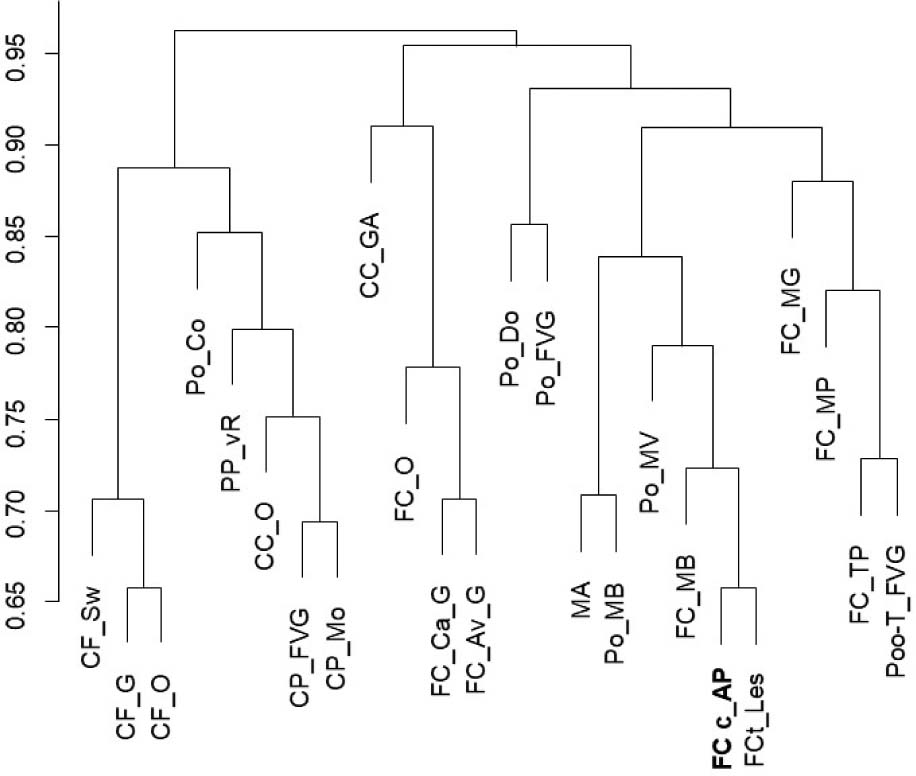
Figure 8:
Classification of the synthetic tables of Festuca rubra agg.- rich pastures from the Asiago Plateau (in bold) and some prealpine and alpine related association (chord distance/UPGMA). For abbreviations see Appendix 2.
Figure 8: Klasifikacija sintetske tabele bogatih pašnikov s prevladujočo vrsto Festuca rubra agg. s planote Asiago (krepko) in nekaterih predalpskih in alpskih asociacij (razdalja tetive/UPGMA).
Table 7:
Festuca rubra-Cynosurus cristatus community from the Asiago Plateau.
Tabela 7: Združba Festuca rubra-Cynosurus cristatus s planote Asiago.
| relevé number | 118 | 121 | 119 | 111 | 112 | 88 | 91 | 85 | 89 | 90 | 107 | 120 | 114 | 115 | 116 | ||
|---|---|---|---|---|---|---|---|---|---|---|---|---|---|---|---|---|---|
| elevation (m) | 1606 | 1600 | 1558 | 1605 | 1738 | 1615 | 1490 | 1360 | 1450 | 1455 | 1645 | 1626 | 1186 | 1285 | 1193 | ||
| aspect | SE | SE | SSE | SE | SW | S | WSW | NE | - | S | SSW | SSE | E | SW | NW | ||
| species number | 55 | 46 | 55 | 39 | 30 | 50 | 35 | 56 | 40 | 49 | 47 | 52 | 46 | 44 | 47 | ||
| pr | fr% | ||||||||||||||||
| diff sp. Festuca-Cynosurus community | |||||||||||||||||
| Carum carvi | 1 | + | 2a | 2a | 1 | 1 | 1 | + | + | 1 | 1 | 1 | + | + | 14 | 93 | |
| Cynosurus cristatus (All1) | + | 1 | 3 | 2b | + | + | 2a | 4 | 3 | 2a | 4 | 3 | 12 | 80 | |||
| Rhinanthus minor | + | 2a | + | 2a | 3 | + | + | + | + | 9 | 60 | ||||||
| Koeleria pyramidata/pyramidata | + | 3 | 1 | 1 | + | + | 6 | 40 | |||||||||
| char sp Cynosurion (All1) | |||||||||||||||||
| Trifolium repens | 1 | 1 | 2a | 2a | 2a | 2b | 2a | + | 2b | 2b | 2a | 2a | 1 | + | 1 | 15 | 100 |
| Prunella vulgaris | + | 1 | 1 | 1 | 2b | 2a | 6 | 40 | |||||||||
| Veronica serpyllifolia/serpyllifolia | + | + | + | + | 4 | 27 | |||||||||||
| Bellis perennis | 1 | + | 2 | 13 | |||||||||||||
| Scorzoneroides autumnalis/autumnalis | + | 1 | 7 | ||||||||||||||
| char sp Poion alpinae | |||||||||||||||||
| Phleum rhaeticum | + | 1 | 1 | 3 | 2a | 2a | 2a | + | 1 | + | + | 11 | 73 | ||||
| Poa alpina | + | 1 | 2b | 3 | 1 | 1 | + | + | 2a | 9 | 60 | ||||||
| char sp Molinio-Arrhenatheretea | |||||||||||||||||
| Festuca rubra s.l. (F. r./rubra p.m.p.) | 4 | 2a | 3 | 4 | 3 | 2a | 3 | 4 | 4 | 4 | 2a | + | 1 | 2a | 2a | 15 | 100 |
| Cerastium fontanum/vulgare | 1 | + | 1 | 1 | 1 | 1 | + | 1 | 1 | + | + | 1 | + | + | 14 | 93 | |
| Dactylis glomerata | 2a | + | + | + | 2a | + | + | + | 1 | 2a | 2a | 1 | + | 2a | 14 | 93 | |
| Ranunculus acris/acris | 1 | 2a | 2a | + | 1 | 2a | 2b | 2a | 1 | 1 | 1 | + | 1 | 1 | 14 | 93 | |
| Trifolium pratense | 2a | 2a | 2a | 1 | + | + | + | + | + | 1 | 1 | 1 | 1 | 1 | 14 | 93 | |
| Agrostis capillaris/capillaris | + | 2b | 1 | 1 | + | 2a | 2a | 1 | 2b | 1 | 2b | 1 | 1 | 13 | 87 | ||
| Stellaria graminea | 2a | 2a | 1 | + | 1 | 1 | + | 2a | + | 1 | 1 | + | + | 13 | 87 | ||
| Lotus corniculatus | + | 1 | 1 | + | + | + | 1 | 1 | + | + | 1 | 1 | 1 | 13 | 87 | ||
| Poa pratensis/pratensis | + | + | + | + | 1 | + | + | + | + | + | + | 1 | 12 | 80 | |||
| Crocus vernus/albiflorus | 1 | 2a | 1 | + | + | 1 | 1 | 1 | 1 | + | 1 | + | 12 | 80 | |||
| Leucanthemum vulgare agg. (L. ircutianum p.m.p) | + | + | + | + | + | + | + | 1 | 1 | 1 | 10 | 67 | |||||
| Schedonorus pratensis/pratensis | 1 | + | + | + | 1 | 2b | 2a | + | 1 | 9 | 60 | ||||||
| Galium mollugo agg. | + | + | r | + | + | + | + | + | + | 9 | 60 | ||||||
| Poa trivialis s.l. (P. t./trivialis p.max.p) | 2a | + | + | + | + | 2a | + | + | + | 9 | 60 | ||||||
| Deschampsia cespitosa | + | + | + | + | + | 2a | 2a | + | 8 | 53 | |||||||
| Phleum pratense/pratense | + | + | + | + | + | 1 | + | + | 8 | 53 | |||||||
| Rumex acetosa/acetosa | r | 1 | + | + | + | + | + | + | 8 | 53 | |||||||
| Plantago lanceolata | + | 2a | + | + | 1 | 2a | + | 1 | 8 | 53 | |||||||
| Trisetum flavescens/flavescens | 2b | r | + | + | 2a | + | 2b | 7 | 47 | ||||||||
| Euphrasia rostkoviana/rostkoviana | r | + | + | + | 1 | + | 6 | 40 | |||||||||
| Ochlopoa supina | + | + | 1 | + | + | + | 6 | 40 | |||||||||
| Ranunculus bulbosus/bulbosus | + | + | + | + | + | + | 6 | 40 | |||||||||
| Leontodon hispidus/hispidus | + | + | + | + | 1 | 5 | 33 | ||||||||||
| Centaurea nigrescens s.l. | r | 1 | 1 | 3 | 20 | ||||||||||||
| Alopecurus pratensis/pratensis | + | + | + | 3 | 20 | ||||||||||||
| Colchicum autumnale | + | + | + | 3 | 20 | ||||||||||||
| Ranunculus repens | + | + | + | 3 | 20 | ||||||||||||
| Viola tricolor/alpestris | + | + | 1 | 3 | 20 | ||||||||||||
| Bistorta officinalis | + | 1 | 2 | 13 | |||||||||||||
| Lathyrus pratensis | + | + | 2 | 13 | |||||||||||||
| Trollius europaeus/europaeus | + | 1 | 2 | 13 | |||||||||||||
| Ajuga reptans | + | 1 | 7 | ||||||||||||||
| Anthriscus sylvestris/sylvestris | r | 1 | 7 | ||||||||||||||
| Gymnadenia conopsea | 1 | 1 | 7 | ||||||||||||||
| Lolium perenne | + | 1 | 7 | ||||||||||||||
| Potentilla reptans | + | 1 | 7 | ||||||||||||||
| Tephroseris longifolia/gaudinii | + | 1 | 7 | ||||||||||||||
| Vicia cracca | r | 1 | 7 | ||||||||||||||
| char sp Festuco-Brometea | |||||||||||||||||
| Plantago media | + | 2a | + | 1 | + | + | + | + | 1 | + | + | 1 | 12 | 80 | |||
| Carlina acaulis/acaulis | + | 1 | + | + | + | + | + | + | + | 1 | 10 | 67 | |||||
| Carex caryophyllea | + | 1 | + | + | + | + | + | + | 8 | 53 | |||||||
| Briza media | 2b | + | 2a | 2a | 1 | 1 | 2b | 7 | 47 | ||||||||
| Cirsium acaulon/acaulon | 1 | 1 | + | + | 1 | + | + | 7 | 47 | ||||||||
| Brachypodium rupestre | 1 | + | + | + | 4 | 27 | |||||||||||
| Arabis hirsuta agg. | + | + | + | 3 | 20 | ||||||||||||
| Rhinanthus freynii | 2b | 1 | 1 | 3 | 20 | ||||||||||||
| Hypericum perforatum | + | 1 | 2 | 13 | |||||||||||||
| Thymus pulegioides | + | + | 2 | 13 | |||||||||||||
| Anthyllis vulneraria/versicolor | + | 1 | 7 | ||||||||||||||
| Euphorbia cyparissias | 2b | 1 | 7 | ||||||||||||||
| Festuca stricta/sulcata | + | 1 | 7 | ||||||||||||||
| Gentiana cruciata | + | 1 | 7 | ||||||||||||||
| Neottia ovata | r | 1 | 7 | ||||||||||||||
| char sp Elyno-Seslerietea | |||||||||||||||||
| Carduus defloratus/tridentinus | 1 | 1 | 1 | + | + | + | + | + | + | 1 | 1 | 11 | 73 | ||||
| Potentilla crantzii | + | 1 | + | + | + | + | + | + | 8 | 53 | |||||||
| Galium anisophyllon | + | + | + | + | + | 5 | 33 | ||||||||||
| Arabis ciliata | + | + | + | 3 | 20 | ||||||||||||
| Clinopodium alpinum/alpinum | 1 | 1 | + | 3 | 20 | ||||||||||||
| Gentiana verna/verna | + | + | 2 | 13 | |||||||||||||
| Polygala alpestris/alpestris | + | + | 2 | 13 | |||||||||||||
| Stachys alopecuros | 2a | + | 2 | 13 | |||||||||||||
| Agrostis alpina | + | 1 | 7 | ||||||||||||||
| Anthyllis vulneraria/alpestris | + | 1 | 7 | ||||||||||||||
| Leucanthemum heterophyllum | + | 1 | 7 | ||||||||||||||
| Myosotis alpestris/alpestris | + | 1 | 7 | ||||||||||||||
| other | |||||||||||||||||
| Achillea millefolium | 1 | 1 | + | 1 | 1 | 1 | 1 | 1 | 1 | 1 | 1 | 1 | 1 | 1 | 1 | 15 | 100 |
| Alchemilla vulgaris agg. | 1 | 2a | 2b | 2a | 2b | 1 | 2a | 2a | 2a | 1 | 1 | 2a | + | 2a | 1 | 15 | 100 |
| Taraxacum sect. Taraxacum | 1 | 1 | 2a | 1 | + | + | + | + | 1 | + | + | + | + | 13 | 87 | ||
| Cruciata laevipes | + | + | + | + | 1 | 1 | + | + | + | + | + | + | + | 13 | 87 | ||
| Veronica chamaedrys/chamaedrys | 1 | + | + | + | + | + | + | + | + | 1 | + | + | + | 13 | 87 | ||
| Anthoxanthum odoratum agg. | 1 | + | + | 1 | 2a | 1 | + | 2a | 1 | + | 10 | 67 | |||||
| Carex pallescens | + | + | + | + | 1 | 1 | + | + | 8 | 53 | |||||||
| Campanula scheuchzeri/scheuchzeri | + | + | 1 | + | + | + | + | + | 8 | 53 | |||||||
| Luzula campestris | + | + | + | r | + | + | + | 7 | 47 | ||||||||
| Myosotis sylvatica | + | + | + | + | + | + | + | 7 | 47 | ||||||||
| Thymus praecox/polytrichus | + | + | + | + | + | + | + | 7 | 47 | ||||||||
| Plantago major/major | r | r | r | r | + | + | 6 | 40 | |||||||||
| Carex ornithopoda | + | + | + | + | + | + | 6 | 40 | |||||||||
| Cirsium arvense | + | + | + | 1 | 1 | + | 6 | 40 | |||||||||
| Dactylorhiza fuchsii | r | + | r | + | + | + | 6 | 40 | |||||||||
| Galium xcentroniae | + | + | + | + | 1 | 1 | 6 | 40 | |||||||||
| Luzula multiflora/multiflora | + | + | + | + | + | + | 6 | 40 | |||||||||
| Veronica officinalis | + | + | + | 1 | + | + | 6 | 40 | |||||||||
| Cirsium eriophorum | + | + | + | + | 2a | 5 | 33 | ||||||||||
| Hypericum maculatum/maculatum | r | + | + | 2a | + | 5 | 33 | ||||||||||
| Luzula alpina agg. | + | + | + | 1 | 4 | 27 | |||||||||||
| Pilosella lactucella/lactucella | + | 1 | + | + | 4 | 27 | |||||||||||
| Primula veris/veris | + | + | + | + | 4 | 27 | |||||||||||
| Avenula pubescens/pubescens | r | + | 1 | 3 | 20 | ||||||||||||
| Medicago lupulina | 1 | + | 1 | 3 | 20 | ||||||||||||
| Potentilla aurea/aurea | + | 1 | + | 3 | 20 | ||||||||||||
| Ranunculus carinthiacus | + | + | + | 3 | 20 | ||||||||||||
| Veratrum lobelianum | + | + | + | 3 | 20 | ||||||||||||
| Blitum bonus-henricus | r | r | 2 | 13 | |||||||||||||
| Centaurea nervosa | + | 2a | 2 | 13 | |||||||||||||
| Cerastium arvense s.l. | + | + | 2 | 13 | |||||||||||||
| Cruciata glabra | + | + | 2 | 13 | |||||||||||||
| Galeopsis tetrahit + pubescens | + | + | 2 | 13 | |||||||||||||
| Galium pumilum/pumilum | + | + | 2 | 13 | |||||||||||||
| Lamium album | r | r | 2 | 13 | |||||||||||||
| Nardus stricta | + | + | 2 | 13 | |||||||||||||
| Pedicularis verticillata | + | + | 2 | 13 | |||||||||||||
| Pilosella officinarum/officinarum | + | + | 2 | 13 | |||||||||||||
| Potentilla erecta | + | + | 2 | 13 | |||||||||||||
| Urtica dioica | + | + | 2 | 13 | |||||||||||||
| Arenaria serpyllifolia | 1 | 1 | 7 | ||||||||||||||
| Barbarea bracteosa | + | 1 | 7 | ||||||||||||||
| Botrychium lunaria | r | 1 | 7 | ||||||||||||||
| Campanula witasekiana | + | 1 | 7 | ||||||||||||||
| Carex leporina | r | 1 | 7 | ||||||||||||||
| Elytrigia repens/repens | + | 1 | 7 | ||||||||||||||
| Helleborus viridis/viridis | 1 | 1 | 7 | ||||||||||||||
| Hieracium bifidum | + | 1 | 7 | ||||||||||||||
| Jacobaea alpina | + | 1 | 7 | ||||||||||||||
| Parnassia palustris | + | 1 | 7 | ||||||||||||||
| Phyteuma zahlbruckneri | + | 1 | 7 | ||||||||||||||
| Pimpinella alpina | r | 1 | 7 | ||||||||||||||
| Primula intricata | + | 1 | 7 | ||||||||||||||
| Pseudorchis albida/albida | + | 1 | 7 | ||||||||||||||
| Rumex arifolius | + | 1 | 7 | ||||||||||||||
| Silene dioica | + | 1 | 7 | ||||||||||||||
| Silene vulgaris/vulgaris | + | 1 | 7 | ||||||||||||||
| Tussilago farfara | + | 1 | 7 | ||||||||||||||
| Veronica arvensis | + | 1 | 7 | ||||||||||||||
Centaureo carniolicae-Arrhenatheretum Oberd. 1964 corr. Poldini et Oriolo 1995
Local diagnostic species. Arrhenatherum elatius (dom. or subdom.), Centaurea nigrescens, Salvia pratensis subsp. pratensis, Silene vulgaris subsp. vulgaris, Tragopogon pratensis subsp. orientalis.
Floristic composition. It is a multilayered meadow where Arrhenatherum elatius or Avenula pubescens dominate, depending on different site conditions (Table 4). Among grasses, Dactylis glomerata and Schoenodorus pratensis occur in the upper stratum, Trisetum flavescens, Anthoxanthum odoratum and Poa pratensis in the mid-low layer. Constantly occurring forbes include Ranunculus acris and Rumex acetosa in the upper layer, Trifolium pratense, Plantago lanceolata and Gallium mollugo agg. in lower stratum or at ground level. Two groups of relevés are distinguishable; the smallest is differentiated by the large cover values of Avenula pubescens and shows a higher mean number of species (45.2, sd 6.9) than the second one which is dominated by Arrhenatherum elatius (36.9, sd 7.9).
Syntaxonomy. Oberdorfer (1964) first focused on the floristic diversity of the Arrhenatherum elatius-meadows in southern Alps with respect to the ecologically similar vegetation type in Central Europe. The occurrence of Centaurea dubia (= C. nigrescens subsp. transalpina), Achillea roseoalba and Knautia transalpina led the German author to describe the regional association Centaureo dubiae-Arrhenatheretum. Later Poldini & Oriolo (1995a; 1995b) proved that in the original relevés Centaurea nigrescens subsp. vochinensis (= C. carniolica) was confused with C. nigrescens subsp. transalpina and introduced the name Centaureo carniolicae-Arrhenatheretum. However, more recently Swiss authors acknowledged Oberdorfer’s typification concerning a neighbouring territory of the Confederation and consider Poldini & Oriolo’s (1995) correction as a synonym (www.infoflora.ch/de/lebensraeume/phytosuisse-(prunier-et-al.).html). The non-univocal interpretation of the Centaurea nigrescens complex (e.g. Conti et al., 2005; Greuter+, 2006; Pignatti, 2018) coupled with the hard taxonomic attribution of some specimens/populations included in the Achillea millefolium agg. make the characterization of this association problematic. Centaurea nigrescens includes many infraspecific taxa and their hybridization forms: as already stated (Poldini & Oriolo, 1995a; Buffa et al., 1995), C. nigrescens subsp. transalpina prevails in the mountain belt, whereas C. nigrescens subsp. nigrescens (C. nigrescens subsp. vochinensis in the relevés carried out by the above-mentioned authors) occurs at lower altitudes, but specimens growing at intermediate altitudes are often difficult to determine. Consequently, in Table 4 we prefer not to treat them separately but to aggregate them. Pignatti & Pignatti (2014) attribute hay meadows in the Dolomites range to Central European Pastinaco-Arrhenatheretum association. Considering the Prealpine context and in accordance with the studies drawn up in neighbouring territories, it is regarded as more appropriate to refer mown grasslands in the Asiago Plateau to Centaureo carniolicae-Arrhenatheretum. Relevés split clearly in two clusters, one representing the typical form developing on mesic soils and the other characteristic of drier sites (Figure 2). The two groups of relevés share species that are regarded as differential of Centaureo-Arrhenatheretum. The latter is characterised by the dominance or co-dominance of Avenula pubescens and the occurrence of a high number of species belonging to Festuco-Brometea: both can be considered as differential of this vegetation type (Table 4; Figure 9). In technical handbooks based on phytosociological relevés from Northern Italy this drier form of mown grasslands has been often and in an uncritical way referred to Ranunculo bulbosi-Arrhenatheretum, following the typification of Austrian hay meadows (e.g. Gusmeroli et al., 2008; Scotton et al., 2012). In fact, Ranunculo-Arrhenatheretum is physiognomically characterised by Arrhenatherum and Avenula pubescens and differs from mesic Pastinaco-Arrhenatheretum only because of the occurrence of dry grassland species, especially of Festuco-Brometea class (Ellmauer, 1995). In our opinion, despite evident common ecological features between Avenula-meadows from Southern Alps and Ranunculo-Arrhenatheretum, Avenula-rich grasslands cannot be classified into Ranunculo-Arrhenatheretum because of the presence of the differential species of Centaureo-Arrhenatheretum. For the same reasons describing a new association is not possible, but it can be assumed to recognise the subassociation level for these less intensive and drier meadows: Centaureo-Arrhenatheretum subass. avenuletosum pubescentis. The group of relevés classified into this subassociation changes depending on the asymmetrical dissimilarity measures used in the cluster analysis, therefore a clearer floristic framing needs a data collection encompassing other southern pre-Alpine areas. Interestingly, this coenose ecologically matches with Arrhenatheretum elatioris helictotrichetosum pubescentis (recte Pastinaco-Arrhenatheretum avenuletosum pubescentis) which Eggler (1959) observed on the northern side of the Alps. Avenula pubescens is also included among the diagnostic species of Rhinantho freynii-Trisetetum flavescentis from the lower montane belt of north-western and western Slovenia (Dakskobler & Seliškar, 2015). The coenosis encompasses meadows with dominant Trisetum flavescens which in our stands has only low covers. The occurrence of Centaurea nigrescens, which is recognised as the diagnostic species of the association Centaureo-Arrhenatheretum, constitutes a further remarkable difference with respect to association Rhinantho-Trisetetum but also compared to the other similar Slovenian coenoses classified in Arrhenatherion (Ranunculo-Arrhenatherum and Pastinaco-Arrhenatherum in Čarni, 2001; Pastinaco-Arrhenatherum in Petras Sackl et al., 2012). The occurrence of other species such as Myosotis sylvatica, Silene dioica, Cruciata laevipes, Rhinanthus alectorolophus, Vicia sativa, Geranium phaeum and, on the contrary, the absence of Centaurea jacea, Campanula patula contribute to distinguish the hay meadows on the Asiago Plateau from the similar Slovenian associations.
Synecology. Arrhenatherum meadows comprise the traditional mesic hay meadows on mineral-rich soils in lowlands up to submontane territories of most of Europe. In the study area, Arrhenatherum elatior alternates with Avenula pubescens in characterising two slightly different mown grassland types. The subass. avenuletosum pubescentis was found on steeper slopes and consequently in drier sites than the former, at a lower mean altitude (846 m vs. 985 m). As a consequence, many xerophilous species belonging to Festuco-Brometea class differentiate these Avenula-rich meadows: Festuca stricta/sulcata, Arabis hirsuta, Bromopsis erecta are some of the most frequent dry grassland species. Avenula pubescens itself cannot be considered strictly characteristic of Molinio-Arrhenatheretea class, its ecological requirements are rather halfway between grasslands belonging to Festuco-Brometea and Molinio-Arrhenatheretea. In flat or gentle slope conditions, finding that Arrhenatherum-rich stands diverge to Avenula-rich vegetation in correspondence of adjacent steeper slopes is quite common. Nowadays, the arising decrease of manuring along with the drier seasons in the vegetative period drives towards the substitution of Arrhenatherum-rich form with the Avenula-rich vegetation type. On the contrary, where excessive slurry spreading is used instead of traditional dung, such as in relevés 21, 24, 40, 41 (Table 4), the Centaureo-Arrhenatheretum floristically tends to change and to become similar to Ranunculo-Alopecuretum. Mown meadows are mostly found in the central plain of the study area around 1,000 m a.s.l., where the accompanying intensive management led to a lowering of plant species diversity. Here, species-rich haymaking grasslands are very rare and scattered, in most cases they are peripheral, far from the centre of farms. According to our data, the mean species number per relevé attains lower values than in past decades: 34 (n = 20, sd 7.9) vs. 41 (n = 10, sd 5.6) in 1986–1993 period (Buffa et al., 1995). After mowing usually twice a year, land use includes cattle grazing at the end of the season.
Synchorology. In the study area the association shows a wide altitudinal range from 300 to 1,350 m a.s.l. The co-occurrence of Rhinanthus alectorolophus and R. freynii underlines the intermediate position of the Asiago Plateau with respect to the western and eastern sectors of the distribution area of the association (see Poldini & Oriolo, 1995b). It spreads in the eastern-central Alpine and pre-Alpine sector of Northern Italy (Poldini & Oriolo, 1995a) as far as Slovenia (Šilc & Čarni, 2012).
EU reference habitat. 6510.
Conservation Status, Pressures, and Threats. Traditional hay meadows are threatened by two opposing reasons: intensification of management practices and abandonment. The former materialises in the central plateau around 1,000 m a.s.l., where sites are more suitable to haymaking and liquid cow waste spreading is done not only to guarantee an increased productivity. The extensively used hay meadows lay in areas that are peripheral to farms, the least accessible to agricultural machinery. Grasslands of the subassociation avenuletosum pubescentis, which occupy sites that are intrinsically less productive, are at higher risk of abandonment and consequently subject to vegetation dynamics.
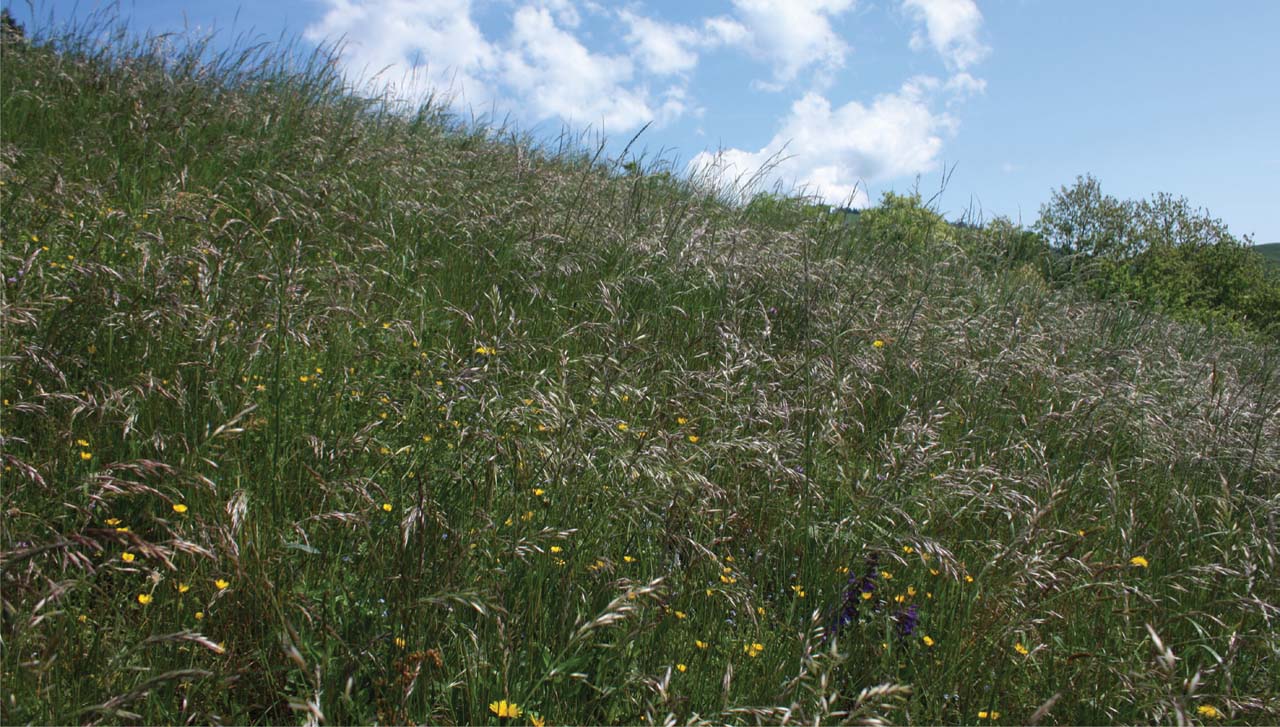
Figure 9:
Stand of Avenula pubescens-rich mesic meadow (Centaureo-Arrhenatheretum subass. avenuletosum pubescentis; rel 2, Costa della Mare (Calvene), Asiago Plateau)).
Slika 9: Sestoj bogatega travnika z vrsto Avenula pubescens (Centaureo-Arrhenatheretum subass. avenuletosum pubescentis; popis 2, Costa della Mare (Calvene), planota Asiago)).
Syntaxonomic scheme
Nardetea strictae Rivas Goday et Borja Carbonell in Rivas Goday et Mayor Lopez 1966
Nardetalia strictae Preising 1950
Nardo-Agrostion tenuis Sillinger 1933
Homogyno alpinae-Nardetum Mráz 1956
Molinio-Arrhenatheretea Tx. 1937
Festuca rubra-Cynosurus cristatus community
Arrhenatheretalia elatioris Tx. 1931
Arrhenatherion elatioris Koch 1926
Centaureo carniolicae-Arrhenatheretum Oberd. 1964 corr. Poldini & Oriolo 1995
avenuletosum pubescentis subass. nov. hoc loco
Ranunculo repentis-Alopecuretum Ellmauer in Ellmauer et Mucina 1993
anthriscetosum Ellmauer 1995
Holcetum lanati Issler 1934
Poo alpinae-Trisetetalia Ellmauer et Mucina 1993
Triseto flavescentis-Polygonion bistortae Br.-Bl. et Tx. ex Marschall 1947
Centaureo transalpinae-Trisetetum flavescentis Poldini et Oriolo 1995
Poion supinae Rivas-Mart. et Géhu 1978
Alchemillo hybridae-Poetum supinae Aichinger 1933 corr. Oberd. 1971
Incertae sedis
Festuca stricta/sulcata-Nardus community
Other syntaxa quoted in the text
Alchemillo-Cynosuretum Th. Mull in Oberdorfer et al 1967 p.p.
Aegopodion podagrariae Tx. 1967
Alopecuro pratensis-Holcetum lanati Julve 1994
Anthriscetum sylvestris Hadač 1978
Aremonio-Fagion (Horvat 1950) Borhidi in Török et al. 1989
Arnico montanae-Brometum erecti Verbič et al. ex Dakskobler 2024
Arrhenatheretum elatioris (Br.-Bl. 1919) Scherrer 1925 helictotrichetosum pubescentis Eggler (1933) 1958
Astrantio-Trisetetum Knapp et Knapp ex Oberd. 1957
Calthion palustris Tx. 1937
Centaureo dubiae-Arrhenatheretum Oberdorfer 1964 nom. inept.
Crepido-Cynosuretum Knapp ex Dietl 1972
Crepido-Festucetum rubrae Lüdi 1948
Crepido aureae-Poetum alpinae Poldini et Oriolo 1995
Cynosurion cristati Tx. 1947
Danthonio-Nardetum Pign. E. et S. 1986
Dentario pentaphylli-Fagetum Mayer et Hofmann 1969
Deschampsion cespitosae Horvatić1930
Elyno-Seslerietea Br.-Bl. 1948
Festuco-Brometea Br.-Bl. et Tx. ex Soó 1947
Festuco commutatae-Cynosuretum cristati Tüxen in Büker 1942
Hacquetio-Fagetum Košir 1962
Holcetum lanati cirsietosum cani Kovář 1981
Homogyno sylvestris-Piceetum Exner in Poldini et Bressan 2007
Molinietalia caeruleae Koch 1926
Nardetum alpigenum Br.-Bl. 1949
Pastinaco-Arrhenatheretum Passarge 1964
Phragmito-Magnocaricetea Klika in Klika et Novák 1941
Poion alpinae Gams ex Oberd. 1950
Polygonion avicularis Br.-Bl. 1931
Polygono-Coronopodion Sissingh 1969
Poo-Cerastietum cerastioidis (Söyrinki 1954) Oberd. 1957
Poo trivialis-Alopecuretum pratensis Regel 1925
Quercion pubescenti-petraeae Br.-Bl. 1932
Ranunculo bulbosi-Arhenatheretum Ellmauer in Ellmauer et Mucina 1993
Rhinantho freynii-Trisetetum flavescentis Dakskobler et Seliškar 2015
Scheuchzerio palustris-Caricetea fuscae Tx. 1937
Sieversio montanae-Nardetum strictae Lüdi 1948
Sieversio montanae-Nardetum strictae Lüdi 1948 vaccinietosum Hartl 1963
Symphyto officinalis-Anthriscetum sylvestris Passarge 1975
Trisetetum flavescentis Rübel 1911
Trisetetum flavescentis insubricum Marschall 1947
Trisetetum flavescentis leponticum Marschall 1947
Acknowledgements
I am indebted to Dr. Ferrarese Francesco for Figure 1. Two anonymous reviewers helped us with valuable improvements and corrections. Copy editing Nizzero Cristina, MA. I thank the journal editorial team for the translation into Slovenian and useful corrections.
Notes
Appendices
Appendix 1
Location, date and geographical coordinates of original relevés or source of relevés
Table 1 (Alchemillo-Poetum): rel 117: M.ga Fiara, 06/07/2021, 45°57′29.23″N, 11°33′8.08″E; rel 81: M.ga Zingarella, 01/06/2020, 45°56′43.63″N, 11°30′25.88″E; rel 84: M.ga Lora, 13/06/2020, 45°55′13.73″N, 11°36′27.67″E; rel 108: M.ga Galmarara, 23/06/2021, 45°57′15.04″N, 11°29′39.65″E; rel 103: M.ga P. Manazzo, 21/06/2021, 45°58′31.95″N, 11°23′46.33″E; rel 104: M.ga P. Manazzo, 21/06/2021, 45°58′37.00″N, 11°23′45.67″E
Table 2 (Festuca stricta/sulcata-Nardus community and Homogyno-Nardetum): rel 82: Lambara, 07/06/2020, 45°55′47.91″N, 11°39′38.75″E; rel 83: Lambara, 13/06/2020, 45°56′2.92″N, 11°39′58.46″E; rel 96: M. Fior, 18/07/2020, 45°55′14.03″N, 11°35′36.12″E; rel 87: bivio C.ra Meletta, 18/06/2020, 45°54′50.39″N, 11°36′30.24″E; rel 86: M.ga Lora, 18/06/2020, 45°54′53.78″N, 11°36′17.94″E; rel 97: M. Fior, 18/07/2020, 45°55′3.44″N, 11°35′47.03″E; rel 124: Rif. Larici, 02/07/2020, 45°58′31.80″N, 11°24′57.61″E; rel 126: Bocchetta Larici, 02/07/2020, 45°58′47.48″N, 11°24′56.81″E; rel 127: Campo Mandriolo, 07/07/2020, 45°58′54.39″N, 11°23′7.60″E; rel 125: Pontarina, 02/07/2020, 45°58′49.21″N, 11°24′47.24″E; rel 128: Campo Mandriolo, 07/07/2020, 45°58′57.60″N, 11°22′39.30″E; rel 98: Longara Davanti, 18/07/2020, 45°55′2.62″N, 11°32′59.21″E; rel 122: M.ga Laste Manazzo, 16/07/2021, 45°57′53.84″N, 11°24′28.29″E; rel 99: Marcesina, 17/06/2021, 45°57′19.90″N, 11°37′21.53″E; rel 92: Coston-Melette, 27/06/2020, 45°54′58.97″N, 11°34′56.05″E; rel 93: Coston-Melette, 27/06/2020, 45°54′55.53″N, 11°34′44.37″E; rel 123: Melette Foza, 30/06/2022, 45°54′29.50″N, 11°36′25.57″E; rel 94: Coston-Melette, 27/06/2020, 45°55′9.25″N, 11°34′52.15″E; rel 110: M.ga Longara Dietro, 23/06/2021, 45°55′32.97″N, 11°32′37.97″E; rel 101: M.ga V. Bella, 17/06/2021, 45°57′21.27″N, 11°38′12.13″E; rel 102: M.ga V. Maron, 17/06/2021, 45°57′29.66″N, 11°38′11.94″E; rel 109: M.ga Longara Dietro, 23/06/2021, 45°55′39.61″N, 11°32′53.24″E; rel 100: M.ga V. Bella, 17/06/2021, 45°57′19.93″N, 11°38′9.45″E; rel 106: M.ga Dosso Sopra, 21/06/2021, 45°58′0.07″N, 11°23′59.16″E; rel 95: Campo Mandriolo, 07/07/2020, 45°58′44.18″N, 11°23′14.07″E; rel 105: M.ga Dosso Sopra, 21/06/2021, 45°58′10.30″N, 11°24′12.74″E; rel 113: M. Spil, 29/06/2021, 45°54′39.86″N, 11°36′11.21″E
Table 4 (Holcetum lanati, Ranunculo repentis-Alopecuretum anthriscetosum and Centaureo-Arrhenatheretum): rel 57: C. Valle-Camporovere, 15/06/2018, 45°52′48.71″N, 11°29′33.76″E; rel 58: C. Vescovi-C. Valle, 20/06/2018, 45°52′41.56″N, 11°29′33.76″E; rel 62: Godenella, 02/06/2021, 45°55′24.73″N, 11°40′13.61″E; rel 63: Foza, 02/06/2021, 45°53′2.09″N, 11°38′3.59″E; rel 16: campeggio Ekar, 25/05/2015, 45°51′35.48″N, 11°33′7.08″E; rel 42: Stellar, 07/06/2017, 45°52′27.00″N, 11°32′15.82″E; rel 39: C. Chiomenti di sopra, 03/06/2017, 45°53′46.62″N, 11°39′10.23″E; rel 12: M.ga Verde-V. Lastaro, 19/05/2015, 45°48′57.97″N, 11°38′11.72″E; rel 66: Pennar, 10/06/2021, 45°51′14.94″N, 11°32′52.65″E; rel 19: Costo Basso, 29/05/2015, 45°49′54.14″N, 11°23′40.10″E; rel 18: M.ga Cava-Treschè, 29/05/2015, 45°49′48.33″N, 11°24′52.83″E; rel 20: via Belmonte-Treschè, 06/06/2015, 45°50′13.20″N, 11°25′27.16″E; rel 22: Camporovere, 06/06/2015, 45°53′6.95″N, 11°29′1.05″E; rel 13: Osteria Ristoro, 19/05/2015, 45°47′47.57″N, 11°32′47.97″E; rel 72: rel 26 in Buffa et al. (1995); rel 40: Capitello Pennar, 07/06/2017, 45°51′36.61″N, 11°32′38.26″E; rel 41: Leiten, 07/06/2017, 45°52′28.71″N, 11°31′32.28″E; rel 21: cimitero Camporovere, 06/06/2015, 45°52′35.36″N, 11°29′12.55″E; rel 24: ristorante Casa Rossa, 06/06/2015, 45°51′8.78″N, 11°29′39.60″E; rel 17: via Tilman-Bertigo, 25/05/2015, 45°52′6.35″N, 11°32′53.88″E; rel 27: Stalla Modello-Canove, 10/06/2015, 45°51′25.24″N, 11°27′22.40″E; rel 44: aeroporto, 07/06/2017, 45°53′1.08″N, 11°30′17.88″E; rel 59: Sacello-Gallio, 21/06/2019, 45°53′0.55″N, 11°32′36.48″E; rel 26: Treschè-Sculazzon, 10/06/2015, 45°50′39.90″N, 11°26′1.35″E; rel 46: V. Gevano, 13/06/2017, 45°49′51.84″N, 11°25′10.74″E; rel 34: Ecchele, 03/06/2017, 45°52′5.59″N, 11°36′36.89″E; rel 50: Bastianelli, 18/05/2018, 45°48′0.68″N, 11°37′57.63″E; rel 53: Cornetta, 21/05/2018, 45°55′43.79″N, 11°42′6.33″E; rel 36: Gianesini, 03/06/2017, 45°53′33.92″N, 11°35′48.52″E; rel 37: Campanella, 03/06/2017, 45°53′25.34″N, 11°34′51.15″E; rel 68: rel 9 in Buffa et al. (1995); rel 75: rel 30 in Buffa et al. (1995); rel 78: rel 33 in Buffa et al. (1995); rel 76: rel 31 in Buffa et al. (1995); rel 77: rel 32 in Buffa et al. (1995); rel 79: rel 34 in Buffa et al. (1995); rel 73: rel 27 in Buffa et al. (1995); rel 74: rel 28 in Buffa et al. (1995); rel 23: Cappella Holl-Fire, 06/06/2015, 45°53′6.61″N, 11°28′39.22″E; rel 55: C. Sculazzon, 02/06/2018, 45°50′39.90″N, 11°26′1.35″E; rel 69: rel 22 in Buffa et al. (1995); rel 51: C. Moscon-Enego, 21/05/2018, 45°57′2.11″N, 11°42′51.04″E; rel 52: Fosse di sotto, 21/05/2018, 45°56′51.83″N, 11°42′49.13″E; rel 56: Zaibena, 11/06/2018, 45°52′53.03″N, 11°35′58.21″E; rel 70: rel 23 in Buffa et al. (1995); rel 71: rel 24 in Buffa et al. (1995); rel 45: V. Gevano, 13/06/2017, 45°49′33.18″N, 11°25′27.00″E; rel 4: Lore, 09/05/2015, 45°46′29.71″N, 11°32′11.67″E; rel 54: Forni-V. d′Astico, 26/05/2018, 45°51′33.02″N, 11°21′42.94″E; rel 47: Basso-S. Pietro-V. d′Astico, 12/05/2018, 45°52′26.90″N, 11°21′43.19″E; rel 48: Settecà, 12/05/2018, 45°51′45.05″N, 11°21′50.86″E; rel 7: M. Alto-Tortima, 12/05/2015, 45°46′54.26″N, 11°36′54.94″E; rel 3: Costa della Mare, 09/05/2015, 45°47′2.10″N, 11°31′15.20″E; rel 10: ripetitori Rubbio, 17/05/2015, 45°48′7.32″N, 11°40′17.70″E; rel 25: Madonna Neve-Kaberlaba, 06/06/2015, 45°51′23.73″N, 11°29′58.26″E; rel 2: Costa della Mare, 09/05/2015, 45°46′59.84″N, 11°31′17.37″E; rel 5: cimitero Lusiana, 09/05/2015, 45°46′54.26″N, 11°35′2.75″E; rel 6: Piazza Campana, 12/05/2015, 45°47′20.61″N, 11°33′18.00″E; rel 15: Marziele, 25/05/2015, 45°47′25.89″N, 11°32′56.92″E; rel 8: Pradipaldo, 17/05/2015, 45°46′59.67″N, 11°39′44.53″E; rel 1: Caluga, 7/5/15, 45°47′25.11″N, 11°42′4.24″E; rel 9: Brombe, 17/05/2015, 45°47′28.36″N, 11°39′44.71″E; rel 11: cimitero Rubbio, 17/05/2015, 45°48′8.48″N, 11°39′6.09″E; rel 32: Stona, 30/05/2017, 45°53′54.25″N, 11°37′12.85″E; rel 33: Tottari-Foza, 30/05/2017, 45°53′42.66″N, 11°37′31.33″E; rel 38: Lazzaretti-Carpanedi, 03/06/2017, 45°54′10.51″N, 11°38′48.74″E; rel 64: Costalta, 02/06/2021, 45°53′37.26″N, 11°36′52.57″E; rel 65: M. del Lupo, 10/06/2021, 45°57′40.07″N, 11°39′7.18″E; rel 28: Cesuna, 10/06/2015, 45°50′26.04″N, 11°27′51.28″E; rel 29: Ori Biasia, 01/07/2015, 45°52′57.85″N, 11°38′53.36″E; rel 30: Godeluna, 03/07/2015, 45°54′45.39″N, 11°41′14.92″E; rel 14: Osteria Ristoro, 19/05/2015, 45°47′57.39″N, 11°32′59.93″E; rel 49: C. Oneste, 18/05/2018, 45°48′24.86″N, 11°35′52.70″E; rel 35: Sprunck, 03/06/2017, 45°51′55.32″N, 11°36′31.59″E; rel 43: via Tiiftelle, 07/06/2017, 45°53′6.48″N, 11°32′15.66″E; rel 67: Sambugari, 21/06/2022, 45°53′35.28″N, 11°34′9.79″E
Table 6 (Centaureo-Trisetetum): rel 60: Lambara, 07/06/2020, 45°55′47.91″N, 11°39′38.75″E; rel 61: Lambara, 13/06/2020, 45°56′2.92″N, 11°39′58.46″E
Table 7 (Festuca rubra-Cynosurus cristatus community): rel 118: M.ga Fiara, 06/07/2021, 45°57′28.18″N, 11°33′4.88″E; rel 121: M.ga Dosso Sotto, 16/07/2021, 45°57′39.40″N, 11°24′15.56″E; rel 119: M.ga Mandrielle, 06/07/2021, 45°57′56.80″N, 11°33′39.23″E; rel 111: M.ga Longara Davanti, 23/06/2021, 45°55′7.88″N, 11°33′0.86″E; rel 112: M.ga Montagna Nova-M.Spil, 29/06/2021, 45°54′34.61″N, 11°36′10.33″E; rel 88: C.ra Mandrielle, 24/06/2020, 45°56′12.90″N, 11°23′5.28″E; rel 91: M.ga Posellaro, 24/06/2020, 45°55′58.04″N, 11°22′24.56″E; rel 85: M.ga Fratte, 18/06/2020, 45°55′19.07″N, 11°38′35.59″E; rel 89: M.ga Camporosà, 24/06/2020, 45°56′16.56″N, 11°22′13.18″E; rel 90: M.ga Camporosà, 24/06/2020, 45°56′18.82″N, 11°21′58.52″E; rel 107: M.ga Larici, 21/06/2021, 45°57′58.52″N, 11°25′10.93″E; rel 120: M.ga Larici, 16/07/2021, 45°58′2.44″N, 11°24′55.15″E; rel 114: C.ra Melaghetto, 02/07/2021, 45°52′25.82″N, 11°35′28.90″E; rel 115: M.ga Montagna Nova-Lastaro, 02/07/2021, 45°50′2.15″N, 11°36′53.91″E; rel 116: M.ga C.dei Remi, 02/07/2021, 45°50′32.02″N, 11°38′3.73″E
Appendix 2
Acronyms and sources of data used in the comparison analyses
F-N c_AP (Festuca stricta/sulcata-Nardus community, Asiago Plateau): this study; D-Na_Do (Danthonio-Nardetum, Dolomites): Tab 8.1 in Pignatti & Pignatti (2016); P-Na_F (Polygalo-Nardetum, Friuli-Venezia Giulia): rel from 1 to 11 (Tab 1) in Poldini & Oriolo (1997); A-Brg_SI (Arnico montanae-Brometum erecti var. Gentiana kochiana, western Slovenia): Tab 1 in Dakskobler (2024); A-Brr_SI (Arnico montanae-Brometum erecti var. Rhinanthus glacialis, western Slovenia): Tab 2 in Dakskobler (2024); H-Na1_SI (Homogyno alpinae-Nardetum, north-eastern Slovenia): rel from 1 to 46 (Tab 1, part 1) in Škornik et al. (2006); H-Na2_SI (Homogyno alpinae-Nardetum, north-eastern Slovenia): rel from 7 to 19 (Tab 1) in Kaligarič & Škornik (2002); H-Nas_SI (Homogyno alpinae-Nardetum scorzoneroidetosum croceae, Julian Alps, Slovenia): Tab 4 in Dakskobler et al. (2022); Naa_Ba (Nardetum alpigenum trifolietosum, M. Baldo): Tab 5 in Gerdol & Piccoli (1980); H-Na_AP (Homogyno alpinae-Nardetum typicum, Asiago Plateau): this study; Naa_JA_I (Nardetum alpigenum trifolietosum, Julian Alps, Italia): Tab 1 Lausi et al. (1981); Naa_Br (Nardetum alpigenum, Val del Braulio): Tab 28 in Giacomini & Pignatti (1955); S-Nas_F (Sieversio-Nardetum, Friuli-Venezia Giulia): rel from 25 to 28 (Tab 4) in Poldini & Oriolo (1997); S-Na_AP (Sieversio-Nardetum, Asiago Plateau): Tab 10 in Giovagnoli & Tasinazzo (2014); S-Na_JA_SI (Sieversio-Nardetum vaccinietosum, Julian Alps, Slovenia): Tab 4 in Dakskobler et al. (2022); H-Na_F (Homogyno-Nardetum, Friuli-Venezia Giulia): Tab 2 in Poldini & Oriolo (1997); S-Nahm_F (Sieversio-Nardetum, Friuli-Venezia Giulia): rel from 1 to 10 (Tab 4) in Poldini & Oriolo (1997); S-Nat_F (Sieversio-Nardetum, Friuli-Venezia Giulia): rel from 11 to 24 (Tab 4) in Poldini & Oriolo (1997); Naa_E-B (‘Nardeti’, Erera-Brendol-Campotorondo): rel from 48 to 57 in Lasen (1983); Naa_VF (Nardetum alpigenum, Vette di Feltre): rel from 1 to 4 pag 46 in Pignatti & Pignatti (1983); S-Na_Do (Sieversio-Nardetum, Dolomites): tab 8.2 in Pignatti & Pignatti (2016).
R-Aant_AP (Ranunculo-Alopecuretum anthriscetosum, Asiago Plateau): this study; P-A_Cz (Poo-Alopecuretum, Czech Republic): in Hájková et al. (2010); R-Aant_A (Ranunculo-Alopecuretum anthriscetosum, Austria): rel from 35 to 45 (Tab 1) in Ellmauer (1995); S-A_G (Symphyto-Anthriscetum, C-Germany): Tab 2 in Passarge (1975); S-A_Cz (Symphyto-Anthriscetum, Czech Republic): in Láníková (2009); Ant-g_G (Anthriscus sylvestris community, Lower Saxony): rel 10-16 (Tab 2) in Brandes (1988)
FC c_AP (Festuca rubra-Cynosurus cristatus community, Asiago Plateau): this study; MA (M. Altissimo di Nago): Tab VII in Prosser (1997); Po_MB (Poion alpinae, M. Baldo): Tab 6 in Gerdol & Piccoli (1980); FC_MB (Alchemillo-Cynosuretum, M. Baldo): Tab 7 in Gerdol & Piccoli (1980); Po_Do (Poion alpinae, Cortina d’Ampezzo): Tab 1 in Scotton et al. (1996); Po_MV (Crepido-Poetum, M. Vignola): Tab VII in Bertolli (2000); FC_TP (Festuco-Cynosuretum, Treviso Pre-Alps): rel 2-3-4 (Tab II), rel 54-55 (Tab VI), rel from 30 to 42 (Tab IV) in Ziliotto & Vettorazzo (1985); CP_FVG (Crepido-Poetum, Friuli Venezia-Giulia): Tab 8 in Poldini & Oriolo (1995); CP_ Mo (Crepido-Festucetum, Montasio): Tab 4 in Lausi et al. (1981); Po_Co (Poion alpinae, Cortina d’Ampezzo): Tab 4 in Rodaro et al. (1998); Po_FVG (Poion alpinae, Friuli Venezia-Giulia): Tab 10 in Poldini & Oriolo (1995; rel from 1 to 5 from Lausi et al., 1981); FC_MP (Triseto-Polygonion, M. Pizzoc): Tab 1 in Marchiori & Ros (1980); CC_GA (Crepido-Cynosuretum, Alpi Giulie): Tab 3 in Lausi et al. (1981); PP_vR (Poo-Prunelletum, Val Rendena): Tab 14 in Bezzi et al. (1982); FC_O (Festuco-Cynosuretum, Austria): rel from 107 to 110 (Tab 1) in Ellmauer (1995); CC_O (Crepido-Cynosuretum, Austria): rel from 26 to 29 (Tab 3) in Ellmauer (1995), rel 7-8 in Hartl (1976; see Ellmauer, 1993); CF_G (Crepido-Festucetum, Germany): col 6 (Tab 234) in Oberdorfer (1993; note: according to the author’s statement, some species with low frequency are not included in the table); FC_Ca_G (Crepis aurea form of Festuco-Cynosuretum, Germany): col 8a (Tab 234) in Oberdorfer (1993; note: according to the author’s statement, some species with low frequency are not included in the table); FC_Av_G (Alchemilla vulgaris form of Festuco-Cynosuretum, Germany): col 8b (Tab 234) in Oberdorfer (1993; note: according to the author’s statement, some species with low frequency are not included in the table); CF_Sw (Crepido-Festucetum, Switzerland): Tab 5 in Lüdi (1948); CF_O (Prunella vulgaris – Poa alpina – Ass., ‘tipische Ausbildung’, Austria): col b (Tab at pag 23–24) in Knapp (1962; note: values in frequency classes were replaced by the midpoints of the percentage cover intervals, i.e. instead of V we put 90%); Poo-T_FVG (Poo-Trisetetalia fitocenon, Friuli Venezia-Giulia): rel 6–13 (Tab 6) in Poldini & Oriolo (1995); FCt_Les (festuco-cinosureto tipico, Lessinia): col E (Allegato 3) in Pasut (2021); FC_MG (Festuco-Cynosuretum, M. Grappa): cluster 1 (Tab 1) in Da Ronch & Ziliotto (2008; note: values in frequency classes were replaced by the midpoints of the percentage cover intervals).
Appendix 3
Association with a single relevé
Rumicetum alpini Beger 1922 (Mulgedio-Aconitetea Hadač et Klika in Klika et Hadač 1944, Adenostyletalia alliariae Br.-Bl. 1930, Rumicion alpini Scharfetter 1938). Locality: M.ga Molina, geographical coordinates: 45°59′18.05″N – 11°32′1.00″E, date: 24-09-2024, elevation: 1725 m,
Rumex alpinus 4, Lamium album 2b, Urtica dioica 2b, Elythrigia repens/repens 2a, Anthriscus sylvestris 1, Blitum bonus-henricus 1, Dactylis glomerata 1, Ranunculus repens 1, Rumex arifolius 1, Alchemilla vulgaris agg. +, Capsella bursapastoris +, Deschampsia cespitosa +, Ochlopoa supina +, Trifolium repens +, Veronica chamaedrys/chamaedrys +